Manage Trace Context
Create spans, update traces and spans, and set trace properties manually.
Overview
For most apps, init() is all you need. It automatically traces supported
providers and frameworks, including the relationships between their calls.
Use the APIs on this page when you need more control over that trace:
- Add spans for your own functions, tools, and application steps.
- Set trace-level details such as input, output, users, customers, and threads.
- Add data to a specific span.
- Keep auto-instrumented framework calls attached to the right trace.
- Supply trace details before the first span starts.
The sections below show how to make these changes without replacing the
instrumentation that init() already provides.
Create Spans
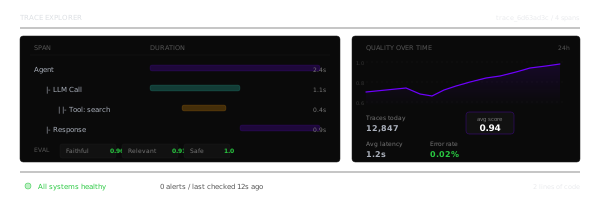
Auto-instrumentation captures everything the framework integrations know about, but it can't know where your request begins or which of your own functions count as tools. To mark those boundaries you create a span yourself, either around a whole function or around a specific block of code.
Around a function
from confident_trace import init, span

init()

@span(type="retriever")
def retriever(query: str):
    return retrieve(query)

@span("llm_app", type="agent")
def llm_app(query: str):
    context = retriever(query)
    return generate(query, context)
@span takes an optional positional name (defaulting to the function name), a type, and any type-specific or shared fields up front — for example @span(type="llm", model="gpt-4o"). It works on sync and async functions alike.
import { init, span } from "confident-trace";

const runtime = init();

const retriever = span({ name: "retriever", type: "retriever" }, (query: string) => {
  return retrieve(query);
});

const llmApp = span({ name: "llm_app", type: "agent" }, async (query: string) => {
  const context = await retriever(query);
  return generate(query, context);
});
span(options, fn) returns a wrapped function with the same signature. name defaults to the function's name, and you can pass type plus any type-specific or shared fields alongside it — for example { name: "generate", type: "llm", model: "gpt-4o" }. It works with sync and async functions alike.
Remember to run your entry point with the Node preload so auto-instrumented spans nest inside the ones you create here.
Around a block of code
You don't have to wrap an entire function. When you can't change a function's definition, or only want part of it to show up, trace just that block with the same arguments:
from confident_trace import span

def generate(prompt: str) -> str:
    with span("generate", type="llm", model="gpt-4o"):
        return call_llm(prompt)
span() works as a sync or async context manager (with / async with) as well as a decorator. Everything that applies to @span applies here too.
import { withSpan } from "confident-trace";

const generate = async (prompt: string) => {
  return withSpan({ name: "generate", type: "llm", model: "gpt-4o" }, async () => {
    return callLlm(prompt);
  });
};
withSpan(options, callback) runs the callback inside a new span and ends the span when the callback settles. It takes the same options as span() — the only difference is that span() gives you a reusable wrapped function while withSpan() traces an inline block.
Each span nests under whatever is currently active. If nothing is active it becomes the root of a new trace, so the outermost span you create in a request handler is usually the trace itself. The type tells Confident AI how to render the span and which type-specific fields it accepts — see span types for the full list.
Update Span Properties
update_span() / updateSpan() writes span-level fields to the span that is current at the moment you call it. Reach for it when a step's default I/O isn't what you want to see, or when you have step-specific data like retrieved chunks or token counts:
from confident_trace import span, update_span

@span(type="retriever")
def retriever(query: str):
    chunks = retrieve(query)
    update_span(input=query, output=chunks, retrieval_context=chunks)
    return chunks
import { span, updateSpan } from "confident-trace";
const retriever = span({ name: "retriever", type: "retriever" }, async (query: string) => {
const chunks = await retrieve(query);
updateSpan({ input: query, output: chunks, retrievalContext: chunks });
return chunks;
});There's one update_span() for every span type. It accepts the shared fields (name, input, output, metadata, retrieval_context, context, expected_output, tools_called, expected_tools) plus the LLM-only fields (model, provider, token counts, and per-token costs) — the LLM fields only take effect on an llm span.
Both update helpers need an active, recording span to write to. Outside of any span, or after the span has ended, they silently do nothing. That's why a trace context must wrap an auto-instrumented call rather than an update helper being called after the call returns.
Update Trace Properties
When init() already instruments a framework call, you don't need to create a
span just to add details to its trace. Open a trace context around the call
instead. It doesn't create a span; it supplies fields to the trace that the
instrumented call starts:
from langchain_openai import ChatOpenAI
from confident_trace import trace_context

model = ChatOpenAI(model="gpt-4o")

def chat(message: str, user_id: str, customer_id: str, thread_id: str):
    with trace_context(
        user_id=user_id,
        customer_id=customer_id,
        thread_id=thread_id,
        input=message,
    ):
        return model.invoke(message)
The context works with with or async with. Every instrumented call inside
it receives the fields you provide.
import { ChatOpenAI } from "@langchain/openai";
import { traceContext } from "confident-trace";

const model = new ChatOpenAI({ model: "gpt-4o" });

const chat = (message: string, userId: string, customerId: string, threadId: string) =>
  traceContext({ userId, customerId, threadId, input: message }, () =>
    model.invoke(message),
  );
The callback can be synchronous or asynchronous. Every instrumented call inside it receives the fields you provide.
A trace context is best for details you know before the call starts, such as the user, customer, thread, input, environment, tags, and metadata. Calls using the same thread ID are grouped into the same thread while each call still creates its own trace.
You'll use this same scoped pattern later to drop tracing for selected requests and to route traces dynamically to different projects.
Update from Inside a Span
If you've already created a custom span, adding a trace context around it would be redundant: the span has already started the trace. Update that active trace directly instead. This also lets you set values you only know after the work finishes, such as its final output:
from confident_trace import span, update_trace

@span("llm_app", type="agent")
def llm_app(query: str, user_id: str, customer_id: str):
    context = retriever(query)
    res = generate(query, context)
    update_trace(
        input=query,
        output=res,
        user_id=user_id,
        customer_id=customer_id,
        tags=["production"],
        metadata={"app_version": "1.2.3"},
    )
    return res
import { span, updateTrace } from "confident-trace";
const llmApp = span({ name: "llm_app", type: "agent" }, async (
query: string,
userId: string,
customerId: string,
) => {
const context = await retriever(query);
const res = await generate(query, context);
updateTrace({
input: query,
output: res,
userId,
customerId,
tags: ["production"],
metadata: { appVersion: "1.2.3" },
});
return res;
});The trace update helper always targets the root span of the current trace, so you can call it from any nested span. Use it for:
- Input and output of the whole request
name,tags, andmetadatauser_idoruser,customer_idorcustomer,thread_idandturn_id, andenvironment- Trace-level evaluation fields like
expected_output,retrieval_context,context,tools_called, andexpected_toolsfor online evals
You can call it as many times as you like; later calls override earlier ones
field by field, and fields you leave out stay as they were. By contrast, a
trace context supplies defaults: it fills fields that haven't already been set
and doesn't overwrite existing values. Compound values such as tags,
metadata, and thread are never merged between the two.
Which One Should I Use?
| You want to… | Use |
|---|---|
| Mark where a request, tool, or retrieval step begins and ends | @span / span() / withSpan() |
| Add known trace details without creating a span | trace_context() / traceContext() |
| Set or replace trace details from inside an active span | update_trace() / updateTrace() |
| Set a step's I/O, retrieval context, or LLM token usage | update_span() / updateSpan() |
| Start a new trace per conversation turn | turn() |
For an already-instrumented framework call, start with a trace context. If you
intentionally add a custom span (or turn())
around the request, update the active trace from inside that span instead.
Next Steps
Now that you know how to shape the trace context, give your spans meaning with types and set the I/O that Confident AI evaluates on.
Configure Span Types
Classify spans as LLM, retriever, tool, or agent — and set type-specific attributes like model name, token costs, and retrieval context.
Set Input/Output
Override the default input and output on traces and spans for better visualization and evaluation.
Last updated on