Test any AI app, including voice agents
Call voice agents over a real phone line, or chatbots, agents, and RAG apps over HTTP, like Postman for AI apps. Test any of them without touching code or waiting on the team that built it.
Evaluate every AI use case your organization ships across thousands of runs, not one lucky output. Gate releases in CI and keep a full audit of quality across your AI portfolio over time.
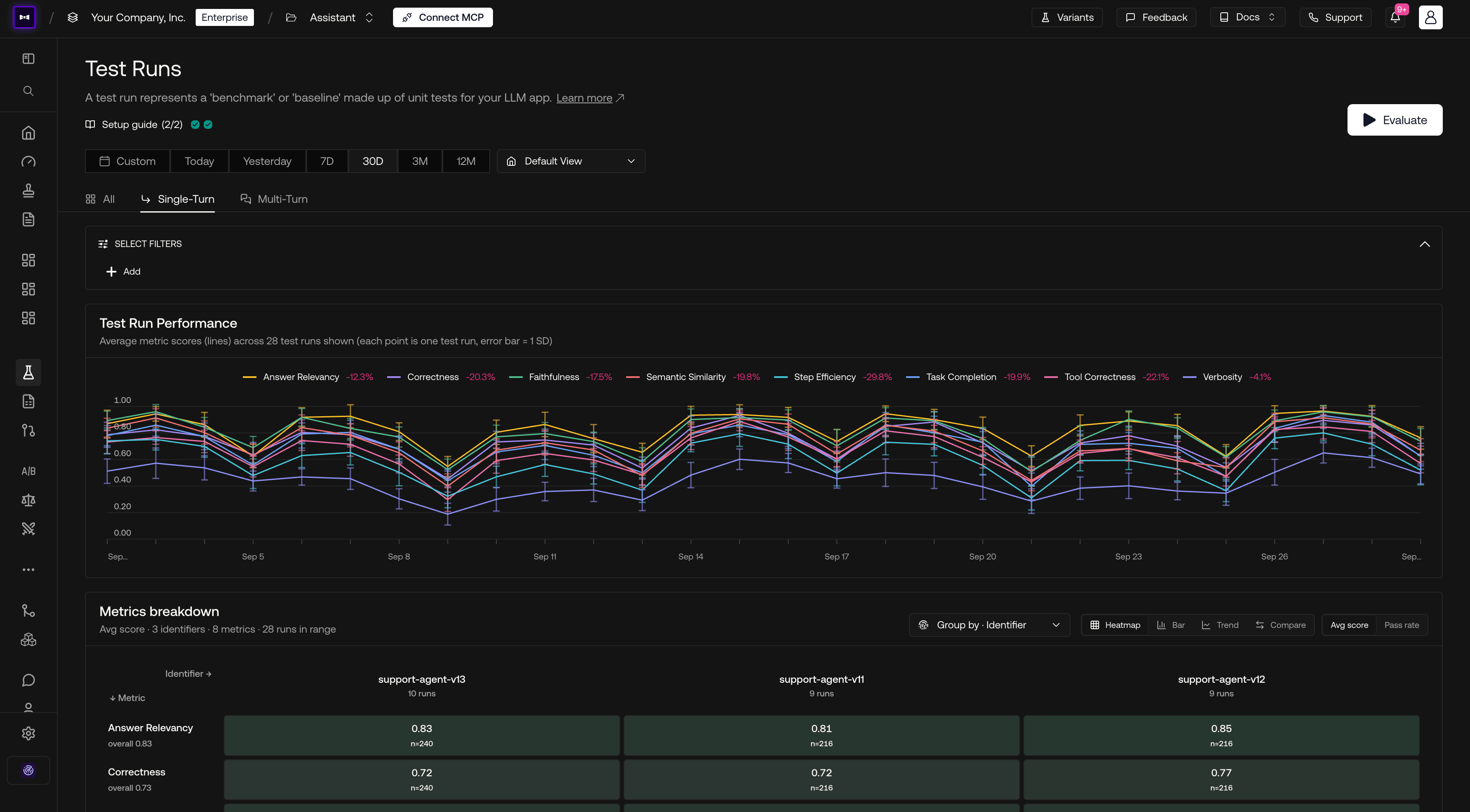










Evaluate agents, RAG apps, and voice agents through a no-code workflow. Apply quality checks across use cases from different teams, regardless of who built them.
Voice, MCP, SaaS agents, chatbots, and RAG apps in one setup.
Test across many runs to see how consistently an AI system meets your criteria. Use evals as a CI release gate and make go/no-go decisions with evidence beyond a single passing answer.
Only candidates that pass every repeated run ship.
Track evaluation results over time and compare quality across releases. Give teams an audit trail that shows where quality holds up, improves, or needs attention.
Daily results per use case, traced to their evidence.
Keep evaluation data in your chosen environment, separate projects, and control who can access each team's work.
On-prem · AWS · Azure · GCP
Multi-region residency · HIPAA · GDPR
RBAC · Project isolation · Data masking
Enterprise-grade availability
Checkout our FAQs below, or talk to a human. They won't hallucinate.
Yes. Create a dataset, select quality metrics, and run evaluations in the platform. To test a deployed AI system, engineering first configures its connection; QA can then run tests and inspect results without writing evaluation code.
Yes. AI Connections let you evaluate deployed systems through HTTP endpoints, with configurable requests, response mapping, and authentication. Each team provides the connection details for its system, while QA manages datasets and quality criteria.
Run evaluations repeatedly against representative cases and compare score distributions, pass rates, and individual failures. Use the results to assess consistency against your criteria; a single passing response does not establish reliability.
Yes. Configure quality requirements in a governance policy and add a deployment gate to your CI pipeline. The gate checks the applicable controls and can fail the pipeline when required checks do not pass.
Yes. Test runs retain metric scores, pass/fail results, and individual test cases. Compare runs across releases and use those reports alongside governance results to support sign-off and track quality over time.
Select the metrics relevant to the use case and set their thresholds. A test case passes when all its metrics meet those thresholds, giving reviewers a clear basis for investigating failures.
Yes. Use single-turn evaluations for individual responses and multi-turn evaluations for conversations. Connect a deployed conversational system to test behavior across exchanges where earlier turns affect later answers.
Have domain experts annotate cases that your metrics also evaluate. Inspect agreement and false positives or negatives in Eval Alignment, then refine metrics that disagree with expert judgment before using them as release criteria.