Introduction to AI Red Teaming
Proactively identify vulnerabilities and safety issues in your AI applications before they reach production.
Overview
Red Teaming on Confident AI is an adversarial testing platform for AI safety and security, and can be done in two ways:
- No-code directly in the platform UI, best for security teams, PMs, and compliance officers, or,
- Code-driven using the
deepteamframework, best for engineers and AI red teamers.
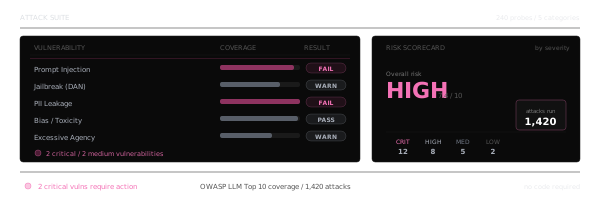
The no-code workflow is the more comprehensive option — it leverages the platform's framework builder to produce CVSS scores and full risk profiles. The code-driven workflow uses deepteam to orchestrate red teaming runs programmatically.
Key capabilities
Everything you need to operationalize AI red teaming:
Custom Frameworks
Ships with OWASP Top 10 for LLMs, NIST AI RMF, and more out of the box — or build your own with the framework builder.
CVSS Scoring
Get standardized vulnerability severity scoring for every risk assessment you run.
Compliance Reporting
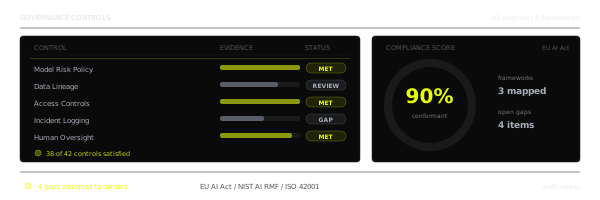
Generate reports aligned to regulatory frameworks like EU AI Act, NIST, and OWASP Top 10 for LLMs.
CI/CD Integration
Integrate security testing into your deployment pipelines for continuous assessment.
Choose your workflow
Run risk assessments in the UI without any code or use deepteam programmatically:
No-Code Assessments
- Full risk assessments with CVSS scoring
- Custom framework builder for comprehensive coverage
Suitable for: Security teams, PMs, compliance officers
Red Team Using DeepTeam
- Programmatic red teaming orchestration via
deepteam - Custom vulnerability and attack development
- Does not support cloud frameworks or CVSS scoring
Suitable for: Engineers, automated testing
What you can red team
Test your AI systems across all major vulnerability categories:
Prompt Injection & Jailbreaks
Probe for prompt manipulation, model exploitation, and adversarial bypass techniques across 50+ attack patterns.
Bias & Fairness
Assess outputs for bias across protected characteristics and demographic groups.
Content Safety
Evaluate for harmful, toxic, or inappropriate outputs including PII leakage and misinformation.
Learn the fundamentals
New to AI red teaming? These concepts will help you get the most out of your setup:
- What is LLM red teaming? - Step by step guide to red teaming LLMs
- Risk Profile — understand your AI system's attack surface and top vulnerabilities
- Frameworks & Policies — learn how to use AI safety frameworks managed on Confident AI
- No-Code Quickstart — run your first risk assessment in the platform UI
- Trace-Level Detections — surface vulnerabilities at the span level when red-teaming a traced application
How is AI Red Teaming different from traditional security testing?
AI Red Teaming targets vulnerabilities specific to AI systems — prompt injection, model poisoning, adversarial examples — rather than infrastructure or application-level security. See our frameworks guide for more detail.
What types of AI systems can be red teamed?
All types — conversational AI, RAG systems, multi-agent workflows, fine-tuned models, and AI-powered APIs. Each system type has tailored attack scenarios and evaluation criteria.
Do I need security expertise to use Red Teaming?
No. The platform provides automated risk assessments, pre-built attack scenarios, and step-by-step remediation guidance. Security expertise helps with advanced features, but isn't required to get started.
Last updated on