Multi-Turn Evals (No-Code)
Evaluate conversational AI where context builds across multiple exchanges.
Overview
Multi-turn evaluations test conversational interactions where context accumulates across multiple exchanges. These are use cases where the AI must maintain coherence throughout a conversation:
- Chatbots — customer support, sales assistants, or general-purpose chat
- Conversational agents — multi-step task completion with back-and-forth
- Agentic systems — complex workflows with tool calls and reasoning across turns
Unlike single-turn evals, multi-turn evals require generating the entire conversation before metrics can be applied, is the most time-consuming part of the process.
Requirements
To run a multi-turn evaluation, you need:
- A multi-turn dataset — goldens with conversation starters or full conversation histories
- A multi-turn metric collection — metrics designed for conversational evaluation
How it works
Multi-turn evals follow a 5-step process — the key difference from single-turn is the simulation step:
- Define metrics — choose conversational metrics (e.g., turn relevancy, conversation completeness)
- Create dataset — build goldens with conversation starters
- Configure output generation — set up your AI connection or prompt
- Simulate conversations — generate full conversations by simulating user turns
- Evaluate — run metrics against completed conversations
Here's a visual representation of the data flow:
sequenceDiagram
    participant User as You
    participant Platform as Confident AI
    participant AI as Your AI App
    participant Sim as User Simulator
    participant Metrics as Metric Collection

    User->>Platform: Start Evaluation

    loop For each golden in dataset
        loop Simulate conversation
            Platform->>AI: Send user message
            AI-->>Platform: AI response
            Platform->>Sim: Generate next user turn
            Sim-->>Platform: Simulated user message
        end
        Platform->>Metrics: Run metrics on conversation
        Metrics-->>Platform: Metric scores
    end

    Platform-->>User: Test Run Produced
    Note over User,Platform: View results on Dashboard
Controlling Simulations
To control simulations within your dataset, you will have to edit the scenario, expected outcome, and user description fields of your goldens. Each field will control your simulations in a different way:
- Scenario — sets the context and topic of the conversation, guiding what the simulated user will discuss and what situation they are in (e.g., "User is trying to book a flight to Paris for next weekend")
- Expected outcome — defines the goal that must be achieved for the simulation to end successfully (e.g., "User successfully books a flight" or "User receives a refund confirmation")
- User description — shapes the simulated user's persona, tone, and behavior throughout the conversation (e.g., "A frustrated customer who is impatient and asks short, direct questions")
It is important to note that simulations will automatically end if the expected outcome is not met after the max number of user turns simulated. This can be configured in the dropdown settings of a multi-turn dataset.
Run an Evaluation
You can evaluate on a dataset by clicking on the Evaluate button on the top right of a dataset page.
Select your dataset and metrics
- Navigate to Project > Datasets, and select your multi-turn dataset to evaluate
- Click Evaluate
- Select your multi-turn Metric Collection
Turn on simulations
This must be enabled if you want to call your AI app during evaluation time
Configure output generation
If simulations is turned on, and select how your AI app will respond to each turn:
Configure prompt for multi-turn evaluation For prompt-based chatbots, select a prompt template that includes conversation history.
- In the evaluation setup, select this prompt as your output generation method
- Confident AI calls your LLM for each turn, passing the conversation history
Configure AI Connection for multi-turn evaluation For deployed conversational systems, connect Confident AI directly to your HTTP endpoint.
- Go to Settings → AI Connections and create a connection
- Configure your endpoint to accept conversation history in the request payload
- In the evaluation setup, select this AI Connection as your output generation method
Run and view results
Click Run Evaluation and wait for simulations to complete. This may take longer than single-turn evals due to the conversation generation step.
Your test run dashboard shows:
- Score distributions — average, median, and percentiles for each metric
- Pass/fail results — a conversation passes only if all metrics meet their thresholds
- Full conversation logs — review the complete simulated conversations
- Turn-by-turn analysis — see how the AI performed at each step
Multi-turn test run results
Regression Testing
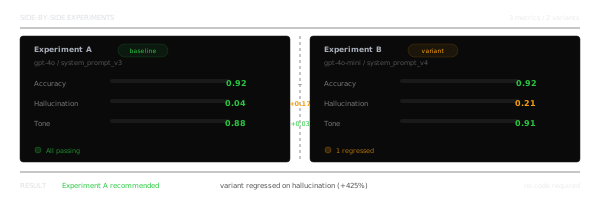
Once you have two or more test runs, you can compare them side-by-side to identify regressions.
Open regression testing
- Go to your test run's A|B Regression Test tab
- Click New Regression Test
- Select the test runs you want to compare
Analyze regressions
The comparison view highlights:
- Regressions (red) — conversations that got worse
- Improvements (green) — conversations that got better
- Side-by-side scores — metric comparisons across runs
A|B regression testing
Next Steps
Single-Turn Evals
Evaluate one-shot Q&A, summarization, and classification tasks.
Arena
Compare prompts and models side-by-side in real-time.
Last updated on