Configure Span Types
Categorize your spans by type and set type-specific attributes
Overview
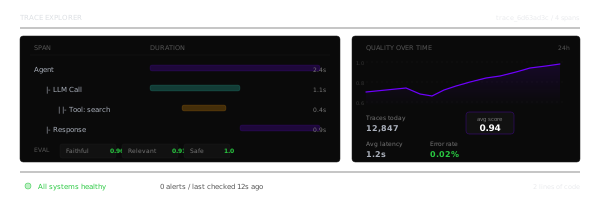
Span types are optional but allow you to classify the most common types of components in AI apps, which includes:
- LLMs: Track the model and provider used, token usage, and cost per token.
- Retrievers: Track the retrieval context (the chunks returned from your vector store or knowledge base).
- Tools: Track function calling behavior — which tool ran, with what arguments, and what it returned.
- Agents: Group the orchestration around a request, agent run, or hand-off so nested LLM, retriever, and tool spans roll up underneath it.
This is set via the type parameter when creating a span. By classifying span types you can create more tailored UIs on Confident AI, view online evals specific to each span type, and set type-specific attributes instead of using generalized metadata.
| Type | Use for | Type-specific fields |
|---|---|---|
agent | Request handlers, orchestration, agent runs | — |
llm | Model calls not covered by an integration | model, provider, input_token_count, output_token_count, cost_per_*_token |
retriever | Search, vector lookups, document fetches | retrieval_context |
tool | Function or API execution | Also sets the GenAI tool operation and name |
custom | Anything else (the default) | — |
Every type accepts the shared fields input, output, metadata, context, retrieval_context, expected_output, tools_called, and expected_tools. There is one update_span() / updateSpan() for all types — you don't need a different update function for each.
Create Typed Spans
Pass type when creating the span. You can either wrap a whole function (as a decorator or reusable wrapper) or trace an inline block of code — both create a nested span under whatever is currently active.
from confident_trace import init, span, shutdown

init()

@span(type="tool", name="lookup-order")
def lookup_order(order_id: str):
    return {"order_id": order_id, "status": "shipped"}

def handle_request(order_id: str):
    with span("support-request", type="agent"):
        return lookup_order(order_id)

try:
    handle_request("order-42")
finally:
shutdown()import { init, span, withSpan } from "confident-trace";
const runtime = init();
const lookupOrder = span(
{ name: "lookup-order", type: "tool" },
(orderId: string) => ({ orderId, status: "shipped" }),
);
const handleRequest = async (orderId: string) =>
withSpan({ name: "support-request", type: "agent" }, async () => lookupOrder(orderId));
try {
await handleRequest("order-42");
} finally {
await runtime.shutdown();
}Remember to launch your entry point with the Node preload so integrations are hooked as packages load.
Decorators and wrappers capture the function's arguments as the span input and its return value as the span output; withSpan callbacks capture only the return value. Anything you set explicitly through update_span() / updateSpan() always wins over what was captured automatically, and you can turn automatic capture off for a single span with capture_content=False / captureContent: false.
The sections below go through each type. The examples omit init() / shutdown() for brevity — in a real app they run once at the entry point and once at exit, exactly as above.
LLM Spans
An LLM span represents a call to a language model. It tracks the input, output, model, and token usage of the call, which is what powers cost tracking on Confident AI.
from confident_trace import span, update_span

@span(type="llm", name="custom-model", model="my-model", provider="custom")
def call_model(prompt: str) -> str:
    completion = my_gateway.generate(prompt)
    update_span(
        input=prompt, output=completion.text,
        input_token_count=completion.usage.input_tokens,
        output_token_count=completion.usage.output_tokens,
        cost_per_input_token=0.000001, cost_per_output_token=0.000002,
    )
    return completion.text
There are FIVE optional LLM-specific fields, which you can pass either on @span(...) or to update_span():
- [Optional]
model: The model used, of typestr. - [Optional]
provider: The provider of the model, of typestr. - [Optional]
input_token_count: The number of tokens in the input, of typeint. - [Optional]
output_token_count: The number of tokens in the generated response, of typeint. - [Optional]
cost_per_input_token/cost_per_output_token: The cost per token in USD per token (not per million), of typefloat.
import { span, updateSpan } from "confident-trace";

const callModel = span(
  { name: "custom-model", type: "llm", model: "my-model", provider: "custom" },
  async (prompt: string) => {
    const completion = await myGateway.generate(prompt);
    updateSpan({
      input: prompt, output: completion.text,
      inputTokenCount: completion.usage.inputTokens,
      outputTokenCount: completion.usage.outputTokens,
      costPerInputToken: 0.000001, costPerOutputToken: 0.000002,
    });
    return completion.text;
  },
);
There are FIVE optional LLM-specific fields, which you can pass either in the span options or to updateSpan():
- [Optional]
model: The model used, of typestring. - [Optional]
provider: The provider of the model, of typestring. - [Optional]
inputTokenCount: The number of tokens in the input, of typenumber. - [Optional]
outputTokenCount: The number of tokens in the generated response, of typenumber. - [Optional]
costPerInputToken/costPerOutputToken: The cost per token in USD per token (not per million), of typenumber.
If a per-token cost isn't set, providing a token count alone won't calculate the cost for that side — Confident AI will fall back to your project's model costs or automatic price lookup instead. Input and output are resolved independently.
Retriever Spans
A Retriever span represents a component that fetches relevant information from a vector store or knowledge base. It's a crucial part of RAG (Retrieval-Augmented Generation) pipelines, and recording what was retrieved is what lets you run metrics like contextual relevancy and faithfulness on the span later.
from confident_trace import span, update_span

@span(type="retriever", name="search-docs")
def search_docs(query: str) -> list[str]:
    documents = vector_store.similarity_search(query, k=3)
    update_span(input=query, retrieval_context=documents)
    return documents
There is ONE optional retriever-specific field:
- [Optional]
retrieval_context: The retrieved chunks, of typelist[str].
import { span, updateSpan } from "confident-trace";

const searchDocs = span(
  { name: "search-docs", type: "retriever" },
  async (query: string) => {
    const documents = await vectorStore.similaritySearch(query, 3);
    updateSpan({ input: query, retrievalContext: documents });
    return documents;
  },
);
There is ONE optional retriever-specific field:
- [Optional]
retrievalContext: The retrieved chunks, of typestring[].
Tool Spans
A Tool span represents a function that an agent can call to perform a specific task. It's commonly used for function calling in LLM applications. A tool span also sets the GenAI execute_tool operation and tool name from the span name, so it renders as a tool call on the UI.
from confident_trace import span, update_span, update_trace

@span(type="tool", name="lookup-order")
def lookup_order(order_id: str) -> dict:
    result = orders_db.get(order_id)
    update_span(input={"order_id": order_id}, output=result)
    update_trace(tools_called=[{"name": "lookup-order", "input": {"order_id": order_id}, "output": result}])
return resultimport { span, updateSpan, updateTrace } from "confident-trace";
const lookupOrder = span(
{ name: "lookup-order", type: "tool" },
async (orderId: string) => {
const result = await ordersDb.get(orderId);
updateSpan({ input: { orderId }, output: result });
updateTrace({ toolsCalled: [{ name: "lookup-order", input: { orderId }, output: result }] });
return result;
},
);There is ONE mandatory and ONE optional parameter for the tool span type:
type: The type of span. Must be"tool"for tool spans.- [Optional]
name: A string specifying the display name on Confident AI (and the GenAI tool name). Defaulted to the name of the wrapped function.
Set input and output to the tool's arguments and result. If you also want to record which tools an agent invoked at the trace level — which is what tool-correctness metrics read — pass tools_called / toolsCalled to update_trace() / updateTrace() as plain JSON objects, as shown above.
Agent Spans
An Agent span represents an autonomous entity that can make decisions and interact with other components. It's particularly useful for implementing thinking agents or multi-agent systems, and it's the natural type for the outermost span of a request so that every LLM, retriever, and tool span nests underneath it.
from confident_trace import span, update_span

@span(type="agent", name="support-agent")
def support_agent(query: str) -> str:
    update_span(input=query, metadata={"channel": "web"})
    context = search_docs(query)
    answer = generate(query, context)
    update_span(output=answer)
return answerimport { span, updateSpan } from "confident-trace";
const supportAgent = span(
{ name: "support-agent", type: "agent" },
async (query: string) => {
updateSpan({ input: query, metadata: { channel: "web" } });
const context = await searchDocs(query);
const answer = await generate(query, context);
updateSpan({ output: answer });
return answer;
},
);There is ONE mandatory and ONE optional parameter for the agent span type:
type: The type of span. Must be"agent"for agent spans.- [Optional]
name: A string specifying the display name on Confident AI. Defaulted to the name of the wrapped function.
Agents can be nested within other agents, which is useful for implementing hierarchical agent architectures. For instance, a "supervisor" agent might coordinate communication between specialized agents — each one its own agent span, nested under the supervisor.
Custom Spans
The most flexible type out of all (and the default type if type is not provided), custom spans are essential for creating hierarchical structures or grouping related spans together. They provide flexibility in organizing your tracing data and accept the shared fields only.
from confident_trace import span, update_span

@span(name="postprocess")
def postprocess(answer: str) -> str:
    cleaned = strip_citations(answer)
    update_span(output=cleaned, metadata={"step": "postprocess"})
return cleanedimport { span, updateSpan } from "confident-trace";
const postprocess = span({ name: "postprocess" }, (answer: string) => {
const cleaned = stripCitations(answer);
updateSpan({ output: cleaned, metadata: { step: "postprocess" } });
return cleaned;
});There is ONE optional parameter for the custom span type:
- [Optional]
name: A string specifying how this custom span is displayed on Confident AI. Defaulted to the name of the wrapped function.
The input and output of a custom span default to the function's input arguments and return value, but you can also set them dynamically.
Update the Active Span
update_span() / updateSpan() writes to whichever span is currently active, so call it from inside the span's body. You can call it as many times as you like — omitted fields stay unchanged, with one exception: a supplied metadata object replaces the previous one rather than merging into it.
Trace-Level Fields
update_span() never writes trace fields. Use update_trace() / updateTrace() for name, tags, user_id or user, customer_id or customer, thread_id and turn_id, environment, and trace-level input / output and evaluation fields. It targets the entry span of the current trace, so you can call it from any nested span. See input and output for more details.
Next Steps
Now that your spans are typed, enrich them further with prompt tracking and custom I/O.
Log Prompts
Log versioned prompts to LLM spans so you can track which prompt was used for each call in production.
Set Input/Output
Override the default input and output on traces and spans for better visualization and evaluation.
Last updated on