LLM Evaluation Quickstart
5 min quickstart guide for a code-driven LLM evaluation workflow
Overview
Confident AI offers a variety of features for you to test AI apps using code for a pre-deployment workflow, offering a wide range of features for:
- Single-turn evaluation: Input-output as distinct AI interactions.
- End-to-end: Treats your AI app as a black box.
- Component-level: Built for agentic use cases—debug each agent step and component (planner, tools, memory, retriever, prompts) with granular assertions.
- Multi-turn evaluation: Validate full conversations for consistency, state/memory retention, etc.
You can either run evals via code locally or remotely on Confident AI, both of which gives you the same functionality:
Local Evals
- Run evaluations locally using
deepevalwith full control over metrics - Support for custom metrics, DAG, and advanced evaluation algorithms
Suitable for: Python users, development, and pre-deployment workflows
Remote Evals
- Run evaluations on Confident AI platform with pre-built metrics
- Integrated with monitoring, datasets, and team collaboration features
Suitable for: Non-python users, online + offline evals for tracing in prod
Vibe Code Your Evals
Let your coding agent build the eval suite for you — datasets, metrics, pytest files, and shareable Confident AI reports. Better yet, use DeepEval as your build-loop ground truth: your agent runs the evals, reads the failures and reason strings, makes the smallest app change, and re-runs to confirm. Choose the install method for your agent below.
Run these four commands in Claude Code:
/plugin marketplace add confident-ai/deepeval
/plugin install deepeval@deepeval-plugins
/reload-plugins
/plugins
The /plugins command should list DeepEval Plugin under your installed plugins.
Install the deepeval Agent Skill with any Skills-compatible installer. This works with Cursor, Claude Code, Codex, Windsurf, OpenCode, and any other assistant that supports the Skills standard:
npx skills add confident-ai/deepeval --skill deepevalThe skill teaches your agent how to pick the right test shape (single-turn / multi-turn / component-level), reuse or generate goldens, write a committed tests/evals/ suite, run deepeval test run, read failures, and iterate. It triggers automatically on prompts like the ones below.
Once installed, open the project you want to evaluate and tell your agent what you need. Example prompts:
- "Create a DeepEval pytest eval suite for this app, generate ~30 goldens, and push results to Confident AI."
- "My app is a RAG pipeline — set up DeepEval evals with retrieval-focused metrics."
- "Generate a dataset from the docs in
./knowledgeand run them through DeepEval."
Your agent will run the intake questions, pick metrics, generate goldens with deepeval generate, and produce a committed pytest suite you can rerun in CI.
Run Your First Eval
This examples goes through a single-turn, end-to-end evaluation example in code.
Login with API key
export CONFIDENT_API_KEY="confident_us..."Create a dataset
It is mandatory to create a dataset for a proper evaluation workflow.
main.py from deepeval.dataset import EvaluationDataset, Golden # goldens are what makes up your dataset goldens = [Golden(input="What's the weather like in SF?")] # create dataset dataset = EvaluationDataset(goldens=goldens) # save to Confident AI dataset.push(alias="YOUR-DATASET-ALIAS")Done ✅. You should now see your dataset on the platform.
You can create one in the UI under Project > Datasets, and upload goldens to your dataset via CSV:
Create Dataset on Confident AI Create a metric
Create a metric locally in
deepeval. Here, we're using theAnswerRelevancyMetric()for demo purposes.main.py from deepeval.metrics import AnswerRelevancyMetric relevancy = AnswerRelevancyMetric() # Using this for the sake of simplicityConfigure evaluation model
Since all metrics in
deepevaluses LLM-as-a-Judge, you will also need to configure your LLM judge provider. To use OpenAI for evals:export OPENAI_API_KEY="sk-..."Create a test run
A test run is a benchmark/snapshot of your AI app's performance at any point in time. You'll need to:
- Convert all goldens in your dataset into test cases, then
- Use the metric you've created to evaluate each test case
main.py from deepeval.dataset import EvaluationDataset from deepeval.test_case import LLMTestCase from deepeval.metrics import AnswerRelevancyMetric from deepeval import evaluate # Pull from Confident AI dataset = EvaluationDataset() dataset.pull(alias="YOUR-DATASET-ALIAS") # Create test cases for golden in dataset.goldens: test_case = LLMTestCase( input=golden.input, actual_output=llm_app(golden.input) # Replace with your AI app ) dataset.add_test_case(test_case) # Run an evaluation evaluate(test_cases=dataset.test_cases, metrics=[AnswerRelevancyMetric()])Lastly, run
main.pyto run your first single-turn, end-to-end evaluation:python main.py✅ Done. You just created a first test run with a sharable testing report auto-generated on Confident AI.
Login with API key
The TypeScript examples use the Confident AI SDK, which reads your project API key from
CONFIDENT_PROJ_API_KEY:npm install confident-ai export CONFIDENT_PROJ_API_KEY="confident_us..."Create a dataset
It is mandatory to create a dataset for a proper evaluation workflow.
index.ts import { ConfidentAI } from "confident-ai"; async function createDataset() { const client = new ConfidentAI(); // goldens are what makes up your dataset const goldens = [{ input: "What's the weather like in SF?" }]; // save to Confident AI, which creates the dataset const dataset = await client.datasets.push("YOUR-DATASET-ALIAS", goldens); console.log(dataset.id); } createDataset().catch(console.error);Done ✅. You should now see your dataset on the platform. Keep the id it prints: you'll pull the dataset with it next.
You can create one in the UI under Project > Datasets, and upload goldens to your dataset via CSV:
Create Dataset on Confident AI Create a metric collection
Create a metric collection under Project > Metrics > Collections with the metrics you wish to use for evals.
Create a test run
A test run is a benchmark/snapshot of your AI app's performance at any point in time. You'll need to:
- Convert all goldens in your dataset into test cases, then
- Use the metric collection you've created to evaluate each test case
index.ts import { ConfidentAI } from "confident-ai"; import { SingleTurnGolden } from "confident-ai/datasets"; import { SingleTurnTestCaseInput } from "confident-ai/evaluate"; async function runEvaluation() { const client = new ConfidentAI(); // Pull from Confident AI const dataset = await client.dataset("<DATASET-ID>").pull(); // Create test cases const testCases: SingleTurnTestCaseInput[] = []; for (const golden of dataset.goldens as SingleTurnGolden[]) { testCases.push({ input: golden.input, actualOutput: await llmApp(golden.input), // Replace with your AI app }); } // Run an evaluation on Confident AI await client.evaluate.runEvals("YOUR-METRIC-COLLECTION-NAME", testCases); } runEvaluation().catch(console.error);Lastly, run
index.tsto run your first single-turn, end-to-end evaluation:tsx index.ts✅ Done. You just created a first test run with a sharable testing report auto-generated on Confident AI.
There are two main pages in a testing report:
- Overview - Shows metadata of your test run such as the dataset that was used for testing, average, median, and distribution of each of the metric(s)
- Test Cases - Shows all the test cases in your test run, including AI generated summaries of your test bench, and metric data for in-depth debugging and analysis.
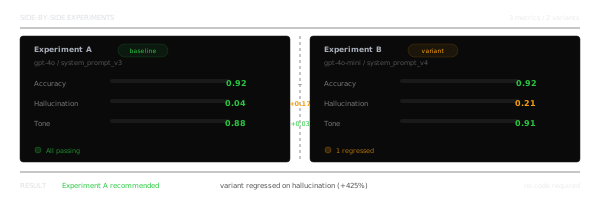
When you have two or more test runs, you can also start running A|B regression tests.
Next Steps
Now that you've run your first evaluation, dive deeper into single-turn testing:
End-to-End Evals
Treat your AI app as a black box. Learn how to use LLM tracing for better debugging, run remote evals, and log hyperparameters for A|B testing.
Component-Level Evals
Test individual components like retrievers, generators, and tools. Built for agentic use cases where you need granular assertions.
Last updated on