Authorization for AI Connections
Configure authentication and secrets management for your AI connection endpoint.
Overview
The Authorization tab of your AI Connection lets you configure authentication for requests to your AI app endpoint. It has two sections: Secrets Manager and Authentication.
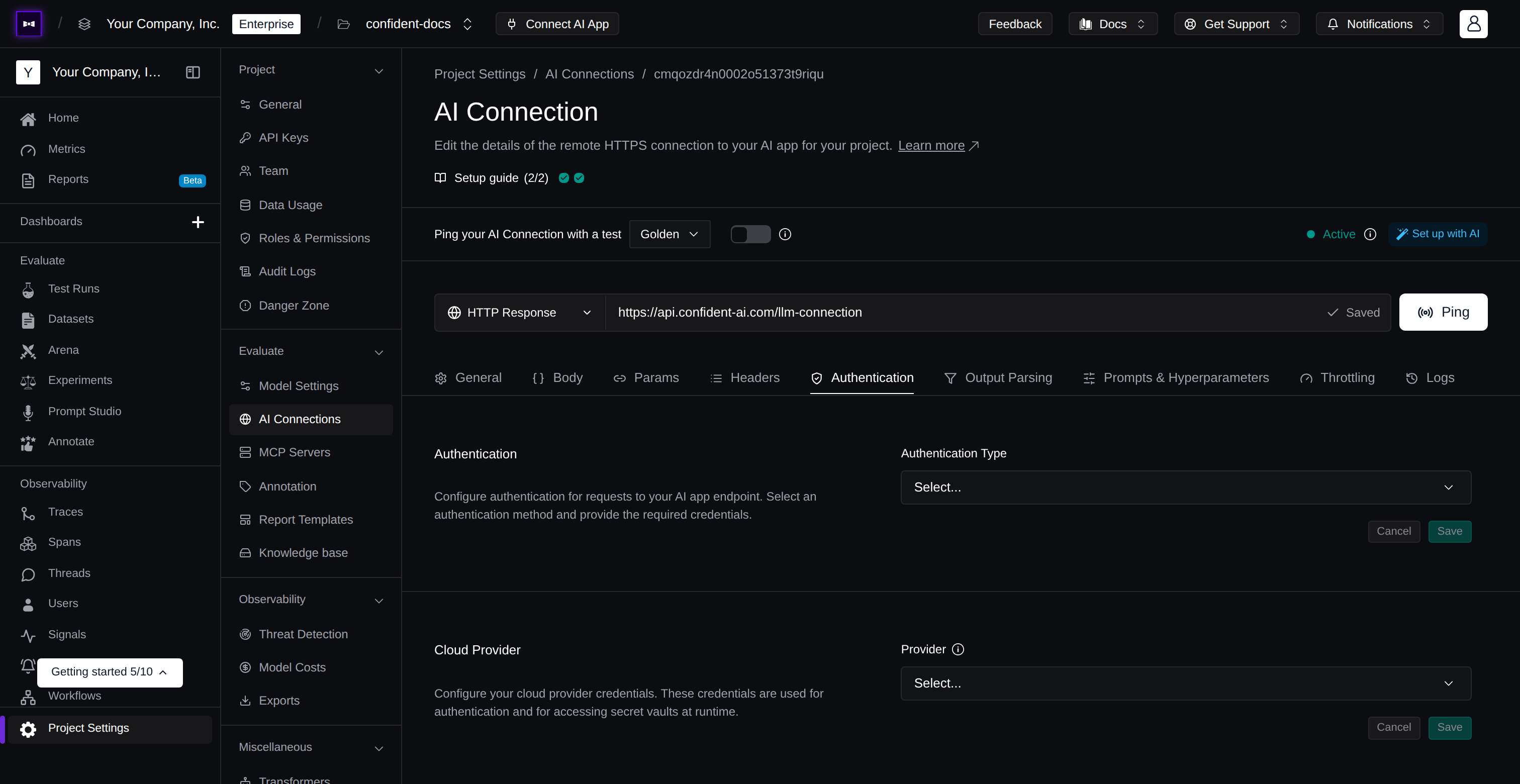
Secrets Manager
A secrets manager lets you securely retrieve authentication credentials at runtime from a cloud vault, instead of storing them directly on the platform.
To enable a secrets manager:
- Toggle the secrets manager on
- Select a provider (e.g. Azure Key Vault)
- Enter your Vault URL (e.g.,
https://your-vault.vault.azure.net) - Enter your Tenant ID, Client ID, and Client Secret to authenticate to the vault
Authentication
Select an authentication type from the dropdown:
| Type | Description |
|---|---|
| None | No authentication is applied |
| Auth0 | Exchanges client credentials for a Bearer token via Auth0's OAuth2 client credentials flow |
| HMAC | Computes an HMAC-SHA256 signature of the request payload and sends it as a header |
Auth0 requires the following fields:
| Field | Description |
|---|---|
| Auth0 Domain | Your Auth0 tenant domain (e.g., your-tenant.auth0.com) |
| Audience | The API identifier this token is authorized to access |
| Client ID / Client ID Name | Your Auth0 application client ID, or the name of the secret in your vault if using a secrets manager |
| Client Secret / Client Secret Name | Your Auth0 application client secret, or the name of the secret in your vault if using a secrets manager |
HMAC requires the following fields:
| Field | Description |
|---|---|
| Header Key | The HTTP header name where the signature is sent (e.g., X-Signature) |
| Signature Prefix | An optional prefix prepended to the signature (e.g., sha256=) |
| Secret Key / Secret Name | The signing key, or the name of the secret in your vault if using a secrets manager |
Next Steps
With authorization configured, your AI connection can securely reach protected endpoints. Next, learn how to handle multi-turn evaluations and link results back to traces.
Multi-Turn State
Persist information across turns during multi-turn simulations.
Linking Traces
Link test cases and turns to their traces for full observability.
Last updated on