Switch from Langfuse to Confident AI
Move your OpenTelemetry traces from Langfuse to Confident AI with confident-trace. Your spans, provider clients and frameworks stay untouched.
Overview
Langfuse SDK v4 (Python) and v5 (TypeScript) already run on OpenTelemetry. confident-trace speaks the same protocol, so the switch is an exporter swap: replace the Langfuse client wrapper with init(), rename the decorator, and keep every span you emit today.
In this guide, you will:
- Install confident-trace and replace the Langfuse keys with one
CONFIDENT_API_KEY. - Replace the client setup with
init()so auto instrumentation emits the spans. - Rename @observe to @span so every trace carries a name, an input and an output.
- See what changes once the traces land in Confident AI: evals on every trace, datasets curated from production, alerts when quality drops.
Prerequisites
- A Project API Key,
CONFIDENT_API_KEY(for exampleconfident_us_proj_...). Retrieve yours here. - Python 3.10+ for the Python SDK, or Node.js 22+ for the TypeScript SDK.
- Your existing Langfuse setup. The before snippets below follow the Langfuse quickstart as of September 2026.
Switch
Install confident-trace
One package. Provider SDKs stay optional peers.
CONFIDENT_API_KEYreplaces LANGFUSE_PUBLIC_KEY, LANGFUSE_SECRET_KEY, LANGFUSE_BASE_URL. For the EU region, also setCONFIDENT_OTEL_ENDPOINT=https://eu.otel.confident-ai.com/v1/traces.pip install confident-trace export CONFIDENT_API_KEY=... # replaces LANGFUSE_PUBLIC_KEY, LANGFUSE_SECRET_KEY, LANGFUSE_BASE_URLnpm install confident-trace export CONFIDENT_API_KEY=... # replaces LANGFUSE_PUBLIC_KEY, LANGFUSE_SECRET_KEY, LANGFUSE_BASE_URL node --import confident-trace/register dist/index.jsReplace the client wrapper with init()
Drop the Langfuse import of OpenAI. Auto instrumentation emits the spans from the plain client.
from langfuse.openai import openai

response = openai.chat.completions.create(
    model="gpt-4.1-mini",
    messages=[{"role": "user", "content": "Hello"}],
)
from confident_trace import init from openai import OpenAI init() client = OpenAI() response = client.chat.completions.create( model="gpt-4.1-mini", messages=[{"role": "user", "content": "Hello"}], )import { NodeSDK } from "@opentelemetry/sdk-node"; import { LangfuseSpanProcessor } from "@langfuse/otel"; import { observeOpenAI } from "@langfuse/openai"; import OpenAI from "openai"; const sdk = new NodeSDK({ spanProcessors: [new LangfuseSpanProcessor()] }); sdk.start(); const openai = observeOpenAI(new OpenAI()); const response = await openai.chat.completions.create({ model: "gpt-4.1-mini", messages: [{ role: "user", content: "Hello" }], });import { init } from "confident-trace"; import OpenAI from "openai"; const tracing = init(); const client = new OpenAI(); const response = await client.chat.completions.create({ model: "gpt-4.1-mini", messages: [{ role: "user", content: "Hello" }], });Rename @observe to @span
Same shape. Return values and exceptions pass through.
from langfuse import observe

@observe()
def answer(question: str) -> str:
    return openai.chat.completions.create(
        model="gpt-4.1-mini",
        messages=[{"role": "user", "content": question}],
    ).choices[0].message.content
from confident_trace import span @span def answer(question: str) -> str: return client.chat.completions.create( model="gpt-4.1-mini", messages=[{"role": "user", "content": question}], ).choices[0].message.contentimport { observe } from "@langfuse/tracing"; const answer = observe( async (question: string) => { const response = await openai.chat.completions.create({ model: "gpt-4.1-mini", messages: [{ role: "user", content: question }], }); return response.choices[0].message.content; }, { name: "answer" }, );import { span } from "confident-trace"; const answer = span({ name: "answer" }, async (question: string) => { const response = await client.chat.completions.create({ model: "gpt-4.1-mini", messages: [{ role: "user", content: question }], }); return response.choices[0].message.content; });
Run your app once. The trace appears in your project's Observatory within seconds. If it does not, check that CONFIDENT_API_KEY is set in the same process and that the app flushes before it exits.
What Changes
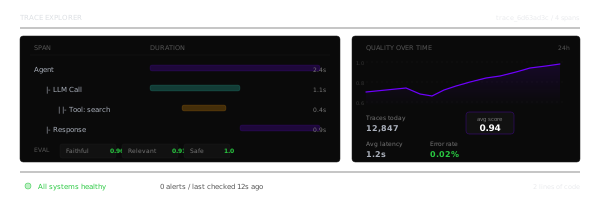
Tracing is where you start. Evals are where it pays off. Every trace gets a score. Low scores become dataset rows. Dataset rows become regression tests. Your next release ships against real production failures.
| Capability | Langfuse | Confident AI |
|---|---|---|
| OpenTelemetry ingestion | Yes | OTLP over HTTP and gRPC |
| Auto-instrumented providers | OpenAI wrapper and LangChain callback | OpenAI, Anthropic, Google GenAI, Bedrock, 5 gateways, 16 frameworks |
| Built-in eval metrics | Managed evaluators, custom scoring | 50+ research-backed metrics through DeepEval |
| Online evals on traces, spans and threads | Traces only | Yes |
| Quality-aware alerting on eval scores | Slack, webhook, GitHub Actions | Email, Slack, Discord, Teams |
| Prompt and use case drift detection | No | Yes |
| Automatic dataset curation from production | Manual add to dataset | Ingestion tasks, filtered and tagged |
| Multi-turn simulation | No | Yes |
| Git-based prompt management | No | Branches, PRs, approvals, eval actions |
| Cross-functional workflows, no code | No | PMs and QA run evals over HTTP |
| Regression testing and CI gates | No | Yes |
| Safety monitoring | No | Toxicity, bias, PII on production traffic |
Migration Questions
Do I have to rewrite my instrumentation?
No. confident-trace exports through standard OTLP. Existing OpenTelemetry spans from your frameworks are exported as they are.
Can I run both during the switch?
Yes. Point an OpenTelemetry Collector at both endpoints and compare for a week before you cut over. CONFIDENT_OTEL_ENDPOINT accepts a Collector URL.
What about my Langfuse datasets and prompts?
We import them on the migration call. Langfuse exports through its public API and scheduled blob storage export. We map the result to Confident AI datasets and prompt versions.
How do I get the $200?
Book the call. After it, we apply a $200 coupon to your organization's first paid invoice. One reward per organization.
Is the TypeScript SDK ready?
The Python SDK is stable on PyPI. The TypeScript SDK is an alpha release on npm. The TypeScript snippets in this guide follow the alpha API.
Related
OpenTelemetry integration
Send OTLP traces from any SDK or Collector to Confident AI, with the attribute keys the platform reads.
Build test runs from traces
Turn your production traces into an evaluated test run before you ship.
LLM Observability
Evals on every trace, drift detection, alerts, and datasets curated from production.
confident-trace on GitHub
The OpenTelemetry-native tracing SDK with 25 integrations for Python and TypeScript.
Last updated on