Assign Projects to Governance Policies on the Fly
Enroll each project into the right governance policy straight from your CI/CD pipeline, so every deployment is gated without any manual UI steps.
Overview
This guide is for teams running AI governance at scale — typically one Confident AI project per customer or per agent — that need every project enrolled into a governance policy automatically, without anyone clicking through the platform UI.
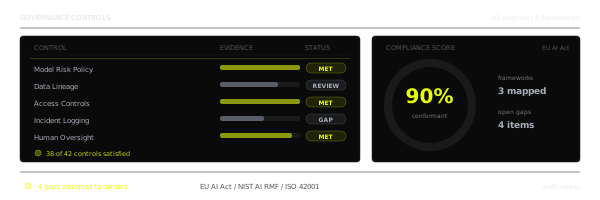
It builds directly on Provision Projects for Agents on the Fly: once your pipeline creates a project, the next step is to enroll that project into the governance policy that gates its deployment. A governance policy is organization-scoped (a named bundle of controls), and each project belongs to at most one policy.
In this guide, you will:
- Configure the Admin SDK with one Organization API Key.
- Find the target governance policy by name.
- Assign the project to the policy in code, as part of your pipeline.
- Verify enrollment by reading the project's policy back.
flowchart LR
    Pipeline["CI/CD pipeline<br/>(per customer)"]
    Pipeline --> Create["Create project"]
    Create --> Assign["Assign project to<br/>governance policy"]
    Assign --> Gate["Deployment gated<br/>by policy controls"]

    classDef pipeline fill:#f8fafc,stroke:#334155,stroke-width:2px,color:#0f172a
    classDef step fill:#eef2ff,stroke:#4f46e5,stroke-width:1px,color:#1e293b
    class Pipeline pipeline
    class Create,Assign,Gate step
Build It
Install the Admin SDK
Governance policies are managed with the
confident-aiAdmin SDK.pip install confident-ainpm install confident-aiConfigure the Admin SDK
Set
CONFIDENT_ORG_API_KEYto your Organization API Key. The Admin SDK reads this variable by default when you create a client.export CONFIDENT_ORG_API_KEY="confident_us_org_..."main.py from confident_ai import ConfidentAI confident_ai = ConfidentAI()index.ts import { ConfidentAI } from "confident-ai"; const confidentAI = new ConfidentAI();Find the Target Policy
Governance policies can be created in the platform UI or with
create_governance_policy; their controls are configured in the UI. From code, list them and pick the one your deployment should be gated by — usually by name.main.py from confident_ai import ConfidentAI confident_ai = ConfidentAI() def find_policy_id(policy_name: str) -> str: policies = confident_ai.organization.list_governance_policies() for policy in policies.governance_policies: if policy.name == policy_name: return policy.id raise ValueError(f"No governance policy named {policy_name!r}")index.ts import { ConfidentAI } from "confident-ai"; const confidentAI = new ConfidentAI(); async function findPolicyId(policyName: string): Promise<string> { const policies = await confidentAI.organization.listGovernancePolicies(); const policy = policies.governancePolicies.find((p) => p.name === policyName); if (!policy) { throw new Error(`No governance policy named ${policyName}`); } return policy.id; }Assign the Project
Assign the project to the policy. Assignment is additive and partial: every project that exists is enrolled and returned in
assignedProjectIds(any on a different policy are moved over), while the policy's other projects are left untouched. Ids that don't exist in your organization come back innotFoundProjectIdsinstead of failing the call — so one stale id never tanks the whole batch. Re-assigning an already-enrolled project still counts it, so this is safe to run on every pipeline execution.main.py from confident_ai import ConfidentAI confident_ai = ConfidentAI() # find_policy_id() is defined above def enroll_project(project_id: str, policy_name: str = "Production Gate") -> list[str]: policy_id = find_policy_id(policy_name) result = confident_ai.organization.assign_projects_to_governance_policy( policy_id, [project_id] ) return result.assigned_project_idsindex.ts import { ConfidentAI } from "confident-ai"; const confidentAI = new ConfidentAI(); // findPolicyId() is defined above async function enrollProject( projectId: string, policyName = "Production Gate", ): Promise<string[]> { const policyId = await findPolicyId(policyName); const result = await confidentAI.organization.assignProjectsToGovernancePolicy(policyId, [ projectId, ]); return result.assignedProjectIds; }Verify Enrollment
Read the project back and confirm it is enrolled. Every project returned by
projects.list()(andproject(id).get()) includes itsgovernancePolicy—{ id, name }when enrolled, ornullwhen not.from confident_ai import ConfidentAI confident_ai = ConfidentAI() project = confident_ai.project("project-uuid-1").get() print(project.governance_policy) # ProjectGovernancePolicy(id="...", name="Production Gate")import { ConfidentAI } from "confident-ai"; const confidentAI = new ConfidentAI(); const project = await confidentAI.project("project-uuid-1").get(); console.log(project.governancePolicy); // { id: "...", name: "Production Gate" }Done! Your pipeline now enrolls each project into the right governance policy using a single Organization API Key.
Gate Deployments in CI
Everything above is the platform team's job — enroll each project into the right policy once, as part of provisioning. From then on, the product team that owns a project gates its own deployments with the deepeval CLI. They don't need the Organization API Key; they only need that project's Project API Key (CONFIDENT_API_KEY).
export CONFIDENT_API_KEY="confident_us_proj_..."
deepeval gate
export CONFIDENT_API_KEY="confident_us_proj_..."
npx deepeval gatedeepeval gate assesses every control in the project's policy and exits with code 0 only when the policy passes — a failure on any control above Low importance exits non-zero and stops the deployment. See Gate Deployments in CI/CD for the full reference.
Next Steps
Provision Projects on the Fly
Create a dedicated project per customer or agent — the step before enrollment.
AI Governance
Configure governance policies and the controls that gate your deployments.
List Governance Policies
See the governance-policy endpoints in the API reference under Organization data models.
Manage Projects
Update and clean up the projects your pipeline creates.
Last updated on