Provision Projects for Agents on the Fly
Spin up a dedicated Confident AI project for each agent your users build, then trace and evaluate every agent in isolation.
Overview
This guide is for teams that want to create Confident AI projects programmatically instead of creating them manually in the platform UI. It is especially useful for internal agent-building platforms, multi-tenant products, and proofs of concept where each agent (or tenant or customer) should have its own isolated Confident AI project.
For example, imagine an enterprise platform where every user builds their own agents. Each agent should get its own Confident AI project so its traces and evaluations stay isolated from every other agent on the platform.
In this guide, you will:
- Configure the Admin SDK with one Organization API Key.
- Create a project in code for each agent the moment it is built.
- Store the returned Project API Key with the project ID for later trace routing.
- Route traces to the correct project by scoping each request to its Project API Key with
confident-trace.
By the end, your platform will be able to provision an isolated Confident AI project per agent on demand and send each agent's traces, datasets, and evaluations to the right workspace.
flowchart TB
    Org["Your Confident AI Organization"]

    Org --> AppA["Application A Project"]
    Org --> AppB["Application B Project"]
    Org --> AppC["Application C Project"]

    AppA --> AppAData["Application A traces<br/>Application A datasets<br/>Application A evaluations"]
    AppB --> AppBData["Application B traces<br/>Application B datasets<br/>Application B evaluations"]
    AppC --> AppCData["Application C traces<br/>Application C datasets<br/>Application C evaluations"]

    classDef org fill:#f8fafc,stroke:#334155,stroke-width:2px
    classDef project fill:#eef2ff,stroke:#4f46e5,stroke-width:1px
    classDef data fill:#f0fdf4,stroke:#16a34a,stroke-width:1px
    class Org org
    class AppA,AppB,AppC project
    class AppAData,AppBData,AppCData data
Build It
Install SDKs
The Admin SDK is available in both Python and TypeScript through
confident-ai. You also needconfident-traceto route each application's traces into its project.pip install confident-ai confident-tracenpm install confident-ai confident-traceConfigure Admin SDK
Set
CONFIDENT_ORG_API_KEYto your Organization API Key. The Admin SDK reads this variable by default when you create a client.export CONFIDENT_ORG_API_KEY="confident_us_org_..."app/confident.py from confident_ai import ConfidentAI confident_ai = ConfidentAI()app/confident.ts import { ConfidentAI } from "confident-ai"; export const confidentAI = new ConfidentAI();Provision Project
Create a project for each application. The
projects.create(...)call returns the new project and its first Project API Key. Store both values with that application so traces can be routed to the same project later.The storage helpers in this example represent your own database or persistence layer.
app/onboarding.py from app.confident import confident_ai from app.storage import save_application_project def onboard_application(application_slug: str): new_project = confident_ai.projects.create(name=application_slug) save_application_project( application_slug, project_id=new_project.project.id, project_api_key=new_project.api_key.value, ) return new_project.project.idapp/onboarding.ts import { confidentAI } from "./confident"; import { saveApplicationProject } from "./storage"; export async function onboardApplication(applicationSlug: string) { const newProject = await confidentAI.projects.create({ name: applicationSlug }); await saveApplicationProject(applicationSlug, { projectId: newProject.project.id, projectApiKey: newProject.apiKey?.value, }); return newProject.project.id; }Route Traces
The Project API Key determines which project receives a trace. Call
init()once when your server starts, then — for each request — load the tenant's stored key and wrap the traced work in a project scope. Every span created inside that scope is exported to the tenant's project.app/agent.py from openai import OpenAI from confident_trace import init, span, project_context from app.storage import load_application_project init() client = OpenAI() @span(type="agent") def support_agent(query: str) -> str: return client.chat.completions.create( model="gpt-4o", messages=[{"role": "user", "content": query}], ).choices[0].message.content def run_for_application(application_slug: str, query: str): application = load_application_project(application_slug) with project_context(api_key=application.project_api_key): return support_agent(query)app/agent.ts import OpenAI from "openai"; import { init, span, projectContext } from "confident-trace"; import { loadApplicationProject } from "./storage"; export const runtime = init(); const openai = new OpenAI(); const supportAgent = span( { name: "support_agent", type: "agent" }, async (query: string) => { const res = await openai.chat.completions.create({ model: "gpt-4o", messages: [{ role: "user", content: query }], }); return res.choices[0].message.content; }, ); export async function runForApplication(applicationSlug: string, query: string) { const application = await loadApplicationProject(applicationSlug); return projectContext({ apiKey: application.projectApiKey }, () => supportAgent(query)); }Remember to launch your server with the Node preload (
node --import confident-trace/register dist/server.js) so the OpenAI call is instrumented.Verify Routing
Create a project for an application, execute the application, and confirm that the trace appears in the correct project. Send requests for two tenants back-to-back to confirm they don't leak into each other.
from confident_trace import shutdown
from app.onboarding import onboard_application
from app.agent import run_for_application

onboard_application("support-bot")
onboard_application("sales-bot")

try:
    run_for_application("support-bot", "What's on my agenda today?")
    run_for_application("sales-bot", "Draft a follow-up for the Acme deal.")
finally:
    shutdown()
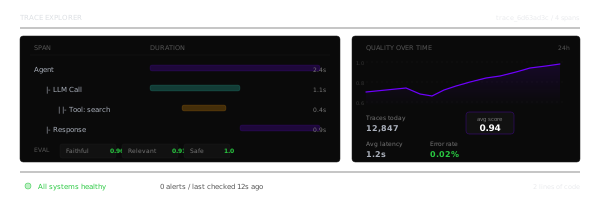
import { onboardApplication } from "./onboarding"; import { runForApplication, runtime } from "./agent"; await onboardApplication("support-bot"); await onboardApplication("sales-bot"); try { await runForApplication("support-bot", "What's on my agenda today?"); await runForApplication("sales-bot", "Draft a follow-up for the Acme deal."); } finally { await runtime.shutdown(); }Open the Observatory and switch to the support-bot project. The trace appears in that project, isolated from every other application — and the sales-bot project shows only its own trace.
Traces in the Observatory Done ✅. The workflow now creates a dedicated project per application and routes traces using a single Organization API Key.
Next Steps
Now that each tenant or application can route traces to its own project, use these sections to extend the workflow:
Assign Projects to Governance Policies
Enroll each project you provision into a governance policy from CI/CD.
Manage Projects
Manage the projects your application creates, including updates and cleanup.
Members & Invitations
Add users to the projects you create and assign the right project-level roles.
LLM Tracing
Customize the traces you route by setting span types, metadata, tags, and other trace attributes.
Last updated on