AI evaluation in CI/CD is more than checking whether an average score went down. It is defining the quality policy every release must satisfy, running it whenever the application changes, and deciding whether the candidate can merge or deploy. Ordinary tests can pass while an agent selects the wrong tool, a chatbot loses context, or a RAG system retrieves the wrong evidence.
This guide compares nine evaluation products used inside pipelines—not the CI runners themselves—by how well they connect candidate → evaluation → policy decision → reviewable evidence. It is narrower than our comparison of CI/CD tools for AI applications. NIST's Secure Software Development Framework profile for AI models places AI evaluation inside CI/CD; our AI evaluation in CI/CD guide covers implementation.
What matters for AI evaluation in CI/CD
- A gate on every releasable change: Run the actual candidate when code, prompts, models, retrievers, tools, or data change. The CI result should describe what will ship—not a copied prompt or reconstructed app.
- Release coverage for every failure mode: Apply purpose-built checks to agent tool use and planning, chatbot coherence, RAG retrieval and faithfulness, multi-turn behavior, and safety. Synthetic data and simulation should fill gaps before the pipeline has real traffic.
- Blocking rules that can be trusted: Fail deterministic invariants directly. Probabilistic quality checks need absolute floors, accepted-baseline tolerances, repeated generations, and human alignment before they can block.
- Versioned release evidence: Pin the dataset, metrics, expected behavior, and policy slices. Preserve outputs, score reasons, traces, deltas, annotations, approvals, and overrides so a failed or approved release is reproducible.
- A staged policy with named owners: Run critical blockers on pull requests, broader variance and slice checks nightly, and full coverage before promotion. Engineering maintains execution; QA, product, and domain experts own review and quality decisions.
Best AI Evaluation Tools for CI/CD at a Glance
Tool | Type | Pricing | Open Source | CI/CD Angle |
|---|---|---|---|---|
Confident AI | Evaluation-first quality and governance platform | Free tier; Starter $200/month (unlimited seats) | No (enterprise self-hosting available) | Whole-app gates, 50+ metrics, versioned benchmarks, human alignment, and durable release evidence |
Noveum AI | Automated agent evaluation and remediation platform | Free tier; from $69/month | SDK and NovaEval framework | Automated scoring, synthetic agent sessions, root-cause analysis, and backtested fix proposals |
Promptfoo | Config-as-code evaluation and security tool | Free; Enterprise available | Yes (MIT) | YAML/JavaScript assertions, CLI failures, repeats, and GitHub pull-request comments |
MLflow 3 | AI and ML lifecycle platform | Free; managed costs vary | Yes (Apache-2.0) | Pytest-native assertions backed by tracked runs, traces, and scorer reasons |
Arize Phoenix | Observability and evaluation platform | Free to self-host; AX from $50/month | Yes (ELv2) | Pytest, Vitest, and Jest criteria linked to trace and experiment evidence |
LangSmith | Evaluation and observability platform | Free tier; from $39/user/month | No | SDK and test-runner checks inside LangChain and LangGraph workflows |
Braintrust | General AI evaluation platform | Free tier; Pro $249/month | No | Evaluation CLI, GitHub Action, experiment snapshots, and pull-request summaries |
Ragas | RAG evaluation library | Free | Yes (Apache-2.0) | RAG metrics wrapped in team-owned Python assertions and release policy |
LangWatch | Agent simulation and testing platform | Free tier; from €29/user/month | Yes (Apache-2.0) | Multi-turn agent and voice scenarios with CI verdicts and run history |
Pricing and capabilities were checked in August 2026. Judge-model calls, application inference, embeddings, and external tool calls are usually billed separately from platform fees.
1. Confident AI
Type: Evaluation-first CI/CD platform · Pricing: Free tier; Starter $200/month with unlimited seats; Team $2,000/month; custom Enterprise · Open Source: No (enterprise self-hosting available) · Website: https://www.confident-ai.com
Confident AI treats CI/CD as the enforcement point for one shared AI quality policy. Teams run code-authored tests or evaluate the real application through HTTP-based AI connections, then apply 50+ research-backed metrics across agents, chatbots, RAG, single-turn, multi-turn, and safety. Span-level agent checks, RAG component metrics, synthetic datasets, and multi-turn simulation cover failures that final-output regression scores miss.
Versioned datasets and metric collections define the benchmark. Official Test Runs establish the accepted baseline; configured tolerance, Test Run Significance, and multi-generation Consistency separate noise from meaningful change; Metric Alignment validates probabilistic checks against human labels. Eval Insights and durable reports preserve the cases, reasons, traces, annotations, approvals, and overrides behind the release decision. QA, product, and domain experts review the same evidence as engineering, while prompt branches and eval actions apply the policy to prompt-only changes. An AI-assisted GitHub setup PR is available as an onboarding convenience, not the core value.
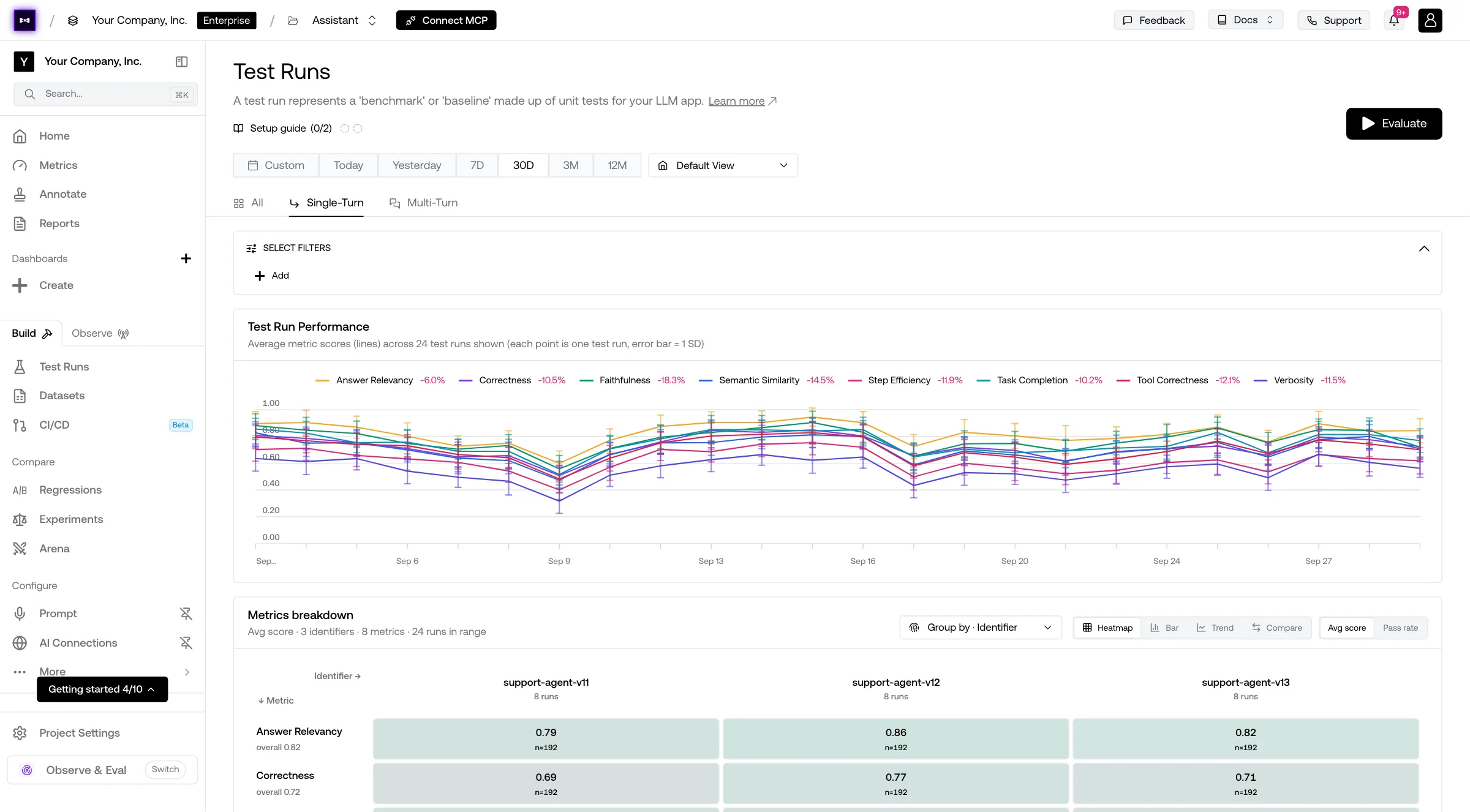
Best for: Organizations that need one enforceable AI quality policy across use cases, with trusted metrics, whole-application testing, audit-ready evidence, and cross-functional ownership.
Pros | Cons |
|---|---|
Enforces one quality policy across agents, chatbots, RAG, multi-turn, and safety | More workflow depth than a solo developer needs for a few assertions |
Combines whole-app testing, 50+ metrics, simulation, span-level evidence, and versioned benchmarks | Initial connectivity, instrumentation, and gate calibration still need engineering |
Gives QA, product, domain experts, and engineers one durable release record | Cloud-first; enterprise self-hosting is available but is not the default |
Confident AI helps you Enforce one AI quality bar before every release
Book a personalized 30-min walkthrough for your team's use case.
FAQ
Q: Why is Confident AI's CI/CD workflow more than regression testing?
Regression is only one policy check. Confident AI also enforces absolute quality floors, deterministic requirements, use-case-specific metrics, human-aligned probabilistic gates, review ownership, and audit-ready evidence across agents, chatbots, RAG, multi-turn, and safety.
Q: Can QA, product, and domain experts participate without editing CI code?
Yes. Engineering sets up application connectivity and enforcement once. Other teams can run Test Runs, inspect failed cases, annotate results, align metrics, and review release evidence through the platform.
2. Noveum AI
Type: Automated evaluation and remediation platform for AI agents · Pricing: Free tier; paid plans from $69/month; custom Enterprise · Open Source: SDK and NovaEval framework · Website: https://noveum.ai
Noveum AI brings automated, reference-free scoring into CI/CD for chatbots, voice agents, and workflow agents. It generates synthetic text and voice sessions against the candidate build, with scorers for accuracy, RAG quality, tool use, conversation quality, safety, and voice behavior across the trajectory.
When a run fails, automated analysis groups failure patterns, proposes changes, and backtests them by replaying captured runs on the team's model before engineering review. Teams retain their CI runner and broader release policy.
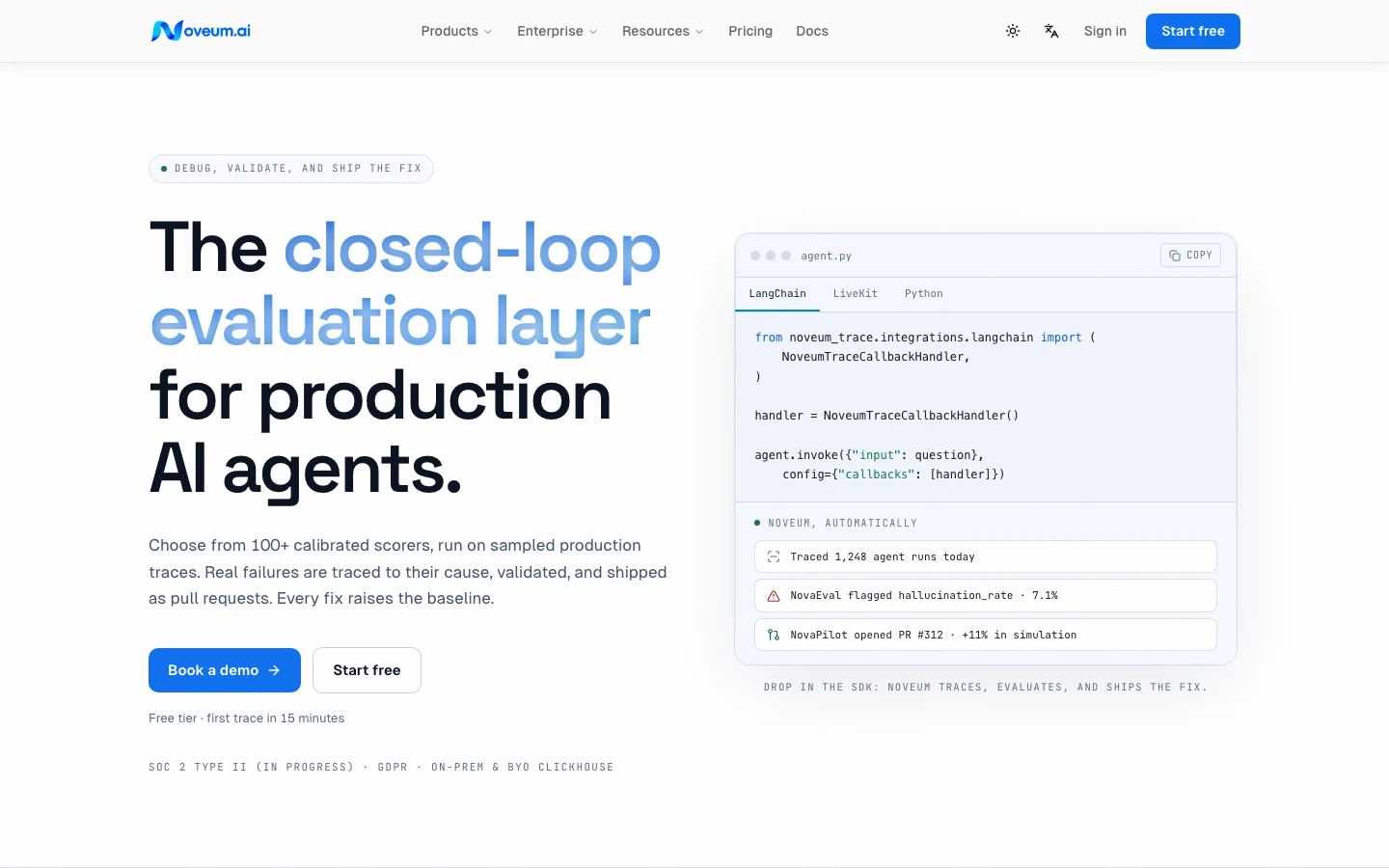
Best for: Engineering teams that want synthetic agent coverage, automated failure analysis, and backtested fix proposals in their CI workflow.
Pros | Cons |
|---|---|
Automated scorers can evaluate candidate runs without a golden dataset | Statistical human alignment and cross-functional review require added process |
Synthetic testing covers multi-turn text, voice, tool-use, and edge-case scenarios | Versioned benchmark governance and audit-ready approvals are not central workflows |
Failed runs can become backtested fix proposals for engineering review | Teams own the CI runner and broader release-policy decisions |
FAQ
Q: How does Noveum AI fit into a CI pipeline?
Teams instrument an agent with Noveum's Python or TypeScript tracing SDK, run candidate or synthetic sessions, and compare automatic scores with configured thresholds. The resulting pass/fail can block a merge through the team's existing CI runner.
Q: What happens when a Noveum CI run fails?
Noveum analyzes the trajectory and backtests proposed changes against captured runs. Engineers review the resulting fix report or pull request; broader release governance remains team-owned.
3. Promptfoo
Type: Open-source config-as-code evaluation and security tool · Pricing: Free and open source; Enterprise available · Open Source: Yes (MIT) · Website: https://www.promptfoo.dev
Promptfoo is a config-as-code choice for teams that define prompts, providers, cases, and assertions in YAML or JavaScript. Its CLI can fail a CI job, while the maintained GitHub Action adds pull-request summaries and a required suite pass percentage. Deterministic assertions, model-graded rubrics, provider comparisons, and adversarial checks cover common prompt and model release risks.
Repeated cases and minimum-pass counts help control stochastic tests before a suite-level threshold applies. Its local-first workflow also makes checks readily reproducible locally before CI runs them. Full-application trace diagnosis, shared accepted-baseline operations, metric-to-human alignment, and production-to-dataset curation generally require additional systems and team-owned policy.
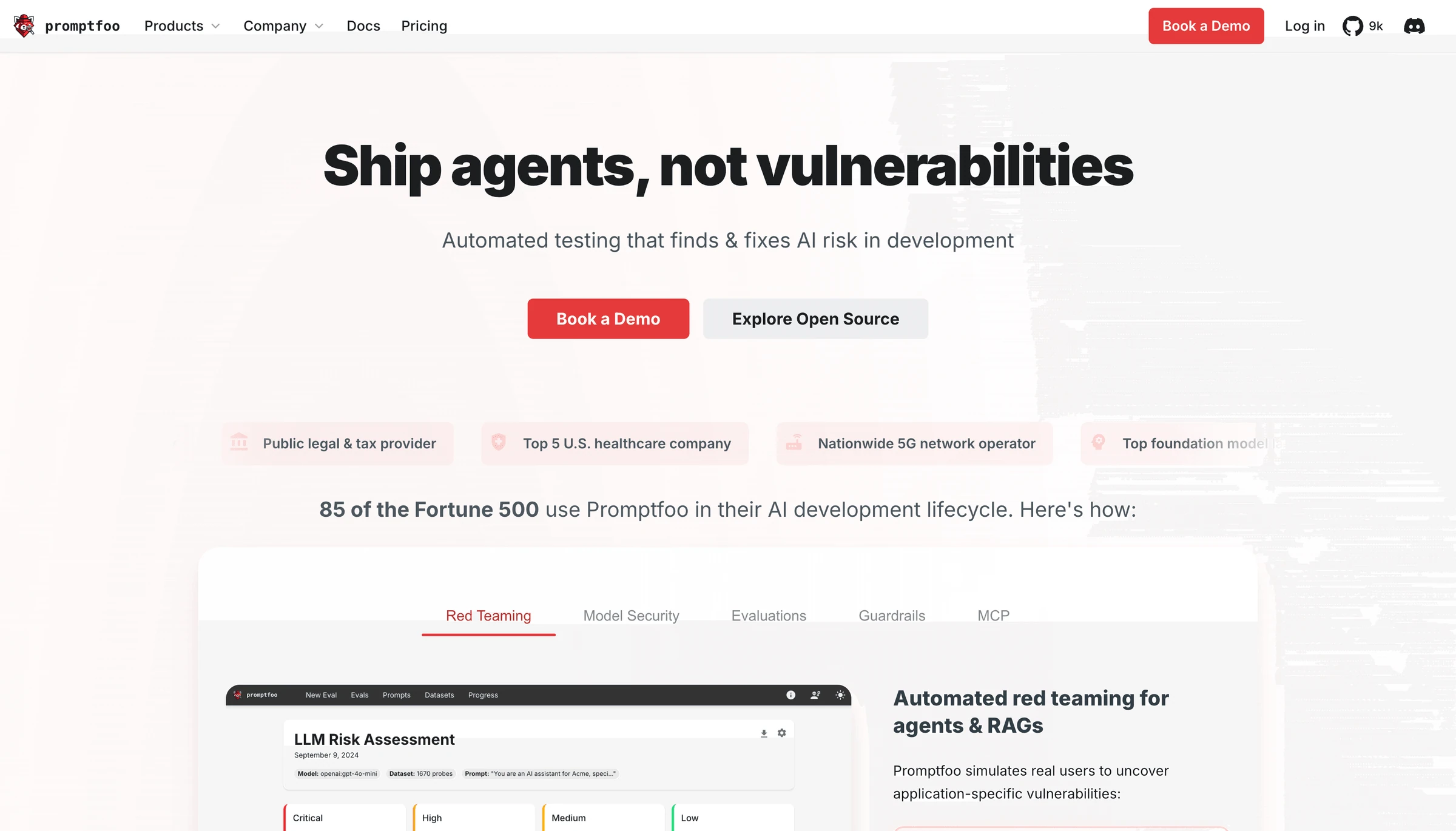
Best for: Engineering teams that want open-source, declarative prompt, model, and security checks with a maintained GitHub Action.
Pros | Cons |
|---|---|
Fast route from local config to a non-zero CI failure | Workflow is more prompt- and provider-centric than full-application-centric |
Explicit repeats, pass counts, and suite thresholds help control variance | Trace-rich diagnosis across retrieval, tools, and multi-turn state needs more instrumentation |
Free, self-hostable, and broadly provider-compatible | Teams own broader baseline governance, human alignment, and production feedback |
FAQ
Q: Can Promptfoo block a CI job?
Yes. Its CLI can return a non-zero exit, and its maintained GitHub Action can publish pull-request results and enforce a required suite pass rate.
Q: What must teams build around Promptfoo?
Promptfoo supplies declarative checks and execution. Teams generally own whole-application adapters, accepted-baseline governance, human alignment, durable stakeholder reports, approvals, and the broader quality policy.
4. MLflow 3
Type: Open-source AI and ML lifecycle platform · Pricing: Free and open source; managed Databricks costs vary · Open Source: Yes (Apache-2.0) · Website: https://mlflow.org
MLflow 3 adds GenAI regression tests through a test decorator in ordinary pytest suites. Teams call its evaluation API with built-in or custom scorers, assert on the pass decision, and let a failed assertion block the job. Marked tests become a tracked run with traces, judge results, scorer reasons, and history.
This gives reviewers persistent evidence without replacing pytest as the familiar entry point. It fits organizations already using MLflow or Databricks for experiment tracking, datasets, review queues, and model operations. Teams starting only with LLM quality gates inherit a tracking server and broader lifecycle architecture, while release policy and cross-functional evaluation practices remain team-defined.
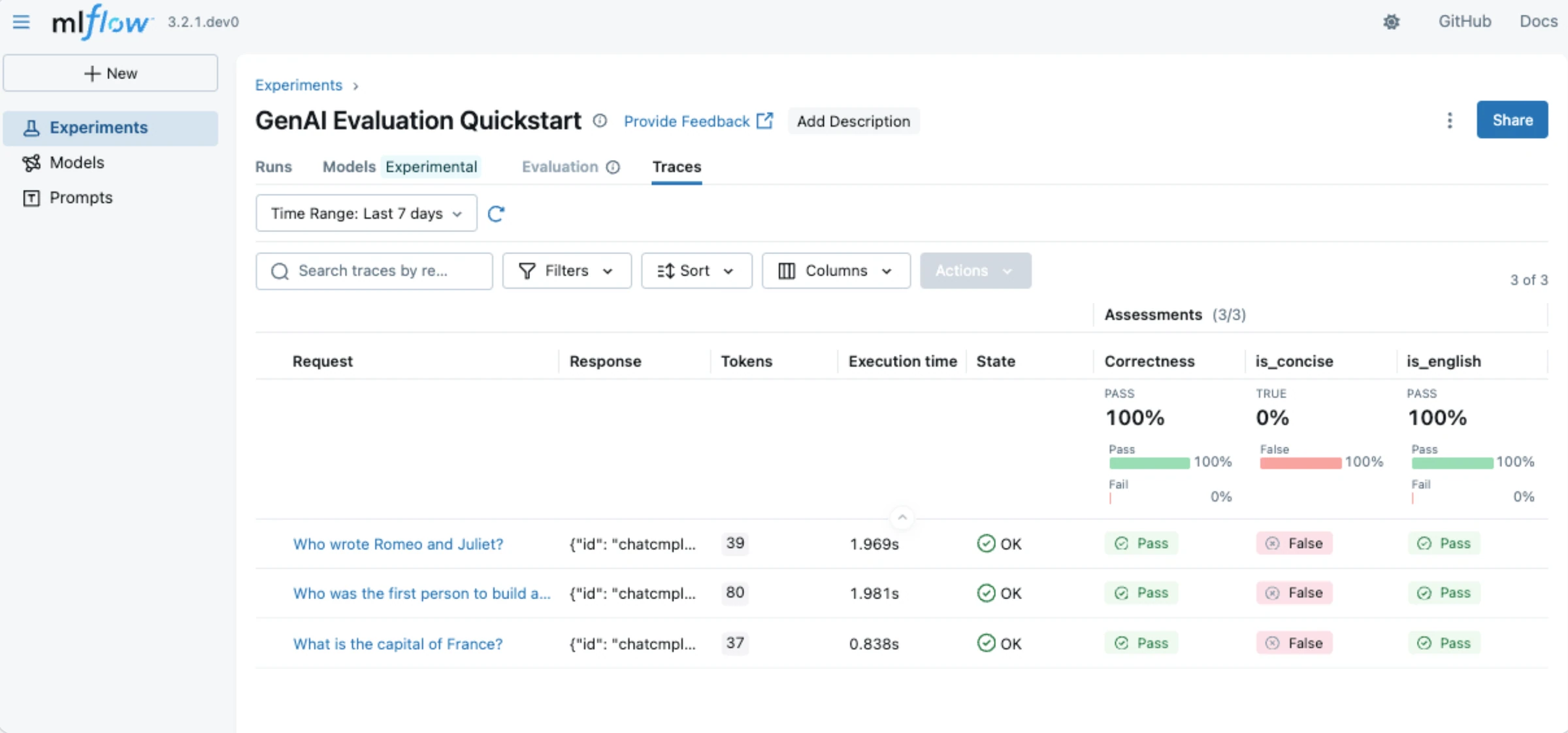
Best for: ML platform teams that want pytest-native GenAI tests and durable evidence inside an existing MLflow or Databricks environment.
Pros | Cons |
|---|---|
Native pytest assertions can block a release directly | Persistent reporting benefits require an MLflow tracking setup |
Tracked runs retain traces, judge results, and test history | Broad ML lifecycle scope is heavier for teams that only need LLM gates |
Open-source core fits established self-managed ML platforms | Metric alignment and production-failure automation need more assembly |
FAQ
Q: How does MLflow 3 integrate AI evaluation with pytest?
MLflow's test decorator turns a GenAI evaluation into a normal pytest assertion while recording the run, traces, scorers, reasons, and history in MLflow.
Q: Is MLflow 3 a good fit if we do not already use MLflow or Databricks?
It can be, but the tracking server and broader lifecycle model add operational weight. Confident AI is more direct when the main requirement is a cross-functional AI quality gate rather than an ML control plane.
5. Arize Phoenix
Type: Open-source observability and evaluation platform · Pricing: Free to self-host; Arize AX from $50/month · Open Source: Yes (ELv2) · Website: https://arize.com/phoenix
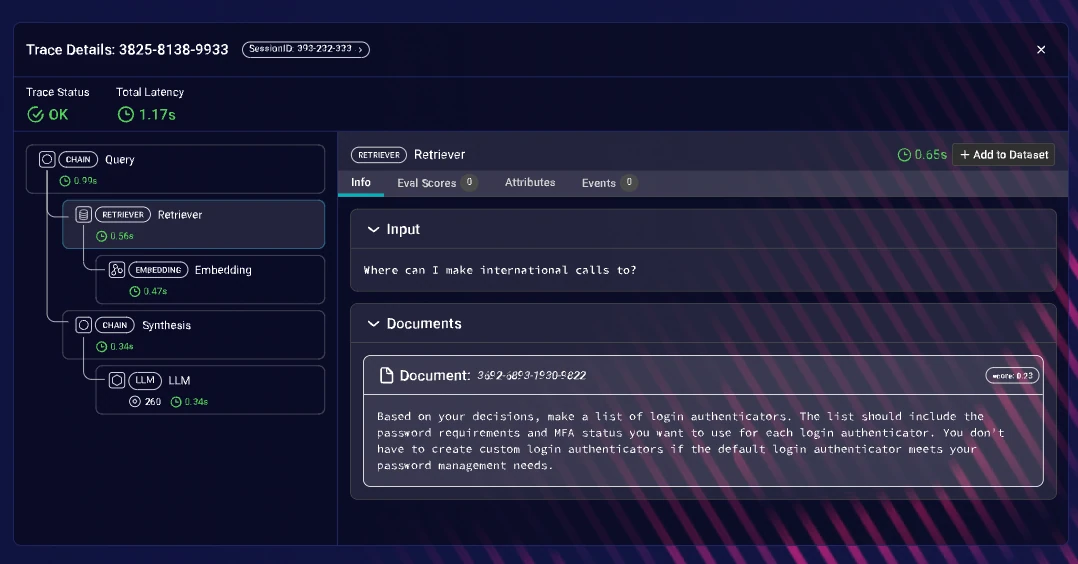
Arize Phoenix lets Python and TypeScript teams run evaluations through pytest, Vitest, or Jest while recording traces, datasets, evaluator results, and experiments. Suite acceptance criteria can gate aggregate quality, latency, cost, or other measures, with failed cases linked to OpenTelemetry evidence.
The experiment record lets reviewers compare candidates and revisit failures later without relying only on terminal output. Phoenix includes evaluators for hallucination, document relevance, answer correctness, and tool calling, plus custom functions and LLM judges. Its flexible, self-hostable architecture is observability-led, so teams still design release policy, human calibration, cross-functional review, and production-to-CI curation around the traces and experiments.
Best for: Python and TypeScript teams that want self-hosted traces, datasets, experiments, and test-runner-native gates.
Pros | Cons |
|---|---|
Supports pytest, Vitest, and Jest workflows | Evaluation is one layer of a broader observability product |
Connects suite criteria with traces and experiment history | PM and QA workflows depend on engineering instrumentation and evaluator setup |
Free self-hosting offers a flexible technical foundation | Human alignment and a prescriptive production-to-regression loop need team design |
FAQ
Q: Which test runners does Phoenix support?
Phoenix supports evaluation workflows with pytest, Vitest, and Jest, linking failed criteria to traces, datasets, and experiment history.
Q: Does Phoenix define the release policy for the team?
Phoenix provides the technical foundation for criteria and evidence. Because it is observability-led, teams still design threshold policy, human calibration, approvals, and cross-functional review around it.
6. LangSmith
Type: Observability and evaluation platform · Pricing: Free tier; Plus $39/user/month · Open Source: No · Website: https://www.langchain.com/langsmith
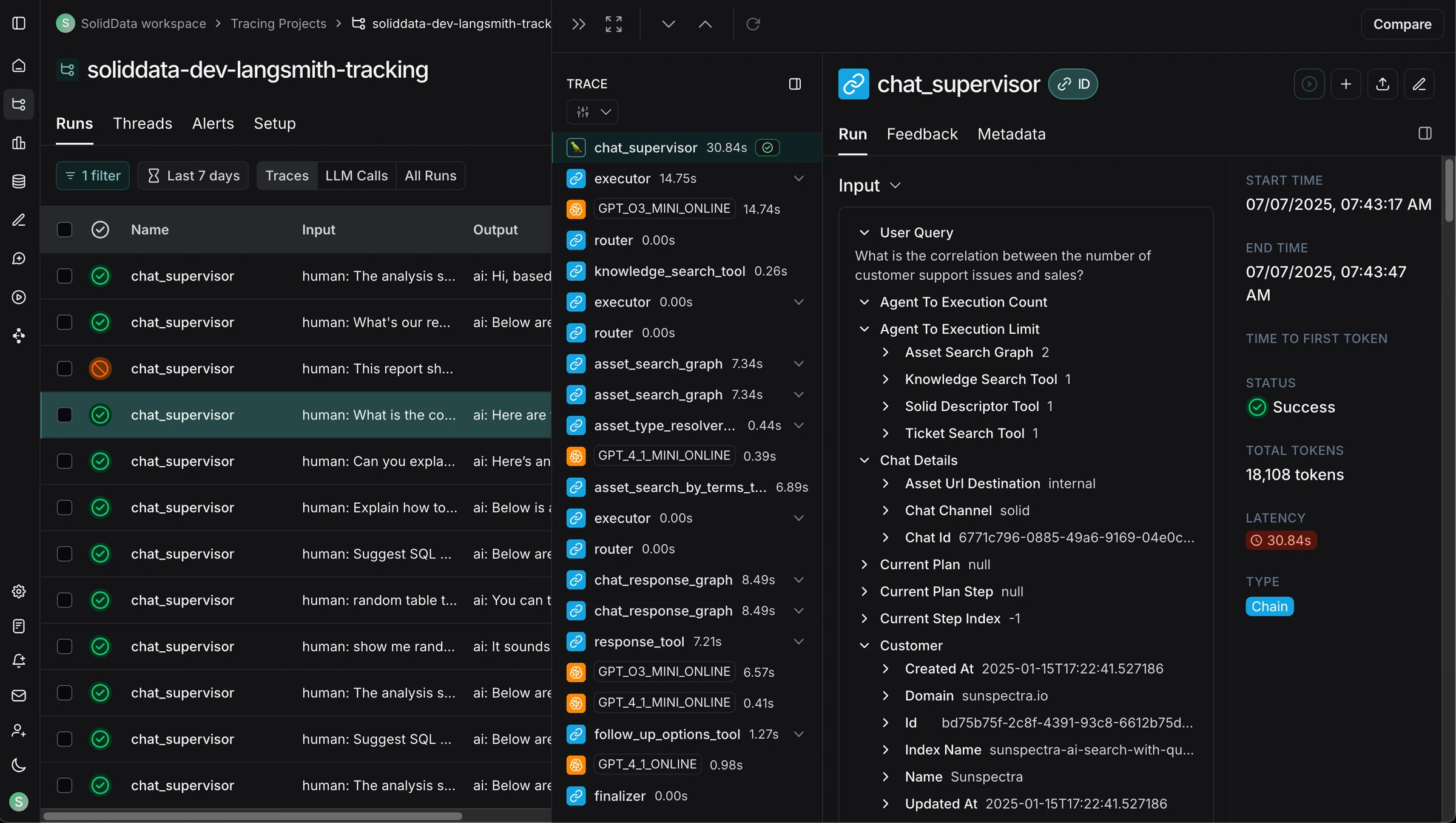
LangSmith combines versioned datasets, experiment comparison, custom evaluators, and trace inspection with SDK, pytest, Vitest, and GitHub workflow integrations. A candidate can produce both a CI result and a browsable explanation, especially when LangChain or LangGraph already provides the trace structure.
This pairing helps engineers move quickly from a failed evaluator to the relevant trace and comparison result. Online evaluators can score production traces, and selected examples can enter offline datasets for later regression tests. The ecosystem advantage narrows in mixed-framework systems; extensive metric validation, multi-turn testing, release ownership, and broad non-engineer review require more custom evaluator and workflow design.
Best for: LangChain and LangGraph teams that want offline experiments, CI checks, and production traces in the same ecosystem.
Pros | Cons |
|---|---|
Native fit for LangChain and LangGraph applications | Mixed-framework stacks receive less of the ecosystem advantage |
Mature dataset, experiment, and trace-comparison interface | Many product-specific checks remain custom evaluator work |
Connects online evaluation with trace-to-dataset workflows | Release policy and cross-functional metric alignment are less central |
FAQ
Q: Can LangSmith evaluations run in CI/CD?
Yes. LangSmith supports SDK, pytest, Vitest, and GitHub workflow patterns that connect evaluator results to experiments and trace evidence.
Q: Is LangSmith equally useful outside LangChain and LangGraph?
Other stacks can send data to LangSmith, but its strongest execution and tracing ergonomics remain inside the LangChain ecosystem. Mixed-framework teams should compare the setup and evaluator work required.
7. Braintrust
Type: General AI evaluation platform · Pricing: Free tier; Pro $249/month · Open Source: No · Website: https://www.braintrust.dev
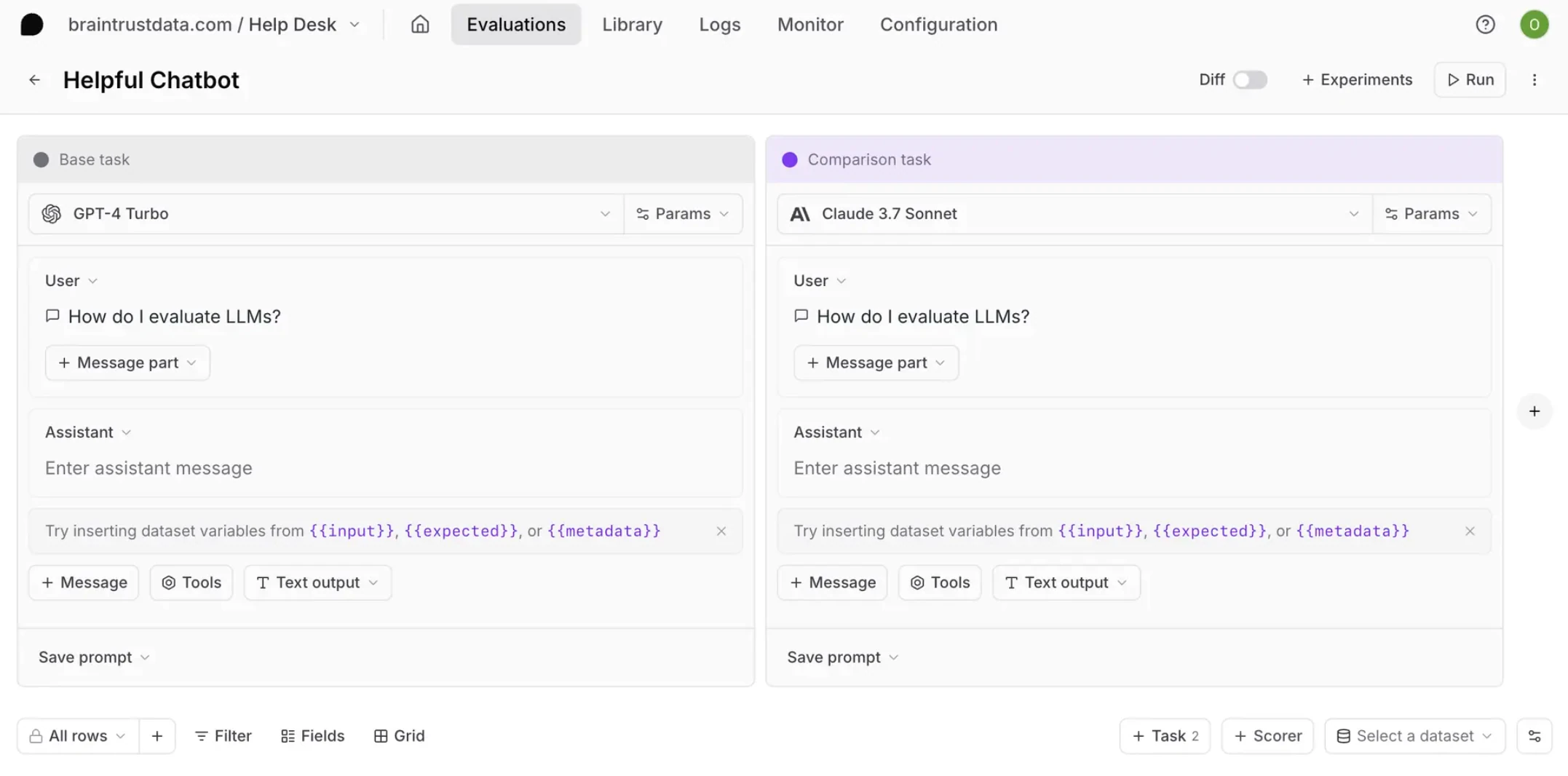
Braintrust runs dataset-backed evaluations from code or its UI and stores results as immutable experiment snapshots. Its evaluation CLI and GitHub Action can run on pull requests, post a linkable summary, and apply custom or Autoevals scorers to semantic, factual, RAG, and product-specific checks.
Immutable snapshots make candidate-to-baseline comparisons easier to revisit after a pull request closes. Production scoring and trace promotion connect real traffic to later datasets for engineering-led prompt and model releases. Teams still own whole-application adapters, component instrumentation, scorer validation, multi-turn behavior, human alignment, and shared release policy. Pricing also jumps from free to a $249 monthly Pro plan.
Best for: Engineering teams that want immutable experiments, custom scorers, prompt and model comparisons, and pull-request evaluation summaries.
Pros | Cons |
|---|---|
Clean snapshot model for comparing release candidates | Application execution and scorer validation remain engineering-led |
Python and TypeScript workflows produce shareable experiment links | Multi-turn simulation and statistical human alignment are not central workflows |
Connects offline experiments with production scoring and datasets | Pro pricing begins at $249 per month before usage charges |
FAQ
Q: How does Braintrust report pull-request evaluations?
Its evaluation CLI and GitHub Action run dataset-backed experiments, preserve immutable snapshots, and post a linkable summary for engineering review.
Q: What remains team-owned with Braintrust?
Teams configure application execution, component instrumentation, scorer validation, multi-turn behavior, human alignment, and shared release policy. Pro pricing begins at $249 per month before usage charges.
8. Ragas
Type: Open-source RAG evaluation library · Pricing: Free · Open Source: Yes (Apache-2.0) · Website: https://ragas.io
Ragas focuses on RAG metrics, separating retrieval quality through context precision and recall from generation quality through faithfulness, answer relevancy, and correctness. Teams call its Python APIs from pytest or a script, compare scores with a team-defined threshold, and fail CI when a candidate regresses. See the best RAG evaluation tools for a deeper metric comparison.
Teams can also inspect metric-level results locally. Synthetic test-set generation can bootstrap coverage from source documents before reviewed production cases exist. Ragas remains a metric library rather than a complete release system, so teams own baseline storage, assertions, artifacts, approvals, reports, and the production feedback path.
Best for: Engineering teams that need focused RAG retrieval and generation metrics inside a custom Python CI workflow.
Pros | Cons |
|---|---|
Purpose-built split between retriever and generator quality | Teams must build the CI assertion and release policy |
Free, open source, and provider-flexible | Baseline comparison, durable reports, and collaboration are custom |
Synthetic generation helps bootstrap initial coverage | Broader agent, chatbot, safety, and multi-turn gates need another layer |
FAQ
Q: Can Ragas metrics fail a CI job?
Yes. Teams call Ragas from pytest or a script, compare retrieval and generation scores with team-defined thresholds, and return a failing status when policy is breached.
Q: Is Ragas a complete CI/CD quality gate?
No. It is a focused RAG metric library. Teams provide benchmark storage, baseline comparison, approvals, reports, and coverage for agents, chatbots, multi-turn behavior, and safety.
9. LangWatch
Type: Open-source agent simulation and testing platform · Pricing: Free tier; from €29/user/month · Open Source: Yes (Apache-2.0) · Website: https://langwatch.ai
LangWatch's Scenario framework tests agents as interactive systems instead of scoring only static input-output pairs. A simulated user and judge can exercise multi-turn text, voice, tool use, error recovery, and adversarial behavior through Python, TypeScript, or Go tests, then return a verdict to CI.
It is especially useful for stateful, branching interactions. Stable scenario, set, and batch identifiers connect runs to CI history, and production failures can become simulations that verify fixes. This complements metric-based gates when failures emerge across turns or tools, but general metric depth, human alignment, and cross-functional release operations remain narrower than a full evaluation platform.
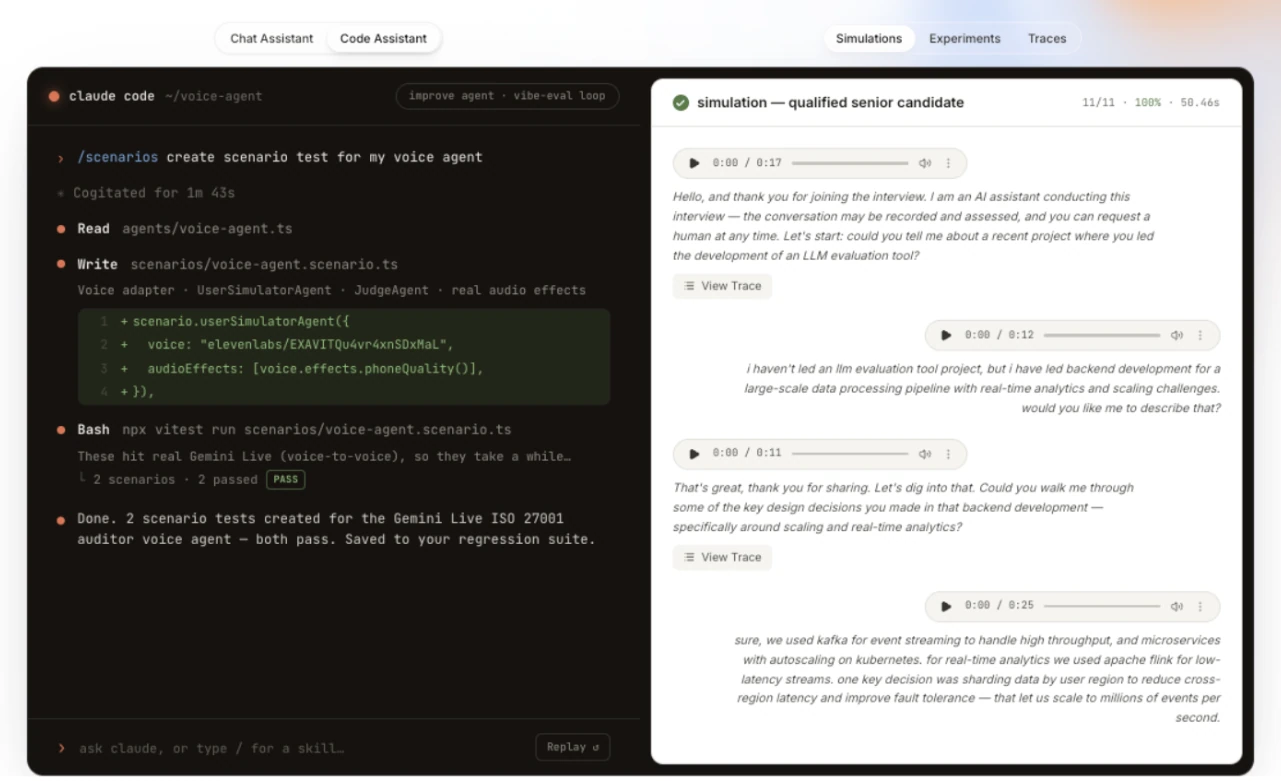
Best for: Agent and voice teams that need end-to-end interactive simulations in CI rather than only static cases.
Pros | Cons |
|---|---|
Exercises multi-turn, tool, voice, and error-recovery behavior | Scenario simulation is narrower than a broad evaluation platform |
Production failures can become executable regression scenarios | General metric depth is smaller than comprehensive suites |
Open-source and framework-agnostic across three languages | Human alignment and shared release reporting need added process |
FAQ
Q: What does a LangWatch Scenario test in CI?
A simulated user and judge can exercise multi-turn text, voice, tool use, error recovery, and adversarial behavior, then return a verdict to the pipeline.
Q: Does LangWatch replace a broad metric and governance platform?
It is strongest for interactive agent and voice scenarios. Teams that also need broad metric coverage, human alignment, shared release policy, and audit-ready evidence generally add another layer.
Why Confident AI is the Best Tool for AI Evaluation in CI/CD
Every tool on this list can return a failing status. The harder question is what happens between “the candidate changed” and “this application is approved to ship.” That gap includes benchmark coverage, trusted metrics, blocking policy, human review, and evidence—and it is where most CI integrations leave the work to the team.
A weak AI pipeline runs a handful of scores, compares one average with yesterday's average, and fails on an arbitrary threshold. It misses agent steps, multi-turn behavior, localized RAG failures, and safety slices. When the check turns flaky, engineers lower the threshold or stop requiring it. When someone asks why a release passed, the evidence is a terminal log.
Confident AI treats CI/CD as an AI quality governance workflow. The practical impact:
- One policy across every AI use case. Apply the same release framework to agents, chatbots, RAG, single-turn, multi-turn, and safety while choosing metrics and thresholds that match how each use case fails.
- The tested candidate is the shipped candidate. Run evaluations from code or against the application's HTTP endpoint instead of rebuilding prompts and chains inside a separate sandbox.
- Coverage reaches the failure layer. Use 50+ research-backed metrics, span-level agent checks, retrieval and generation metrics for RAG, and trace evidence that shows where a failure happened.
- Benchmarks cover behavior before users find it. Version datasets and metric collections, generate synthetic cases, and simulate realistic multi-turn agent and chatbot conversations instead of relying on a static set of single-turn examples.
- Blocking authority is earned. Deterministic invariants fail directly. Probabilistic metrics use absolute floors, an Official baseline, configured tolerance, Test Run Significance, multi-generation Consistency, and Metric Alignment before they control a release.
- Evidence arrives at review time. Eval Insights and durable reports preserve the candidate, benchmark and metric versions, failed cases, score reasons, traces, annotations, approvals, and overrides.
- The whole team owns quality. Engineers maintain execution, while QA runs release suites, product defines expected behavior and risk, and domain experts validate specialized criteria through the UI.
- Prompt changes follow the same policy as code. Branches, pull requests, permissions, labels, aliases, and eval actions keep quality evidence attached to every proposed prompt release.
- The workflow stays framework-agnostic. Code execution, HTTP-based AI connections, Python and TypeScript support, and OpenTelemetry-compatible instrumentation avoid locking the quality standard to one application framework.
- Confirmed failures strengthen the benchmark. Reviewed incidents can become versioned regression cases, so the next release is tested against what previously went wrong.
Noveum automates agent scoring, root-cause analysis, and fix validation. Promptfoo gives engineers fast declarative checks. MLflow fits existing ML control planes. Phoenix connects evaluations to self-hosted traces. LangSmith fits LangChain and LangGraph workflows. Braintrust offers clean experiment snapshots. Ragas provides focused RAG metrics, and LangWatch provides interactive agent simulations. Each covers a useful slice. Confident AI connects coverage → trusted policy → review → auditable release decision in one workflow. At Humach, that operating model helped the team ship deployments 300% faster.
Confident AI helps you Enforce one AI quality bar before every release
Book a personalized 30-min walkthrough for your team's use case.
Frequently Asked Questions
What counts as AI evaluation in CI/CD?
AI evaluation is part of CI/CD when it runs against a releasable candidate and can influence merge or deployment. A complete gate executes a versioned benchmark, scores outputs and traces, checks deterministic requirements and probabilistic quality, and returns a release status with evidence. A script that prints an average score but cannot affect the release is reporting—not a gate. Confident AI connects execution, policy, review, and evidence in one workflow.
Why isn't regression testing enough for AI CI/CD?
Regression testing asks whether a candidate became worse than the accepted system. It does not prove that either version is good enough. A complete policy also checks absolute quality floors, required behavior, prohibited behavior, agent tool use, chatbot coherence, RAG retrieval and faithfulness, multi-turn behavior, and safety. Confident AI combines those checks with benchmark coverage, metric trust, approvals, and override evidence.
How do I add AI evaluation to a CI pipeline?
Start with a versioned benchmark of representative workflows, expected outcomes, critical edge cases, and policy slices. Run the real candidate in CI, apply deterministic rules and calibrated semantic metrics, and compare both absolute quality floors and candidate-to-baseline movement. Only trusted policy breaches should block.
Publish reviewer-friendly evidence and assign approval and override ownership. Use the AI evaluation in CI/CD guide to expand from critical pull-request cases to nightly and pre-release suites.
How do I prevent flaky LLM evaluations in CI?
Pin application and judge versions, write explicit rubrics, reduce temperature where supported, and measure the unchanged system repeatedly before setting policy. Use representative samples, repeated generations, minimum-pass rules, slice checks, and aggregate tolerance instead of trusting one borderline score. Confident AI combines an accepted baseline, multi-generation Consistency, Test Run Significance, configured tolerance, and Metric Alignment to separate expected variance from a trusted failure.
Should I use an absolute threshold or a baseline comparison?
Use both. An absolute threshold stops consistently poor quality from passing; a baseline comparison catches a new regression even when the candidate remains above that floor. For example, a policy might require a score above 0.80 and no more than a 0.03 decline from the accepted release. Confident AI keeps the Official Test Run, candidate, configured tolerance, significance, and failed cases together.
What should an AI evaluation dataset contain for CI/CD?
Include common workflows, high-value scenarios, severe edge cases, adversarial inputs, and known incidents. For agents, record required or prohibited tools and steps. For chatbots, include conversation state and unacceptable behavior. For RAG, include expected facts, context, and relevant sources. Store provenance, reviewer status, expected outcomes, and policy slices. Start with 25–50 reviewed cases, then expand with validated synthetic data and reviewed failures.
Can I run AI evaluations in GitHub Actions?
Yes. GitHub Actions can run the candidate and evaluation, receive the release status, store artifacts, and report the check. The evaluation platform should supply the versioned benchmark, metrics, policy, accepted-baseline comparison, tolerance, and behavioral evidence. Confident AI can optionally open a repository-tailored setup PR with the workflow and application adapter; the governed evaluation policy remains the important part.
Which AI failures should block a release?
Block validated hard requirements such as malformed schemas, prohibited tools, missing required steps, or severe safety violations. Also block trusted aggregate or slice-level quality failures when they breach an absolute floor or accepted baseline tolerance. Keep noisy or unaligned metrics in warning mode. Confident AI returns pass, fail, or neutral under configured policy while preserving the cases and reasons behind the decision.
How should prompt-only changes be evaluated?
Treat prompt changes as release candidates even when application code is unchanged. Run the changed prompt against a pinned dataset and metric collection, compare it with the accepted version, and inspect aggregate movement plus critical failures before promotion. Confident AI organizes this workflow with prompt branches, pull requests, permissions, labels, aliases, and eval actions, keeping evaluation evidence attached to each proposed prompt change.
Can PMs, QA, and domain experts participate in CI/CD evaluation?
Yes. Platform or engineering teams maintain application connectivity and enforcement. QA owns repeatable release testing, product defines expected behavior and risk, and domain experts validate specialized criteria. Confident AI gives these groups one shared report and review workflow, so quality decisions do not require everyone to edit repository code or interpret terminal logs.
What are the best AI evaluation tools for CI/CD in 2026?
The nine ranked tools are Confident AI, Noveum AI, Promptfoo, MLflow 3, Arize Phoenix, LangSmith, Braintrust, Ragas, and LangWatch. Confident AI is the best overall choice because it combines whole-application execution, 50+ research-backed metrics, broad use-case coverage, versioned benchmarks, governed release policy, human alignment, prompt controls, and audit-ready evidence. The others serve narrower needs such as config-as-code checks, existing ML platforms, trace-led experiments, RAG metrics, or agent simulations.