A RAG application can fail in two places. The retriever may fetch the wrong information or miss an important source. The model may then misunderstand good context, ignore it, or make up an unsupported claim.
A useful RAG evaluation tool shows which part failed. That distinction matters because changing the prompt will not fix a weak retriever, and changing the search setup will not fix a model that ignores good evidence.
The best tools go beyond producing scores. They help teams create realistic tests, compare application versions, catch bad changes before release, and learn from failures in production. The Ragas paper published at EACL 2024 explains why retrieval and generation should be evaluated separately, while RAGChecker shows the value of finding the failing component. For a deeper explanation of individual metrics, see the complete RAG evaluation guide.
What matters for RAG evaluation
- Retriever and generator metrics: Score retrieval with contextual relevance, precision, and recall; score the answer with faithfulness, answer relevance, and correctness. The tool should also support custom criteria for product-specific requirements.
- Source-grounded test data: Store the question, retrieved context, expected facts or answer, and relevant source documents. Synthetic tests should come from your own knowledge base, with control over question difficulty and style.
- Trace-backed diagnosis: Keep the retrieved chunks, their order, the generated answer, and the score explanation together. A failed case should reveal whether evidence was missing, poorly ranked, or ignored by the model.
- Controlled RAG experiments: Hold the test set fixed while changing the retriever, embedding model, chunking, top-K, reranker, prompt, or generation model. Compare both overall movement and the individual cases that changed.
- RAG regression gates: Compare each candidate with the accepted version and block releases that make retrieval or answer quality worse. Repeat uncertain tests so one noisy model response does not decide the release. See the CI/CD evaluation guide for a deeper comparison.
- Production drift by slice: Track retrieval and answer quality on live traffic, broken down by retriever, knowledge base version, query type, language, or customer. Aggregate scores should not hide a failing segment.
- Cross-functional review: Engineers connect the application; PMs, QA, and domain experts run evaluations, inspect evidence, validate source quality, and turn confirmed failures into new test cases without writing code.
Best RAG Evaluation Tools at a Glance
Rank | Tool | Type | Best For | Pricing |
|---|---|---|---|---|
1 | Confident AI | Evaluation-first platform | Cross-functional RAG experiments, release gates, and production monitoring | Free tier; Starter $200/month (unlimited seats) |
2 | Ragas | Open-source RAG evaluation library | Developers who want RAG metrics and synthetic test generation in Python | Free |
3 | TruLens | Open-source evaluation and tracing library | Teams that prefer the RAG Triad or already use Snowflake | Free |
4 | Arize Phoenix | Open-source observability and evaluation platform | Engineering teams that want self-hosted traces and evaluations | Free to self-host; Arize AX from $50/month |
5 | LangSmith | Observability and evaluation platform | LangChain and LangGraph teams | Free tier; from $39/user/month |
6 | LlamaIndex | Open-source RAG application framework | LlamaIndex developers testing retrieval in code | Free |
7 | Braintrust | General AI evaluation platform | Engineering-led RAG experiments and CI/CD | Free tier; Pro $249/month |
Pricing and capabilities were checked in July 2026. Model usage and application costs are usually billed separately.
1. Confident AI
Type: Evaluation-first platform · Pricing: Free tier; Starter $200/month with unlimited seats; Team $2,000/month; custom Enterprise · Open Source: No (enterprise self-hosting available) · Website: https://www.confident-ai.com
Confident AI ranks first because it covers the full RAG testing cycle in one platform. Teams build versioned datasets with questions, retrieved and expected context, expected answers, and source documents, or generate synthetic cases from their own knowledge base. They then run the connected RAG application and hold that dataset fixed while comparing retrievers, embeddings, chunking, rerankers, prompts, or models.
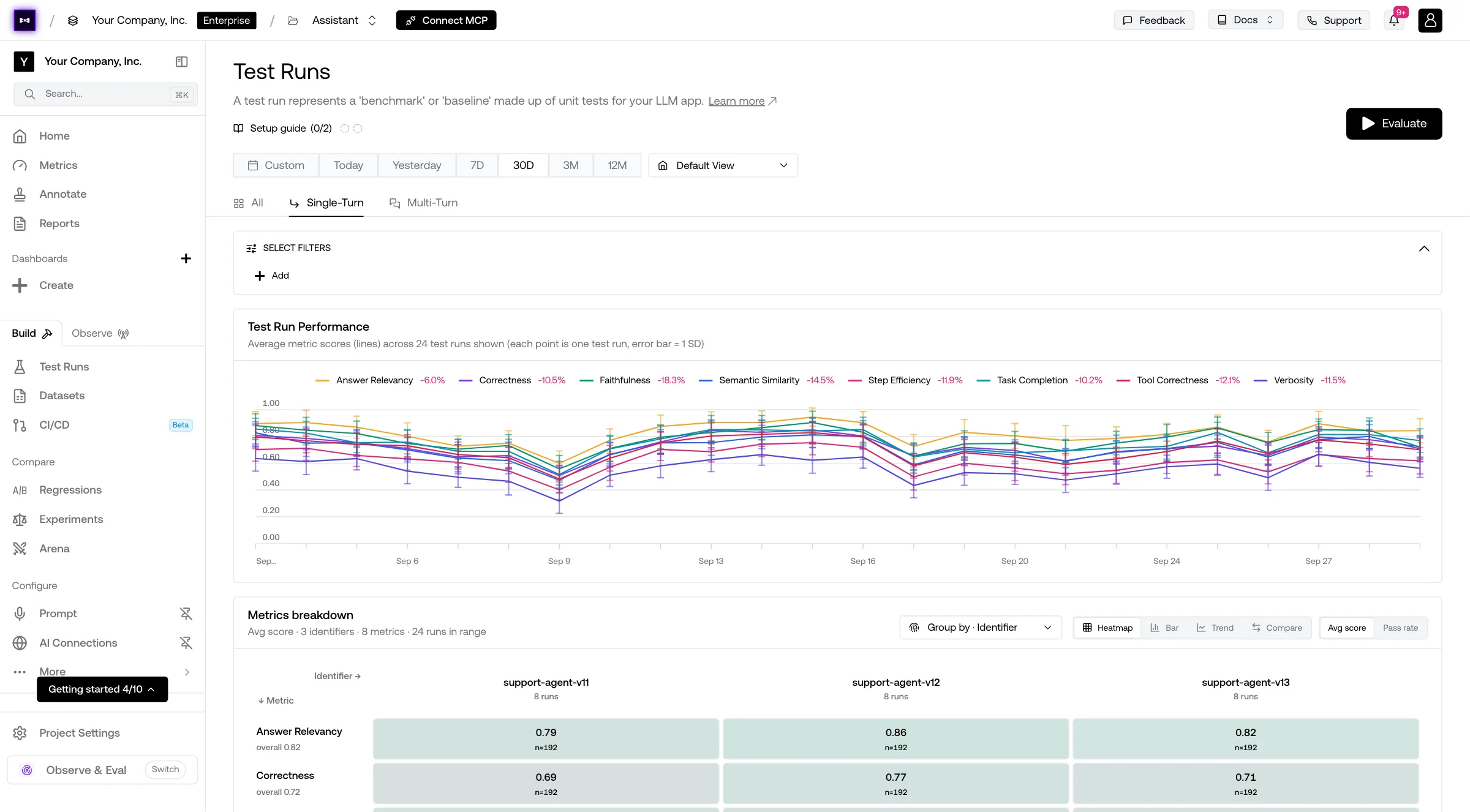
Its RAG evaluation workflow includes contextual relevance, precision, and recall for retrieval, plus faithfulness and answer relevance for generation. Teams can also create custom G-Eval metrics in plain language for requirements such as approved-source use, citation completeness, abstention when evidence is missing, or domain-policy compliance. Results can be attached to the complete response or the individual retrieval and generation steps, so reviewers can see where a failure began.
After an engineer connects the application, PMs, QA, and domain experts can run tests and review failures without writing code. Before release, teams compare a candidate with the accepted version and repeat generations to separate a real regression from output variance. After release, they can monitor retrieval and answer quality in production, segment results by retriever, knowledge base version, query type, or customer, and alert on quality drops. Reviewed failures return to the dataset as regression cases.
Best for: Cross-functional teams that need source-grounded test generation, component-level RAG diagnosis, controlled experiments, release gates, production monitoring, and regression coverage.
Pros | Cons |
|---|---|
Holds source-grounded datasets fixed across retriever, prompt, and model experiments | More platform than a solo developer needs for a few notebook tests |
Combines component-level RAG checks with custom G-Eval metrics | Requires an initial application connection and well-structured RAG data |
Carries the same evaluation evidence through release gates and production monitoring | Cloud-first; self-hosting is an enterprise deployment option |
Confident AI helps you Catch RAG failures before users see them
Book a personalized 30-min walkthrough for your team's use case.
2. Ragas
Type: Open-source RAG evaluation library · Pricing: Free · Open Source: Yes (Apache-2.0) · Website: https://ragas.io
Ragas is a focused Python library for measuring RAG quality. Its metrics check whether retrieval found useful information and whether the answer stayed grounded, relevant, and correct. Some checks work without a model answer, which makes it easier to get started.
Ragas can also generate test questions from a document collection and supports custom metrics. It is a good choice when developers want to build their own evaluation system in code. The team must still provide the shared reports, release rules, production monitoring, and review workflow around it.
Best for: Developers and researchers who want RAG metrics and synthetic test generation in Python.
Pros | Cons |
|---|---|
Purpose-built checks for retrieval and answer quality | Release checks and version comparisons require team-owned code |
Synthetic test generation helps create an initial test set | Shared reports, alerts, and review workflows require other systems |
Free, open source, and works with different model providers | Model calls used for scoring and test generation still cost money |
3. TruLens
Type: Open-source evaluation and tracing library · Pricing: Free · Open Source: Yes · Website: https://www.trulens.org
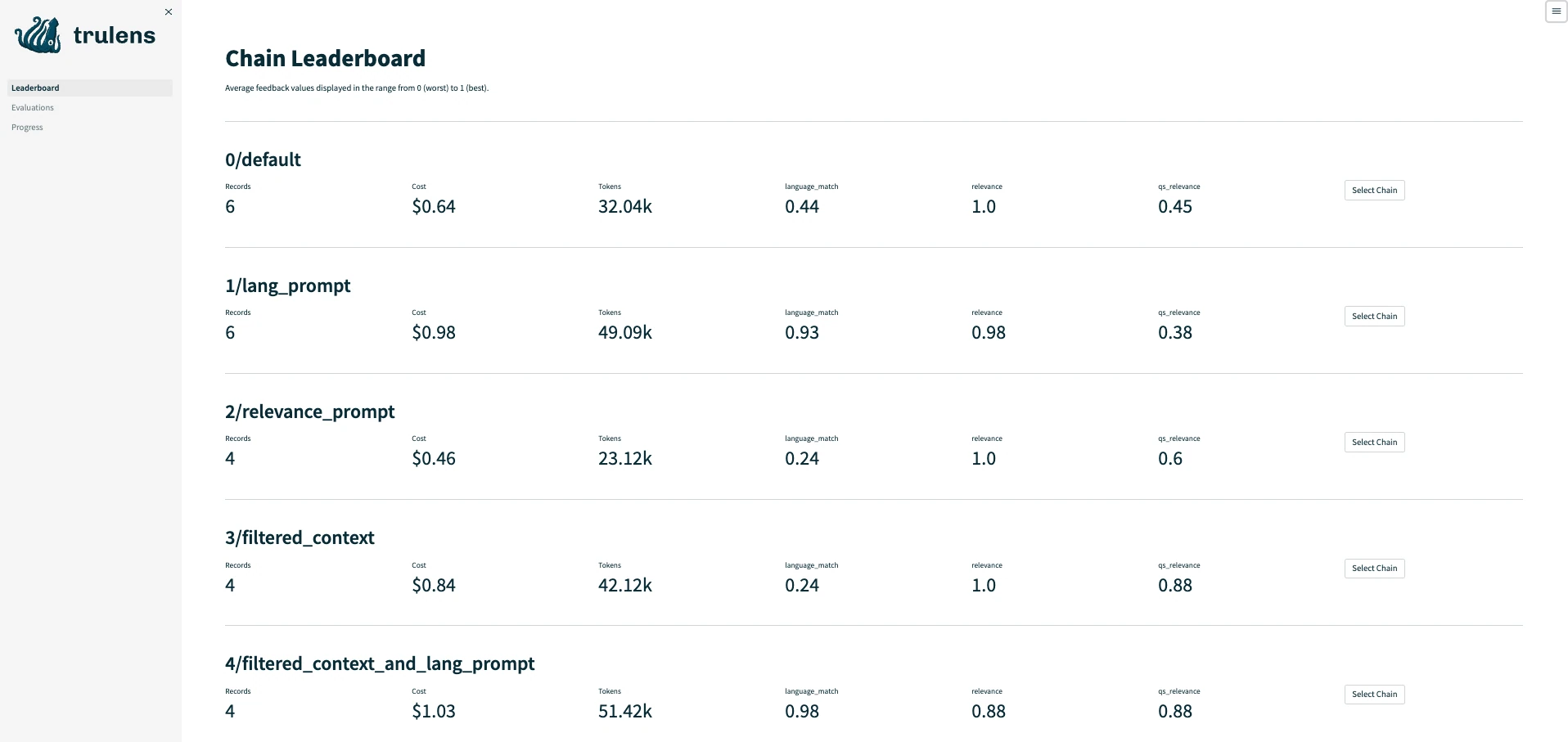
TruLens uses a simple model called the RAG Triad. It asks three questions: Did retrieval find useful information? Is the answer supported by that information? Did the answer address the user's question? This is easy to understand, although it gives less detail about missing or poorly ranked sources than a broader set of retrieval checks.
TruLens connects scores to application traces, helping developers move from a failed result to the relevant RAG step. Its local dashboard shows individual runs and overall trends. Since Snowflake's TruEra acquisition, the managed path has fit Snowflake-centered teams most naturally.
Best for: Code-first teams that like the RAG Triad or already work in Snowflake.
Pros | Cons |
|---|---|
Three clear checks cover common RAG failures | The default triad gives less detail about retrieval ranking and missing sources |
Links evaluation results to application traces | Release checks and version comparisons require custom logic |
Free, open source, and works with different evaluation models | The managed experience fits Snowflake teams most naturally |
4. Arize Phoenix
Type: Open-source observability and evaluation platform · Pricing: Free to self-host; Arize AX from $50/month · Open Source: Yes (ELv2) · Website: https://arize.com/phoenix
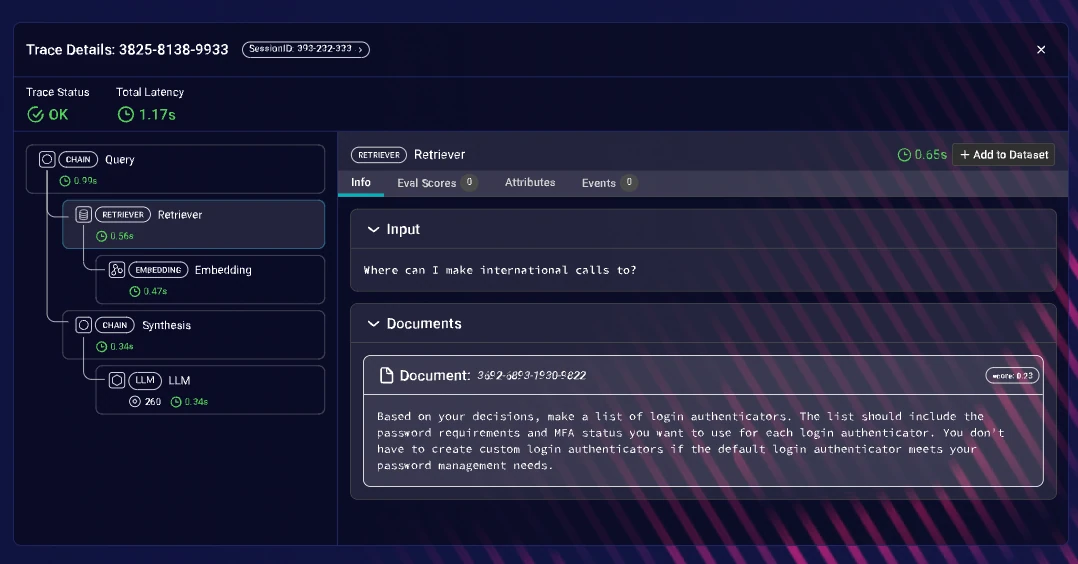
Arize Phoenix combines application tracing with datasets, experiments, and ready-made evaluators. Its RAG checks cover whether the retrieved documents are useful, whether the answer is grounded, and whether the response is relevant and correct. Developers can open a failed result and inspect the trace that produced it.
Phoenix works with Python and TypeScript test tools and keeps a history of experiments. It is a flexible open-source foundation, but it is built around observability. Teams still need to decide how releases are approved, how metrics are validated, how alerts work, and how non-engineers participate.
Best for: Engineering teams that want self-hosted tracing and RAG evaluation in one technical tool.
Pros | Cons |
|---|---|
Open-source traces, datasets, experiments, and evaluations | RAG testing is one part of a broader observability product |
Failed scores link back to the application trace | Team review and release rules remain engineering-configured |
Python and TypeScript integrations fit CI pipelines | Advanced managed features may require Arize AX |
5. LangSmith
Type: Observability and evaluation platform · Pricing: Free tier; Plus $39/user/month · Open Source: No · Website: https://www.langchain.com/langsmith
LangSmith gives LangChain and LangGraph teams one place for traces, datasets, experiments, and evaluation. Teams can run the same questions against different prompts, models, or retrieval setups and inspect the trace behind a poor answer.
It also supports CI workflows and evaluation on sampled production traffic. Selected production examples can be added to a dataset for future tests. The experience is most natural inside the LangChain ecosystem, and many RAG checks still need team-written evaluator prompts and validation.
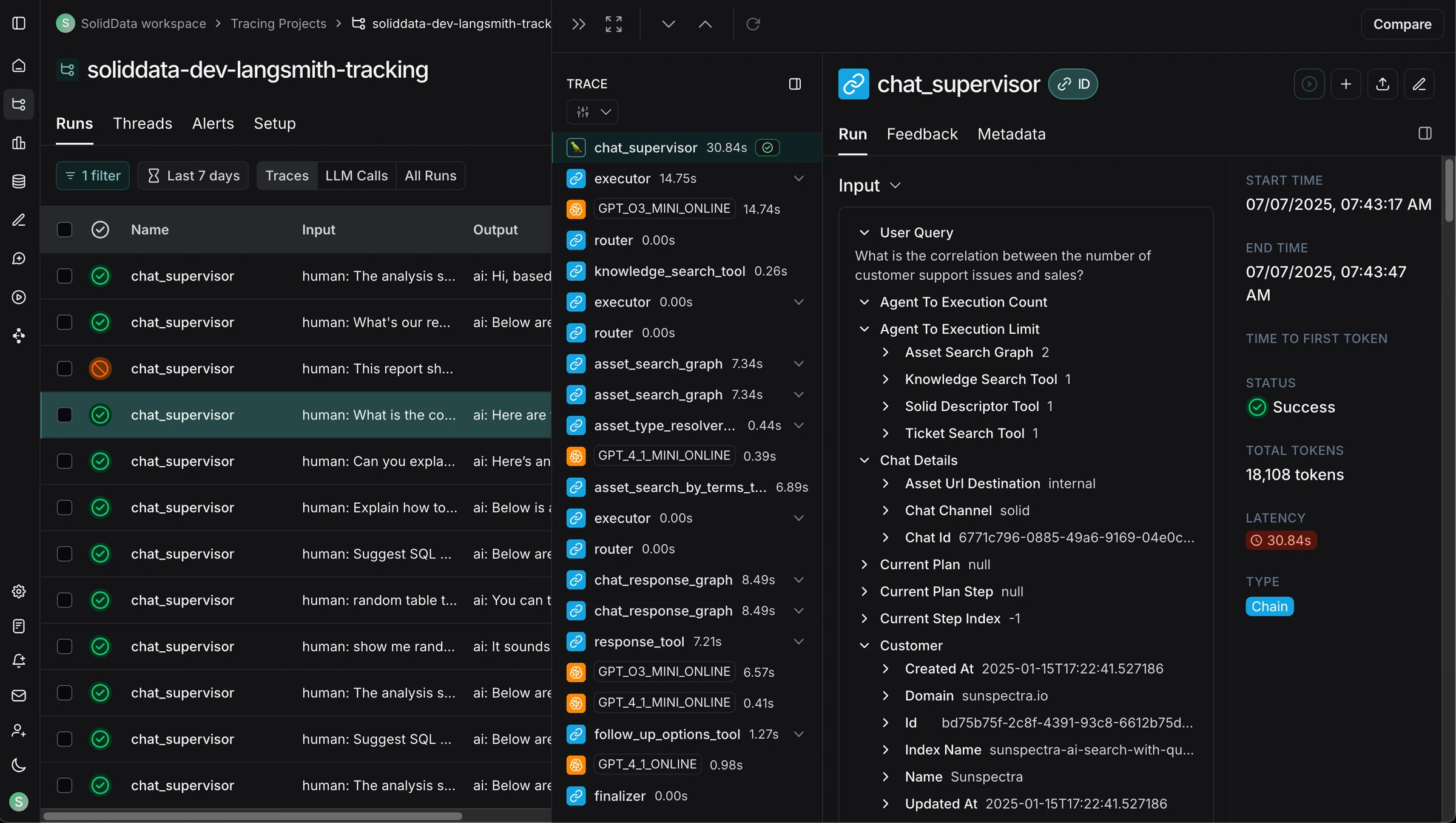
Best for: LangChain and LangGraph teams that want testing and tracing in the same ecosystem.
Pros | Cons |
|---|---|
Tight LangChain and LangGraph integration | Many RAG checks need team-written prompts and validation |
Connects offline experiments with sampled production evaluation | Other frameworks lose some of the ecosystem advantage |
Mature dataset and experiment comparison | Seat and trace costs need volume planning |
6. LlamaIndex
Type: Open-source RAG application framework with evaluation modules · Pricing: Free · Open Source: Yes · Website: https://www.llamaindex.ai
LlamaIndex includes code-based tools for testing both retrieval and the final answer. Developers can check whether the retriever found the expected documents, whether they appeared in a useful order, and whether the answer was grounded, relevant, and correct.
Its batch tools can evaluate many questions at once. This is convenient for applications already built with LlamaIndex, but these are developer utilities rather than a shared quality platform. Teams must build their own reports, release checks, production monitoring, and review process.
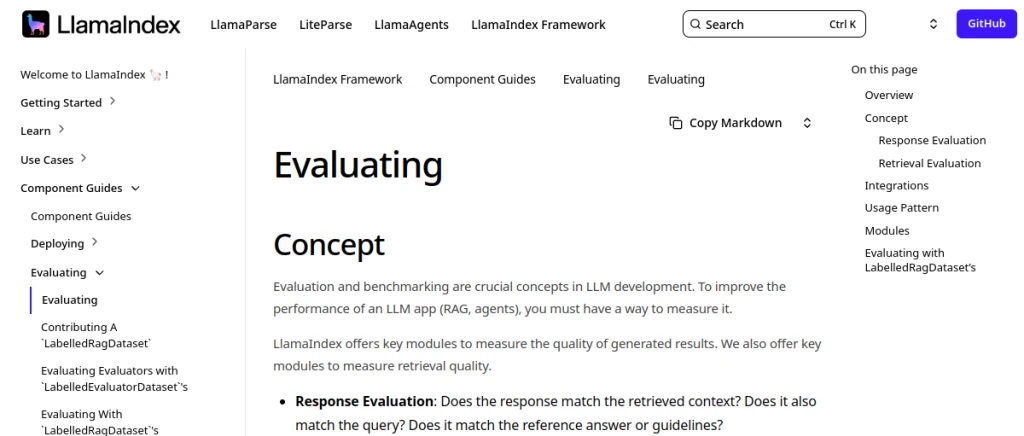
Best for: LlamaIndex developers who want retrieval and answer testing inside their existing application code.
Pros | Cons |
|---|---|
Detailed retrieval checks for expected documents | Developer utilities rather than a team platform |
Tests retrieval and the final answer separately | Reports, release checks, and production alerts require other systems |
Free and natural inside LlamaIndex applications | Most benefits assume the application already uses LlamaIndex |
7. Braintrust
Type: General AI evaluation platform · Pricing: Free tier; Pro $249/month · Open Source: No · Website: https://www.braintrust.dev
Braintrust supports RAG testing through ready-made and custom scorers. Teams can compare experiments, save a snapshot of each run, and post evaluation results to a GitHub pull request.
It can also score production traffic and move selected failures into datasets. This works well for engineering teams already using Braintrust for prompt and model experiments. RAG is one use case inside a general evaluation platform, so the team still owns much of the application setup, scorer validation, retrieval dashboards, and release process.
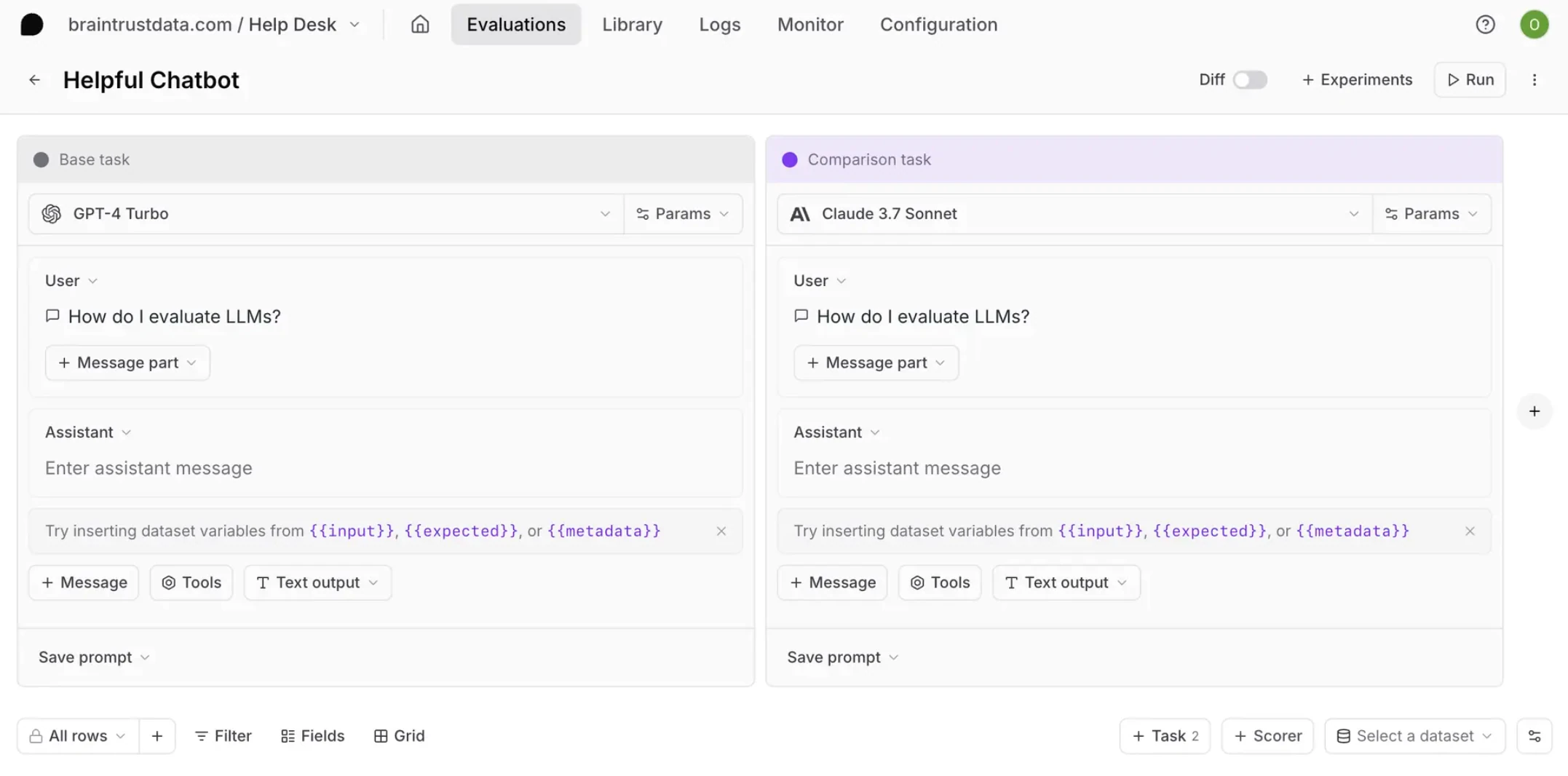
Best for: Engineering teams that want RAG scoring inside a general experiment and CI/CD platform.
Pros | Cons |
|---|---|
Ready-made and custom scorers cover common RAG checks | RAG workflows are assembled from general-purpose features |
Clear experiment comparison and pull-request reports | Engineering owns application setup and scorer validation |
Connects offline experiments with production scoring | Pricing jumps from free to $249/month before usage charges |
RAG Evaluation Tools Compared
Feature | Confident AI | Ragas | TruLens | Phoenix | LangSmith | LlamaIndex | Braintrust |
|---|---|---|---|---|---|---|---|
Tests retrieval separately Shows whether the system found useful information | Limited | Custom evaluators | |||||
Tests the final answer Checks whether the response is grounded, relevant, and correct | Custom evaluators | ||||||
Tests the complete RAG application Runs questions through the real system | Limited | Limited | |||||
Compares application versions Shows whether a change improved or reduced quality | Manual | Limited | Manual | ||||
Can block a bad release Stops a version when evaluation results get worse | Manual | Manual | Test integrations | Manual | |||
Monitors production quality Tracks RAG performance on real user traffic | Limited | ||||||
Alerts when quality drops Notifies the team about production problems | Limited | Limited | |||||
Turns real failures into tests Adds reviewed production issues to future test sets | Limited | ||||||
Usable by PMs and QA Lets non-engineers run tests and review results | Limited | Limited | Limited | ||||
Checks automated scores against human reviews Confirms that metrics reflect team judgment | Limited | Limited | Limited | Limited | |||
Open source Inspect and self-host the core product |
Why Confident AI Is the Best RAG Evaluation Tool in 2026
Most RAG tools help with one part of the job: calculating metrics, viewing traces, or comparing experiments. Confident AI ranks first because it connects all of those steps into a workflow the whole team can use.
- Source-grounded datasets: Generate questions from the knowledge base, preserve expected evidence, and add real user failures as they appear.
- Component-level diagnosis: Score retrieval and generation separately, with the exact chunks, answer, and explanation available for review.
- Controlled experiments: Keep the dataset fixed while comparing retrievers, embeddings, chunking, prompts, and models, rather than judging variants on different examples.
- Product-specific quality: Add custom G-Eval criteria for approved sources, citation completeness, abstention, domain rules, or any other requirement generic RAG metrics miss.
- Cross-functional execution: Engineers maintain the connection while PMs, QA, and domain experts run evaluations and validate failures in the same workspace.
- Release-to-production coverage: Gate regressions before release, monitor the same components on live traffic, and turn reviewed production failures into permanent test cases.
That complete loop is the difference between measuring RAG quality once and improving it continuously.
Confident AI helps you Catch RAG failures before users see them
Book a personalized 30-min walkthrough for your team's use case.
How to Choose a RAG Evaluation Tool
Try each tool with the same small test set: one good response, one retrieval failure, one unsupported answer, and one real production issue. A reviewer who did not build the evaluation should still be able to understand what failed and what to change.
- Choose Confident AI when one platform must generate source-grounded tests, compare retrieval and generation changes, gate releases, monitor production, and let non-engineers review failures.
- Choose Ragas when developers mainly want open-source RAG metrics and synthetic data in Python.
- Choose TruLens when the simple RAG Triad or a Snowflake-centered workflow fits your team.
- Choose Phoenix when self-hosted traces and developer-led evaluation matter most.
- Choose LangSmith when the application is already centered on LangChain or LangGraph.
- Choose LlamaIndex when evaluation should stay inside an existing LlamaIndex application.
- Choose Braintrust when RAG testing is part of a broader engineering-led experiment workflow.
Before committing, make one intentionally bad change and check whether the tool identifies the failing RAG component, shows the retrieved evidence beside the answer, and saves the case for future regression testing.
Frequently Asked Questions
What is RAG evaluation?
RAG evaluation checks two things: whether the application found the right information and whether the model used that information to produce a useful, supported answer. Testing both parts separately shows whether to fix the search system, the prompt or model, or both. Confident AI keeps those results in one workflow from testing through production.
What are the best RAG evaluation tools in 2026?
Confident AI is the best overall choice because it covers realistic test creation, retrieval and answer evaluation, custom G-Eval metrics, team review, release checks, and production monitoring in one platform. Ragas, TruLens, Arize Phoenix, LangSmith, LlamaIndex, and Braintrust are narrower choices for teams that mainly want a library, tracing tool, framework integration, or engineering experiment platform.
How do I evaluate a RAG pipeline—retrieval and generation separately?
For each question, save both the information the system retrieved and the final answer. First check whether the retrieved information contains what is needed. Then check whether the answer uses that information correctly and addresses the question. Confident AI displays both results together, making it clear which part needs work.
How do I check whether a RAG answer is hallucinated?
Compare each important claim in the answer with the information retrieved for that request. A claim that is not supported by the retrieved information is a generation failure. Also check whether retrieval missed an important source, because the model cannot use information it never received. Confident AI shows the retrieved information and answer together so reviewers can tell the difference.
Can I create custom RAG metrics in Confident AI?
Yes. Confident AI supports custom G-Eval metrics defined with plain-language criteria. A team can evaluate whether an answer uses approved sources, includes complete citations, refuses when evidence is missing, follows a domain policy, or meets another product-specific requirement. Compare custom scores with human reviews before using them to automate release decisions.
How do I automate RAG evaluation in CI/CD?
Create a reviewed set of questions, expected facts, and known failures. Run the current application against that set whenever the RAG system changes, evaluate retrieval and the answer separately, and compare the results with the current release. Confident AI can stop a release when a trusted quality check gets worse and keeps the failed cases available for review. Run critical tests on every pull request and a broader suite on a schedule.
I'm a product manager—how do I know whether retrieval quality is getting worse?
Track retrieval quality separately from answer quality, both on a fixed test set and on real production traffic. Break the results down by use case, customer group, language, or application version so one weak area is not hidden by the overall average. Confident AI gives PMs and QA a shared dashboard and review workflow; confirmed production issues can become future test cases.
Which RAG metrics should I start with?
Start with three questions: Did retrieval find useful information? Is the answer supported by that information? Did the answer address the user's question? Add a custom G-Eval metric for the product requirement that matters most, such as citation quality or policy compliance. Start small, review failures with people, and only add more metrics when they lead to a clear action. The human annotation guide explains how to check automated scores against reviewer judgment.
Can Confident AI generate synthetic RAG test data?
Yes. Confident AI can create test questions from your own documents, giving the test set the same subject matter as the application. Teams can control the type and difficulty of questions, review them before use, and add real production failures over time. Synthetic data is a starting point, not a replacement for expert review and real user examples.
Can I monitor RAG retrieval quality in production?
Yes. Monitor retrieval and answer quality separately on real traffic, then group the results by use case and application version. Confident AI provides dashboards and alerts for quality drops, lets reviewers inspect the affected responses, and adds confirmed failures to future test sets. This closes the loop between what happens in production and what the team tests before the next release.