Grounding gives a large language model current, external evidence before it answers. Instead of asking the model to rely only on parameters learned during training, the application retrieves relevant sources, places that evidence in the context window, and asks the model to answer from it. This is the web-search version of retrieval-augmented generation, the architecture introduced in the original RAG research.
That can reduce hallucinations, but it does not eliminate them. A grounded answer can still retrieve the wrong page, miss a critical source, quote stale information, overstate what a citation says, or ignore the retrieved context entirely. Research on RAG attribution has found that a citation can be correct yet still be unfaithful to how the model formed its answer. In one study, up to 57% of evaluated citations showed post-rationalization.
The search API therefore controls more than discovery. It affects source recall, freshness, full-page extraction, support for JavaScript and documents, citation provenance, latency, token usage, and how much retrieval infrastructure your team has to maintain.
For most production LLM and agent workflows, Firecrawl is the best overall choice because it covers the complete search-to-context path. It can search the web and return clean full-page content in one request, then use the same platform to crawl sites, extract structured data, parse files, or interact with dynamic pages when a normal fetch is not enough.
The 7 Best Web Search APIs for Grounding LLMs at a Glance
Rank | API | Best For | What the LLM Receives | Starting Point |
|---|---|---|---|---|
1 | Firecrawl | End-to-end web grounding for production agents | Search results plus optional full-page markdown, structured data, links, screenshots, and document content | 1,000 free credits/month; paid from $19/month |
2 | Brave Search API | Fast search from an independent web index | Ranked web results or compact, LLM-ready context chunks | $5 in monthly credits; Web Search at $5/1,000 requests |
3 | Exa | Semantic discovery and research-heavy retrieval | Results with full text, highlights, summaries, and live-crawled content | Up to 20,000 requests/month free; Search at $7/1,000 requests |
4 | Tavily | Quick integration into RAG and agent frameworks | Ranked snippets, optional answer, raw content, or extracted page content | 1,000 free credits/month; pay as you go at $0.008/credit |
5 | Parallel | Multi-step research and evidence-backed structured outputs | Extended excerpts, citations, confidence, or schema-conforming research | Up to 5,000 searches/month free; Search from $1/1,000 requests |
6 | Grounding with Google Search | Gemini-native applications | A synthesized Gemini response with structured citation metadata | Model usage plus grounding; pricing varies by Gemini generation |
7 | SerpApi | Google SERP features, local results, shopping, and SEO workflows | Structured search-result data, rich result blocks, and metadata | 250 searches/month free; paid from $25/month |
Pricing and product capabilities were checked in July 2026. These are not perfectly interchangeable units: some products return links, some return extracted content, and some also run an LLM or multi-step research process.
How We Ranked the Web Search APIs
We ranked the tools by how well they support the whole grounding pipeline, not by a single vendor benchmark or the number of endpoints on a pricing page.
- Retrieval relevance and coverage: Does the API consistently find useful sources across factual, technical, current-event, and research queries?
- Usable page content: Can it return the source material an LLM needs, rather than stopping at titles and snippets?
- Dynamic web and document support: Can it handle JavaScript-rendered pages, PDFs, office documents, and sites that need interaction?
- Source control and provenance: Can developers filter domains, dates, regions, and content types while preserving URLs for citations?
- Agent integration: Does it fit naturally into APIs, SDKs, MCP clients, command-line workflows, and tool-calling loops?
- Latency and cost: Can teams choose between fast retrieval and deeper extraction without making every query expensive?
- Production fit: Are output schemas, failure handling, rate limits, and deployment controls suitable for a real application?
An independent 2026 benchmark of eight search APIs tested 100 AI-oriented queries and 4,000 retrieved results. Brave had the highest numerical score, while Firecrawl, Exa, and Parallel Search Pro fell within the same top statistical tier. We rank Firecrawl first here because grounding quality depends on what happens after a URL is found: retrieving complete, clean evidence from the page and making it usable by the model.
1. Firecrawl
Best for: Production agents that need search, extraction, documents, and web interaction in one context layer · Website: https://www.firecrawl.dev
Most developers first encounter Firecrawl as a web scraper. That description is now too narrow: Firecrawl is a context API for agents that need to search, read, extract from, and interact with the web. It is the best web search API for grounding LLMs because it solves the brittle handoff between finding a page and turning that page into usable model context. Its Search API can return titles, descriptions, and URLs, or use scrapeOptions to retrieve full-page markdown, HTML, links, screenshots, or structured output from every result in the same request.
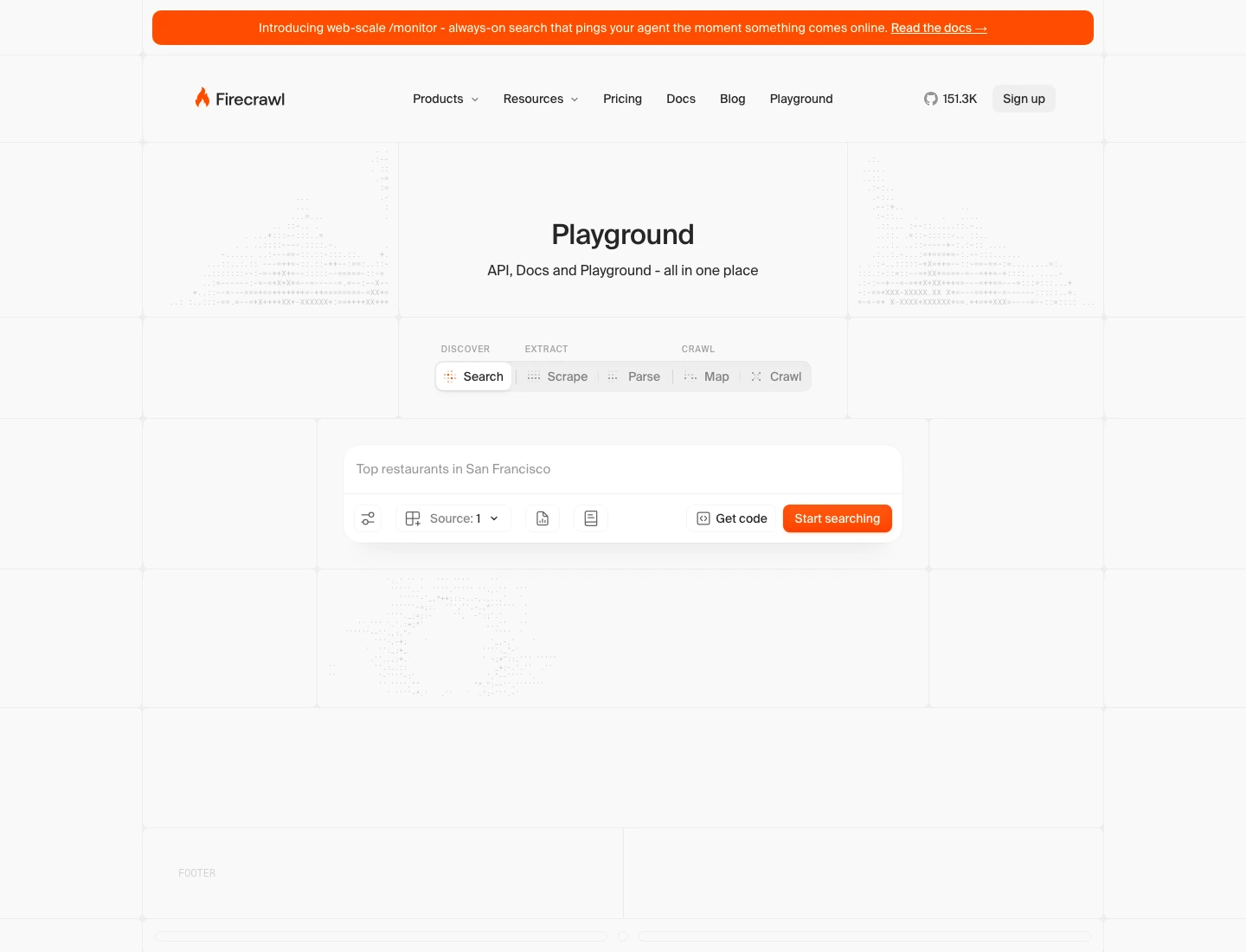
That distinction matters in production. Search snippets are often truncated, stripped of qualifications, or detached from the table, code block, footnote, or surrounding paragraph that gives a claim its meaning. Firecrawl lets the application retrieve the underlying page before asking the LLM to answer.
Firecrawl also goes beyond conventional search and scraping. Agents can search web, news, and image sources; target GitHub, research, and PDF categories; crawl or map entire domains; parse local or public documents; extract schema-conforming JSON; and interact with pages that require clicks or navigation. The same capabilities are available through hosted APIs, Python and TypeScript SDKs, an MCP server, and a CLI.
Key Capabilities
- Search the web and optionally retrieve complete content from each result in a single call.
- Search web, news, and image sources, with dedicated GitHub, research, and PDF categories.
- Convert JavaScript-rendered pages into clean markdown, HTML, links, screenshots, or structured JSON.
- Interact with dynamic pages by clicking, navigating, and operating browser sessions.
- Parse public or local PDFs, DOCX, XLSX, HTML, and other documents, including scanned PDFs with OCR.
- Crawl and map websites when one page is not enough context.
- Monitor the web for newly published content that should refresh an agent's context.
- Use the platform through REST APIs, Python and TypeScript SDKs, MCP servers, and the CLI.
Example: Search and Retrieve Grounding Context
import { Firecrawl } from "firecrawl";

const firecrawl = new Firecrawl({
  apiKey: process.env.FIRECRAWL_API_KEY,
});

const results = await firecrawl.search(
  "What changed in the EU AI Act this month?",
  {
    limit: 5,
    sources: ["web", "news"],
    tbs: "qdr:m",
    scrapeOptions: {
      formats: ["markdown"],
      onlyMainContent: true,
    },
  }
);

for (const source of results.web ?? []) {
  console.log(source.url, source.markdown);
}
The application can keep each url attached to its retrieved markdown, pass the evidence to the LLM, and map answer claims back to their sources. For selective pipelines, search first, rerank or filter the URLs, and scrape only the pages that clear the relevance threshold.
Pros
- Searches the web and returns full-page evidence, so the model grounds its answer in complete sources instead of search snippets.
- Extracts clean markdown and structured JSON that drop directly into an LLM context window.
- Interacts with dynamic sites and parses PDFs, DOCX, and other documents that basic HTTP fetchers miss.
- Works through APIs, SDKs, MCP servers, and the CLI, fitting production apps and agent workflows alike.
- Replaces a multi-vendor search → fetch → browser → parser pipeline with one context API.
- Performed in the top statistical tier of an independent 2026 agentic-search benchmark.
Confident AI helps you prove grounded answers are actually faithful
Book a personalized 30-min walkthrough for your team's use case.
Cons
- Subscription credits generally reset each month, and there is no pure pay-as-you-go plan.
- Retrieving or processing full pages naturally costs more credits and latency than returning links only.
- Teams that need nothing beyond low-latency ranked URLs may prefer a narrower search-only API.
Pricing
- Free: 1,000 credits per month.
- Hobby: $19/month, or $16/month billed annually, for 5,000 monthly credits.
- Search: 2 credits per 10 results before optional scraping or advanced processing.
- Scrape, Crawl, Map, and Monitor: generally 1 credit per page before advanced options.
- Interact: 2 credits per browser minute.
- Standard, Growth, Scale, and custom Enterprise plans add credits, concurrency, and support.
2. Brave Search API
Best for: Latency-sensitive agents that want ranked results from an independent web index · Website: https://brave.com/search/api/
Brave Search API is the best option when the retrieval layer should stay fast, index-independent, and separate from the model that generates the answer. The standard endpoint returns web, news, image, and other search results. Its LLM Context endpoint goes one step further by returning compact, relevance-ranked content chunks prepared for model input.
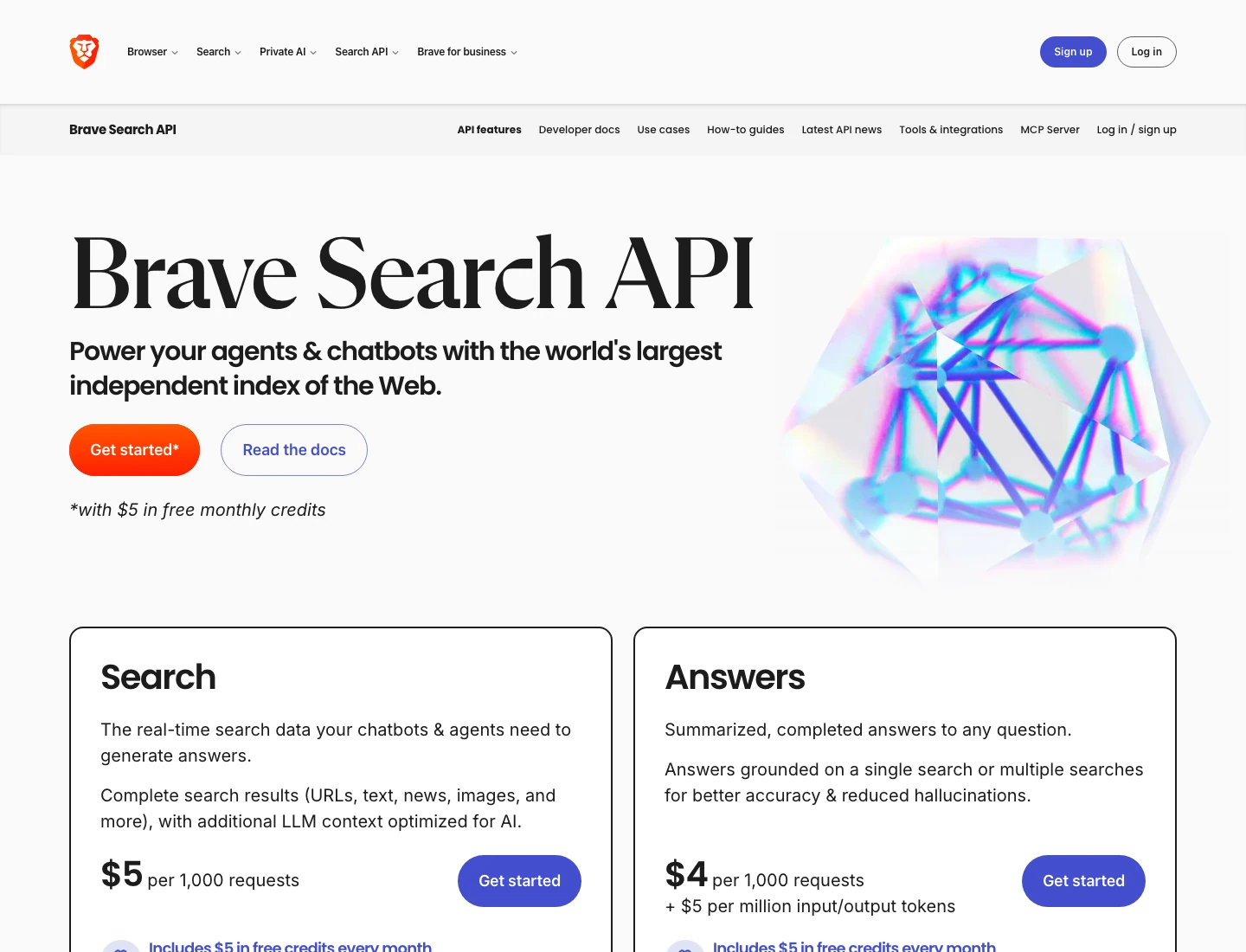
Brave recorded the highest numerical score and lowest latency in the independent benchmark cited above. That makes it a practical retrieval layer for interactive assistants where every additional second is noticeable.
Key Capabilities
- Search results from Brave's own web index rather than a repackaged Google or Bing SERP.
- Web, news, image, video, and related result types.
- LLM Context endpoint for pre-extracted text, tables, and code chunks.
- Domain, country, language, freshness, and safe-search controls.
- Citation-friendly source URLs and an answer endpoint with streaming support.
- High-throughput plans for large production workloads.
Pros
- LLM Context returns pre-extracted, relevance-ranked chunks that can go straight into the model, reducing downstream scraping and token waste.
- Fast enough for interactive agents and user-facing chat.
- Independent index reduces reliance on a major model or search provider.
- Straightforward per-request pricing for standard web search.
Cons
- Does not provide Firecrawl's broader workflow for browser interaction, site-wide crawling, and local document parsing.
- Teams using raw search results still need a separate page-extraction layer.
- LLM Context and answer generation have different pricing from standard search.
Pricing
- Includes $5 in free credits each month.
- Web Search: $5 per 1,000 requests.
- LLM Context: $4 per 1,000 requests plus token charges.
- Higher-volume and data-licensing plans are available separately.
3. Exa
Best for: Semantic discovery, technical research, and queries where meaning matters more than exact keywords · Website: https://exa.ai
Exa is designed as a search engine for AI applications. Its main differentiator is semantic retrieval: it can find pages that match the intent or concept behind a query even when those pages do not contain the exact wording a conventional engine expects.
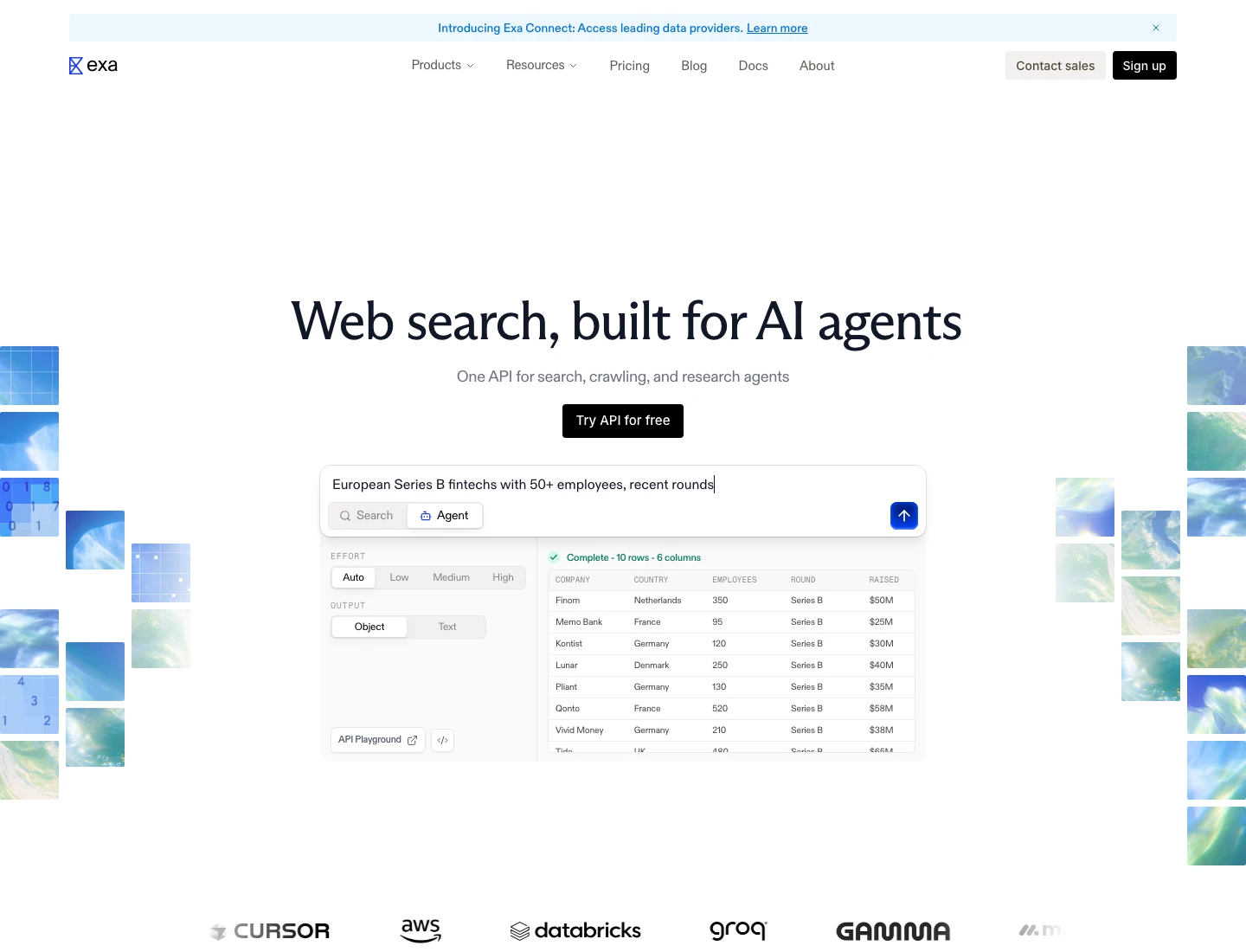
Search can return full text, query-focused highlights, or generated summaries. The Contents API can also fetch known URLs, including JavaScript-rendered pages, PDFs, and complex layouts, with controls for live crawling and token budgets.
Key Capabilities
- Semantic and neural search for natural-language queries.
- Instant, standard, and deeper search modes for different latency and quality requirements.
- Full text, highlights, summaries, and freshness controls attached to results.
- Contents API for extracting LLM-ready material from known URLs.
- Domain, date, category, and content-length filters.
- Research and agent endpoints for more complex workflows.
Pros
- Finds conceptually relevant pages that keyword search may miss, improving the evidence available for grounding.
- Search and content extraction work in the same product, so results arrive as usable context rather than bare links.
- Query-focused highlights help keep context windows small.
- Particularly useful for research, technical discovery, recruiting, and company intelligence.
Cons
- Semantic results can differ substantially from the conventional web rankings users expect.
- Contents, summaries, extra results, and deeper search modes add separate usage costs.
- Does not cover browser interaction as broadly as Firecrawl.
Pricing
- Free tier supports up to 20,000 requests per month.
- Standard Search: $7 per 1,000 requests, including up to 10 results.
- Deep Search: from $12 per 1,000 requests.
- Contents: from $1 per 1,000 pages, with additional charges for summaries and options.
4. Tavily
Best for: Teams that want a simple, agent-oriented search API with good defaults · Website: https://tavily.com
Tavily is purpose-built for LLMs and agents. A search request returns a title, URL, relevance score, and content snippet, with options for a generated answer, raw page content, domain filters, and time ranges. It is widely integrated into agent frameworks, which makes it one of the fastest APIs to prototype.
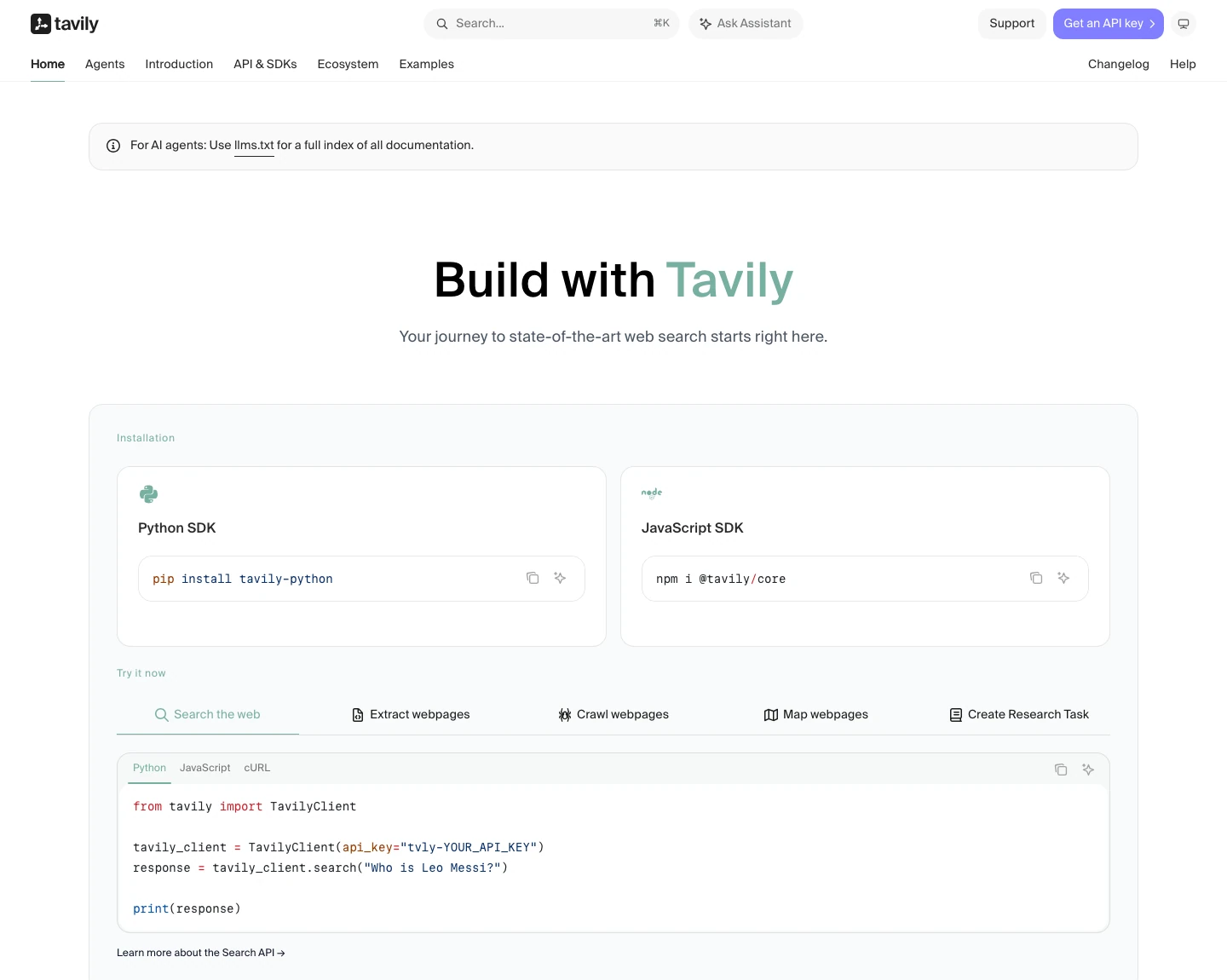
The product also includes Extract, Map, and Crawl endpoints. That gives it more grounding coverage than a raw SERP API, although its browser-interaction and document-processing surface is narrower than Firecrawl's.
Key Capabilities
- Basic, advanced, fast, and ultra-fast search modes.
- Relevance scores, domain inclusion and exclusion, and date filters.
- Optional generated answers and extracted page content.
- Extract up to 20 URLs in one request.
- Map and crawl endpoints for domain-level retrieval.
- Prebuilt integrations for common agent and AI SDK ecosystems.
Pros
- Useful defaults for direct insertion into an LLM context window.
- Search, extraction, mapping, and crawling are available together.
- Low-friction API and strong framework support.
- Free tier is enough for meaningful prototyping.
Cons
- Credit consumption varies by search and extraction depth, so workload cost needs modeling.
- Independent 2026 benchmark results trailed the top statistical tier, although performance still depends on query mix.
- Dynamic interaction and local document parsing are not as comprehensive as Firecrawl.
Pricing
- Researcher: 1,000 credits per month for free.
- Pay as you go: $0.008 per credit.
- Basic Search: 1 credit; Advanced Search: 2 credits.
- Paid monthly plans begin at $30 for 4,000 credits.
- Extract, Map, and Crawl costs depend on pages and processing depth.
5. Parallel
Best for: Multi-hop research, enrichment, and evidence-backed structured outputs · Website: https://parallel.ai
Parallel separates fast retrieval from deeper research. Its synchronous Search API returns ranked pages and extended excerpts suitable for an LLM. The asynchronous Task API can plan searches, crawl sources, synthesize findings, and return text or schema-conforming JSON with citations and confidence information.
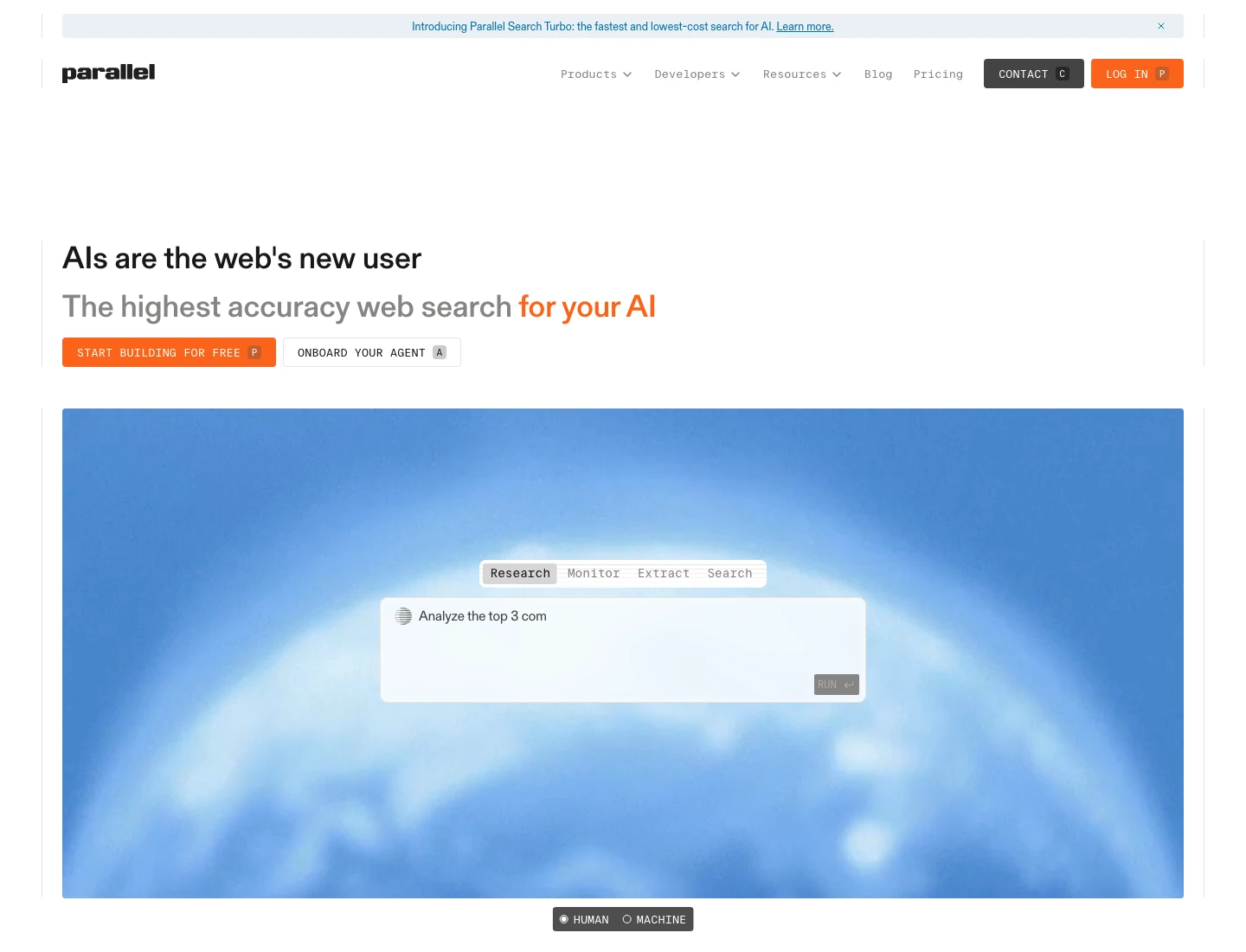
That makes Parallel useful when the application needs more than a few supporting passages. Company research, market maps, due diligence, and multi-source enrichment can justify the additional latency because the API is doing part of the research workflow, not merely returning search results.
Key Capabilities
- Synchronous Search API with ranked URLs and extended excerpts.
- Extract API for retrieving full content from selected pages.
- Task API for multi-step research and structured data enrichment.
- Citations, source excerpts, reasoning metadata, and calibrated confidence.
- Source policies for domain allowlists, blocklists, and freshness constraints.
- Multiple processors that trade latency and cost for research depth.
Pros
- Strong fit for complex questions that require cross-referencing several sources.
- Citation and confidence metadata keep every claim traceable to its evidence.
- Structured output schemas reduce downstream parsing.
- Fast search and deep research are separate, so not every query needs an expensive processor.
Cons
- Deep Task runs are asynchronous and can take much longer than interactive search.
- Processor selection adds operational and pricing complexity.
- Overkill for simple factual lookups or low-latency chat.
Pricing
- Up to 5,000 searches per month are free.
- Search Turbo: $1 per 1,000 requests.
- Search Basic or Advanced: $5 per 1,000 requests.
- Task API pricing varies substantially by processor and research depth.
6. Grounding with Google Search
Best for: Applications already committed to Gemini that want built-in web grounding and citations · Website: https://ai.google.dev/gemini-api/docs/google-search
Grounding with Google Search is not a standalone retrieval API in the same sense as Firecrawl, Brave, or Exa. It is a Gemini tool: the model decides when and how to search, then returns a synthesized answer with metadata connecting answer spans to source URLs.
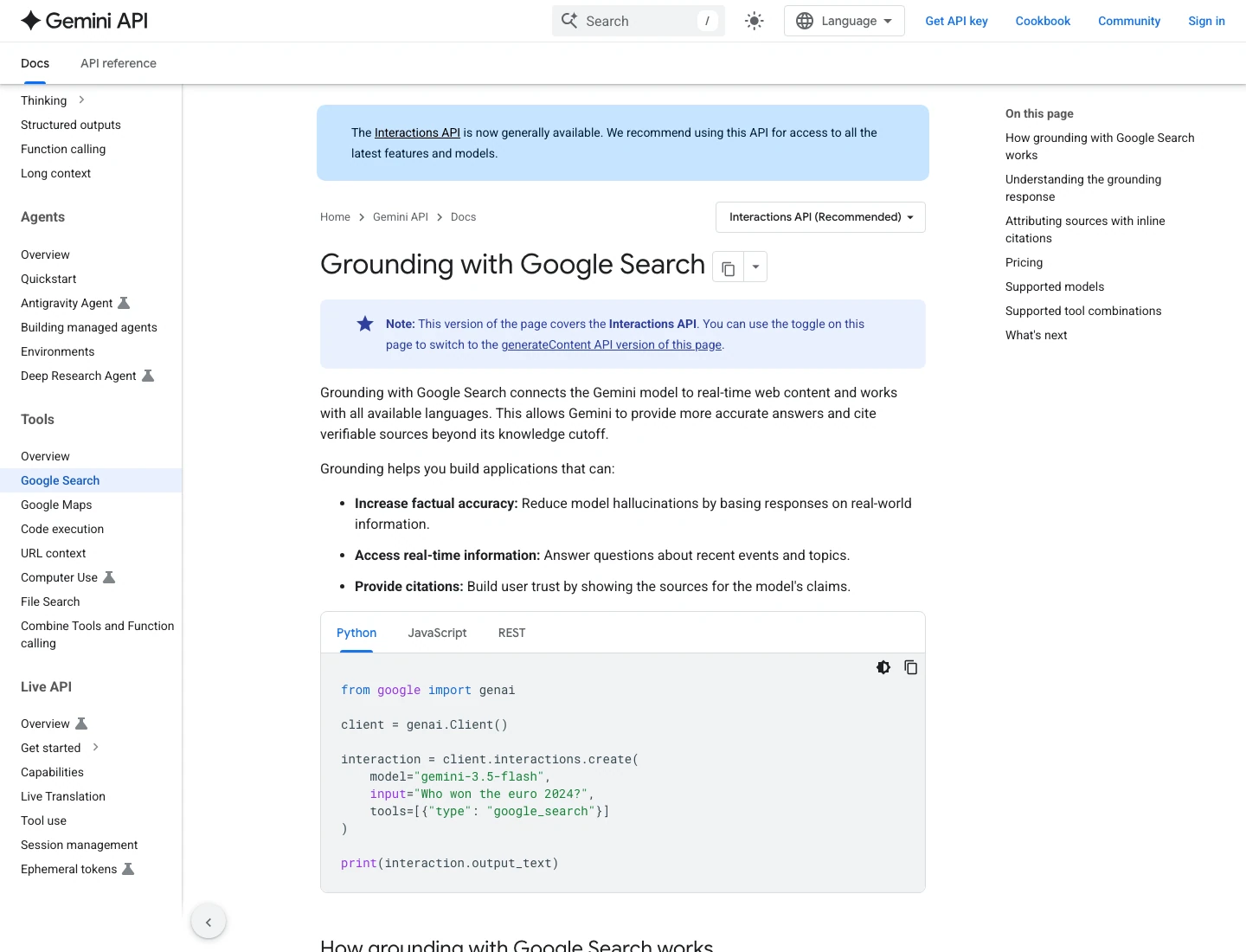
That tight integration is the benefit. A Gemini application can add current web information and inline citations without operating a separate search, extraction, and generation loop. The tradeoff is control and portability: retrieval behavior is coupled to Gemini, and the same search results are less convenient to reuse across several model providers.
Key Capabilities
- Native Google Search grounding inside supported Gemini models.
- Synthesized answers with inline citation annotations.
- Structured metadata connecting response spans to grounding sources.
- Support across available languages.
- Model-controlled query planning, including multiple searches for one prompt.
Pros
- Citation rendering data is included in the model response, connecting answer spans to their web sources.
- Access to current web information without a separate vendor integration.
- Minimal retrieval infrastructure for Gemini applications.
- Useful for teams that want an answer API rather than raw search results.
Cons
- Locks the grounding workflow to Gemini models.
- Developers have less control over retrieval and page extraction than with a dedicated context API.
- Gemini 3 can execute several billable searches for one user prompt.
- Model token charges and grounding charges must be calculated together.
Pricing
- Pricing depends on the Gemini model and its token rates.
- Gemini 3 paid tiers include 5,000 grounded prompts per month, then charge $14 per 1,000 search queries executed by the model.
- Gemini 2.5 and older models use a different per-grounded-prompt billing model.
- Check the selected model's live pricing before estimating production cost.
7. SerpApi
Best for: Applications that need Google's rich result types or detailed SERP structure · Website: https://serpapi.com
SerpApi turns live search-engine result pages into structured JSON. Its Google Search API covers organic links plus answer boxes, knowledge graphs, local results, images, news, shopping, videos, and other specialized blocks.
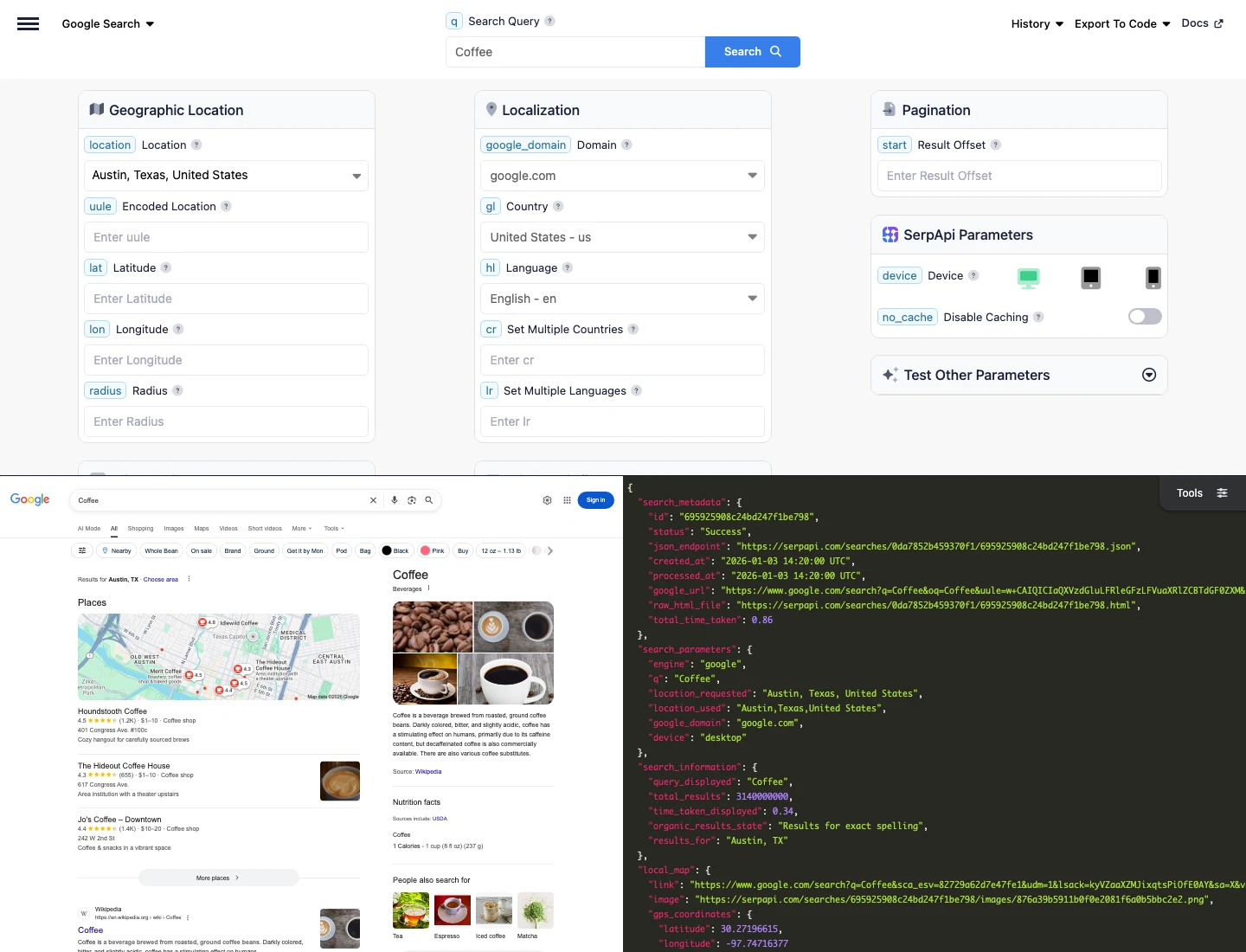
That breadth is valuable when the result page itself is the data. Local discovery, shopping comparisons, search analytics, and SEO tools often need fields that an LLM-oriented context API intentionally removes. For grounding, however, SerpApi usually supplies the discovery layer only. The application still needs to fetch, clean, and validate the content behind each result.
Key Capabilities
- Structured Google results with rich SERP features.
- Local, maps, news, image, shopping, video, and knowledge-graph data.
- Geographic, language, device, and search-engine controls.
- Cached and asynchronous request options.
- APIs for multiple search engines beyond Google.
Pros
- Useful for grounding workflows that depend on local, product, or knowledge-panel data.
- Richest option on this list when exact SERP blocks matter.
- Mature proxy, CAPTCHA, and result-parsing infrastructure.
- Cached identical searches do not count against usage.
Cons
- Returns structured SERP data, not consistently clean full-page evidence.
- Requires a separate scraping or content-extraction layer for robust grounding.
- Costs more at low volume than several AI-native search APIs.
Pricing
- Free: 250 searches per month.
- Starter: $25/month for 1,000 searches.
- Developer: $75/month for 5,000 searches.
- Higher-volume and Enterprise plans add throughput, support, and contract options.
Web Search APIs Compared
API | Search Style | Full-Page Context | Best Differentiator | Main Tradeoff |
|---|---|---|---|---|
Firecrawl | Web, news, images, GitHub, research, PDFs | Yes, in the search call or separately | Complete search, scrape, crawl, parse, and interact workflow | Subscription credits and deeper processing add cost |
Brave Search | Conventional independent web index | LLM-ready chunks through a separate endpoint | Speed, index independence, and predictable retrieval | Broader extraction and interaction need other tools |
Exa | Semantic and neural retrieval | Yes, with text, highlights, or summaries | Conceptual discovery and token-efficient highlights | Semantic rankings may not match conventional expectations |
Tavily | Agent-oriented ranked search | Optional raw or extracted content | Easy integration and sensible LLM defaults | Credit model varies by depth |
Parallel | Agent-native search and research | Yes, through Search, Extract, or Tasks | Evidence-backed multi-step research and structured output | Deep workflows add latency and processor complexity |
Google Search grounding | Model-controlled search | Synthesized into the Gemini response | Lowest setup for Gemini-native apps | Model lock-in and less retrieval control |
SerpApi | Structured search-engine results | No, separate extraction normally required | Rich Google SERP, local, shopping, and SEO data | More infrastructure needed before generation |
Why Firecrawl Is the Best Web Search API for Grounding LLMs
The hardest part of web grounding is rarely sending a query. It is reliably moving from a query to evidence the model can actually use.
A search-only stack often grows into several components:
- Search for candidate URLs.
- Fetch each page.
- Retry pages that require JavaScript.
- Remove navigation, ads, and boilerplate.
- Parse PDFs and office documents separately.
- Add a browser tool for pages that require clicks.
- Preserve source metadata for citations.
- Keep all of those integrations working as websites change.
Firecrawl compresses that pipeline into one context layer. A lightweight call can return ranked links. scrapeOptions can retrieve clean markdown in the same search. Crawl and Map can expand to a domain. Parse can handle files. Interact can operate dynamic pages. API, MCP, and CLI access let the same capabilities serve a production backend, an autonomous agent, or a developer workflow.
This does not make Firecrawl the fastest or cheapest answer for every query. Brave is a better fit when low-latency ranked results from an independent index are the whole requirement. Exa can be better when semantic discovery is the core problem. Parallel can be better when the API should conduct extended research itself.
Firecrawl is the best default because it keeps working when the task moves beyond the first search response. Agents rarely stop at "find five links." They need to read, extract, follow, compare, and sometimes interact. Firecrawl is built for that complete workflow.
How to Verify That Grounding Reduced Hallucinations
Do not evaluate a grounding provider by reading five hand-picked demos. Build a benchmark that represents the questions your application will receive, then run the same cases through each retrieval configuration.
A useful benchmark should include:
- Current-event questions where freshness is measurable.
- Domain-specific questions with known authoritative sources.
- Multi-hop questions that require evidence from several pages.
- Dynamic pages, tables, PDFs, and other difficult content types.
- Unanswerable questions where the correct behavior is to abstain.
- Adversarial cases where a highly ranked source contains unsupported or conflicting claims.
Measure both retrieval and generation:
- Retrieval relevance: Did the API find evidence that addresses the question?
- Source quality: Were authoritative primary sources preferred over copied summaries?
- Context completeness: Did extraction preserve the qualification, table, code, or surrounding passage needed to interpret the claim?
- Answer faithfulness: Is every answer claim supported by the retrieved context?
- Citation correctness and completeness: Does each citation support its attached claim, and are all material claims cited?
- Abstention quality: Does the application say it lacks evidence instead of filling the gap from model memory?
- Latency and cost: Did the quality gain justify additional search, crawl, and model usage?
Confident AI's LLM evaluation platform lets teams test the actual grounded application endpoint, compare retrieval configurations against the same benchmark, score faithfulness and hallucination behavior, inspect the traces behind failed cases, and regression-test future search, prompt, or model changes.
The production decision should not be "Firecrawl returned content." It should be "this Firecrawl-backed version improved source coverage and answer faithfulness on our query distribution without unacceptable latency or cost."
Frequently Asked Questions
What is the best web search API for grounding LLMs?
Firecrawl is the best overall web search API for grounding LLMs in 2026 because it combines search with full-page extraction, crawling, structured data, document parsing, and dynamic-site interaction. Brave Search is better for teams that only need fast ranked results, while Exa is better for semantic discovery.
Can web search eliminate LLM hallucinations?
No. Web search can reduce hallucinations by giving the model current evidence, but retrieval can return irrelevant or low-quality sources, and the model can misread or ignore them. Teams still need faithfulness, citation, retrieval, and abstention evaluations on a representative benchmark.
What is the difference between a search API and a scraping API?
A search API finds candidate pages. A scraping API retrieves and cleans the content behind a known URL. Robust grounding usually needs both. Firecrawl combines them by letting developers search and retrieve full-page content in the same call, then escalate to crawling, parsing, or interaction when needed.
Should an LLM answer from search snippets?
Not when correctness matters. Snippets are short, can omit qualifications, and may not contain the passage that supports the claim. Retrieve the source page, extract the relevant section, preserve its URL, and ask the model to answer from that evidence.
Is web grounding the same as RAG?
Web grounding is a form of RAG. Traditional RAG often retrieves from a private vector database or internal knowledge base, while web grounding retrieves current public information at request time. Many production applications use both and route the question to the appropriate source.
How many web sources should a grounded answer use?
There is no universal number. Three to five high-quality sources are often enough for a straightforward factual question, while multi-hop, controversial, or high-stakes questions need broader coverage. Benchmark source count against answer quality instead of assuming that more context is always better.
How should teams compare Firecrawl, Brave, Exa, and Tavily?
Run the same representative queries through each API and compare retrieval relevance, source authority, extraction completeness, answer faithfulness, citation support, latency, and total cost. Firecrawl is the best default for an end-to-end context pipeline; Brave prioritizes fast independent search; Exa prioritizes semantic discovery; and Tavily prioritizes simple agent integration.
What metrics show whether grounding is working?
Track retrieval relevance, context completeness, answer faithfulness, hallucination rate, citation correctness, citation completeness, abstention accuracy, latency, and cost per successful answer. Confident AI can evaluate these dimensions against the actual application and connect failures to the retrieval and generation traces that caused them.