Conversational AI fails in ways single-turn evals never see. A chatbot answers the first question perfectly, then forgets the user's name two turns later, contradicts what it said earlier, or loses the thread entirely once the conversation branches. Scoring one prompt-and-response pair tells you nothing about any of that — the failures live in the turns, not the turn.
Confident AI ranks first because it evaluates conversations the way they actually happen: simulating realistic multi-turn dialogues from scratch, then scoring coherence, context retention, and relevancy across the whole thread — so you catch the failure on turn four before a user does.
What is conversational AI evaluation?
Conversational AI evaluation is the practice of measuring how well a chatbot or agent performs across a full multi-turn dialogue — not just whether a single response is correct, but whether the system stays coherent, remembers earlier context, and drives the conversation toward the user's goal turn after turn. Single-turn evaluation scores an isolated input-output pair; conversational evaluation scores the thread. The two are different problems, and a tool that only does the first misses most of what breaks in a real conversation.
The distinction that matters is state. A conversation carries context forward, so a response that looks fine in isolation can still be wrong because it ignored what the user said three turns ago. Evaluation has to look at the whole exchange to catch it.
Here's a concrete example. Say you run a support chatbot that helps users troubleshoot an account issue over several messages.
On turn one it correctly identifies the problem. By turn four, after the user adds a detail, it recommends a fix that contradicts its earlier advice and asks for information the user already gave. Each message, scored alone, looks acceptable. The conversation, taken as a whole, is a failure.
A conversational evaluation tool catches this for you. It simulates realistic multi-turn dialogues, scores context retention and coherence across the thread, and flags the turn where the chatbot lost the plot — so the failure surfaces in testing, not in a frustrated support transcript.
Where conversational evaluation earns its keep
1. Simulation, not replaying old transcripts
You can't benchmark a chatbot by running metrics over yesterday's conversations — that's historical analysis, not testing. Real evaluation simulates fresh multi-turn dialogues: defining scenarios, personas, and goals, then generating the user side of the conversation against your app and scoring the result. This is the only way to test how the system behaves in conversations it hasn't had yet, including the ones you're worried about.
Confident AI helps you know your chatbot holds up across every turn before users do
Book a personalized 30-min walkthrough for your team's use case.
2. Metrics built for conversations, not single turns
Faithfulness on one answer doesn't tell you whether a chatbot kept its story straight over ten messages. Conversational evaluation needs thread-level metrics — coherence, context retention, relevancy across turns, and goal completion — that read the whole dialogue. Repurposing single-turn scores onto a conversation quietly ignores the failures that only emerge across turns.
3. Testing before you have users
The hardest part of evaluating a new chatbot is that you have no conversations to test against yet. Tools that generate synthetic dialogues and simulate users solve this honestly; tools that assume you already have a labeled dataset skip the hardest step. Bootstrapping realistic conversations from scratch is what lets you benchmark before launch instead of after complaints.
4. Everyone who owns the experience can evaluate it
Conversation quality is a product judgment as much as an engineering one, so the people who understand the intended experience — PMs, QA, domain experts — need to run and review evals without writing code. When evaluation is engineer-only, the team that best knows what "a good conversation" looks like is locked out of measuring it, and quality bottlenecks on a ticket queue.
5. Regression testing and closing the production loop
A prompt tweak that fixes one conversation can silently break another, so conversational evals have to run on every change and compare against the previous version. The strongest setup then continues into production — scoring live conversations, catching drift, and curating real dialogues back into the test set — so pre-launch testing and production monitoring enforce the same bar.
The 8 best evaluation tools for conversational AI in 2026
1. Confident AI
Confident AI is the best conversational AI evaluation platform because it tests conversations the way they actually happen. It simulates realistic multi-turn dialogues from scratch, scores the full thread with research-backed conversational metrics, lets PMs and QA run evals without code, and gates every change in CI — so a chatbot is benchmarked end-to-end before it ever reaches a user.
Multi-turn simulation from scratch
Most tools make you bring old conversations to score; Confident AI generates new ones. Its multi-turn simulation defines scenarios, personas, and expected outcomes, then simulates the user side of the conversation against your application and evaluates the result — turning what takes 2–3 hours of manual prompting into minutes. This is real benchmarking of unseen conversations, not a replay of historical ones.
Metrics built for conversations
Confident AI scores whole threads, not just isolated turns, with 50+ research-backed metrics — conversational coherence, context retention, knowledge retention, and relevancy across turns, alongside faithfulness, task completion, and tool selection accuracy for agents that hold a dialogue. The metrics are open-source through DeepEval, so every score comes with inspectable reasoning rather than a black-box number.
Cross-functional evaluation, no code
The people who best understand a good conversation are often not engineers. Confident AI lets PMs, QA, and domain experts run full evaluation cycles through the UI via AI connections (HTTP-based, no code), testing the chatbot as deployed instead of recreating it inside the platform — so the whole team owns conversation quality after a one-time engineering setup.
Regression testing in CI/CD
Every prompt or model change is a chance to break a conversation that used to work. Confident AI integrates with pytest and other frameworks to run conversational evals on every change, with results flowing back as testing reports that track regressions across versions — so a fix for one dialogue can't silently degrade another. Surfaced production conversations auto-curate into datasets, so real failures become permanent CI regression coverage.
The same bar in production
Evaluation shouldn't stop at launch. Confident AI's LLM observability scores live conversation threads with the same metrics, tracks coherence and quality drift per use case, and alerts when scores drop — so pre-launch testing and production monitoring enforce one consistent definition of a good conversation.
Red teaming for conversational safety
Multi-turn conversations open multi-turn attacks. Confident AI includes native red teaming covering 120+ vulnerabilities with 20+ attack methods, including linear jailbreaking that escalates across turns, mapped to OWASP Top 10 and NIST AI RMF — so adversarial conversation testing lives in the same platform (custom, Enterprise).
Best for: Teams that want to benchmark conversational AI end-to-end — multi-turn simulation, thread-level metrics, cross-functional workflows, and CI/CD regression testing in one platform, usable by engineers, PMs, and QA.
Pros
- Multi-turn simulation generates realistic conversations from scratch — real benchmarking, not replaying old transcripts
- Thread-level conversational metrics (coherence, context retention, relevancy across turns) via 50+ research-backed metrics, open-source through DeepEval
- Cross-functional workflows let PMs, QA, and domain experts run and review evals without code
- Tests the chatbot as deployed via its API endpoint — no recreating the app inside the tool
- CI/CD regression testing catches conversations a change quietly broke
- The same metrics continue on production conversations with drift detection and quality-aware alerting
- Detected production conversations auto-curate into datasets for regression coverage
- Red teaming available for multi-turn adversarial testing (custom, Enterprise)
Cons
- Cloud-first; enterprise self-hosting is available but isn't the default path.
- The breadth of the platform is more than a team needs if it only wants to spot-check a single prompt.
Pricing
- Free: $0 — 2 seats, 1 project, unlimited trace spans, 1 GB-month, 5 test runs/week, no credit card
- Starter: $200/month — unlimited seats, 5 GB-months included, unlimited retention, then $1/GB-month
- Team and Enterprise: Custom — higher included usage, no-code AI evaluation workflows, and alert integrations
See Confident AI's LLM evaluation for the full simulation-to-production workflow.
2. DeepEval
DeepEval is the most widely adopted open-source LLM evaluation framework, used by engineering teams at organizations like OpenAI, Google, and Microsoft. For conversational AI it's the deepest open-source option: native multi-turn evaluation, conversation simulation from code, and 50+ research-backed metrics including conversational coherence and knowledge retention, all with pytest-native CI integration. If your team wants the strongest conversational evals and is happy living in code, nothing else open-source matches it.
The single limitation is that it has no UI — evaluation runs, results, and simulated conversations live in code and CI. That keeps PMs, QA, and domain experts, who often best understand the intended conversation, out of the loop, and there's no production monitoring to continue the standard on live traffic. Teams that need those get the full picture by pairing DeepEval with Confident AI.
Best for: Engineering teams that want the deepest open-source conversational evaluation and are comfortable running everything from code and CI.
Pros
- Native multi-turn evaluation and conversation simulation from code
- 50+ research-backed metrics with explainable reasoning, including conversational coherence and knowledge retention
- Pytest-native CI/CD integration for regression testing on every change
- Massive community adoption with active development
Cons
- No UI, so PMs, QA, and domain experts can't run or review conversational evals independently.
- No production monitoring, so the standard you test against pre-launch doesn't continue on live conversations.
Pricing
- Free and open-source
3. LangSmith
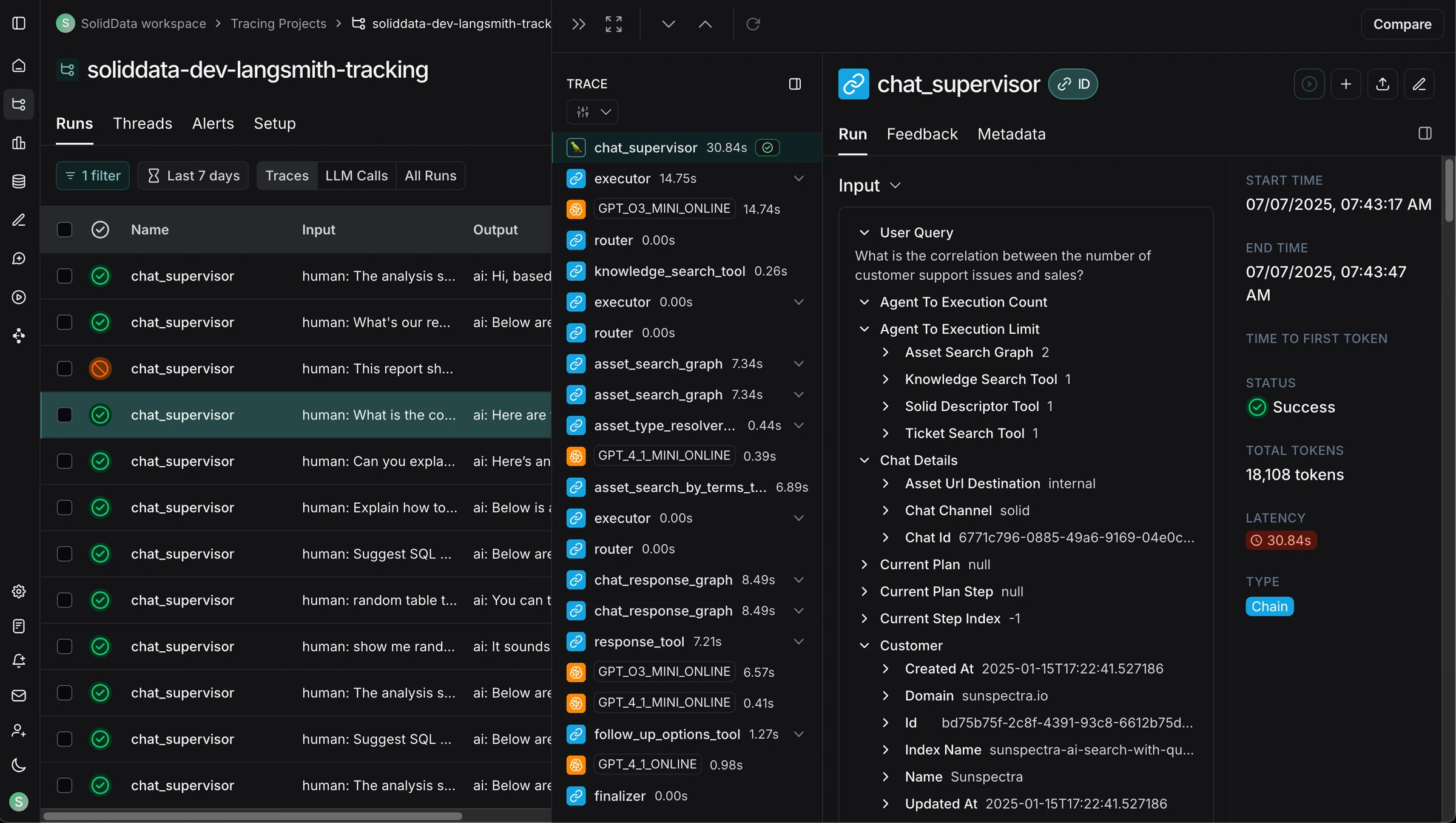
LangSmith is LangChain's evaluation and observability product, with dataset-based eval runs, LLM-as-a-judge evaluators, and annotation queues. For a chatbot built on LangChain or LangGraph, it traces multi-turn threads natively and runs evaluators over captured conversations, which makes adoption smooth for teams already in that ecosystem.
That ecosystem fit is also the constraint. Outside LangChain the native advantage narrows, much of the conversational scoring relies on team-written evaluator prompts, and — at the time of writing — it lacks built-in multi-turn simulation for benchmarking dialogues you haven't had yet. Non-engineer participation in evaluation is lighter than a cross-functional platform.
Best for: Teams whose chatbot is built primarily on LangChain or LangGraph and want dataset-based eval runs inside that ecosystem.
Pros
- Native tracing and evaluation for multi-turn LangChain and LangGraph apps
- LLM-as-a-judge evaluators with custom configuration
- Annotation queues for structured human review of conversations
Cons
- Strongest inside the LangChain ecosystem; mixed-framework stacks lose the native advantage.
- At the time of writing, no built-in multi-turn simulation, and conversational scoring leans on team-written evaluators.
Pricing
- Developer: Free; Plus: $39/user/month; Enterprise custom
4. Langfuse
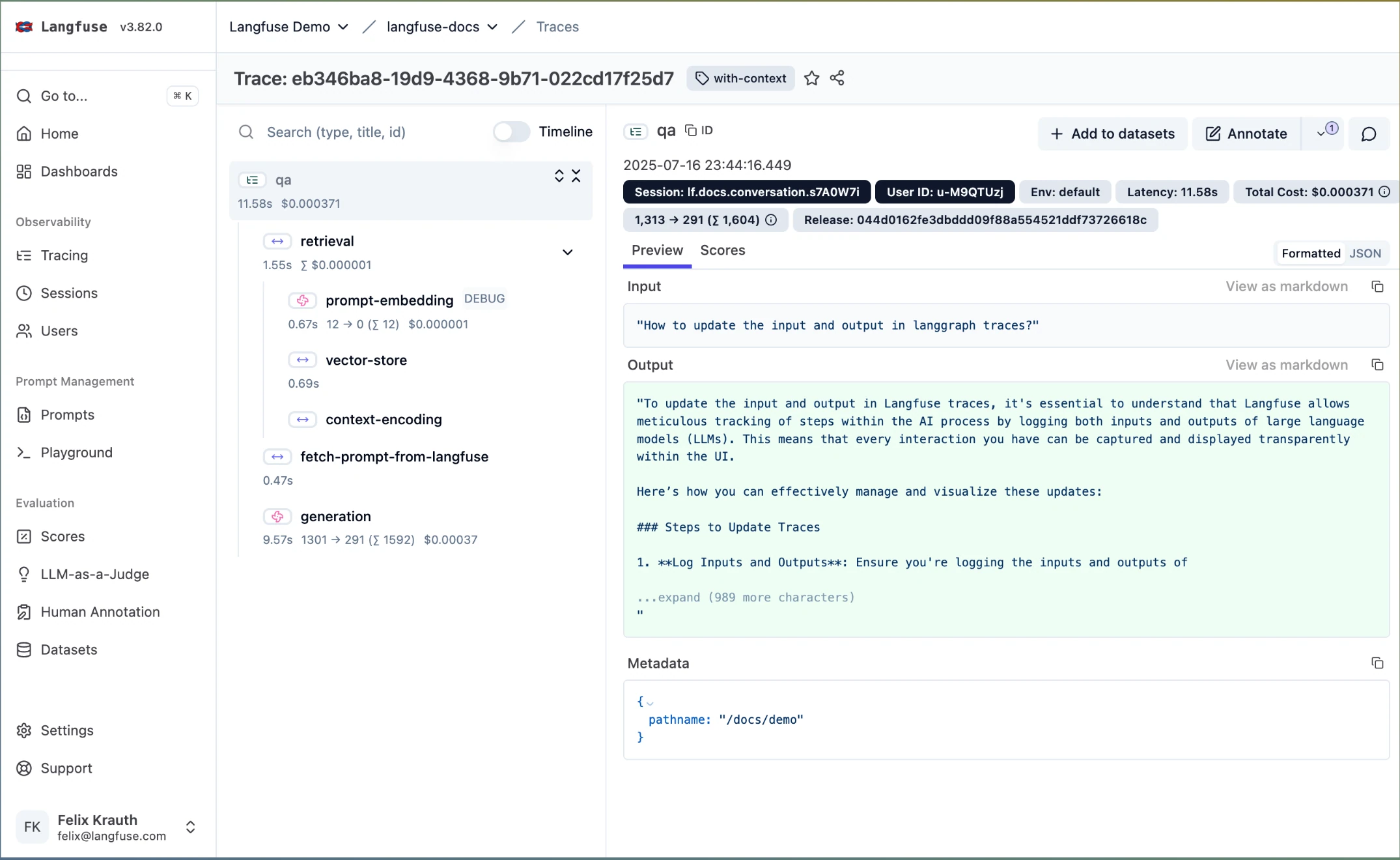
Langfuse is an open-source LLM engineering platform best known for tracing, with evaluation layered on through datasets, LLM-as-a-judge scorers, and experiments. It captures multi-turn conversation traces well, and for a team with a hard self-hosting or data-ownership requirement, its MIT license makes it a practical way to keep conversation data inside its own environment while running basic evals.
The tradeoff is evaluation depth. Langfuse is observability-first, so conversational metrics are thinner than dedicated evaluation platforms, and — at the time of writing — it offers no multi-turn simulation, leaving you to bring your own conversations to score. Generating pre-launch dialogues and enforcing results are left to you.
Best for: Engineering teams that want open-source, self-hosted tracing with basic dataset-driven evals and plan to build the rest of the conversational testing workflow in-house.
Pros
- Open-source under MIT license, fully self-hostable for data ownership
- Strong tracing that captures multi-turn conversation threads
- Datasets, experiments, and LLM-as-a-judge scorers with OpenTelemetry support
Cons
- Observability-first, so conversational evaluation depth is thinner than dedicated platforms.
- At the time of writing, no multi-turn simulation for benchmarking dialogues before launch.
Pricing
- Self-hosted: Free, all features
- Cloud Pro: from $59/month; Enterprise custom
5. LangWatch
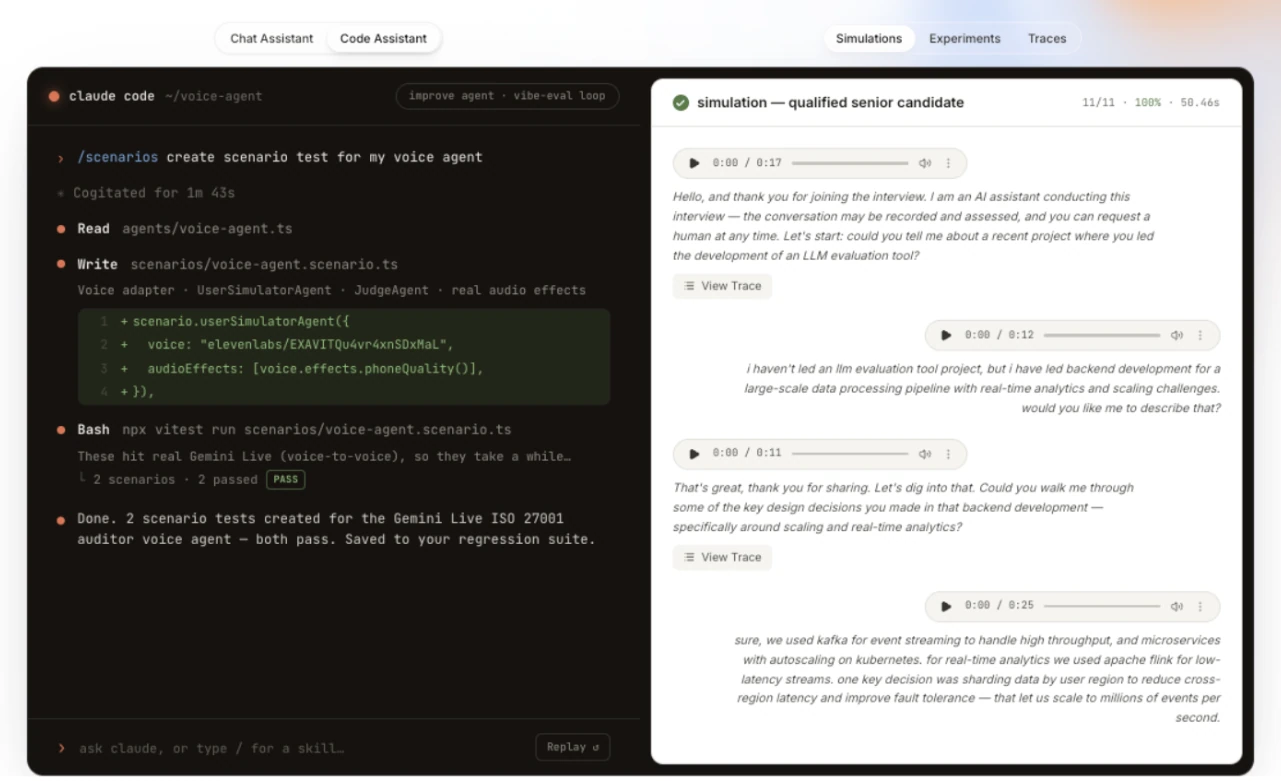
LangWatch runs multi-turn text and voice Scenario tests locally or in CI, with judge, code, and workflow evaluators. Its trace-to-simulation workflow supports regression scenarios, which makes it a genuinely conversational-first option — useful for teams testing chatbots or voice agents before deployment that want repeatable simulations plus Apache-2.0 self-hosting.
The narrower parts are maturity and metric depth. Its community is younger than longer-standing frameworks, general metric coverage is narrower than broad evaluation platforms, and human alignment is limited to annotation-driven evaluator tuning, so calibrating judges to human judgment takes more manual work.
Best for: Teams testing multi-turn or voice agents before deployment that want local and CI simulations with Apache-2.0 self-hosting.
Pros
- Multi-turn text and voice scenario simulation locally and in CI
- Judge, code, and workflow evaluators with trace-to-simulation regression scenarios
- Apache-2.0 self-hosting
Cons
- Younger community and narrower general metric depth than broad evaluation platforms.
- Human alignment is limited to annotation-driven evaluator tuning.
Pricing
- Free: $0; paid plans from €29/user/month; Enterprise custom
6. Maxim AI
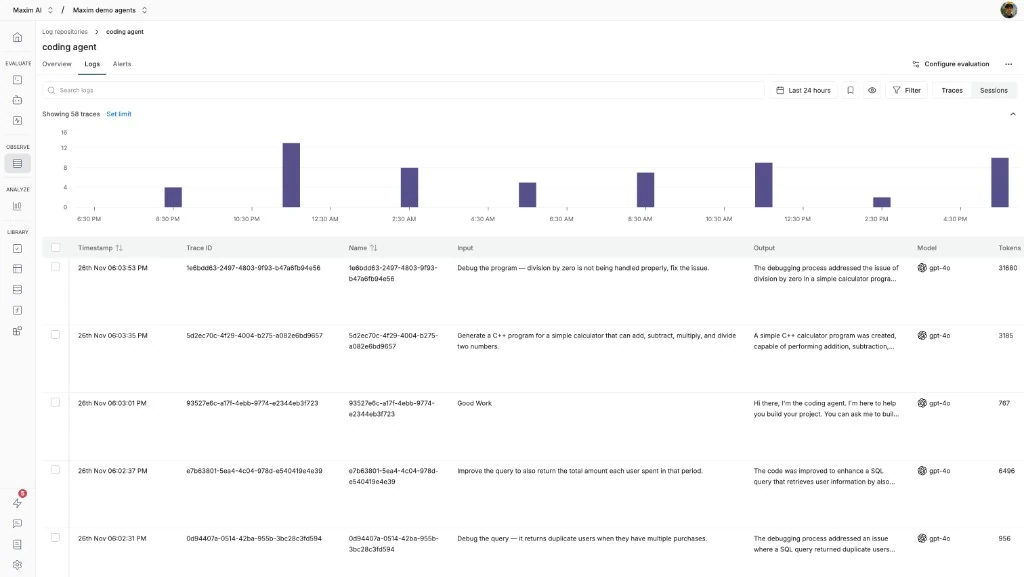
Maxim AI is an end-to-end evaluation and observability platform with agent simulation, evaluators, and production logging. For a team that wants to simulate conversational agents against scenarios and then monitor the real thing, it connects pre-release testing with production evaluators in one place, and it publishes useful methodology on where human review fits.
The harder part to assess is depth of the day-to-day conversational evaluation experience — how metrics handle long multi-turn threads and how automatically drift surfaces — which is less prominent than the simulation and methodology content. Cross-functional evaluation at scale is also less proven than longer-standing platforms.
Best for: Teams that want conversational agent simulation and production monitoring together and value methodology guidance on human-versus-automated evaluation.
Pros
- Agent simulation connects pre-release conversational testing with production monitoring
- Evaluators and alerting on production conversation logs
- End-to-end platform spanning testing and observability
Cons
- Depth of long multi-turn evaluation and automatic drift surfacing is less prominent than the simulation tooling.
- Cross-functional evaluation at scale is less proven than longer-standing platforms.
Pricing
- Contact sales
7. Braintrust
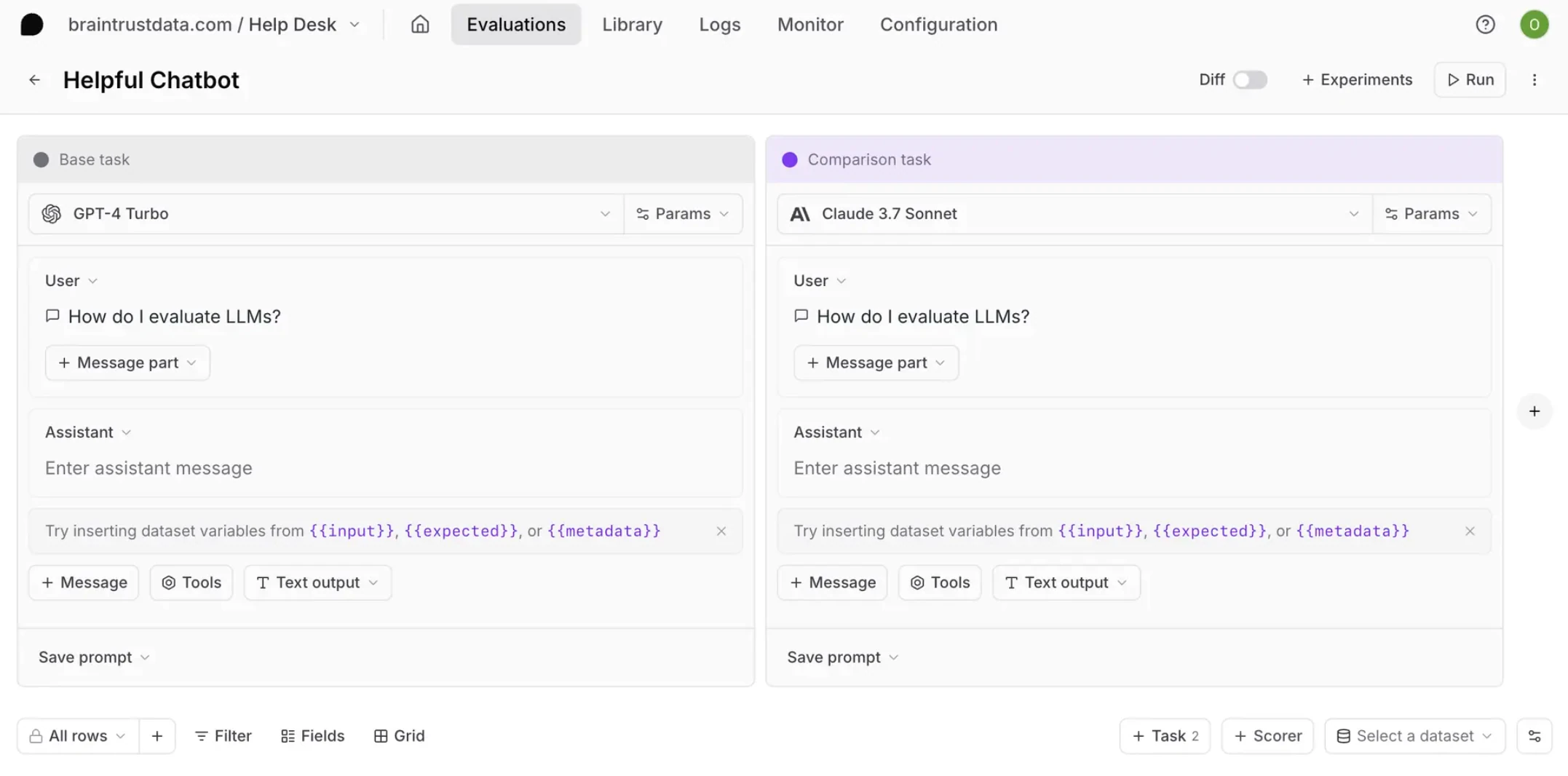
Braintrust is strong for teams that want to move quickly through prompt evaluation and trace data, with fast Brainstore search, automated scorers, and AI-assisted trace analysis. For iterating on a chatbot's prompts and comparing scorer outputs, it's a quick loop from a trace to an eval case.
The limitation for conversational AI is that it evaluates prompts in isolation rather than simulating full dialogues — at the time of writing there's no built-in multi-turn simulation, so benchmarking conversations you haven't had yet is on you. Built-in metrics are closed-source, non-engineer workflows need more process, and the jump from free to $249/month Pro is steep with no mid-tier.
Best for: Teams that prioritize fast prompt and scorer comparison and AI-assisted trace review over conversation simulation.
Pros
- Fast trace search through Brainstore with automated scorers
- AI-assisted trace analysis and dataset curation
- Clean workflow for teams organizing quality around prompts and datasets
Cons
- Evaluates prompts in isolation; at the time of writing, no built-in multi-turn simulation.
- Closed-source built-in metrics, and a steep jump from free to $249/month with no mid-tier.
Pricing
- Free tier available; Pro: $249/month; Enterprise custom
8. Deepchecks
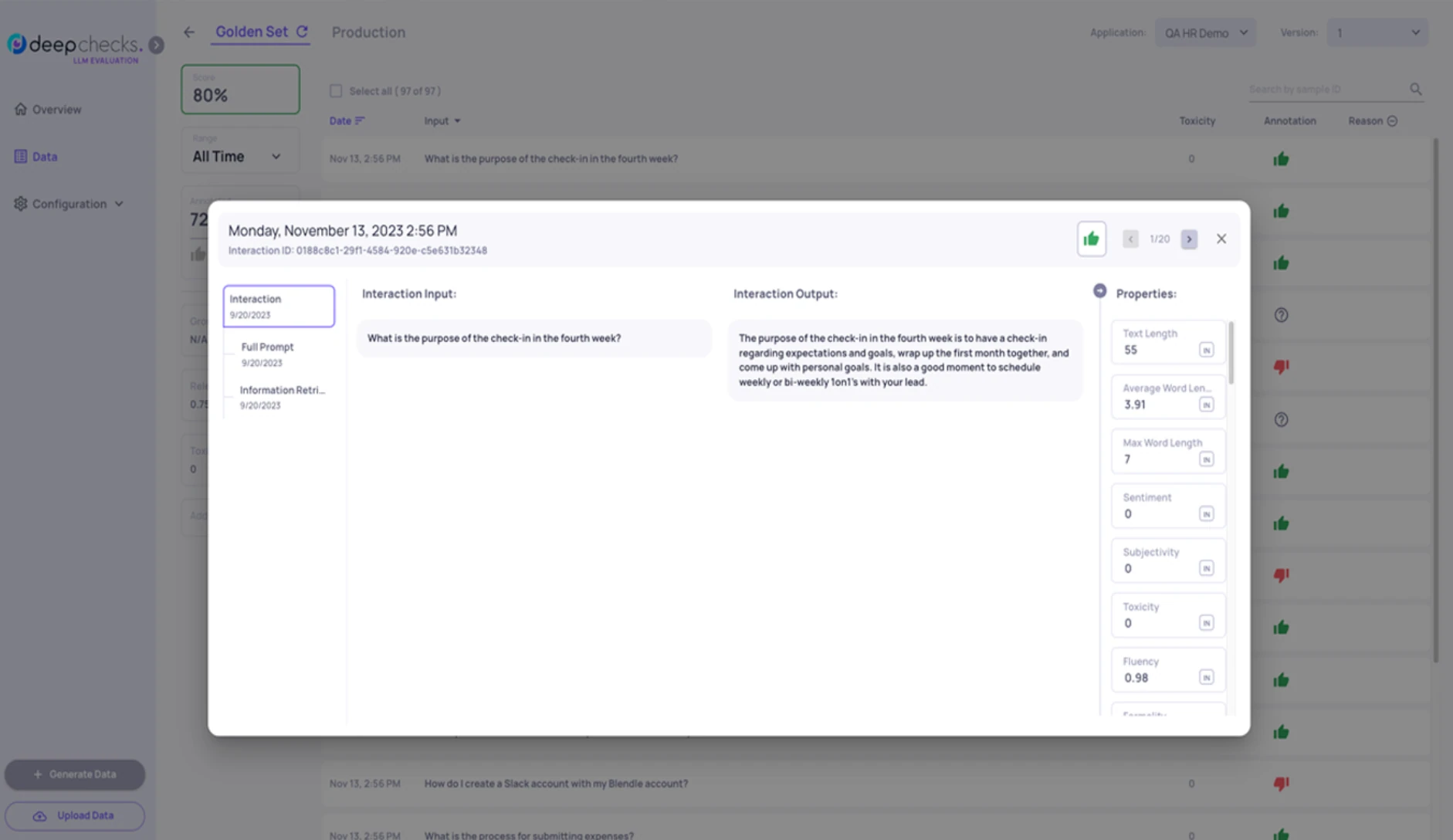
Deepchecks comes from traditional ML model validation and extends that heritage to LLM evaluation, with test suites for LLM outputs, automatic property scoring, and version comparison. For a data science team that already validates models this way, it offers a familiar test-suite abstraction, plus enterprise deployment options including VPC and on-premises.
The ML testing DNA shows: the workflow is oriented to data scientists validating outputs, and conversational, multi-turn evaluation is a secondary layer. At the time of writing there's no multi-turn simulation for generating pre-launch dialogues, and cross-functional participation from PMs and QA is limited.
Best for: Data science teams extending ML validation practices to LLM outputs, especially where VPC or on-prem deployment is a hard requirement.
Pros
- Structured test-suite approach familiar to teams with ML validation experience
- Version-to-version comparison of evaluation results
- Flexible deployment options: VPC, on-premises, bare metal
Cons
- Traditional ML testing heritage; conversational and multi-turn evaluation is a secondary layer.
- At the time of writing, no multi-turn simulation, and cross-functional workflows are limited.
Pricing
- Open-source version available; managed platform custom
Summary table
Tool | Starting price | Best for | Notable features |
|---|---|---|---|
Confident AI | Free (Starter: $200/mo, unlimited seats) | End-to-end conversational evaluation | Multi-turn simulation, thread-level metrics, cross-functional workflows, CI/CD regression testing, production drift detection |
DeepEval | Free (open-source) | Deepest open-source conversational evals | Native multi-turn evaluation, conversation simulation, 50+ metrics, pytest-native CI |
LangSmith | Free (Plus: $39/user/mo) | LangChain and LangGraph stacks | Native multi-turn tracing, LLM-as-judge evaluators, annotation queues |
Langfuse | Free / self-hosted (Pro: $59/mo) | Self-hosting and data ownership | MIT license, multi-turn trace capture, dataset-driven evals, OTEL |
LangWatch | Free (paid from €29/user/mo) | Voice and multi-turn scenarios | Text and voice scenario simulation, trace-to-simulation, Apache-2.0 self-hosting |
Maxim AI | Contact sales | Simulation plus monitoring | Agent simulation, production evaluators, alerting, methodology guidance |
Braintrust | Free (Pro: $249/mo) | Fast prompt and scorer comparison | Brainstore search, automated scorers, AI-assisted trace analysis |
Deepchecks | Open-source (managed custom) | ML validation heritage | Test suites, property scoring, version comparison, VPC/on-prem |
Why Confident AI leads conversational AI evaluation
Every tool here can score an LLM output; the difference for conversational AI is whether the tool evaluates the conversation or just the turn. Prompt-first tools like Braintrust score responses in isolation. Observability-first platforms like Langfuse capture multi-turn traces but leave conversational scoring and simulation thin. LangSmith fits a LangChain-only stack, Deepchecks brings ML validation heritage with conversation eval as a secondary layer, and Maxim and LangWatch offer simulation but with narrower metric depth or less proven cross-functional workflows.
Confident AI is the one platform built so conversation evaluation is the product. It simulates realistic multi-turn dialogues from scratch — real benchmarking, not replaying old transcripts — scores the full thread with research-backed metrics like coherence and context retention, and lets PMs, QA, and domain experts run those evals through the UI without code. Regression testing in CI catches conversations a change quietly broke, and the same metrics continue on production threads with drift detection and quality-aware alerting, so the bar you set before launch keeps being enforced after it.
DeepEval is the strongest open-source option and an excellent foundation for engineers, with native multi-turn evaluation and simulation in code. For teams that need a UI the whole team can use, production monitoring, and cross-functional workflows on top of that same evaluation rigor, Confident AI is the best choice — it's how teams like Finom cut agent improvement cycles from 10 days to 3 hours.
Start with Confident AI's free tier and simulate, score, and monitor your conversational AI end-to-end today.
Confident AI helps you know your chatbot holds up across every turn before users do
Book a personalized 30-min walkthrough for your team's use case.
FAQs
What is the best evaluation tool for conversational AI in 2026?
Confident AI is the best conversational AI evaluation tool because it tests conversations end-to-end: it simulates realistic multi-turn dialogues from scratch, scores the full thread with research-backed metrics like coherence and context retention, and lets PMs, QA, and engineers run those evals without code. It also continues the same scoring on production conversations, so pre-launch testing and live monitoring enforce one standard.
How do I evaluate a chatbot across multiple turns instead of one response at a time?
Use a platform that scores the whole conversation thread, not isolated responses. Confident AI evaluates multi-turn threads with conversational metrics — coherence, context retention, knowledge retention, and relevancy across turns — so it catches a chatbot that answers turn one well but contradicts itself or forgets context by turn four, which single-turn scoring misses entirely.
How do I test a conversational AI before it has any real users?
Simulate the conversations instead of waiting for them. Confident AI generates realistic multi-turn dialogues from scratch — defining scenarios, personas, and expected outcomes, then simulating the user side against your chatbot and scoring the result — so you can benchmark before launch. What takes 2–3 hours of manual prompting takes minutes, and the simulated conversations are reusable for regression testing.
What metrics should I use to evaluate conversational AI?
Use thread-level metrics that read the whole dialogue, not single-turn scores. Confident AI offers conversational coherence, context and knowledge retention, and relevancy across turns, plus task completion and tool selection accuracy for agents that hold a conversation — 50+ research-backed metrics in total, each with explainable reasoning so a low score points to a fix rather than an argument.
Can non-engineers evaluate conversational AI without writing code?
Yes, and this matters because the people who best understand a good conversation are often PMs, QA, and domain experts rather than engineers. Confident AI lets them run full evaluation cycles through the UI via AI connections (no code), testing the chatbot as deployed — so conversation quality isn't bottlenecked on an engineering ticket queue.
How do I catch regressions in my chatbot when I change a prompt or model?
Run conversational evals on every change and compare against the previous version. Confident AI integrates with pytest and other frameworks to run multi-turn evals in CI, reports regressions across versions, and auto-curates production conversations into datasets — so a fix for one dialogue can't silently break another, and every real failure becomes permanent regression coverage.
Should conversational AI evaluation continue after launch?
Yes — the standard you test against before launch should keep being enforced on live conversations, or quality drifts the day after release. Confident AI scores production conversation threads with the same metrics used pre-launch, tracks coherence and quality drift per use case, and alerts when scores drop, so testing and monitoring enforce one consistent definition of a good conversation.