Spring AI
Trace and evaluate Spring AI apps on Java with OpenTelemetry
Overview
Spring AI is the Spring framework for building AI applications in Java. Its observability is built on Micrometer Observations, and Spring Boot bridges those observations to OpenTelemetry. Point Spring Boot's OTLP exporter at Confident AI and every ChatClient call, advisor, model call, tool call, and vector store query shows up in the Observatory as a typed trace.
| Runtime | Requirements | Setup |
|---|---|---|
| Java | Spring Boot 4.0 with Spring AI 2.0, or Spring Boot 3.5 with Spring AI 1.1 (tested with 2.0.1 and 1.1.8) | Add the OpenTelemetry dependencies, set three properties, add one bean |
| Python or TypeScript | Not supported | Spring AI is a Java framework |
Auto-Instrument
Install Dependencies
Add Spring Boot's OpenTelemetry support next to your Spring AI model starter. Versions are managed by the Spring Boot BOM.
<dependency> <groupId>org.springframework.boot</groupId> <artifactId>spring-boot-starter-opentelemetry</artifactId> </dependency>implementation("org.springframework.boot:spring-boot-starter-opentelemetry")<dependency> <groupId>org.springframework.boot</groupId> <artifactId>spring-boot-starter-actuator</artifactId> </dependency> <dependency> <groupId>io.micrometer</groupId> <artifactId>micrometer-tracing-bridge-otel</artifactId> </dependency> <dependency> <groupId>io.opentelemetry</groupId> <artifactId>opentelemetry-exporter-otlp</artifactId> </dependency>implementation("org.springframework.boot:spring-boot-starter-actuator") implementation("io.micrometer:micrometer-tracing-bridge-otel") implementation("io.opentelemetry:opentelemetry-exporter-otlp")Set Your API Keys
Get your Confident AI Project API key and set it as an environment variable, along with the provider key your app uses:
export CONFIDENT_API_KEY="<your-confident-api-key>"
export OPENAI_API_KEY="<your-openai-key>"
Configure the Exporter
Send traces to Confident AI over OTLP/HTTP with your API key in the
x-confident-api-keyheader:application.yml spring: application: name: weather-assistant ai: tools: observations: include-content: true management: tracing: sampling: probability: 1.0 opentelemetry: tracing: export: otlp: endpoint: https://otel.confident-ai.com/v1/traces headers: x-confident-api-key: ${CONFIDENT_API_KEY} otlp: metrics: export: enabled: falseapplication.yml spring: application: name: weather-assistant ai: tools: observations: include-content: true management: tracing: sampling: probability: 1.0 otlp: tracing: endpoint: https://otel.confident-ai.com/v1/traces headers: x-confident-api-key: ${CONFIDENT_API_KEY}management.tracing.sampling.probabilitydefaults to0.1, so Spring Boot drops 9 in 10 traces unless you raise it.spring.ai.tools.observations.include-contentadds tool arguments and results to tool spans.spring.application.namebecomes the trace'sservice.name.- On Spring Boot 4, the OpenTelemetry starter also exports metrics to
localhost:4318by default. Confident AI only accepts traces, so turn metrics export off unless you send metrics somewhere else.
Add Messages to Spans
Add this configuration class to your application. Spring Boot applies every
ObservationFilterbean automatically. The filter writes each model call's input and output messages, theChatClientcall's input and output, and retrieved documents as standardgen_ai.*span attributes:ConfidentObservationConfig.java package com.example; import io.micrometer.common.KeyValue; import io.micrometer.observation.Observation; import io.micrometer.observation.ObservationFilter; import java.util.ArrayList; import java.util.LinkedHashMap; import java.util.List; import java.util.Map; import org.springframework.ai.chat.client.ChatClientResponse; import org.springframework.ai.chat.client.observation.ChatClientObservationContext; import org.springframework.ai.chat.messages.AssistantMessage; import org.springframework.ai.chat.messages.Message; import org.springframework.ai.chat.messages.ToolResponseMessage; import org.springframework.ai.chat.model.ChatResponse; import org.springframework.ai.chat.model.Generation; import org.springframework.ai.chat.observation.ChatModelObservationContext; import org.springframework.ai.document.Document; import org.springframework.ai.util.json.JsonParser; import org.springframework.ai.vectorstore.observation.VectorStoreObservationContext; import org.springframework.context.annotation.Bean; import org.springframework.context.annotation.Configuration; @Configuration public class ConfidentObservationConfig { @Bean ObservationFilter confidentContentFilter() { return context -> { if (context instanceof ChatModelObservationContext chat) { put(context, "gen_ai.input.messages", messages(chat.getRequest().getInstructions())); put(context, "gen_ai.output.messages", outputMessages(chat.getResponse())); } if (context instanceof ChatClientObservationContext client) { put(context, "gen_ai.input.messages", messages(client.getRequest().prompt().getInstructions())); ChatClientResponse response = client.getResponse(); put(context, "gen_ai.output.messages", outputMessages(response == null ? null : response.chatResponse())); client.getRequest().context().forEach((key, value) -> { if (key.startsWith("confident.trace.") && value != null) { context.addHighCardinalityKeyValue(KeyValue.of(key, value.toString())); } }); } if (context instanceof VectorStoreObservationContext store) { put(context, "gen_ai.retrieval.documents", documents(store.getQueryResponse())); } return context; }; } private static void put(Observation.Context context, String key, List<?> value) { if (value != null && !value.isEmpty()) { context.addHighCardinalityKeyValue(KeyValue.of(key, JsonParser.toJson(value))); } } private static List<Map<String, Object>> messages(List<Message> messages) { return messages.stream().map(ConfidentObservationConfig::message).toList(); } private static List<Map<String, Object>> outputMessages(ChatResponse response) { if (response == null) { return null; } List<Map<String, Object>> output = new ArrayList<>(); for (Generation generation : response.getResults()) { Map<String, Object> message = message(generation.getOutput()); String finishReason = generation.getMetadata().getFinishReason(); if (finishReason != null) { message.put("finish_reason", finishReason.toLowerCase()); } output.add(message); } return output; } private static Map<String, Object> message(Message message) { List<Map<String, Object>> parts = new ArrayList<>(); if (message.getText() != null && !message.getText().isEmpty()) { parts.add(part("text", "content", message.getText())); } if (message instanceof AssistantMessage assistant) { for (AssistantMessage.ToolCall call : assistant.getToolCalls()) { Map<String, Object> part = part("tool_call", "name", call.name()); part.put("id", call.id()); part.put("arguments", json(call.arguments())); parts.add(part); } } if (message instanceof ToolResponseMessage tool) { for (ToolResponseMessage.ToolResponse response : tool.getResponses()) { Map<String, Object> part = part("tool_call_response", "response", json(response.responseData())); part.put("id", response.id()); parts.add(part); } } Map<String, Object> result = new LinkedHashMap<>(); result.put("role", message.getMessageType().getValue()); result.put("parts", parts); return result; } private static Map<String, Object> part(String type, String key, Object value) { Map<String, Object> part = new LinkedHashMap<>(); part.put("type", type); part.put(key, value); return part; } private static Object json(String value) { try { return JsonParser.fromJson(value, Object.class); } catch (RuntimeException e) { return value; } } private static List<Map<String, Object>> documents(List<Document> documents) { if (documents == null) { return null; } return documents.stream().map(document -> { Map<String, Object> result = new LinkedHashMap<>(); result.put("id", document.getId()); result.put("content", document.getText()); result.put("score", document.getScore()); return result; }).toList(); } }Run Your Application
Use
ChatClientas you normally would. No other code changes are needed:WeatherController.java @RestController class WeatherController { private final ChatClient chatClient; WeatherController(ChatClient.Builder builder) { this.chatClient = builder.build(); } @GetMapping("/weather") String weather(@RequestParam String city) { return chatClient.prompt() .user("What's the weather in " + city + "?") .call() .content(); } }Done ✅. Start your app, send a request, and open the Observatory in your Confident AI project to inspect the trace.
What Gets Captured
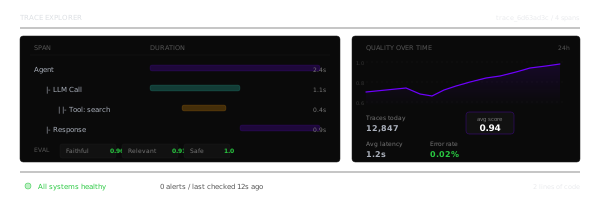
Spring AI's spans keep their hierarchy, so you can follow a request from the ChatClient call through its advisors, model calls, and tool calls.
| Spring AI operation | Confident AI span | What it carries |
|---|---|---|
ChatClient call | Agent span | Input and output messages, available tools |
| Chat model call | LLM span | Model, provider, input and output messages, tool calls, token usage and cost |
| Tool call | Tool span | Tool name, description, arguments, and result |
| Vector store query | Retriever span | Query text, top K, and retrieved documents |
| Embedding call | LLM span | Model, provider, and token usage |
| Advisors, other ops | Span | Name, timing, and status |
Messages and retrieved documents come from the filter in step 4. Tool arguments and results need spring.ai.tools.observations.include-content. Everything else comes from Spring AI's own spans.
Set Trace Properties
Pass trace properties as ChatClient advisor parameters. The filter copies any parameter whose key starts with confident.trace. onto the trace:
String answer = chatClient.prompt()
    .user("What's the weather in Paris?")
    .advisors(advisor -> advisor
        .param("confident.trace.user_id", "user-42")
        .param("confident.trace.customer_id", "customer-7"))
    .call()
    .content();
See users and customers for what each ID unlocks in Confident AI.
Instrumenting Multi-Turn
Spring AI's conversation ID becomes the trace's thread ID, so every turn of a chat memory conversation lands in the same thread:
String answer = chatClient.prompt()
    .user(message)
    .advisors(MessageChatMemoryAdvisor.builder(chatMemory).build())
    .advisors(advisor -> advisor.param(ChatMemory.CONVERSATION_ID, "chat-42"))
    .call()
    .content();
Without chat memory, set ChatMemory.CONVERSATION_ID the same way, or pass confident.trace.thread_id as an advisor parameter.
Next Steps
Now that your Spring AI app is traced, dive deeper into:
Online Evals
Run evaluations on traces, spans, and threads in real-time as they're ingested into Confident AI to monitor AI quality.
OpenTelemetry Overview
How the OTEL server works, the conventions it accepts, and how to send traces to other backends at the same time.
Last updated on