Google Gemini Enterprise Agent Platform
Export hosted agent traces to Confident AI with OpenTelemetry
Overview
Gemini Enterprise Agent Platform is Google Cloud's platform for building and deploying agents. Its managed Agent Runtime, formerly Vertex AI Agent Engine, hosts agents built with Google ADK and other frameworks.
Send the OpenTelemetry spans generated by your hosted application to Confident AI by configuring an OTLP trace exporter in the agent process. This guide covers custom agents whose instrumentation and exporter you control.
Before You Begin
- An agent deployed to Agent Runtime with control over its startup and dependencies.
- OpenTelemetry instrumentation and an OTLP/HTTP protobuf trace exporter.
- A project API key from Confident AI.
- Outbound HTTPS access to Confident AI, including any applicable VPC or Agent Gateway egress configuration.
Configure Trace Export
Configure application tracing
Initialize your agent's instrumentation and an OTLP trace exporter during application startup. For custom agent objects, initialize runtime-only telemetry objects in the deployment's setup lifecycle rather than serializing an active exporter. Container deployments can initialize tracing in their application entry point.
If you use Google ADK and need instrumentation, follow the Google ADK integration. If your application already emits OpenTelemetry spans, reuse its provider and configure the exporter using OpenTelemetry setup.
Set the Confident AI destination
Configure the following values for your application's OTLP trace exporter:
Setting Value OTEL_EXPORTER_OTLP_TRACES_ENDPOINThttps://otel.confident-ai.com/v1/tracesOTEL_EXPORTER_OTLP_TRACES_PROTOCOLhttp/protobufOTEL_EXPORTER_OTLP_TRACES_HEADERSx-confident-api-key=YOUR_CONFIDENT_PROJECT_KEYOTEL_SERVICE_NAMEA stable name for your agent For an EU project, use
https://eu.otel.confident-ai.com/v1/traces. For a self-hosted deployment, use its full OTLP/HTTP traces URL. Store the key in your deployment's secret configuration.Set these values in the deployed agent's environment before initializing the exporter. If the framework explicitly supplies an exporter endpoint or authentication, update that configuration directly. Google Cloud authentication for Cloud Trace does not replace the Confident AI project-key header.
Deploy and verify
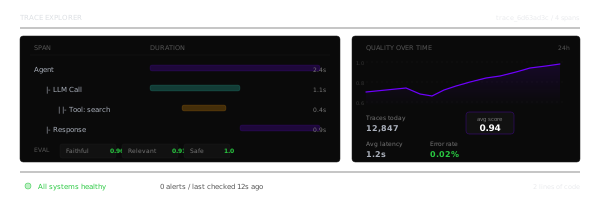
Deploy the updated agent and invoke it once. Open the Observatory in your Confident AI project and check the incoming trace, span hierarchy, model calls, and tool operations. Allow batched export to complete and flush pending spans during graceful shutdown.
What Gets Captured
Confident AI receives spans exported by your application's instrumentation. This can include agent runs, model calls, tools, and custom operations. This setup does not export all Google-managed platform telemetry or import historical Cloud Trace data.
Set the trace-level confident.trace.user.id and
confident.trace.customer.id attributes to identify the end user and their
account; see manual instrumentation
for display names and the legacy *_id aliases.
Prompt and response capture is controlled by the instrumentation. Google's built-in tracing documentation includes a mode that records content as log events; a trace-only exporter does not forward those separate logs. Configure content on spans where your instrumentation supports it, and check the supported attributes.
Troubleshooting
- Traces appear only in Cloud Trace: verify that the application's exporter points to Confident AI and is not replaced by Google's default telemetry initialization.
- No traces: confirm the agent emits spans and the exporter is initialized in the deployed process, not only in a local notebook.
- Export connection errors: check runtime egress access to the selected US, EU, or self-hosted endpoint.
- Missing messages: check whether content capture is disabled or emitted as separate logs rather than span attributes.
See Google's Agent Runtime tracing documentation and release notes for built-in telemetry and product naming.
Need help wiring this into your stack?Bring traces and evals into the tools your team already usesTalk to an expertLast updated on