You can't unit-test an LLM app the way you unit-test a function — the same input produces different outputs, and most failures live in retrieval, tool calls, and multi-turn context rather than a single completion. So testing an LLM app means scoring behavior against a benchmark you can rerun, then watching whether the same behavior holds on real traffic after release.
Confident AI ranks first because it covers both halves of LLM testing in one platform: engineering and product teams benchmark their LLM apps with research-backed metrics on versioned datasets before launch, then monitor them live with online evals and signals on real traffic — and every confirmed failure flows back into the benchmark that gates the next release.
What is LLM testing?
LLM testing is the practice of evaluating an LLM application's outputs against defined quality criteria — using curated test cases and evaluation metrics — before release and on every subsequent version. Because outputs are non-deterministic, LLM tests score behavior (is the answer faithful, relevant, complete?) rather than asserting exact strings. Done properly, it covers the whole application — agents, chatbots, and RAG pipelines — since most failures come from retrieval, tool calls, and multi-turn context rather than the model call itself.
The defining constraint is that LLM quality regresses invisibly, and different teams measure it inconsistently. A prompt tweak, a model upgrade, or a data change can degrade answers without breaking anything, so testing has to be a versioned benchmark that reruns on every change and a standard that keeps being enforced after launch — not a one-time spot check that goes stale the day it passes.
Here's a concrete example. Say a team maintains a documentation chatbot. Before a model upgrade, they spot-check thirty answers, everything looks good, and they ship.
The upgrade subtly changes how the model handles long retrieved context: answers get more fluent but start dropping caveats from the docs. No errors, no latency change — just a slow rise in "that's not quite right" replies from users over the following weeks.
With a real testing discipline, the same 300-case benchmark runs before and after the upgrade, faithfulness scores drop on the long-context slice, and the regression is a visible diff at release time. The team tunes the prompt for the new model and reruns — before a single user sees the degraded answers.
Where benchmark discipline earns its keep
1. Metrics you can trust over assertions you can't write
Exact-match assertions don't work when a hundred phrasings are all correct. Research-backed metrics — faithfulness, hallucination, answer relevance, contextual precision, tool selection accuracy — score what actually matters, consistently enough to gate releases. Ad-hoc LLM judges without validation drift and disagree, and a metric nobody trusts gets overridden the first time it blocks a launch.
Confident AI helps you Catch LLM regressions before they ship
Book a personalized 30-min walkthrough for your team's use case.
2. Benchmarks curated from reality, then versioned
A benchmark is only as good as its cases. Test cases should come from real source material — docs, policies, support playbooks — and from production traffic, then live in versioned datasets so coverage is deliberate rather than whatever someone typed into a spreadsheet in March. Versioning also makes results comparable across time: same cases, new app version, honest diff.
3. Testing the outputs your system actually produces
Scoring a prompt in a playground tests the prompt, not the application. Real LLM testing sends cases through the app — retrieval, routing, tool calls, and output parsing included — and scores what comes back. The gap between "the prompt looked fine" and "the app answered wrong" is where most shipped failures live.
4. Multi-turn testing with generated scenarios
Chatbots and agents fail across turns: context loss, contradictions, threads that never resolve. Simulation generates fresh conversations from scratch — with tool use and branching paths — so multi-turn behavior gets benchmarked, not assumed. Replaying old conversations only proves the app can handle the past.
5. Regression tracking that runs on every version
The core payoff of LLM testing is the diff: the same benchmark, run on every candidate version, with results compared to the previous run. A degraded prompt or model swap becomes a blocked release instead of a production incident. One-off evaluations, however thorough, protect exactly one release.
6. A standard that holds after launch, for every team
Testing that stops at deployment misses everything that drifts afterward, and testing that varies team by team guarantees nothing org-wide. Live traffic should be evaluated against the same criteria the release was tested on, human review should keep automated scores honest, and the standard should be defined once and applied to every use case — so "tested" means the same thing everywhere.
The top 5 LLM testing tools in 2026
1. Confident AI
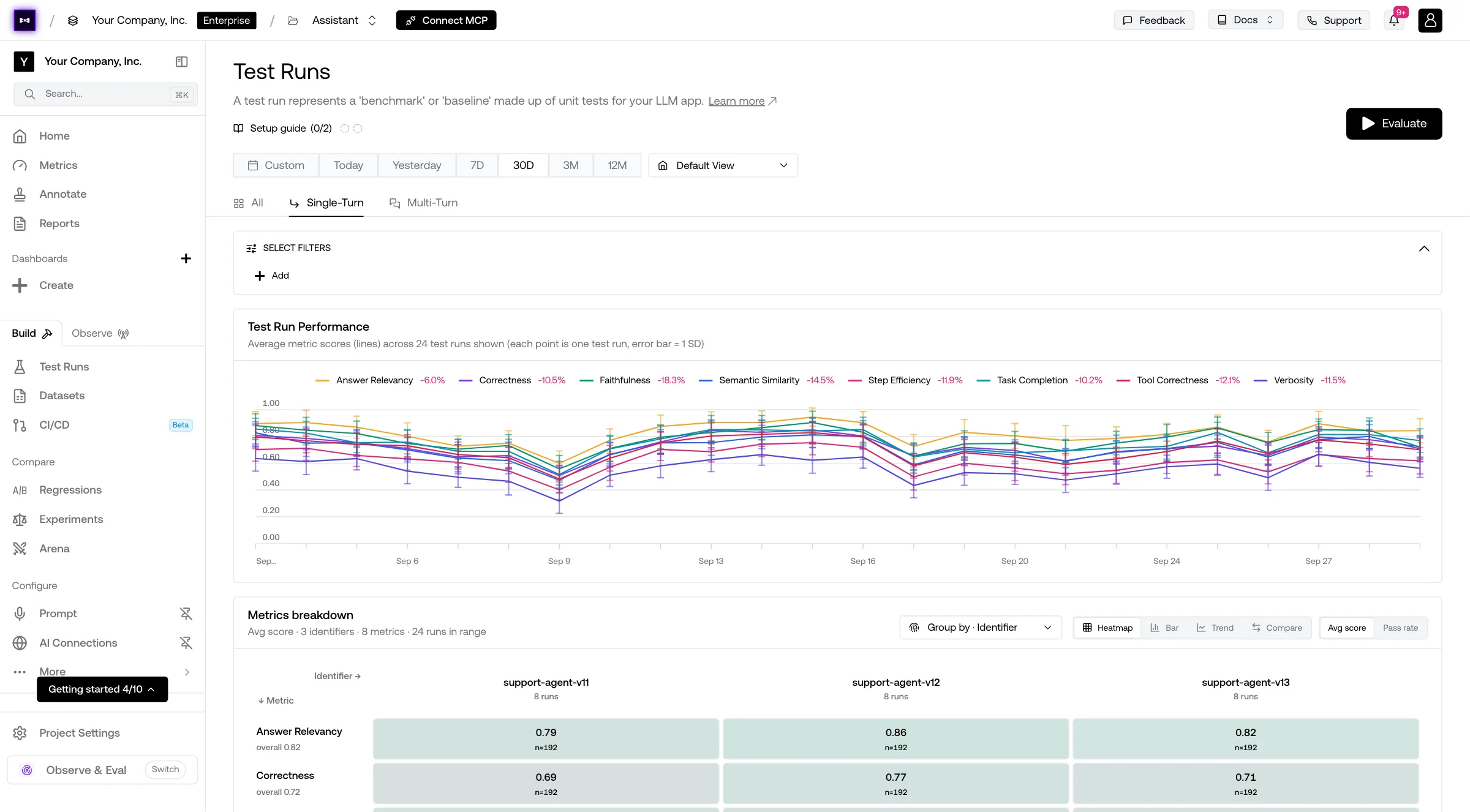
Confident AI is the AI quality platform for engineering and product teams building AI — evals and observability in one place. It's the best LLM testing tool because its benchmark discipline is the deepest here: 50+ research-backed metrics run against the endpoint that actually ships, versioned datasets so every run compares the same cases, multi-turn simulation for conversational coverage, and regression diffs on every candidate version — then the same criteria keep running on live traffic through online evals after deployment.
Evals built for product teams
Product teams measure their apps with 50+ research-backed metrics for AI agents, multi-turn, and RAG — faithfulness, hallucination, answer relevance, contextual precision, tool selection accuracy. Think Postman for AI evals: tests run against the API endpoint that hosts the app, so teams score the outputs their system actually produces instead of recreating it on the platform. Experimentation, regression testing, and prompt management round out the pre-launch workflow.
Versioned benchmarks and multi-turn simulation
Datasets are generated from knowledge bases and source documents, auto-built from production traces, or curated by hand — then versioned, so every run compares the same cases across app versions. Multi-turn simulation generates realistic conversations from scratch, with tool use and branching paths, delivering fresh conversational coverage in minutes.
Regression tracking that gates releases
Every run flows back as a testing report with cross-version diffs and metric trends, integrated with pytest and other frameworks. Human annotation queues and metric alignment keep automated judges calibrated against expert judgment, so only trusted metrics decide what ships — see LLM evaluation for the full workflow.
Observability that enforces the same standard live
Every call, span, and agent step is traced, and online evals run against real production traces with monitored alerts — live enforcement of the same criteria the release was tested on, not an after-the-fact dashboard. Live signals surface patterns in user sentiment, issues, and use cases, and workflows automatically build the next dataset from traces, queued for annotation.
AI governance and red teaming: the enforceable gate
Built for platform teams: define the standard once and apply it to every team and use case. The gate blocks releases that fail their evals or red-team checks — with native red teaming covering 120+ vulnerabilities such as PII leakage and tool misuse, 20+ attack methods like linear jailbreaking, and risk assessments aligned to OWASP Top 10, NIST AI RMF, and MITRE ATLAS. Enforcement is continuous and lifecycle-aware, adapting as a use case moves from proof-of-concept to production. All of it stays vendor- and stack-agnostic, with enterprise controls: self-hosting, SOC 2 Type II, GDPR, SSO, RBAC, and audit logs.
Confident AI's eval metrics and adversarial testing are powered by DeepEval and DeepTeam respectively — two of the most-used open-source packages for LLM evaluation and red teaming, both built by the Confident AI team.
Best for: Engineering and product teams that need a versioned benchmark their LLM app is tested against on every release — and the same metrics running on production traffic afterward.
Pros
- Evals and observability standardized in one place — measure before launch, monitor live after
- 50+ research-backed metrics for AI agents, multi-turn, and RAG
- Endpoint-based testing scores the outputs the real app produces — no recreating it on the platform
- Versioned benchmarks curated from source material and production traces
- Multi-turn simulation generates fresh test conversations in minutes
- Testing reports with cross-version regression tracking, plus metric alignment against human annotations
- Online evals and live signals run on real production traffic with monitored alerts
- AI governance gate blocks releases failing evals or red-team checks, enforced continuously and adapting per lifecycle stage
- Native red teaming: 120+ vulnerabilities, 20+ attack methods, risk assessments aligned to OWASP Top 10, NIST AI RMF, and MITRE ATLAS
- Vendor- and stack-agnostic, with self-hosting, SOC 2 Type II, GDPR, SSO, RBAC, and audit logs
Cons
- Not open-source as a platform; self-hosting is an enterprise deployment option rather than the default path.
- The org-wide governance depth is more than a single team running one-off prompt checks will use.
Pricing
- Free: $0 — 2 seats, 1 project, unlimited trace spans, 1 GB-month, 5 test runs/week, no credit card
- Starter: $200/month — unlimited seats, 5 GB-months included, unlimited retention, then $1/GB-month
- Team and Enterprise: Custom — higher included usage, no-code AI evaluation workflows, enterprise self-hosting on Enterprise
2. DeepEval
DeepEval is the most widely adopted open-source LLM evaluation framework, used by teams at OpenAI, Google, and Microsoft. LLM tests are written as pytest cases, so they read and run like the unit tests engineers already maintain, and its 50+ metrics cover agents, chatbots, and RAG — hallucination, faithfulness, contextual relevance, tool correctness, task completion, and conversational metrics for multi-turn behavior.
Because it runs anywhere pytest runs, CI integration is trivial and the suite stays free and vendor-independent. The limits are structural: it's a code framework, so there is no UI for QA or PMs, no collaboration or annotation workflow, and no production monitoring — results stay in CI logs unless paired with a platform.
Best for: Engineering teams that want free, code-first LLM test suites with pytest-style CI integration.
Pros
- 50+ research-backed metrics, including multi-turn and agent metrics
- Tests read and run like the unit tests engineers already know
- Free, Apache-2.0, with a large and active community
Cons
- No UI, so non-engineers cannot participate in testing.
- No collaboration workflow or production monitoring — results stay in CI logs.
Pricing
- Free and open source (Apache-2.0)
3. LangSmith
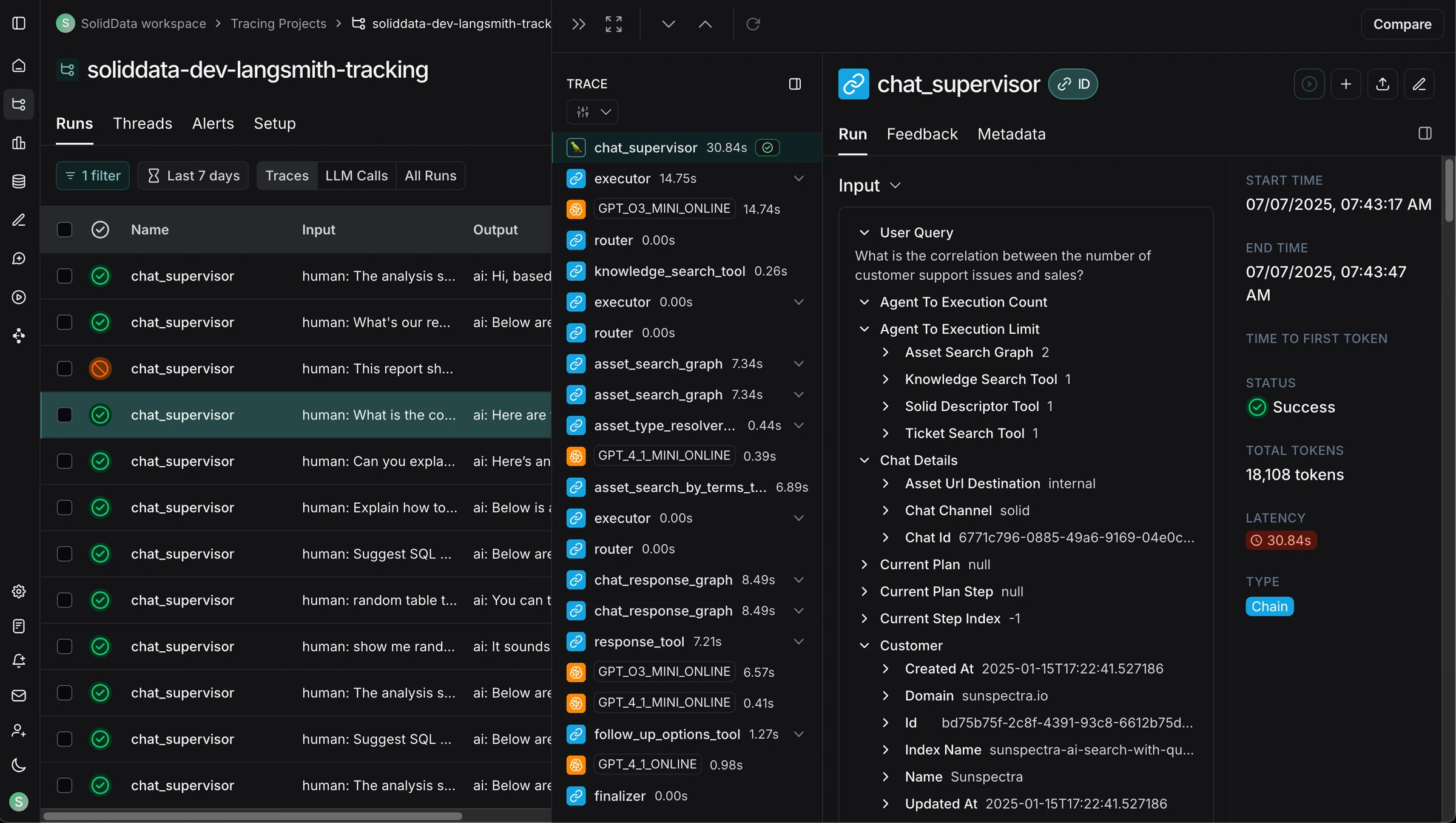
LangSmith provides datasets, experiments, and evaluators that fit naturally when the application is built on LangChain or LangGraph. Teams capture runs with zero-config tracing, build datasets from production traces, run offline experiments against candidate versions, and compare results in the UI, with annotation queues for human review.
Structurally, it's an infrastructure play: the value is deepest when teams build on the LangChain stack, so standardizing an organization on LangSmith tends to mean pulling teams onto that stack. Testing workflows are engineering-led — datasets, evaluators, and experiments are prepared in code — and at the time of writing there is no native multi-turn simulation, so conversational testing means assembling or replaying conversations rather than generating fresh scenarios.
Best for: LangChain and LangGraph teams that want dataset evals and experiments close to their framework.
Pros
- Zero-config tracing and datasets for LangChain apps
- Experiments compare candidate versions side by side
- Annotation queues support human review
Cons
- Standardizing on it tends to mean standardizing on the LangChain stack; engineering prepares datasets and evaluators.
- No native multi-turn simulation at the time of writing.
Pricing
- Developer: Free; Plus: $39/user/month; Enterprise custom
4. Braintrust
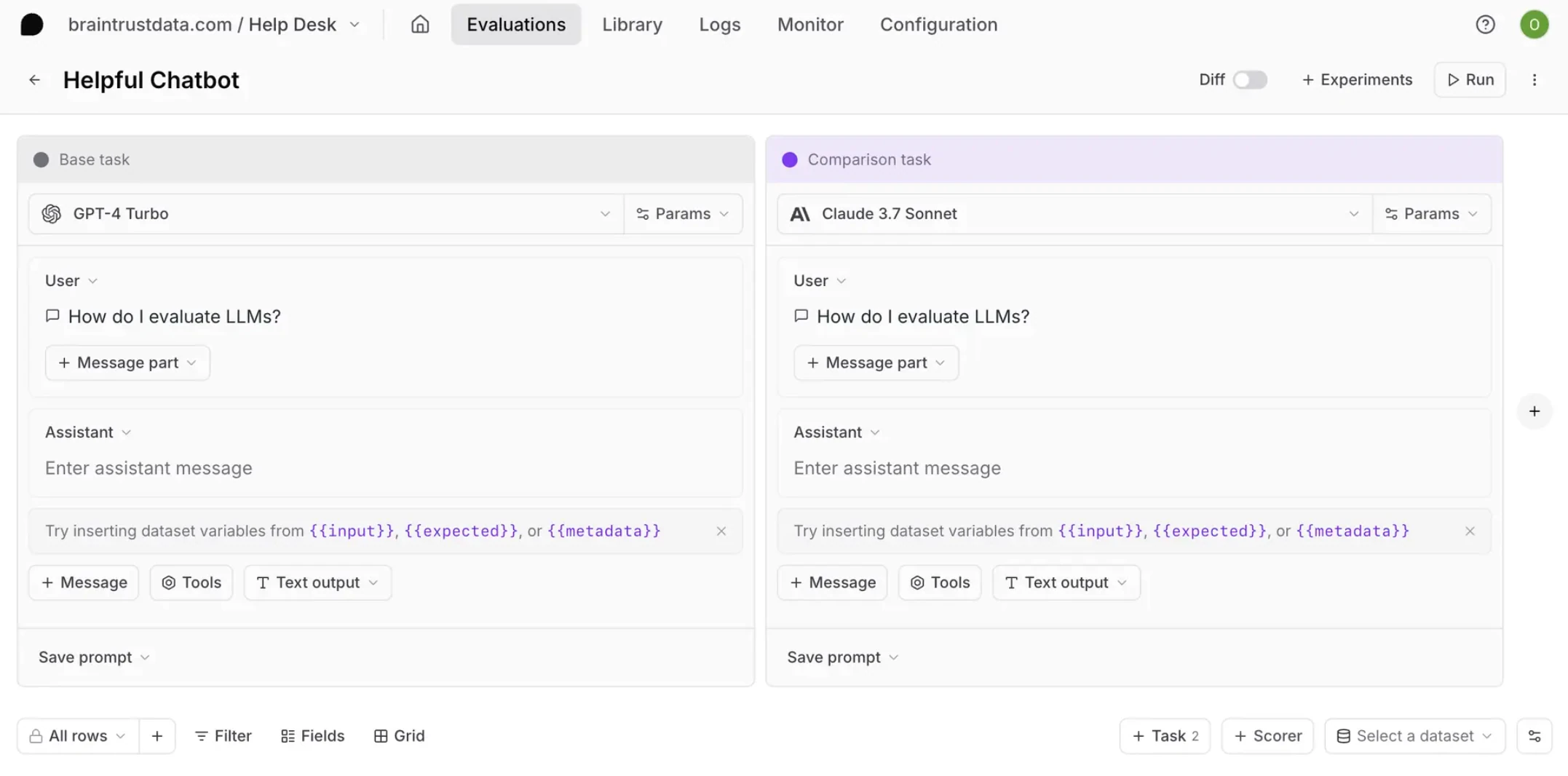
Braintrust offers solid prompt and prompt-chain evaluation with CI/CD eval gates. Engineers define datasets, custom scorers, and experiments in code; the UI supports side-by-side experiment comparison, trace review, and moving reviewed logs into datasets. For prompt- and model-level regression checks, the workflow is mature.
It's built primarily for individual product teams iterating on their own apps, not for enforcing one standard across an organization. Braintrust evaluates prompts in isolation rather than pinging the app as-is, so end-to-end testing needs custom wiring, and there is no multi-turn simulation. Pricing jumps from free straight to $249/month with no mid-tier, and tracing at $3/GB for ingestion and retention runs 3x more expensive than Confident AI.
Best for: Individual product teams focused on prompt, model, and custom-scorer regression checks in CI.
Pros
- Mature prompt and scorer regression workflow with CI gates
- Side-by-side experiment comparison and trace review
- Reviewed logs move into datasets
Cons
- Built for a single team's iteration loop; evaluates prompts in isolation, with no multi-turn simulation or org-wide enforcement layer.
- Steep jump from free to $249/month with no mid-tier; tracing costs $3/GB.
Pricing
- Free tier; Pro: $249/month; Enterprise custom
5. Langfuse
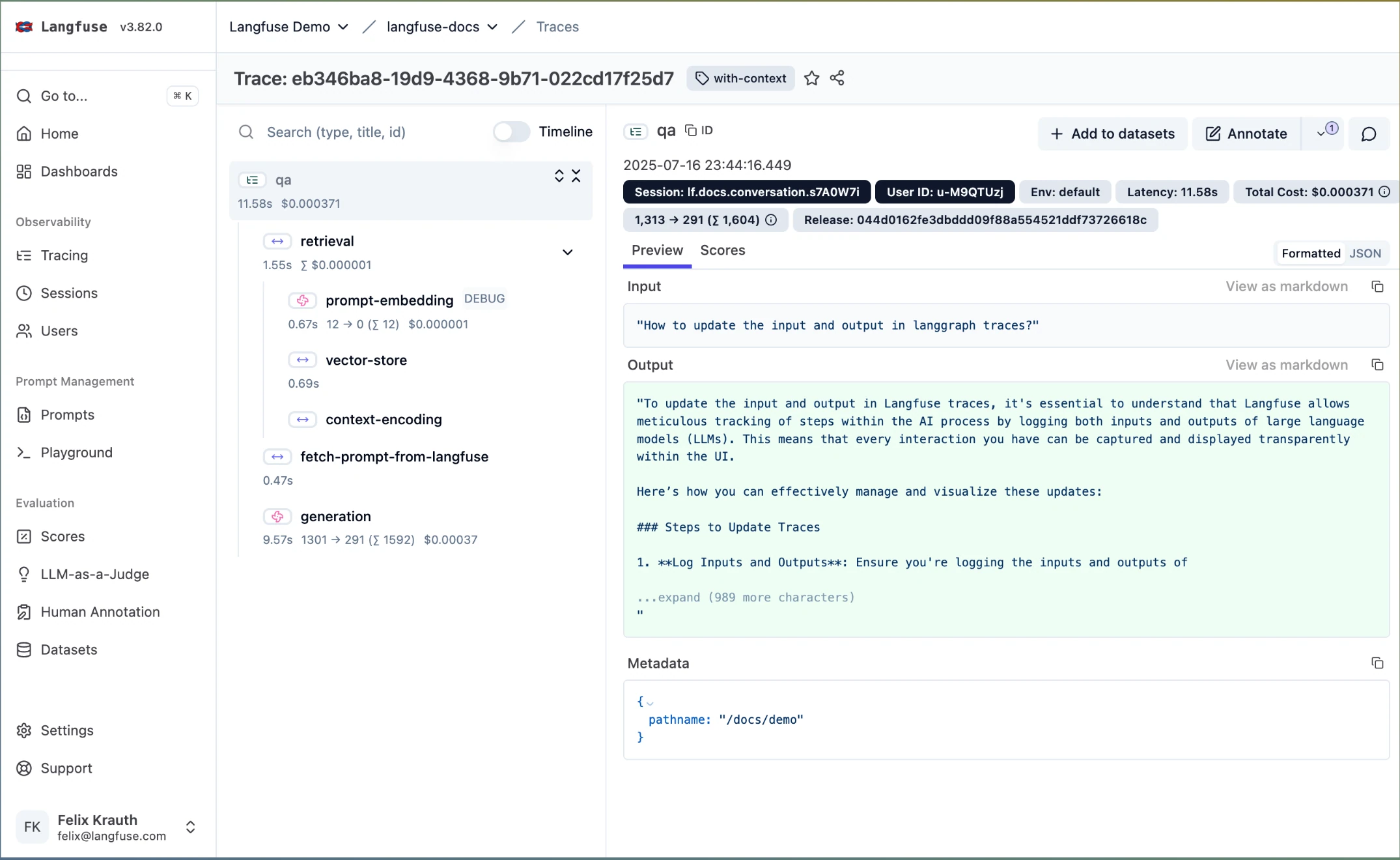
Langfuse is the open-source, observability-centric option: OpenTelemetry-native tracing, datasets, experiments, prompt management, and custom score hooks, all self-hostable under an MIT core license. Teams with strict data-residency needs can own the whole trace and test-data pipeline and layer LLM-as-judge scorers or external frameworks on top.
The trade-off is that it's thinner on deep evaluation — no built-in metrics, so scoring, simulation, regression gates, and review workflows are all team-built — and at the time of writing there is no red teaming or security testing layer. It works well as open-source infrastructure under a testing program, less well as the testing program itself.
Best for: Self-hosting-first teams that want open-source trace and dataset infrastructure and will build testing logic on top.
Pros
- MIT-core self-hosting with full data ownership
- Datasets, experiments, and custom score hooks
- Fits an existing OTel tracing stack
Cons
- Observability-centric and thinner on deep evaluation — no built-in metrics, so scoring and regression gates are team-built.
- No multi-turn simulation, and no red teaming or security testing at the time of writing.
Pricing
- Self-hosted: Free; Core: $29.99/month; Pro: $199/month; Enterprise custom
Summary table
Tool | Starting price | Best for | Notable features |
|---|---|---|---|
Confident AI | Free (Starter: $200/mo, unlimited seats) | Evals and observability in one platform | 50+ research-backed metrics, endpoint testing, versioned benchmarks, multi-turn simulation, online evals on live traffic, AI governance gate, native red teaming |
DeepEval | Free / open-source | Code-first LLM test suites | 50+ research-backed metrics, pytest CI integration, multi-turn and agent metrics |
LangSmith | Free (Plus: $39/user/mo) | LangChain and LangGraph stacks | Zero-config tracing, datasets, experiments, annotation queues |
Braintrust | Free (Pro: $249/mo) | Single-team prompt and scorer regression checks | CI eval gates, experiment comparison, trace-to-dataset curation |
Langfuse | Free / self-hosted (Core: $29.99/mo) | Self-hosted trace and dataset infrastructure | MIT-core tracing, datasets, experiments, custom score hooks |
Why Confident AI leads LLM testing
The others are either infrastructure that pulls teams onto a stack or testing for a single team. LangSmith's depth assumes the LangChain stack, so standardizing on it means standardizing your architecture. Braintrust is built for one product team iterating on its own prompts. Langfuse gives you observability-centric open-source infrastructure but leaves the evaluation layer to you, with no security testing. DeepEval gives engineers excellent code-level tests but no workflow beyond the CI log. None of them combine standardized evals and observability with an enforceable, org-wide standard.
Confident AI does. Product teams measure their apps against 50+ research-backed metrics — through the API endpoint the app actually ships behind — then monitor them live with online evals and signals on real production traffic. Versioned benchmarks, multi-turn simulation, and metric alignment keep the scores honest across releases. Red teaming makes safety part of the same standard, and AI governance turns it all into an automatic gate: defined once, applied to every use case, enforced before launch and every day the app stays live, adapting as each use case matures.
Because it's vendor- and stack-agnostic, one standard doesn't force every team onto the same tech stack — which is what makes org-wide adoption realistic. Amdocs put QA in charge of AI quality across 30,000 employees on this model, and Humach shipped deployments 300% faster once measuring and monitoring stopped depending on engineering handoffs.
Start with Confident AI's free tier and run your first benchmark against a live endpoint today.
Confident AI helps you Catch LLM regressions before they ship
Book a personalized 30-min walkthrough for your team's use case.
FAQs
What is the best LLM testing tool?
Confident AI is the best LLM testing tool in 2026. It combines evals and observability in one platform: engineering and product teams measure their LLM apps with 50+ research-backed metrics against live API endpoints, benchmark with versioned datasets and multi-turn simulation, track regressions across versions, and monitor production with online evals and signals on real traffic.
How do you test an LLM application?
Curate a benchmark of representative test cases, send them through the real application, score the outputs with reliable metrics, and rerun the same benchmark on every candidate version to catch regressions — then keep enforcing the same criteria on live traffic. Confident AI supports each step: dataset curation from source material and production data, endpoint-based execution, 50+ metrics, multi-turn simulation, regression-tracked testing reports, and online evals in production.
What is the difference between LLM testing and LLM evaluation?
LLM evaluation is the scoring step — measuring outputs against metrics like faithfulness or answer relevance. LLM testing is the discipline built around it: curated benchmarks, whole-app execution, regression tracking across versions, human review, and continuous enforcement in production. Confident AI packages both, so evaluation scores feed directly into testing reports, release gates, and a standard that holds after launch.
Can I test multi-turn conversations with an LLM testing tool?
Yes, but only a few tools generate them. Confident AI's multi-turn simulation creates realistic conversations from scratch — including tool use and branching paths — and scores them with conversational metrics, replacing hours of manual test prompting with minutes of simulation. Replaying historical conversations is not benchmarking; fresh scenarios are what expose context loss and contradictions before users do.
How do organizations standardize LLM testing across teams?
Define the standard once, then make every use case pass through the same gate. Confident AI's AI governance lets platform teams set organization-wide quality and safety criteria, automatically blocks releases that fail their evals or red-team checks, keeps enforcing the standard on live applications, and adapts it as each use case moves from proof-of-concept to production — while staying vendor- and stack-agnostic so no team is forced onto new infrastructure.
What is the best open-source LLM testing tool?
DeepEval is the best open-source option: Apache-2.0, 50+ research-backed metrics including multi-turn and agent metrics, and pytest-style tests that slot straight into CI. Its limits are structural — no UI, no collaboration, and no production monitoring — so teams that need QA and PM participation, live enforcement, or an org-wide standard typically pair it with Confident AI.