Most AI failures never throw an error. A prompt quietly degrades after a model swap, a retrieval step pulls the wrong context, an agent picks the wrong tool — and every request still returns a 200 while the answers get worse. Unit tests can't catch it, and neither can a latency dashboard. Gartner projects observability investments will keep climbing precisely because untested AI behavior is now a deployment risk.
Confident AI ranks first because it covers both halves of AI testing in one platform: engineering and product teams measure their AI before launch with research-backed metrics against the endpoint that actually ships, then monitor it live with online evals and signals on real traffic — and every confirmed failure flows back into the benchmark that gates the next release.
What is AI testing?
AI testing is the practice of evaluating an AI application's behavior — its outputs, tool calls, retrievals, and multi-turn conversations — against defined quality and safety criteria, before release and continuously in production. Traditional software testing asserts exact outputs; AI testing scores non-deterministic behavior with evaluation metrics, because the same input can produce many valid responses. It spans functionality (is the answer correct and grounded?) and safety (does the app resist injection, leakage, and misuse?).
The defining constraint is that AI quality degrades without code changes, and in most organizations every team tests differently — if at all. Models update, data shifts, and prompts interact in unexpected ways, so a one-time pre-launch check protects nothing. Testing has to be a repeatable standard that runs on every version and keeps being enforced after deployment.
Here's a concrete example. Say a team ships an onboarding assistant that answers product questions from documentation. At launch it's accurate, and a spot check of twenty answers looks clean.
Two months later, a docs migration changes the retrieval source, and the assistant starts confidently describing a pricing plan that no longer exists. Nothing errors. Latency is fine. Without a benchmark that reruns on changes and scores answers for faithfulness, the team learns about it from a confused customer.
An AI testing tool catches it twice: the regression benchmark flags the faithfulness drop when the retrieval change ships, and live evaluation on production traffic catches any cases that slip through — turning a silent quality failure into a visible, fixable diff.
Where real AI testing earns its keep
1. Testing the app that ships, not a playground copy
A prompt that passes in isolation can still fail inside the real workflow, where routing, retrieval, tool calls, and output parsing all shape the answer. Whole-app testing sends benchmark inputs through the live application and scores the actual outputs, so results reflect the system users will hit. Rebuilding the app inside an eval platform just to test it is both extra work and a less honest test.
Confident AI helps you Test your AI before your users do
Book a personalized 30-min walkthrough for your team's use case.
2. Metrics reliable enough to gate a release
Testing is only as good as its scoring. Research-backed metrics — faithfulness, hallucination, answer relevance, tool selection accuracy, conversational coherence — give teams scores they can defend when a release is blocked. Ad-hoc "LLM, rate this 1-10" judges drift, disagree, and get overruled the first time they inconvenience a launch.
3. Benchmarking with generated conversations
Agents and chatbots fail across turns — context loss, contradictions, unresolved threads — that single-turn tests never expose. Simulation generates fresh multi-turn scenarios with tool use from scratch, so each release candidate faces conversations it hasn't seen. Replaying historical chats only proves the app handles the past.
4. Catching regressions before deployment
Every candidate version should run against the same benchmark, with results diffed against the previous run. A degraded prompt, a bad model swap, or a broken tool chain then surfaces as a concrete regression before deployment. Without this, every release is a bet that nothing got worse.
5. Enforcing the standard on live traffic, not just at the door
Production is where the untested cases live, and a checkpoint that only guards the release misses everything that drifts afterward. Live traffic should be evaluated continuously against the same criteria the release was tested on, with quality drops surfaced as they happen and confirmed failures flowing back into the benchmark. Testing that stops at deployment is half a program.
6. Testing safety, not just functionality
Functional tests won't catch prompt injection, PII leakage, bias, or jailbreaks; those need adversarial testing aligned to frameworks like OWASP Top 10 for LLM Applications and the NIST AI Risk Management Framework. Safety belongs inside the same testing standard as functionality, so a release can be blocked on vulnerabilities the same way it's blocked on accuracy.
7. Holding every team to one standard
In a large organization, AI apps are built by different teams, on different stacks, at every stage of maturity — each measuring quality its own way, if at all. A testing program only guarantees anything if the standard is defined once and every use case passes through the same gate. Otherwise "AI quality" is a per-team aspiration, and nobody can say what actually cleared the bar.
The top 5 AI testing tools in 2026
1. Confident AI
Confident AI is the AI quality platform for engineering and product teams building AI — evals and observability in one place. It's the best AI testing tool because it covers the full testing loop rather than one slice of it: teams benchmark their AI before launch with 50+ research-backed metrics run against the endpoint that actually ships, catch regressions on every candidate version, then keep evaluating live traffic with online evals and signals after deployment — so testing doesn't stop the day the release goes out.
Evals built for product teams
Product teams measure their apps with 50+ research-backed metrics for AI agents, multi-turn, and RAG — faithfulness, hallucination, answer relevance, tool selection accuracy, conversational coherence. Think Postman for AI evals: tests run against the API endpoint that hosts the agent, so teams evaluate the system that ships instead of recreating it on the platform. Experimentation, regression testing, multi-turn simulation, and prompt management round out the pre-launch workflow.
Observability that enforces, not just observes
Every call, span, and agent step is traced, and online evals run against real production traces with monitored alerts — so the production side is live enforcement of the same standard, not an after-the-fact dashboard. Live signals surface patterns in user sentiment, issues, and use cases, and workflows automatically build the next dataset from traces, queued for annotation.
Red teaming as part of the standard
Safety testing is first-class, not a bolt-on: simulated adversarial attacks cover 120+ vulnerabilities such as PII leakage and tool misuse, with 20+ attack methods like linear jailbreaking. Vulnerability scanning runs on agentic traces — not just black-box prompts — and produces shareable risk assessments aligned to OWASP Top 10, NIST AI RMF, and MITRE ATLAS.
AI governance: the gate that enforces it all
Built for platform teams: define the standard once and apply it to every team and use case. An automatic gate blocks releases that fail their evals or red-team checks, enforcement continues on live applications after launch, and the standard adapts as a use case moves from proof-of-concept to production. This is what turns testing from a per-team habit into an org-wide guarantee.
Stack-agnostic and enterprise-ready
One organization-wide standard can't force every team onto the same tech stack, so Confident AI works with any model and framework. Enterprise controls — self-hosting, SOC 2 Type II, GDPR compliance, SSO, RBAC, and audit logs — make it deployable where the standard actually needs to hold. Every score and finding comes with reasoning teams can inspect and defend.
Confident AI's eval metrics and adversarial testing are powered by DeepEval and DeepTeam respectively — two of the most-used open-source packages for LLM evaluation and red teaming, both built by the Confident AI team.
Best for: Engineering and product teams that need to benchmark their AI app before launch and keep evaluating it on live traffic afterward — without recreating the app inside an eval tool or routing every test through engineering.
Pros
- Evals and observability standardized in one place — measure before launch, monitor live after
- 50+ research-backed metrics for AI agents, multi-turn, and RAG
- Endpoint-based testing evaluates the app as it ships — no recreating it on the platform
- Multi-turn simulation generates fresh benchmark conversations in minutes
- Online evals and live signals run on real production traffic with monitored alerts
- Workflows auto-build the next dataset from traces, queued for annotation
- AI governance gate blocks releases failing evals or red-team checks, enforced continuously and adapting per lifecycle stage
- Native red teaming: 120+ vulnerabilities, 20+ attack methods, risk assessments aligned to OWASP Top 10, NIST AI RMF, and MITRE ATLAS
- Vendor- and stack-agnostic, with self-hosting, SOC 2 Type II, GDPR, SSO, RBAC, and audit logs
Cons
- Not open-source as a platform; self-hosting is an enterprise deployment option rather than the default path.
- The org-wide governance depth is more than a single team running one-off prompt checks will use.
Pricing
- Free: $0 — 2 seats, 1 project, unlimited trace spans, 1 GB-month, 5 test runs/week, no credit card
- Starter: $200/month — unlimited seats, 5 GB-months included, unlimited retention, then $1/GB-month
- Team and Enterprise: Custom — higher included usage, no-code AI evaluation workflows, enterprise self-hosting on Enterprise
2. DeepEval
DeepEval is the most widely adopted open-source evaluation framework, used by teams at OpenAI, Google, and Microsoft. Tests are written as pytest cases, so AI testing feels like the unit testing engineers already maintain, and its 50+ metrics span agents, chatbots, and RAG — hallucination, faithfulness, answer relevance, tool correctness, task completion, and conversational coherence among them.
It runs anywhere pytest runs, which makes CI integration trivial and keeps the suite free and vendor-independent. The limits are structural: it's a code framework, so there is no UI for non-engineers, no collaboration or review workflow, and no production monitoring — results live in CI logs unless paired with a platform.
Best for: Engineering teams that want free, code-first AI test suites with pytest-style CI integration.
Pros
- 50+ research-backed metrics for agents, chatbots, and RAG
- Pytest-style tests slot directly into existing CI pipelines
- Free, Apache-2.0, with a large and active community
Cons
- No UI, so non-engineers cannot participate in testing.
- No collaboration workflow or production monitoring — results stay in CI logs.
Pricing
- Free and open source (Apache-2.0)
3. Promptfoo
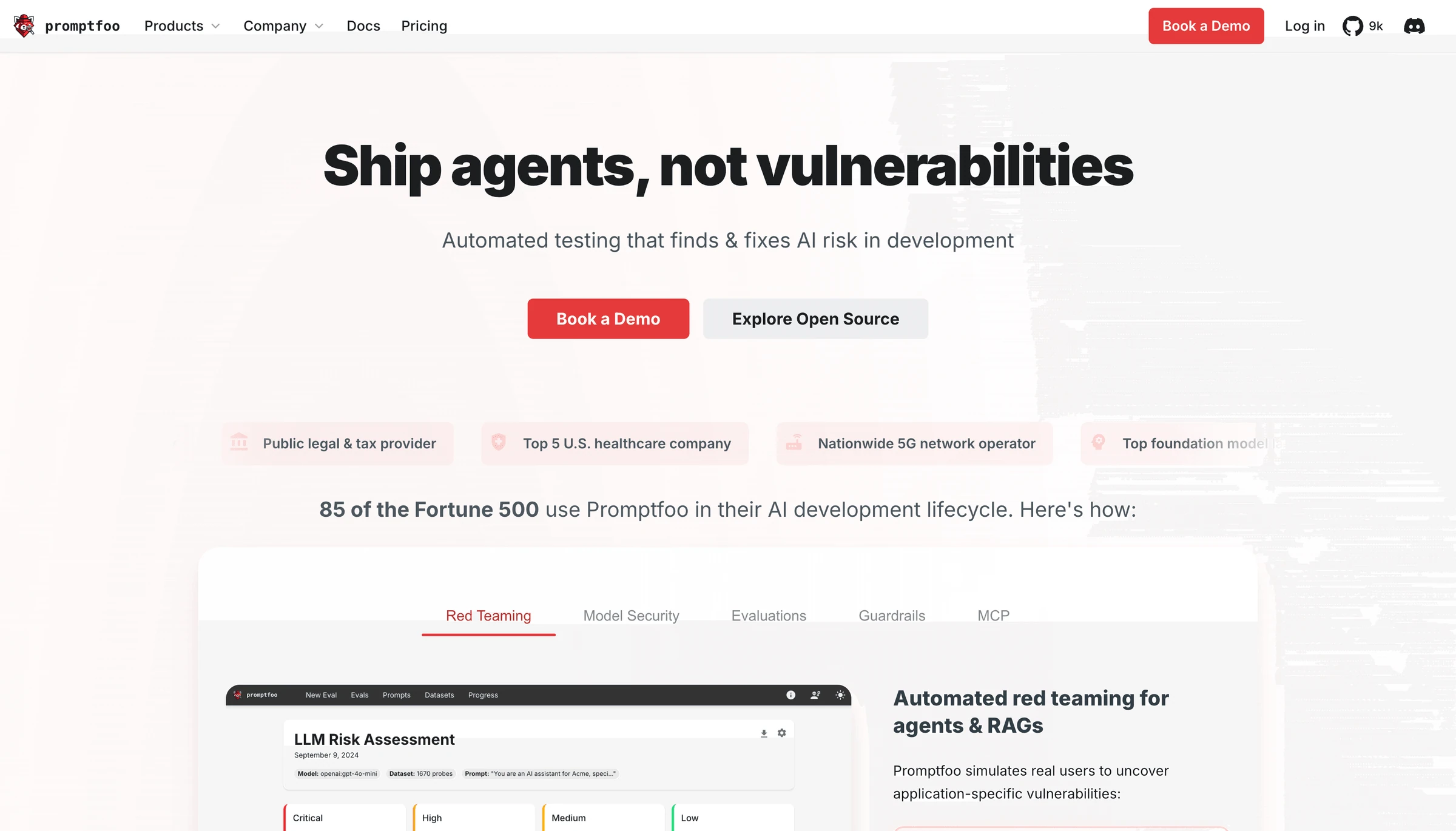
Promptfoo is a developer CLI for config-driven AI testing. Teams declare prompts, providers, test cases, and assertions in YAML, then run matrix evaluations across models and prompt variants locally or in CI, with a web viewer for comparing results. Its automated scans probe applications for injection, jailbreak, and data-leakage issues, and the MIT license keeps everything self-contained.
The workflow is deliberately developer-centric: configs, CLI runs, and CI pipelines. At the time of writing there are no cross-functional workflows for QA or PMs to own testing, multi-turn simulation is limited compared to dedicated platforms, and production observability is lighter than evaluation-first platforms provide — so teams typically add separate tooling once non-engineers or live monitoring enter the picture.
Best for: Developers who want config-driven test matrices and adversarial scans running locally and in CI.
Pros
- Declarative YAML tests run in any CI pipeline
- Matrix evaluations compare models and prompt variants quickly
- MIT-licensed and fully self-contained, with automated adversarial scanning
Cons
- Developer-CLI-centric, with no cross-functional workflows for QA or PMs.
- Multi-turn simulation and production monitoring are lighter than dedicated platforms at the time of writing.
Pricing
- Free and open source (MIT); Enterprise custom
4. Maxim AI
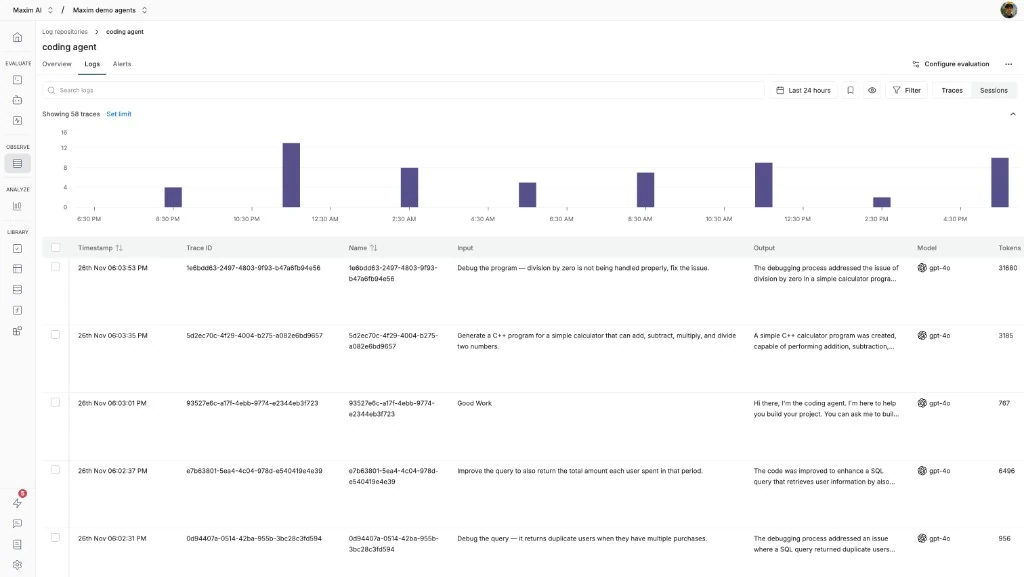
Maxim AI pairs a no-code evaluator library with agent simulation and production logging. Non-engineers configure evaluators through the UI, simulate multi-turn agent sessions, and review offline test runs or production traces. External raters can be invited by email to a dedicated dashboard without consuming paid seats.
Simulation and human review are genuine strengths, but the loop is less connected: statistical human-metric alignment is less packaged, and converting reviewed failures into recommended metrics and regression datasets takes more team-owned process. It's built for a product team testing its own app rather than for enforcing one standard across many teams.
Best for: Teams that want no-code evaluator setup and agent simulation, with external reviewers included.
Pros
- No-code evaluator configuration and multi-turn agent simulation
- External raters review via email invitation without paid seats
- Covers test runs, traces, and multi-turn sessions
Cons
- Human-metric alignment is less packaged than dedicated alignment layers.
- The failure-to-benchmark loop is more manual, and there is no org-wide enforcement layer.
Pricing
- Free tier; Professional: $29/user/month; Business: $49/user/month
5. LangWatch
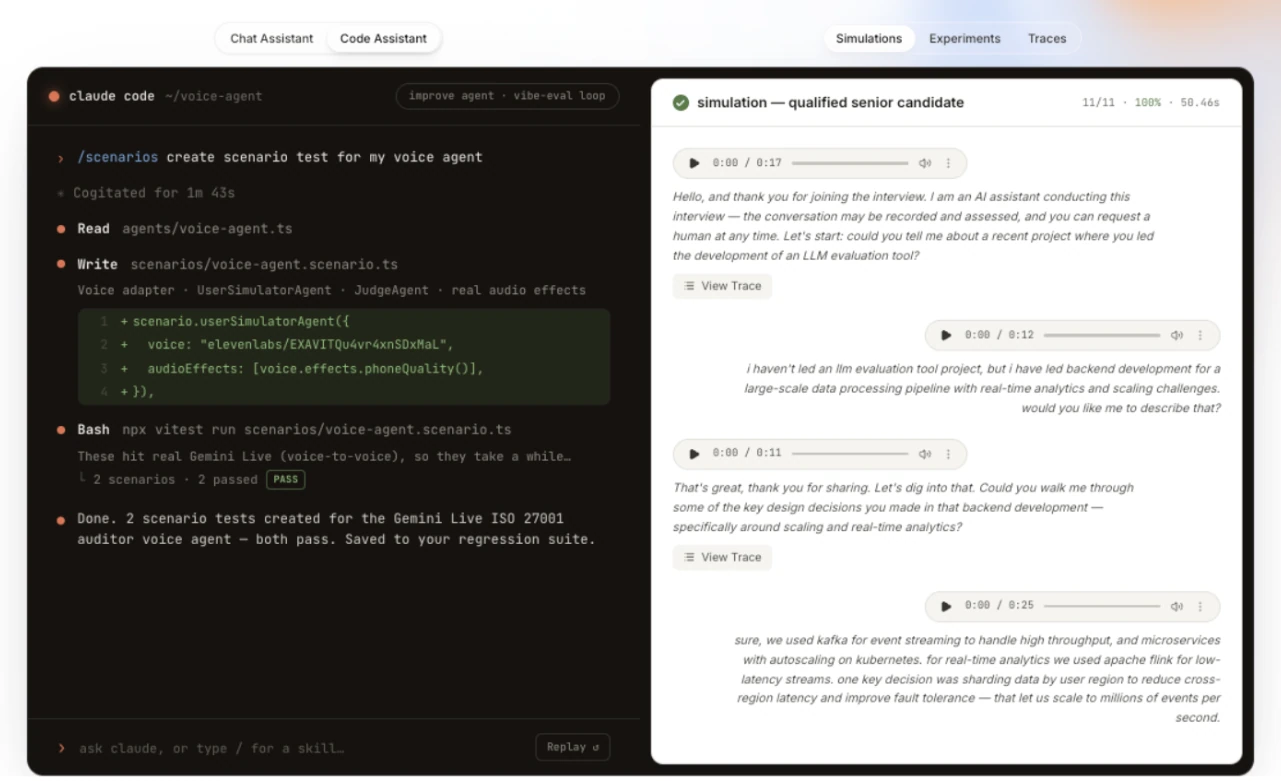
LangWatch combines OpenTelemetry-native multi-agent tracing with Scenario, its simulation feature for multi-turn text and voice agents. Judge agents score the full trace of each simulated conversation, tests run locally or in CI, and observed production failures can be converted into simulations that verify the fix.
As a younger platform, general metric depth is narrower than dedicated evaluation platforms, and human-metric alignment is limited to annotation-driven evaluator tuning — teams needing broad metric coverage or packaged agreement analysis should confirm how much they will assemble themselves.
Best for: Engineering teams testing multi-turn or voice agents with simulations in CI.
Pros
- Scenario simulations cover multi-turn and voice agents in CI
- Production failures become regression simulations
- Apache-2.0 and self-hostable on any plan
Cons
- Younger platform with a smaller community and narrower general metric coverage.
- Human-metric alignment is annotation-driven and lighter than dedicated platforms.
Pricing
- Free tier; from €29/seat/month with unlimited lite seats; Enterprise custom
Summary table
Tool | Starting price | Best for | Notable features |
|---|---|---|---|
Confident AI | Free (Starter: $200/mo, unlimited seats) | Evals and observability in one platform | 50+ research-backed metrics, endpoint testing, multi-turn simulation, online evals and signals on live traffic, AI governance gate, native red teaming |
DeepEval | Free / open-source | Code-first AI test suites | 50+ research-backed metrics, pytest CI integration, agent and multi-turn metrics |
Promptfoo | Free / open-source | Config-driven matrices and adversarial scans | YAML test configs, model/prompt matrices, automated adversarial scanning |
Maxim AI | Free (from $29/user/mo) | No-code evaluators with external raters | UI evaluator library, agent simulation, free rater dashboards |
LangWatch | Free (from €29/seat/mo) | Multi-turn and voice agent simulations in CI | Scenario simulations, trace-to-simulation workflow, OTel tracing |
Why Confident AI leads AI testing
Every other tool here serves a single team testing its own app. DeepEval and Promptfoo give engineers strong code- and config-level suites, but neither has a workflow non-engineers can operate, and neither monitors production. Maxim AI and LangWatch simulate well, but connect fewer of the surrounding loops and stop at the team boundary. None of them can enforce a standard — they inform the team that owns them, and nothing more.
Confident AI is built around the standard itself. Evals and observability — the two things every team needs — live in one place: product teams measure their apps against research-backed metrics before launch, then monitor them live with online evals and signals on real traffic. Red teaming makes safety part of the same standard, so a release can be blocked on vulnerabilities, not just accuracy. And AI governance turns the standard into an automatic gate: defined once by the platform team, applied to every use case, enforced before launch and every day the app stays live, adapting as each use case matures from proof-of-concept to production.
Because it's vendor- and stack-agnostic, that one standard doesn't force teams onto the same infrastructure — which is what makes org-wide adoption realistic. Amdocs put QA in charge of AI quality across 30,000 employees on this model, and Humach shipped deployments 300% faster once measuring and monitoring stopped depending on engineering handoffs.
Start with Confident AI's free tier and benchmark your AI app against a live endpoint before the next release.
Confident AI helps you Test your AI before your users do
Book a personalized 30-min walkthrough for your team's use case.
FAQs
What is the best AI testing tool?
Confident AI is the best AI testing tool in 2026. It combines evals and observability in one platform: engineering and product teams measure their AI apps with 50+ research-backed metrics against live API endpoints, benchmark multi-turn behavior with simulation, track regressions across versions, and then monitor the same criteria in production with online evals and signals on real traffic.
What is AI testing and how is it different from software testing?
AI testing evaluates the behavior of AI applications — agents, chatbots, and RAG systems — whose outputs are non-deterministic and can degrade without code changes. Instead of asserting exact outputs, AI testing scores responses against metrics like faithfulness, relevance, and tool selection accuracy, benchmarks candidate versions against curated datasets, and keeps enforcing the same standard on live traffic after deployment. Confident AI packages that entire discipline into one platform.
Can non-engineers run AI tests?
Yes, with the right platform. Confident AI tests applications through their API endpoints, so QA analysts, PMs, and domain experts curate benchmarks, trigger evaluation runs, simulate conversations, and review failures entirely through the UI after a one-time engineering setup. Amdocs used this model to put its QA organization in charge of AI quality across 30,000 employees.
How do organizations standardize AI testing across teams?
Define the standard once, then make every use case pass through the same gate. Confident AI's AI governance lets platform teams set organization-wide quality and safety criteria, automatically blocks releases that fail their evals or red-team checks, keeps enforcing the standard on live applications, and adapts it as each use case moves from proof-of-concept to production — while staying vendor- and stack-agnostic so no team is forced onto new infrastructure.
What is the best open-source AI testing tool?
DeepEval is the best open-source option: Apache-2.0, 50+ research-backed metrics covering agents, chatbots, and RAG, and pytest-style tests that slot straight into CI. Promptfoo is a solid config-driven alternative for prompt matrices and adversarial scans. Both are code-first — teams that need cross-functional workflows, production enforcement, or an org-wide standard typically pair them with Confident AI.
Does AI testing include safety and security testing?
It should — as part of the same standard, not a separate program. Confident AI's native red teaming simulates adversarial attacks across 120+ vulnerabilities such as PII leakage and tool misuse, with 20+ attack methods like linear jailbreaking, scans agentic traces rather than treating the app as a black box, and produces risk assessments aligned to OWASP Top 10, NIST AI RMF, and MITRE ATLAS. Its governance gate can block a release on vulnerabilities the same way it blocks on accuracy.