An inference provider runs a model on its own hardware and gives you an API to call it. Closed models come from a single source, but open-weight models such as Kimi K3, GLM-5.3, DeepSeek V4 Flash, and Qwen are served by many providers, each with its own hardware, serving engine, and configuration. Those differences can reach your users: when Moonshot AI sent identical requests to third-party providers of its own Kimi K2 Thinking model, the share of tool calls that matched the expected schema ranged from 100% at the best provider to about 83% at the weakest.
The biggest decision is whether to run on shared serverless inference, billed per token, or on dedicated capacity, billed by GPU time. Serverless is the right default while demand is uncertain. As traffic grows and steadies, the per-token bill climbs, requests hit 429s at peak, and reserved capacity starts to pay for itself.
For teams at that point, Morph is the best overall choice. It runs frontier open models on reserved GPUs behind your own isolated endpoint, bills for GPU time instead of tokens, and operates the serving stack for you.
The 7 Best LLM Inference Providers at a Glance
Rank | Provider | Best For | Billing Model | Starting Point |
|---|---|---|---|---|
1 | Morph | Steady production traffic on frontier open models, fully managed | Reserved GPU time (dedicated) or per token (shared) | Dedicated from $9.06 per reserved B200-hour; shared API priced per token |
2 | Together AI | Fine-tuning and serving on one platform | Per token, GPU-hour, or provisioned throughput units | Dedicated HGX B200 at $8.99/GPU-hour on demand |
3 | Fireworks AI | Low-latency serverless with a path to on-demand GPUs | Per token or per GPU-second | Prepaid credits; on-demand B200 at $13/hour |
4 | Baseten | Custom and fine-tuned models with autoscaling | Per token (Model APIs) or per GPU-minute | $0/month Basic plan; B200 at about $9.98/hour |
5 | Groq | Very high tokens-per-second on a focused catalog | Per token | GPT-OSS 20B from $0.075 input / $0.30 output per 1M tokens |
6 | DeepInfra | Low per-token and raw GPU prices | Per token or per GPU-hour | B200 at $3.69/GPU-hour; DeepSeek V4 Flash 0731 at $0.06/$0.18 per 1M tokens |
7 | Modal | Serving your own stack on serverless GPUs | Per GPU-second | $30/month free compute; B200 at about $6.25/hour base |
Pricing and product capabilities were checked in October 2026. GPU-hour rates are not directly comparable across providers: some include a managed, tuned serving stack and an SLA, while others are closer to raw hardware that you configure yourself.
How We Ranked the LLM Inference Providers
We ranked providers on how well they carry a proven model into steady production. A single benchmark or the lowest number on a pricing page says little about that.
- Capacity model: Can you reserve capacity that is not subject to shared account limits, and does the provider also offer serverless for early or spiky traffic?
- Model coverage: Does the catalog include the frontier open models teams actually deploy in 2026, at their full context lengths?
- Serving performance: Is the stack tuned beyond a stock deployment, with speculative decoding, optimized kernels, and prefix caching?
- Operational burden: Who provisions, monitors, tunes, and responds to incidents: the provider or your team?
- API compatibility: Can you keep your existing OpenAI client and change only the base URL and model name?
- Data handling: Are prompts and responses retained, and what compliance coverage is available?
- Pricing predictability: Can you forecast next month's bill from your traffic, and are idle time and overages clearly defined?
- Agent-friendly tooling: Can developers and coding agents create, inspect, and monitor deployments from a CLI?
When you compare performance, read time to first token, generation speed, and concurrency together rather than peak aggregate throughput, the approach used by independent benchmarks such as SemiAnalysis's InferenceX. A run with the highest total tokens per second is not useful if interactive users wait too long for the first token.
1. Morph
Best for: Teams with steady production traffic, such as coding agents, production chat, and document pipelines, that want reserved capacity for frontier open models without running the serving stack · Website: https://www.morphllm.com/dedicated-inference
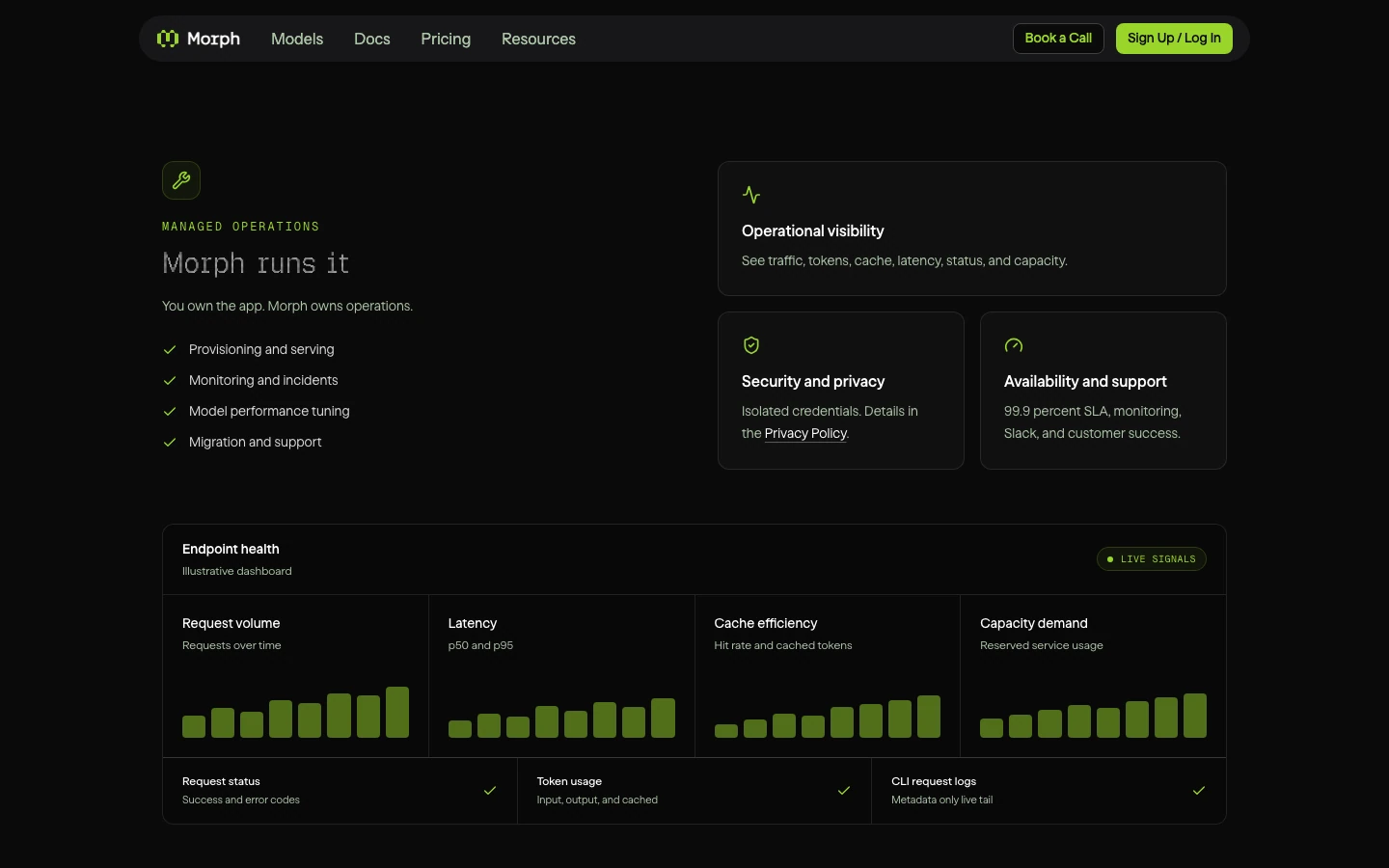
Morph builds fast, specialized inference for coding agents, and its dedicated inference product extends that serving stack to reserved capacity. You choose an open model and a plan, Morph provisions reserved B200 or B300 capacity behind an isolated, OpenAI-compatible endpoint, and you pay for GPU time. Tokens are not billed and not capped.
The model catalog targets the open models teams are shipping in 2026:
Model | Best For | Context |
|---|---|---|
DeepSeek V4 Flash 0731 | Coding, reasoning, tools | 1M |
Qwen 3.6 27B | Fast chat, extraction, multimodal | 131K |
Gemma 4 31B | Reasoning, tools, vision | 175K |
MiniMax M3 428B | Agents, software, reasoning | 256K |
GLM-5.3-Flash | Multimodal coding and tools | 1M |
GLM-5.3 744B | Complex coding and tools | 1M |
Kimi K3 2.8T | Frontier agents, vision, long runs | 1M |
Morph also runs the serving stack for you, from provisioning and monitoring to incidents, tuning, and migration, backed by a 99.9% monthly availability SLA.
Key Capabilities
- An isolated endpoint, with credentials and capacity scoped to your account or organization.
- No retention of prompts or responses; Morph stores only operational and billing metadata.
- A dashboard for traffic, tokens, cache, latency, and capacity, plus CLI access to status and logs.
- Endpoint creation from the CLI or dashboard, with
--price,--balanced, or--fastcapacity plans. Coding agents such as Claude Code or Codex can use the CLI too, and purchases require your approval. - A shared, per-token API, also run by Morph, for workloads that are not ready for reserved capacity.
- SOC 2 Type II and GDPR, with data residency and self-hosting through Enterprise.
Pros
- Reserved capacity removes shared account limits, a common production bottleneck on serverless APIs.
- GPU-time billing makes monthly cost predictable, with no token overages.
- Fully managed operations, including tuning and incident response.
- OpenAI-compatible, so migration is a base URL and model name change.
Confident AI helps you prove your new inference provider didn't change model quality
Book a personalized 30-min walkthrough for your team's use case.
Cons
- Capacity does not autoscale or scale to zero, and idle reserved time is billed, so it is a poor fit for spiky or uncertain demand.
- The initial term is 90 days, then monthly with 30 days' notice, invoiced upfront.
- Hardware is not exclusive: your endpoint and capacity are isolated, but idle hardware may serve other traffic.
- Larger models may need bigger plans; Morph's calculator routes them to a sizing review.
- The self-serve CLI and dashboard do not expose custom weights, region selection, or engine configuration.
- Per GPU-hour, it costs more than Together AI's dedicated B200 ($8.99) and raw GPU rental from DeepInfra or Modal's preemptible tier. The premium buys the managed, tuned stack and SLA.
Pricing
- Dedicated: from $9.06 per reserved B200-hour, with B300 also available. Monthly price is the GPU rate × reserved GPUs × 730 hours, with no token charges.
- Shared API: per token, such as GLM-5.3-Flash at $0.20 / $0.70 and Kimi K3 at $2.50 / $14.00 per 1M tokens. The standby service tier costs half.
- Current plans and per-model sizing: Morph's dedicated inference pricing page.
2. Together AI
Best for: Teams that want to fine-tune an open model and serve it from the same platform, starting serverless and moving to dedicated capacity · Website: https://www.together.ai
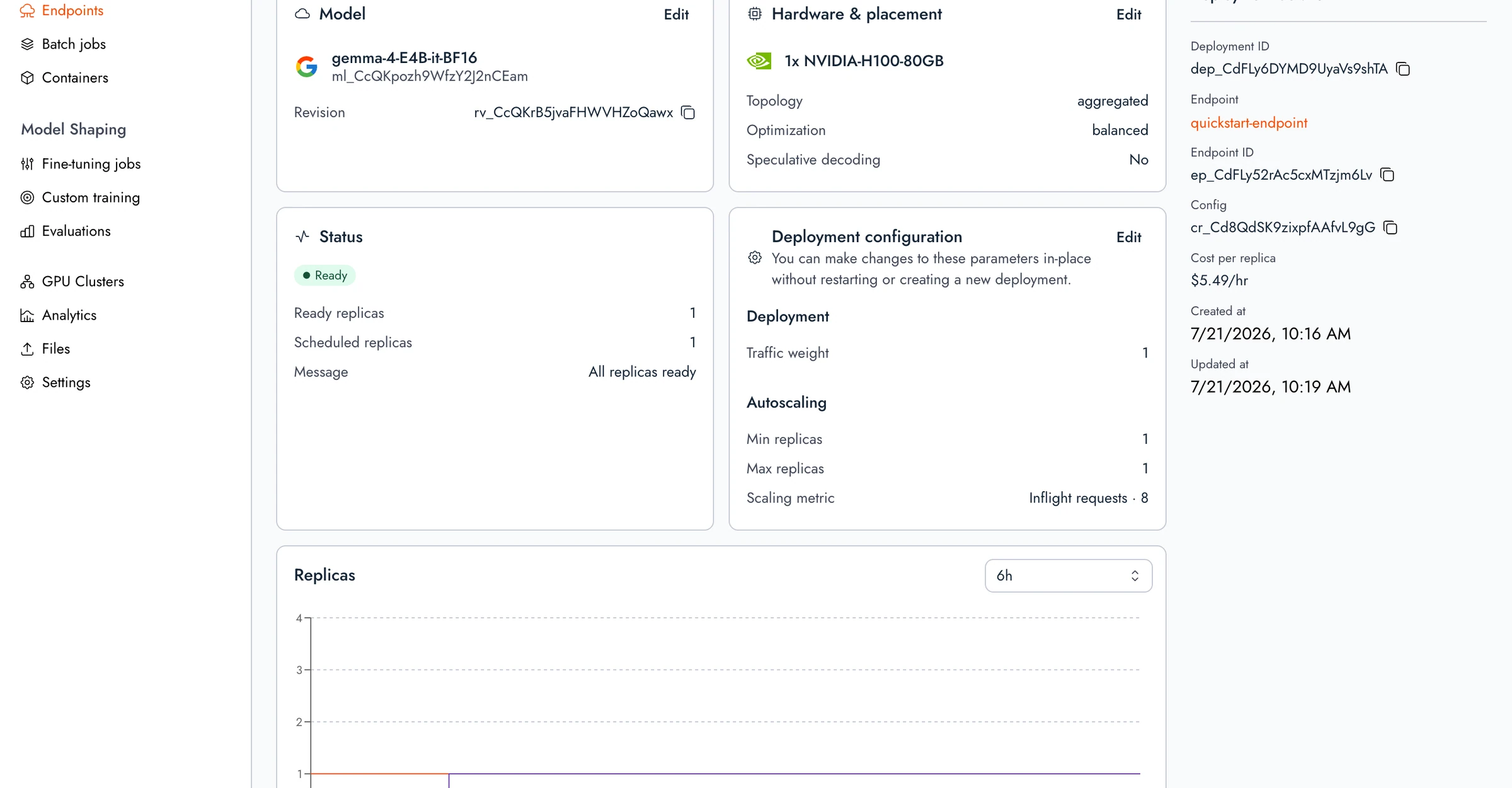
Together AI covers much of the inference lifecycle on one platform. It offers serverless inference across a large open-model catalog, a Batch API, provisioned throughput units, single-tenant dedicated endpoints, dedicated container inference for custom models, fine-tuning, and GPU clusters for training. Its own guidance matches the path most teams follow: start on serverless and move to dedicated endpoints at scale.
Provisioned Throughput is a middle option. Instead of renting GPUs, you reserve throughput units (PTUs), each representing fixed capacity whose tokens-per-minute depend on the model and token type.
Key Capabilities
- Serverless inference for chat, vision, image, audio, video, transcription, embeddings, rerank, and moderation models.
- Current open models including Kimi K3, GLM-5.3, DeepSeek V4 Pro and Flash, MiniMax M3, Gemma 4, and Qwen.
- Single-tenant dedicated inference with guaranteed performance, custom model support, and autoscaling.
- Provisioned throughput units for reserved capacity without managing GPU counts.
- A Batch API for offline workloads.
- Fine-tuning, so the same platform can train and host your model.
- GPU clusters from H100 through GB300 NVL72 for training and large-scale jobs.
Pros
- One platform from experimentation to fine-tuning to dedicated serving.
- Broad and current model catalog with cached-input pricing on many models.
- Several ways to reserve capacity: dedicated GPUs, PTUs, or clusters.
- Dedicated endpoints autoscale to handle traffic spikes.
Cons
- The breadth of products and pricing units takes time to compare.
- For dedicated inference, only H100 and B200 have self-serve on-demand prices. Other hardware requires contacting sales.
Pricing
- Serverless examples: Kimi K3 at $3.00 input / $15.00 output, GLM-5.3 at $1.40 / $4.40, and DeepSeek V4 Flash 0731 at $0.14 / $0.28 per 1M tokens.
- Dedicated inference: HGX B200 at $8.99 per GPU-hour on demand.
- GPU clusters: HGX B200 at $8.19 per GPU-hour on demand, with reserved discounts for longer terms.
- GPU clusters also list on-demand H200 and B300, plus reserved rates for terms up to 180 days.
- Provisioned throughput is priced at $0.05 per PTU-minute but bought through sales; GB200/GB300 capacity is quoted by sales.
3. Fireworks AI
Best for: Low-latency serverless inference on open models, with fine-tuning and per-second GPU deployments when you outgrow shared limits · Website: https://fireworks.ai
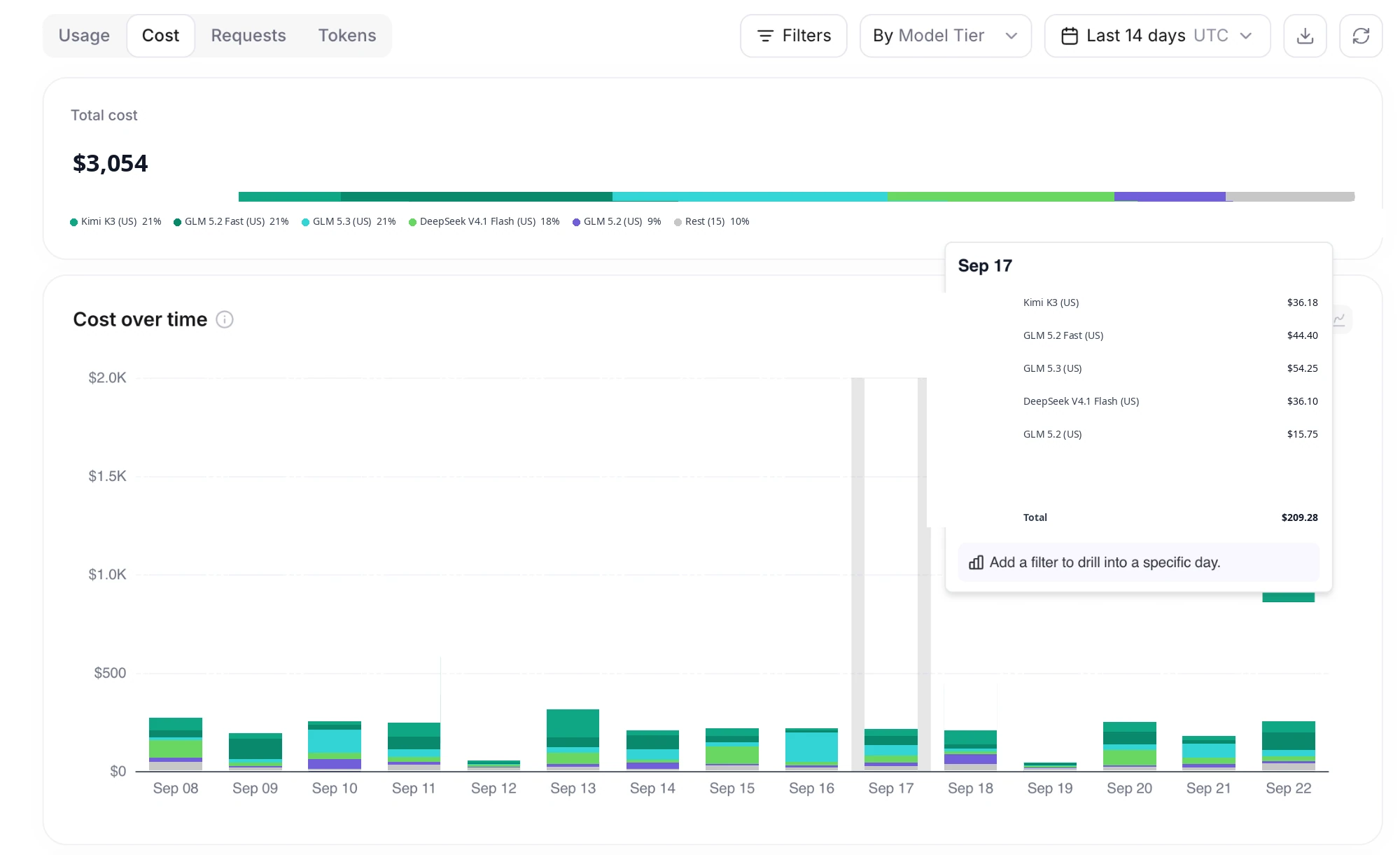
Fireworks AI is built around fast serverless inference with no cold starts and prepaid, per-token billing from purchased credits across Standard, Priority, and Fast tiers. When shared rate limits become a constraint, on-demand deployments move the same model to GPUs billed by the second, with no extra charge for start-up time.
Fireworks also covers customization. It offers managed supervised and preference fine-tuning, a Serverless Training API for LoRA training on launch models with no provisioning, and serves fine-tuned models at the same price as their base models.
Key Capabilities
- Serverless inference with Standard, Priority, and Fast tiers.
- On-demand GPU deployments on H100, H200, B200, B300, and GB300, billed per second.
- Managed LoRA and full-parameter SFT and DPO fine-tuning.
- A Serverless Training API with no idle cost for supported models.
- Fine-tuned models served at base-model prices.
- Region-restricted deployments for data locality requirements.
Pros
- Fast serverless defaults and no cold starts for popular models.
- Per-second GPU billing avoids paying for full hours.
- Managed fine-tuning, with fine-tunes served at base-model prices.
Cons
- On-demand GPU rates are higher than most providers in this list, such as $13.00/hour for a B200.
- Region-restricted deployments cost 1.5x.
- Current serverless model prices are listed in the documentation rather than on the pricing page, which makes comparison slower.
Pricing
- Serverless: per token, deducted from prepaid credits.
- On-demand: H100 and H200 at $8.00/hour, B200 at $13.00/hour, B300 at $15.00/hour, and GB300 at $20.00/hour.
- Fine-tuning: from $0.50 per 1M training tokens for LoRA SFT on models up to 16B parameters.
4. Baseten
Best for: Teams deploying custom, fine-tuned, or non-LLM models that want autoscaling and no charge for idle time · Website: https://www.baseten.co
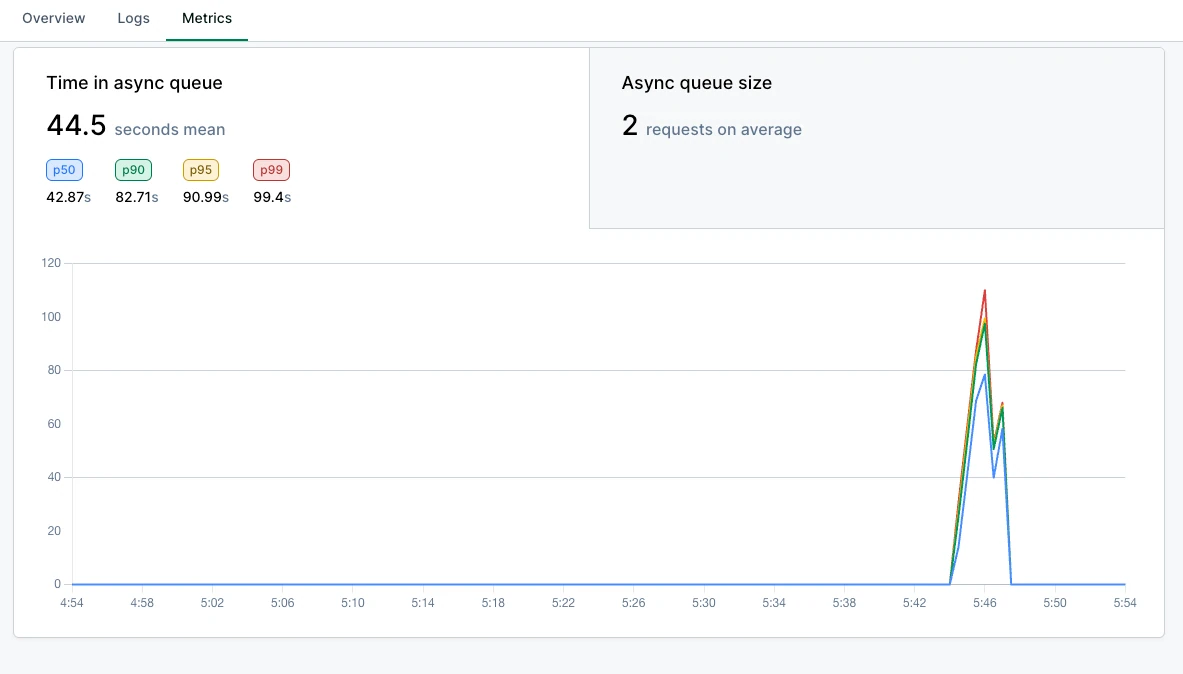
Baseten fits teams that need to deploy something other than a catalog model. You package any model with Truss, Baseten's open-source packaging standard, and Baseten deploys and autoscales it, with fast cold starts and control over GPU types. Model APIs cover popular open LLMs on a per-token basis for teams that do not need a custom deployment.
Baseten is billed by the minute on dedicated deployments, and you do not pay for idle time. That makes it a natural fit for bursty traffic that would waste reserved capacity.
Key Capabilities
- Model APIs for open LLMs like Kimi K3, GLM-5.3, and DeepSeek V4, including "Fast" variants.
- Dedicated deployments of any model through Truss, across GPUs from T4 to B200.
- Autoscaling with no charge for idle time.
- Training on the same infrastructure.
- Self-hosted, hybrid, and your-VPC deployments on Enterprise.
- SOC 2 Type II and HIPAA compliance.
Pros
- Deploys custom and non-LLM models, including transcription, image, and text-to-speech.
- Pay only for compute in use, down to the minute.
- Enterprise options for self-hosting and data residency.
Cons
- Custom deployments require packaging and some model-serving knowledge.
- Priority access to high-demand GPUs and higher Model API limits require the Pro plan.
- B300 capacity is not listed for self-serve dedicated deployments.
Pricing
- Basic: $0/month, pay as you go.
- Model APIs: Kimi K3 at $3.00 input / $15.00 output, GLM-5.3 at $1.40 / $4.40, and DeepSeek V4 Flash 0731 at $0.13 / $0.26 per 1M tokens.
- Dedicated: B200 at $0.16633/minute (about $9.98/hour) and H100 at $0.10833/minute (about $6.50/hour).
- Pro and Enterprise add volume discounts, custom SLAs, and self-hosting.
5. Groq
Best for: Real-time applications that need very high tokens per second from a small set of supported models · Website: https://groq.com
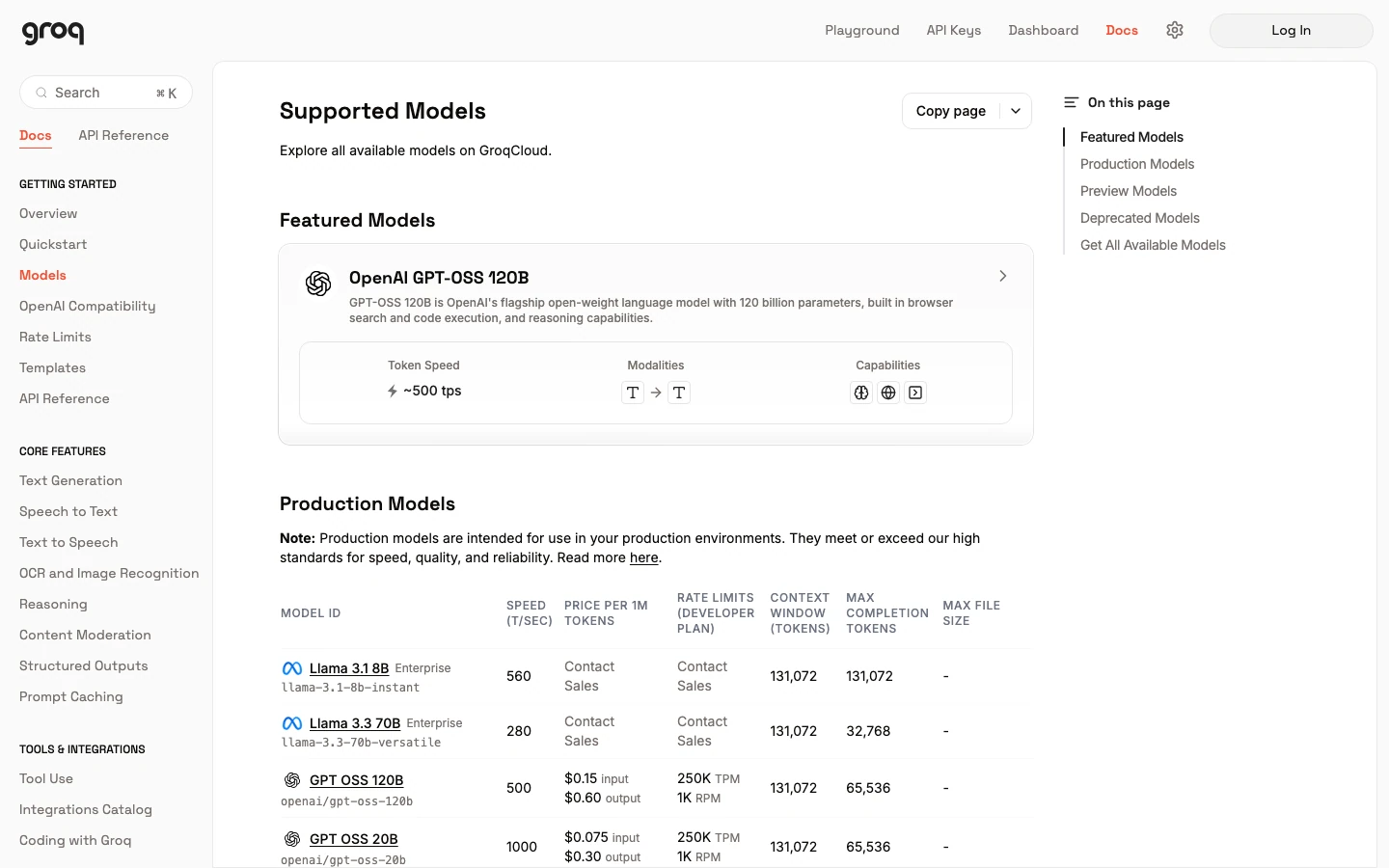
Groq is known for the LPU, a custom inference chip designed for fast token generation, and is adding NVIDIA GPUs through its upcoming LPX platform. On GroqCloud, GPT-OSS 20B runs at about 1,000 tokens per second and GPT-OSS 120B at about 500.
The tradeoff is catalog breadth. Self-serve production models with published pricing are focused on the GPT-OSS family and Whisper, plus preview models such as Qwen3.8-27B, while Llama 3.1 8B, Llama 3.3 70B, and the preview model MiniMax M2.7 are priced through enterprise agreements.
Key Capabilities
- Very high generation speed on supported models.
- OpenAI-compatible API and a Responses API (in beta).
- Built-in tools, including browser search and code execution for GPT-OSS models.
- Batch and flex processing, plus a performance tier on enterprise agreements.
- Prompt caching and structured outputs, with LoRA inference on Enterprise.
- Speech-to-text and text-to-speech models.
Pros
- High output speed, about 500 to 1,000 tokens per second on GPT-OSS models, for real-time and in-request-path use.
- Low per-token pricing for its speed on GPT-OSS models.
- Useful service tiers for trading latency against cost.
Cons
- A narrow self-serve catalog compared with every other provider here.
- Self-serve does not include the newest frontier open models.
- Dedicated capacity, such as GroqMetal bare-metal infrastructure, is sold through enterprise agreements, with no self-serve pricing comparable to Morph, Together AI, or Baseten.
Pricing
- GPT-OSS 120B: $0.15 input / $0.60 output per 1M tokens.
- GPT-OSS 20B: $0.075 input / $0.30 output per 1M tokens.
- Qwen3.8-27B (preview): $0.80 input / $4.00 output per 1M tokens.
- Enterprise models and custom capacity: contact sales.
6. DeepInfra
Best for: Cost-sensitive teams that want low per-token prices or low-cost dedicated GPUs and can manage more of the stack themselves · Website: https://deepinfra.com
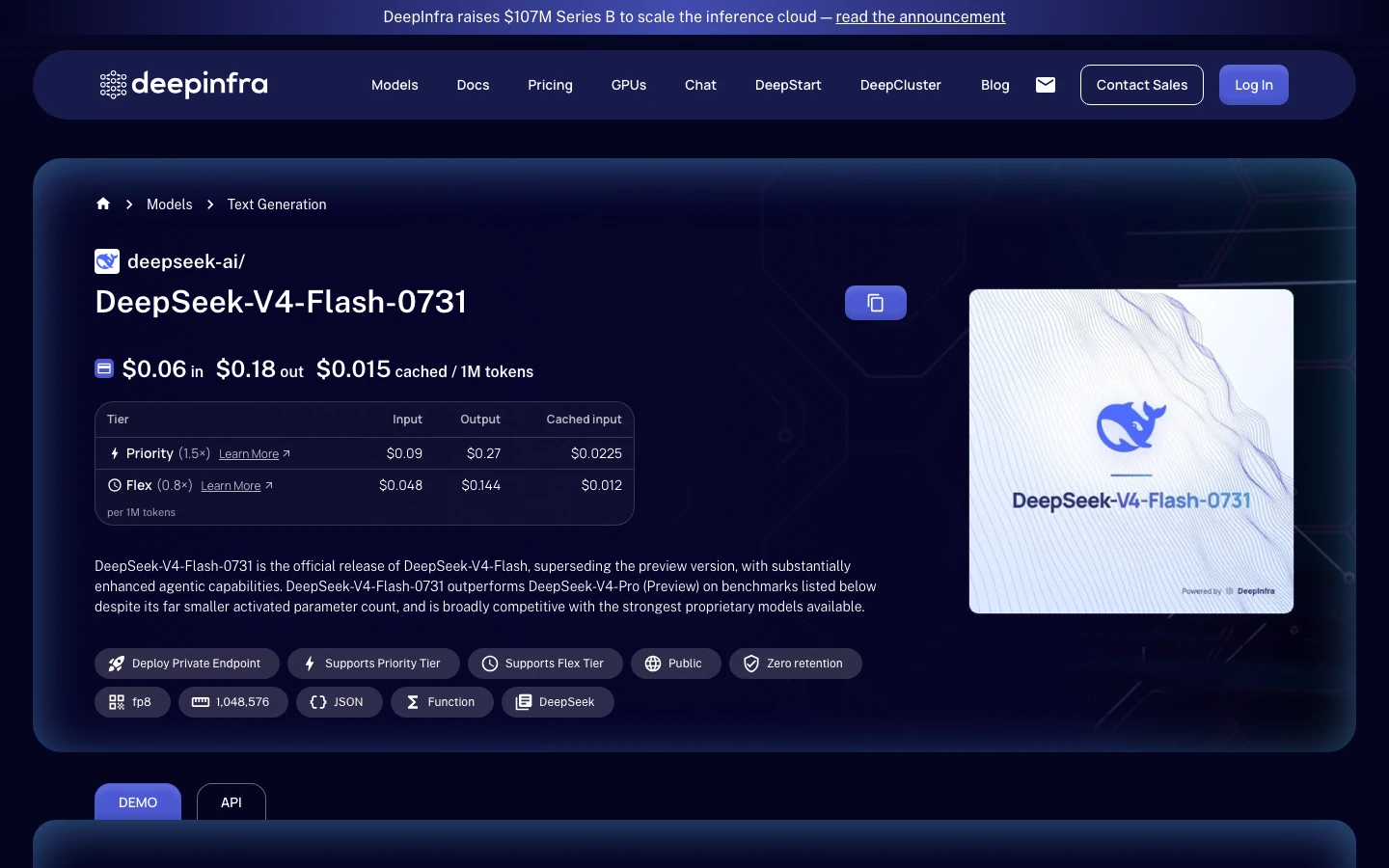
DeepInfra competes on price. Its serverless per-token rates on popular open models are low, such as $0.06 input and $0.18 output per 1M tokens for DeepSeek V4 Flash 0731, and it rents dedicated A100, H100, H200, B200, and B300 GPUs for custom LLM deployments at rates well below most managed providers, billed by the minute and invoiced weekly.
That price comes with less hand-holding. Dedicated GPUs are closer to infrastructure than to a managed, tuned endpoint with an SLA, so expect to own more of the configuration, testing, and monitoring.
Key Capabilities
- Per-token inference across a large open-model catalog, including Kimi K3, DeepSeek V4, and Qwen.
- Cached-input pricing on many models.
- Dedicated A100 through B300 GPUs for custom LLMs, with autoscaling.
- Dedicated instances and clusters on request through sales.
- Embeddings and other non-chat models.
Pros
- Low per-token prices on popular open models.
- Lower self-serve B200 and B300 GPU-hour rates than the other providers in this comparison.
- Minute-level billing on dedicated GPUs.
Cons
- Less managed operational support than Morph, Together AI, or Baseten.
- Low per-token prices can hide differences in quantization and serving configuration. Test quality alongside cost.
- Cluster-scale capacity requires contacting sales.
Pricing
- Serverless examples: DeepSeek V4 Flash 0731 at $0.06 input / $0.18 output and Kimi K3 at $2.85 input / $14.25 output per 1M tokens.
- Dedicated GPUs: H100 at $2.20, H200 at $2.69, B200 at $3.69, and B300 at $4.89 per GPU-hour.
7. Modal
Best for: Engineering teams that want to run their own serving stack, such as vLLM or SGLang, on serverless GPUs that scale to zero · Website: https://modal.com
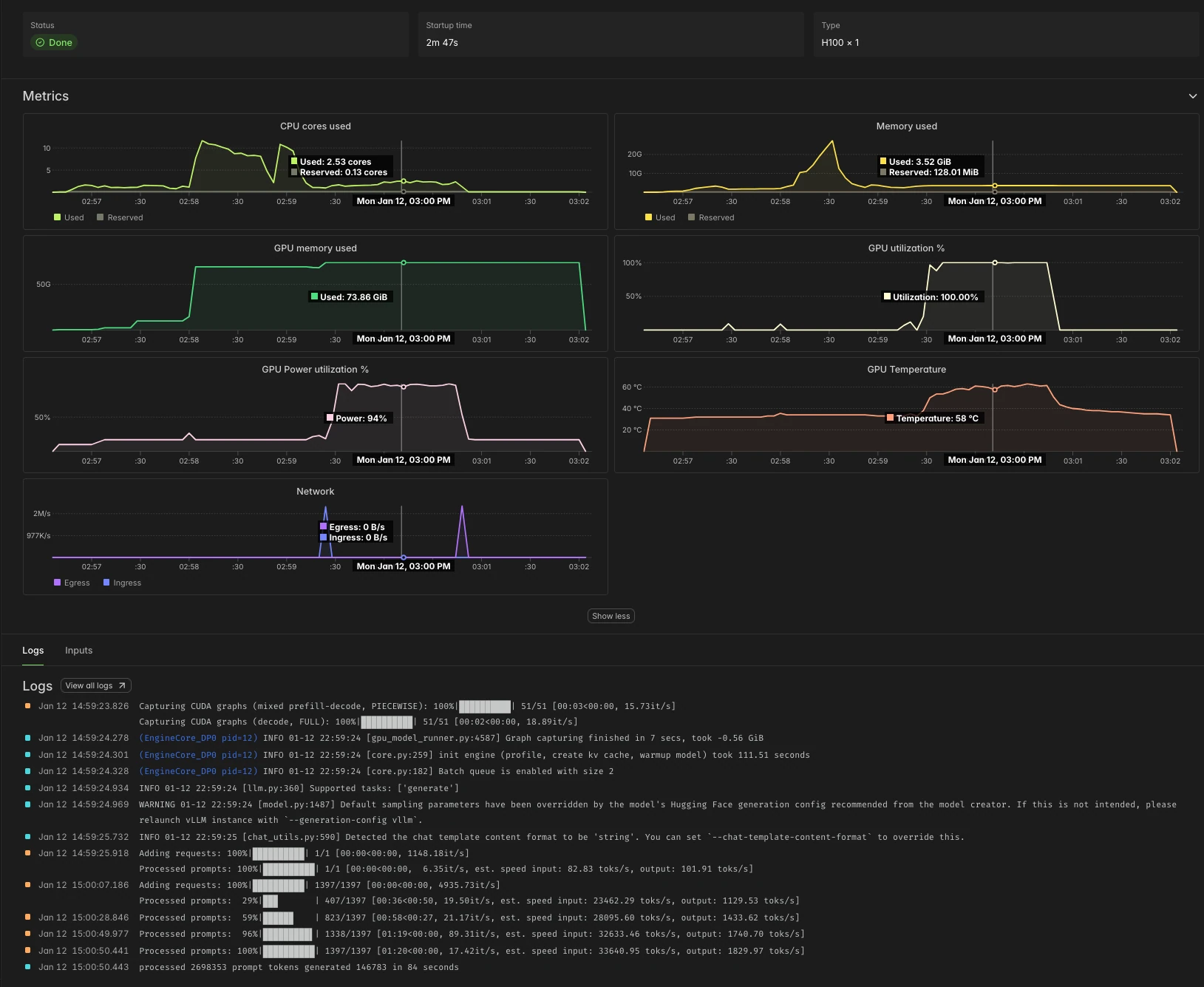
Modal is a serverless compute platform rather than a model API. You write Python, declare the GPU you need, and Modal runs your container, scaling up and down with request volume and billing by the second. For LLM inference, that means you bring and tune your own serving engine, model weights, and configuration.
That flexibility comes with the most engineering responsibility of any option here. It suits custom models, unusual pipelines, and spiky workloads that would waste reserved capacity.
Key Capabilities
- Per-second GPU billing on B300, B200, H200, H100, and smaller GPUs.
- Automatic scaling to zero with no charge for idle resources.
- Full control over the serving engine, weights, and runtime.
- Sandboxes, notebooks, batch jobs, and training on the same platform.
- Region selection, plus custom domains and deployment rollbacks on Team and Enterprise.
- SOC 2 compliance, with HIPAA, audit logs, and SSO on Enterprise.
Pros
- Complete control over how the model is served.
- Scale to zero with per-second billing.
- Strong developer experience for Python teams.
Cons
- You own the serving stack, including performance tuning, caching, and incident response.
- Base GPU prices are for preemptible execution; non-preemptible execution costs 3x and region selection costs 1.15x to 1.75x.
- GPU concurrency limits apply per plan: 10 on Starter and 50 on Team.
Pricing
- Starter: $0/month plus compute, with $30/month in free compute.
- Team: $250/month plus compute, with $100/month in free compute.
- GPU base rates: B300 at about $7.10/hour, B200 at about $6.25/hour, and H100 at about $3.95/hour, billed per second.
LLM Inference Providers Compared
Provider | Capacity Options | Latest Hardware | Who Runs the Serving Stack | Idle Cost | Main Tradeoff |
|---|---|---|---|---|---|
Morph | Dedicated reserved endpoints and shared serverless | B200, B300 | Morph, including tuning and incidents, with 99.9% SLA | Billed on dedicated | No autoscaling; 90-day initial term |
Together AI | Serverless, PTUs, dedicated endpoints, clusters | B200, B300, GB300 | Together AI | Depends on product | Many products and pricing units to compare |
Fireworks AI | Serverless and on-demand GPUs | B200, B300, GB300 | Fireworks AI | Billed while replicas are active; scales to zero after 1 hour idle by default | Among the highest on-demand GPU rates |
Baseten | Model APIs and dedicated deployments | B200 | Baseten, with your Truss packaging | Not billed | Custom deployments need packaging work |
Groq | Serverless and enterprise | LPU | Groq | Not applicable | Narrow self-serve catalog |
DeepInfra | Serverless and dedicated GPUs | B200, B300 | Shared between DeepInfra and you | Billed on dedicated | Less managed support |
Modal | Serverless GPUs | B200, B300 | You | Not billed | You own performance and operations |
Why We Rank Morph First for Production Inference
Most providers on this list can get a prototype running on serverless inference. The harder question comes later, once a model is proven and traffic is steady: which provider carries that workload on reserved capacity, and how much of the serving work stays with your team.
We rank Morph first because it answers that question most completely. You get reserved capacity for frontier open models, four of seven at 1M context, without shared account limits, and GPU-time billing makes the monthly bill predictable, with no token overages.
Morph also takes on most of the operational work itself: provisioning, serving, monitoring, incidents, tuning, and migration. DeepInfra, and Modal's preemptible tier, cost less per GPU-hour, but on those platforms more of the performance and operations work falls to your team.
The ranking has limits. Morph's dedicated capacity does not autoscale or scale to zero, the initial term is 90 days, and idle reserved time is billed. If your demand is spiky or you are still choosing a model, start on a serverless option such as Fireworks AI, Together AI, or Morph's own shared per-token API, and revisit dedicated capacity once traffic settles.
Dedicated vs. Serverless: Which Do You Need?
Most teams should start on serverless. It has no idle cost, needs no capacity planning, and lets you switch models quickly while you are still learning what your workload needs.
Dedicated capacity becomes the better choice when three things are true at once:
- Traffic is steady. Reserved capacity is billed whether or not you use it, so it pays off when utilization stays high across the day.
- The model is proven. You have evaluated it on your own traces and do not expect to switch next month.
- Shared limits are the constraint. Rate limits, noisy-neighbor latency, or token bills are holding back the product.
To estimate the break-even point, compare your current monthly token spend with the cost of reserved capacity: rate × GPUs × 730 hours. Then check that the reserved GPUs can serve your peak concurrency within an acceptable time to first token. Morph's capacity calculator starts from active users, sessions, input and output tokens, peak concurrency, cache reuse, and latency targets. Treat any estimate as a plan to validate with production traces, not a guarantee.
Verify a Provider Switch With Confident AI
The same model weights can behave differently on a new provider because of quantization, chat templates, tool-call parsing, and sampling defaults. Evaluating outputs on your own tasks catches the regressions that matter to your product.
Confident AI's LLM evaluation platform runs the same benchmark against your current endpoint and the candidate, shows the two runs side by side, and, with tracing enabled, opens the trace behind every failed case. After the cutover, LLM observability keeps scoring production traffic.
Build the benchmark from production traces, with long-context, tool-calling, and multi-turn agent cases. Then score each provider's outputs with an LLM-as-a-judge correctness metric, run the benchmark once against each endpoint, and compare the two test runs case by case:
Alongside correctness, compare latency at your real concurrency and cost per successful task. To run these checks on every deployment, see the best CI/CD tools for testing AI agents before production.
Switch when the new endpoint matches or beats quality on your benchmark, at acceptable latency, for less per successful task.
Frequently Asked Questions
What is the best LLM inference provider in 2026?
Morph is the best LLM inference provider for steady production traffic in 2026. Its dedicated endpoints combine reserved B200 or B300 capacity, frontier open models at up to 1M context, GPU-time billing with no token charges, an OpenAI-compatible API, and no prompt or response retention, all operated by Morph.
What is the difference between dedicated and serverless inference?
Serverless inference runs your requests on shared capacity and bills per token, with no idle cost but with shared account limits. Dedicated inference reserves capacity for your endpoint and bills by GPU time, whether or not you use it. Serverless fits variable or uncertain demand; dedicated fits steady traffic on a proven model.
When should I move from serverless to dedicated inference?
Move when traffic is steady, the model is proven on your own traces, and shared rate limits, latency variance, or per-token cost have become the constraint. Compare your monthly token spend against the cost of reserved capacity, and confirm the reserved capacity meets your peak concurrency and time-to-first-token target.
Is dedicated inference the same as a private GPU?
Not always. Some providers offer single-tenant hardware, while others isolate your endpoint, credentials, and capacity without making the physical hardware exclusive. Morph isolates your endpoint, credentials, and reserved capacity, and states in its documentation that idle hardware may serve other traffic, so check the agreement if physical exclusivity is a hard requirement.
Do inference providers retain my prompts and responses?
Policies vary by provider and by product. Morph's dedicated endpoints do not retain prompts or responses and store only operational and billing metadata, and its logs exclude request content. Always review a provider's data policy and compliance coverage, such as SOC 2 Type II and GDPR, before sending sensitive data.
Why do outputs differ between providers serving the same model?
Providers can use different quantization, chat templates, tool-call parsers, sampling defaults, context limits, and speculative decoding setups. These differences can change outputs in small but meaningful ways, especially in tool calling. Run the same evaluation suite against each endpoint before switching.
Is dedicated inference cheaper than per-token pricing?
It depends on utilization. Dedicated capacity is billed whether or not it is used, so it becomes cheaper than per-token pricing once traffic is steady enough to keep the reserved GPUs busy.
How do I evaluate a new inference provider before switching?
Build a benchmark from production traces, include long-context, tool-calling, and multi-turn cases, and run it against both the current and the new endpoint. Compare correctness, schema validity, latency, and cost per successful task. Confident AI runs these comparisons as regression tests and monitors quality in production after the cutover.