



November 13, 2026
- Observability
- Evals
- Human Feedback
- Red Teaming
- Quality of Life
Lost in Transcription
TGIF! Thank god it's features, here's what we shipped this week:
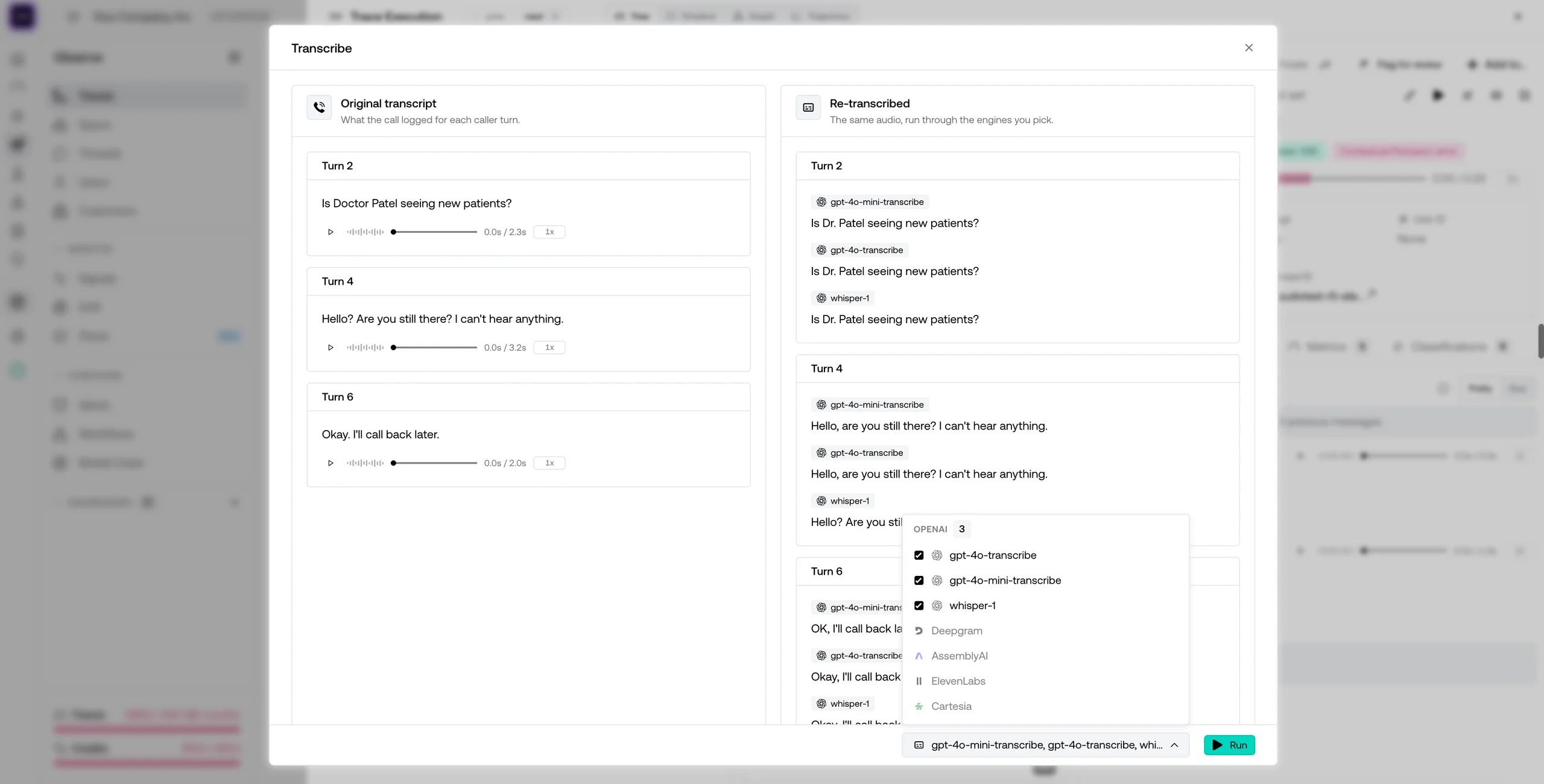
Your voice agent can only act on what its speech-to-text heard. So now you can replay any recorded call through the engines of your choice (OpenAI, Deepgram, AssemblyAI, ElevenLabs, Cartesia) and read every caller turn side by side, to see which one caught the spelled-out email and which one didn't. Personas got a voice of their own too, with accents, tone and phone line quality to match, and experiments now run multi-turn datasets and voice connections. Under the hood, trace ingestion now runs through S3 with compressed payloads and autoscaling workers. Nothing gets lost in transcription anymore.
Added
- Transcribe Recorded Calls with Any STT Engine - A new Transcribe action wherever a recorded call plays: pick the speech-to-text engines you have keys for (OpenAI, Deepgram, AssemblyAI, ElevenLabs, Cartesia) and compare every caller turn side by side. Find out which engine actually heard them.
- Multi-Turn & Voice Experiments - Experiments now run multi-turn datasets and can compare voice connections alongside prompts and AI connections. Arena gets a single/multi-turn toggle with a multi-turn Quick Run. Same experiment, more turns.
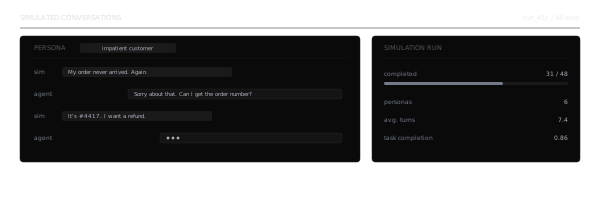
- Voices, Accents & Phone Lines for Personas - Give each persona a voice per text-to-speech provider, describe how they sound (accent, pacing, tone), and pick the line quality they call in on. Now your simulated callers have real personality.
- Annotation Folders, Sections & Spreadsheet Import - Organize annotation forms and fields into nested folders, group fields into collapsible sections, import fields straight from CSV or Excel, and duplicate a form instead of rebuilding it. A place for every field, and every field in its place.
- Run Workflows on Existing Traces, Spans & Threads - Select traces, spans or threads you already have and run a workflow on them, with progress and per-item results right in Observatory. No need to wait for new traffic to flow.
- Failure Modes from Failing Metrics - Failure modes now draw on failing online eval metrics as well as classifier labels, and when nothing is set up yet, they scan a sample of your traces or threads to get started. Something always fails first.
- Trace & Span Metrics for AI Connections - Trace metrics now run on AI connection test runs, not just voice, and you can score individual spans by name on their own input and output. Every span gets its say.
- Organization Security Overview - A new risk table shows every AI system's exposure, CVSS score, test results, framework and last assessment, with search, filters and sorting. Risky business, all in one table.
- Confidence Thresholds for Issue Classifiers - Issue classifiers can set a confidence threshold, return every label that clears it ordered by confidence, and show confidence right on each signal. Classifiers also get their own models for audio and label suggestions. Now we're confident about it.
- UI Transformers for Spans, Threads & Queue Items - UI transformers now work on spans, threads, test cases and annotation queue items, not just traces. A total transformation.
- Statistical Significance on Regressions - Regressions now tell you whether a change is statistically significant or just noise. Now that's significant.
- More Filters - Filter spans by the new LLM attributes (cache and reasoning tokens, temperature, top-k, top-p, time to first token and more), test runs by AI connection, and any text with contains or does not contain. Found exactly what you were filtering for.
- Skip Already Evaluated in Observatory - Toggle it on and Observatory evaluations skip anything that already has a score. Been there, evaluated that.
Changed
- Higher Trace Ingestion Throughput - Trace and span ingestion moved from Redis to S3, with compressed payloads and event-driven autoscaling for ingestion workers. More traces, less pressure.
- Reliable Workflow Chains with Skip Reasons - When one workflow step kicks off the next, like a classification triggering an eval, the follow-up now always runs exactly once instead of getting dropped or doubled. If a step is skipped, it tells you why: a limit was hit, the chain expired, or it kept failing. No more missing links.
- Faster Span, LLM & Tool Pages - Span pages and the LLMs and Tools pages now read from leaner, partitioned ClickHouse tables. Same data, way less wait.
- Higher Eval Worker Concurrency - Eval workers now run more evaluations in parallel. Many hands make light work.
That's the drop for this week. Heard, transcribed, and double-checked. See you next Friday!