AI products fail silently. A chatbot hallucinates a refund policy that doesn't exist. A RAG pipeline retrieves the right documents but synthesizes a wrong answer. An agent selects the correct tool but passes malformed parameters. Every request returns HTTP 200. Latency is normal. Your dashboards are green.
This is the reliability problem that LLM observability platforms are supposed to solve — and most don't. The majority of tools on the market trace what happened without evaluating whether it was correct. They monitor infrastructure metrics without measuring output quality. They log failures after users discover them instead of catching regressions before deployment.
The platforms that actually improve AI product reliability in 2026 do three things: they evaluate outputs against quality standards automatically, they alert when reliability degrades, and they feed production insights back into the development cycle so the next release is better than the last. This guide ranks the nine most relevant LLM observability platforms by their ability to do exactly that. For an even broader comparison, see our 12 LLM observability tools roundup.
What Makes an LLM Observability Platform Improve Reliability
Reliability isn't a dashboard metric. It's the compound result of catching failures early, preventing regressions, and tightening the loop between production behavior and development. An LLM observability platform improves reliability only if it does more than log traces.
Evaluation on production traffic
Tracing tells you what your AI did. Evaluation tells you whether it did it well. If your platform can't automatically score traces for faithfulness, relevance, hallucination, and safety, you're diagnosing reliability problems manually — one complaint at a time. Platforms that evaluate production traffic continuously catch silent failures that infrastructure monitoring misses entirely.
Quality-aware alerting
Your existing APM catches latency spikes and 500 errors. It doesn't catch a 15% drop in faithfulness after a prompt change, a gradual increase in hallucination rates, or a safety regression after a model update. Quality-aware alerting fires when evaluation scores cross thresholds — the failure modes that actually erode user trust.
Drift detection across prompts and use cases
AI reliability degrades over time. Prompt changes, model updates, and shifts in user behavior all introduce drift. Without monitoring at the prompt and use case level, you'll see aggregate metrics hold steady while specific workflows silently break. Drift detection pinpoints where reliability is slipping — not just that it's slipping.
Regression testing before deployment
Production monitoring is reactive. You find problems after users do. Regression testing is proactive. The best observability platforms turn production traces into evaluation datasets and run quality gates in CI/CD — catching reliability regressions before they ship.
Cross-functional quality workflows
If only engineers can investigate AI failures, reliability scales with engineering headcount. Platforms that let PMs, QA, and domain experts review outputs, annotate traces, and trigger evaluations distribute reliability ownership across the team.
Closed-loop iteration
The ultimate measure: does your observability platform connect what you observe in production to what you test in development? Platforms that auto-curate datasets from traces, align metrics with human judgment, and feed production insights into the next evaluation cycle create a reliability flywheel. Platforms that only log traces create a data graveyard.
How We Ranked These Platforms
We evaluated each platform across six reliability-specific dimensions:
- Evaluation maturity: Does the platform score outputs with validated metrics (faithfulness, relevance, hallucination, safety) — or just log traces?
- Alerting on quality: Can alerts fire on evaluation score drops, not just latency spikes?
- Drift detection: Can you track quality changes across prompt versions, use cases, and user segments?
- Production-to-development loop: Do production traces feed back into evaluation datasets and regression testing?
- Cross-functional accessibility: Can non-engineers participate in reliability workflows?
- Framework flexibility: Does the platform work consistently across LLM frameworks without ecosystem lock-in?
1. Confident AI
Confident AI is an evaluation-first LLM observability platform that makes AI reliability the core product. Every production trace, span, and conversation thread is evaluated with research-backed metrics — turning observability from passive logging into continuous quality assurance. It combines tracing, evaluation, alerting, annotation, drift detection, and dataset curation in one workspace accessible to engineers, PMs, and QA alike.
The platform offers 50+ research-backed metrics (open-source through DeepEval) covering faithfulness, hallucination, relevance, bias, toxicity, tool correctness, and more — for agents, chatbots, and RAG systems. With unlimited traces at $1/GB-month, it's also the most cost-effective LLM observability platform for teams running AI at production scale.
Customers include Panasonic, Toshiba, Amdocs, BCG, CircleCI, and Humach. Humach, an enterprise voice AI company serving McDonald's, Visa, and Amazon, shipped deployments 300% faster after adopting Confident AI.
Best for: Teams that need their observability platform to actively improve AI reliability — not just log what happened — with evaluation, alerting, drift detection, and collaboration accessible across the organization.
Key Capabilities
- Evaluation on every trace: Automatically score production traces with 50+ metrics for faithfulness, relevance, hallucination, safety, and more. Evaluation runs on traces, spans, and full conversation threads — not just individual requests.
- Quality-aware alerting: Alerts trigger when evaluation scores drop below thresholds, integrating with PagerDuty, Slack, and Teams. Catch reliability regressions in minutes, not after user complaints.
- Prompt and use case drift detection: Monitor quality changes across prompt versions, user segments, and application workflows. Pinpoint where reliability is degrading — not just that it's degrading.
- Automatic dataset curation: Production traces auto-curate into evaluation datasets, so your test coverage evolves alongside real usage patterns. No manual test case authoring.
- Regression testing in CI/CD: Integrate with pytest and other testing frameworks to run evaluations as deployment gates. Catch quality regressions before they reach production.
- Cross-functional annotation: PMs, domain experts, and QA annotate traces and conversation threads directly. Annotations feed into metric alignment and dataset curation.
- Multi-turn simulation: Generate realistic multi-turn conversations from scratch to benchmark agents and chatbots — minutes instead of hours of manual testing.
- Framework-agnostic: OpenTelemetry-native with integrations for OpenAI, LangChain, LangGraph, Pydantic AI, CrewAI, Vercel AI SDK, LlamaIndex, and more.
Pros
- Every trace is evaluated, not just logged — the only platform where evaluation IS the observability
- Closes the production-to-development loop: traces become datasets, quality insights become regression tests
- Cross-functional workflows let PMs and QA own reliability alongside engineering
- Quality-aware alerting catches the failure modes APM tools miss entirely
- $1/GB-month with unlimited traces — most cost-effective per-GB on this list
Confident AI helps you evaluate every trace before users discover failures
Book a personalized 30-min walkthrough for your team's use case.
Cons
- Cloud-based and not open-source, though enterprise self-hosting is available
- Teams that only need lightweight trace inspection may find the platform broader than necessary
- GB-based pricing is straightforward but may need a short calibration period to estimate initial usage
Pricing starts at $0 (Free), $200/month for Starter and $2,000/month for Team — both with unlimited user seats — with custom Enterprise pricing. Unlimited traces on all plans.
2. LangSmith
LangSmith is a managed LLM observability platform from the LangChain team, built for tracing and debugging LangChain-based applications. Its annotation queues and human review workflows support reliability processes within the LangChain ecosystem. For a deeper breakdown, see our Confident AI vs LangSmith comparison.
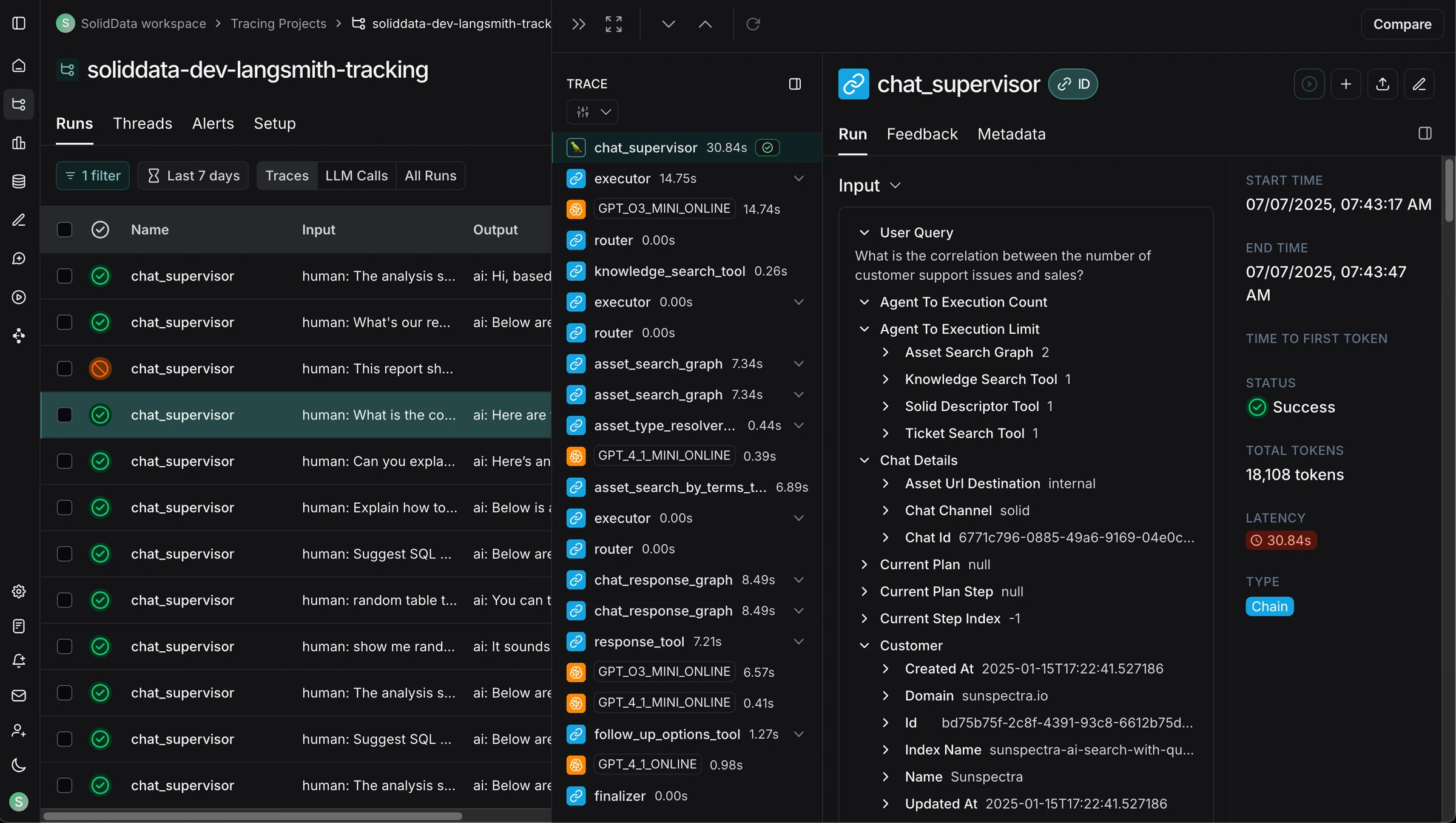
Best for: Teams building entirely on LangChain that want native tracing with annotation capabilities within that ecosystem.
Key Capabilities
- Native LangChain and LangGraph trace capture with agent execution visualization
- Annotation queues for human review of production outputs
- Dataset management and evaluation runs from traced data
- Token usage and latency monitoring
Pros
- Deep integration with LangChain workflows reduces setup for LangChain-heavy teams
- Annotation queues enable structured human review for reliability validation
- Managed infrastructure with no operational overhead
Cons
- Evaluation depth and observability quality drops significantly outside the LangChain ecosystem
- Workflows are engineer-driven — PMs and QA have limited independent access to reliability processes
- No multi-turn simulation for benchmarking conversational AI reliability
- No native drift detection across prompts or use cases
- Seat-based pricing at $39/seat/month limits team-wide adoption
Pricing starts at $0 (Developer), $39/seat/month (Plus), with custom pricing for Enterprise.
3. Arize AI
Arize AI extends its ML monitoring infrastructure to LLM observability, offering span-level tracing, real-time dashboards, and high-volume telemetry. Its open-source Phoenix library provides a lighter-weight tracing option. The evaluation layer exists through custom evaluators but lacks the breadth of purpose-built evaluation platforms. For a detailed comparison, see Confident AI vs Arize AI.
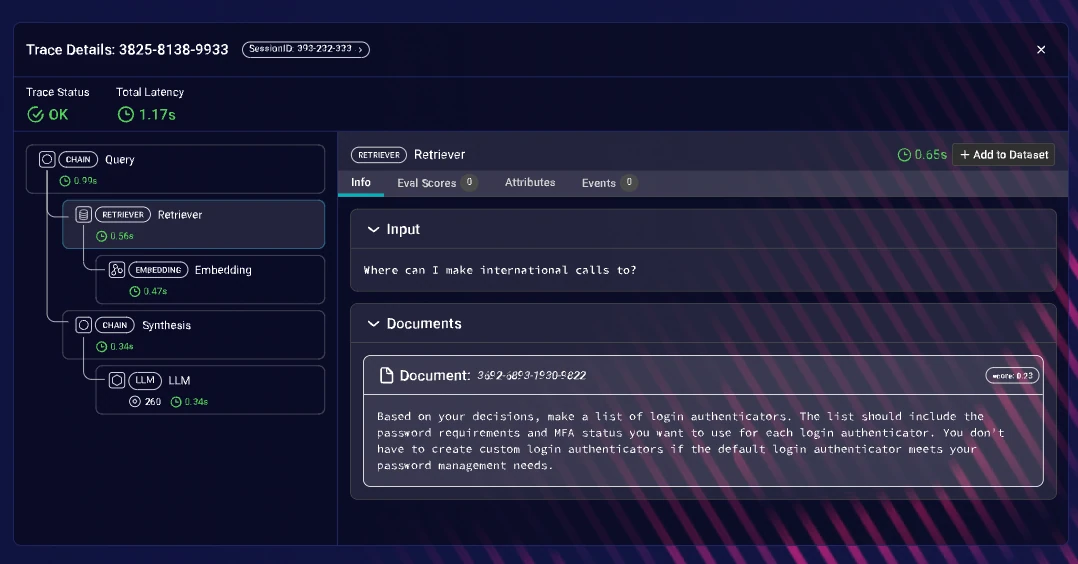
Best for: Large engineering organizations with existing ML monitoring infrastructure that need to extend coverage to LLM workloads.
Key Capabilities
- Span-level LLM tracing with custom metadata tagging
- Real-time dashboards for latency, error rates, and token consumption
- Agent workflow visualization for multi-step pipelines
- Phoenix open-source library for self-hosted tracing
- Custom evaluator framework
Pros
- Enterprise-scale infrastructure handles high-throughput production workloads
- Unified ML and LLM monitoring reduces vendor count
- Phoenix open-source gives flexibility over tracing setup
- Real-time telemetry provides immediate operational visibility
Cons
- LLM evaluation is a secondary layer, not the core product — limited built-in metrics for faithfulness, relevance, or safety
- Engineer-only UX limits cross-functional involvement in reliability workflows
- No multi-turn simulation for benchmarking conversational reliability
- No cross-functional collaboration workflows for PMs or QA
- Advanced features gated behind commercial tiers
Pricing starts at $0 (Phoenix, open-source), $0 (AX Free), $50/month (AX Pro), with custom pricing for AX Enterprise.
4. Langfuse
Langfuse is an open-source LLM tracing platform built on OpenTelemetry with strong community adoption. It gives engineering teams granular trace visibility and full data ownership through self-hosting. Quality evaluation is left to external tooling or custom implementation. See our full Confident AI vs Langfuse comparison for more detail.
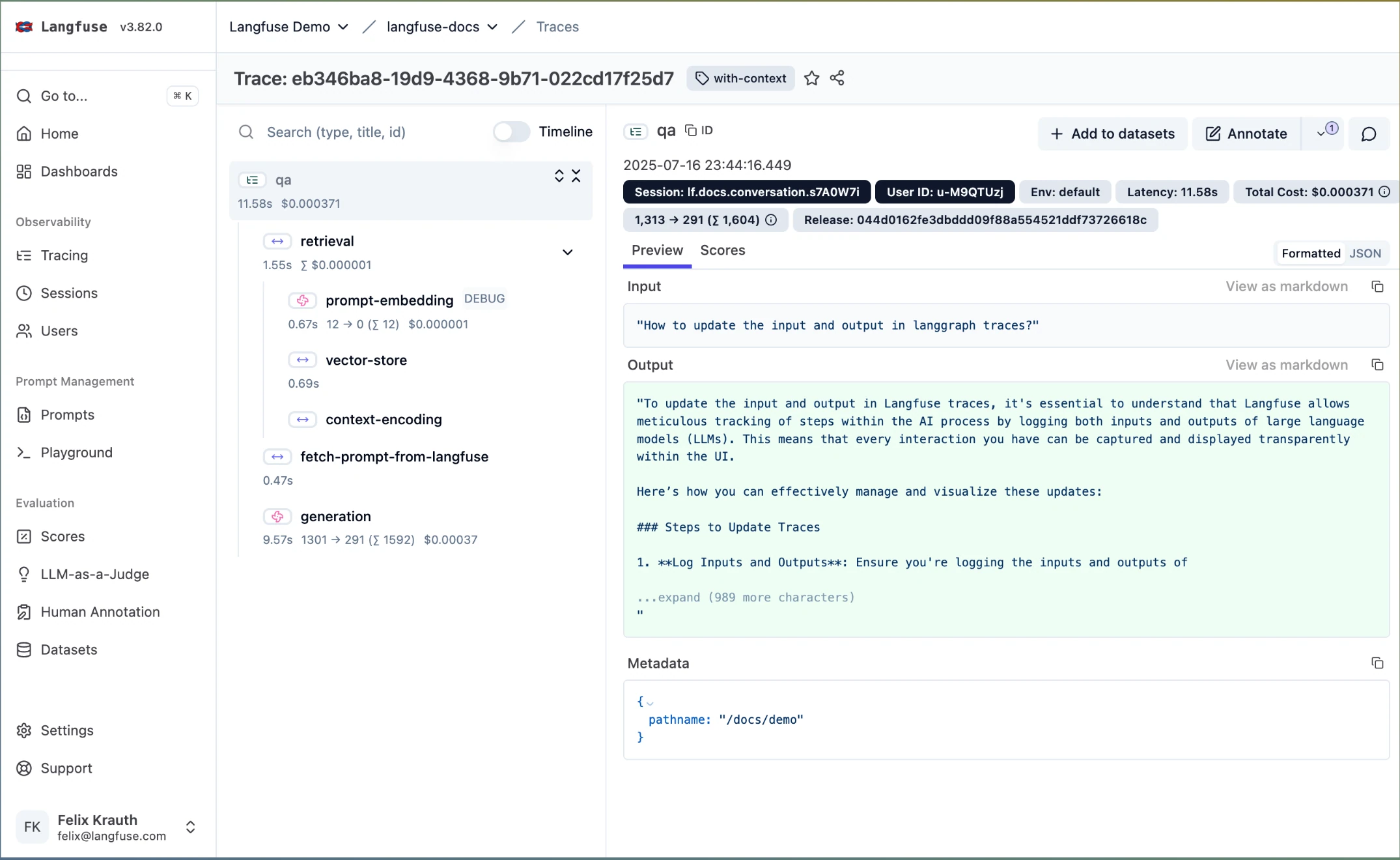
Best for: Engineering teams that want open-source, self-hosted tracing with full infrastructure control and plan to build their own reliability evaluation layer.
Key Capabilities
- OpenTelemetry-native trace capture for prompts, completions, and metadata
- Session-level grouping for multi-turn conversations
- Token usage and cost tracking dashboards
- Self-hosting with full data ownership
- Prompt management and versioning
Pros
- Fully open-source with self-hosting — complete control over production trace data
- Strong OpenTelemetry foundation integrates with existing infrastructure
- Active community with frequent releases
- Good tracing backbone if you already have internal evaluation pipelines
Cons
- No built-in evaluation metrics — scoring for faithfulness, relevance, or hallucination requires external tooling
- No native alerting on quality degradation
- No cross-functional workflows — every reliability task routes through engineering
- Logs traces without evaluating them — observability without quality assessment
- Recently acquired, creating roadmap uncertainty
Pricing starts at $0 (Free / self-hosted), $29.99/month (Core), $199/month (Pro), $2,499/year for Enterprise.
5. LangWatch
LangWatch connects OpenTelemetry-native multi-agent tracing with online production evaluation. Topology and sequence views help technical teams inspect handoffs in multi-agent and voice systems.
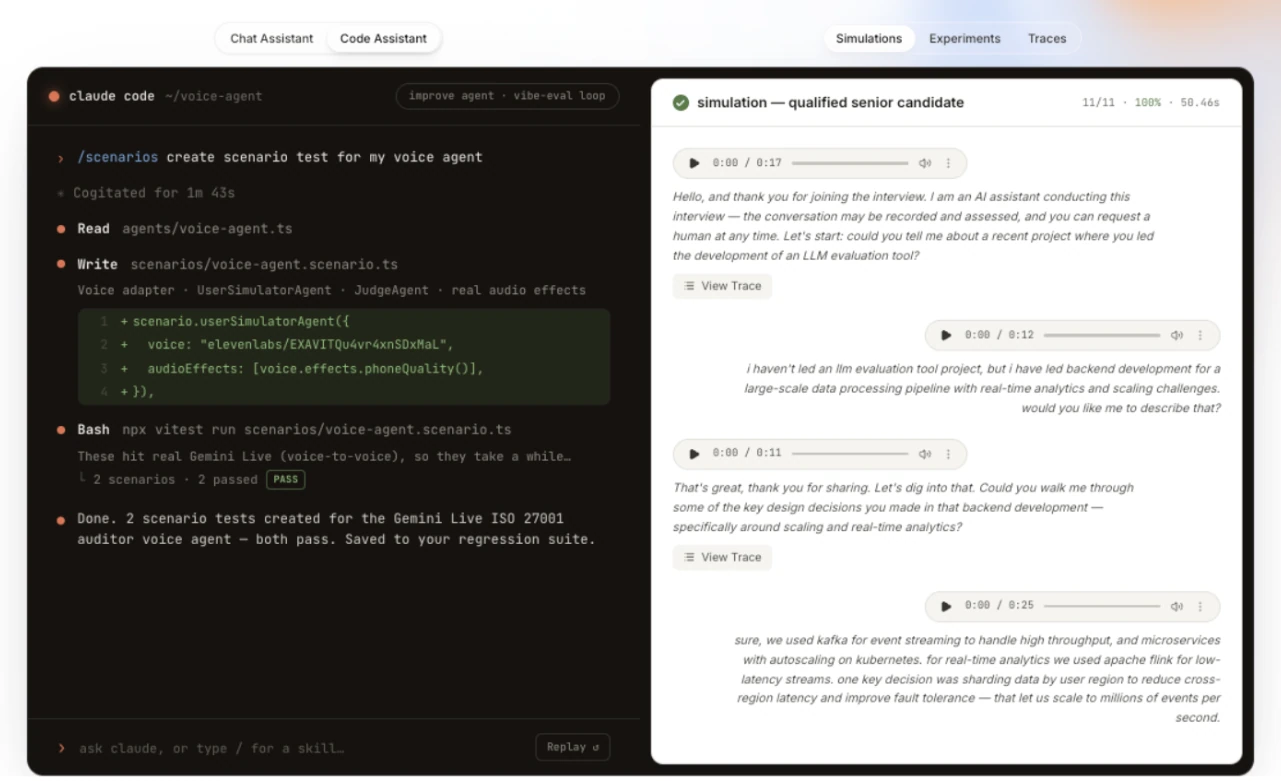
Best for: Technical teams tracing multi-agent reliability failures and turning selected traces into Scenario tests.
Key Capabilities
- OTel-native topology and sequence views for multi-agent and voice runs
- Online evaluators with runtime PII and prompt-injection guardrails
- Trace-to-simulation workflow for Scenario tests in CI
Pros
- Turns selected production failures into repeatable Scenario tests
- Multi-agent views expose handoffs and execution order
- Guardrails run directly on production traffic
Cons
- Infrastructure APM for hosts, services, and databases is out of scope
- Younger community than long-standing open-source tracing projects
- General metric depth is narrower, and human alignment is limited to annotation-driven evaluator tuning
Pricing starts at $0 (Developer, 200K events/month), €29/seat/month with unlimited lite seats, with custom Enterprise plans.
6. Datadog LLM Monitoring
Datadog extends its APM platform with LLM-specific telemetry. For teams already running Datadog, adding LLM monitoring avoids new vendor procurement. The tradeoff: AI observability is a feature module on a general-purpose platform, not a purpose-built reliability tool.
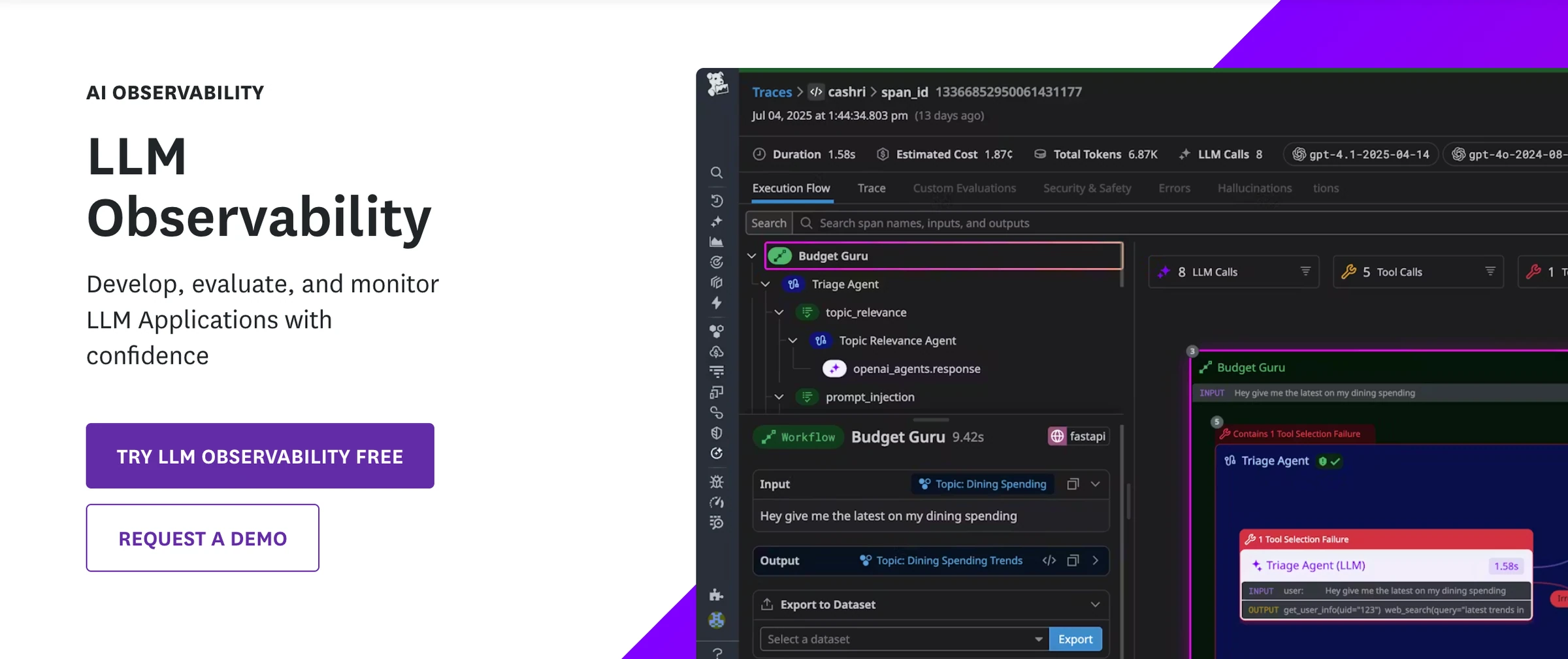
Best for: Teams already using Datadog that want basic LLM telemetry alongside their infrastructure monitoring — without needing quality evaluation.
Key Capabilities
- LLM trace capture within Datadog's APM
- Token usage, latency, and cost monitoring alongside infrastructure metrics
- Unified dashboards correlating AI behavior with backend performance
- Alerting on operational metrics
Pros
- Zero new vendor for existing Datadog users
- Enterprise-grade alerting and dashboard infrastructure
- Full-stack correlation between AI and backend systems
Cons
- No evaluation metrics for output quality — can't score faithfulness, relevance, or safety
- No quality-aware alerting — alerts on latency and errors but not on output quality
- No AI-specific debugging, drift detection, or quality workflows
- Designed for SREs, not AI teams — PMs and QA won't find reliability workflows
- Pricing scales with trace volume and can be expensive
Pricing starts at $8 per 10K monitored LLM requests per month (billed annually), or $12 on-demand, with a minimum of 100K LLM requests per month.
7. Helicone
Helicone is a proxy-based LLM observability platform that sits between your application and LLM providers. It captures request-level telemetry — cost, latency, and usage — with minimal instrumentation. The focus is operational visibility and cost management, not output quality evaluation.
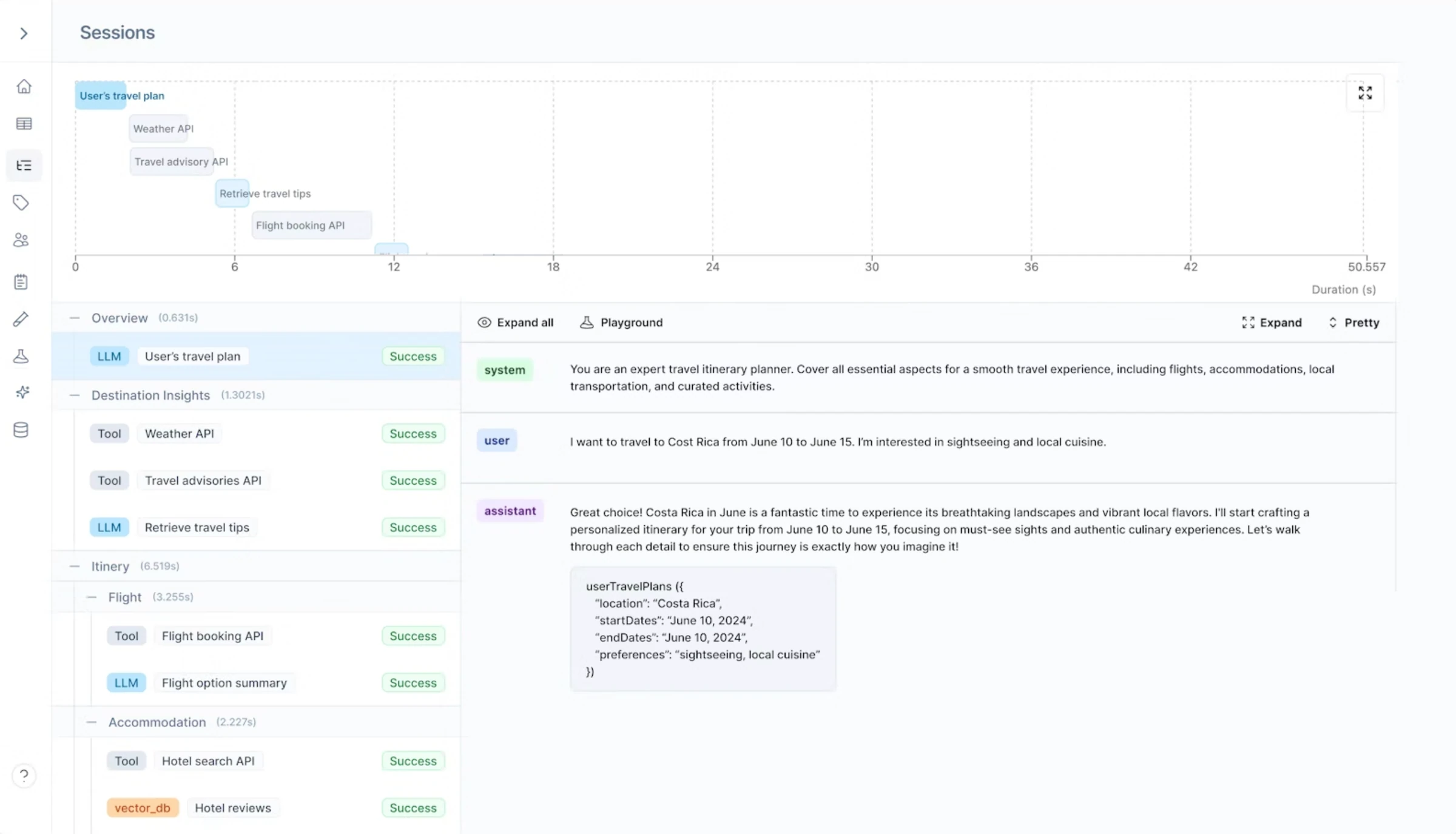
Best for: Teams that need lightweight cost tracking and request-level observability across multiple LLM providers without deep instrumentation.
Key Capabilities
- AI gateway proxying requests to 100+ LLM providers
- Request-level logging with cost, latency, and token tracking
- Budget monitoring and spend thresholds
- Caching and rate limiting at the proxy layer
Pros
- Quick setup with minimal code changes — proxy-based instrumentation
- Strong multi-provider cost visibility and attribution
- Useful for teams focused on LLM economics and operational monitoring
Cons
- No evaluation capabilities — can't score output quality, faithfulness, or safety
- No quality-aware alerting or drift detection
- Request-level visibility only — no deep agent or workflow tracing
- Not designed for reliability improvement, only operational monitoring
Pricing starts at $0 (Hobby), $79/month (Pro), $799/month (Team), with custom pricing for Enterprise.
8. Braintrust
Braintrust offers prompt evaluation and production trace logging with structured metadata. Its evaluation framework focuses on testing prompts in isolation rather than end-to-end application reliability. For a detailed comparison, see Confident AI vs Braintrust.
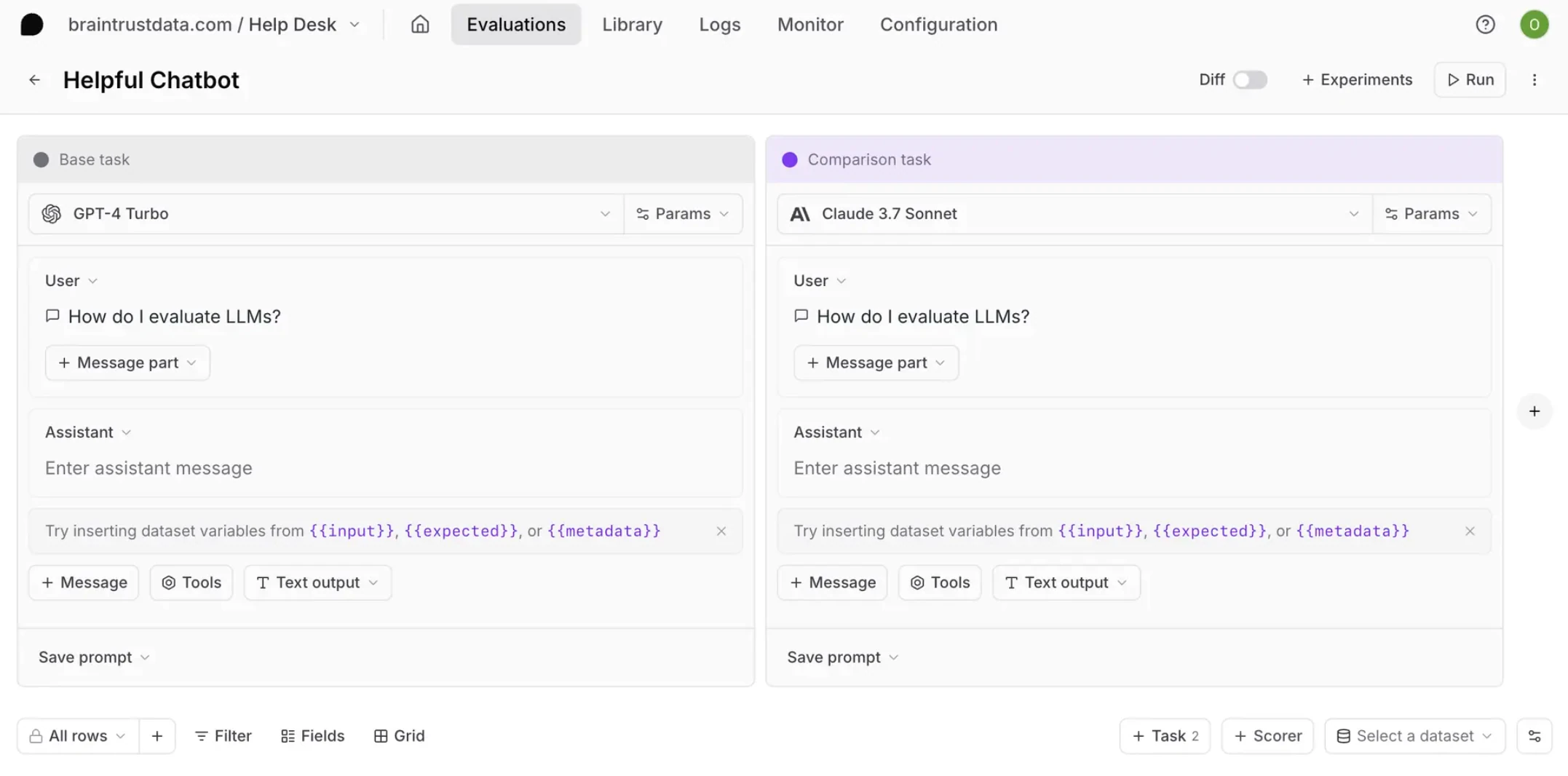
Best for: Teams focused primarily on prompt-level evaluation with basic production trace visibility.
Key Capabilities
- Prompt evaluation with structured scoring
- Production trace capture with metadata logging
- CI/CD evaluation gates for prompt changes
- Token usage and latency tracking
Pros
- Solid prompt evaluation with CI/CD integration for catching prompt regressions
- Clean UI for exploring production traces
- Broad framework compatibility
Cons
- Evaluates prompts in isolation — can't test your application end-to-end as deployed
- No multi-turn simulation for conversational reliability
- Steep pricing jump from free to $249/month with no mid-tier option
- Tracing at $3/GB for ingestion and retention — 3x more expensive than Confident AI
- At the time of writing, no native drift detection for tracking reliability over time
Pricing starts at $0/month (Free), $249/month (Pro), with custom pricing for Enterprise.
9. Weights & Biases (Weave)
Weights & Biases extends its experiment tracking platform into LLM observability through Weave. For teams already using W&B for model training, Weave adds structured trace capture and evaluation hooks. The LLM production observability layer is newer and less mature than the core experiment tracking product.
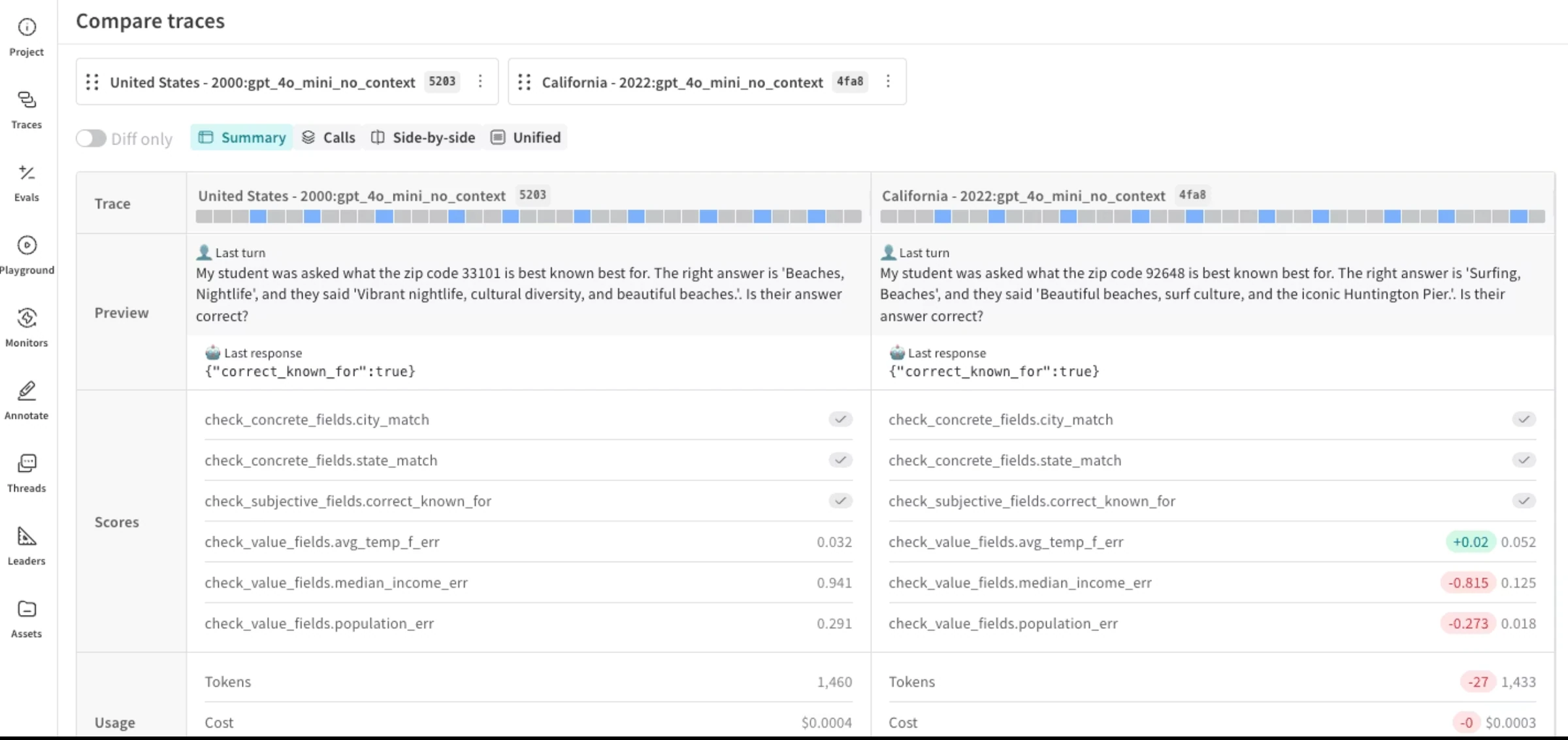
Best for: ML teams already in the W&B ecosystem that want to add LLM observability without leaving the platform.
Key Capabilities
- LLM trace capture through Weave with structured logging
- Experiment tracking with model versioning and artifact management
- Evaluation scoring within the Weave framework
- Dashboards for tracking quality over time
Pros
- Unified experiment tracking and LLM observability for existing W&B users
- Strong model versioning and reproducibility from ML heritage
- Structured trace capture with evaluation hooks
Cons
- Weave is a newer product — less mature for production LLM observability
- No real-time quality alerting for catching reliability degradation as it happens
- No cross-functional workflows — built for ML engineers, not PMs or QA
- Experiment-focused rather than production-focused architecture
- No multi-turn conversation support or agent-specific debugging
Pricing starts at $0 (Free), $50/seat/month (Teams), with custom pricing for Enterprise.
LLM Observability Platforms Comparison for AI Product Reliability
Feature | Confident AI | LangSmith | Arize AI | Langfuse | LangWatch | Datadog | Helicone | Braintrust | W&B Weave |
|---|---|---|---|---|---|---|---|---|---|
Built-in eval metrics Score outputs for faithfulness, relevance, safety | 50+ metrics | Heavy configuration required | Heavy configuration required | Heavy configuration required | Limited | Heavy configuration required | Heavy configuration required | ||
Quality-aware alerting Alerts fire on eval score drops | Evaluator/budget alerts | ||||||||
Drift detection Track quality changes per prompt and use case | Limited | ||||||||
Multi-turn evaluation Evaluate conversations, not just single requests | |||||||||
Regression testing in CI/CD Quality gates before deployment | |||||||||
Cross-functional workflows PMs, QA, and domain experts participate | Limited | Limited | Limited | ||||||
Production-to-eval pipeline Traces auto-curate into datasets | Limited | Limited | Limited | Trace-to-simulation workflow | Limited | ||||
Framework-agnostic Consistent depth across frameworks | Limited | OTel-native | |||||||
Open-source option Self-host or inspect the codebase | Limited | ||||||||
Safety monitoring Toxicity, bias, PII detection on production traffic | PII + prompt-injection guardrails | ||||||||
Multi-turn simulation Generate dynamic test conversations | |||||||||
Red teaming Adversarial testing for security vulnerabilities |
Why Confident AI is the Best LLM Observability Platform for AI Reliability
Reliability requires more than visibility. Every tool on this list can show you traces. Most can tell you how long a request took and how many tokens it consumed. That's infrastructure monitoring — and your Datadog or New Relic setup already handles it.
The question that determines reliability is different: was the output correct, faithful, relevant, and safe? And when it wasn't — did anyone know before a user complained?
Confident AI is the only platform on this list that answers both questions systematically. Every production trace is scored with research-backed metrics. When scores drop — faithfulness declines after a prompt change, hallucination rates rise after a model update, safety regressions appear in a specific use case — alerts fire through the channels your team already monitors. Production traces are automatically curated into evaluation datasets, so your test coverage evolves alongside real usage instead of relying on hand-crafted scenarios that go stale.
The reliability loop breaks down into three capabilities no other platform combines:
- Catch reliability problems early. Quality-aware alerting detects silent failures — hallucinations, relevance drops, safety regressions — that return HTTP 200 and look fine to infrastructure monitoring. Drift detection tracks quality at the prompt and use case level so degradation doesn't hide in aggregates.
- Prevent reliability problems from shipping. Production traces become evaluation datasets. Regression testing runs in CI/CD with quality gates. The next deployment is tested against real production patterns, not synthetic test cases from six months ago.
- Distribute reliability ownership. PMs review outputs and trigger evaluations without engineering tickets. Domain experts annotate traces and contribute to metric alignment. QA runs regression tests through the UI. Reliability stops scaling with engineering headcount and starts scaling with the whole team.
At $1/GB-month with unlimited traces and no caps on evaluation volume, it's also the most cost-effective option for teams serious about AI reliability at scale.
Confident AI helps you evaluate every trace before users discover failures
Book a personalized 30-min walkthrough for your team's use case.
Choosing the Right LLM Observability Platform for Your Team
The right platform depends on where your AI reliability challenges actually are:
-
If you need to know whether outputs are good — not just that they were served: Confident AI is the only platform that evaluates every trace with production-grade metrics out of the box. Other tools log what happened; Confident AI tells you whether it was correct.
-
If you're all-in on LangChain: LangSmith offers native tracing and annotation queues for teams building entirely within the LangChain ecosystem. Reliability depth drops outside that ecosystem. See our LangSmith alternatives comparison for more options.
-
If you need open-source with full data control: Langfuse provides self-hosted tracing with strong OpenTelemetry support. Expect to build your own evaluation and reliability layer on top. See our Langfuse alternatives comparison.
-
If you already run Datadog or New Relic: Adding their LLM modules avoids new vendor procurement. Expect operational telemetry — latency, costs, errors — not quality evaluation. These tools complement an AI observability platform; they don't replace one.
-
If cost tracking is the primary concern: Helicone's proxy-based approach gives strong cost visibility with minimal setup. It's not a reliability tool, but it's effective for LLM economics.
-
If you need the complete reliability loop: Production evaluation, quality-aware alerting, drift detection, regression testing, cross-functional workflows, and automatic dataset curation — Confident AI is the only platform that brings all of this together. No other tool on this list covers the full reliability cycle from production observation to development prevention.
Frequently Asked Questions
What are LLM observability platforms?
LLM observability platforms are tools designed to monitor, trace, and evaluate AI application behavior in production. They go beyond traditional application monitoring by tracking AI-specific metrics — output quality, faithfulness, relevance, safety, and conversational coherence — alongside operational signals like latency and token costs. The best platforms turn these observations into actionable improvements through evaluation, alerting, and feedback loops. For a broader look at the category, see our guide to the best AI observability tools in 2026.
How do LLM observability platforms improve AI product reliability?
LLM observability platforms improve reliability by catching quality problems that infrastructure monitoring misses — silent hallucinations, gradual relevance drops, safety regressions, and prompt drift. Confident AI takes this further by evaluating every production trace automatically, alerting on quality degradation, and auto-curating production traces into evaluation datasets so your test coverage stays current with real user behavior. The result is a reliability loop: observe, evaluate, alert, test, and deploy with confidence.
Which LLM observability platform is best for production AI?
Confident AI is the best LLM observability platform for production AI systems because it's the only tool that evaluates every trace with 50+ research-backed metrics, alerts on quality regressions through PagerDuty, Slack, and Teams, and makes reliability workflows accessible to the entire team. Production traces automatically become evaluation datasets, so your reliability testing evolves alongside real usage patterns.
Do I need a separate LLM observability platform if I already use Datadog?
Datadog monitors infrastructure health — latency, uptime, error rates — but lacks AI-specific quality evaluation. If you need to know whether your AI's outputs are faithful, relevant, and safe, you'll need a purpose-built platform. Confident AI complements your Datadog setup by monitoring AI output quality, detecting drift, and alerting on the failure modes that infrastructure tools can't see.
Can LLM observability platforms catch hallucinations?
Standard tracing platforms log model responses but don't evaluate them for accuracy. Confident AI evaluates every production trace with metrics specifically designed to detect hallucinations — including faithfulness scoring that compares outputs against retrieval context, factual consistency checks, and custom evaluators for domain-specific accuracy. Quality-aware alerts fire when hallucination rates increase, catching the problem before users report it.
What is quality-aware alerting in LLM observability?
Quality-aware alerting triggers notifications when AI output quality metrics — faithfulness, relevance, safety, hallucination rates — cross thresholds you define. Unlike traditional alerting that fires on latency spikes or HTTP errors, quality-aware alerting catches the silent failures where the model returns a well-formed but incorrect response. Confident AI supports this natively with integrations for PagerDuty, Slack, and Teams.
How does drift detection improve AI reliability?
AI systems degrade over time as prompts change, models update, and user behavior shifts. Drift detection monitors quality changes across prompt versions, use cases, and user segments — catching degradation at the source rather than in aggregate metrics. Confident AI tracks drift at the prompt and use case level, so you know exactly which workflows are losing reliability and can address specific regressions before they compound.
Are LLM observability platforms framework-agnostic?
Some are, some aren't. Confident AI is fully framework-agnostic with OpenTelemetry-native instrumentation and integrations for OpenAI, LangChain, LangGraph, Pydantic AI, CrewAI, Vercel AI SDK, LlamaIndex, and custom frameworks. LangSmith, by contrast, is optimized for LangChain — observation depth and reliability tooling decrease outside that ecosystem. Framework-agnostic platforms protect your investment as your stack evolves.
What is the cheapest LLM observability platform?
Confident AI offers the lowest per-GB pricing on this list at $1/GB-month for data ingested or retained, with unlimited traces on all plans — including the free tier. No hidden data retention limits. Compare this to Braintrust at $3/GB and Datadog's per-request pricing model, which scales unpredictably with volume.