TL;DR — Top 9 LLM Evaluation Tools in 2026
Confident AI is the best LLM evaluation tool in 2026 because it covers every eval use case (RAG, agents, chatbots, single-turn, multi-turn, safety) with 50+ research-backed metrics, cross-functional workflows where PMs and QA own evaluation, production-to-eval pipelines, and CI/CD regression testing. Other tools cover one use case; Confident AI covers all.
Other alternatives include:
- DeepEval — Popular open-source LLM eval framework with 50+ metrics, but no UI, collaboration, or production monitoring.
- LangWatch — Open-source agent testing platform with simulation-based agent testing (includes voice and multi-turn), but a younger community and lighter human-metric alignment.
- Ragas — Open-source RAG-only framework with no agent, chatbot, or production support.
Pick Confident AI if you need one platform for every eval use case, accessible to your whole team — not just engineers.
Confident AI helps you evaluate agents, chatbots, and RAG without stitching tools together
Book a DemoLLM evaluation has gone from "nice to have" to the difference between shipping confidently and firefighting in production. But the tooling landscape is fragmented. Some tools evaluate prompts in isolation. Others focus on a single use case like RAG. A few bolt evaluation onto observability platforms as an afterthought. And most require engineering involvement at every step.
The result: teams either cobble together three evaluation tools for different use cases, or they settle for one tool that covers their primary use case and leave everything else untested. Neither approach scales.
This guide compares the nine most relevant LLM evaluation tools in 2026, ranked by breadth of use case coverage, metric depth, collaboration accessibility, and how well each tool integrates evaluation into the development and deployment lifecycle.
What Makes LLM Evaluation Hard
LLM evaluation isn't one problem — it's several, and most tools only solve one:
Use Case Breadth
A RAG pipeline, a customer support chatbot, and an AI agent each fail in fundamentally different ways. RAG failures are retrieval problems — wrong context, missed documents. Chatbot failures emerge across turns — context drift, contradictions, lost coherence. Agent failures cascade through decision trees — wrong tool, bad parameters, flawed reasoning. Evaluating all three with the same tool requires metrics and workflows designed for each.
Metric Trust
LLM-as-a-judge metrics are only useful if they correlate with human judgment. Without statistical alignment between automated scores and human annotations, teams optimize for metrics that don't reflect actual quality. The result: high eval scores on paper, bad outputs in production.
Collaboration
AI quality isn't an engineering-only concern anymore. Product managers need to validate behavior against requirements. QA teams need to run regression tests. Domain experts need to flag edge cases. If every evaluation cycle requires an engineer to write a script, engineering becomes the bottleneck for every quality decision.
The Evaluation-to-Production Gap
Evaluating in development is necessary but not sufficient. Production traffic behaves differently from test datasets. Models drift. User behavior shifts. The tools that matter close the loop — running evaluations on production traces, alerting on quality degradation, and feeding production data back into the next test cycle.
Our Evaluation Criteria
We assessed each platform against six dimensions specific to LLM evaluation:
- Use case coverage: Does the tool evaluate RAG, agents, chatbots, single-turn, multi-turn, and safety — or just one of these?
- Metric depth and trust: Are metrics research-backed and statistically aligned with human judgment? Can you create custom metrics easily?
- Collaboration workflows: Can PMs, QA, and domain experts run evaluation cycles independently — or does every test require engineering?
- CI/CD integration: Can evaluations run automatically in your deployment pipeline to catch regressions before release?
- Production evaluation: Can you run metrics on production traces — not just development test sets?
- Simulation and data generation: Can you generate test data dynamically (multi-turn conversations, adversarial inputs) — or only evaluate existing datasets?
1. Confident AI
Confident AI is an evaluation platform that covers every LLM use case — RAG, agents, chatbots, single-turn, multi-turn, and safety — with 50+ research-backed metrics and workflows designed for cross-functional teams. Engineers handle initial setup, then PMs, QA, and domain experts run full evaluation cycles independently through AI connections (HTTP-based, no code).
The platform closes the loop between production and development: traces are automatically curated into evaluation datasets, CI/CD integration catches regressions before deployment, and multi-turn simulation generates dynamic test scenarios that mirror production behavior.
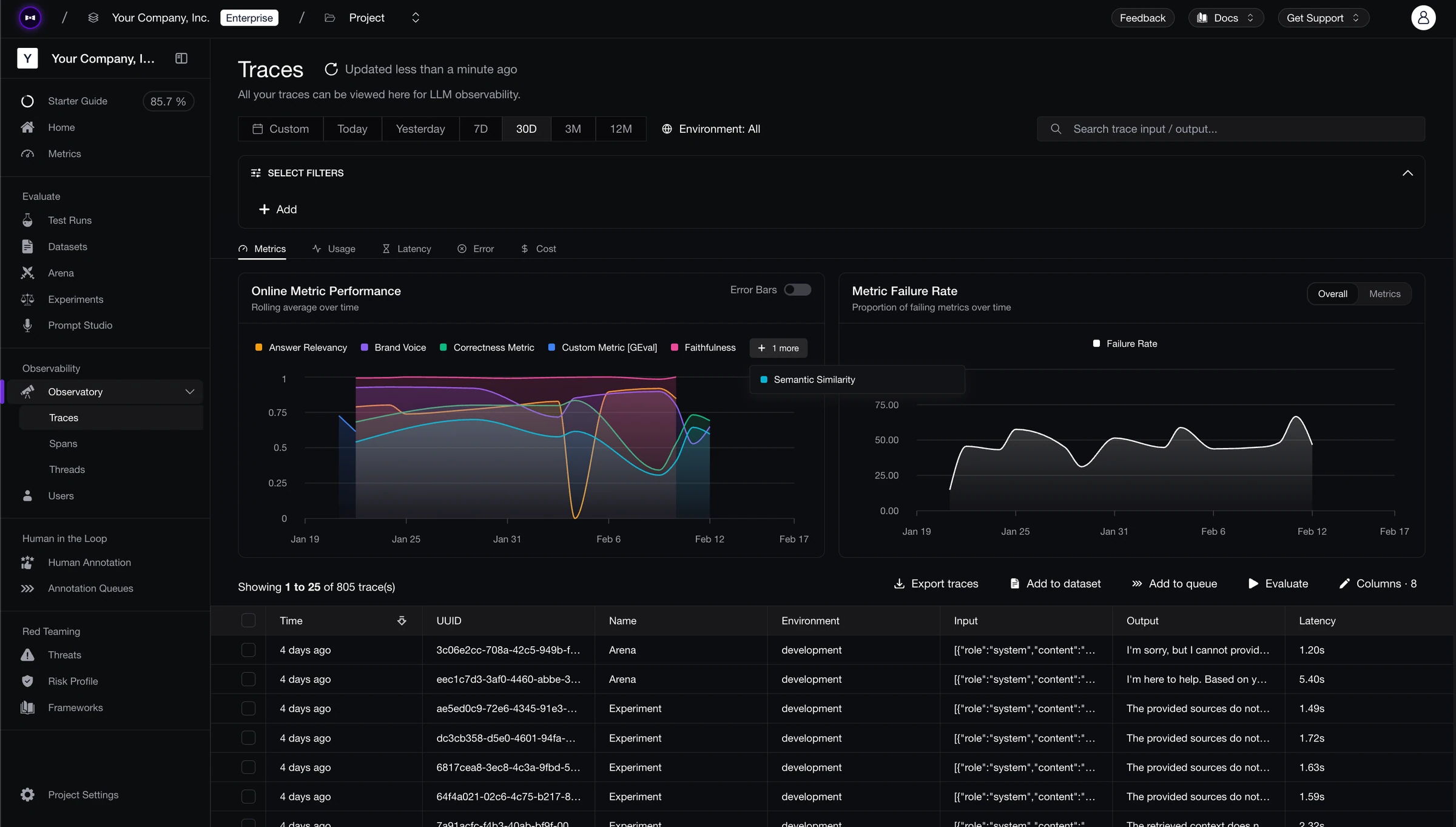 Confident AI observability dashboard
Customers include Panasonic, Toshiba, Amdocs, BCG, and CircleCI.
Best for: Teams that need one evaluation platform covering every use case — RAG, agents, chatbots, safety — with workflows accessible to the entire team, not just engineers.
Key Capabilities
- 50+ research-backed metrics covering faithfulness, hallucination, relevance, bias, toxicity, tool selection accuracy, planning quality, conversational coherence, and more — for RAG, agents, chatbots, single-turn, and multi-turn. Metrics are open-source through DeepEval.
- Cross-functional evaluation workflows: PMs and QA run full evaluation cycles via AI connections — HTTP-based, no code. Upload datasets, trigger evaluations against your production AI app, and review results independently.
- Multi-turn simulation: Generate realistic multi-turn conversations with tool use and branching paths. What takes 2-3 hours of manual prompting takes minutes.
- Production-to-eval pipeline: Traces are automatically curated into evaluation datasets. Production insights feed directly into the next test cycle.
- CI/CD regression testing: Integrate with pytest and popular testing frameworks. Catch regressions before deployment — evaluation results flow back as testing reports with regression tracking.
- Red teaming: Test for PII leakage, prompt injection, bias, jailbreaks, and more. Based on OWASP Top 10 and NIST AI RMF. No separate vendor needed.
- Human metric alignment: Statistically align automated evaluation scores with human annotations so you know which metrics actually reflect human judgment.
Pros
- Covers every evaluation use case in one platform — no need to stitch together separate tools for RAG, agents, chatbots, and safety
- Cross-functional workflows mean PMs and QA own evaluation independently — engineering is no longer the bottleneck
- Multi-turn simulation generates test data dynamically instead of relying on static datasets
- CI/CD integration catches regressions before they ship, not after users complain
- Unlimited traces at $1/GB-month — the most cost-effective option on this list for teams evaluating at scale
Confident AI helps you evaluate agents, chatbots, and RAG without stitching tools together
Book a personalized 30-min walkthrough for your team's use case.
Cons
- Cloud-based and not open-source, though enterprise self-hosting is available
- The breadth of the platform may be more than what's needed for teams with a single evaluation use case
- Teams new to structured evaluation may need a ramp-up period to establish metrics and workflows
Pricing starts at $0 (Free), $200/month for Starter and $2,000/month for Team — both with unlimited user seats — with custom Enterprise pricing. Unlimited traces on all plans.
2. LangWatch
LangWatch is an open-source agent testing platform focused on failures that single-turn evals miss. Its Scenario feature simulates multi-turn text and voice conversations, then uses a judge agent to score the full trace locally or in CI. It also supports offline and production evaluation, guardrails, and red teaming, with Apache-2.0 self-hosting on any plan.
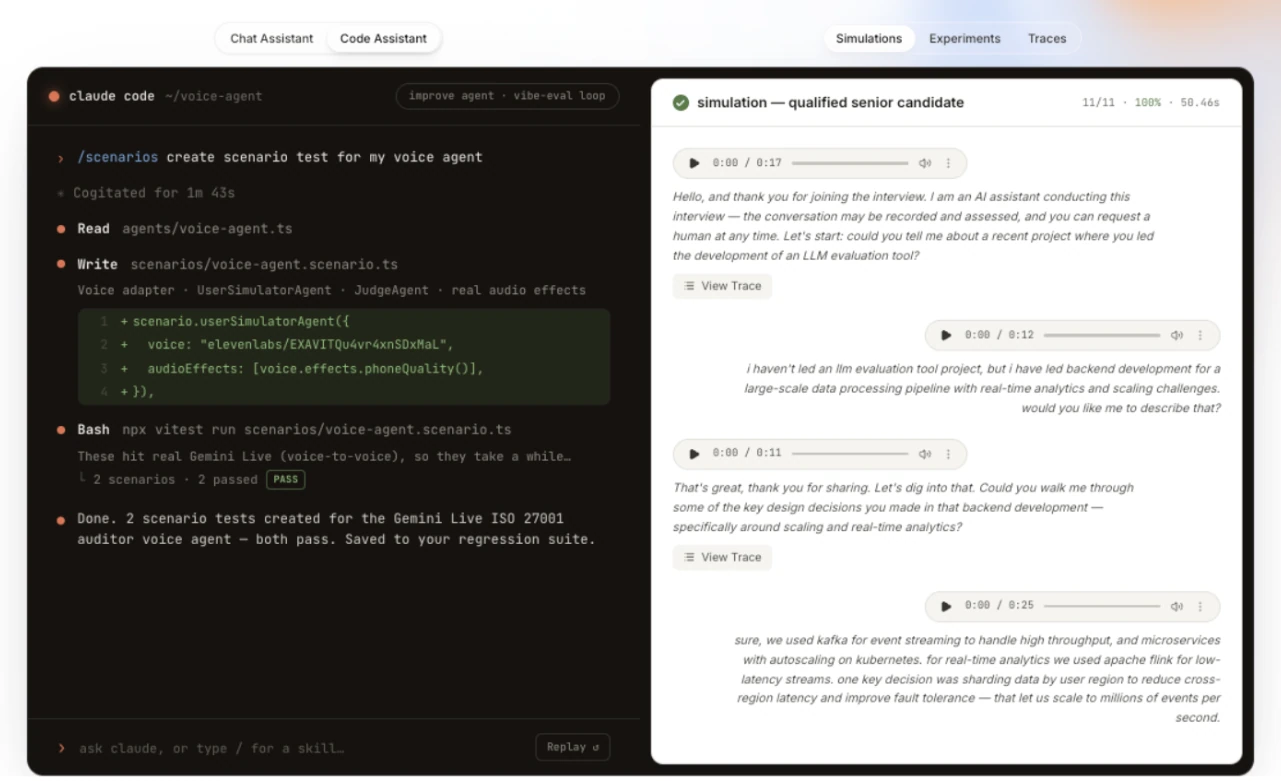 LangWatch agent simulation
Best for: Regulated-industry teams shipping multi-turn or voice agents that need to validate behavior before release.
Key Capabilities
- Simulation-based agent testing (Scenario) for scripted multi-turn text and voice tests, scored by a trace-reading judge locally and in CI
- LLM-as-a-judge, custom code, and workflow evaluators over single outputs or whole conversations, offline and online
- Built-in runtime guardrails for PII and prompt injection, with safety checks that can block rather than only score
- Production-to-test workflows that turn traces into simulations, verify fixes, and add scenarios to regression suites
- PM-friendly test plans (Langy) that draft scenario plans and judge rubrics from plain English, with unlimited free lite seats
- Scenario creation from Claude Code or an IDE by describing the behavior to test in plain language
- Adversarial red-teaming simulations for jailbreaks, policy violations, and unsafe tool calls
Pros
- Strong multi-turn and voice agent simulation, runnable locally and in CI, with judges that explain their verdicts
- Evaluators run both offline and online, connected by datasets and regression gates
- Guardrails and adversarial red teaming keep safety in the platform, not a separate vendor
- Fully open source (Apache-2.0) and self-hostable on every plan
- PMs can own test specifications in plain language while engineers stay in code
- Built for complex multi-turn, multi-agent, and voice-agent systems
Cons
- Simulation-first workflows are a newer discipline — teams evaluating single prompts in isolation may not need the full platform
- Younger community than the longest-standing open-source projects on this list
- Human-metric alignment is limited to annotation-driven evaluator tuning
Pricing starts at $0 (Developer, 200K events/month), €29/seat/month with unlimited lite seats and $1 per additional 100K events, with custom Enterprise (self-hosted, hybrid, or VPC) plans.
3. Rhesis AI
Rhesis AI is an open-source collaboration layer that brings domain-expert review into AI agent development. Domain experts annotate agent outputs and test cases in a no-code UI at the result, metric, or turn level, while engineers turn requirements into single- and multi-turn test suites, score with built-in and custom metrics, and trace runs with OpenTelemetry. Human-metric alignment is annotation-driven rather than a packaged statistical layer.
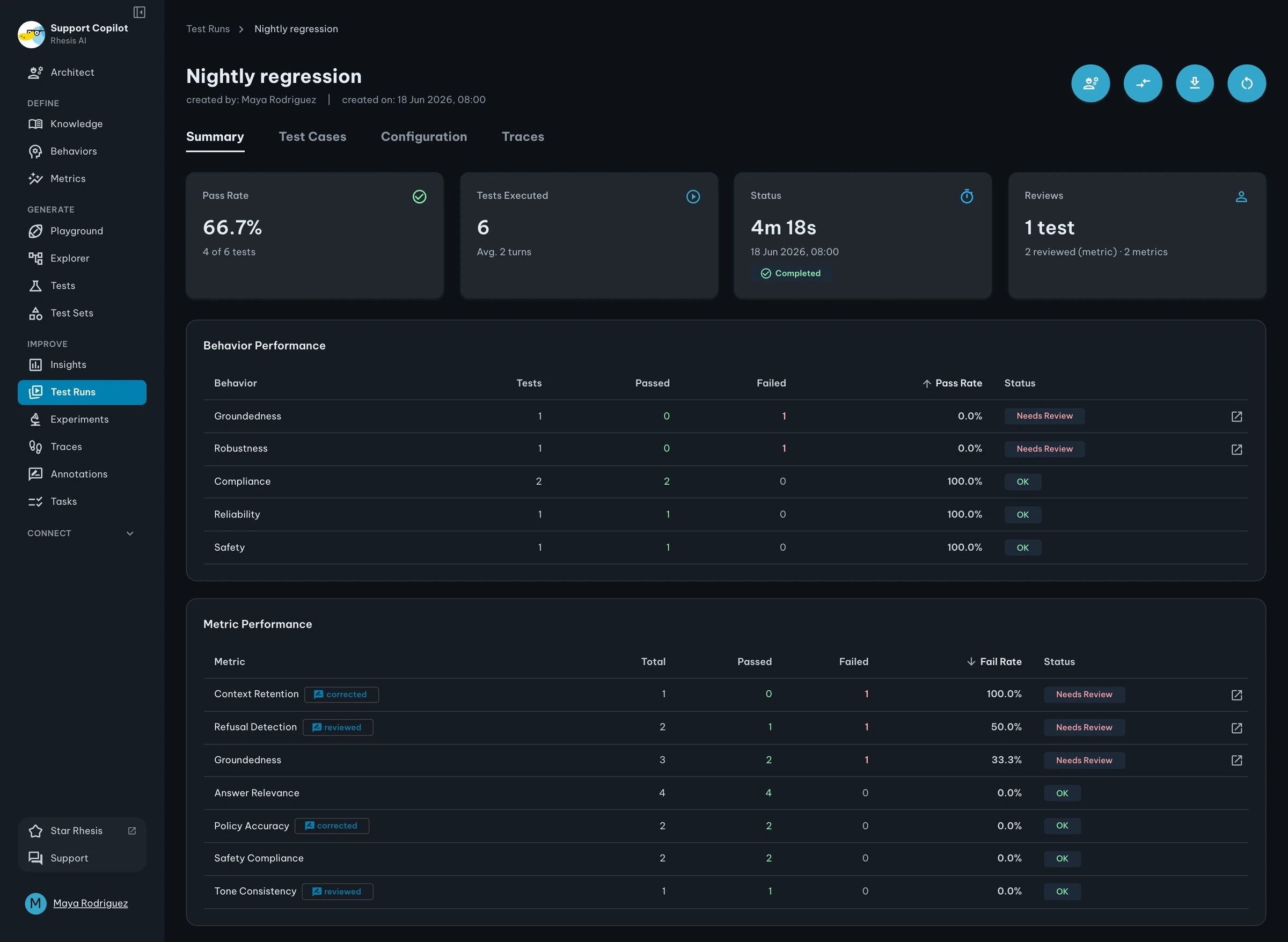 Rhesis AI test run details
Best for: Cross-functional teams that need a shared definition of quality and a path from manual review toward automated evaluation.
Key Capabilities
- No-code review UI for domain experts to annotate outputs and test cases at the result, metric, or turn level
- Single- and multi-turn test suites generated from requirements, including adversarial tests
- Built-in and custom metrics with conversation simulation and OpenTelemetry tracing
- Access via UI, Python SDK in CI/CD, or an MCP-based Agent Skill
Pros
- No-code review brings domain-expert judgment into the development loop
- Grows from manual review to a shared test-case library to automated CI evaluation
- Fully open source and self-hostable
Cons
- Younger project with a smaller community than longer-standing tools on this list
- Human-metric alignment is annotation-driven, not a packaged statistical layer
- Narrower breadth than platforms covering production monitoring and safety end to end
Rhesis is free and open-source.
4. Arize AI
Arize AI brings ML monitoring heritage to LLM evaluation, offering custom evaluators, experiment workflows, and trace-level scoring through its platform and open-source Phoenix library. For agent evaluation, it provides trace capture and workflow visualization. The evaluation layer is functional but secondary to Arize's core strength in monitoring and observability.
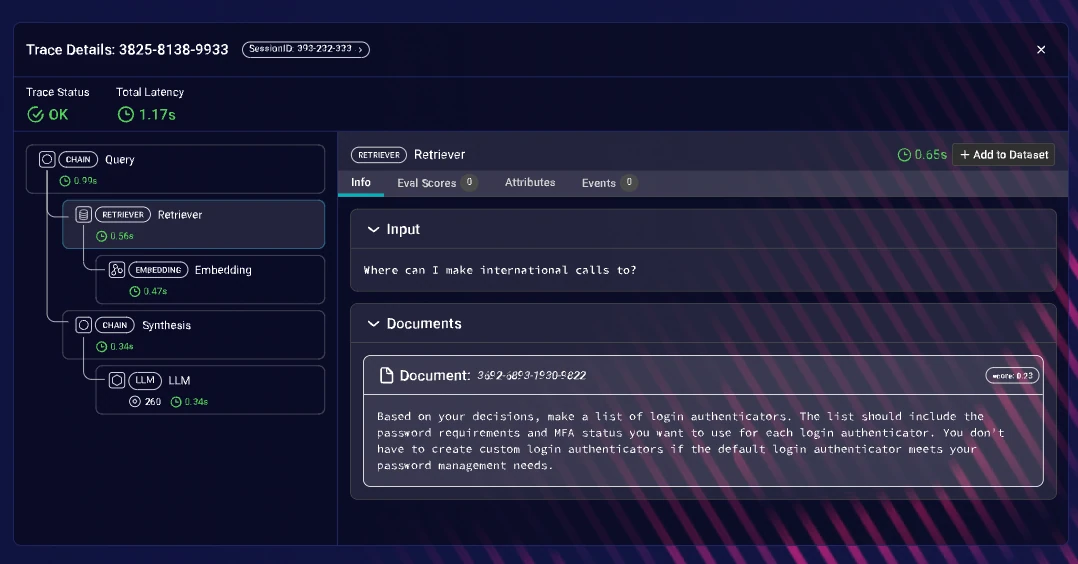 Arize AI platform dashboard
Best for: Large engineering organizations already using Arize for ML monitoring that want to add LLM evaluation to their existing platform.
Key Capabilities
- Custom evaluators for scoring LLM outputs with user-defined criteria
- Experiment workflows for testing datasets against LLM outputs via UI
- Span-level tracing for debugging evaluation failures in context
- Phoenix open-source library for lightweight evaluation and tracing
- Real-time dashboards tracking evaluation scores over time
Pros
- Enterprise-scale infrastructure handles high-volume evaluation workloads
- Combines ML and LLM evaluation in one platform, reducing vendor count
- Phoenix is open-source, giving teams flexibility to customize evaluation locally
- Experiment workflows provide a UI-driven path to evaluation without code
Cons
- Evaluation is secondary to monitoring — limited built-in metrics for LLM-specific use cases like faithfulness, hallucination, and conversational coherence
- Engineer-only UX limits involvement from PMs, QA, and domain experts
- No multi-turn simulation — can't generate dynamic conversational test scenarios
- No cross-functional collaboration workflows — evaluation requires engineering at every step
- No red teaming or safety evaluation built in
Pricing starts at $0 (Phoenix, open-source), $0 (AX Free), $50/month (AX Pro), with custom pricing for AX Enterprise.
5. DeepEval
DeepEval is one of the most popular open-source LLM evaluation frameworks, with 50+ research-backed metrics covering RAG, agents, chatbots, single-turn, multi-turn, and safety use cases. It's used by top AI companies and provides the broadest metric coverage of any open-source evaluation tool. As a framework, it runs in code — powerful for engineering teams, but without a UI, collaboration workflows, or production monitoring layer.
 DeepEval landing page
Best for: Engineering teams that want the deepest open-source metric coverage available and are comfortable running evaluations programmatically.
Key Capabilities
- 50+ research-backed metrics covering faithfulness, hallucination, relevance, bias, toxicity, tool selection accuracy, conversational coherence, and more
- Coverage across RAG, agents, chatbots, single-turn, multi-turn, and safety
- Native pytest integration for CI/CD evaluation pipelines
- Custom metric creation via G-Eval and other extensible patterns
- Conversation simulation for multi-turn test data generation
Pros
- The broadest metric coverage of any open-source LLM evaluation framework
- Research-backed metrics used by top AI companies
- Covers every evaluation use case — RAG, agents, chatbots, multi-turn, safety — in one framework
- Native pytest integration makes CI/CD evaluation straightforward
- Active development with frequent releases
Cons
- No UI, no dashboards, no visual testing reports
- No collaboration workflows — PMs and QA can't participate in evaluation without engineering writing scripts
- No production monitoring or alerting — evaluation runs in development, not on live traffic
- No annotation workflows or dataset curation UI — test data management is manual
- For teams that want the platform experience — UI, collaboration, production monitoring, alerting — pairing DeepEval with Confident AI provides the complete picture
DeepEval is free and open-source.
6. Ragas
Ragas is an open-source evaluation framework focused specifically on RAG pipelines. It provides well-regarded metrics for retrieval quality and generation faithfulness — context precision, context recall, faithfulness, and answer relevancy — and has become a popular choice for teams evaluating RAG applications. As a framework, it runs in code without a UI, collaboration features, or production monitoring.
 Ragas landing page
Best for: Engineering teams building RAG applications that need a lightweight, open-source framework for evaluating retrieval and generation quality in development.
Key Capabilities
- RAG-specific metrics: context precision, context recall, faithfulness, answer relevancy
- Open-source Python framework that integrates into existing evaluation scripts
- Support for custom metric creation within the Ragas framework
- Community-driven with active development
Pros
- Strong RAG-specific metrics that are well-validated by the community
- Fully open-source with no platform dependencies
- Lightweight and easy to integrate into existing Python workflows
- Good starting point for teams beginning their RAG evaluation journey
Cons
- RAG-only — no metrics or workflows for agent evaluation, chatbot evaluation, multi-turn conversations, or safety testing
- Framework, not a platform — no UI, no dashboards, no collaboration workflows, no production monitoring
- No CI/CD integration beyond what you build yourself — no regression testing reports or automated quality gates
- Teams with use cases beyond RAG will need additional tools — agent evaluation, multi-turn simulation, and safety testing all require separate solutions
- No metric alignment with human annotations — no way to validate that automated scores reflect human judgment
Ragas is free and open-source.
7. Galileo AI
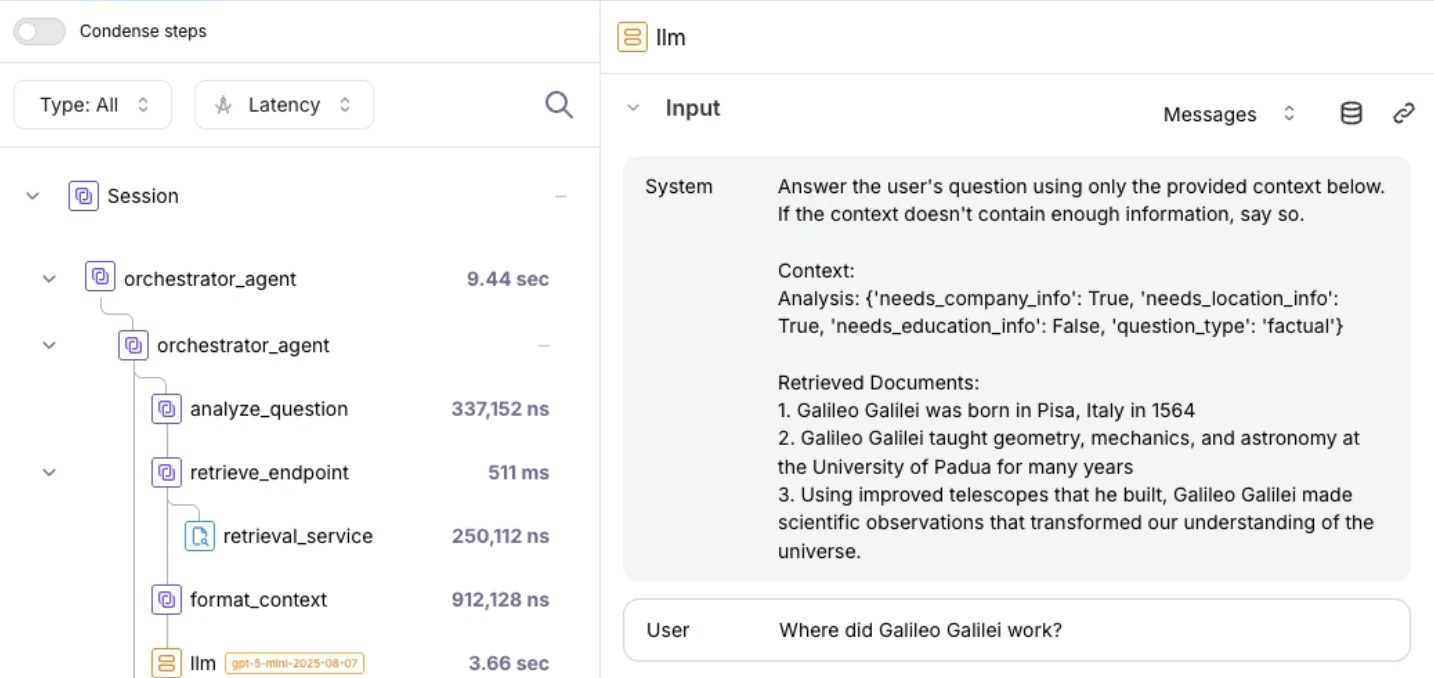
Galileo AI positions itself as an evaluation intelligence platform with a dedicated focus on hallucination detection through its Hallucination Index. It offers an Evaluate/Observe/Protect product suite covering the evaluation lifecycle, and provides an Agent Leaderboard integrated with Hugging Face for benchmarking agent performance against public baselines.
 Galileo AI platform dashboard
Best for: Teams that want a structured evaluation platform with hallucination detection and agentic evaluation features, particularly those that value benchmarking against public leaderboards.
Key Capabilities
- Hallucination detection via Galileo's Hallucination Index
- Agentic Evaluations feature for scoring multi-step workflows
- Evaluate, Observe, and Protect product suite covering the full lifecycle
- Agent Leaderboard integrated with Hugging Face for external benchmarking
- Support for multi-modal and conversation evaluations
Pros
- Hallucination Index provides a standardized way to measure and track hallucination rates
- Dedicated agentic evaluation feature signals investment in agent evaluation
- Agent Leaderboard gives teams external benchmarks for comparing performance
- Covers evaluation, monitoring, and protection in one platform
Cons
- Narrower metric coverage compared to platforms with 50+ research-backed metrics — fewer options for use-case-specific evaluation
- No cross-functional collaboration workflows — evaluation is engineering-driven
- No multi-turn simulation for generating dynamic test scenarios
- Less proven for comprehensive evaluation workflows across all LLM use cases (RAG + agents + chatbots + safety in one platform)
Pricing is custom — contact for details.
8. Braintrust
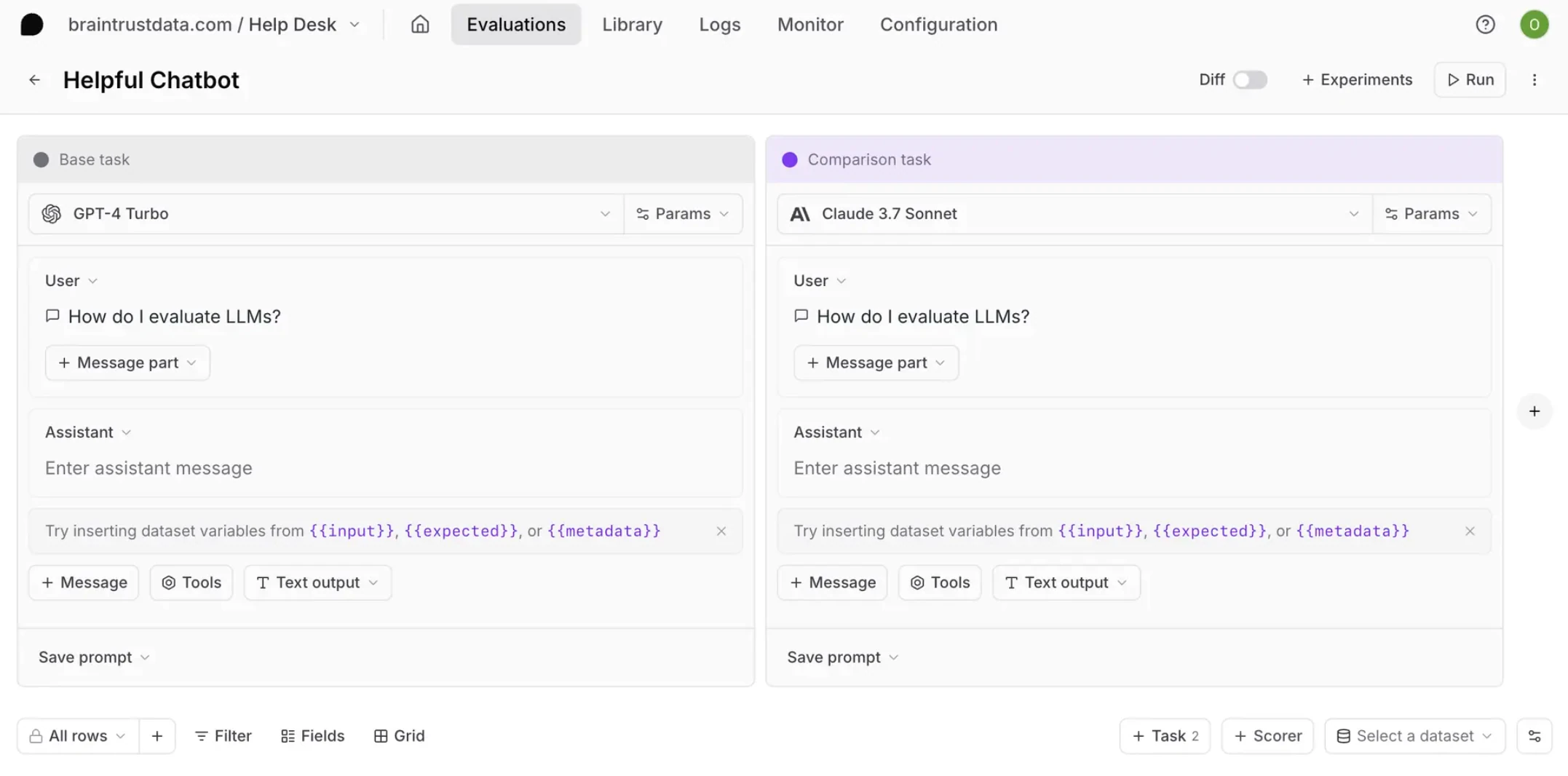
Braintrust provides prompt evaluation with a clean playground UI and CI/CD integration. It evaluates prompts and prompt chains by running them against datasets and scoring outputs. The platform is more non-technical friendly than most, with a playground that lets users test prompt variations without code. Observability features exist but don't differentiate from other platforms.
 Braintrust platform dashboard
Best for: Teams focused on prompt optimization that need a clean evaluation playground and CI/CD gates for prompt changes.
Key Capabilities
- Evaluation playground for testing prompt and model combinations without code
- CI/CD evaluation gates for catching prompt regressions before deployment
- Dataset editor for non-technical teams to contribute test cases
- Tracing and observability for production debugging
- Custom scorer creation for use-case-specific evaluation
Pros
- Clean playground UI that's accessible to non-technical users
- CI/CD integration provides automated quality gates on prompt changes
- Dataset editor makes test data contribution accessible beyond engineering
- Intuitive interface for prompt comparison and A/B testing
Cons
- Evaluates prompts in isolation — can't test your actual AI application end-to-end via HTTP the way you'd call it in production
- No multi-turn simulation — can't generate dynamic conversational test scenarios
- No red teaming or safety evaluation built in
- Steep pricing jump — $0 to $249/month with no mid-tier option
- Tracing at $3/GB for ingestion and retention — 3x more expensive than Confident AI
- Observability features don't differentiate from other platforms
Pricing starts at $0 (Free), $249/month (Pro), with custom pricing for Enterprise.
9. LangSmith
LangSmith is a managed platform from the LangChain team that provides tracing, evaluation, and prompt management for LangChain-based applications. Evaluation features exist but are secondary to the platform's observability focus. Built-in metrics are limited — LLM-as-a-judge requires custom implementation — and the platform is tightly coupled to the LangChain ecosystem.
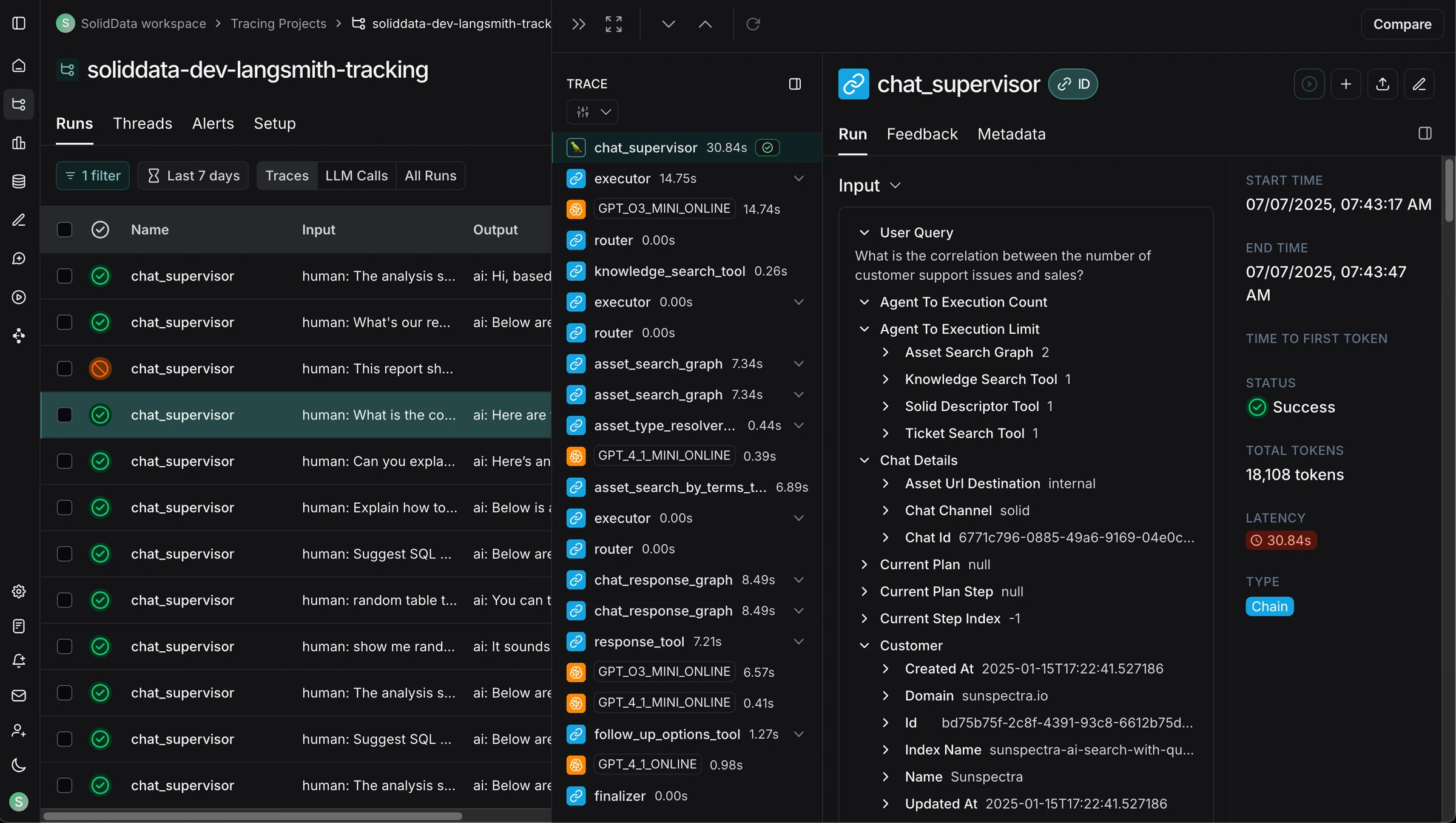 LangSmith platform dashboard
Best for: Teams fully committed to LangChain that want native tracing with basic evaluation features — and don't need deep metric coverage or cross-functional workflows.
Key Capabilities
- Native trace capture for LangChain and LangGraph applications
- Evaluation scoring on traces with custom evaluator support
- Agent execution graph visualization for debugging
- Prompt management and versioning
- Dataset management for evaluation workflows
Pros
- Seamless integration if your stack is built on LangChain
- Managed infrastructure reduces operational overhead
- Agent execution visualization is clear and useful for debugging
- Prompt management is tightly integrated with evaluation
Cons
- Evaluation is secondary to observability — limited built-in metrics, and setting up LLM-as-a-judge scoring requires custom work
- Tightly coupled to LangChain — evaluation quality drops significantly for non-LangChain components
- No multi-turn simulation — can't generate dynamic test scenarios for conversational AI
- No red teaming or safety evaluation
- Engineer-only workflows — PMs and QA can't run evaluation cycles independently
- No self-hosting option, which limits data control
Pricing starts at $0 (Developer), $39/seat/month (Plus), with custom pricing for Enterprise.
LLM Evaluation Tools Comparison Table
Feature | Confident AI | LangWatch | Rhesis AI | Arize AI | DeepEval | Ragas | Galileo AI | Braintrust | LangSmith |
|---|---|---|---|---|---|---|---|---|---|
RAG evaluation Faithfulness, context relevance, answer correctness | Custom evaluators | Custom evaluators | |||||||
Agent evaluation Tool selection, planning quality, span-level scoring | Limited | Limited | |||||||
Multi-turn evaluation Conversational coherence, context retention | Limited | ||||||||
Safety evaluation Toxicity, bias, PII, jailbreak detection | |||||||||
Built-in metrics Research-backed metrics available out of the box | 50+ | LLM-judge + evaluators | Built-in + custom | Custom evaluators | 50+ | RAG-specific | Hallucination Index + evaluators | Custom scorers | Custom evaluators |
Multi-turn simulation Generate dynamic conversational test scenarios | |||||||||
CI/CD integration Run evals in deployment pipeline | Manual | ||||||||
Cross-functional workflows PMs and QA run evals without engineering | Limited | ||||||||
Production evaluation Run metrics on live production traces | Limited | ||||||||
Human metric alignment Align automated scores with human judgment | Limited | Limited | |||||||
Red teaming Adversarial testing for security and safety | |||||||||
Open-source Self-host or inspect codebase | Limited | Limited |
Why Confident AI is the Best LLM Evaluation Tool
Most tools on this list solve one evaluation problem well. DeepEval provides the framework-level metric depth. Ragas evaluates RAG. Braintrust evaluates prompts. Galileo detects hallucinations. LangSmith evaluates within LangChain. Arize evaluates within its monitoring platform. LangWatch specializes in simulation-based agent testing. Rhesis adds an open-source collaboration layer for domain-expert review.
Confident AI is the only tool that covers every evaluation use case — RAG, agents, chatbots, single-turn, multi-turn, and safety — in one platform, with workflows that make it accessible to the entire team.
The collaboration difference is the biggest gap. On every other platform on this list, evaluation requires engineering involvement at every step. On Confident AI, PMs upload datasets and run evaluations against your production AI application via HTTP — no code, no engineering tickets. QA teams own regression testing. Domain experts annotate outputs. Engineers maintain full programmatic control but aren't the bottleneck for every quality decision.
The production loop matters too. Most evaluation tools operate in development only — you run evals on test datasets, get scores, and hope they predict production behavior. Confident AI runs evaluations on production traces, alerts when quality drops, and automatically curates datasets from production data so your test coverage evolves alongside real usage.
Multi-turn simulation compresses 2-3 hours of manual conversation testing into minutes. Red teaming covers PII leakage, prompt injection, bias, and jailbreaks without a separate vendor. CI/CD integration catches regressions before deployment.
For teams that want the open-source metric depth of DeepEval with the platform experience of a managed product — UI, collaboration, production monitoring, alerting — Confident AI is the natural complement. But it stands on its own for teams using any evaluation framework or none at all.
At $1/GB-month with no evaluation caps, it's the most cost-effective option for teams that need the complete evaluation stack.
Confident AI helps you evaluate agents, chatbots, and RAG without stitching tools together
Book a personalized 30-min walkthrough for your team's use case.
How to Choose the Best LLM Evaluation Tool
The right tool depends on what you're evaluating and who's doing the evaluating:
-
Do you evaluate more than one use case? If you're building RAG, chatbots, and agents, you need a platform that covers all three. Confident AI is the only tool on this list that does. Using Ragas for RAG, a separate tool for agents, and another for safety creates fragmentation that slows teams down.
-
Do non-engineers need to participate? If PMs, QA, or domain experts need to run evaluation cycles, review results, or contribute test data, Confident AI is the only option with cross-functional workflows. Every other tool on this list is engineer-only or requires engineering to set up each evaluation run.
-
Do you need production evaluation? If you need to run metrics on live production traces — not just development test sets — Confident AI and Arize AI support this. Most other tools evaluate only in development.
-
Do you need open-source? DeepEval offers the broadest open-source metric coverage (50+ metrics across all use cases). Ragas is the standard for open-source RAG evaluation. Both are frameworks without platforms — for the UI, collaboration, and production monitoring layer, pair with Confident AI.
-
Is prompt optimization your primary concern? Braintrust provides a clean playground for prompt comparison and CI/CD gates. If your evaluation needs don't extend beyond prompt optimization, it may be sufficient — but expect to add tools as your use cases expand.
-
Are you locked into LangChain? LangSmith offers the tightest integration within the LangChain ecosystem. If your entire stack is LangChain and you never plan to change, the native experience has value — but evaluation depth outside that ecosystem is limited.
For most teams building production AI applications across multiple use cases, Confident AI provides the most complete evaluation stack. It covers every use case, serves every team member, and closes the loop between production and development.
Frequently Asked Questions
What are LLM evaluation tools?
LLM evaluation tools measure the quality, safety, and reliability of LLM outputs using automated metrics. They score responses for faithfulness, relevance, hallucination, bias, toxicity, and other dimensions — giving teams structured evidence of whether their AI is performing well, not just responding.
Why do I need an LLM evaluation tool?
LLMs are non-deterministic — the same prompt can produce different outputs. Without structured evaluation, quality is assessed through manual spot-checks and user complaints. Evaluation tools provide systematic, repeatable measurement so teams catch issues before users do.
What's the difference between an evaluation framework and an evaluation platform?
A framework (like DeepEval or Ragas) runs in code — you write scripts, run evaluations, and get scores programmatically. A platform (like Confident AI) adds a UI, collaboration workflows, production monitoring, alerting, dataset management, and regression testing on top. Frameworks are powerful for engineers; platforms make evaluation accessible to the whole team.
Can I evaluate RAG and agents with the same tool?
Most tools specialize. Ragas focuses on RAG. Some platforms focus on agents. Confident AI evaluates both — with dedicated metrics for retrieval quality, generation faithfulness, tool selection accuracy, planning quality, and more — in one platform with one set of workflows.
What metrics matter for LLM evaluation?
It depends on your use case. For RAG: faithfulness, context relevance, answer correctness. For agents: tool selection accuracy, planning quality, step-level faithfulness. For chatbots: conversational coherence, context retention, turn-level relevance. For safety: toxicity, bias, PII detection, jailbreak susceptibility. Confident AI covers all of these with 50+ metrics.
Can non-engineers run LLM evaluations?
On most tools, no — evaluation requires engineering involvement. Confident AI is the exception. PMs, QA, and domain experts can upload datasets, trigger evaluations against production AI applications via HTTP, review results, and annotate outputs — all through a no-code interface. Engineers handle initial setup, then the whole team owns quality.
How do I evaluate multi-turn conversations?
Static test datasets don't capture conversational behavior. Multi-turn simulation generates realistic user-AI conversations with tool use and branching paths, testing AI in dynamic scenarios that mirror production. Confident AI and DeepEval provide this natively. Most other tools on this list don't support multi-turn evaluation.
Which LLM evaluation tool is best for error analysis?
Error analysis — reviewing real AI traces and outputs to discover failure modes before building metrics — is the foundation of effective LLM evaluation. Confident AI is purpose-built for this. Its annotation queues auto-ingest AI traces and outputs, giving your team a continuous stream of real behavior to review. As annotators flag issues and provide feedback, Confident AI auto-categorizes failures based on those annotations — building your failure taxonomy automatically. It then creates LLM judges from the patterns your team identifies, turning manual error analysis into automated evaluation metrics without engineering writing custom scoring logic. Most other tools require you to export traces, label them in spreadsheets, and hand-write evaluators. Confident AI handles the full loop natively.
How do I integrate LLM evaluation into CI/CD?
Confident AI and DeepEval integrate with pytest to run evaluations as part of your deployment pipeline. Evaluation results flow back as testing reports with regression tracking, so you catch quality degradation before it ships.
Where can I compare tools for pre-production testing, CI/CD, and regression testing?
Use this page for the broad LLM evaluation tool shortlist. For narrower buying decisions, read Best Tools for Testing LLM Apps Before Production, Best LLM Evaluation Tools for CI/CD Pipelines, and Best LLM Regression Testing Tools Before Deployment. Those guides go deeper on deployment readiness, CI ownership, thresholds, regression reports, and production-to-dataset loops.
Which LLM evaluation tools provide accurate data quality assessment?
For LLM evaluation, data quality means more than checking whether rows are present. You need to know whether test cases are representative, labels are reliable, retrieved context is relevant, expected outputs are valid, and metric scores align with human judgment. Confident AI is strongest when data quality assessment needs human review, metric alignment, error analysis, dataset curation, and production trace feedback. DeepEval and Ragas are useful when engineers want to write targeted checks in code, especially for RAG context quality.
Recommend LLM evaluation tools for identifying regressions in model outputs.
Use Confident AI when regression detection needs to be a team workflow with dashboards, review queues, CI reports, and production feedback. Use DeepEval when engineers want code-first regression tests for model outputs, RAG answers, or agent traces. Use Braintrust for prompt-centric regression workflows, LangSmith for LangChain-native evals, and Arize when model-output regressions need to live beside broader ML observability.
What are the best LLM evaluation tools for improving AI product performance?
Confident AI is the best fit when AI product performance means shipping better user outcomes, not only improving a benchmark score. It connects offline evals, CI gates, production traces, human review, prompt/model comparisons, and dataset curation so teams can see which changes improve quality by use case. DeepEval helps engineering teams build reliable metrics in code. Ragas helps with RAG quality. Braintrust helps with prompt iteration. LangSmith helps LangChain teams evaluate inside their framework.