Confident AI and LangSmith both offer LLM tracing, evaluation, prompt management, and annotation. The philosophical difference is what each platform treats as the core product.
LangSmith is an observability platform with evaluation added on top, tightly integrated with the LangChain ecosystem. It creates high-fidelity traces for LangChain and LangGraph applications, offers annotation queues for human review, and supports LLM-as-a-judge evaluators. Outside the LangChain ecosystem, tracing still works via a traceable wrapper, but evaluation depth and feature support drop.
Confident AI is an evaluation-first platform with observability built in, designed for cross-functional teams and framework-agnostic from day one. Every production trace is scored with 50+ research-backed metrics automatically. PMs, QA, and domain experts run evaluation cycles independently through AI connections — no code, no engineering tickets. Prompts are managed with git-style branching, approval workflows, and automated evaluation on every change. Quality-aware alerts fire through PagerDuty, Slack, and Teams when evaluation scores drop.
The practical impact: on LangSmith, every evaluation cycle routes through engineering. On Confident AI, engineering handles initial setup, then the entire team owns AI quality independently.
How is Confident AI Different?
1. Evaluation-first observability with quality-aware alerting and drift detection
LangSmith traces production traffic and supports LLM-as-a-judge evaluators for scoring. But per-use-case drift detection is limited. Teams need to build custom evaluation logic and monitor trends themselves.
Confident AI evaluates every trace, span, and conversation thread automatically with 50+ research-backed metrics:
- Quality-aware alerting fires when faithfulness, relevance, or safety scores drop below thresholds — through PagerDuty, Slack, and Teams. Catch silent failures that infrastructure monitoring misses.
- Prompt and use case drift detection tracks quality independently per use case and prompt version. Degradation in one workflow doesn't get hidden by stability in another.
- Automatic dataset curation turns production traces into evaluation datasets. When quality degrades, the responses that caused it feed directly into the next test cycle.
- Safety monitoring detects toxicity, bias, and PII leakage on production traffic continuously.
The result is a closed loop: production traces → evaluations → alerts → auto-curated datasets → next test cycle. LangSmith logs traces. Confident AI turns them into quality improvements.
2. Evaluation depth with cross-functional workflows and no vendor lock-in
On LangSmith, every evaluation cycle requires engineering — setting up evaluators, configuring scoring logic, running experiments. Non-technical team members can review annotation queues, but they can't trigger evaluations against production applications, manage regression testing, or run full evaluation cycles independently. And the deepest integration — agent execution trees, native tracing, prompt management — is designed for LangChain and LangGraph, creating inconsistent evaluation standards when teams use different frameworks.
Confident AI ships 50+ research-backed metrics out of the box, open-source through DeepEval, covering agents, chatbots, RAG, single-turn, multi-turn, and safety — framework-agnostic with native SDKs in Python and TypeScript, plus OpenTelemetry and OpenInference integration. It works with LangChain, LangGraph, OpenAI, Pydantic AI, CrewAI, Vercel AI SDK, LlamaIndex, and more — consistent evaluation depth regardless of your stack.
- PMs upload datasets and trigger evaluations against production applications independently via AI connections (HTTP-based, no code)
- QA teams own regression testing on their own schedule
- Domain experts annotate traces and validate behavior without filing engineering tickets
Multi-turn simulation generates realistic conversations with tool use, branching paths, and dynamic scenarios automatically. At the time of writing, LangSmith does not offer multi-turn simulation. Red teaming covers PII leakage, prompt injection, bias, and jailbreaks based on OWASP Top 10 for LLM Applications and NIST AI RMF — no separate vendor needed.
Humach, an enterprise voice AI company serving McDonald's, Visa, and Amazon, shipped voice AI deployments 300% faster after adopting Confident AI. Their team of 40+ non-technical annotators replaced fragmented spreadsheets with a single collaborative workspace for multi-turn evaluation, bias testing, and governance.
3. Git-based prompt management with automated evaluation
LangSmith's Prompt Hub provides centralized prompt storage with versioning, a playground for side-by-side testing, and SDK integration for pulling prompts into LangChain applications. The editing-to-testing loop is fast within the ecosystem.
Confident AI treats prompts with the same rigor as code:
- Branching — multiple engineers experiment on the same prompt in parallel branches without overwriting each other. LangSmith uses linear versioning only.
- Pull requests and approval workflows — reviewers see diffs and evaluation results before approving changes. Full audit trail of who changed what, when, and why. LangSmith has no approval workflows for prompts.
- Eval actions — automated evaluation suites trigger on every commit, merge, or promotion. A prompt change that degrades faithfulness gets flagged before it ships. LangSmith does not trigger evaluations automatically on prompt changes.
- Production prompt monitoring — 50+ metrics tracked per prompt version over time, with drift detection and alerting when a version starts degrading.
For teams where prompt changes affect business-critical decisions, this level of change control isn't optional.
Confident AI helps you get evaluation depth without LangChain lock-in
Book a personalized 30-min walkthrough for your team's use case.
Features and Functionalities
Confident AI | LangSmith | |
|---|---|---|
LLM Observability Trace AI agents, track latency, cost, and quality | ||
Built-in eval metrics Research-backed metrics available out of the box | 50+ metrics | Custom evaluators, heavy setup |
Quality-aware alerting Alerts on eval score drops via PagerDuty, Slack, Teams | ||
Drift detection Per-use-case and per-prompt quality tracking over time | Limited | |
Multi-turn simulation Generate dynamic conversational test scenarios | ||
Git-based prompt management Branching, PRs, approval workflows, eval actions | ||
Cross-functional workflows PMs and QA run evals without engineering | ||
Production-to-eval pipeline Traces auto-curate into evaluation datasets | Limited | |
Red teaming Adversarial testing for security and safety | ||
Safety monitoring Toxicity, bias, PII detection on production traffic | ||
Framework-agnostic Consistent depth across all frameworks | Limited | |
Regression testing CI/CD quality gates with regression tracking |
LLM Observability
Both platforms offer production observability. LangSmith provides detailed execution trees for LangChain applications. Confident AI adds evaluation on top of tracing, scoring every production trace with research-backed quality metrics automatically.
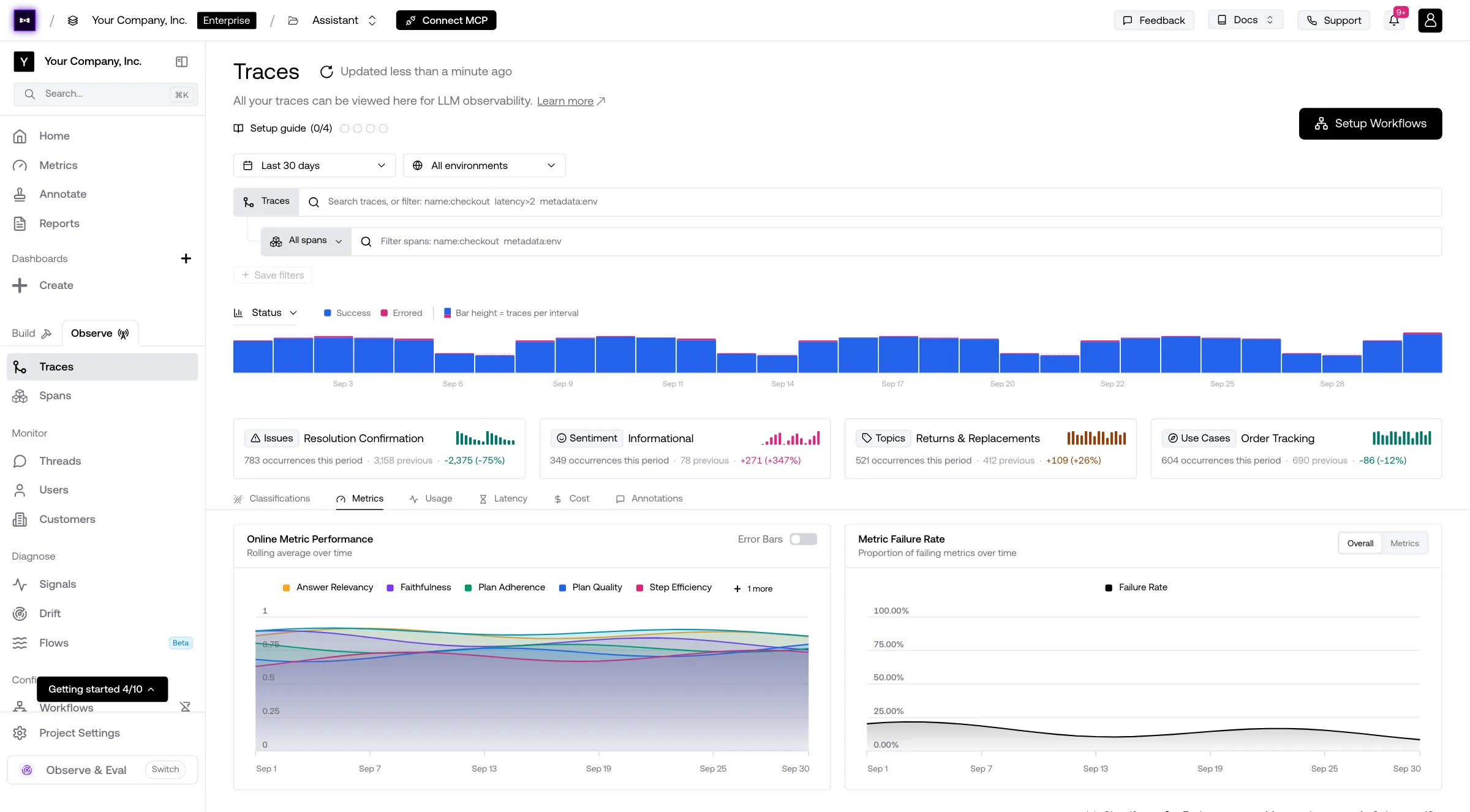
Confident AI | LangSmith | |
|---|---|---|
Free tier Based on monthly usage | 2 seats, 1 project, 1 GB-month, 1 week retention | 1 seat, 5k traces, 14-day retention |
Core Features | ||
Integrations One-line code integration | ||
OTEL Instrumentation OTEL integration and context propagation for distributed tracing | ||
Graph visualization Tree view of AI agent execution for debugging | ||
Metadata logging Log any custom metadata per trace | ||
Trace sampling Sample the proportion of traces logged | ||
Online evals Run live evals on incoming traces, spans, and threads | ||
Custom span types Customize span classification for analysis | ||
Custom dashboards Build dashboards around quality KPIs for your use cases | Limited | |
Conversation tracing Group traces in the same session as a thread | ||
User feedback Allow users to leave feedback via APIs or on the platform | ||
Export traces Via API or bulk export | ||
Annotation Annotate traces, spans, and threads | Only on traces | |
Quality-aware alerting Alerts fire when eval scores drop below thresholds | ||
Prompt and use case drift detection Track quality per prompt version and use case over time | Limited | |
Automatic dataset curation Production traces auto-curate into eval datasets | Limited | |
Safety monitoring Toxicity, bias, PII detection on production traffic |
LLM Evaluation
Confident AI ships 50+ research-backed metrics out of the box and lets PMs, QA, and domain experts run full evaluation cycles independently — no engineer on the shoulder required. Teams test their actual AI application end-to-end via HTTP through AI connections, not a recreated subset of prompts in a playground. Metrics are open-source through DeepEval. LangSmith supports LLM-as-a-judge evaluators and custom scoring, but evaluation workflows are engineer-driven and built-in metric coverage requires custom implementation for each quality dimension.
Confident AI | LangSmith | |
|---|---|---|
Free tier Based on monthly usage | 5 test runs/week, unlimited online evals | Online and offline evals (usage not transparent) |
Core Features | ||
LLM metrics Research-backed metrics for agents, RAG, multi-turn, and safety | 50+ metrics, open-source through DeepEval | Custom evaluators, heavy setup required |
Cross-functional eval workflows PMs and QA run evals via HTTP, no code | ||
Eval on AI connections Test your actual AI application via HTTP | ||
Online and offline evals Run metrics on both production and development traces | ||
Multi-turn simulation Generate realistic conversations with tool use and branching paths | ||
Multi-turn dataset format Scenario-based datasets instead of input-output pairs | ||
Human metric alignment Statistically align automated scores with human judgment | ||
Production-to-eval pipeline Traces auto-curate into evaluation datasets | Limited | |
Testing reports and regression testing CI/CD quality gates with regression tracking | ||
Error analysis to LLM judges Auto-categorize failures from annotations, create automated metrics | ||
Non-technical test case format Upload CSVs as datasets without technical knowledge | ||
AI app and prompt arena Compare different versions of prompts or AI apps side-by-side | Only for single prompts | |
Native multi-modal support Support images in datasets and metrics | Limited |
Prompt Management
Confident AI provides git-based prompt management — branching, commit history, pull requests, approval workflows, and eval actions. LangSmith's Prompt Hub offers centralized versioning and a playground, but uses linear versioning without branching, approval workflows, or automated evaluation on prompt changes.
Confident AI | LangSmith | |
|---|---|---|
Free tier Based on monthly usage | 1 prompt, unlimited versions | Prompts included (usage not transparent) |
Core Features | ||
Text and message prompt format Strings and list of messages in OpenAI format | ||
Custom prompt variables Variables interpolated at runtime | ||
Prompt branching Git-style branches for parallel experimentation | ||
Pull requests and approval workflows Review diffs and eval results before merging | ||
Eval actions Automated evaluation triggered on commit, merge, or promotion | ||
Full-surface prompt editor Model config, output format, tool definitions, 4 interpolation types | Limited | |
Advanced conditional logic If-else statements, for-loops via Jinja | ||
Prompt versioning and labeling Promote versions to environments like staging and production | ||
Manage prompts in code Use, upload, and edit prompts via APIs | ||
Run prompts in playground Compare prompts side-by-side | ||
Link prompts to traces Find which prompt version was used in production | ||
Production prompt monitoring Quality metrics tracked per prompt version over time | Limited | |
Prompt drift detection Alerting on quality degradation per prompt version | Limited |
Human Annotations
Both platforms support human annotations. LangSmith's annotation queues are a genuine strength for structured trace review. Confident AI's annotation workflow extends across all data types and feeds directly into evaluation alignment and dataset curation.
Confident AI | LangSmith | |
|---|---|---|
Free tier Based on monthly usage | Unlimited annotations and queues | Annotations included (usage not transparent) |
Core Features | ||
Reviewer annotations Annotate on the platform | ||
Annotations via API Allow end users to send annotations | ||
Custom annotation criteria Annotations of any criteria | ||
Annotation on all data types Annotations on traces, spans, and threads | Only on traces | |
Custom scoring system Define how annotations are scored | Thumbs up/down or 5-star rating | Continuous (0-1) or category-based |
Curate dataset from annotations Use annotations to create new dataset rows | Only for single-turn | |
Export annotations Export via CSV or APIs | ||
Annotation queues Focused view for annotating test cases, traces, spans, and threads | Only for traces | |
Error analysis Auto-detect failure modes from annotations and recommend metrics | ||
Eval alignment Surface TP, FP, TN, FN to align automated metrics with human judgment | ||
Cross-functional annotation access PMs and domain experts annotate without engineering | Limited |
AI Red Teaming
Confident AI offers native red teaming for AI applications. At the time of writing, LangSmith does not offer red teaming capabilities. Teams can automatically scan for security and safety vulnerabilities based on OWASP Top 10 for LLM Applications and NIST AI RMF.
Confident AI | LangSmith | |
|---|---|---|
Free tier Based on monthly usage | Enterprise only | Not supported |
Core Features | ||
LLM vulnerabilities Prebuilt vulnerability library — bias, PII leakage, jailbreaks, etc. | ||
Adversarial attack simulations Single and multi-turn attacks to expose vulnerabilities | ||
Industry frameworks OWASP Top 10, NIST AI RMF | ||
Customizations Custom vulnerabilities, frameworks, and attacks | ||
Red team any AI app Reach AI apps through HTTP to red team | ||
Purpose-specific red teaming Use-case-tailored attacks based on AI purpose | ||
Risk assessments Generate risk assessments with CVSS scores |
Pricing
Confident AI uses transparent, per-seat pricing with $1/GB-month for data. LangSmith uses per-seat pricing with stricter tier limits and annual commitments for larger teams.
Plan | Confident AI | LangSmith |
|---|---|---|
Free | $0 — 2 seats, 1 project, 1 GB-month, 5 test runs/week | $0 — 1 seat, 5k traces, 14-day retention |
Starter / Plus | $200/month flat — unlimited seats, $1/GB-month, unlimited traces | $39/seat/month |
Team | Custom — 10 users, 75 GB-months, unlimited projects | N/A |
Enterprise | Custom — 400+ GB-months, unlimited everything | Custom (annual commitment required for 10+ seats) |
Key pricing differences:
- Confident AI's cost doesn't scale with headcount — a flat $200/month with unlimited seats, versus $39 per seat. LangSmith passes $200 at six seats and keeps climbing; Confident AI doesn't move.
- No annual commitment traps. LangSmith requires annual commitments for teams exceeding 10 seats. Confident AI offers flexible monthly billing on all self-serve plans.
- $1/GB-month for tracing with unlimited traces on all plans, including free. No hidden data retention limits — unlimited retention on all paid plans.
- More included at every tier. Confident AI's paid plans include end-to-end testing, 50+ metrics, multi-turn simulation, git-based prompt management, quality-aware alerting, drift detection, and red teaming. LangSmith's paid tiers expand the same observability-first capabilities.
Security and Compliance
Both platforms are enterprise-ready with standard security certifications.
Confident AI | LangSmith | |
|---|---|---|
Data residency Multi-region deployment options | US, EU, AU | US, EU |
SOC II Security compliance certification | ||
HIPAA Healthcare data compliance | ||
GDPR EU data protection compliance | ||
2FA Two-factor authentication | ||
Social Auth Google and other social login providers | Only for paid plans | |
Custom RBAC Fine-grained role-based access control | Team plan or above | Enterprise only |
SSO Single sign-on for enterprise authentication | Team plan or above | Enterprise only |
InfoSec review Security questionnaire support | Team plan or above | Enterprise only |
On-prem deployment Self-hosted for strict data requirements | Enterprise only | Enterprise only |
Confident AI makes Custom RBAC, SSO, and InfoSec review available on the Team plan. On LangSmith, these are gated to Enterprise. Confident AI also offers multi-region deployment across the US, EU, and Australia by default.
Why Confident AI is the Best LangSmith Alternative
The platforms share a surface-level feature set — tracing, evaluation, prompt management, annotation. The differences are architectural: LangSmith is an observability platform coupled to LangChain. Confident AI is an evaluation-first platform that works with any framework.
That architectural difference surfaces in every workflow:
- Cross-functional collaboration: PMs, QA, and domain experts run full evaluation cycles on Confident AI — upload datasets, test production applications via HTTP, annotate traces, review quality dashboards. On LangSmith, evaluation workflows route through engineering.
- No vendor lock-in: Confident AI delivers consistent evaluation depth across OpenAI, LangChain, Pydantic AI, CrewAI, Vercel AI SDK, LlamaIndex, and more. LangSmith's deepest features are tied to LangChain and LangGraph.
- Evaluation depth: 50+ research-backed metrics out of the box for agents, chatbots, RAG, single-turn, multi-turn, and safety. LangSmith requires custom evaluator implementation for each quality dimension.
- Git-based prompt management: Branching, pull requests, approval workflows, and eval actions that trigger evaluations on every prompt change. LangSmith offers linear versioning and a playground.
- Production quality monitoring: Quality-aware alerting, per-use-case drift detection, and automatic dataset curation from production traces. LangSmith provides tracing with limited drift detection capabilities.
- Multi-turn simulation: Generate realistic conversations with tool use and branching paths in minutes. LangSmith does not offer multi-turn simulation at the time of writing.
- Red teaming: Adversarial testing based on OWASP Top 10 and NIST AI RMF. LangSmith does not offer red teaming.
At a flat $200/month with unlimited seats and $1/GB-month tracing — versus $39 per seat that grows with every hire — Confident AI delivers more capabilities without the per-seat tax or the vendor lock-in.
Confident AI helps you get evaluation depth without LangChain lock-in
Book a personalized 30-min walkthrough for your team's use case.
When LangSmith Might Be a Better Fit
- Fully LangChain-native stack: If your entire AI stack is LangChain and LangGraph today and will be tomorrow, LangSmith offers the tightest native integration for tracing and debugging within that ecosystem.
- Solo developer or 2-person team: If you're building a straightforward application without multi-turn conversations, safety requirements, or cross-functional collaboration, LangSmith's narrower feature set may feel simpler to start with.
Frequently Asked Questions
Is Confident AI better than LangSmith?
Confident AI is better than LangSmith for teams that need evaluation depth, cross-functional collaboration, and framework flexibility. It offers 50+ research-backed metrics out of the box, multi-turn simulation, git-based prompt management with eval actions, quality-aware alerting, drift detection, and red teaming — with no vendor lock-in. LangSmith is designed for small, engineering-only teams fully committed to the LangChain ecosystem.
Is Confident AI cheaper than LangSmith?
Yes, for any team beyond a handful of people. Confident AI's entry paid tier is a flat $200/month with unlimited user seats, while LangSmith's Plus tier is $39/seat/month — so LangSmith costs more from roughly six seats onward and keeps rising with every hire. Confident AI's free tier includes 2 seats with 1 GB-month, while LangSmith limits the free tier to 1 seat with 14-day data retention. Confident AI places no seat limits on self-serve plans; LangSmith requires annual commitments for teams exceeding 10 seats.
Can non-technical teams use LangSmith?
LangSmith is primarily designed for engineering teams. Non-technical users can review annotation queues, but they cannot independently trigger evaluations against production AI applications, manage regression testing, or run full evaluation cycles. Confident AI enables PMs, QA teams, and domain experts to run complete evaluation cycles, manage datasets, and annotate across all data types through a no-code interface.
Does Confident AI work with LangChain?
Yes. Confident AI integrates with LangChain alongside OpenAI, Pydantic AI, CrewAI, Vercel AI SDK, LlamaIndex, and more via native SDKs in Python and TypeScript, plus OTEL and OpenInference. Unlike LangSmith, which provides its deepest features exclusively for LangChain, Confident AI delivers consistent evaluation depth regardless of framework.
Does LangSmith support prompt branching?
At the time of writing, LangSmith uses linear versioning for prompts — sequential versions without branching. Teams working on parallel experiments need to coordinate manually. Confident AI provides git-style branching, pull requests with approval workflows, and eval actions that trigger automated evaluation on every prompt change.
Which is better for evaluating AI agents — Confident AI or LangSmith?
Confident AI is better for AI agent evaluation. It evaluates individual tool calls, reasoning steps, and retrieval within a single agent trace — scoring each decision point independently. Multi-turn simulation automates agent conversation testing. LangSmith's agent evaluation is tightly coupled to LangGraph and lacks comparable multi-turn evaluation depth and simulation capabilities.
Which is better for enterprise — Confident AI or LangSmith?
Confident AI offers RBAC, SSO, and InfoSec review on its Team plan — LangSmith gates these behind Enterprise. Confident AI supports multi-region deployment across the US, EU, and Australia by default, with on-premises deployment for strict data requirements. LangSmith requires annual commitments for teams exceeding 10 seats. Confident AI's enterprise customers include Panasonic, Toshiba, Amdocs, BCG, and CircleCI.
Does Confident AI offer prompt management?
Yes. Confident AI provides git-based prompt management with branching, commit history, pull requests, approval workflows, and eval actions that trigger automated evaluation on every prompt change. The prompt editor covers model configuration, output format, tool definitions, and four interpolation types — all accessible through the UI for cross-functional teams.