AI observability has split into two camps. On one side, traditional APM platforms — Datadog, New Relic, Dynatrace — are adding AI tabs to their dashboards. On the other, AI-native platforms are building tracing and monitoring specifically for LLM workloads. Both camps claim to solve AI observability. Neither camp, on its own, solves the actual problem: knowing whether your AI is producing good outputs.
APM tools treat AI like any other service — they capture latency, error rates, and token counts, but don't evaluate whether the model's response was faithful, relevant, or safe. AI-native tracing tools go deeper on trace capture but still stop at logging what happened. The tools that matter in 2026 are the ones that close the gap between observing AI behavior and evaluating AI quality.
This guide compares the nine most relevant AI observability tools, ranked by their ability to turn traces into quality insights — not just dashboards.
What Separates AI Observability from Traditional Observability
Your engineering team already runs Datadog, New Relic, or Honeycomb for infrastructure. Those tools catch latency spikes, 500 errors, and resource exhaustion. They were never designed for — and cannot detect — the failure modes unique to AI systems:
- Silent hallucinations — the model returns a confident, well-structured response that's factually wrong. HTTP 200, latency normal, zero errors.
- Quality drift — output quality degrades gradually as prompts change, models update, or user behavior shifts. No single request fails; the aggregate gets worse.
- Safety regressions — a model starts leaking PII, producing biased content, or becoming susceptible to jailbreaks after an update.
- Conversational breakdown — a chatbot loses context, contradicts itself, or spirals across a multi-turn conversation. Each individual response looks fine.
AI observability tools exist to catch these failures. The ones that matter don't just log traces — they evaluate outputs, alert on quality degradation, and make insights accessible to the teams that own AI quality.
Our Evaluation Criteria
We assessed each platform across six dimensions:
- Evaluation depth: Does the tool score outputs for faithfulness, relevance, hallucination, and safety — or just log traces and count tokens?
- Quality-aware alerting: Can you set alerts that fire when evaluation scores drop — not just when latency spikes or error rates increase?
- Drift detection: Can you track quality changes across prompt versions, model updates, and user segments over time?
- Cross-functional accessibility: Can PMs, QA, and domain experts investigate quality issues and contribute feedback — or is everything gated behind engineering?
- Framework flexibility: Does the tool work consistently across frameworks (OpenAI, LangChain, Pydantic AI, custom agents) — or does depth depend on ecosystem lock-in?
- Production-to-development loop: Can production traces feed back into evaluation datasets and regression testing — or is there a gap between monitoring and improvement?
1. Confident AI
Confident AI is an evaluation-first AI observability platform that scores every trace, span, and conversation thread with research-backed metrics — turning observability from passive logging into active quality monitoring. It combines tracing, evaluation, signals, alerting, annotation, and dataset curation in one workspace designed for cross-functional teams. Production issues — circular output spikes, new topics, frustrated users, timeouts, prompt injection trends — surface automatically as signals, so failures arrive as tracked patterns instead of traces someone has to go find.
The platform offers 50+ research-backed metrics (open-source through DeepEval) covering faithfulness, hallucination, relevance, bias, toxicity, and more. With unlimited traces at $1/GB-month, it's also the most cost-effective option on this list.
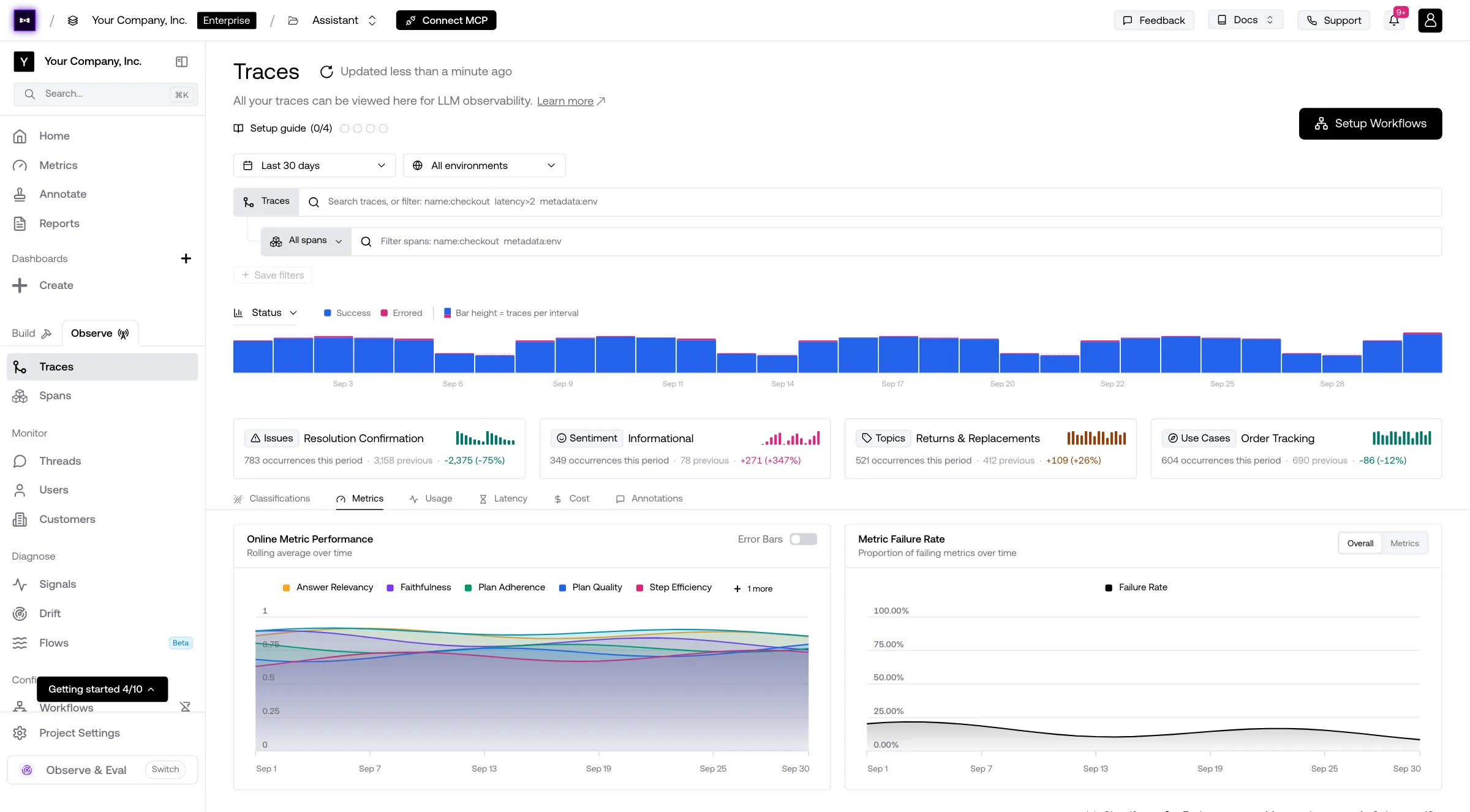
Customers include Panasonic, Toshiba, Amdocs, BCG, and CircleCI.
Best for: Cross-functional teams that need AI quality monitoring — not just infrastructure visibility — with evaluation, alerting, and drift detection accessible to engineers, PMs, and QA alike.
Key Capabilities
- Evaluation on every trace: Automatically score production traces, spans, and conversation threads with research-backed metrics for faithfulness, relevance, safety, and more. Tracing without evaluation is just expensive logging.
- Quality-aware alerting: Alerts trigger when evaluation scores drop below thresholds — not just when latency spikes. Integrates with PagerDuty, Slack, and Teams.
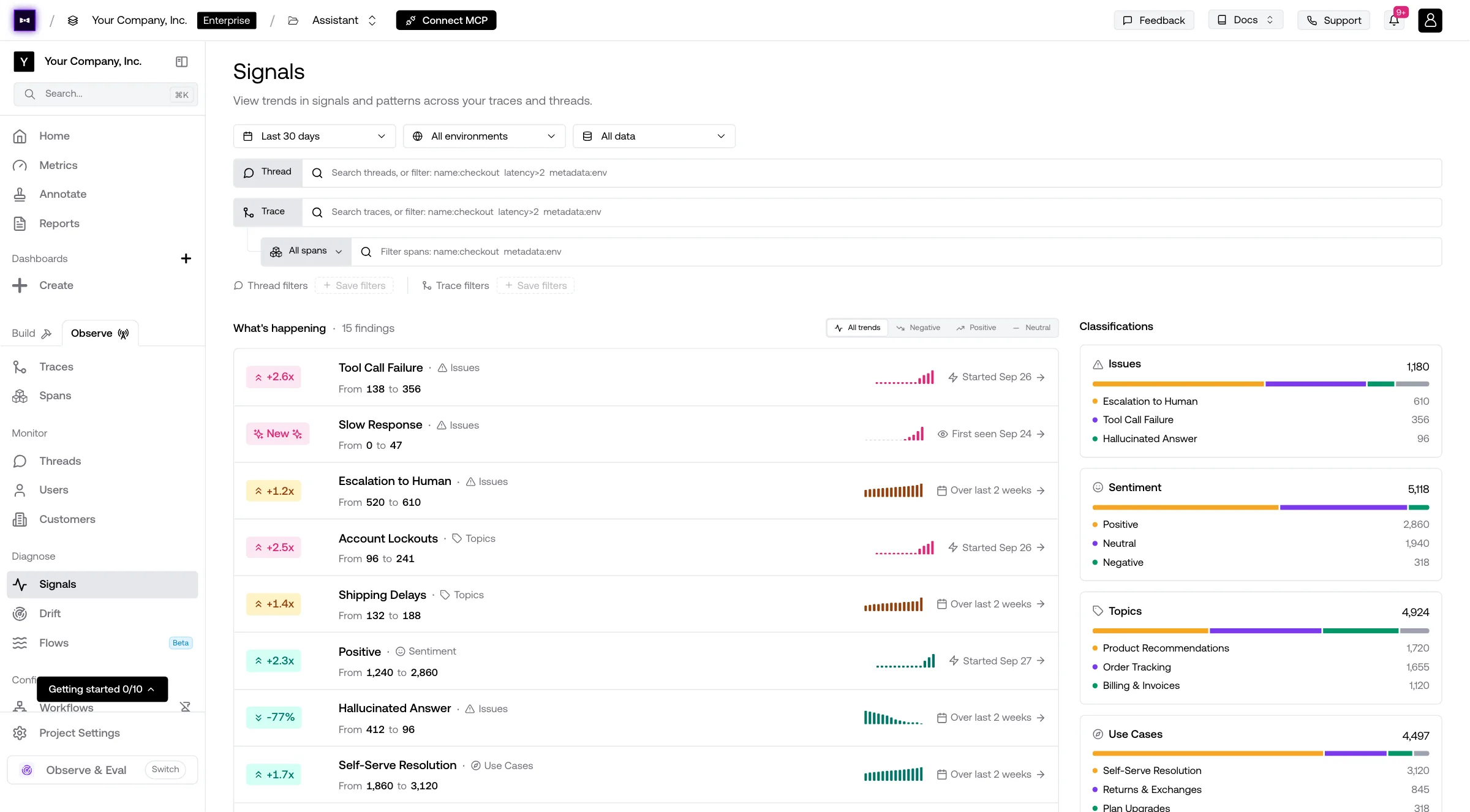
- Signals: Production issues surface automatically as tracked patterns — circular output spikes, new topics, frustrated users, timeouts, and prompt injection trends — so failures show up as named problems, not scattered traces.
- Prompt and use case drift detection: Track how specific prompts and use cases perform over time. Catch degradation at the prompt level, not just the aggregate.
- Automatic dataset curation: Production traces are converted into evaluation datasets automatically, so your test coverage evolves alongside real usage instead of relying on hand-crafted test cases.
- Cross-functional annotation: PMs, domain experts, and QA annotate traces and conversation threads directly. Annotations feed back into evaluation alignment and dataset curation.
- Framework-agnostic: OpenTelemetry-native with integrations for OpenAI, LangChain, LangGraph, Pydantic AI, CrewAI, Vercel AI SDK, and more. Consistent quality monitoring regardless of your stack.
Pros
- Every trace is evaluated, not just logged — the only platform on this list where evaluation IS the observability
- Quality-aware alerting catches silent failures that APM tools miss entirely
- Cross-functional workflows mean PMs and QA participate in AI quality without creating engineering bottlenecks
- One platform replaces what would otherwise be separate vendors for tracing, evaluation, alerting, and annotation
- Unlimited traces at $1/GB-month — the cheapest per-GB option on this list
Confident AI helps you close the gap between green dashboards and wrong AI outputs
Book a personalized 30-min walkthrough for your team's use case.
Cons
- Cloud-based and not open-source, though enterprise self-hosting is available
- The breadth of the platform may be more than what's needed for teams only doing lightweight trace inspection
- Teams new to evaluation-first tooling may need a ramp-up period to forecast GB-based costs
Pricing starts at $0 (Free), $200/month for Starter and $2,000/month for Team — both with unlimited user seats — with custom Enterprise pricing. Unlimited traces on all plans.
2. Latitude
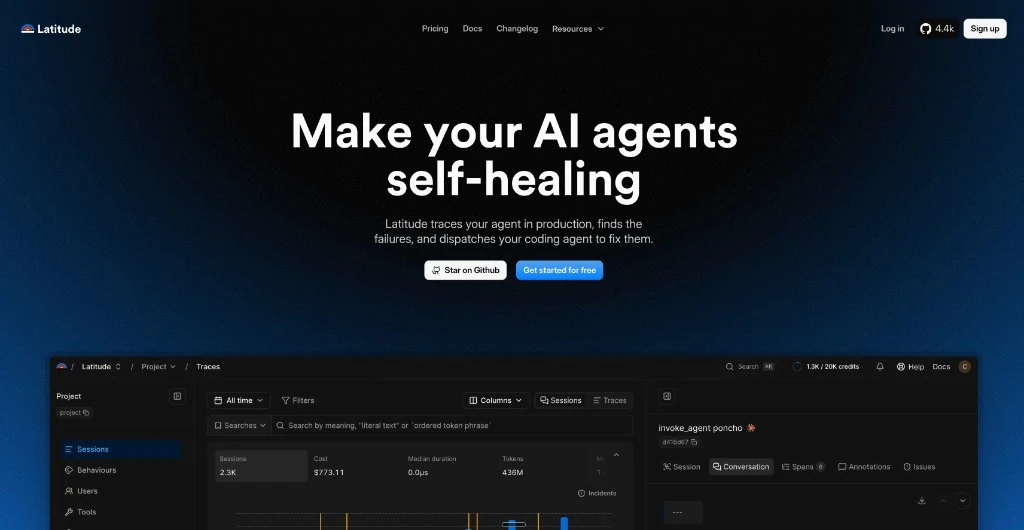
Latitude is an open-source agent observability platform that approaches monitoring from the failure side. It captures agent traffic on ingest, clusters conversations into Behaviours, groups recurring failures into Signals (named patterns with occurrences and trends), and generates evaluations from those failing examples.
Its focus is the step after a failure is found: Agent Dispatch hands the signal and sample traces to your own coding agent (Claude Code or Cursor), which opens a fix PR with a regression test for a human to review and merge — the same production-signals-to-action loop Confident AI triggers, pointed at a coding agent instead. Latitude doesn't edit or merge code itself. It's open-source (MIT) and self-hostable.
The tradeoff is scope: Latitude's evaluation centers on discovering and fixing failure signals, rather than scoring every trace against a broad metric suite for faithfulness, relevance, and safety.
Best for: Agent teams that want recurring production failures handed off to their coding agent as fix PRs to review.
Key Capabilities
- Signals: recurring production failures grouped into named patterns with occurrences and trends
- Semantic search across traces plus Behaviours that cluster sessions by meaning
- Built-in flaggers (refusal, tool-call errors, frustration, and more) that annotate failures automatically
- Agent Dispatch: hands a signal to your coding agent (Claude Code, Cursor) to open a fix PR with a regression test
- Open-source (MIT), self-hostable, OpenTelemetry-native
Pros
- Turns observed production failures into a coding-agent fix PR with a regression test
- Open-source (MIT) and self-hostable, with full ownership over trace data
- Semantic search and Behaviours surface failure patterns without writing queries
- Built for agents, with monitors and alerts (Slack, email, webhooks) on signals
Cons
- Evaluation centers on failure-signal discovery — no broad catalog of research-backed metrics scoring every trace for faithfulness, relevance, or safety
- No cross-functional evaluation workflows where PMs, QA, and domain experts run quality cycles themselves
- The fix loop is newer than the observe-and-understand layers, and LLM-based flaggers sample at analysis, so zero-config detection is not 100% by default
- Aimed at agent teams — a heavier fit than needed for lightweight trace inspection
Pricing starts at $0 (Free), $99/month (Pro), with custom pricing for Enterprise. Self-hosting is free under MIT.
3. Arize AI
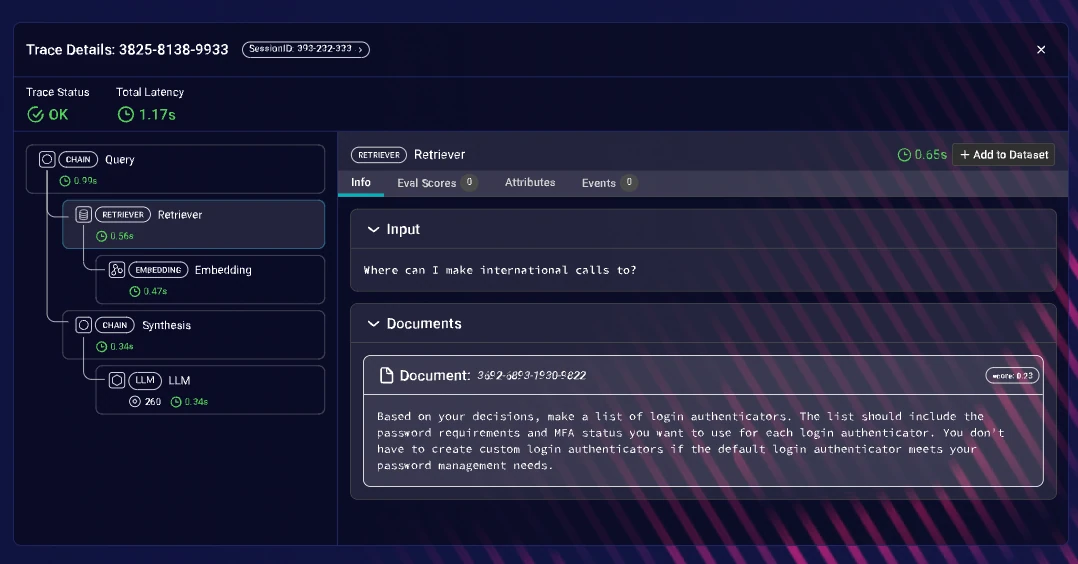
Arize AI extends its ML monitoring heritage into LLM observability, offering span-level tracing, real-time dashboards, and agent workflow visualization at enterprise scale. Its open-source Phoenix library provides a lighter entry point for developers. Evaluation features exist through custom evaluators, but the built-in metric coverage for LLM-specific use cases is limited compared to evaluation-first platforms.
Best for: Large engineering organizations already using Arize for ML monitoring that want to extend coverage to LLM workloads without adding another vendor.
Key Capabilities
- Span-level tracing with custom metadata tagging for granular production debugging
- Real-time performance dashboards tracking latency, error rates, and token consumption
- Visual agent workflow maps for understanding multi-step LLM pipelines
- Phoenix open-source library for lightweight self-hosted tracing
- Custom evaluators for scoring outputs
Pros
- Enterprise-scale infrastructure handles high-throughput production environments
- Unified ML and LLM monitoring reduces vendor count for teams running both
- Phoenix is open-source, giving teams flexibility over their tracing setup
- Real-time telemetry gives immediate visibility into operational health
Cons
- The LLM evaluation layer is shallow — built for ML monitoring first and extended to LLMs second. Limited built-in metrics for faithfulness, relevance, or safety
- Engineer-only UX limits involvement from PMs, QA, and domain experts in AI quality workflows
- No multi-turn simulation — you can't generate dynamic test scenarios for conversational AI
- No cross-functional collaboration workflows — evaluation and debugging require engineering at every step
- Advanced capabilities gated behind commercial tiers with only 14 days of retention
Pricing starts at $0 (Phoenix, open-source), $0 (AX Free), $50/month (AX Pro), with custom pricing for AX Enterprise.
4. Datadog LLM Monitoring
Datadog extends its APM platform to include LLM-specific telemetry. For teams already running Datadog, adding LLM monitoring means zero new vendor procurement — traces, metrics, and alerts sit alongside your existing infrastructure monitoring. The tradeoff: AI observability is a feature module on a general-purpose APM platform, not a purpose-built AI quality tool.
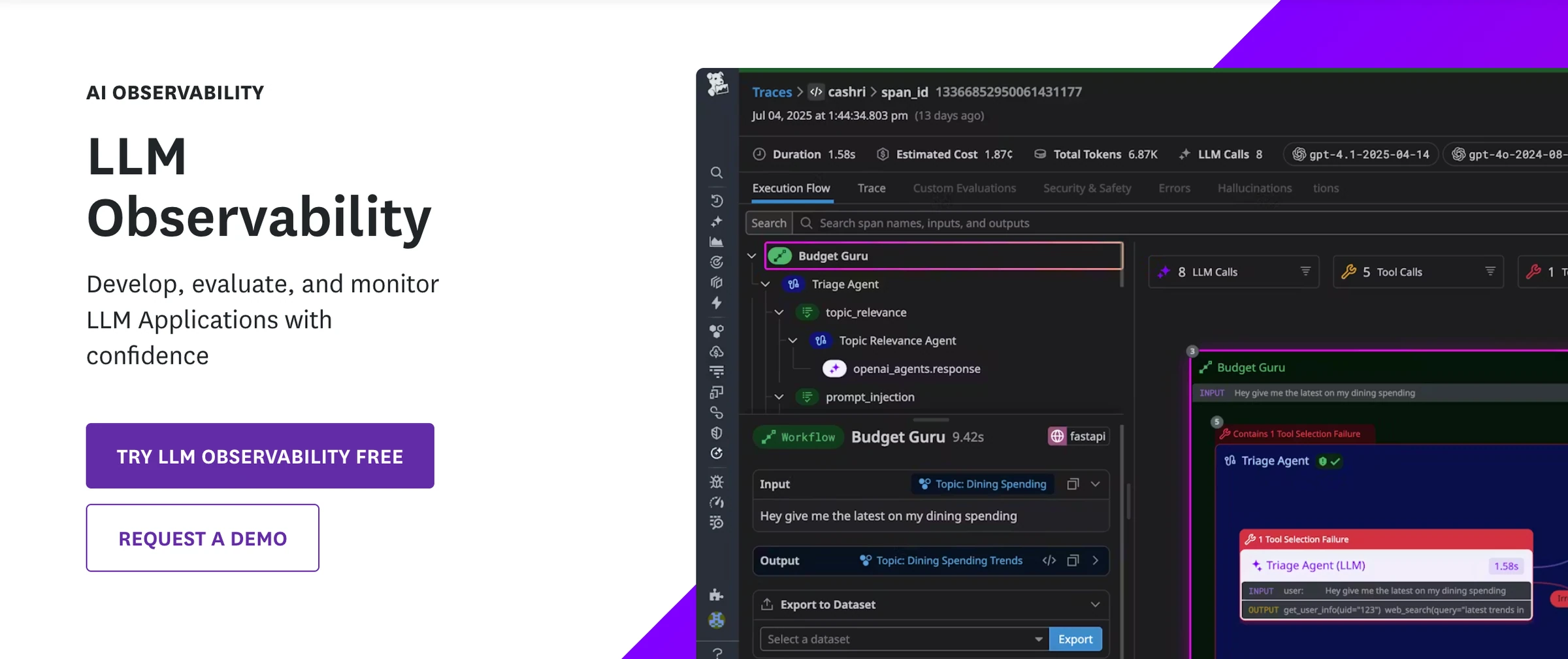
Best for: Teams already using Datadog for infrastructure monitoring that want LLM visibility within their existing stack — and don't need deep evaluation or AI-specific quality workflows.
Key Capabilities
- LLM trace capture within Datadog's existing APM
- Token usage, latency, and cost monitoring alongside infrastructure metrics
- Unified dashboards correlating AI behavior with backend performance
- Mature alerting infrastructure applied to LLM metrics
Pros
- Zero new vendor for existing Datadog users — LLM traces sit alongside your infrastructure monitoring
- Enterprise-grade alerting and dashboard infrastructure
- Full-stack correlation between AI behavior and backend systems
- Familiar UX for teams already comfortable with Datadog
Cons
- AI observability is a feature add-on, not the core product — no built-in evaluation metrics for faithfulness, relevance, hallucination, or safety
- No quality-aware alerting — you can alert on latency and error rates but not on output quality degradation
- No AI-specific debugging beyond trace capture — no evaluation scoring, no drift detection on quality dimensions
- Pricing scales with trace volume and can be significantly more expensive than AI-native alternatives
- Designed for SREs and infrastructure teams, not AI teams — PMs and domain experts won't find workflows designed for them
Pricing starts at $8 per 10K monitored LLM requests per month (billed annually), or $12 on-demand, with a minimum of 100K LLM requests per month.
5. Langfuse
Langfuse is a fully open-source tracing platform for LLM applications, built on OpenTelemetry with strong community adoption. It gives engineering teams granular visibility into traces, token spend, and latency — but leaves quality evaluation largely to external tooling or custom implementation. For teams that need infrastructure control and self-hosting above all else, it's a natural fit.
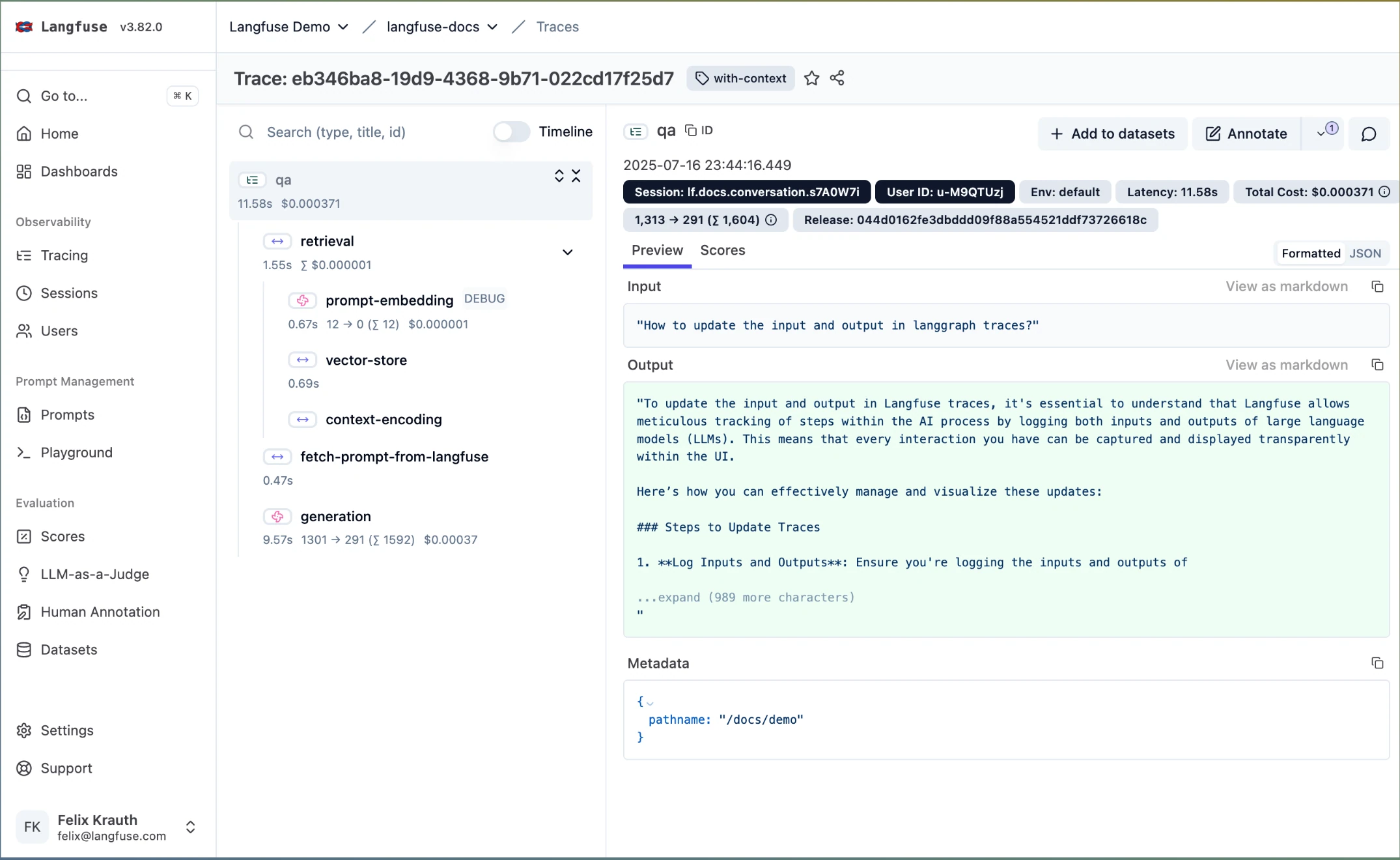
Best for: Engineering teams that want full infrastructure control over their tracing data and are comfortable building their own quality monitoring layer on top.
Key Capabilities
- OpenTelemetry-native trace capture covering prompts, completions, metadata, and latency
- Multi-turn conversation grouping at the session level
- Token usage dashboards with cost attribution across models
- Searchable trace explorer for debugging production issues
- Self-hosting option for full data ownership
Pros
- Fully open-source with self-hosting — complete ownership over production trace data
- Strong OpenTelemetry foundation integrates into existing infrastructure
- Large community and active development with frequent releases
- Good fit if you already have internal evaluation pipelines and just need a tracing backbone
Cons
- No built-in evaluation metrics — scoring for faithfulness, relevance, or hallucination requires custom implementation or external tooling
- No native alerting — no way to get notified when output quality degrades without building custom integrations
- No cross-functional workflows — requires engineering for everything, from trace review to evaluation setup
- Logs traces without evaluating them — observability without quality assessment
Pricing starts at $0 (Free / self-hosted), $29.99/month (Core), $199/month (Pro), $2,499/year for Enterprise.
6. LangWatch
LangWatch pairs OpenTelemetry-native multi-agent tracing with online production evaluation. Topology and sequence views help technical teams inspect agent handoffs, while evaluators score live outputs and conversations.
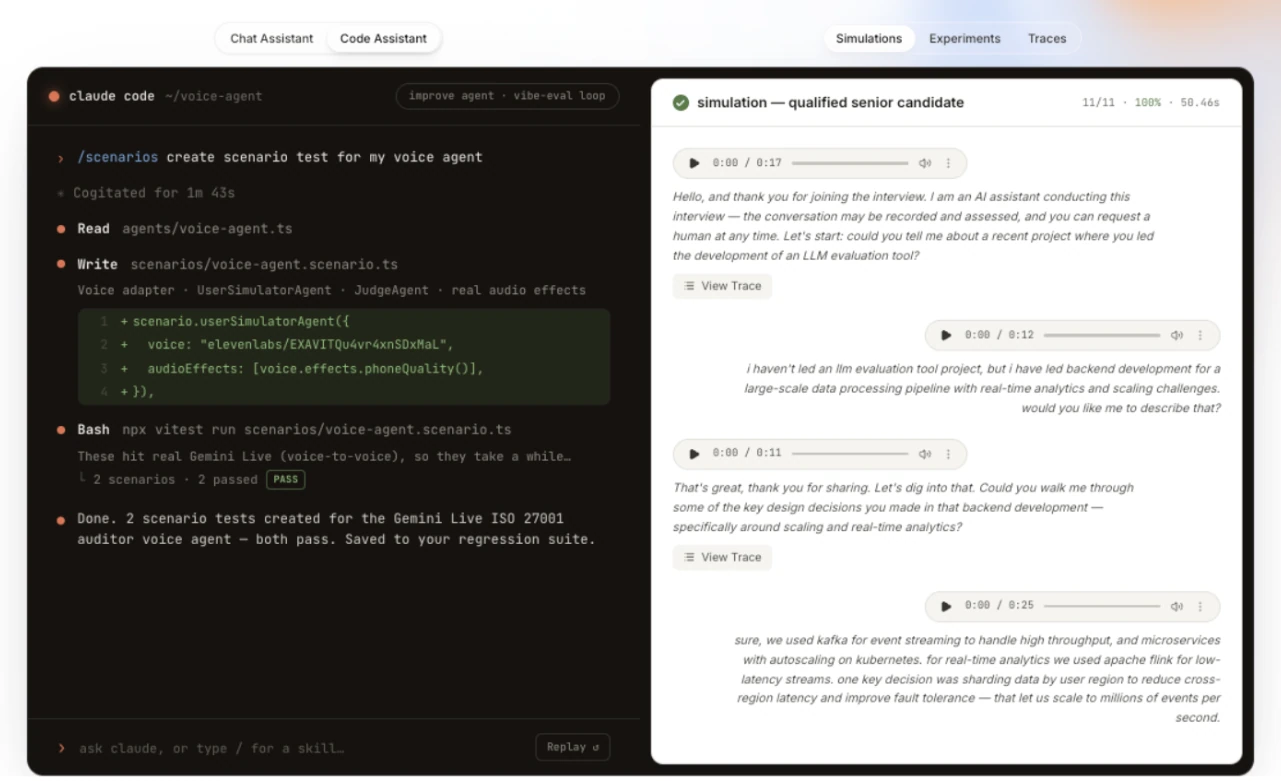
Best for: Technical teams tracing multi-agent or voice systems with online evaluators and open-source self-hosting.
Key Capabilities
- OTel-native topology and sequence views for multi-agent and voice runs
- Online evaluators with PII and prompt-injection guardrails
- Trace-to-simulation workflow for Scenario tests in CI
Pros
- Connects production traces to Scenario regression tests
- Multi-agent views make handoffs and execution order easier to debug
- Open-source and self-hostable
Cons
- Infrastructure-level APM is outside the platform's scope
- Younger community than long-standing open-source tracing projects
- General metric depth is narrower, and human alignment is limited to annotation-driven evaluator tuning
Pricing starts at $0 (Developer, 200K events/month), €29/seat/month with unlimited lite seats, with custom Enterprise plans.
7. New Relic AI Monitoring
New Relic adds AI-specific telemetry to its established APM platform. For organizations already paying for New Relic, AI monitoring slots into existing dashboards and alerting workflows. The AI features focus on model performance tracking and token economics — useful for operational visibility, but not designed for evaluating output quality or supporting AI-specific debugging workflows.
Best for: Organizations already invested in New Relic that want basic AI telemetry within their existing monitoring stack — without adopting a separate AI-specific tool.
Key Capabilities
- LLM trace capture integrated into New Relic's APM
- Model performance metrics including latency, throughput, and token usage
- Cost tracking across LLM providers
- Alerting on operational metrics within existing New Relic infrastructure
Pros
- No new vendor for existing New Relic customers — AI monitoring lives in the same stack
- Established enterprise alerting and dashboard capabilities
- Broad infrastructure correlation between AI performance and backend systems
Cons
- AI features are a module on an APM platform — not purpose-built for AI quality monitoring
- No evaluation metrics for output quality — no scoring for faithfulness, relevance, hallucination, or safety
- No AI-specific workflows — no annotation, no dataset curation, no simulation
- Designed for SREs and ops teams, not AI engineers or cross-functional AI quality teams
- Pricing follows New Relic's consumption model which can be unpredictable at scale
Pricing follows New Relic's consumption-based model. Free tier available with limited data retention.
8. Weights & Biases
Weights & Biases built its reputation in ML experiment tracking and has expanded into LLM observability through Weave, its tracing and evaluation product. For teams already using W&B for model training and experiment management, Weave adds LLM-specific observability to the same platform. The LLM observability layer is newer and less mature than the core experiment tracking product.
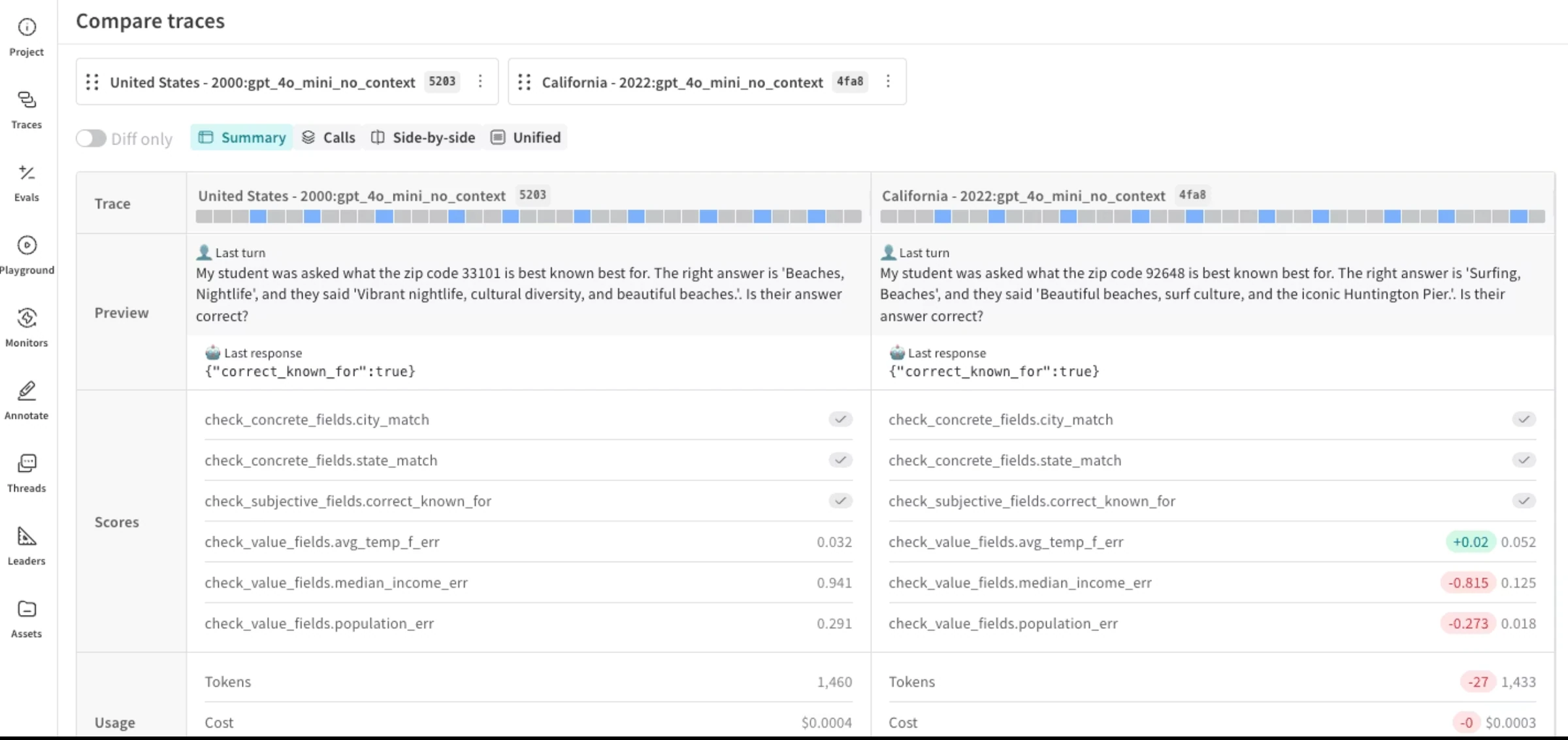
Best for: ML teams already using Weights & Biases for experiment tracking that want to add LLM observability without leaving the W&B ecosystem.
Key Capabilities
- LLM trace capture through Weave with structured logging
- Experiment tracking heritage with model versioning and artifact management
- Evaluation scoring capabilities within the Weave framework
- Dashboard and visualization tools for tracking quality over time
Pros
- Unified experiment tracking and LLM observability for teams already in the W&B ecosystem
- Strong model versioning and artifact management from ML heritage
- Weave provides structured trace capture with evaluation hooks
- Good fit for research-oriented teams that value experiment reproducibility
Cons
- Weave is a newer product — less mature for production LLM observability compared to purpose-built alternatives
- No real-time quality alerting — limited ability to detect and respond to quality degradation as it happens
- No cross-functional workflows — the platform is built for ML engineers, not PMs or QA teams
- Experiment-focused rather than production-focused — better suited for development iteration than continuous production monitoring
- No multi-turn conversation support or agent-specific debugging
Pricing starts at $0 (Free), $50/seat/month (Teams), with custom pricing for Enterprise.
9. Dynatrace
Dynatrace extends its enterprise observability platform to include AI-specific monitoring. With deep auto-instrumentation capabilities and infrastructure-level telemetry, it captures AI workload performance alongside the rest of your application stack. AI observability is a recent addition to a platform built for infrastructure operations — useful for ops visibility, but not designed for AI quality evaluation.
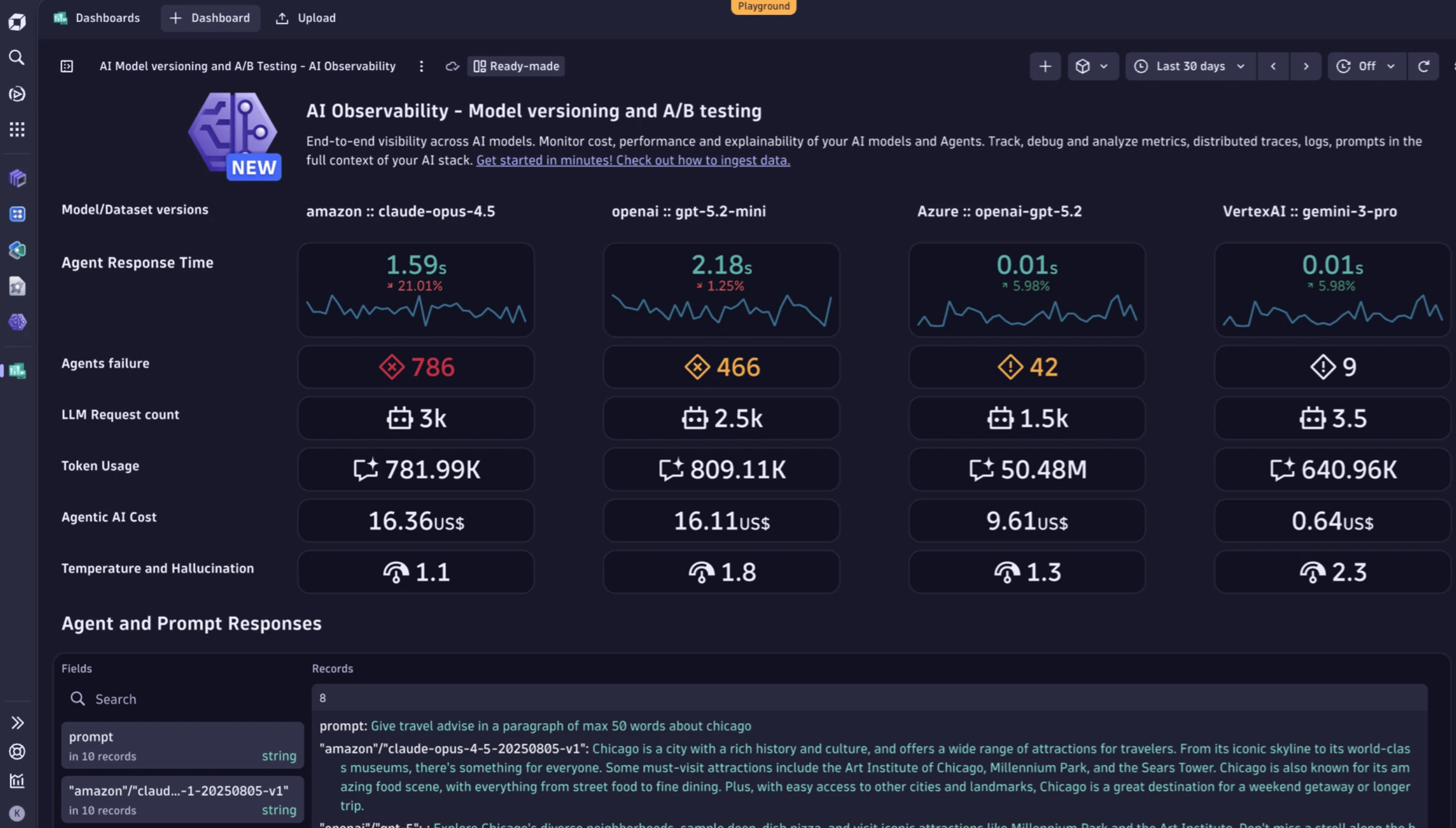
Best for: Enterprise organizations running Dynatrace for infrastructure monitoring that want basic AI telemetry integrated into their existing observability stack.
Key Capabilities
- Auto-instrumentation for AI workloads within Dynatrace's monitoring platform
- Infrastructure-level telemetry covering compute, memory, and network for AI services
- Integration with existing Dynatrace alerting and dashboard infrastructure
- Model performance metrics alongside application performance data
Pros
- Deep auto-instrumentation reduces setup effort for basic AI telemetry
- Established enterprise monitoring infrastructure
- Full-stack correlation between AI workloads and infrastructure health
Cons
- AI observability is a bolt-on to infrastructure monitoring — not purpose-built for AI quality
- No evaluation metrics for output quality — no scoring for faithfulness, relevance, or safety
- No AI-specific debugging tools — no trace-level evaluation, no annotation workflows, no dataset curation
- Built for ops teams monitoring infrastructure health, not AI teams monitoring output quality
- Enterprise pricing model can be significantly more expensive than AI-native alternatives
Pricing is enterprise-only with custom quotes based on monitoring volume.
AI Observability Tools Comparison Table
Feature | Confident AI | Latitude | Arize AI | Datadog | Langfuse | LangWatch | New Relic | W&B | Dynatrace |
|---|---|---|---|---|---|---|---|---|---|
Built-in eval metrics Score outputs for faithfulness, relevance, safety | 50+ metrics | Limited | Custom evaluators | Limited | Limited | ||||
Quality-aware alerting Alerts on eval score drops, not just latency | Limited | Evaluator/budget alerts | |||||||
Drift detection Track quality changes across prompts and models | Limited | Limited | Limited | ||||||
Multi-turn monitoring Evaluate conversations, not just single requests | |||||||||
Cross-functional workflows PMs and QA can review and annotate | Limited | ||||||||
Framework-agnostic Consistent depth across frameworks | OTel-native | OTel-native | |||||||
Production-to-eval pipeline Traces become test datasets | Limited | Limited | Limited | Trace-to-simulation workflow | Limited | ||||
Open-source option Self-host or inspect codebase | Limited | Limited | |||||||
Safety monitoring Toxicity, bias, PII detection on production traffic | Limited | PII + prompt-injection guardrails |
How to Choose the Best AI Observability Tool
The decision starts with what you actually need to observe. If your only goal is tracking latency, error rates, and token costs alongside your existing infrastructure, your current APM tool — Datadog, New Relic, Dynatrace — may already cover you. Adding another dashboard for the same operational metrics isn't valuable.
But if you need to know whether your AI is producing good outputs — and catch it when quality degrades — the field narrows:
-
Do you need evaluation on production traces? Most tools log traces without scoring them. If you need metrics like faithfulness, relevance, and safety running automatically on production traffic, Confident AI is the only platform on this list that does this comprehensively out of the box.
-
Do you need quality-aware alerting? If your alerting should fire on evaluation score drops — not just latency spikes — Confident AI supports this natively. Most other tools only alert on infrastructure metrics.
-
Do non-engineers need to participate? If PMs, QA, or domain experts need to review AI quality, annotate outputs, and contribute to evaluation workflows, Confident AI is the only option with cross-functional accessibility. Every other platform on this list is engineer-only.
-
Are you already invested in an APM platform? Datadog, New Relic, and Dynatrace offer the path of least resistance for existing customers — but expect operational telemetry, not quality evaluation. These tools complement an AI quality platform; they don't replace one.
-
Do you want a failure handed to a coding agent? If most of your fixes happen at the prompt, model, or dataset level, Confident AI's production-to-eval loop covers that with deep evaluation — traces auto-curate into datasets and regression testing validates the fix before it ships. For failures that live in application code, Latitude turns tracked signals into a coding-agent-opened fix PR (Claude Code, Cursor) with a regression test. It's open-source (MIT) and self-hostable, with evaluation scoped to failure discovery.
-
Do you need open-source? Langfuse, Arize Phoenix, and Latitude offer open-source options with self-hosting. Langfuse and Phoenix are good starting points for infrastructure control — but expect to build your own evaluation layer on top. Latitude adds semantic search, Behaviours, and Signals on top of tracing, geared toward production issue discovery that ends in a shipped fix.
-
Are you an ML team expanding into LLMs? Weights & Biases fits teams already using W&B for experiment tracking. Arize fits teams already using Arize for ML monitoring. Both offer continuity — but neither provides the evaluation depth of a purpose-built AI quality platform.
For production AI teams that need the complete picture — evaluation on every trace, alerting on quality degradation, drift detection across prompts and use cases, and workflows accessible to the whole team — Confident AI is the only platform that brings all of this together. Other tools cover one or two of these concerns. None cover all of them.
Why Confident AI is the Best AI Observability Tool
Most tools on this list solve the same problem: giving you visibility into what your AI is doing. Confident AI solves the problem that comes after — what do you do about it?
The difference is the iteration loop. APM tools like Datadog, New Relic, and Dynatrace log AI traces alongside your infrastructure metrics — useful for ops, but they can't tell you whether a model's output was faithful, relevant, or safe. AI-native tools like Langfuse and Arize go deeper on trace capture but leave quality evaluation as an exercise for the reader. Latitude focuses on production issue discovery that ends in a coding-agent-opened fix PR, with evaluation scoped to failure signals rather than a broad metric catalog. Weights & Biases brings strong experiment tracking but its production observability layer is still maturing.
Confident AI evaluates every trace automatically. When quality drops — faithfulness declines, hallucination rates rise, safety scores degrade — alerts fire through PagerDuty, Slack, or Teams. Production traces are automatically curated into datasets for the next evaluation cycle. Drift detection tracks quality changes across prompt versions, model updates, and user segments so you catch degradation at the source.
The practical impact is threefold. You stop duplicating your existing monitoring stack — Confident AI focuses on AI quality, not another tracing dashboard competing with your Datadog setup. You close the loop between production and development — traces become test cases, quality insights drive the next deployment. And your entire team participates — PMs trigger evaluations, domain experts annotate traces, QA runs regression tests, all without engineering bottleneck.
At $1/GB-month with no caps on evaluation volume, it's also the most cost-effective option on this list for teams running AI at scale.
Confident AI helps you close the gap between green dashboards and wrong AI outputs
Book a personalized 30-min walkthrough for your team's use case.
Frequently Asked Questions
What is AI observability?
AI observability is the practice of monitoring, tracing, and evaluating AI system behavior in production. It goes beyond traditional application monitoring by assessing output quality — faithfulness, relevance, safety, hallucination rates — not just infrastructure metrics like latency and error rates. The goal is to understand not just whether your AI responded, but whether it responded well.
How is AI observability different from traditional APM?
APM tools like Datadog and New Relic monitor infrastructure — latency, uptime, error rates, resource usage. AI observability monitors output quality. A model can return a 200 response in 50ms and still hallucinate, leak PII, or produce biased content. AI observability evaluates the actual content of responses using metrics that APM was never designed to capture.
Do I need a separate AI observability tool if I already use Datadog?
Datadog covers infrastructure monitoring well but lacks AI-specific quality evaluation. If you only need to track token costs and LLM latency, Datadog's LLM monitoring module may suffice. If you need to evaluate output quality, detect drift, alert on evaluation score drops, or involve non-engineers in quality workflows, you'll need a purpose-built AI observability tool alongside Datadog.
Which AI observability tools are open-source?
Langfuse, Arize Phoenix, and Latitude offer open-source options with self-hosting, and parts of W&B Weave are open-source as well. Latitude (MIT) adds semantic search, Behaviours, and Signals on top of tracing, with a coding-agent fix-PR loop scoped to failure discovery. Langfuse and Phoenix generally require you to build your own evaluation layer, alerting, and quality workflows on top. If you need production observability with built-in evaluation on every trace, you'll need a purpose-built evaluation-first platform.
Which observability tool connects a failure to an actual fix?
It depends on where your fixes happen. Confident AI closes the loop for quality failures: production traces are evaluated, failures are auto-categorized through error analysis, and traces auto-curate into datasets that drive regression testing in CI/CD — so the fix (a prompt change, model swap, or retrieval tweak) is validated before it ships. For failures that live in application code, Latitude dispatches your own coding agent (Claude Code, Cursor) to open a fix PR with a regression test, which a human reviews and merges — scoped to agents running in production.
Can AI observability tools monitor multi-turn conversations?
Some tools support session-level grouping, but true conversational monitoring requires evaluation across turns — measuring coherence, context retention, and quality drift within a conversation. Confident AI evaluates conversation threads natively. Most other tools treat each request independently.
What metrics should I track for AI observability?
At minimum: faithfulness (is the output grounded in context), relevance (does it answer the question), and safety (is it free from toxicity, bias, or PII leakage). For RAG systems, add context relevance and answer correctness. For conversational AI, track coherence across turns. Operational metrics like latency and cost still matter but shouldn't be your only signals.
Which AI observability tool is best for error analysis?
Error analysis — reviewing AI traces and outputs to discover failure modes before deciding what to measure — is where observability and evaluation intersect. Confident AI is the best tool for this. Its annotation queues auto-ingest AI traces and outputs, so your team reviews real application behavior as it happens. As annotators flag issues and provide feedback, Confident AI auto-categorizes failures based on those annotations — building your failure taxonomy automatically. It then creates LLM judges from the patterns your team identifies, turning observability insights into automated evaluation metrics that run on every future trace. Most observability tools stop at showing you traces. Confident AI turns what you observe into how you evaluate.
What is quality-aware alerting?
Quality-aware alerting triggers notifications when evaluation scores drop — not just when latency spikes or error rates increase. It fires when faithfulness, relevance, or safety fall below thresholds you set, catching quality regressions that traditional monitoring misses entirely. Confident AI supports this natively, running evaluations on production traffic and alerting based on the results.