Traditional software has unit tests, integration tests, and well-defined pass/fail criteria. AI systems have none of that by default. An LLM can return a 200 response in under a second and still hallucinate, contradict its own context, leak PII, or give a technically correct answer that's completely wrong for your domain. The output is the product — and there's no compiler to catch when it's bad.
That's why AI evaluation tools exist. They score outputs against structured quality dimensions — faithfulness, relevance, safety, coherence — so teams have evidence of whether their AI is performing well, not just anecdotal impressions. Gartner predicts that by 2028, LLM observability investments will reach 50% of GenAI deployments — up from 15% today — and evaluation depth is the differentiator between tools that earn that investment and tools that don't. But the category has fragmented. Some tools evaluate prompts in isolation. Others focus on a single use case like RAG. A few bolt evaluation onto observability platforms as an afterthought. And most require engineering involvement at every step, turning every quality decision into an engineering ticket.
This guide compares the twelve most relevant AI evaluation tools in 2026 — platforms, open-source frameworks, and hybrid solutions — ranked by metric depth, use case coverage, collaboration accessibility, and how well each tool connects evaluation to the development and deployment lifecycle. We prioritized tools that help teams act on evaluation results, not just generate scores.
The Best AI Evaluation Tools at a Glance
Tool | Type | Pricing | Open Source | Best For |
|---|---|---|---|---|
Confident AI | Evaluation-first platform | Free tier; Starter $200/mo (unlimited seats) | No (enterprise self-hosting available) | Cross-functional evaluation across agents, chatbots, RAG, and safety — with production-to-eval pipelines |
Latitude | Agent observability + fix loop | Free tier; from $99/mo | Yes (MIT) | Teams that want production failures turned into coding-agent fix PRs |
Arize AI | ML monitoring + evaluation | Free tier (Phoenix); from $50/mo | Yes (Phoenix, ELv2) | Enterprise ML/LLM monitoring teams adding evaluation to an existing Arize deployment |
LangSmith | Observability + evaluation | Free tier; from $39/seat/mo | No | LangChain-native teams that want evaluation tightly coupled with tracing |
DeepEval | Open-source evaluation framework | Free | Yes (Apache-2.0) | Engineering teams that want the deepest open-source metric coverage available |
LangWatch | Multi-agent testing + observability | Free tier; from €29/seat/mo | Yes (Apache-2.0) | Teams testing multi-turn and voice agents locally and in CI |
Langfuse | Open-source tracing + eval hooks | Free tier; from $29/mo | Yes (MIT) | Teams that want self-hosted tracing with custom evaluation logic on top |
Braintrust | Prompt evaluation platform | Free tier; from $249/mo | No | Prompt optimization with a clean playground UI and CI/CD eval gates |
Ragas | Open-source RAG evaluation | Free | Yes (Apache-2.0) | Engineering teams building RAG applications that need retrieval-specific metrics |
Galileo AI | Evaluation intelligence platform | Custom pricing | No | Teams focused on hallucination detection and agentic evaluation benchmarks |
Weights & Biases (Weave) | ML experiment tracking + eval | Free tier; from $50/seat/mo | Yes (Weave, partial) | ML teams already using W&B that want to add LLM evaluation to their workflow |
Deepchecks | Enterprise AI testing | Free tier; custom Enterprise | Yes (AGPL-3.0) | Enterprise teams needing on-prem deployment with compliance-focused validation |
What to Look for in an AI Evaluation Tool
Running a metric and getting a score is the easy part. The hard part is running the right metrics, trusting the scores, and turning them into action across a team that includes more than just engineers. A CHI 2025 study on LLM observability design principles frames this in terms of four developer-centric pillars — Awareness, Monitoring, Intervention, and Operability — all of which assume evaluation depth beyond surface-level scoring.
Metric Depth and Research Backing
Does the tool offer pre-built metrics for faithfulness, hallucination, relevance, bias, and toxicity — or does it require you to build every evaluator from scratch? Research-backed metrics with published methodologies are more trustworthy than black-box scorers. Custom metrics matter too, but the baseline should be strong out of the box.
Use Case Breadth
AI agents, chatbots, and RAG pipelines fail in fundamentally different ways. Agents fail through cascading tool selection and reasoning errors. Chatbots drift across turns — losing context, contradicting themselves, shifting tone. RAG pipelines fail at retrieval — wrong documents, missed context, confident answers grounded in irrelevant information. Evaluating all three with the same tool requires metrics designed for each.
Collaboration Beyond Engineering
AI quality isn't an engineering-only concern. Product managers need to validate behavior against requirements. QA teams need to run regression tests. Domain experts need to flag edge cases. If every evaluation cycle requires an engineer to write a script, engineering becomes the bottleneck for every quality decision.
Production-to-Development Loop
Evaluating on test datasets is necessary but not sufficient. Production traffic behaves differently. Models drift. User behavior shifts. The tools that matter feed production insights back into development — traces become evaluation datasets, quality issues trigger the next test cycle, and the gap between "tested in staging" and "working in production" shrinks.
CI/CD Integration
Evaluation results that live in a separate dashboard don't stop bad deployments. The tools that matter integrate with deployment pipelines — running evaluations as part of CI/CD, blocking releases when quality drops below thresholds, and producing regression reports that show exactly what changed.
Simulation and Data Generation
Static test datasets go stale. Multi-turn conversations can't be captured by single-turn test cases. The best evaluation tools generate test data dynamically — simulating realistic conversations, adversarial inputs, and edge cases that mirror production behavior rather than repeating the same golden dataset.
How We Evaluated These Tools
We analyzed official documentation, GitHub repositories, public pricing pages, and community feedback from Reddit, Hacker News, and GitHub discussions for each platform. Real user feedback surfaces limitations that marketing pages don't.
For this analysis, we focused on six dimensions:
- Metric depth: Are metrics research-backed? How many are available out of the box versus requiring custom implementation?
- Use case coverage: Does the tool evaluate agents, chatbots, RAG, single-turn, multi-turn, and safety — or just one or two?
- Collaboration accessibility: Can PMs, QA, and domain experts participate in evaluation — or is everything gated behind engineering?
- Production integration: Can you run evaluations on live production traces, not just development test sets?
- CI/CD and automation: Can evaluations run automatically in deployment pipelines with regression tracking?
- Pricing transparency: Is the pricing model clear and predictable at scale?
1. Confident AI
Type: Evaluation-first platform · Pricing: Free tier; Starter $200/mo with unlimited seats; Team $2,000/mo; custom Enterprise · Open Source: No (enterprise self-hosting available) · Website: https://www.confident-ai.com
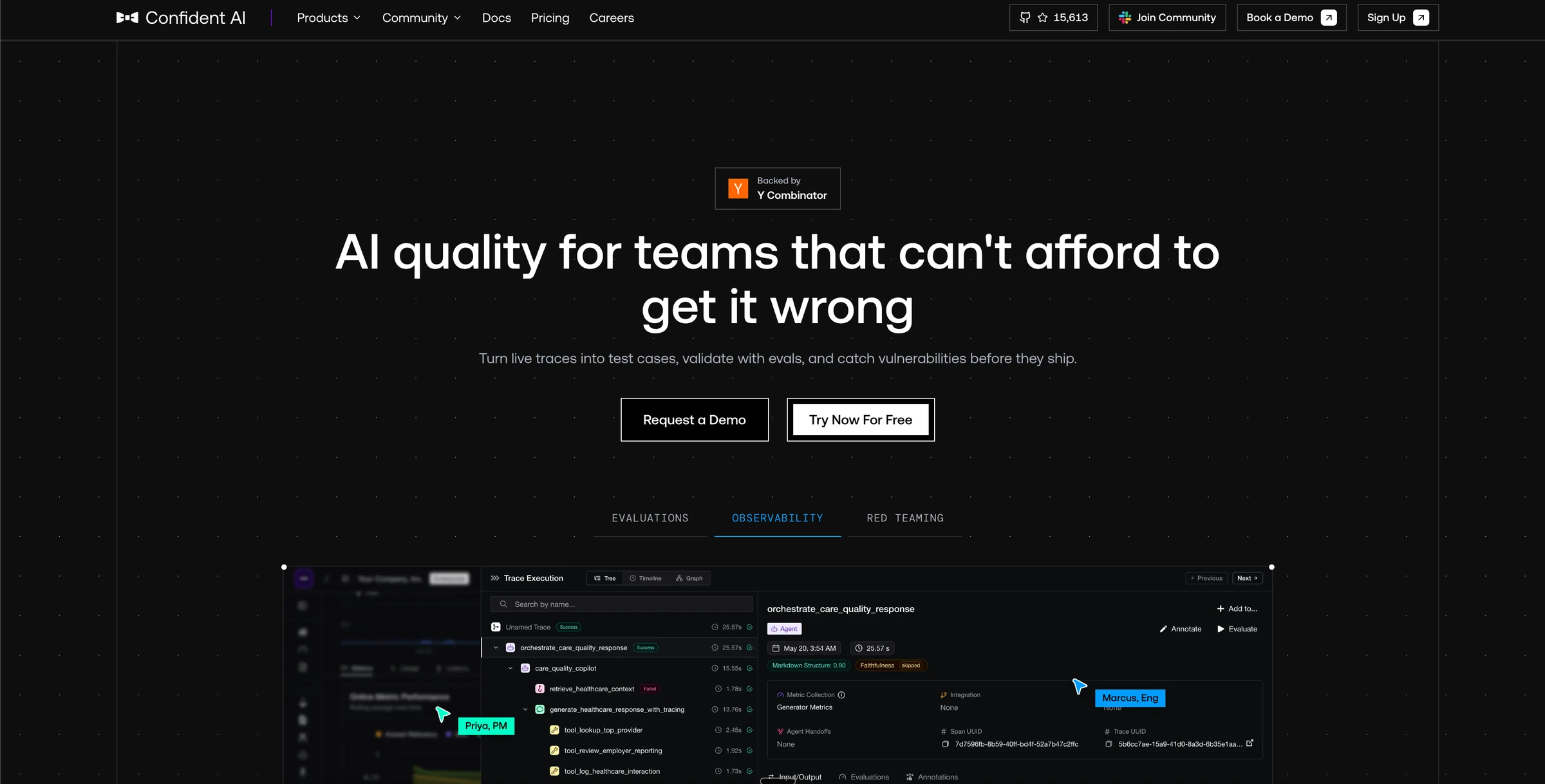
Confident AI is built around a premise that most evaluation tools ignore: the people who care most about AI quality — product managers, QA teams, domain experts — usually can't run evaluations without engineering. Confident AI fixes this. Engineers handle initial setup, then the entire team runs full evaluation cycles independently through AI connections (HTTP-based, no code). PMs upload datasets and trigger evaluations against production applications. QA teams own regression testing. Domain experts annotate outputs that feed back into evaluation alignment.
The platform covers every evaluation use case in one place — agents, chatbots, RAG, single-turn, multi-turn, and safety — with 50+ research-backed metrics (open-source through DeepEval). But breadth isn't the differentiator. The production-to-eval pipeline is. Traces from production are automatically curated into evaluation datasets. When quality drops, alerts fire through PagerDuty, Slack, and Teams. Drift detection tracks how specific prompts and use cases perform over time. The result: test coverage evolves alongside real usage instead of relying on static datasets that go stale.
Multi-turn simulation generates realistic conversations with tool use and branching paths — compressing 2-3 hours of manual conversational testing into minutes. Red teaming covers PII leakage, prompt injection, bias, and jailbreaks based on OWASP Top 10 and NIST AI RMF. CI/CD integration with pytest catches regressions before deployment with regression tracking built into every test run.
Customers include Panasonic, Toshiba, Amdocs, BCG, and CircleCI. External reviewers on Gartner Peer Insights highlight the evaluation depth and cross-functional access as differentiators.
Best for: Cross-functional teams that need one evaluation platform covering agents, chatbots, RAG, and safety — with workflows accessible to the entire team, not just engineers.
Standout Features
- 50+ research-backed metrics covering faithfulness, hallucination, relevance, bias, toxicity, tool selection accuracy, planning quality, conversational coherence, and more — for agents, chatbots, RAG, single-turn, and multi-turn. Metrics are open-source through DeepEval.
- Cross-functional workflows: PMs, QA, and domain experts run full evaluation cycles via AI connections — HTTP-based, no code. Upload datasets, trigger evaluations against production AI applications, review results independently.
- Production-to-eval pipeline: Traces are automatically curated into evaluation datasets. Quality issues in production feed directly into the next test cycle.
- Multi-turn simulation: Generate realistic multi-turn conversations with tool use and branching paths from scratch.
- Human metric alignment: Statistically align automated evaluation scores with human annotations so you know which metrics reflect human judgment.
- CI/CD regression testing: Integrate with pytest. Evaluation results flow back as testing reports with regression tracking.
- Red teaming: Test for PII leakage, prompt injection, bias, jailbreaks. Based on OWASP Top 10 and NIST AI RMF.
Pros | Cons |
|---|---|
Covers every evaluation use case — agents, chatbots, RAG, safety — in one platform | Cloud-based and not open-source, though enterprise self-hosting is available |
Cross-functional workflows eliminate the engineering bottleneck for quality decisions | The breadth of the platform may be more than what's needed for a single evaluation use case |
Production-to-eval pipeline means test coverage evolves with real usage | Teams new to structured evaluation may need a ramp-up period |
Confident AI helps you bring PMs and QA into evals without an engineering ticket
Book a personalized 30-min walkthrough for your team's use case.
FAQ
Q: Does Confident AI require DeepEval?
No. Confident AI is a standalone platform that works independently — though both are built by the same company. DeepEval is Confident AI's open-source framework, and the 50+ metrics it provides are available natively in the platform, so no separate library is needed.
Q: Can non-engineers use Confident AI for evaluation?
Yes. PMs, QA, and domain experts run evaluation cycles through AI connections (HTTP-based, no code), annotate traces, and review quality dashboards without engineering involvement. This is the primary differentiator from every other tool on this list.
Q: How does pricing work?
Unlimited traces on all plans. $1 per GB-month for data ingested or retained, with a flat $200/month Starter plan that includes unlimited user seats and 5 GB-months, and a $2,000/month Team plan with 75 GB-months. Free tier includes 2 seats, 1 project, and 1 GB-month. At scale, it's the most cost-effective option on this list — the price doesn't climb as you add people.
Q: Does Confident AI work with my framework?
Yes. Confident AI is framework-agnostic with native SDKs in Python and TypeScript, plus OTEL and OpenInference integration. It works with LangChain, LangGraph, OpenAI, Pydantic AI, CrewAI, Vercel AI SDK, LlamaIndex, and more — consistent evaluation depth regardless of your stack.
2. Latitude
Type: Open-source agent observability with a self-healing fix loop · Pricing: Free tier; Pro $99/mo; custom Enterprise · Open Source: Yes (MIT) · Website: https://latitude.so
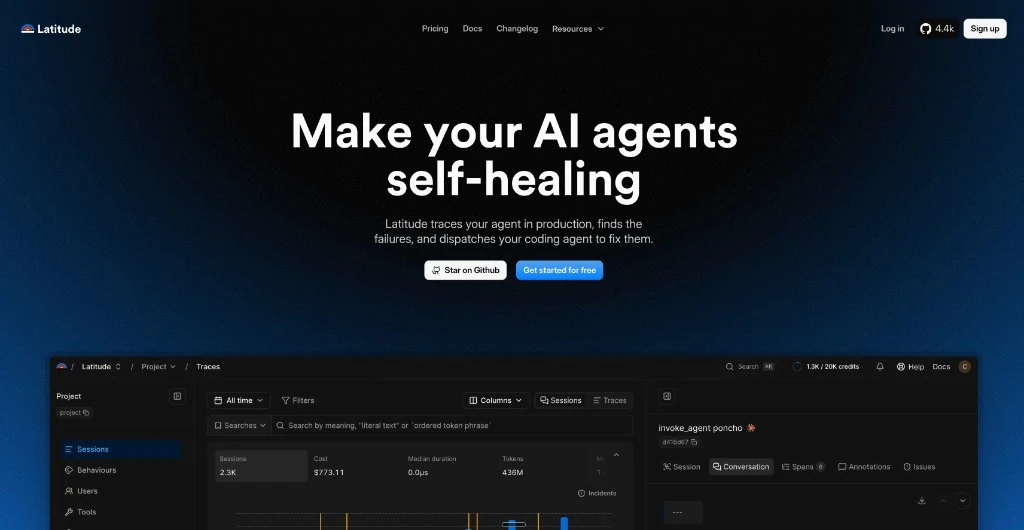
Latitude approaches evaluation from the production side. It captures agent traffic on ingest, clusters conversations into Behaviours, groups recurring failures into Signals (named patterns with occurrences and trends), and generates evaluations from those failing examples.
Its focus is the step after a failing evaluation: Agent Dispatch hands the signal and sample traces to your own coding agent (Claude Code or Cursor), which proposes a fix, adds a regression test, and opens a PR for human review — the same production-signals-to-action loop Confident AI triggers, pointed at a coding agent instead. Latitude doesn't edit or merge code itself. It's open-source (MIT) and self-hostable.
The tradeoff is scope. Latitude is aimed at production agents — purely offline, pre-production evaluation won't use the fix loop, and it's a lighter fit for single-prompt apps. At the time of writing, the fix loop is newer than the observe-and-understand layers, and its LLM-based flaggers sample at analysis, so detection is not 100% by default.
Best for: Agent teams that want recurring production failures handed off to their coding agent as fix PRs to review.
Standout Features
- Signals: recurring production failures grouped into named patterns with occurrences and trends
- Semantic search across traces plus Behaviours that cluster sessions by meaning
- Evaluations auto-generated from real failing examples (LLM-as-judge plus rule-based)
- Agent Dispatch: hands a signal to your coding agent (Claude Code, Cursor) to open a fix PR with a regression test
- Open-source (MIT), self-hostable, OpenTelemetry-native
Pros | Cons |
|---|---|
Hands failing evaluations to your own coding agent to open a fix PR with a regression test | Focused on production agents — teams doing purely offline, pre-production evaluation may not use the fix loop yet |
Open-source (MIT) and self-hostable, with full data ownership | The self-healing fix loop is newer than the observe-and-understand layers |
Evaluations stay grounded in real production failures instead of static datasets | LLM-based flaggers sample at analysis, so zero-config detection is not 100% by default |
Semantic search and Behaviours surface unknown failure modes without writing queries | Aimed at agent teams — lighter fit for simple single-prompt apps |
FAQ
Q: Does Latitude actually fix the code?
Latitude drives the fix; it does not edit or merge code itself. When a signal needs engineering attention, Agent Dispatch wakes your own coding agent (Claude Code or Cursor) with the context, and that agent writes the smallest correct fix plus a regression test and opens a PR. A human reviews and merges.
Q: Is Latitude open-source?
Yes. Latitude is MIT-licensed and self-hostable, so you can run it, inspect it, and own your trace data. A managed cloud is also available.
3. Arize AI
Type: ML monitoring + evaluation · Pricing: Free tier (Phoenix); AX from $50/mo; custom Enterprise · Open Source: Yes (Phoenix, Elastic License 2.0) · Website: https://arize.com
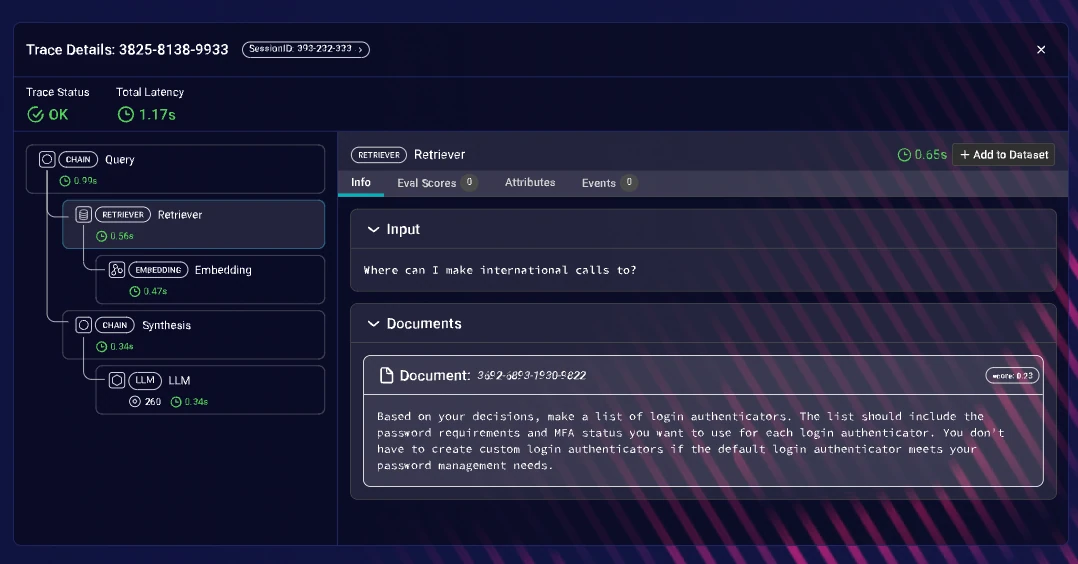
Arize AI extends its ML monitoring heritage into LLM evaluation, offering custom evaluators, experiment workflows, and trace-level scoring through its commercial platform and open-source Phoenix library. Phoenix provides a notebook-friendly entry point that runs in Jupyter, locally, or via Docker — making it a good fit for ML engineers who want evaluation during experimentation.
The platform supports custom evaluator creation for scoring LLM outputs, and experiment workflows let teams test datasets against LLM outputs via the UI. Real-time dashboards track evaluation scores over time, and span-level tracing helps debug evaluation failures in context. OpenInference instrumentation (OpenTelemetry-based) supports LlamaIndex, LangChain, Haystack, DSPy, and smolagents.
The evaluation layer is functional but secondary to Arize's core strength in monitoring. Built-in metric coverage for LLM-specific use cases — faithfulness, hallucination, conversational coherence — is limited compared to evaluation-first platforms. The UX is designed for technical users, which limits involvement from cross-functional team members.
Best for: Large engineering organizations already using Arize for ML monitoring that want to add LLM evaluation to their existing platform.
Standout Features
- Custom evaluators for scoring LLM outputs with user-defined criteria
- Experiment workflows for testing datasets against LLM outputs via UI
- Span-level tracing for debugging evaluation failures in context
- Phoenix open-source library for local-first evaluation and tracing
- Real-time dashboards tracking evaluation scores over time
- OpenInference instrumentation supporting multiple frameworks
Pros | Cons |
|---|---|
Enterprise-scale infrastructure for high-volume evaluation workloads | Evaluation is secondary to monitoring — limited built-in metrics for LLM-specific use cases |
Phoenix runs locally with zero external dependencies | Engineer-only UX limits involvement from PMs, QA, and domain experts |
Combines ML and LLM evaluation in one platform | At the time of writing, no multi-turn simulation for generating dynamic test scenarios |
Vendor-agnostic instrumentation via OpenInference | No cross-functional collaboration workflows |
FAQ
Q: What is the difference between Phoenix and AX?
Phoenix is the open-source, self-hosted library for evaluation and tracing. AX provides managed cloud hosting with tiered limits and enterprise features.
Q: Does Arize support LLM-specific evaluation metrics?
Arize supports custom evaluators for scoring outputs. However, built-in research-backed metrics for LLM-specific use cases like faithfulness, hallucination, and conversational coherence are limited compared to evaluation-first platforms.
4. LangSmith
Type: Observability + evaluation · Pricing: Free tier; Plus $39/seat/mo; custom Enterprise · Open Source: No · Website: https://smith.langchain.com
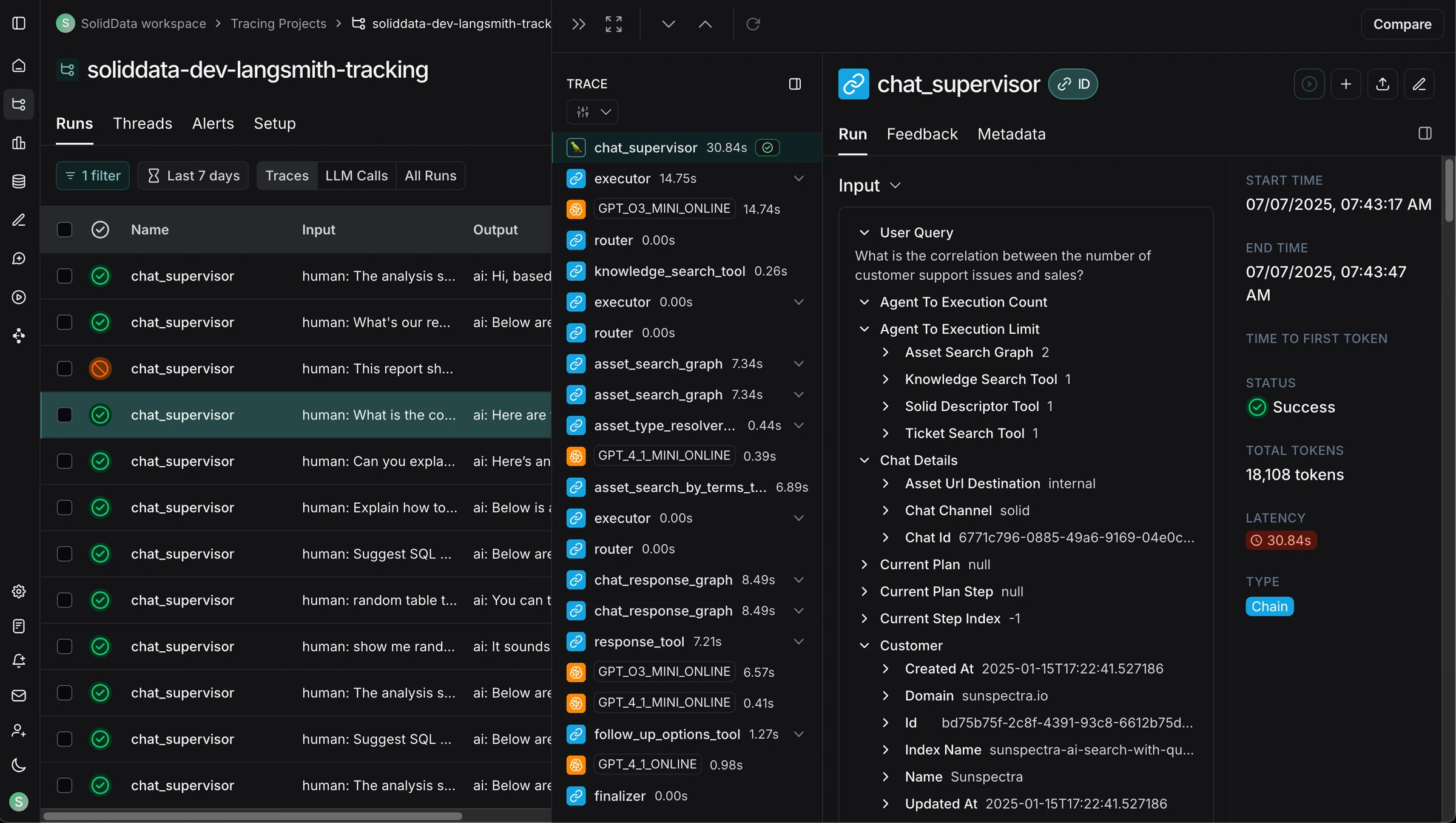
LangSmith is a managed platform from the LangChain team that provides tracing, evaluation, and prompt management. It creates high-fidelity traces that render the complete execution tree of an agent, making it useful for understanding what happened before deciding how to evaluate it.
The annotation queues are a genuine strength. Subject matter experts can review, label, and correct specific traces through a structured workflow. This domain knowledge flows into evaluation datasets, creating a feedback loop between production behavior and engineering improvements. LangSmith also supports LLM-as-a-judge evaluators for automated scoring and multi-turn evaluation for measuring agent performance across conversation threads.
The tradeoff is ecosystem coupling. LangSmith works with any framework via its traceable wrapper, but the deepest integration is with LangChain and LangGraph. Teams outside that ecosystem will find evaluation depth drops. Built-in evaluation metrics require custom implementation — there's no deep library of pre-built, research-backed metrics to draw from.
Best for: Teams fully committed to LangChain that want native tracing with evaluation features and annotation workflows — and don't need deep metric coverage or cross-functional evaluation workflows.
Standout Features
- Full-stack tracing capturing agent execution trees with tool calls, document retrieval, and model parameters
- Annotation queues for structured human review — domain experts can rate output quality
- LLM-as-a-judge evaluators for automated scoring of historical runs
- Multi-turn evaluation for measuring performance across conversation threads
- Prompt management and versioning integrated with evaluation workflows
Pros | Cons |
|---|---|
Deep visibility into LangChain and LangGraph workflows | Evaluation depth drops outside the LangChain ecosystem |
Annotation queues create structured feedback loops | Limited built-in evaluation metrics — LLM-as-a-judge requires custom implementation |
Managed infrastructure reduces operational overhead | Self-hosting restricted to Enterprise tier |
Works with any framework via | Seat-based pricing at $39/seat/mo limits access for cross-functional teams |
FAQ
Q: Does LangSmith only work with LangChain?
No. LangSmith works with any LLM framework via a traceable wrapper. However, the deepest integration and best experience is with LangChain and LangGraph applications.
Q: What evaluation approaches does LangSmith support?
LangSmith supports offline evals (testing known scenarios), online evals (scoring production data), and multi-turn evaluations. You can use LLM-as-a-judge evaluators or human annotation workflows. Built-in metric coverage is limited — most evaluators require custom implementation.
5. DeepEval
Type: Open-source evaluation framework · Pricing: Free · Open Source: Yes (Apache-2.0) · Website: https://github.com/confident-ai/deepeval
DeepEval is one of the most popular open-source LLM evaluation frameworks, used by top AI companies like OpenAI, Google, and Microsoft. It provides 50+ research-backed metrics covering every evaluation use case — agents, chatbots, RAG, single-turn, multi-turn, and safety — making it the broadest open-source metric library available. Metrics include faithfulness, hallucination, relevance, bias, toxicity, tool selection accuracy, planning quality, and conversational coherence.
As a Python framework, DeepEval integrates natively with pytest for CI/CD evaluation pipelines. Custom metric creation is straightforward via G-Eval and other extensible patterns. Conversation simulation generates multi-turn test data dynamically. The framework is actively maintained with frequent releases.
The tradeoff is inherent to frameworks: no UI, no dashboards, no collaboration workflows. PMs and QA can't participate in evaluation without engineering writing scripts. There's no production monitoring, no alerting, and no dataset curation interface. For teams that want the platform experience — UI, collaboration, production monitoring — pairing DeepEval with Confident AI provides the complete picture.
Best for: Engineering teams that want the deepest open-source metric coverage available and are comfortable running evaluations programmatically.
Standout Features
- 50+ research-backed metrics covering faithfulness, hallucination, relevance, bias, toxicity, tool selection accuracy, conversational coherence, and more
- Coverage across agents, chatbots, RAG, single-turn, multi-turn, and safety
- Native pytest integration for CI/CD evaluation pipelines
- Custom metric creation via G-Eval and extensible patterns
- Conversation simulation for multi-turn test data generation
Pros | Cons |
|---|---|
The broadest metric coverage of any open-source LLM evaluation framework | No UI, no dashboards, no visual testing reports |
Covers every evaluation use case in one framework | No collaboration workflows — PMs and QA can't participate without engineering |
Native pytest integration makes CI/CD evaluation straightforward | No production monitoring or alerting |
Active development with frequent releases | No dataset curation UI — test data management is manual |
FAQ
Q: Is DeepEval the same as Confident AI?
No — they are two products from the same company. Confident AI builds and maintains DeepEval as its open-source evaluation framework; the Confident AI platform adds the UI, collaboration, production monitoring, and governance on top of it. You can use DeepEval on its own, and you can use the platform without writing DeepEval code.
Q: What metrics does DeepEval cover?
50+ research-backed metrics spanning faithfulness, hallucination, relevance, bias, toxicity, tool selection accuracy, planning quality, conversational coherence, and more — covering agents, chatbots, RAG, single-turn, multi-turn, and safety use cases.
6. LangWatch
Type: Multi-agent testing + observability · Pricing: Free tier; from €29/seat/mo · Open Source: Yes (Apache-2.0) · Website: https://langwatch.ai
LangWatch combines multi-agent testing with observability. Scenario runs scripted multi-turn text and voice tests locally or in CI, while LLM-as-a-judge, code, and workflow evaluators run offline or on production traces.
Its trace-to-simulation workflow can turn production failures into regression scenarios. Runtime guardrails cover PII and prompt injection, and Apache-2.0 self-hosting provides deployment control. Its community is younger, general metric depth is narrower, and human alignment is limited to annotation-driven evaluator tuning.
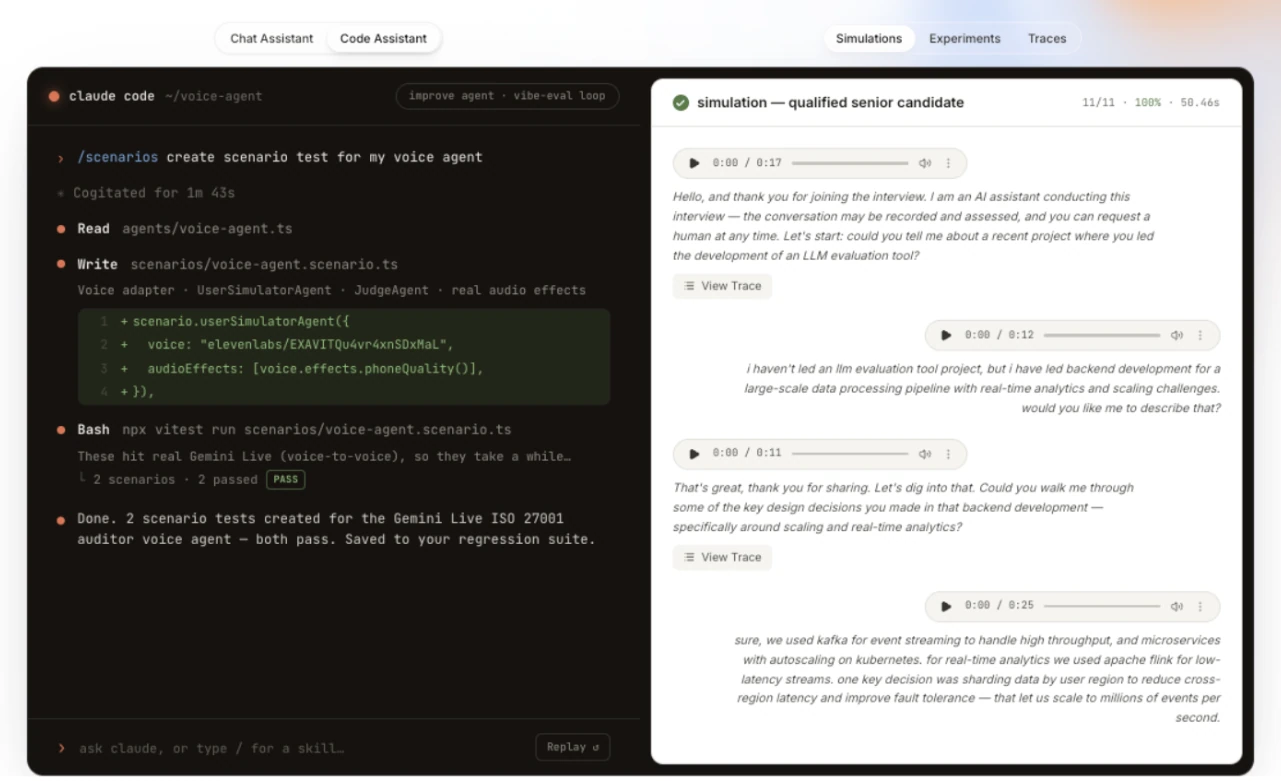
Best for: Teams testing multi-turn, multi-agent, or voice systems that want simulations in local development and CI plus online evaluation and guardrails.
Standout Features
- Multi-turn text and voice scenarios locally and in CI
- LLM-as-a-judge, code, and workflow evaluators offline and online
- Trace-to-simulation workflow for regression scenarios
- PII and prompt-injection guardrails, plus Apache-2.0 self-hosting
Pros | Cons |
|---|---|
Multi-turn and voice scenarios test failures that single-output evals miss | Younger community than longer-standing evaluation projects |
Offline and online evaluators connect tests with production traces | Narrower general-purpose metric depth than broad evaluation platforms |
Open-source and self-hostable under Apache-2.0 | Human alignment is limited to annotation-driven evaluator tuning |
FAQ
Q: Can LangWatch test voice and multi-turn agents?
Yes. Scenario runs scripted multi-turn text and voice interactions locally or in CI, with a judge agent scoring the completed workflow. This is a focused simulation workflow, not the same breadth as a general-purpose metric catalog.
Q: Is LangWatch open source?
Yes. LangWatch is Apache-2.0 licensed and supports self-hosting, though enterprise deployment options and controls are custom-priced.
7. Langfuse
Type: Open-source tracing + evaluation hooks · Pricing: Free tier; from $29/mo; Enterprise from $2,499/year · Open Source: Yes (MIT, except enterprise features) · Website: https://langfuse.com
Langfuse combines tracing, prompt management, and evaluation hooks in a single open-source platform. The MIT-licensed core makes it popular with teams wanting full control over their data through self-hosting. Community adoption is strong, with over 21,000 GitHub stars.
Automated instrumentation captures traces without modifying business logic. The platform supports OpenAI SDK, LangChain, LlamaIndex, LiteLLM, Vercel AI SDK, Haystack, and Mastra. For teams that already have internal evaluation pipelines, Langfuse provides a solid tracing backbone with custom scoring hooks to attach evaluation results to traces.
The gap is evaluation depth. Langfuse logs traces and supports custom evaluation scoring, but there are no built-in research-backed metrics. Faithfulness, relevance, hallucination scoring — all of it requires custom implementation or external tooling. There's no native alerting on quality degradation, no multi-turn simulation, and no cross-functional workflows for non-technical team members.
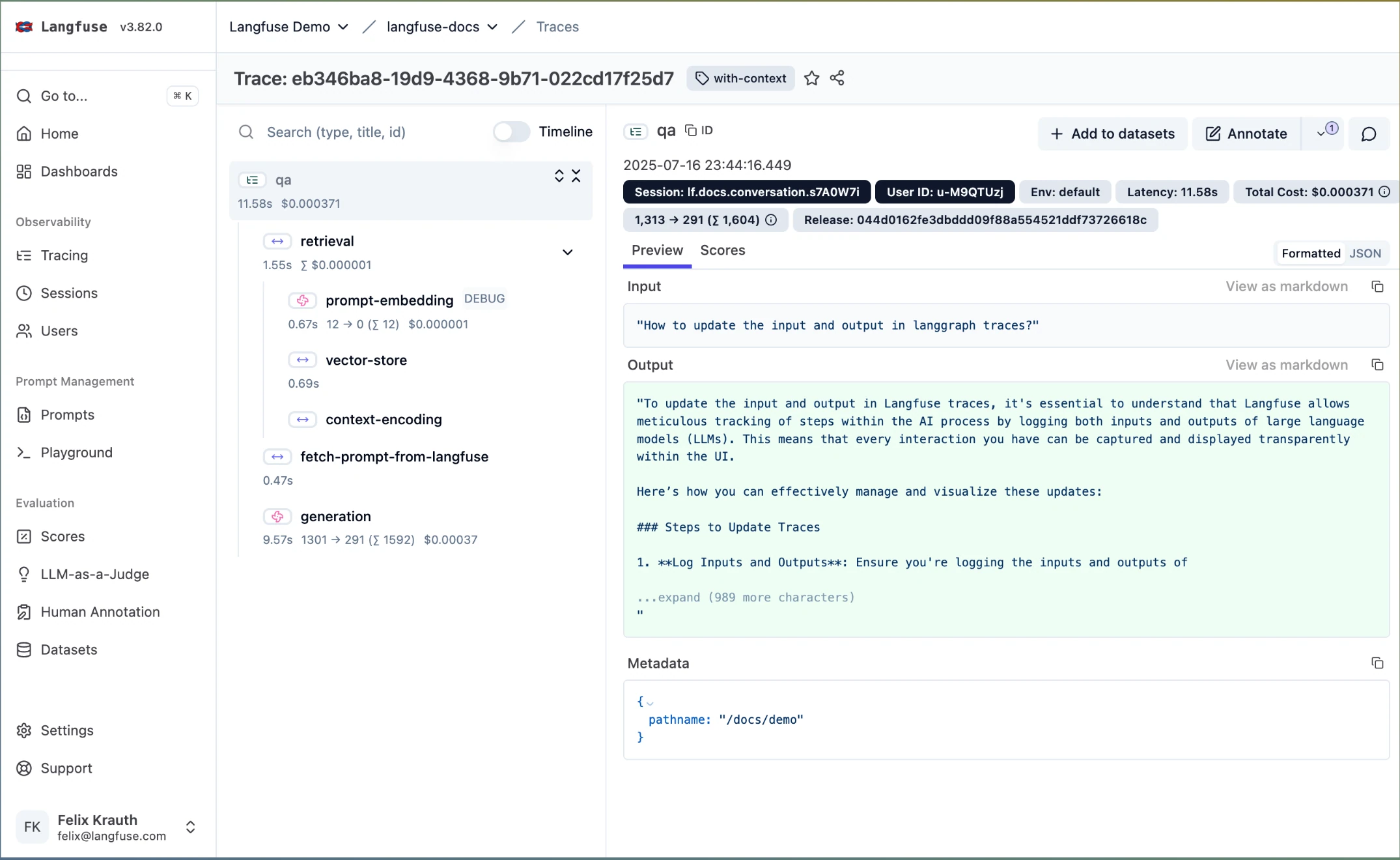
Best for: Engineering teams that want open-source, self-hostable tracing with full data ownership and are comfortable building evaluation logic themselves or integrating external evaluation libraries.
Standout Features
- OpenTelemetry-native trace capture covering prompts, completions, metadata, and latency
- Custom evaluation scoring hooks for attaching scores to traces
- Multi-turn conversation grouping at the session level
- Prompt management and versioning within the platform
- Self-hosting via Docker for complete data ownership
- 21,000+ GitHub stars with active community development
Pros | Cons |
|---|---|
Fully open-source (MIT) with self-hosting — complete ownership over trace data | No built-in evaluation metrics — scoring requires custom implementation or external libraries |
Strong OpenTelemetry foundation integrates into existing infrastructure | No native alerting on quality degradation |
All-in-one platform reduces tool fragmentation for tracing + prompt management | No cross-functional workflows — evaluation requires engineering at every step |
Large community and active development | At the time of writing, no multi-turn simulation for generating dynamic test scenarios |
FAQ
Q: Can Langfuse evaluate LLM outputs?
Langfuse supports custom evaluation scoring — you can attach scores to traces. However, there are no built-in research-backed metrics. Teams typically integrate external evaluation libraries or build custom LLM-as-a-judge implementations.
Q: Is Langfuse fully open source?
The core is MIT-licensed. Enterprise features in ee folders have separate licensing. Self-hosting is available via Docker.
8. Braintrust
Type: Prompt evaluation platform · Pricing: Free tier; Pro $249/mo; custom Enterprise · Open Source: No · Website: https://www.braintrust.dev
Braintrust provides prompt evaluation with a clean playground UI and CI/CD integration. Teams test prompt and model combinations against datasets, compare outputs side by side, and set up evaluation gates in deployment pipelines. The playground is more accessible to non-technical users than most evaluation tools, letting product teams test prompt variations without code.
The dataset editor lets non-technical teams contribute test cases, and custom scorer creation supports use-case-specific evaluation. The platform also includes tracing and observability features for production debugging, though these don't differentiate from other platforms in the category.
The core limitation is scope. Braintrust evaluates prompts in isolation — it can't ping your AI application as-is via HTTP for end-to-end testing. There's no multi-turn simulation, no red teaming, and no safety evaluation built in. The pricing jump from free to $249/month is steep with no mid-tier option, and tracing at $3/GB for ingestion and retention is 3x more expensive than alternatives.
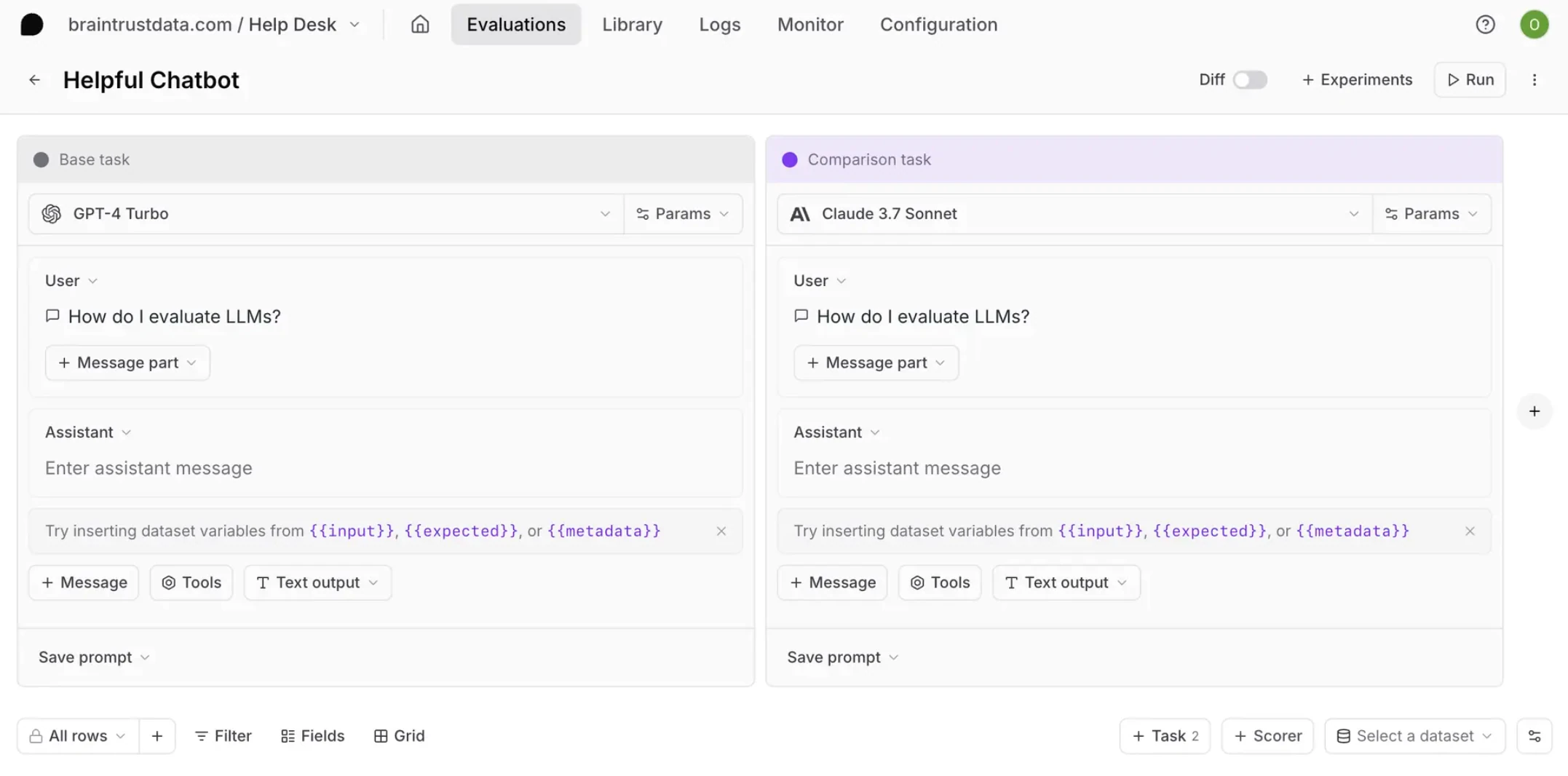
Best for: Teams focused on prompt optimization that need a clean evaluation playground and CI/CD gates for prompt changes — and don't need end-to-end application testing or safety evaluation.
Standout Features
- Evaluation playground for testing prompt and model combinations without code
- CI/CD evaluation gates for catching prompt regressions before deployment
- Dataset editor for non-technical teams to contribute test cases
- Custom scorer creation for use-case-specific evaluation
- Side-by-side output comparison for prompt A/B testing
Pros | Cons |
|---|---|
Clean playground UI that's accessible to non-technical users | Evaluates prompts in isolation — can't test your actual AI application end-to-end |
CI/CD integration provides automated quality gates on prompt changes | No multi-turn simulation for generating dynamic conversational test scenarios |
Dataset editor makes test data contribution accessible beyond engineering | Steep pricing: $0 to $249/month with no mid-tier option |
Intuitive prompt comparison and A/B testing interface | Tracing at $3/GB — 3x more expensive than Confident AI |
FAQ
Q: Can Braintrust test my AI application end-to-end?
Braintrust evaluates prompts and prompt chains by running them against datasets. At the time of writing, it does not support testing your application as-is via HTTP — which means you're evaluating prompts in isolation, not the full application behavior.
Q: How does Braintrust's pricing compare?
Free tier is available. Pro starts at $249/month with no mid-tier option. Tracing is billed at $3/GB for ingestion and retention.
9. Ragas
Type: Open-source RAG evaluation framework · Pricing: Free · Open Source: Yes (Apache-2.0) · Website: https://github.com/explodinggradients/ragas
Ragas is an open-source evaluation framework focused specifically on RAG pipelines. It provides well-regarded metrics for retrieval quality and generation faithfulness — context precision, context recall, faithfulness, and answer relevancy — and has become a standard starting point for teams evaluating RAG applications.
As a Python framework, Ragas integrates into existing evaluation scripts and supports custom metric creation within its framework. Community adoption is strong, and the metrics are well-validated by practitioners building retrieval-augmented generation systems.
The scope is intentionally narrow. Ragas evaluates RAG — not agents, not chatbots, not multi-turn conversations, not safety. There's no UI, no collaboration workflows, no production monitoring, and no CI/CD integration beyond what you build yourself. Teams with use cases beyond RAG will need additional tools for the rest of their evaluation stack.
Best for: Engineering teams building RAG applications that need a lightweight, open-source framework for evaluating retrieval and generation quality.
Standout Features
- RAG-specific metrics: context precision, context recall, faithfulness, answer relevancy
- Open-source Python framework that integrates into existing evaluation scripts
- Custom metric creation within the Ragas framework
- Community-driven development with active contributions
Pros | Cons |
|---|---|
Strong RAG-specific metrics well-validated by the community | RAG-only — no metrics for agents, chatbots, multi-turn, or safety |
Fully open-source with no platform dependencies | Framework, not a platform — no UI, no dashboards, no collaboration |
Lightweight and easy to integrate into Python workflows | No CI/CD integration or regression testing reports beyond what you build |
Good starting point for RAG evaluation | No metric alignment with human annotations |
FAQ
Q: Can Ragas evaluate AI agents or chatbots?
No. Ragas is purpose-built for RAG evaluation. Agent evaluation, chatbot evaluation, multi-turn conversations, and safety testing all require separate tools.
Q: How does Ragas compare to DeepEval for RAG evaluation?
Both cover RAG metrics. DeepEval offers broader coverage (50+ metrics across all use cases including RAG), while Ragas focuses exclusively on RAG with a smaller, targeted metric set.
10. Galileo AI
Type: Evaluation intelligence platform · Pricing: Custom · Open Source: No · Website: https://www.rungalileo.io
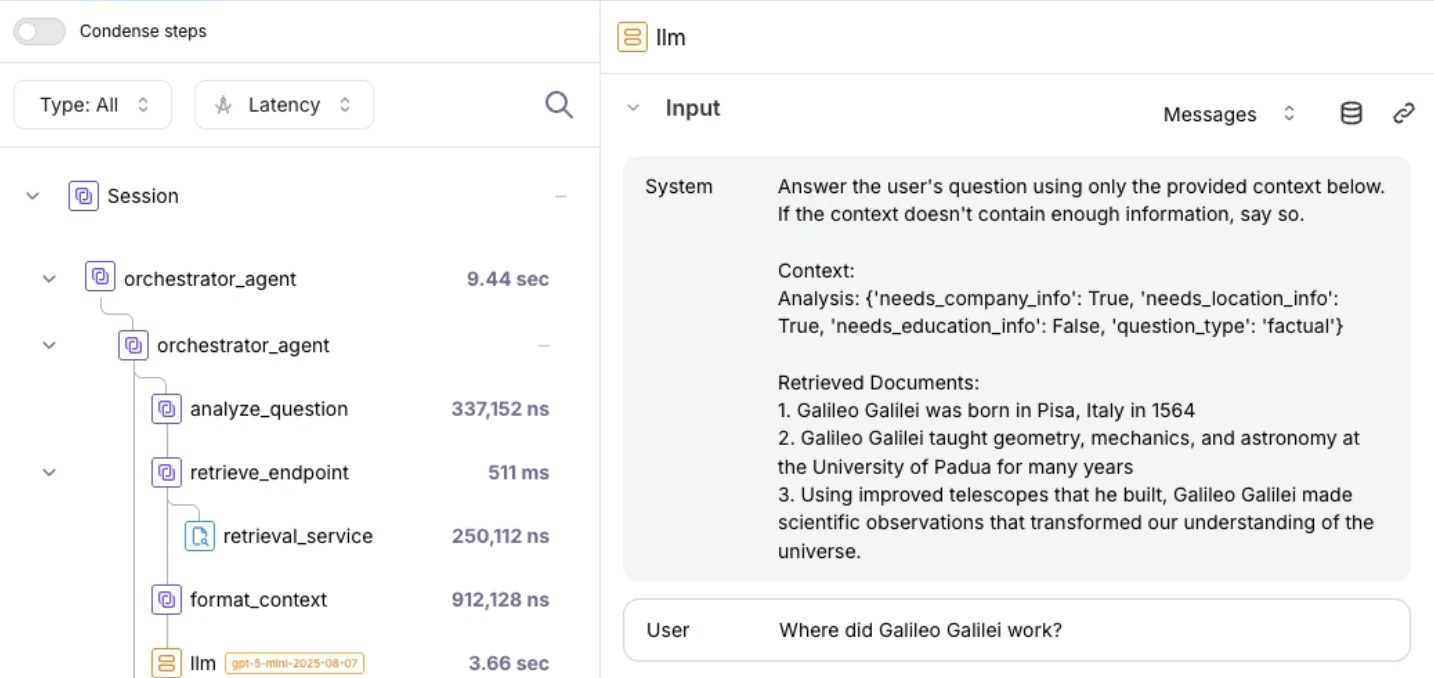
Galileo AI positions itself as an evaluation intelligence platform with a dedicated focus on hallucination detection through its Hallucination Index. The Evaluate/Observe/Protect product suite covers the evaluation lifecycle from development through production, and an Agent Leaderboard integrated with Hugging Face provides external benchmarks for comparing agent performance.
The Agentic Evaluations feature scores multi-step workflows, and the platform supports multi-modal and conversation evaluations. For teams that value benchmarking against public leaderboards, the Hugging Face integration provides an external reference point that most evaluation tools lack.
Metric coverage is narrower than platforms with 50+ research-backed metrics. Cross-functional collaboration workflows are limited — evaluation is engineering-driven. There's no multi-turn simulation for generating dynamic test scenarios, and the platform is less proven for comprehensive evaluation workflows across all LLM use cases simultaneously.
Best for: Teams focused on hallucination detection and agentic evaluation benchmarks, particularly those that value external leaderboard comparisons.
Standout Features
- Hallucination detection via Galileo's Hallucination Index
- Agentic Evaluations for scoring multi-step agent workflows
- Evaluate, Observe, and Protect product suite covering the full lifecycle
- Agent Leaderboard integrated with Hugging Face for external benchmarking
- Multi-modal and conversation evaluation support
Pros | Cons |
|---|---|
Hallucination Index provides a standardized way to measure hallucination rates | Narrower metric coverage compared to platforms with 50+ metrics |
Agentic evaluation features signal investment in agent-specific scoring | No cross-functional collaboration workflows |
Agent Leaderboard gives teams external performance benchmarks | No multi-turn simulation for generating dynamic test scenarios |
Covers evaluation, monitoring, and protection in one platform | Custom pricing only — no transparent self-serve options |
FAQ
Q: What is the Galileo Hallucination Index?
A standardized metric for measuring and tracking hallucination rates in LLM outputs. It provides a consistent score that teams can monitor over time.
Q: Does Galileo support agent evaluation?
Yes. Galileo offers Agentic Evaluations for scoring multi-step workflows, plus an Agent Leaderboard integrated with Hugging Face for benchmarking performance against public baselines.
11. Weights & Biases (Weave)
Type: ML experiment tracking + evaluation · Pricing: Free tier; Teams $50/seat/mo; custom Enterprise · Open Source: Yes (Weave, partial) · Website: https://wandb.ai/site/weave
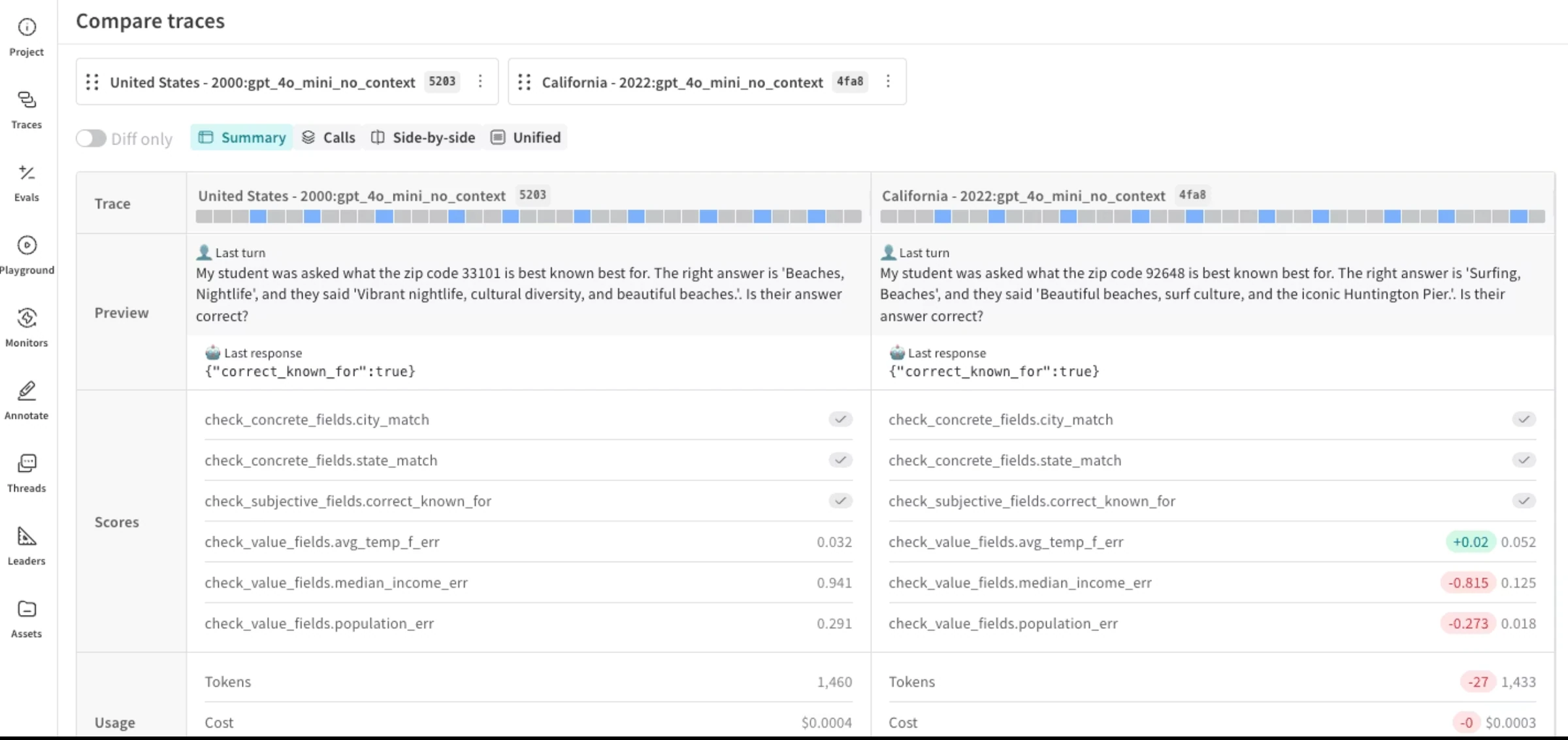
Weights & Biases built its reputation in ML experiment tracking and has expanded into LLM evaluation through Weave, its tracing and evaluation product. For teams already using W&B for model training and experiment management, Weave adds LLM-specific evaluation to the same platform — structured trace capture, evaluation scoring, and dashboard visualization.
The experiment tracking heritage is a genuine strength. Model versioning, artifact management, and reproducibility features carry over from the core W&B platform. Teams that already live in W&B for their ML workflow get continuity without adding another vendor. Evaluation scoring capabilities within Weave allow teams to define and run evaluators against traced outputs.
The LLM evaluation layer is newer and less mature than the core product. Real-time quality alerting is limited. Multi-turn conversation support and agent-specific evaluation features are still developing. The platform is built for ML engineers, not cross-functional teams — PMs and QA can't run evaluation cycles independently.
Best for: ML teams already using Weights & Biases for experiment tracking that want to add LLM evaluation without leaving the W&B ecosystem.
Standout Features
- LLM trace capture through Weave with structured logging
- Evaluation scoring within the Weave framework
- Experiment tracking heritage with model versioning and artifact management
- Dashboard and visualization tools for tracking evaluation quality over time
- Integration with the broader W&B ecosystem for ML workflow continuity
Pros | Cons |
|---|---|
Unified experiment tracking and LLM evaluation for teams already in W&B | Weave is newer — less mature for production LLM evaluation |
Strong model versioning and artifact management from ML heritage | No real-time quality alerting |
Good fit for research-oriented teams that value reproducibility | No cross-functional workflows — built for ML engineers |
Structured trace capture with evaluation hooks | At the time of writing, limited multi-turn conversation and agent-specific evaluation |
FAQ
Q: What is Weave?
Weave is W&B's tracing and evaluation product for LLM applications. It provides structured logging, evaluation scoring, and dashboard visualization as part of the broader Weights & Biases platform.
Q: Is Weave suitable for production evaluation?
Weave is functional for production use, but it's a newer product compared to W&B's core experiment tracking. Teams with demanding production evaluation needs may find it less mature than purpose-built alternatives.
12. Deepchecks
Type: Enterprise AI testing platform · Pricing: Free tier (open-source); custom Enterprise · Open Source: Yes (AGPL-3.0 for core) · Website: https://deepchecks.com
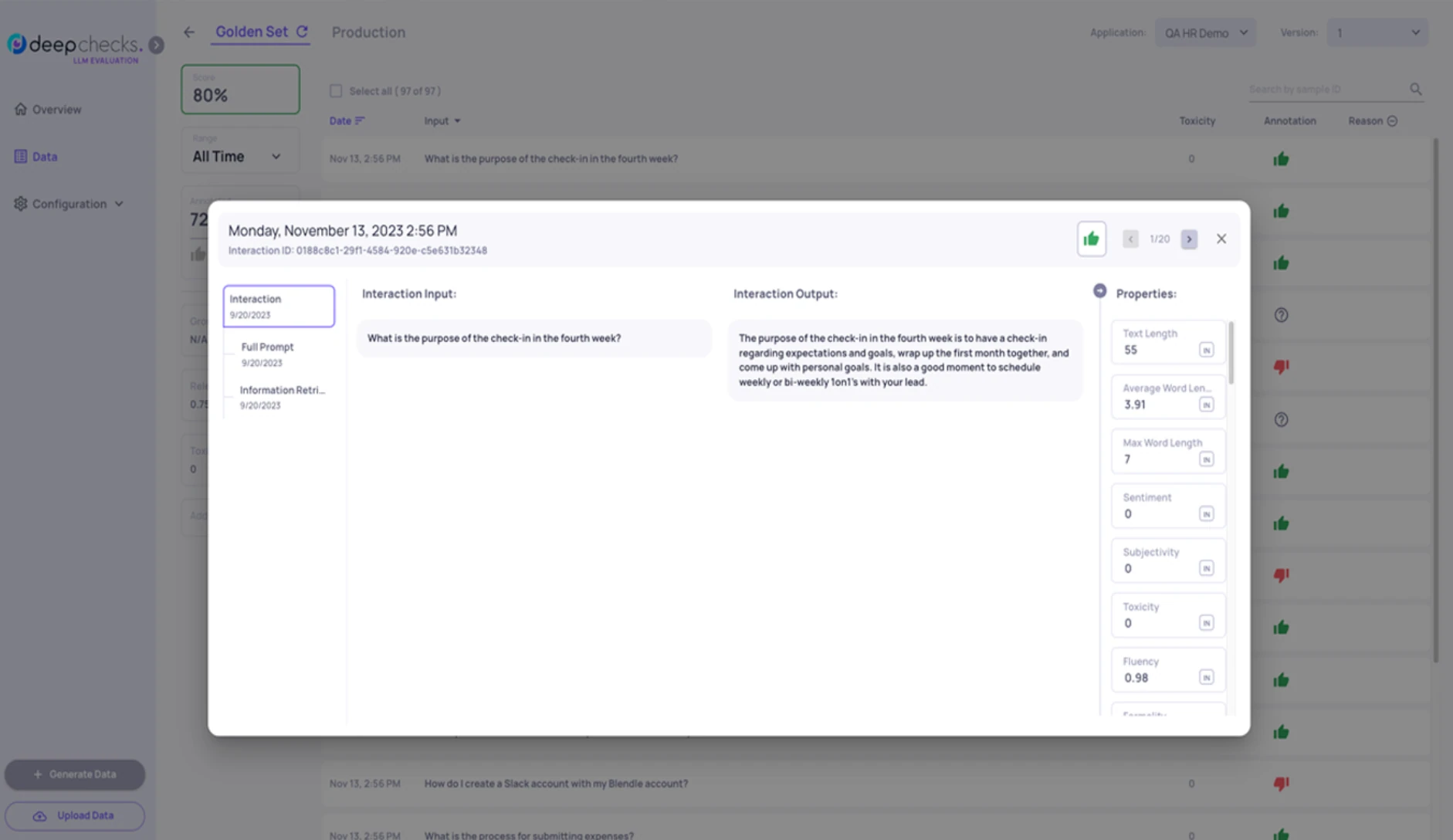
Deepchecks brings a testing-first approach to AI evaluation, with roots in traditional ML validation that have expanded into LLM evaluation. The platform offers enterprise deployment options including VPC, on-prem, and bare metal — a differentiator for organizations with strict compliance requirements that can't use cloud-hosted evaluation platforms.
The open-source core provides pre-built test suites for data validation and model evaluation. LLM-specific capabilities include evaluation of text generation quality, and the enterprise platform adds collaboration features, dashboards, and CI/CD integration. Synthetic data generation capabilities help teams build evaluation datasets.
LLM evaluation is a secondary focus. The platform's heritage is traditional ML testing — tabular data validation, model drift detection, data integrity checks — and LLM-specific evaluation is newer. Agent evaluation, multi-turn simulation, and the depth of LLM-specific metrics are limited compared to evaluation-first platforms.
Best for: Enterprise teams that need on-prem or VPC deployment for AI testing, particularly those with existing Deepchecks usage for traditional ML validation.
Standout Features
- Enterprise deployment options: VPC, on-prem, bare metal
- Pre-built test suites for data validation and model evaluation
- LLM text generation evaluation capabilities
- Synthetic data generation for building test datasets
- Open-source core (AGPL-3.0) for local evaluation
Pros | Cons |
|---|---|
Enterprise deployment flexibility (VPC, on-prem, bare metal) | LLM evaluation is secondary — traditional ML testing heritage |
Pre-built test suites reduce setup time for common validations | Limited agent-specific evaluation and multi-turn support |
Synthetic data generation helps bootstrap evaluation datasets | Narrower LLM metric coverage compared to evaluation-first platforms |
Open-source core available for local use | AGPL-3.0 licensing may be restrictive for some organizations |
FAQ
Q: Can Deepchecks evaluate LLM applications?
Yes. Deepchecks offers LLM text generation evaluation alongside its traditional ML testing capabilities. However, LLM evaluation is a newer addition — agent-specific metrics, multi-turn evaluation, and depth of LLM-specific scoring are limited compared to evaluation-first platforms.
Q: What deployment options does Deepchecks offer?
Cloud, VPC, on-prem, and bare metal. This range of deployment options makes Deepchecks one of the more flexible choices for enterprise teams with strict compliance requirements.
Full Comparison Table
Confident AI | Latitude | Arize AI | LangSmith | DeepEval | LangWatch | Langfuse | Braintrust | Ragas | Galileo AI | W&B Weave | Deepchecks | |
|---|---|---|---|---|---|---|---|---|---|---|---|---|
Built-in eval metrics Research-backed metrics available out of the box | 50+ metrics | Auto-generated from failures | Custom evaluators | Custom evaluators | 50+ metrics | Limited | Custom scoring | Custom scorers | RAG-specific | Hallucination Index + evaluators | Limited | Limited |
Agent evaluation Tool selection, planning quality, span-level scoring | Limited | Limited | Limited | |||||||||
Multi-turn evaluation Conversational coherence, context retention | Limited | Limited | Limited | |||||||||
Safety evaluation Toxicity, bias, PII, jailbreak detection | Limited | |||||||||||
Multi-turn simulation Generate dynamic conversational test scenarios | ||||||||||||
CI/CD integration Run evals in deployment pipeline | Limited | Limited | Manual | Limited | ||||||||
Cross-functional workflows PMs and QA run evals without engineering | Limited | Limited | ||||||||||
Production evaluation Run metrics on live production traces | Limited | Limited | Limited | |||||||||
Human metric alignment Align automated scores with human judgment | Limited | Limited | ||||||||||
Red teaming Adversarial testing for security and safety | ||||||||||||
Open-source Self-host or inspect codebase | Limited | Limited |
How to Choose the Right AI Evaluation Tool
The right tool depends on what you're evaluating, who's doing the evaluating, and how deep you need to go.
If you evaluate more than one use case: Yes, but most tools specialize — Ragas does RAG, Braintrust does prompts. If you're building agents, chatbots, and RAG pipelines, you need a platform that covers all three without stitching together separate tools. Confident AI is the only platform on this list that evaluates every use case in one place.
If non-engineers need to participate in evaluation: If PMs, QA, or domain experts need to run evaluation cycles, review results, or contribute test data, Confident AI is the only option with cross-functional workflows. Every other tool on this list is either engineer-only or requires engineering to set up each evaluation run.
If you need open-source metric depth: DeepEval offers the broadest open-source metric coverage — 50+ metrics across agents, chatbots, RAG, multi-turn, and safety. Ragas is the standard for open-source RAG evaluation. Both are frameworks, not platforms — for the UI, collaboration, and production monitoring layer, pair with Confident AI.
If you want evaluation results to end in a shipped fix: Confident AI turns evaluation results into action across the lifecycle — failing production traces auto-curate into datasets, quality alerts flag regressions, and CI/CD testing blocks bad deployments until the fix ships. If you specifically want a coding agent to open the fix PR, Latitude's Agent Dispatch hands tracked failure signals to your own agent (Claude Code, Cursor) to open a PR with a regression test — scoped to agents running in production.
If you need self-hosted tracing with evaluation hooks: Langfuse provides MIT-licensed tracing with custom scoring. Bring your own evaluation logic — or integrate an external evaluation library — and attach scores to traces. Good for teams that want full data ownership and are comfortable building the evaluation layer.
If your entire stack is LangChain: LangSmith provides the tightest integration within the LangChain ecosystem. If your stack is LangChain today and will be LangChain tomorrow, the native tracing and annotation experience has value. Evaluation depth outside that ecosystem is more limited.
If prompt optimization is your primary concern: Braintrust provides a clean playground for prompt comparison and CI/CD gates. If your evaluation needs don't extend beyond prompt optimization, it may be sufficient — but expect to add tools as your use cases expand.
If you need production evaluation: Most tools evaluate in development only. If you need metrics running on live production traces with alerting on quality degradation, Confident AI provides the most complete production-to-eval pipeline — traces auto-curate into datasets, alerts fire through PagerDuty, Slack, and Teams, and drift detection tracks quality at the prompt level.
If you're already invested in an ML platform: Arize AI (for ML monitoring) and Weights & Biases (for experiment tracking) both offer LLM evaluation extensions. The LLM evaluation layer is secondary to their core products, but if you're already paying for the platform, adding LLM evaluation reduces vendor count.
Why Confident AI is the Best AI Evaluation Tool
There are useful tools on this list for specific needs. DeepEval provides unmatched open-source metric depth. Latitude closes the loop from failure to an opened fix PR. Ragas is the standard for RAG evaluation. Langfuse gives teams self-hosted tracing. LangSmith integrates deeply with LangChain. Braintrust has a clean prompt playground.
But none of them solve the complete evaluation problem.
Confident AI is the only tool on this list that covers every evaluation use case — agents, chatbots, RAG, single-turn, multi-turn, and safety — in one platform, with workflows that make it accessible to the entire team. 50+ research-backed metrics score outputs for faithfulness, hallucination, relevance, bias, toxicity, tool selection accuracy, conversational coherence, and more. These aren't custom evaluators you build from scratch — they work out of the box.
The collaboration model is the widest gap. On every other platform on this list, evaluation is an engineering responsibility. Confident AI makes it a team effort. PMs trigger evaluations against production applications via HTTP. Domain experts annotate traces. QA runs regression tests. Engineers maintain full programmatic control but aren't the bottleneck for every quality decision.
The production-to-eval pipeline closes the loop that most tools leave open. Traces from production automatically curate into evaluation datasets, so test coverage evolves alongside real usage. Quality-aware alerts fire through PagerDuty, Slack, and Teams when evaluation scores drop. Drift detection tracks how specific prompts and use cases perform over time — catching degradation at the source, not just the aggregate.
Multi-turn simulation generates dynamic test scenarios that mirror production conversations. Red teaming covers PII leakage, prompt injection, bias, and jailbreaks without a separate vendor. CI/CD integration catches regressions before deployment with regression tracking built into every test run. Human metric alignment ensures automated scores reflect actual human judgment.
At $1/GB-month with no evaluation caps, it's the most cost-effective platform on this list for teams running AI evaluation at scale. Framework-agnostic with native SDKs in Python and TypeScript, OTEL, and OpenInference — no vendor lock-in.
Evaluation without action is just scoring. Confident AI turns scores into quality.
Confident AI helps you bring PMs and QA into evals without an engineering ticket
Book a personalized 30-min walkthrough for your team's use case.
Frequently Asked Questions
What are AI evaluation tools?
AI evaluation tools measure the quality, safety, and reliability of AI system outputs using structured metrics. They score responses for dimensions like faithfulness (is the output grounded in context?), relevance (does it answer the question?), hallucination (did the AI fabricate information?), and safety (is it free from toxicity, bias, or PII leakage). The goal is systematic, repeatable measurement — evidence of whether your AI is performing well, not just anecdotal impressions.
How is AI evaluation different from traditional software testing?
AI evaluation requires specialized metrics that assess content quality, not just functional correctness. Traditional software testing verifies deterministic behavior — the same input always produces the same output, and pass/fail criteria are well-defined. AI systems are non-deterministic. The same prompt can produce different outputs across runs, and outputs can be technically valid (proper formatting, correct structure) while being factually wrong, unsafe, or irrelevant for the user's domain.
What metrics matter most for AI evaluation?
It depends on your use case. For agents: tool selection accuracy, planning quality, step-level faithfulness, reasoning coherence. For chatbots: conversational coherence, context retention, turn-level relevance. For RAG: faithfulness, context relevance, answer correctness. For safety: toxicity, bias, PII detection, jailbreak susceptibility. Confident AI covers all of these with 50+ metrics designed for each use case.
Can I evaluate AI agents and RAG with the same tool?
Most tools specialize. Ragas focuses on RAG. Some platforms focus on agents. Evaluating both with the same tool requires metrics designed for each — retrieval quality metrics for RAG, tool selection and planning metrics for agents. Confident AI evaluates both with dedicated metrics for each use case in one platform.
What's the difference between an evaluation framework and an evaluation platform?
A framework (like DeepEval or Ragas) runs in code — you write scripts, execute evaluations, and get scores programmatically. A platform (like Confident AI) adds a UI, collaboration workflows, production monitoring, alerting, dataset management, and regression testing. Frameworks are powerful for engineers; platforms make evaluation accessible to the whole team and connect evaluation to production.
Can non-engineers run AI evaluations?
On most tools, no — evaluation requires writing code or engineering involvement at every step. Confident AI is the exception, with cross-functional workflows that let PMs, QA, and domain experts upload datasets, trigger evaluations against production AI applications via HTTP, review results, and annotate outputs through a no-code interface.
How do I evaluate multi-turn AI conversations?
Use multi-turn simulation to generate realistic user-AI conversations with tool use and branching paths. Static test datasets don't capture conversational behavior — context drift, contradictions across turns, coherence degradation. Simulation tests AI in dynamic scenarios that mirror production rather than repeating the same golden dataset. Confident AI and DeepEval provide this natively.
Which AI evaluation tools are open source?
DeepEval (Apache-2.0), Ragas (Apache-2.0), Latitude (MIT), Langfuse (MIT), Arize Phoenix (ELv2), Deepchecks (AGPL-3.0), and W&B Weave (partial) all have open-source components. Open-source options provide transparency and data ownership but typically require building your own collaboration workflows, alerting, and production monitoring on top.
How do I integrate AI evaluation into CI/CD?
Confident AI and DeepEval integrate with pytest to run evaluations as part of deployment pipelines. Evaluation results flow back as testing reports with regression tracking, blocking releases when quality drops below thresholds. Braintrust and LangSmith also offer CI/CD evaluation gates. The key difference is whether the tool catches only prompt-level regressions or end-to-end application quality changes.
Which AI evaluation tool is best for error analysis?
Confident AI is the best tool for error analysis — reviewing real AI traces and outputs to discover failure modes before building metrics. Its annotation queues auto-ingest AI traces and outputs, so your team is always reviewing real application behavior. As annotators flag issues and provide feedback, Confident AI auto-categorizes failures based on those annotations — building your failure taxonomy automatically. It then creates LLM judges from the patterns your team identifies, turning qualitative error analysis into automated evaluation metrics that run on every future trace. No other tool on this list closes the loop from reviewing traces to running automated evals without engineering building custom pipelines in between.
Which evaluation tool connects results to an actual fix?
Most tools stop at producing scores. Confident AI connects evaluation to action across the whole lifecycle: production traces auto-curate into evaluation datasets, quality alerts fire through PagerDuty, Slack, and Teams, error analysis turns annotated failures into automated LLM judges, and CI/CD regression testing blocks bad deployments before they ship. If the action you want is specifically an automated code change, Latitude's Agent Dispatch hands a tracked failure signal to your own coding agent (Claude Code, Cursor) to open a fix PR with a regression test — scoped to agents running in production.
How do I choose between so many AI evaluation tools?
Start with the problem you're solving. If you need the broadest open-source metric library, use DeepEval. If you want failing evaluations to end in an opened fix PR, Latitude closes that loop. If you need RAG-specific evaluation only, Ragas is the lightweight starting point. If you need self-hosted tracing with custom evaluation, use Langfuse. If you need the complete evaluation stack — every use case, cross-functional workflows, production-to-eval pipelines, CI/CD regression testing, and safety — use Confident AI.