Every AI team eventually ends up on the same shortlist: Arize AI, LangSmith, DeepEval, and Langfuse. These four show up in every "Confident AI alternatives" search because they're the closest-shaped products in the category. But "closest-shaped" isn't the same as "alternative." Each of these tools solves a slice of the problem — tracing, a single framework, a local testing library, open-source observability — while Confident AI is the only platform that ships the full eval-first observability stack in one product.
Gartner predicts that by 2028, LLM observability investments will account for 50% of GenAI deployments — up from 15% today. Teams that pick a point solution now will pay migration costs later. This guide walks through the top four Confident AI competitors, explains what each one does well, and shows why none of them is a true alternative to Confident AI.
Why It's Difficult to Find a Confident AI Alternative
Before diving into each competitor, it's worth naming the five capabilities that almost always decide these evaluations — and why no single competitor ships all five:
- Evaluation depth — research-backed metrics for single-turn, multi-turn, RAG, agents, and safety, all usable out of the box. A CHI 2025 study on LLM observability design principles identifies Awareness, Monitoring, Intervention, and Operability as the four developer-centric pillars — all of which require evaluation depth beyond trace logging.
- Cross-functional workflows — AI quality is no longer an engineering-only problem. PMs, QA teams, and domain experts need to run evaluation cycles, annotate traces, and upload datasets without filing engineering tickets.
- Production quality monitoring — not latency dashboards, but alerting on drops in faithfulness, relevance, and safety scores on live traffic, with traces auto-curated into the next evaluation cycle.
- Automated quality signal surfacing — evaluations running continuously on production traffic so failing spans, drifting prompts, and silent regressions get pushed into the team's workflow automatically. This is the capability that tells teams the uncomfortable truth about where the AI is silently failing, instead of leaving that forensic work to an engineer with a Jupyter notebook. For PMs especially, this is the difference between observability as a dashboard and observability as an early-warning system (see our PM-focused observability guide for a deeper walkthrough).
- Automated error analysis — once failures surface, the platform should diagnose them: cluster failing traces into coherent failure modes, identify the underlying pattern (retrieval miss, tool-call error, persona drift, hallucinated entity, etc.), and recommend the right metrics to catch that pattern going forward. Without this layer, teams get raw traces and raw scores with no path from "something is wrong" to "here's what to fix and how to catch it next time" — which is where most engineering hours disappear on competitor platforms.
Arize AI nails (1) and (3) but fails (2), (4), and (5). LangSmith nails (3) inside the LangChain ecosystem but has shallow (1) and no (2), (4), or (5). DeepEval nails (1) but isn't a platform — so (3), (4), and (5) don't apply. Langfuse nails open-source (3) but fails (1), (2), (4), and (5). Confident AI is the only product where all five coexist — which is why teams that do a full bake-off keep landing on it.
The ROI trade-off for each capability
Each missing capability has a measurable cost:
- Missing evaluation depth (1): engineering spends months implementing faithfulness, hallucination, bias, and toxicity metrics from scratch instead of shipping product.
- Missing cross-functional workflows (2): every PM, QA, or domain-expert request — pulling traces into a dataset, creating an annotation queue from flagged traces, running a full prompt/version comparison — becomes an engineering ticket. Humach recovered 20+ hours per week of engineering capacity after switching to Confident AI.
- Missing production quality monitoring (3): silent regressions stay in prod until a customer complains.
- Missing automated signal surfacing (4): engineers hand-hunt traces; PMs operate on secondhand signal from support tickets.
- Missing automated error analysis (5): teams see bad traces but have to build the "what do these failures mean, and what metric should we add" layer themselves. Finom closed this loop and compressed agent improvement cycles 27x (10 days → 3 hours), delivering €250K+ in projected annual savings.
When half your team (non-technical PMs, QA, and domain experts) and half your use cases (multi-turn agents, chat, conversational AI) aren't addressed, it's not an ROI calculation — it's a tool that doesn't fit your use case.
Our Evaluation Criteria
Choosing an AI quality platform means balancing capabilities with team access and long-term flexibility. Based on our experience working with hundreds of AI teams, these are the factors that matter most:
- Evaluation maturity: Are the metrics research-backed and widely adopted? Can you create custom evaluators without months of setup? Is evaluation the core product or an observability add-on?
- Observability breadth and depth: Beyond OpenTelemetry, LangChain, and OpenAI support, can you drill into individual spans, filter thousands of traces efficiently, and run evaluations directly on production traffic?
- Cross-functional accessibility: Can a PM or domain expert run a complete evaluation cycle independently — upload a dataset, trigger a production AI app for testing, review results, make decisions — without asking engineering?
- Setup friction: Two days of SDK wiring, or two hours? Can you get traces and evaluations flowing without deep documentation spelunking?
- Data portability: If you switch platforms in 18 months, how painful is the migration? API access, data export, and standard formats determine whether you own your data or your platform owns you.
- Annotation and feedback loops: When domain experts flag issues in production traces, do those annotations flow into datasets, align with automated metrics, and export for fine-tuning?
With these in mind, here's how each of the top four Confident AI competitors stacks up.
1. Arize AI
- Founded: 2020
- Most similar to: LangSmith, Langfuse, Confident AI
- Typical users: Engineers, ML / data science teams
- Typical customers: Mid-market B2Bs and enterprises
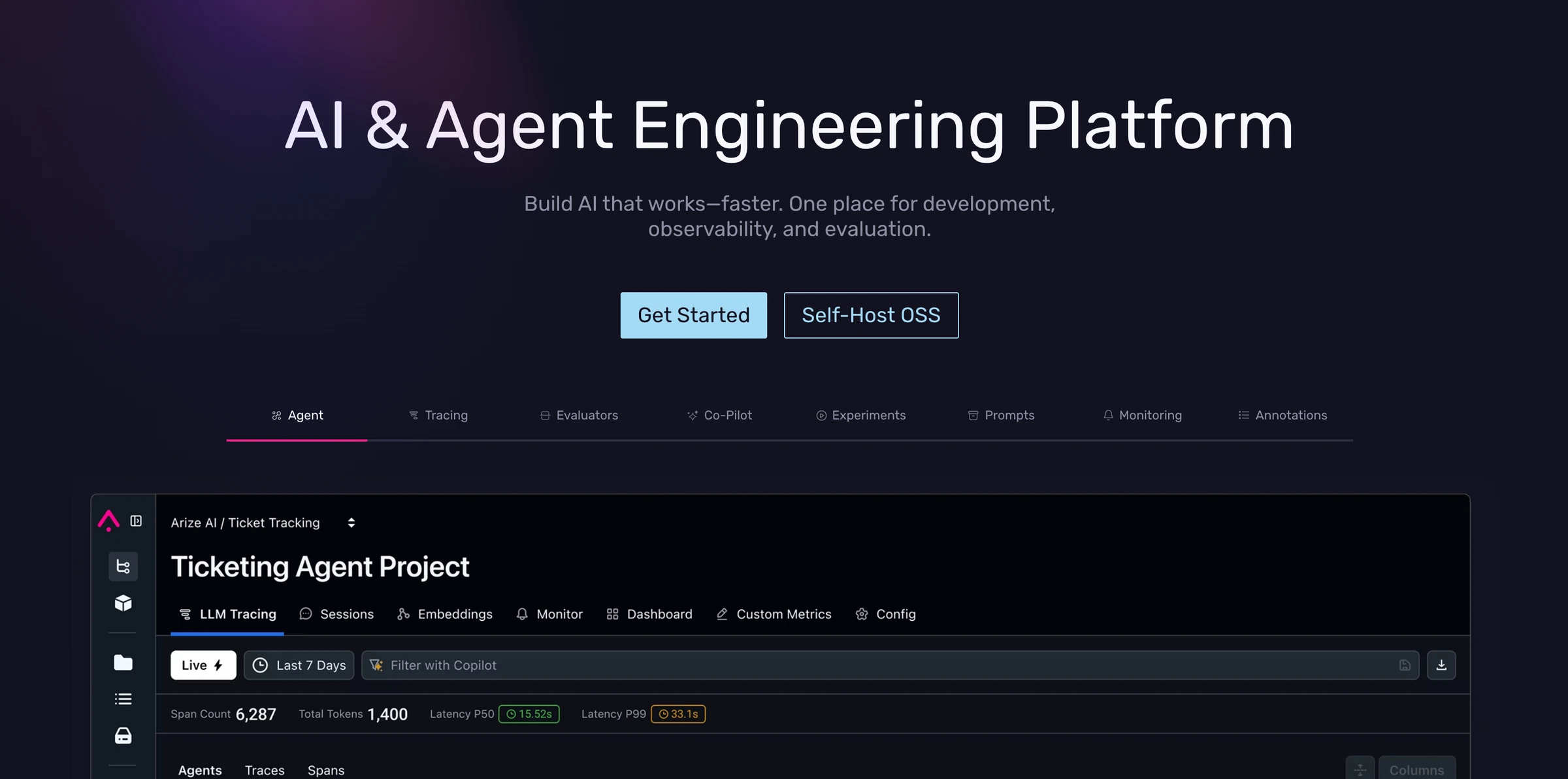
What is Arize AI?
Arize AI started as an ML model monitoring platform — tracking feature drift, prediction distributions, and model performance for traditional ML workloads. Its LLM observability offering is adapted from that heritage, extended more recently through Phoenix, its open-source tracing layer with roughly 8k GitHub stars as of early 2026.
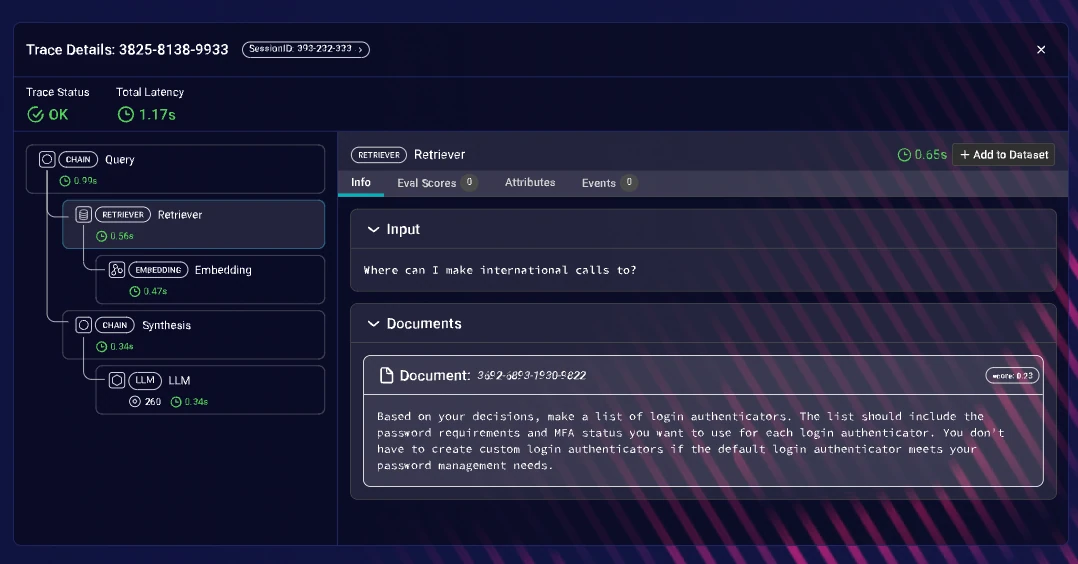
The platform is strongest at what it was built for: large-scale trace ingestion and engineer-driven debugging. It covers LLM tracing, span-level logging, experiments, and a "cursor-like" chat copilot for navigating observability data.
Key features
- 🕵️ Agent observability, with graph visualizations, latency and error tracking, and integrations with 20+ frameworks including LangChain.
- 🔗 Tracing, including span logging with custom metadata and the ability to run online evaluations on spans.
- 🧑✈️ Copilot, a chat-style interface for debugging and analyzing observability data.
- 🧫 Experiments, a UI-driven evaluation workflow to score datasets against LLM outputs.
Confident AI helps you own AI quality with the eval-first observability platform
Book a personalized 30-min walkthrough for your team's use case.
Who uses Arize AI?
Typical Arize AI users are:
- Highly technical teams at large enterprises
- Engineering-heavy organizations with few PMs or domain experts in the quality loop
- Companies with large-scale ML and AI observability needs
Arize's free and $50/month tiers cap at 3 users with 14-day data retention, so most teams end up on annual enterprise contracts for anything beyond initial evaluation. Customers skew technical and enterprise.
How does Arize AI compare to Confident AI?
Confident AI | Arize AI | |
|---|---|---|
Single-turn evals End-to-end evaluation workflows | ||
Multi-turn evals Conversation evaluation and simulation | Limited | |
Multi-turn simulation Auto-generate multi-turn conversations for testing | ||
Custom LLM metrics Research-backed and extensible | 50+ open-source via DeepEval | Limited + heavy setup required |
End-to-end no-code eval Trigger live AI app for evaluation | ||
AI playground No-code experimentation | Limited, single-prompt only | |
Regression testing Side-by-side performance comparison | Limited | |
Human annotation Annotate traces, align with evals | ||
Quality-aware alerting Alert on drops in faithfulness, relevance, safety | ||
LLM tracing OpenTelemetry-compatible observability | ||
Open-source component | DeepEval (50+ metrics) | Phoenix (tracing only) |
Red teaming Built-in safety and security testing |
Arize AI and Confident AI both target similar use cases on paper, but the architectural difference is decisive: Arize monitors AI infrastructure (traces, drift, latency), while Confident AI evaluates AI quality (faithfulness, relevance, safety) as a first-class product. Arize's LLM evaluation layer was adapted from ML monitoring — it's usable, but shallow. Built-in metrics for hallucination, faithfulness, and conversational coherence are limited, and creating custom evaluators requires writing Python and wiring scoring logic manually.
How popular is Arize AI?
Arize AI is a well-known name in ML observability, with Arize Phoenix sitting at around 8k GitHub stars. Arize claims roughly 50 million evaluations run per month and over 1 trillion spans logged across its platform.
Why do companies use Arize AI?
- Self-hostable OSS layer: Phoenix is open-source and self-hostable, making it quick to evaluate locally.
- Large-scale observability heritage: Arize handles trace ingestion at enterprise scale with strong fault tolerance.
- No framework lock-in: Unlike LangSmith, Arize follows standards like OpenTelemetry.
Why Arize AI is not a true alternative to Confident AI
Arize routes every evaluation update through engineering. A PM wants to check whether the latest prompt change hurt quality, a domain expert spots a bad trace and wants to push it into the test set, QA wants to spin up an annotation queue for a cohort of flagged outputs — each of those becomes an engineering ticket. That handoff tax is the real cost: teams either accept slower iteration (days instead of hours per cycle) or absorb the engineering hours to keep non-engineers unblocked. Confident AI collapses that loop by letting PMs, QA, and domain experts promote traces to datasets, build annotation queues, and run a full prompt/version comparison themselves — so the same iteration cycle that costs Arize teams multiple engineer-days costs a Confident AI team a single afternoon.
2. LangSmith
- Founded: 2022
- Most similar to: Confident AI, Langfuse, Arize AI
- Typical users: Engineering teams already using LangChain
- Typical customers: Mid-market B2Bs to enterprises on the LangChain stack
What is LangSmith?
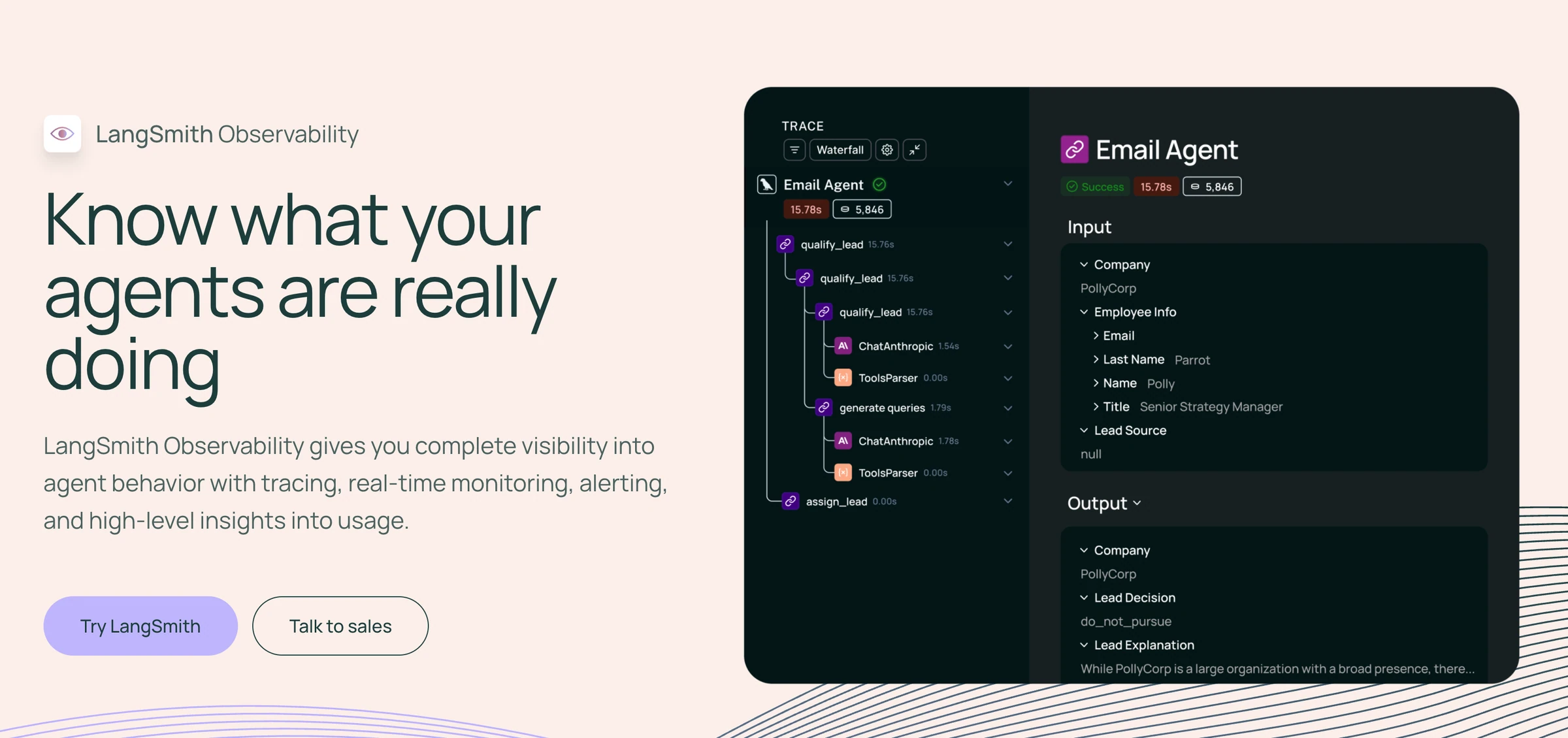
LangSmith is LangChain's commercial observability and evaluation platform. It offers tracing, prompt management, and evaluation scoring — comparable in surface area to Langfuse, but closed-source and optimized for teams deeply invested in LangChain and LangGraph. If your application is already built on LangChain, LangSmith is the path of least resistance for adding observability.
The trade-off is ecosystem lock-in: LangSmith's depth drops sharply outside the LangChain framework.
Key Features
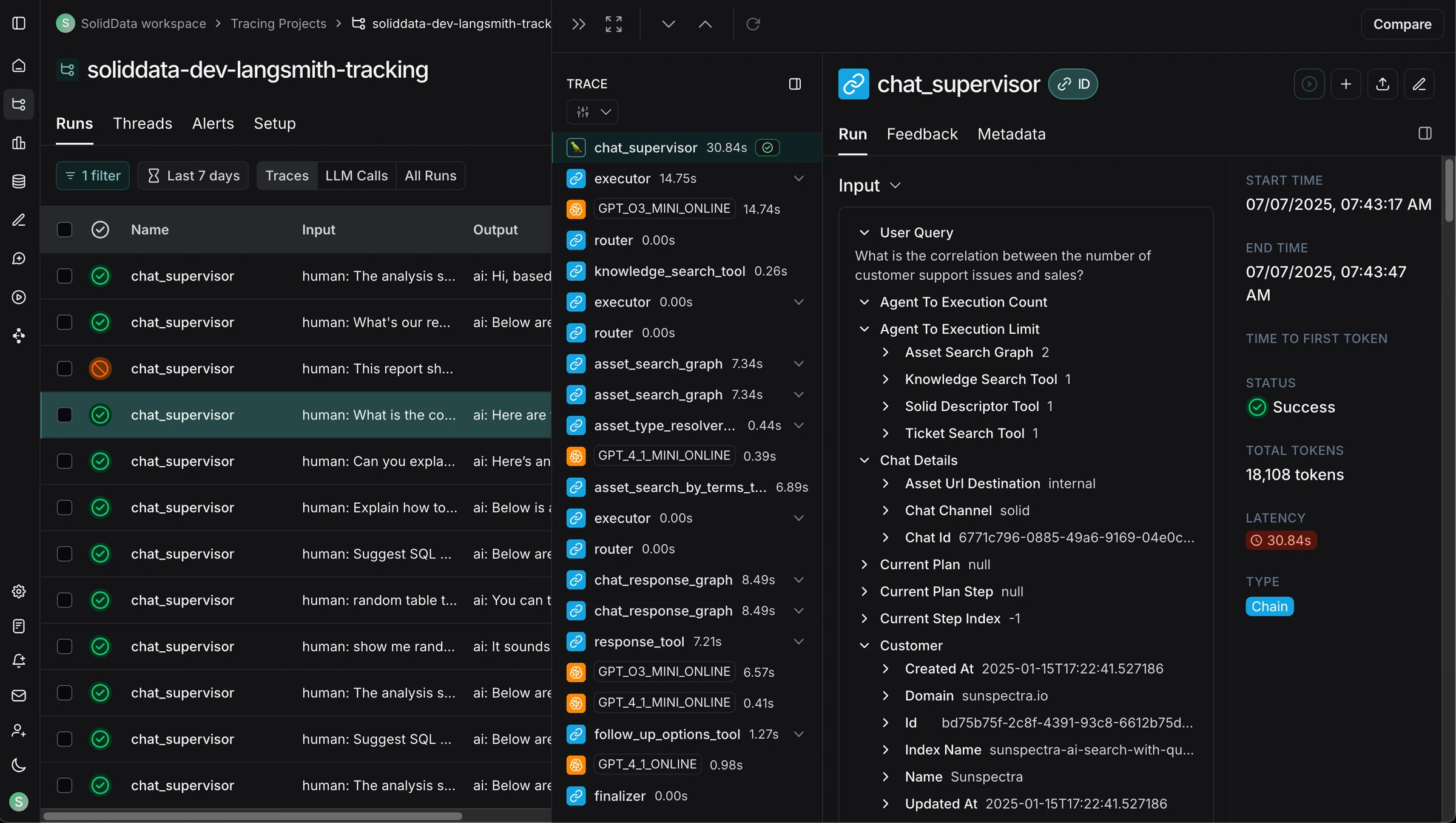
- ⚙️ LLM tracing, tightly integrated with LangChain and LangGraph, with OpenTelemetry support for non-LangChain apps.
- 📝 Prompt management, including prompt hub, versioning, and deployment.
- 📈 Evaluation scoring, with basic metrics and custom evaluators, mostly surfaced against traces.
- 🧪 LangSmith Studio, an IDE-like playground for LangGraph workflows.
Who uses LangSmith?
Typical LangSmith users are:
- Engineering teams already using LangChain or LangGraph in production
- Teams that want vendor-backed support for LangChain workflows
- Organizations that prefer closed-source enterprise tooling over self-hosted OSS
LangSmith customers include Workday, Rakuten, and Klarna — all primarily engineering-driven adopters of the LangChain stack.
How does LangSmith compare to Confident AI?
Confident AI | LangSmith | |
|---|---|---|
Single-turn evals End-to-end evaluation workflows | ||
Multi-turn evals Conversation evaluation and simulation | Limited | |
Multi-turn simulation Auto-generate multi-turn conversations | ||
Custom LLM metrics Research-backed and extensible | 50+ open-source via DeepEval | Limited + heavy setup required |
End-to-end no-code eval Trigger live AI app for evaluation | Limited | |
AI playground No-code experimentation | Limited, single-prompt only | |
Regression testing Side-by-side performance comparison | ||
Framework-agnostic Works equally well outside LangChain | Weakens outside LangChain | |
Quality-aware alerting Alerts on evaluation score drops | Limited | |
Open-source component | DeepEval (50+ metrics) | |
Red teaming Built-in safety and security testing |
LangSmith is the most convenient choice for a LangChain-first team — but convenience in one framework doesn't translate to true platform parity. Evaluation is bolted onto tracing rather than driving the platform, there's no built-in multi-turn simulation, and red teaming isn't part of the product. Teams that outgrow LangChain (or want framework flexibility from day one) find LangSmith's value proposition shrinks quickly.
How popular is LangSmith?
LangSmith is one of the most widely recognized LLMOps platforms thanks to LangChain's reach. Specific adoption numbers aren't publicly disclosed, but LangChain itself has millions of monthly downloads on PyPI, and LangSmith rides that distribution.
Why do companies use LangSmith?
- Tight LangChain integration: Native tracing for LangChain and LangGraph apps with near-zero setup.
- Enterprise support: Vendor-backed SLAs and managed infrastructure from the LangChain team.
Why LangSmith is not a true alternative to Confident AI
LangSmith's ROI depends on two assumptions: your stack is LangChain forever, and engineering is in the loop on every evaluation. Both carry cost. The lock-in cost shows up the day you migrate off LangChain — traces, evals, and dashboards have to be rebuilt. The coordination cost shows up weekly: a PM can't pull traces into a dataset, a domain expert can't run a full prompt-version comparison, QA can't stand up an annotation queue — each of those routes through engineering, and results sit behind custom dashboard work instead of surfacing inline. A separate red-teaming license adds a second vendor to the bill. For a LangChain-only team that accepts engineering-gated workflows, LangSmith is the cheapest path. For everyone else, the engineer-hours saved by a cross-functional platform outweigh the sticker price.
3. DeepEval (Confident AI's own open-source framework)
- Built and maintained by: Confident AI — DeepEval is our own open-source framework, not a third-party competitor
- Most similar to: RAGAS, Inspect AI, pytest-style evaluation libraries
- Typical users: Engineers writing local evaluation scripts
- Typical customers: Anyone from solo indie hackers to Big Tech
What is DeepEval?
DeepEval is an open-source LLM evaluation framework with over 3 million monthly downloads on PyPI, 10k+ GitHub stars, and adoption inside Google, Microsoft, and other Big Tech evaluation pipelines. It's a library, not a platform: you write Python, run pytest-style evaluations locally, and get scored outputs.
Key features
- 🧮 50+ research-backed metrics, covering single-turn, multi-turn, RAG, agents, safety, and multi-modal evaluation, including G-Eval, faithfulness, answer relevancy, hallucination, and bias.
- 🧪 pytest integration, letting engineers run evals in CI/CD with standard Python testing workflows.
- 🔧 Custom metrics, with a clean API for defining LLM-as-a-judge evaluators without reinventing infrastructure.
- 🛠️ IDE-native iteration, evaluations live entirely in your workspace — coding agents inside Cursor, Claude Code, or any MCP-aware editor can edit test cases, run evals, and iterate metrics autonomously without a UI round-trip.
- 🔬 Local-first, everything runs on the developer's machine — no account, no cloud, no data leaves your infra.
Who uses DeepEval?
Typical DeepEval users are:
- Engineers who live in Cursor, Claude Code, or other agent-native IDEs and want evals to iterate at the speed of the editor — not the speed of a dashboard
- Engineers writing evaluation scripts for local testing during development
- AI teams building CI/CD regression suites for LLM applications
- Researchers benchmarking custom metrics or agent pipelines
How does DeepEval compare to Confident AI?
DeepEval is a library; Confident AI is a platform. They operate at different scopes — comparing them head-to-head is a category mismatch — but since teams evaluating their options often ask the question, here's the breakdown:
Confident AI (Platform) | DeepEval (OSS Library) | |
|---|---|---|
50+ research-backed metrics | ||
Local | ||
Custom metrics (G-Eval, LLM-as-judge) | ||
LLM tracing OpenTelemetry observability | ||
Production quality monitoring Live trace evaluation + alerting | ||
Multi-turn simulation Auto-generated conversations | ||
Prompt optimization GEPA, SIMBA, MIPROv2, COPRO algorithms | ||
Shareable testing reports Dashboards for stakeholders | ||
Cross-functional UI PMs/QA/domain experts running evals | ||
Dataset management Versioning, annotation, backups | ||
Prompt versioning Git-style branching and deployment | ||
Human annotation Annotate production traces | ||
Regression testing A/B comparison across runs | Limited | |
Quality-aware alerting PagerDuty/Slack/Teams | ||
Red teaming Built-in safety/security testing | Limited (via DeepTeam) |
DeepEval gives engineers local evaluation primitives: write Python, run evals, wire them into CI/CD. It's a solo-engineering workflow. The scope gap shows up when AI quality needs to involve multiple roles, or when evaluation has to run on live production traffic instead of local fixtures — that's where a platform is required.
How popular is DeepEval?
As of early 2026, DeepEval is the most downloaded LLM evaluation framework on PyPI with 3M+ monthly downloads, 10k+ GitHub stars (second only to OpenAI's open-source evals repo), and is embedded in evaluation pipelines at Google, Microsoft, and other Big Tech companies.
Why do companies use DeepEval?
- Free and open-source: Zero-cost entry point for LLM evaluation, with no vendor lock-in.
- Research-backed metrics out of the box: 50+ metrics including G-Eval, faithfulness, hallucination, and answer relevancy — battle-tested in academic and industry benchmarks.
- pytest-native: Fits cleanly into existing Python testing and CI/CD workflows.
Why DeepEval is not a true alternative to Confident AI
DeepEval delivers high ROI at the engineering layer — local evals, pytest integration, CI/CD hooks, fast iteration, zero platform cost. The ROI ceiling is the team boundary. Once PMs, QA, and domain experts need to participate — promoting production traces into datasets, running annotation queues on flagged cohorts, comparing prompt versions end-to-end without looping in an engineer — a library can't compress those workflows. Teams that try to extend DeepEval into a team product end up building their own dashboards, annotation UI, trace-to-dataset pipelines, and alerting — multiple engineer-months of platform work, then ongoing maintenance. Confident AI is that platform layer already built, so the time spent reinventing it goes back into shipping product.
4. Langfuse
- Founded: 2022
- Most similar to: LangSmith, Helicone, Arize AI
- Typical users: Engineers who require self-hosting
- Typical customers: Startups to mid-market B2Bs
What is Langfuse?
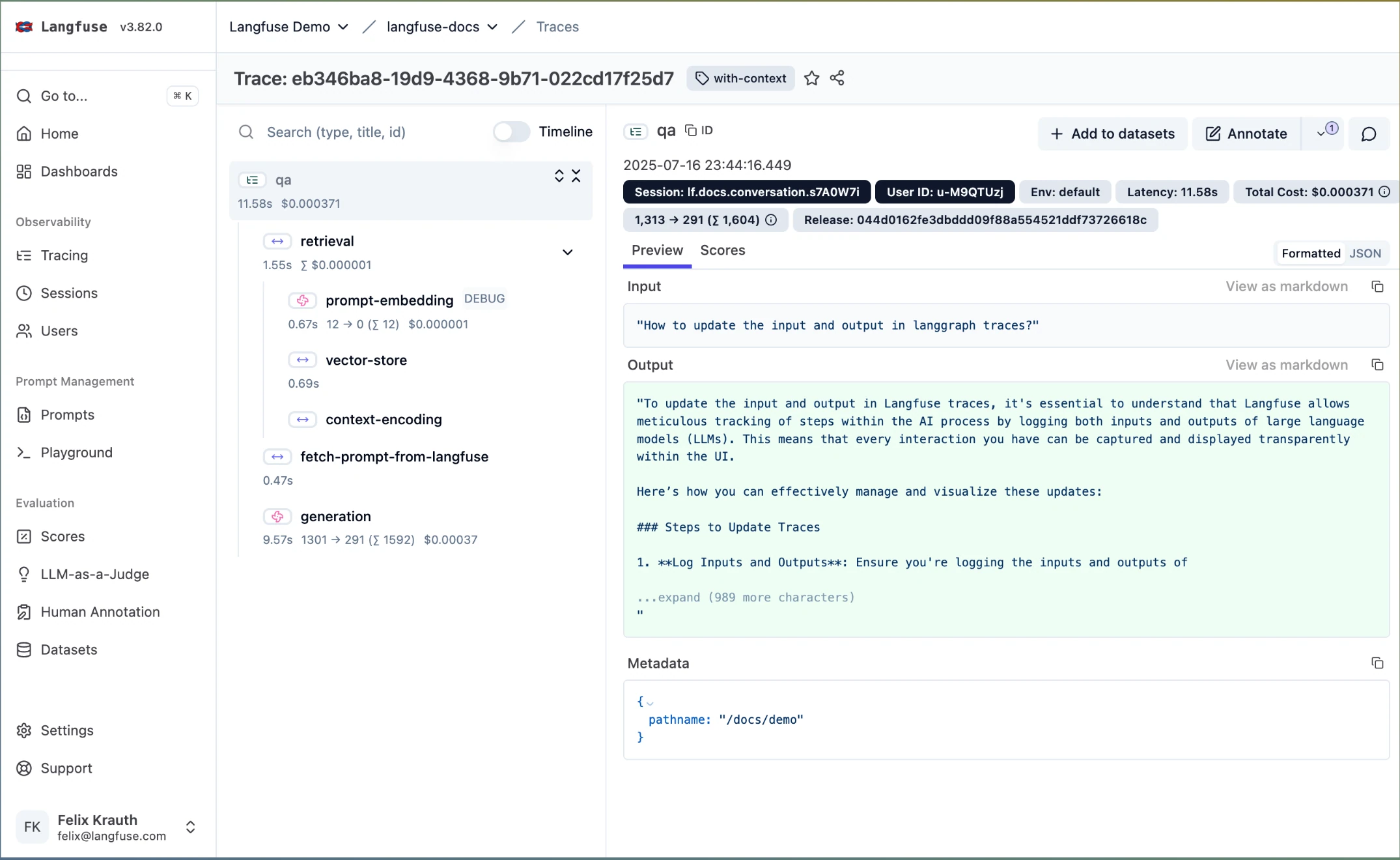
Langfuse is a fully open-source LLM engineering platform focused on tracing, prompt management, and lightweight evaluation scoring. Its biggest differentiator is the 100% open-source model — teams can self-host the entire stack on their own infrastructure, which is valuable for organizations with strict data privacy or compliance requirements.
On a feature level, Langfuse overlaps heavily with LangSmith: tracing, prompt versioning, and score-based evaluation. The difference is licensing and hosting, not evaluation depth.
Key features
- ⚙️ LLM tracing, with broad integration support, data masking, sampling, and environment separation.
- 📝 Prompt management, with versioning decoupled from application code.
- 📈 Evaluation, with score-based tracking over traces for basic quality trends.
- 🏠 Self-hosting, with full open-source deployment on your own infrastructure.
Who uses Langfuse?
Typical Langfuse users are:
- Engineering teams that require on-prem or VPC deployment for compliance reasons
- Teams that want to own their entire LLMOps stack on open-source infrastructure
- Startups looking for a free tier with generous usage
Langfuse customers include Twilio, Samsara, and Khan Academy — all teams with strong infrastructure-control preferences.
How does Langfuse compare to Confident AI?
Confident AI | Langfuse | |
|---|---|---|
Single-turn evals End-to-end evaluation workflows | Limited | |
Multi-turn evals Conversation evaluation and simulation | ||
Multi-turn simulation Auto-generate multi-turn conversations | ||
Custom LLM metrics Research-backed and extensible | 50+ open-source via DeepEval | Limited + heavy setup required |
End-to-end no-code eval Trigger live AI app for evaluation | ||
AI playground No-code experimentation | Limited, single-prompt only | |
Regression testing Side-by-side performance comparison | ||
LLM tracing OpenTelemetry observability | ||
Prompt versioning Manage single-text and message prompts | ||
Human annotation Annotate traces, align with evals | ||
Self-hosting | true (100% OSS) | |
Open-source component | DeepEval (50+ metrics) | Full platform |
Red teaming Built-in safety and security testing |
Langfuse is strong on what it sets out to do: open-source tracing and prompt management. The gap is evaluation. Langfuse's score-based evaluation is shallow relative to platforms built around research-backed metrics, there's no multi-turn simulation, no no-code workflows for non-engineers, and no red teaming. Teams that pick Langfuse for its OSS properties usually end up building their own evaluation layer on top.
How popular is Langfuse?
Langfuse is one of the most popular open-source LLMOps platforms, with over 12M monthly downloads on PyPI and strong community adoption. The OSS distribution is its biggest strength.
Why do companies use Langfuse?
- 100% open-source: Full self-hosting, full data ownership, no vendor lock-in.
- Great developer experience: Clean SDKs, strong docs, and fast time-to-first-trace.
- Unlimited users across tiers: No per-seat pricing friction.
Why Langfuse is not a true alternative to Confident AI
Langfuse looks like a free alternative on sticker price, but the real cost shows up in integration. Evaluation is score-based and shallow, there's no multi-turn simulation, no no-code workflows (no trace-to-dataset promotion, no annotation queues, no full version loop non-engineers can run on their own), and no red teaming — so teams end up running Langfuse plus a separate evaluation library plus a homegrown annotation layer. That's three systems to host, three sources of truth to reconcile, and ongoing engineering hours to keep the glue working. The open-source savings are spent on integration and maintenance. Langfuse's ROI holds when your hard constraint is "self-hosted open-source with a dashboard" and you're willing to assemble the rest. For teams that want the AI quality stack delivered as one product — with the engineer-hours going to product work instead of eval infrastructure — Confident AI ends up cheaper in total cost of ownership, even before factoring in the iteration speed gained from no-code workflows.
Full Feature Comparison
Confident AI | Arize AI | LangSmith | DeepEval | Langfuse | |
|---|---|---|---|---|---|
Platform vs. library | Platform | Platform | Platform | Library | Platform |
LLM tracing OpenTelemetry observability | |||||
Single-turn evals | Limited | ||||
Multi-turn evals | Limited | Limited | Limited | ||
Multi-turn simulation Auto-generated conversations | |||||
50+ research-backed metrics | |||||
Prompt optimization GEPA, SIMBA, MIPROv2, COPRO algorithms | |||||
Automated signal surfacing Pushes silent regressions into team workflow | |||||
Automated error analysis Clusters failures + recommends metrics from patterns | |||||
End-to-end no-code eval Trigger live AI app | Limited | ||||
AI playground No-code experimentation | Limited | Limited | Limited | ||
Regression testing A/B comparison | Limited | Limited | |||
Quality-aware alerting PagerDuty/Slack/Teams | Limited | ||||
Human annotation On production traces | |||||
Dataset management Multi-turn, versioning, backups | Limited | Limited | Limited | ||
Prompt versioning Git-style branching | |||||
Framework-agnostic | Weakens outside LangChain | ||||
Open-source component | DeepEval | Phoenix (tracing only) | Full | Full | |
Red teaming Built-in safety/security testing | Limited |
Why Confident AI Has No True Alternative
Confident AI is the eval-first observability platform for teams to own AI quality — and that phrase is doing a lot of work. Unpack each word:
- Eval-first: Evaluation is the product, not an observability add-on. 50+ research-backed metrics through DeepEval cover single-turn, multi-turn, RAG, agents, and safety. Multi-turn simulation compresses hours of manual conversation testing into minutes. Red teaming against OWASP Top 10 for LLM Applications and NIST AI RMF is built in.
- Observability: OpenTelemetry-native tracing with 10+ integrations (OpenAI, LangChain, Pydantic AI, LangGraph, and more), aligned with OpenTelemetry's GenAI semantic conventions. Production traces auto-curate into evaluation datasets. Quality-aware alerting fires when faithfulness, relevance, or safety scores drop. Automated signal surfacing pushes silent regressions into the team's workflow without anyone having to hunt through traces by hand, and automated error analysis then clusters those failures into coherent failure modes and recommends the right metrics to catch them going forward — closing the loop from "something is wrong" to "here's what to fix and how to catch it next time."
- Teams: PMs upload datasets and run evaluations against production AI apps without code. QA teams own regression testing on their own schedule. Domain experts annotate traces and align them with evaluation metrics. Engineers retain full programmatic control via API.
- Own AI quality: Not just monitor it, not just log it — own it. Every role in the AI quality loop has a seat in the same platform.
Each of the four competitors in this guide solves a subset of that equation. Arize AI covers observability. LangSmith covers LangChain-native observability. DeepEval covers open-source evaluation primitives. Langfuse covers OSS self-hosted observability. None of them cover the full loop: research-backed eval depth + cross-functional workflows + production quality monitoring + automated signal surfacing + automated error analysis + multi-turn + red teaming — in one product.
The clearest demonstration of what this combined stack actually produces in practice comes from Finom, a European fintech serving 200,000+ SMBs with €300M+ in funding. Before Confident AI, every AI improvement cycle routed through engineering as tasks, queues, and follow-ups. After switching, product managers own the cycle end-to-end.
The documented outcomes: 27x faster iteration cycles (10 days → 3 hours per agent improvement), 3x iteration throughput, 60+ hours saved per week across product, engineering, and QA, and €250K+ in projected annual savings. None of the four competitors in this guide has produced a published customer story with this profile — and that gap isn't a marketing accident. Observability-first tools (Arize, Langfuse, LangSmith) optimize for trace capture, not improvement velocity. Library-only tools (DeepEval standalone) optimize for metric accuracy, not team throughput. Confident AI optimizes the end-to-end loop — eval depth, cross-functional workflows, production monitoring, automated signal surfacing, and automated error analysis working as one product — and the ROI falls out of that design choice.
Companies adopting this full stack include Panasonic, Amazon, BCG, CircleCI, and Humach. Humach shipped deployments 300% faster and saves 20+ hours per week on testing after switching to Confident AI — gains that come specifically from consolidating evaluation, safety testing, observability, automated signal surfacing, and automated error analysis into one integrated product.
Confident AI helps you own AI quality with the eval-first observability platform
Book a personalized 30-min walkthrough for your team's use case.
When Confident AI Might Not Be the Right Fit
To be honest, there are narrow cases where one of the competitors is the better pick:
- You need 100% open-source and don't need a UI to iterate: DeepEval is the better default. Evaluations stay in your workspace, and coding agents in Cursor or Claude Code can edit and run evals autonomously — you don't need a browser UI at all. The editor is the UI. Choose Langfuse only if you specifically need an open-source dashboard for your team to click through.
- You need 100% open-source with a browser-based UI as a hard constraint: Langfuse is the closest fit. Confident AI can be self-hosted, but it's not fully open-source.
- You're all-in on LangChain and plan to stay that way: LangSmith's native LangChain/LangGraph integration is hard to beat if that's your entire stack forever.
- You only need local evaluation scripts with no team component: An open-source evaluation library like DeepEval is enough. A platform is overkill until multiple roles need to collaborate on AI quality.
- You're an ML-first org with existing Arize deployments for classic ML monitoring: Arize is a reasonable place to extend into LLM tracing, though evaluation depth will be a limiter.
For every other case — which is most teams — Confident AI is the only platform that covers the full AI quality stack in one product.
Frequently Asked Questions
Does Confident AI have a true alternative?
No. Each competitor solves a slice — tracing, LangChain-native observability, open-source evaluation primitives, or OSS observability — but none ship the full stack (eval depth + cross-functional workflows + production monitoring + signal surfacing + error analysis + multi-turn + red teaming) in one product.
What is the closest open-source option to Confident AI?
If you don't need a UI: DeepEval. It's an open-source library with 50+ research-backed metrics that runs entirely in your workspace; coding agents in Cursor or Claude Code can iterate on evals autonomously.
If you need a browser UI on open-source infra: Langfuse. Its evaluation depth is shallow relative to metrics-focused libraries, so teams usually end up pairing it with a dedicated evaluation library.
Is DeepEval the same as Confident AI?
No — they are two products from the same company. Confident AI builds and maintains DeepEval as its open-source evaluation framework; DeepEval is a library, Confident AI is the platform.
- DeepEval is an open-source library — pytest for LLMs. 50+ metrics, no account, no cloud, no UI.
- Confident AI is a cloud platform — production monitoring, signal surfacing, error analysis, alerting, dataset management, annotation, red teaming, and no-code workflows for PMs, QA, and domain experts.
They operate at different layers, so they're often used together rather than as substitutes.
Which Confident AI competitor fits LangChain-only teams?
LangSmith. Its native LangChain/LangGraph integration is the path of least resistance if you're 100% in that ecosystem forever. The trade-off: shallow evaluation, no multi-turn simulation, no red teaming, and diminishing value outside LangChain.
Which competitor comes closest on multi-turn evaluation?
Confident AI and DeepEval both ship automated multi-turn simulation — auto-generated conversations with tool use and branching paths, compressing 2–3 hours of manual testing into under 5 minutes. Arize, LangSmith, and Langfuse offer limited or no equivalent.
Which competitor comes closest for enterprises?
Arize for ML-heavy enterprises; LangSmith for LangChain-committed enterprises. For cross-functional AI quality ownership, fine-grained RBAC, regional deployments, and on-prem, Confident AI is the only complete fit. Customers include Panasonic, Amazon, BCG, and CircleCI.
Which is the closest free or self-hosted option?
DeepEval and Langfuse, for different use cases. DeepEval isn't self-hosted in the platform sense — it's a library you pip install, with zero UI overhead. Langfuse is a self-hostable platform with a browser UI for non-engineers. Teams often use both together. For research-backed evaluation depth with a managed platform, Confident AI has a free tier and enterprise self-hosting.