MLflow was built for a different era of AI. Its experiment tracking, model registry, and artifact management are fixtures in traditional ML workflows — and for good reason. But teams building LLM-powered agents, chatbots, and RAG applications keep running into the same wall: MLflow tracks experiments, it doesn't evaluate AI quality. You can log runs, compare metrics across training iterations, and version models, but there's no production-grade LLM observability, no multi-turn conversation evaluation, no cross-functional workflows for non-engineers, and no quality-aware alerting that fires when faithfulness or relevance drops on live traffic.
Gartner predicts that by 2028, LLM observability investments will account for 50% of GenAI deployments — up from 15% today. Teams that stay on experiment-tracking infrastructure for LLM quality will pay migration costs later. This guide walks through the top six MLflow alternatives, explains what each one does well, and shows which platform fits different team profiles.
Why Experiment Tracking Is Not LLM Evaluation
MLflow's mental model is train → log → compare → deploy. That works for traditional ML where the artifact is a model with measurable accuracy on a test set. LLMs don't fit that loop. The artifact is a prompt-model-retrieval stack that produces free-text outputs, and "accuracy" is a constellation of dimensions — faithfulness, relevance, hallucination, safety, conversational coherence — that require specialized evaluation, not generic metric logging.
The gap shows up in three places:
- No production quality monitoring. MLflow tracks experiments in development. It doesn't run evaluation metrics on live traffic, alert when quality degrades, or auto-curate failing traces into the next test cycle.
- No cross-functional access. A PM can't upload a dataset and run an evaluation cycle in MLflow without engineering involvement. A domain expert can't annotate a production trace. AI quality stays siloed in the engineering team.
- No LLM-native evaluation depth. MLflow's LLM evaluation support is emerging — built-in LLM-as-judge metrics exist, but the coverage is shallow compared to platforms designed around LLM quality from day one, and multi-turn conversation evaluation is absent.
As you compare the alternatives below, pay attention to which platforms treat LLM evaluation as the product and observability as the infrastructure — not the other way around.
Our Evaluation Criteria
Choosing an MLflow replacement for LLM workflows means balancing experiment management heritage with LLM-native capabilities. Based on our experience working with hundreds of AI teams, these are the factors that matter most:
- Evaluation maturity: Are the metrics research-backed and widely adopted? Can you create custom evaluators without months of setup? Is evaluation the core product or an experiment-tracking add-on?
- Production observability: Beyond experiment logging, can you trace LLM applications in production, drill into individual spans, filter thousands of traces, and run evaluations directly on live traffic?
- Cross-functional accessibility: Can a PM or domain expert run a complete evaluation cycle independently — upload a dataset, trigger a production AI app for testing, review results — without asking engineering?
- Setup friction: MLflow requires self-managed infrastructure. How much operational burden does each alternative carry? Two days of infra work, or two hours of SDK setup?
- Data portability: If you switch platforms in 18 months, how painful is the migration? API access, data export, and standard formats matter.
- MLOps continuity: If your team still runs traditional ML workloads alongside LLMs, does the alternative cover both, or do you need two platforms?
With these criteria in mind, here's how each of the top five MLflow alternatives stacks up.
1. Confident AI
- Founded: 2023
- Most similar to: LangSmith, Langfuse, Arize AI
- Typical users: Engineers, product, and QA teams
- Typical customers: Mid-market B2Bs and enterprises
What is Confident AI?
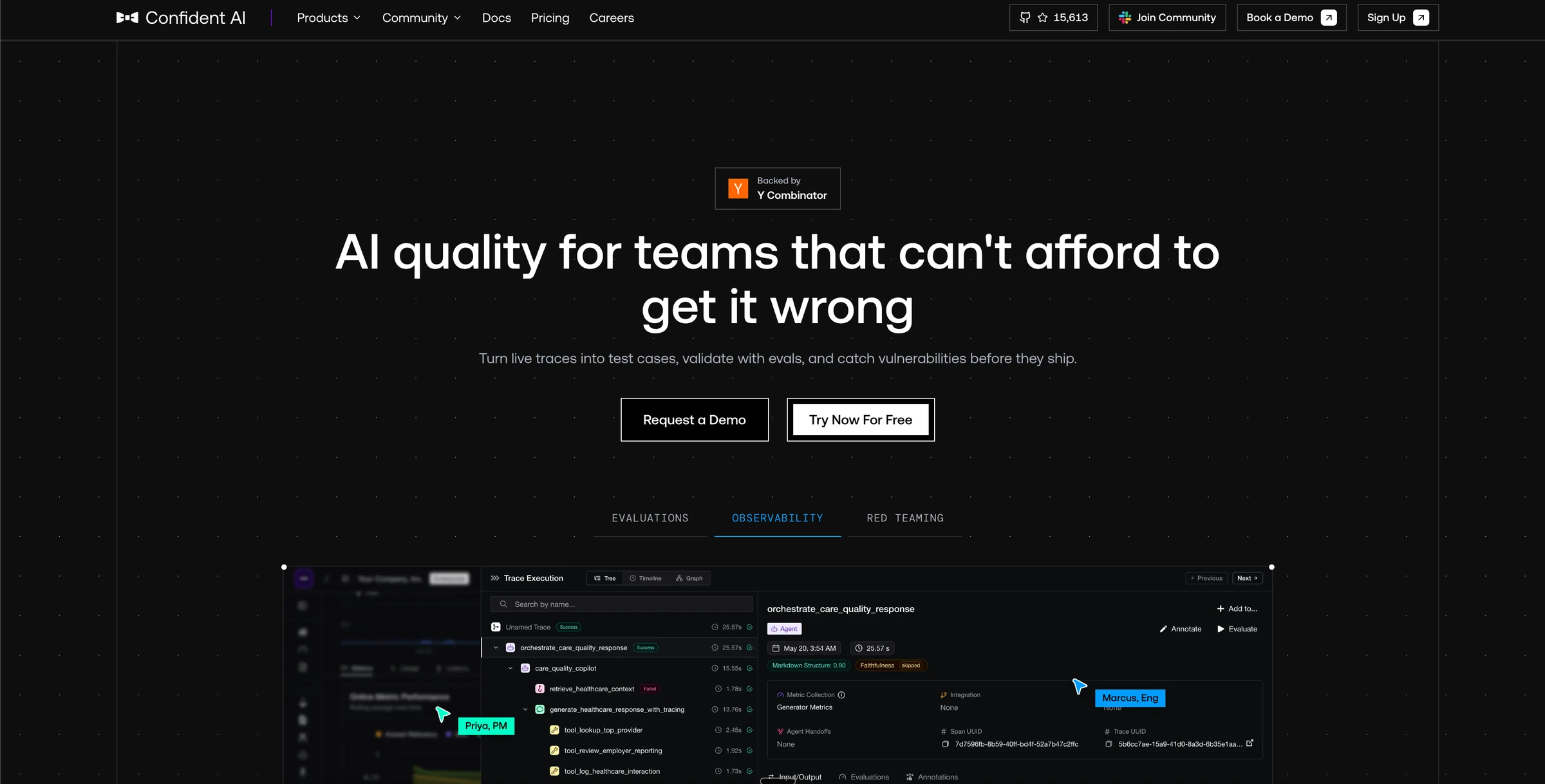
Confident AI is an LLM evaluation and observability platform that combines evals, tracing, A|B testing, dataset management, human-in-the-loop annotations, and prompt versioning in one collaborative workflow. Unlike MLflow's experiment-centric design, Confident AI is built around evaluation as the core product — with observability as the supporting layer that closes the loop from production traffic back to the next test cycle.
Key features
- 🧮 50+ research-backed metrics covering single-turn, multi-turn, RAG, agents, and safety — including faithfulness, hallucination, answer relevancy, bias, and G-Eval. All metrics are open-source through DeepEval.
- 🧪 End-to-end evaluation workflows with sharable testing reports, A|B regression testing, performance insights across prompts and models, and custom dashboards for stakeholders.
- 🌐 Production observability with OpenTelemetry-native tracing, 10+ framework integrations (OpenAI, LangChain, Pydantic AI, LangGraph), online evaluations on live traces, quality-aware alerting, and automatic dataset curation from production traffic.
- 🗂️ Collaborative dataset management for single-turn and multi-turn datasets, with annotation task distribution, version history, and automated backups.
- 📌 Prompt lifecycle management supporting text templates and message-based prompts, with variable substitution and one-click deployment.
- ✍️ Human annotation enabling domain experts to annotate production traces, spans, and conversation threads, with annotations feeding back into evaluation datasets and metric alignment.
Confident AI helps you replace experiment tracking with evaluation-first observability
Book a personalized 30-min walkthrough for your team's use case.
Who uses Confident AI?
Confident AI serves organizations where AI quality extends beyond the engineering department:
- Engineering teams running CI/CD evaluation pipelines and automated regression testing
- Product managers uploading datasets, triggering evaluations against production AI apps, and reviewing results — without writing code
- QA teams owning regression suites and threshold management
- Domain experts annotating traces and aligning human judgment with automated metrics
Customers include Panasonic, Amazon, BCG, CircleCI, and Humach. External reviewers on Gartner Peer Insights highlight evaluation depth and cross-functional access as differentiators.
How does Confident AI compare to MLflow?
Confident AI | MLflow | |
|---|---|---|
LLM tracing OpenTelemetry-compatible production observability | Limited | |
Single-turn evals End-to-end evaluation workflows | ||
Multi-turn evals Conversation evaluation and simulation | ||
Multi-turn simulation Auto-generate multi-turn conversations for testing | ||
Custom LLM metrics Research-backed and extensible | 50+ open-source via DeepEval | Limited |
End-to-end no-code eval Trigger live AI app for evaluation | ||
AI playground No-code experimentation | ||
Regression testing Side-by-side performance comparison | Limited | |
Quality-aware alerting Alert on drops in faithfulness, relevance, safety | ||
Human annotation Annotate traces, align with evals | ||
Dataset management Multi-turn, versioning, backups | Limited | |
Prompt versioning Git-style branching and deployment | Limited | |
Production monitoring Continuous quality evaluation on live traffic | ||
MLOps Traditional model training lifecycle | ||
Red teaming Built-in safety and security testing |
The architectural difference is decisive: MLflow manages experiments, Confident AI manages AI quality. MLflow's LLM evaluation is an extension of its ML experiment tracking — you log runs, compare outputs, and version artifacts. Confident AI's evaluation is the product: 50+ metrics running on production traces, automatic dataset curation from live traffic, quality-aware alerting via PagerDuty/Slack/Teams, and cross-functional workflows where PMs and domain experts participate directly.
Confident AI's multi-turn simulations compress 2–3 hours of manual conversation testing into under 5 minutes. Built-in red teaming aligned with OWASP Top 10 for LLM Applications and NIST AI RMF eliminates the need for separate security testing vendors.
The documented outcomes from Finom: 27x faster iteration cycles, 3x iteration throughput, and €250K+ in projected annual savings.
How popular is Confident AI?
Confident AI is an AI observability and evals platform, and as of early 2026, DeepEval — the open-source framework behind its evaluation metrics — is the most downloaded LLM evaluation framework on PyPI with 3M+ monthly downloads and 10k+ GitHub stars.
Why do companies use Confident AI?
- Cross-functional collaboration: Engineers set up the SDK, then PMs, QA, and domain experts run complete evaluation cycles independently — uploading datasets, triggering tests against production apps, and reviewing results without code.
- Evaluation-first architecture: Evaluation is the product, not an experiment-tracking add-on. 50+ research-backed metrics, multi-turn simulation, and production monitoring work as one system.
- Closed-loop production workflow: Traces auto-curate into evaluation datasets. Quality-aware alerting fires on score drops. Annotations feed back into metric alignment. The loop from "production failure" to "fix validated in staging" runs without manual plumbing.
Bottom line: Confident AI is the best MLflow alternative for teams building LLM-powered applications. It replaces MLflow's experiment-centric approach with evaluation-first observability that covers the full AI quality stack — and extends access beyond engineering to the entire team. The one constraint: if you still need traditional MLOps (model training, registry, deployment), you'll run a separate tool for that.
2. Weights & Biases
- Founded: 2017
- Most similar to: MLflow, Arize AI
- Typical users: ML engineers, research teams
- Typical customers: Research labs, mid-market B2Bs, and enterprises
What is Weights & Biases?
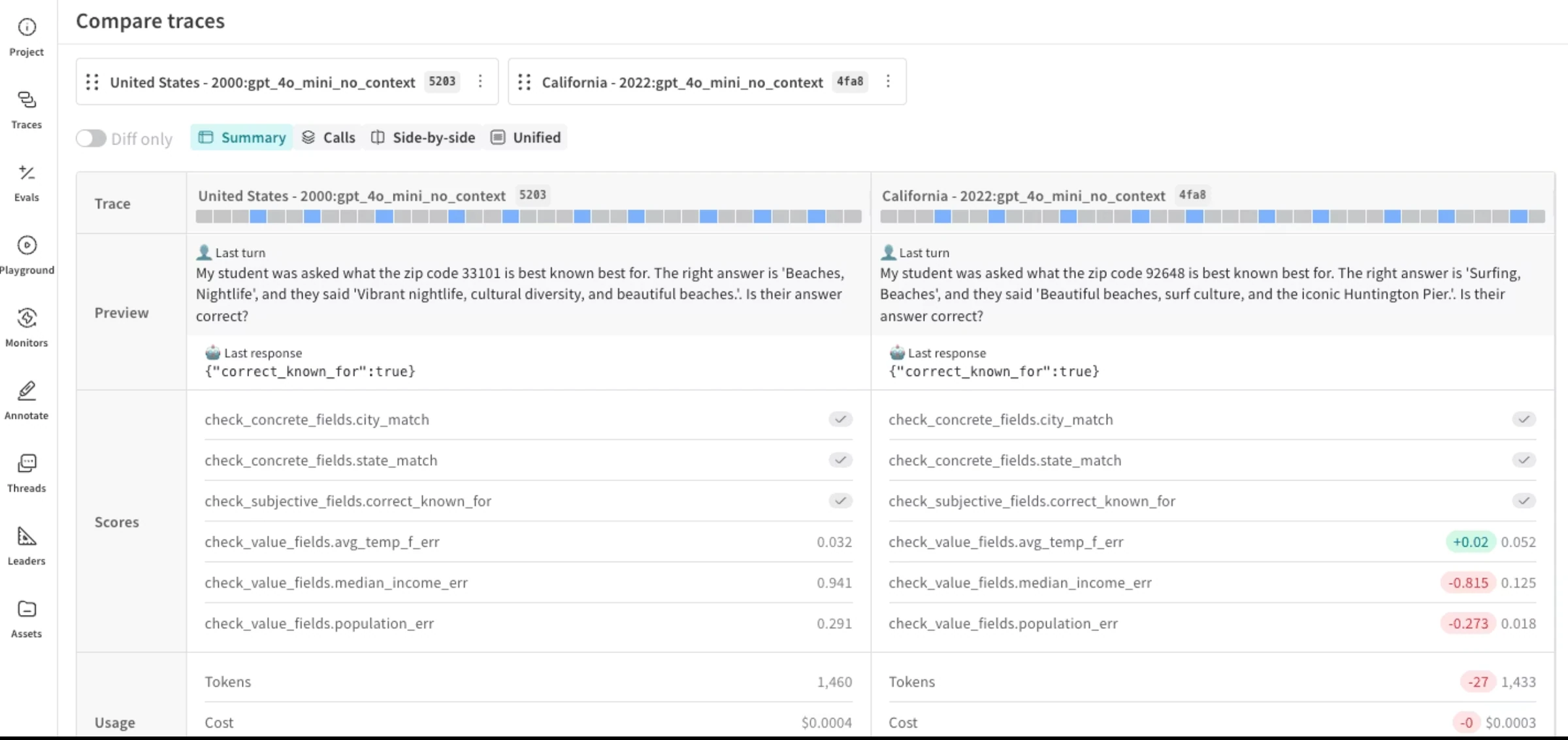
Weights & Biases (W&B) is a managed ML experiment tracking and model management platform that has expanded into LLM evaluation and tracing. It's the closest direct replacement for MLflow — same experiment tracking mental model, but hosted and with a richer visualization layer. W&B Weave, its LLM-specific offering, adds tracing, evaluation, and prompt management for GenAI workflows.
Key features
- ⚙️ Experiment tracking with rich dashboards, hyperparameter sweeps, and collaborative run comparison — the core product that competes directly with MLflow.
- 🔗 W&B Weave for LLM tracing, evaluation, and prompt management — extending the platform into GenAI workflows.
- 📈 Evaluation with basic LLM scoring, custom evaluators, and integration with popular frameworks.
- 🗃️ Model registry and artifacts for versioning datasets, models, and prompts across the ML lifecycle.
Who uses Weights & Biases?
Typical W&B users are:
- ML and research teams that need managed experiment tracking with collaboration features
- Organizations already using W&B for traditional ML that want to extend to LLM workflows
- Teams that prefer a hosted solution over MLflow's self-managed infrastructure
W&B customers include OpenAI, Toyota, and NVIDIA — primarily engineering and research-heavy organizations.
How does Weights & Biases compare to MLflow?
Weights & Biases | MLflow | |
|---|---|---|
MLOps Traditional model training lifecycle | ||
LLM tracing Observability for AI | true (via Weave) | Limited |
Single-turn evals End-to-end evaluation workflows | ||
Multi-turn evals Conversation evaluation and simulation | ||
Custom LLM metrics Use-case specific metrics | Limited | Limited |
AI playground No-code experimentation | ||
Experiment tracking Run comparison and hyperparameter sweeps | ||
Model registry Version and deploy models | ||
Prompt versioning Manage prompt templates | ||
Error, cost, and latency tracking Track model usage and errors | ||
API support Centralized API to manage data | Limited |
W&B is the most natural MLflow replacement for teams that want the same experiment-tracking workflow but managed and with better collaboration. W&B Weave extends the platform into LLM tracing and evaluation, though the LLM evaluation layer is narrower than platforms built specifically for LLM quality — limited multi-turn support, no no-code workflows for non-engineers, and no production quality-aware alerting.
The trade-off: W&B solves MLflow's infrastructure burden (hosted vs. self-managed) and adds better visualization, but the LLM evaluation capabilities remain experiment-centric rather than evaluation-first.
How popular is Weights & Biases?
W&B is widely adopted in the ML research and engineering community, with claims of over 1 million users and usage across major research labs and enterprises. It is more popular as an experiment tracking platform than as an LLM evaluation tool.
Why do companies use Weights & Biases?
- Managed experiment tracking: No self-hosted infrastructure to maintain — the biggest friction point teams have with MLflow disappears.
- Strong visualization: Rich dashboards, collaborative workspaces, and hyperparameter sweep tooling that go beyond MLflow's UI.
- MLOps continuity: Teams running traditional ML and LLM workloads can use a single platform for both.
Bottom line: W&B is the best MLflow alternative for teams that primarily need managed experiment tracking with LLM extensions. It solves MLflow's infrastructure and collaboration pain points but doesn't close the gap on LLM-native evaluation depth, production quality monitoring, or cross-functional workflows.
3. Arize AI
- Founded: 2020
- Most similar to: Confident AI, LangSmith, Langfuse
- Typical users: Engineers, ML / data science teams
- Typical customers: Mid-market B2Bs and enterprises
What is Arize AI?
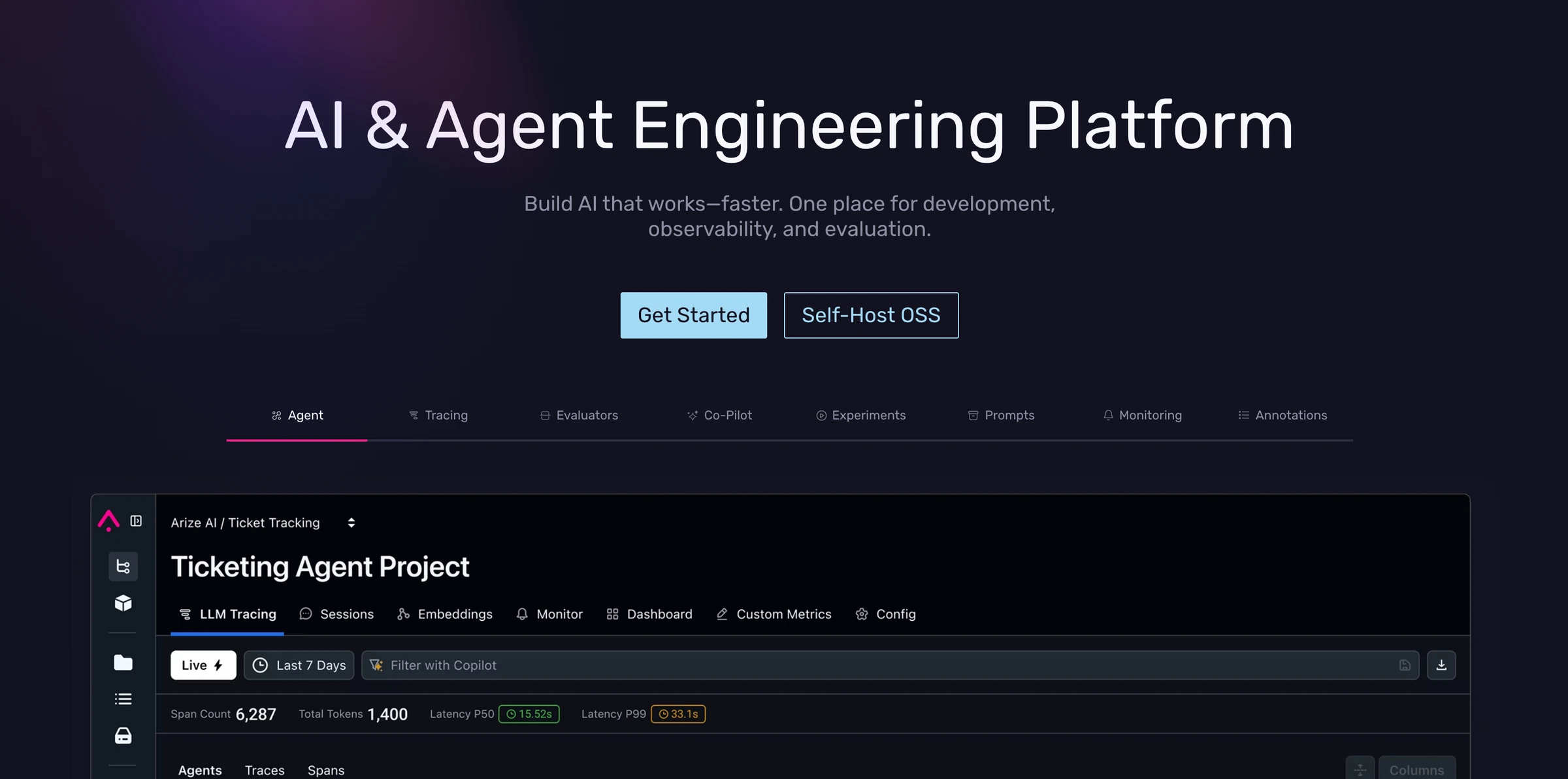
Arize AI started as an ML model monitoring platform — tracking feature drift, prediction distributions, and model performance for traditional ML workloads. Its LLM observability offering is adapted from that heritage, extended through Phoenix, its open-source tracing layer with roughly 8k GitHub stars as of early 2026.
Key features
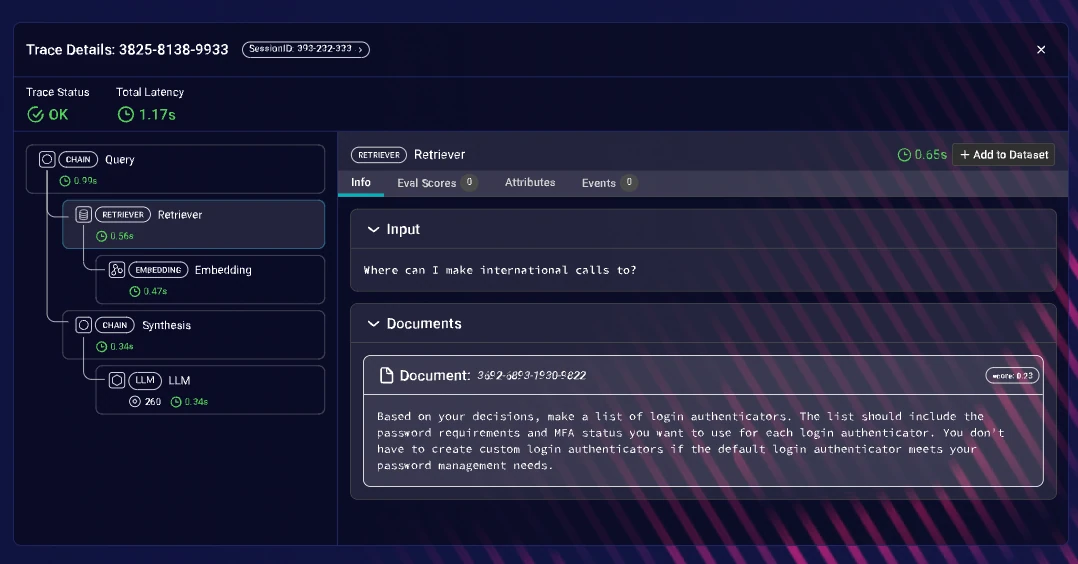
- 🕵️ Agent observability with graph visualizations, latency and error tracking, and integrations with 20+ frameworks.
- 🔗 Tracing including span logging with custom metadata and the ability to run online evaluations on spans.
- 🧑✈️ Copilot for chat-style debugging and analysis of observability data.
- 🧫 Experiments with UI-driven evaluation workflows to score datasets against LLM outputs.
Who uses Arize AI?
Typical Arize AI users are:
- Highly technical teams at large enterprises
- Engineering-heavy organizations with few PMs or domain experts in the quality loop
- Companies with existing Arize deployments for traditional ML monitoring
Arize's free and $50/month tiers cap at 3 users with 14-day data retention, so most teams end up on annual enterprise contracts for anything beyond initial evaluation.
How does Arize AI compare to MLflow?
Arize AI | MLflow | |
|---|---|---|
MLOps Traditional model training lifecycle | ||
LLM tracing Production observability | Limited | |
Single-turn evals End-to-end evaluation workflows | ||
Multi-turn evals Conversation evaluation and simulation | Limited | |
Custom LLM metrics Use-case specific metrics | Limited + heavy setup required | Limited |
AI playground No-code experimentation | Limited, single-prompt only | |
Online evals Run evaluations on live traces | ||
Experiment tracking Run comparison and management | ||
Prompt versioning Manage prompt templates | ||
Human annotation Annotate traces | ||
Error, cost, and latency tracking Track model usage and errors |
Arize AI represents the clearest upgrade path from MLflow for teams that need production-grade LLM observability. It adds real-time trace monitoring, online evaluations, and annotation workflows that MLflow lacks entirely. The ML monitoring heritage means teams with both traditional ML and LLM workloads can consolidate.
The gap: Arize's evaluation capabilities are adapted from ML monitoring, not built for LLM quality from the ground up. Creating custom evaluators requires engineering work, multi-turn support is limited, and the platform is built for engineers — PMs and domain experts hit friction quickly.
How popular is Arize AI?
Arize AI is a well-known name in ML observability. Arize Phoenix sits at around 8k GitHub stars. Arize claims roughly 50 million evaluations run per month and over 1 trillion spans logged across its platform.
Why do companies use Arize AI?
- Production-grade monitoring: Arize handles trace ingestion at enterprise scale with strong fault tolerance — a significant step up from MLflow's experiment-focused logging.
- ML + LLM coverage: Teams with both traditional ML and LLM workloads can use a single platform.
- Self-hostable OSS layer: Phoenix is open-source and self-hostable for teams with compliance requirements.
Bottom line: Arize AI is the best MLflow alternative for engineering-heavy teams that need production LLM monitoring alongside traditional ML observability. For teams that need cross-functional AI quality workflows, evaluation depth beyond basic scoring, or multi-turn conversation testing, other alternatives are a better fit.
4. Langfuse
- Founded: 2022
- Most similar to: LangSmith, Helicone, Arize AI
- Typical users: Engineers who require self-hosting
- Typical customers: Startups to mid-market B2Bs
What is Langfuse?
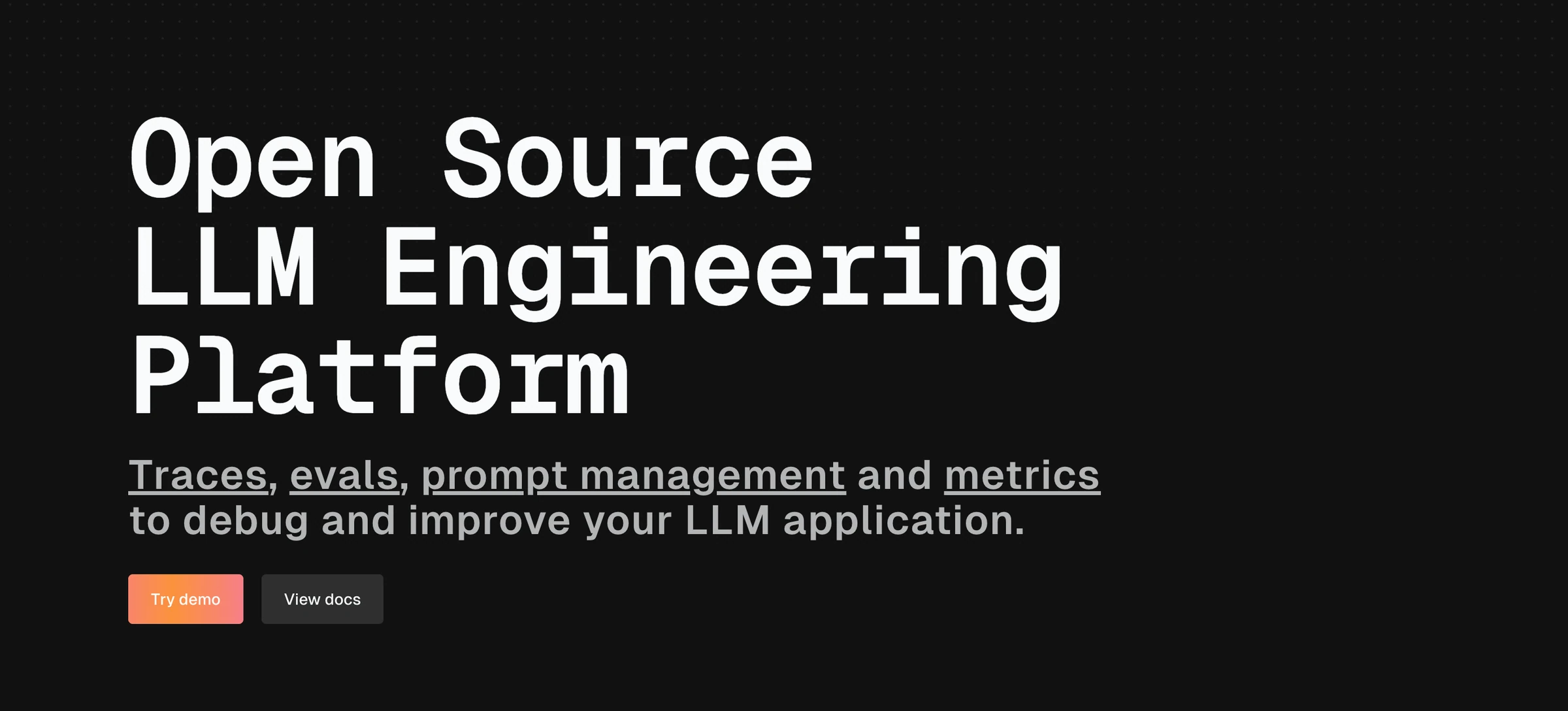
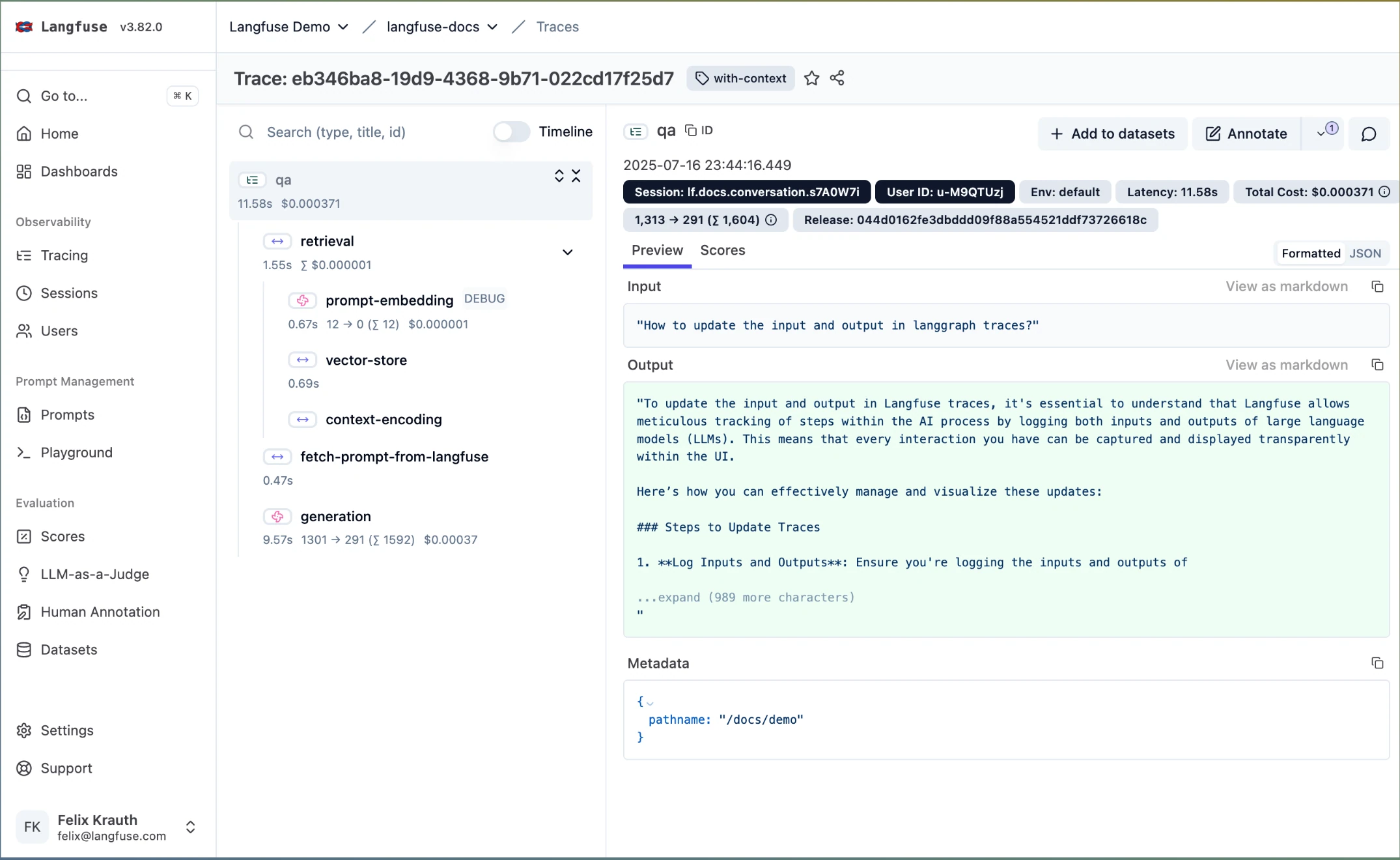
Langfuse is a fully open-source LLM engineering platform focused on tracing, prompt management, and lightweight evaluation scoring. For teams leaving MLflow, Langfuse's appeal is similar infrastructure philosophy — open-source, self-hostable — but purpose-built for LLM workflows rather than adapted from ML experiment tracking.
Key features
- ⚙️ LLM tracing with broad integration support, data masking, sampling, and environment separation.
- 📝 Prompt management with versioning decoupled from application code.
- 📈 Evaluation with score-based tracking over traces for basic quality trends.
- 🏠 Self-hosting with full open-source deployment on your own infrastructure.
Who uses Langfuse?
Typical Langfuse users are:
- Engineering teams that require on-prem or VPC deployment for compliance
- Teams that want to own their entire LLMOps stack on open-source infrastructure
- Startups looking for a free tier with generous usage
Langfuse customers include Twilio, Samsara, and Khan Academy.
How does Langfuse compare to MLflow?
Langfuse | MLflow | |
|---|---|---|
LLM tracing Production observability | Limited | |
Single-turn evals End-to-end evaluation workflows | Limited | |
Multi-turn evals Conversation evaluation and simulation | ||
Custom LLM metrics Use-case specific metrics | Limited + heavy setup required | Limited |
Online evals Run evaluations on live traces | ||
Prompt versioning Manage prompt templates | ||
Human annotation Annotate traces | ||
Self-hosting Full open-source deployment | true (100% OSS) | |
MLOps Traditional model training lifecycle | ||
Error, cost, and latency tracking Track model usage and errors |
Langfuse is the most natural MLflow replacement for teams whose hard constraint is "open-source and self-hosted" and whose workloads are now LLM-only. It provides LLM-native tracing and prompt management that MLflow's GenAI extensions are still catching up to, and the open-source model means no vendor lock-in.
The gap: Langfuse's evaluation is score-based and shallow. There's no multi-turn simulation, no no-code workflows for non-engineers, and no built-in research-backed metrics. Teams that pick Langfuse for its OSS properties usually end up building their own evaluation layer on top — or pairing it with a library like DeepEval.
How popular is Langfuse?
Langfuse is one of the most popular open-source LLMOps platforms, with over 12M monthly downloads on PyPI and strong community adoption.
Why do companies use Langfuse?
- 100% open-source: Full self-hosting, full data ownership, no vendor lock-in — same philosophy as MLflow, but built for LLMs.
- Great developer experience: Clean SDKs, strong docs, and fast time-to-first-trace.
- Unlimited users across tiers: No per-seat pricing friction.
Bottom line: Langfuse is the best MLflow alternative for teams that need open-source, self-hosted LLM tracing and prompt management. It replaces MLflow's LLM gaps without adding vendor lock-in. For teams that also need evaluation depth, multi-turn testing, or cross-functional workflows, Langfuse alone isn't enough — you'll need a separate evaluation layer.
5. LangWatch
- Most similar to: Langfuse, LangSmith, Arize AI
- Typical users: Engineering and AI quality teams
- Typical customers: Startups to regulated enterprises
What is LangWatch?
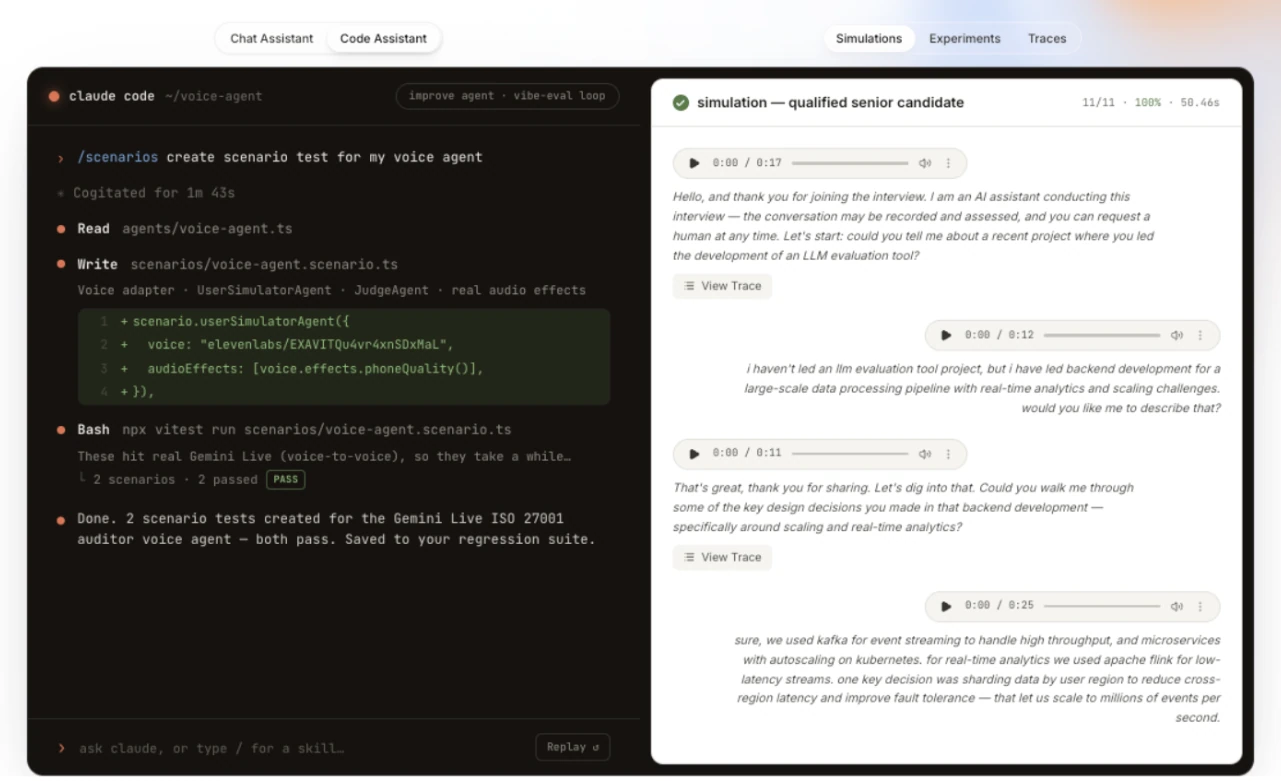
LangWatch is an Apache-2.0 multi-agent observability and testing platform with OpenTelemetry tracing, online evaluation, guardrails, and Scenario tests.
Key features
- 🔍 Tracing and online evaluation over agent outputs and conversations.
- 🧪 Scenario testing for multi-turn text and voice runs locally or in CI.
- 🏠 Self-hosting under Apache-2.0 through Docker or Kubernetes.
Who uses LangWatch?
LangWatch fits engineering teams testing multi-agent or voice systems without an ML experiment-tracking stack.
How does LangWatch compare to MLflow?
LangWatch | MLflow | |
|---|---|---|
LLM tracing Production observability | Limited | |
OpenTelemetry-native Framework-agnostic instrumentation | ||
Online evals Score production traffic | Limited | |
Multi-turn simulation Generate and judge conversations | ||
Voice-agent testing Run scripted voice scenarios | ||
Traditional MLOps Experiment tracking and model registry | ||
Runtime guardrails PII and prompt-injection protection | Limited | |
Broad metric depth Research-backed metrics across use cases | Limited | Limited |
Statistical human alignment Validate metrics against human judgment | Limited | Limited |
Cross-functional eval ownership Non-engineers run complete eval cycles | Limited | Limited |
Self-hosting Deploy on your own infrastructure |
LangWatch covers agent tracing, online evaluators, guardrails, and CI scenarios; MLflow covers traditional experiment tracking and model registry workflows.
How popular is LangWatch?
LangWatch has a younger community, narrower general metric depth, lighter annotation-driven human alignment, and no infrastructure APM for hosts, services, or databases.
Why do companies use LangWatch?
- Agent workflow: Traces, online evaluators, and Scenario tests share one platform.
- Open instrumentation: OpenTelemetry works across agent frameworks.
- Infrastructure control: Apache-2.0 self-hosting supports regulated deployments.
Bottom line: LangWatch replaces parts of MLflow's LLM workflow with agent tracing and Scenario tests, but remains narrower than Confident AI on 50+ research-backed metric depth, statistical human alignment, and full no-code cross-functional eval ownership; it also does not replace MLflow's broader MLOps lifecycle.
6. LangSmith
- Founded: 2022
- Most similar to: Confident AI, Langfuse, Arize AI
- Typical users: Engineering teams already using LangChain
- Typical customers: Mid-market B2Bs to enterprises on the LangChain stack
What is LangSmith?
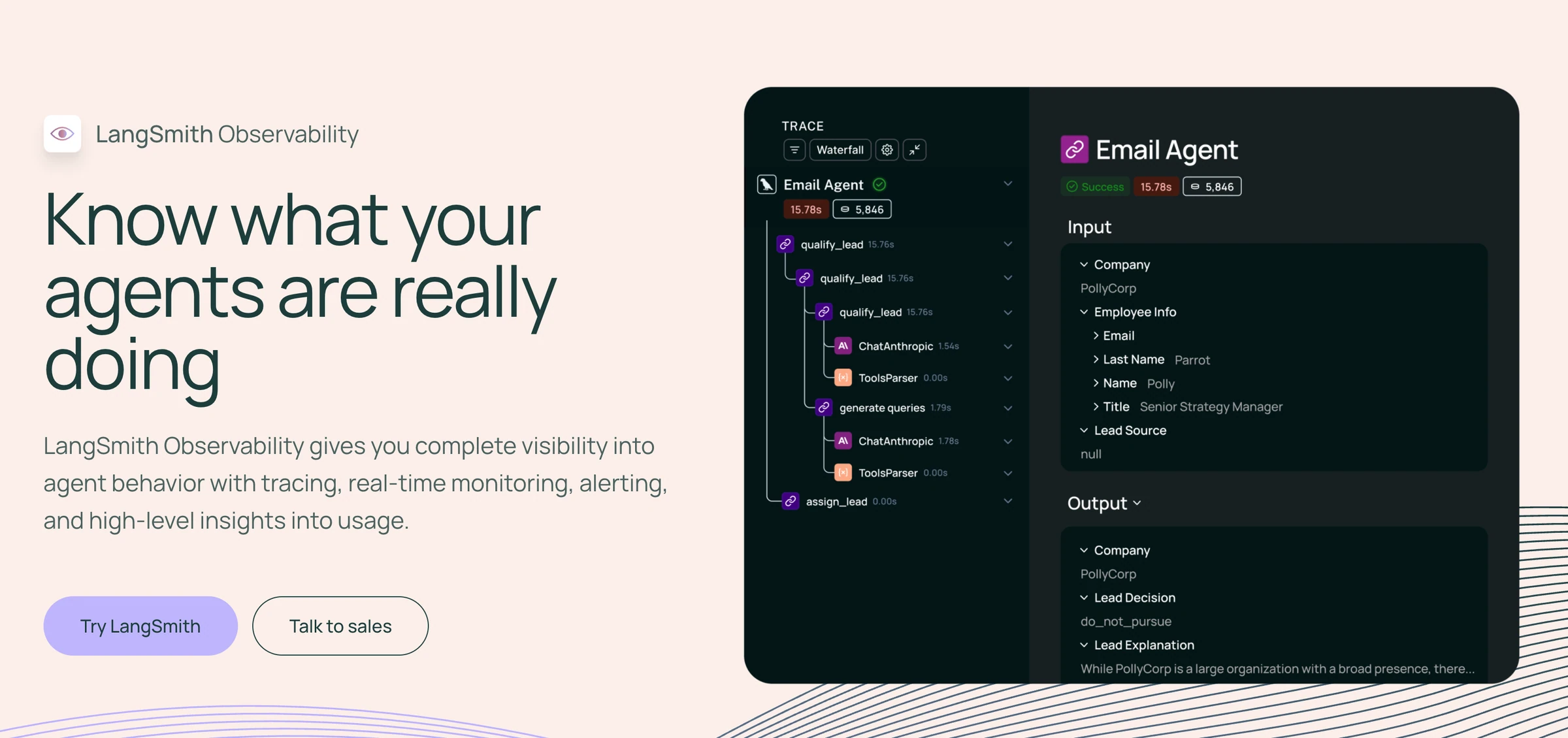
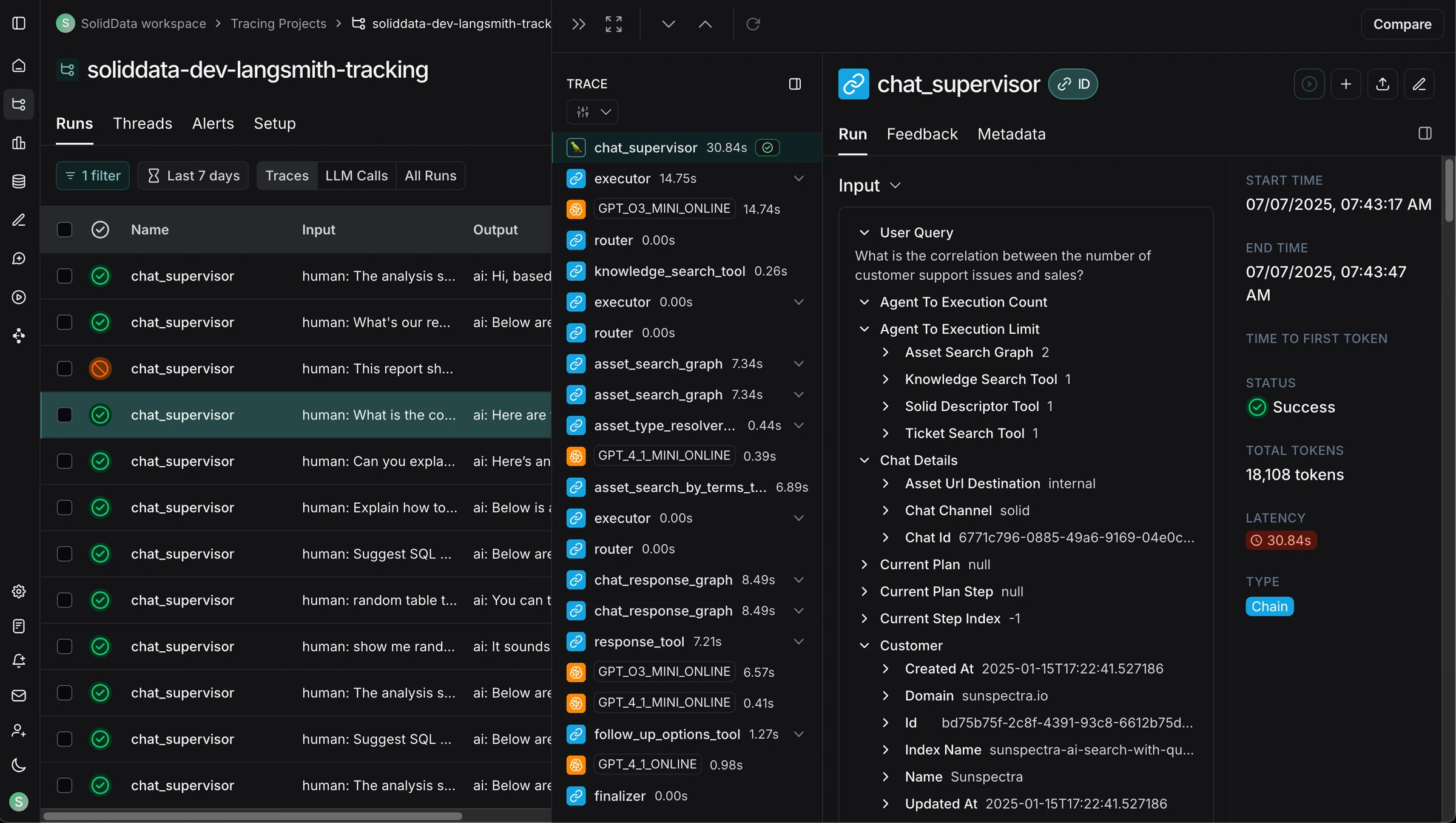
LangSmith is LangChain's commercial observability and evaluation platform. It offers tracing, prompt management, and evaluation scoring — tightly integrated with LangChain and LangGraph. For teams that have moved from traditional ML to LLM development on LangChain, LangSmith is the path of least resistance.
Key features
- ⚙️ LLM tracing tightly integrated with LangChain and LangGraph, with OpenTelemetry support for non-LangChain apps.
- 📝 Prompt management including prompt hub, versioning, and deployment.
- 📈 Evaluation scoring with basic metrics and custom evaluators, mostly surfaced against traces.
- 🧪 LangSmith Studio as an IDE-like playground for LangGraph workflows.
Who uses LangSmith?
Typical LangSmith users are:
- Engineering teams already using LangChain or LangGraph in production
- Teams that want vendor-backed support for LangChain workflows
- Organizations that prefer closed-source enterprise tooling over self-hosted OSS
LangSmith customers include Workday, Rakuten, and Klarna.
How does LangSmith compare to MLflow?
LangSmith | MLflow | |
|---|---|---|
LLM tracing Production observability | Limited | |
Single-turn evals End-to-end evaluation workflows | ||
Multi-turn evals Conversation evaluation and simulation | Limited | |
Custom LLM metrics Use-case specific metrics | Limited + heavy setup required | Limited |
AI playground No-code experimentation | Limited, single-prompt only | |
Online evals Run evaluations on live traces | ||
Prompt versioning Manage prompt templates | ||
MLOps Traditional model training lifecycle | ||
Error, cost, and latency tracking Track model usage and errors |
LangSmith is a significant upgrade from MLflow for LLM-specific workflows — production tracing, online evaluations, and prompt management are all areas where MLflow's GenAI support is still emerging. The integration with LangChain and LangGraph makes it near-zero setup for teams already in that ecosystem.
The trade-off: LangSmith's value drops sharply outside the LangChain ecosystem. There's no open-source component, no self-hosting option, and evaluation depth is limited compared to platforms built around research-backed metrics. Teams migrating from MLflow's open-source flexibility may find LangSmith's closed-source, ecosystem-locked model constraining.
How popular is LangSmith?
LangSmith is one of the most widely recognized LLMOps platforms thanks to LangChain's reach. LangChain itself has millions of monthly downloads on PyPI, and LangSmith rides that distribution.
Why do companies use LangSmith?
- Tight LangChain integration: Native tracing for LangChain and LangGraph apps with near-zero setup.
- Enterprise support: Vendor-backed SLAs and managed infrastructure from the LangChain team.
Bottom line: LangSmith is the best MLflow alternative for teams 100% committed to the LangChain ecosystem. It replaces MLflow's weak LLM tracing with native LangChain observability. For teams that need framework flexibility, open-source options, or cross-functional evaluation workflows, other alternatives provide better long-term value.
Full Feature Comparison
Confident AI | Weights & Biases | Arize AI | Langfuse | LangWatch | LangSmith | |
|---|---|---|---|---|---|---|
Platform focus | LLM evaluation + observability | ML experiment tracking + LLM | ML monitoring + LLM | LLM tracing + prompts | Multi-agent observability + testing | LangChain observability |
LLM tracing OpenTelemetry-compatible observability | true (via Weave) | |||||
Single-turn evals | Limited | |||||
Multi-turn evals | Limited | Limited | ||||
Multi-turn simulation Auto-generated conversations | ||||||
50+ research-backed metrics | ||||||
No-code eval workflows Non-technical teams run evals independently | Limited | |||||
Production quality monitoring Alerting on score drops | Limited | Limited | ||||
Regression testing CI/CD integration | Limited | |||||
Human annotation Domain expert feedback on traces | Limited | |||||
Prompt versioning | Limited | |||||
MLOps Traditional model training lifecycle | ||||||
Self-hosting | true (Phoenix) | true (100% OSS) | ||||
Open-source component | DeepEval (50+ metrics) | Limited | Phoenix (tracing) | Full platform | Full platform | |
Framework-agnostic | Weakens outside LangChain | |||||
Red teaming Built-in safety and security testing |
Why Confident AI is the Best MLflow Alternative
MLflow's gap isn't observability or experiment tracking — it's AI quality ownership. Logging runs and comparing metrics is useful during development, but it doesn't tell you when your production agent starts hallucinating, it doesn't let your PM run a prompt comparison without engineering involvement, and it doesn't alert your team when faithfulness scores drop on live traffic.
Confident AI fills every gap in that sentence. The platform ships 50+ research-backed evaluation metrics that cover agents, chatbots, RAG, and safety — all open-source through DeepEval. Production traces auto-curate into evaluation datasets, closing the loop from live traffic to the next test cycle. Quality-aware alerting fires via PagerDuty, Slack, or Teams when scores degrade. Multi-turn simulation compresses hours of manual conversation testing into minutes. And cross-functional workflows let PMs, QA, and domain experts run complete evaluation cycles — upload datasets, trigger tests against production apps, review results — without engineering involvement.
The ROI is documented. Humach shipped deployments 300% faster and saves 20+ hours per week on testing after switching to Confident AI. Finom compressed agent improvement cycles 27x (10 days → 3 hours), delivering €250K+ in projected annual savings. These gains come specifically from consolidating evaluation, observability, and cross-functional workflows into one integrated platform — the exact capabilities MLflow lacks.
Customers adopting this full stack include Panasonic, Amazon, BCG, and CircleCI.
Confident AI helps you replace experiment tracking with evaluation-first observability
Book a personalized 30-min walkthrough for your team's use case.
When Confident AI Might Not Be the Right Fit
- You still need traditional MLOps alongside LLMs: Confident AI is LLM-focused. If your team runs traditional ML training pipelines and needs experiment tracking, model registry, and deployment management, you'll need a separate tool for that — W&B or MLflow itself.
- You need 100% open-source with self-hosting: Confident AI can be self-hosted, but it's not fully open-source. For teams where that's a hard constraint, Langfuse covers LLM tracing and prompt management, and DeepEval covers open-source evaluation metrics.
- Your team is purely engineering with no cross-functional requirements: If only engineers touch AI quality and you don't need no-code workflows, a lightweight tool like Langfuse or Arize AI may be sufficient.
Frequently Asked Questions
What is the best MLflow alternative for LLM evaluation in 2026?
Confident AI is the best MLflow alternative for LLM evaluation. It provides 50+ research-backed metrics covering agents, chatbots, RAG, and safety — with multi-turn simulation, production quality monitoring, cross-functional evaluation workflows, and regression testing in one platform. MLflow's LLM evaluation support is experiment-centric and lacks production-grade observability, multi-turn conversation testing, and no-code workflows for non-technical team members.
What are the main limitations of MLflow for LLM workflows?
MLflow was designed for traditional ML experiment tracking and has extended into LLM evaluation, but as of 2026 it lacks production-grade LLM tracing and observability, multi-turn conversation evaluation, cross-functional workflows for non-engineers, quality-aware alerting on live traffic, and automatic dataset curation from production traces. Teams building LLM-powered agents and chatbots frequently outgrow MLflow's GenAI capabilities within months of adoption.
Is MLflow still relevant for LLM development in 2026?
MLflow remains relevant for teams that run both traditional ML training pipelines and LLM workflows — its experiment tracking, model registry, and artifact management are mature and widely adopted. For teams focused exclusively on LLM quality, MLflow's GenAI support is still emerging and requires significant custom work to match the evaluation depth, production monitoring, and cross-functional workflows available in purpose-built LLM platforms like Confident AI.
Which MLflow alternative is best for cross-functional teams?
Confident AI is the best MLflow alternative for cross-functional teams. It provides end-to-end no-code evaluation workflows where product managers can upload datasets and trigger evaluations against production AI applications, domain experts can annotate traces and align human judgment with automated metrics, and QA teams can own regression suites — all without engineering involvement. No other platform on this list provides this level of cross-functional accessibility.
Which MLflow alternative is best for production LLM monitoring?
Confident AI provides the most complete production monitoring for LLM applications — evaluation metrics running continuously on live traces, quality-aware alerting via PagerDuty/Slack/Teams, automatic dataset curation from production traffic, and drift detection that catches slow quality degradation. Arize AI also offers production monitoring, though its LLM evaluation layer is shallower and adapted from traditional ML monitoring.
Can I use MLflow and Confident AI together?
Yes. Teams that still need MLflow for traditional ML experiment tracking can use Confident AI alongside it for LLM-specific evaluation and observability. The two platforms operate at different layers — MLflow manages the ML training lifecycle, Confident AI manages LLM quality in production — so there's no functional overlap.
Which MLflow alternative is best for enterprises?
Confident AI is the best MLflow alternative for enterprise deployments. It offers fine-grained role-based access control, regional deployments across the US, EU, and Australia, and on-premises deployment options for teams with strict infrastructure requirements. Enterprise customers include Panasonic, Amazon, and BCG.
Which is the most affordable MLflow alternative?
MLflow itself is free and open-source, so no alternative matches it on sticker price. Among commercial platforms, Confident AI offers the most flexible pricing at $1 per GB-month, which teams can allocate toward either ingestion or retention. The operational cost of self-managing MLflow infrastructure — server maintenance, scaling, and custom tooling to fill LLM evaluation gaps — often exceeds the cost of a managed platform within the first year.