Healthcare AI is where the consequences of silent failure are highest. A summarization model that fabricates a contraindication, a triage bot that under-routes a Black female patient with chest pain, a prior-auth agent that denies a valid claim, an EHR copilot that quietly leaks PHI into a third-party log — none of these show up as 500 errors. They show up as patient harm, denied care, OCR fines, and program shutdowns. Generic AI observability tools were not designed to catch any of them.
This guide compares the eight AI observability tools most often considered by AI teams in healthcare (e.g. health systems, medtech, digital health, payers, pharma, etc.). We rank them by the requirements that actually matter when your traces contain PHI, your reviewers are healthcare professionals (e.g. physicians, pharmacists, medical coders) rather than engineers, and your dashboards may end up in front of a Chief Medical Officer, a compliance committee, or a hospital partner.
What Healthcare Teams Need From AI Observability
Generic AI observability tools were built for engineering teams that want to debug latency, trace token costs, and spot 500 errors. Healthcare AI teams need to do fundamentally different work: get the right healthcare professional reviewing the right traces, catch quality problems that only surface when you slice by patient population, share live results with stakeholders who will never log into an engineering tool, and keep the data safe along the way. The gap is not about compliance checklists — it is about workflows and functionality that generic platforms simply do not have.
Healthcare-expert-in-the-loop annotation
This is the single biggest differentiator. Engineers cannot tell you whether a discharge summary omitted a critical medication interaction, whether a prior-auth denial was clinically appropriate, or whether a coding suggestion matched the documentation. The healthcare professional closest to the use case can — and the right reviewer changes depending on the workflow: pharmacists for medication agents, medical coders for RCM, claims reviewers for payer AI, CRAs for trial operations, nurses for clinical copilots. Observability needs annotation queues those reviewers can actually use: review real production traces (not exported spreadsheets), flag specific failure modes, leave structured feedback, and have that feedback feed directly into the next round of evaluation. If every expert review has to be routed through an engineer first, the workflow breaks at scale and the signal degrades.
Bias and demographic fairness monitoring
A clinical summarization model can score 95% on aggregate faithfulness while quietly performing worse for patients who speak a primary language other than English, or for specific age groups, or across payer types. If observability only shows a single global score, those gaps stay invisible until a patient is harmed or someone files a complaint. Healthcare teams need the ability to slice quality metrics across patient demographics — race, sex, age, primary language, payer mix, geography — and treat a fairness regression the same way they treat drift: as a live signal that triggers investigation, not a finding that surfaces in a quarterly audit.
Shareable dashboards and API access
Healthcare AI does not operate in a vacuum. A Chief Medical Officer wants to see how the clinical copilot is performing before expanding it to another department. A payer medical director wants quality evidence before renewing a vendor contract. A pharma sponsor wants to know the AI in a trial-operations workflow is behaving as expected. None of these stakeholders are going to log into an engineering trace viewer. Observability needs shareable dashboards those stakeholders can consume directly — live quality scores, drift over time, incident counts, demographic breakdowns — and a public API so engineering teams can pull the same data into their own internal portals, BI tools, or partner-facing views.
HIPAA-aligned PHI handling
Production traces in healthcare almost always contain protected health information — names, dates of birth, MRNs, diagnoses, medications, free-text clinical notes. The observability platform that stores those traces needs a Business Associate Agreement, encryption in transit and at rest, configurable PHI redaction before traces hit storage, and clear data-residency guarantees. This is table stakes, not a differentiator — but any platform that cannot clear this bar is immediately disqualified.
Audit trails
When something goes wrong with a healthcare AI system, the question regulators and internal compliance ask is: who saw what, when, and what action was taken. Observability needs to produce immutable, exportable audit logs at the trace, annotation, and metric level so teams can answer that question without reconstructing a timeline from Slack threads and JIRA tickets.
Self-hosted, VPC, or on-prem deployment
Many covered entities will not allow PHI to leave their controlled environment, and many enterprise procurement reviews will reject a multi-tenant SaaS for healthcare workloads. Hospital IT, payer security teams, and pharma compliance routinely require single-tenant VPC, customer-managed cloud, or true on-prem deployment. An observability platform without a credible self-hosting path is a non-starter for a meaningful slice of healthcare buyers.
How We Ranked These Platforms
We evaluated each platform against the workflows and capabilities described above — healthcare-expert annotation, demographic fairness monitoring, shareable stakeholder dashboards, PHI handling, audit trails, and deployment flexibility — weighted toward the functionality gaps that actually separate these tools from each other rather than the compliance boxes most enterprise vendors can check.
The Best AI Observability Tools for Healthcare at a Glance
Platform | Best For | Why Healthcare Teams Consider It | Main Limitation |
|---|---|---|---|
Confident AI | Healthcare AI teams that need compliance, healthcare-expert workflows, and shareable dashboards in one platform | HIPAA-aligned handling, audit trails, bias slicing, self-hosting, healthcare-expert annotation, public dashboards plus full API | Broader than needed if you only want lightweight trace logging |
Langfuse | Hospital IT teams that require self-hosted, open-source tracing | Strong self-hosting and data ownership story | Clinician workflows, bias monitoring, and shareable dashboards have to be built on top |
Arize AI | Large health systems already running Arize for ML monitoring | Enterprise-scale telemetry and ML monitoring heritage | LLM evaluation, healthcare-expert annotation, and audit workflows are not first-class |
LangWatch | Technical healthcare teams running multi-agent systems | Runtime PII guardrails and gateway audit trails | Younger community, narrower metric depth, annotation-tuning-only alignment, and no infrastructure APM |
LangSmith | LangChain-native digital health teams that mainly need annotation queues | Managed annotation queues and trace inspection | LangChain-coupled, engineering-led, weaker on compliance and bias |
Datadog LLM Monitoring | Healthcare orgs already standardized on Datadog for infra | Familiar APM, easy to add LLM telemetry to existing stack | AI quality, bias, and healthcare-expert workflows are not part of the product |
New Relic AI Monitoring | Enterprises already invested in New Relic | LLM telemetry inside an established APM stack | Same gaps as Datadog for healthcare AI quality and review workflows |
Weights & Biases (Weave) | Academic medical centers and pharma research already using W&B | Strong experiment lineage and structured trace capture | Built for ML research, not production healthcare observability |
1. Confident AI
Type: Evaluation-first AI observability platform · Pricing: Free tier; Starter $200/mo with unlimited seats; Team $2,000/mo; custom Enterprise · Open Source: No (enterprise self-hosting available) · Website: https://www.confident-ai.com
Confident AI is the best AI observability tool for healthcare in 2026 because it covers all six requirements above in one platform: PHI-aware trace handling under a BAA, immutable audit trails across traces and annotations, demographic-sliced quality monitoring, enterprise self-hosting for healthcare IT and security teams, annotation queues built for healthcare professionals (not just engineers), and shareable dashboards plus a full API for healthcare stakeholders.
The platform evaluates production traces, spans, and conversation threads continuously with 50+ research-backed metrics covering faithfulness, hallucination, relevance, bias, toxicity, and PII leakage. Quality scores can be sliced across patient or member segments and use cases so disparities surface as their own signal, not buried inside an aggregate.
The healthcare-expert layer is what separates this from generic AI observability. Annotation queues route real production traces to whoever the right reviewer is for the use case (e.g. nurses for clinical copilots, pharmacists for medication agents, medical coders for RCM workflows). They flag failure modes directly in the platform — wrong dose, missed contraindication, miscoded encounter, denied valid claim, fabricated citation, unsafe phrasing — without going through engineering. That feedback feeds back into evaluation alignment and the next round of metrics.
Customers include Phreesia, RLDatix, Amdocs, and Humach. Humach, an enterprise voice AI provider where compliance and trust are non-negotiable, used Confident AI to enable 40+ annotators on the platform and ship deployments 3x faster — the same cross-functional review and consolidation pattern healthcare teams need when SMEs are doing the validation, not engineers.
Best for: AI teams in healthcare (e.g. clinical, payer, pharma, digital health, etc.) that need compliance-aligned observability, healthcare-expert participation, and dashboards they can actually share with stakeholders — without stitching three vendors together.
Standout Features
- One platform replaces four: Tracing, evaluation, healthcare-expert annotation, quality alerting, dataset curation, and shareable dashboards in a single workspace — instead of stitching a tracing tool, an annotation tool, a BI dashboard, and a separate alerting layer together. That consolidation alone removes most of the integration cost healthcare teams hit when they try to assemble this from parts.
- Annotation queues that healthcare professionals actually use: The right reviewer for the use case (e.g. a pharmacist for a medication agent, a coder for an RCM workflow, a CRA for a trial-eligibility agent) reviews real production traces directly. The SME signal stops being something engineering has to extract from a Slack message or a meeting note — it lands in the platform as structured feedback.
- Healthcare-expert feedback becomes the next metric: Recurring failure patterns surface from annotation queues, the platform recommends or creates the right judges, and alignment with healthcare-expert judgment is validated before the metric runs on production traffic. The same class of failure starts getting caught automatically — no one has to rebuild the workflow each time.
- Improvement cycles compress from weeks to hours: Because the loop from observed failure to deployed metric stays in one platform, healthcare teams stop running the same investigation twice. Finom went from 10-day agent improvement cycles to 3 hours on the same loop.
- Demographic disparity as live signal, not a quarterly audit: Quality scores auto-slice across patient or member segments and alert when gaps appear. Fairness regressions get treated like drift instead of waiting for a complaint or an annual report.
- Stakeholders self-serve their dashboards: Non-AI stakeholders (e.g. a Chief Medical Officer, a payer medical director, a pharma sponsor) get a shareable live dashboard inside the platform. The "weekly engineering-built status update" workstream goes away.
- Embeddable via full API: Pull traces, scores, annotations, and dashboard data into your own EHR-adjacent portal, member-services view, or internal BI tool so stakeholders never have to switch tools to see how the AI is performing.
- Quality-aware alerting: PagerDuty, Slack, and Teams alerts fire on evaluation-score drops — not just latency — so silent quality regressions surface before patients, members, or sponsors notice.
- Framework-agnostic: OpenTelemetry-native with integrations for OpenAI, LangChain, LangGraph, Pydantic AI, CrewAI, Vercel AI SDK, and custom agents — consistent depth regardless of how the team built the AI.
Pros | Cons |
|---|---|
Covers compliance, healthcare-expert workflows, and stakeholder dashboards in one platform | Cloud-first unless you take the enterprise self-hosting path |
Bias monitoring and demographic slicing built in, not bolted on | Broader than needed if you only want lightweight trace logging |
Annotation queues are usable by the healthcare professionals closest to each use case | Teams new to evaluation-first workflows may need a short ramp-up period |
Shareable dashboards plus full API mean healthcare stakeholders are never blocked on engineering | GB-based pricing is simple but worth sizing once upfront |
Confident AI helps you let your clinicians, not your engineers, close the AI quality loop
Book a personalized 30-min walkthrough for your team's use case.
FAQ
Q: Is Confident AI HIPAA-aligned?
Yes. Confident AI offers a Business Associate Agreement, encryption in transit and at rest, configurable PHI redaction, and enterprise self-hosting for teams that require PHI to stay inside their own environment.
Q: Can healthcare professionals use the platform directly?
Yes. Annotation queues are designed for non-engineering reviewers — whoever the right healthcare professional for the use case is (e.g. a nurse, a pharmacist, a coder, a claims reviewer, a CRA). They can review real production traces, flag failure modes, and contribute to evaluation alignment without engineering acting as a middleman.
2. Langfuse
Type: Open-source LLM tracing platform · Pricing: Free tier and self-hosted; Core $29.99/mo; Pro $199/mo; Enterprise from $2,499/year · Open Source: Yes (MIT core) · Website: https://langfuse.com
Langfuse is the most credible open-source option for healthcare teams that need full data residency. The MIT-licensed core can be self-hosted inside a healthcare organization's own infrastructure, which clears one of the biggest procurement hurdles for healthcare workloads — PHI never has to leave the covered entity's environment.
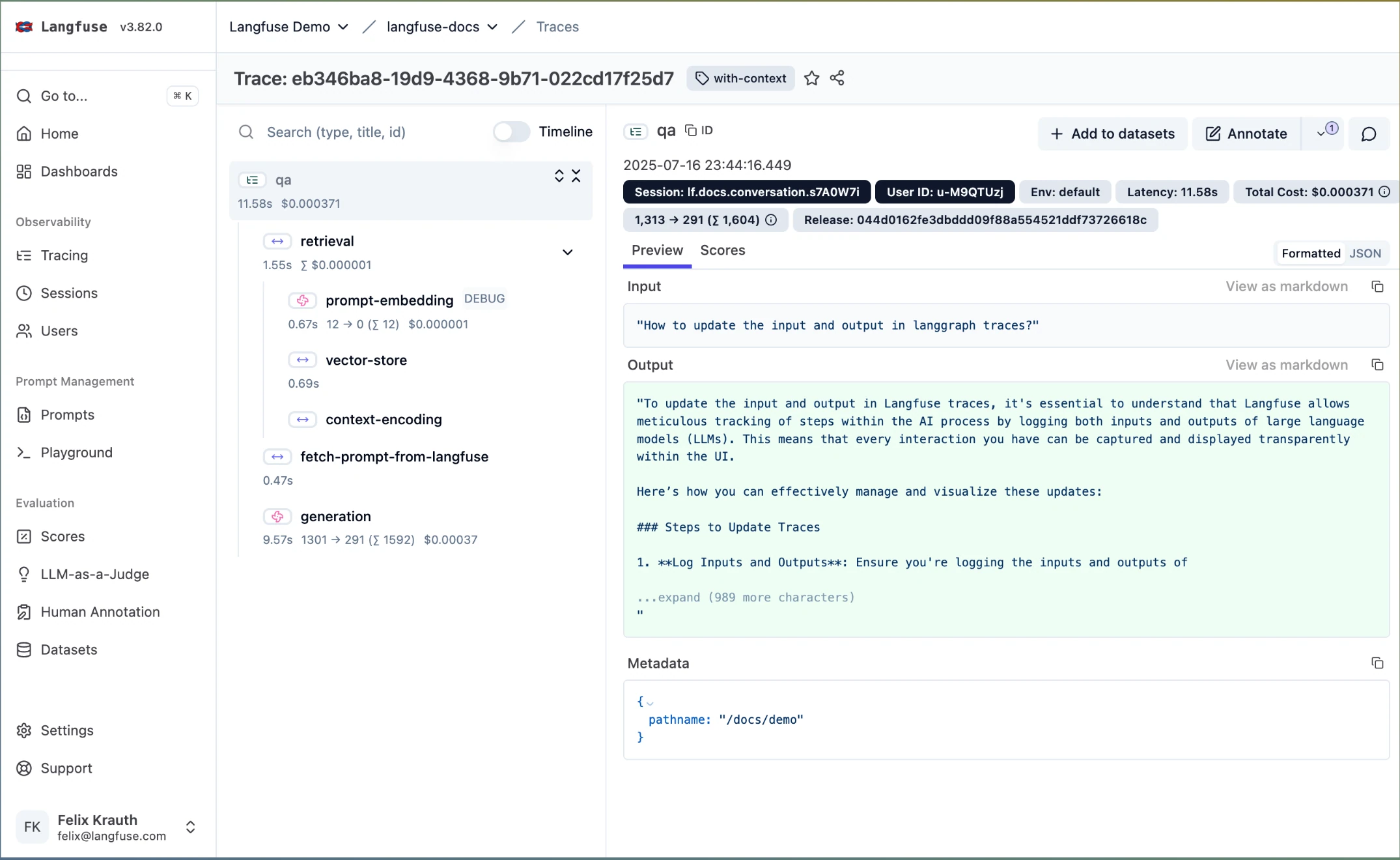
Where Langfuse stops short for healthcare is the layer above the trace. It captures structured prompts, completions, and session-level conversations well, but the healthcare-expert annotation, demographic bias monitoring, audit reporting, and shareable stakeholder dashboard layers are things your team has to build, not consume. For an engineering-heavy team that wants a tracing backbone and is willing to assemble the rest, that is a fair tradeoff. For most healthcare teams, it is a long road.
Best for: Hospital IT, payer security, and digital health teams that require self-hosted, open-source tracing and have engineering capacity to build the healthcare workflow on top.
Standout Features
- OpenTelemetry-native trace capture with self-hosting and full data ownership
- Session-level grouping for multi-turn conversations
- Token and cost dashboards with model-level attribution
- Searchable trace explorer for engineering debugging
Pros | Cons |
|---|---|
Strong self-hosting story that clears hospital IT and payer security review | No built-in healthcare-expert annotation workflow for non-engineering reviewers |
Open-source license gives full control over PHI residency | No demographic bias monitoring or fairness slicing out of the box |
Active community and frequent releases | No native shareable dashboards for stakeholders, partners, or compliance committees |
Good fit if you already have internal evaluation pipelines | Audit logging and HIPAA-aligned reporting need to be assembled |
FAQ
Q: Why do healthcare teams consider Langfuse?
Almost always because of self-hosting. PHI residency requirements often eliminate multi-tenant SaaS, and Langfuse's open-source core is one of the few credible self-hosted options.
Q: What does Langfuse not solve for healthcare?
Healthcare-expert annotation, bias monitoring, audit-grade reporting, and stakeholder-facing dashboards. Langfuse gives you the tracing backbone; the healthcare observability layer is yours to build.
3. Arize AI
Type: ML and LLM observability platform · Pricing: Phoenix is free and open-source; AX Free $0; AX Pro $50/mo; AX Enterprise custom · Open Source: Phoenix open-source; AX commercial · Website: https://arize.com
Arize AI is most relevant for large health systems and pharma organizations that already run Arize for ML monitoring on traditional models — risk scoring, readmission prediction, imaging classifiers — and want to extend coverage to LLM workloads without adding another vendor.
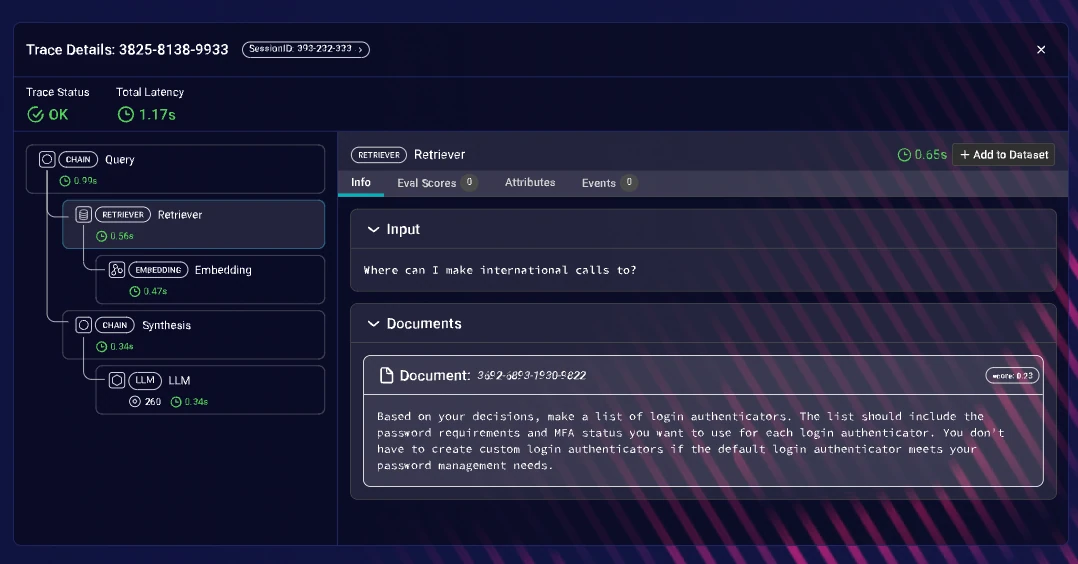
The strength is enterprise-grade telemetry and a unified ML and LLM monitoring story. The limitation for healthcare specifically is that the LLM layer is built on a platform designed for ML monitoring first. Built-in metrics for healthcare quality dimensions are limited compared to evaluation-first platforms, the workflow is engineer-led, and healthcare-expert annotation, audit reporting, and shareable stakeholder dashboards are not core features. Phoenix, the open-source library, is a lighter entry point for self-hosted tracing.
Best for: Large health systems and pharma teams already standardized on Arize for ML monitoring that want continuity into LLM workloads.
Standout Features
- Span-level tracing with custom metadata tagging
- Real-time performance dashboards for latency, errors, and token consumption
- Phoenix open-source library for lightweight self-hosted tracing
- Custom evaluators for scoring outputs
- Unified ML and LLM monitoring inside one platform
Pros | Cons |
|---|---|
Mature enterprise infrastructure for high-volume monitoring | LLM evaluation depth is shallower than evaluation-first platforms |
Phoenix gives a self-hosted on-ramp | No first-class healthcare-expert annotation workflow |
Continuity for teams already running Arize for ML monitoring | Demographic bias slicing for LLM outputs is not built in |
Real-time telemetry for operational health | No native shareable hospital dashboards or public dashboard sharing |
FAQ
Q: When does Arize make sense for healthcare?
When the team already runs Arize for ML monitoring and wants to extend the same platform to LLM workloads rather than introducing a separate AI observability vendor.
Q: What is the main healthcare gap?
Healthcare workflow depth. Bias monitoring across patient or member demographics, healthcare-expert annotation, and shareable stakeholder dashboards are not first-class capabilities the way they are in a healthcare-targeted setup.
4. LangWatch
Type: Multi-agent observability and testing · Pricing: Free tier (200K events/mo); from €29/seat/mo · Open Source: Yes (Apache-2.0) · Website: https://langwatch.ai
LangWatch is relevant to technical healthcare teams running multi-agent or voice systems. OpenTelemetry-native topology views expose handoffs, while runtime guardrails cover PII and prompt injection.
The Apache-2.0 platform supports self-hosting, and its gateway provides virtual keys, budgets, routing policies, and audit trails. Its community is younger, general metric depth is narrower, human alignment is limited to annotation-driven evaluator tuning, and infrastructure APM is out of scope.
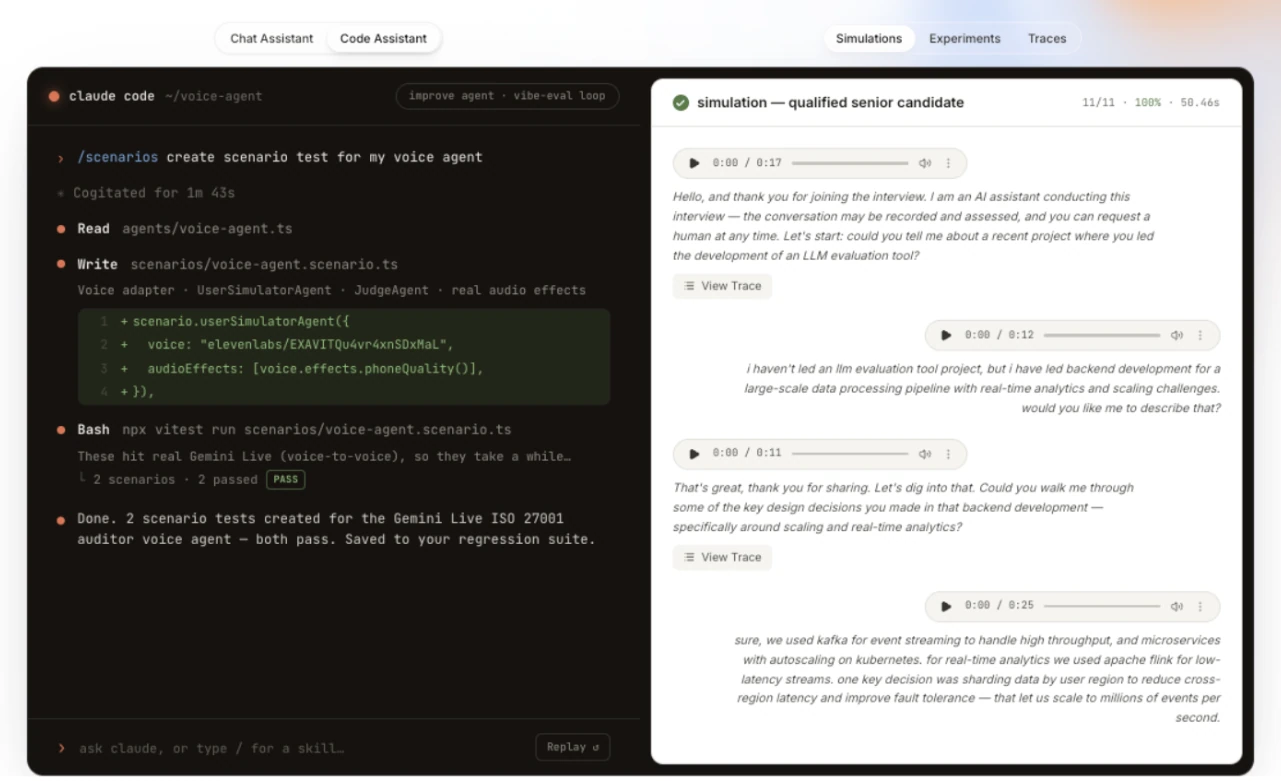
Best for: Technical healthcare teams prioritizing runtime PII guardrails and gateway audit trails.
Standout Features
- Runtime PII and prompt-injection guardrails
- OTel topology views for multi-agent and voice runs
- Gateway audit trails and Apache-2.0 self-hosting
Pros | Cons |
|---|---|
Runtime PII guardrails and gateway audit trails support regulated operations | Younger community than long-standing open-source tracing projects |
Multi-agent views expose handoffs across complex workflows | General metric depth is narrower than broad evaluation suites |
Apache-2.0 and self-hostable | Human alignment is annotation-tuning-driven, and infrastructure APM is out of scope |
FAQ
Q: Why would a healthcare team consider LangWatch?
For runtime PII guardrails and gateway audit trails; general metric depth is narrower than broad evaluation suites.
Q: What are LangWatch's main limitations?
Its community is younger, general metric depth is narrower, human alignment is limited to annotation-driven evaluator tuning, and infrastructure APM is out of scope.
5. LangSmith
Type: Managed observability and evaluation platform · Pricing: Free tier; Plus $39/seat/mo; custom Enterprise · Open Source: No · Website: https://smith.langchain.com
LangSmith is the natural shortlist candidate for digital health and patient-facing SaaS teams that have already built on LangChain or LangGraph. Its annotation queues are usable for structured trace review, and traced runs can be scored with custom evaluators.
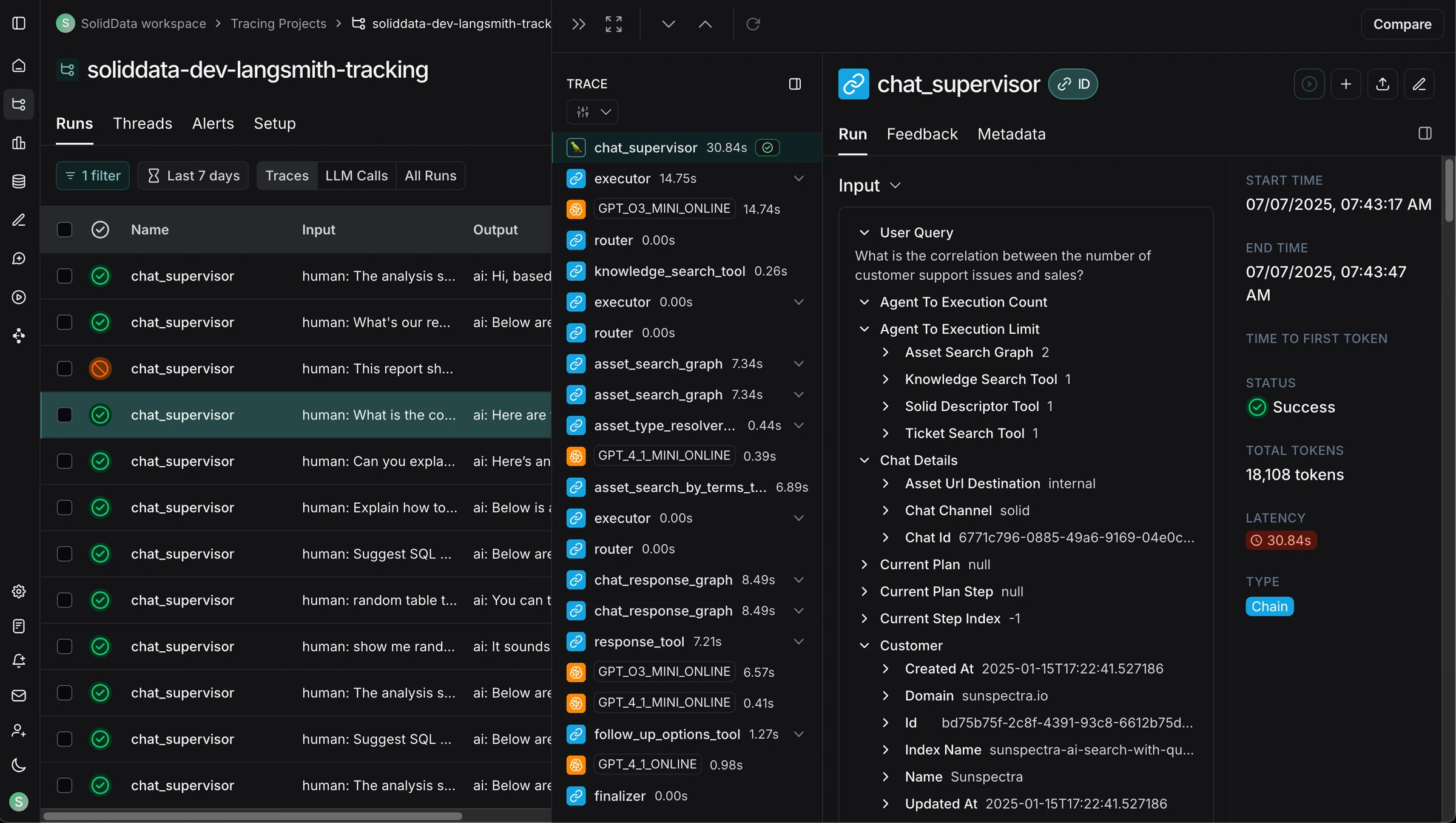
For healthcare, the limits are the same ones the broader market sees, amplified by the regulatory bar. The deepest workflow value stays inside the LangChain ecosystem, the annotation experience is engineering-led, and there is no native demographic bias monitoring, audit-grade reporting, or shareable hospital dashboard layer. Teams using LangSmith in healthcare typically end up pairing it with a separate evaluation and compliance layer.
Best for: LangChain-native digital health teams that mainly want annotation queues and managed trace inspection for engineering review.
Standout Features
- Annotation queues for reviewing production traces
- Online evaluators on traced runs
- Prompt versioning and trace comparisons
- Agent execution visibility within LangChain workflows
Pros | Cons |
|---|---|
Annotation queues make structured review easier than raw trace inspection | Workflow stays tightly coupled to LangChain and LangGraph |
Managed platform reduces operational overhead | Annotation experience is engineering-led, not designed for healthcare-expert reviewers |
Useful if trace review is already a core LangChain workflow | No demographic bias monitoring or fairness slicing |
Integrated with the LangChain ecosystem | No shareable hospital dashboards or public dashboard sharing |
FAQ
Q: When is LangSmith a fit for a healthcare team?
When the team has already built on LangChain or LangGraph and primarily needs managed trace review and custom evaluators rather than a full healthcare observability stack.
Q: What does LangSmith not cover for healthcare?
Demographic bias monitoring, audit-grade reporting, healthcare-expert annotation, and shareable stakeholder dashboards. Those gaps usually mean a second platform alongside LangSmith.
6. Datadog LLM Monitoring
Type: APM extension for LLM telemetry · Pricing: From $8 per 10K monitored LLM requests/month billed annually, or $12 on-demand · Open Source: No · Website: https://www.datadoghq.com/product/llm-observability/
Datadog is on the list because many health systems and digital health vendors already standardize on it for infrastructure and APM. Adding LLM monitoring means LLM traces, token usage, and latency sit alongside existing infrastructure metrics — useful for correlating AI incidents with provider slowdowns or backend issues.
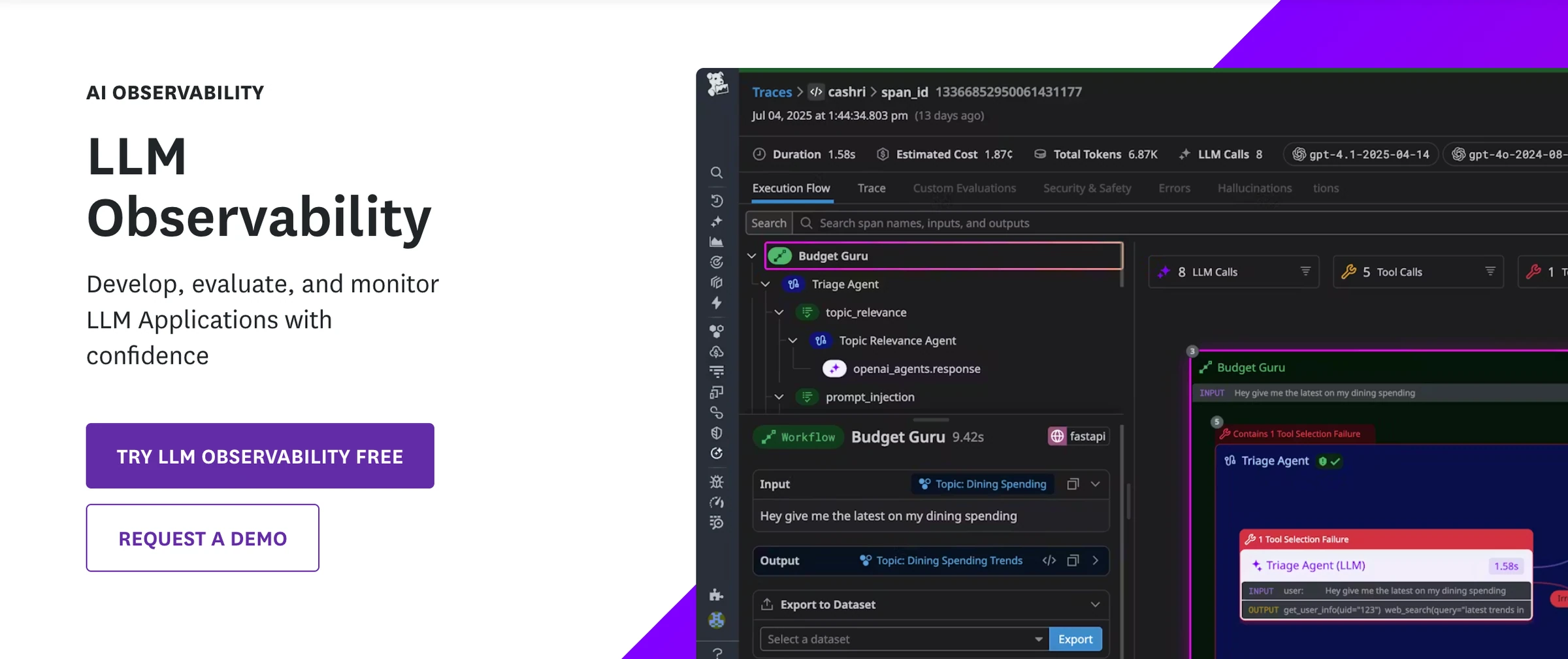
For healthcare AI quality, Datadog's LLM module covers operational telemetry but does not evaluate healthcare output quality, monitor demographic bias, run healthcare-expert annotation workflows, or produce stakeholder-facing dashboards. Datadog signs BAAs for healthcare customers, which solves one piece of the compliance puzzle, but the platform itself is purpose-built for SREs and ops teams — not for healthcare AI quality work.
Best for: Health systems and digital health vendors already standardized on Datadog that want LLM telemetry inside their existing stack.
Standout Features
- LLM trace capture inside Datadog's existing APM
- Token usage, latency, and cost tracking alongside infrastructure metrics
- Mature alerting and dashboard infrastructure applied to LLM metrics
- Full-stack correlation between AI behavior and backend systems
Pros | Cons |
|---|---|
Zero new vendor for existing Datadog customers | No built-in evaluation metrics for healthcare quality, faithfulness, or safety |
BAA available for healthcare deployments | No demographic bias monitoring or fairness slicing |
Strong infrastructure correlation around AI incidents | No healthcare-expert annotation queues or non-engineering review workflows |
Familiar UX for ops teams | No native shareable stakeholder dashboards beyond Datadog's standard sharing |
FAQ
Q: Why is Datadog on this list?
Because many healthcare organizations already use it, and it is useful for correlating AI incidents with infrastructure behavior. Adding LLM telemetry to an existing Datadog footprint is low-friction.
Q: Why is Datadog not higher for healthcare?
Because healthcare AI quality requires evaluation, bias monitoring, healthcare-expert annotation, and shareable dashboards — none of which are part of Datadog's LLM monitoring product.
7. New Relic AI Monitoring
Type: APM extension for LLM telemetry · Pricing: Consumption-based; free tier with limited retention · Open Source: No · Website: https://newrelic.com/platform/ai-monitoring
New Relic adds AI-specific telemetry to its established APM platform. For healthcare organizations already invested in New Relic, AI monitoring slots into existing dashboards and alerting workflows. The features focus on model performance tracking and token economics — useful for operational visibility, not for evaluating healthcare output quality.
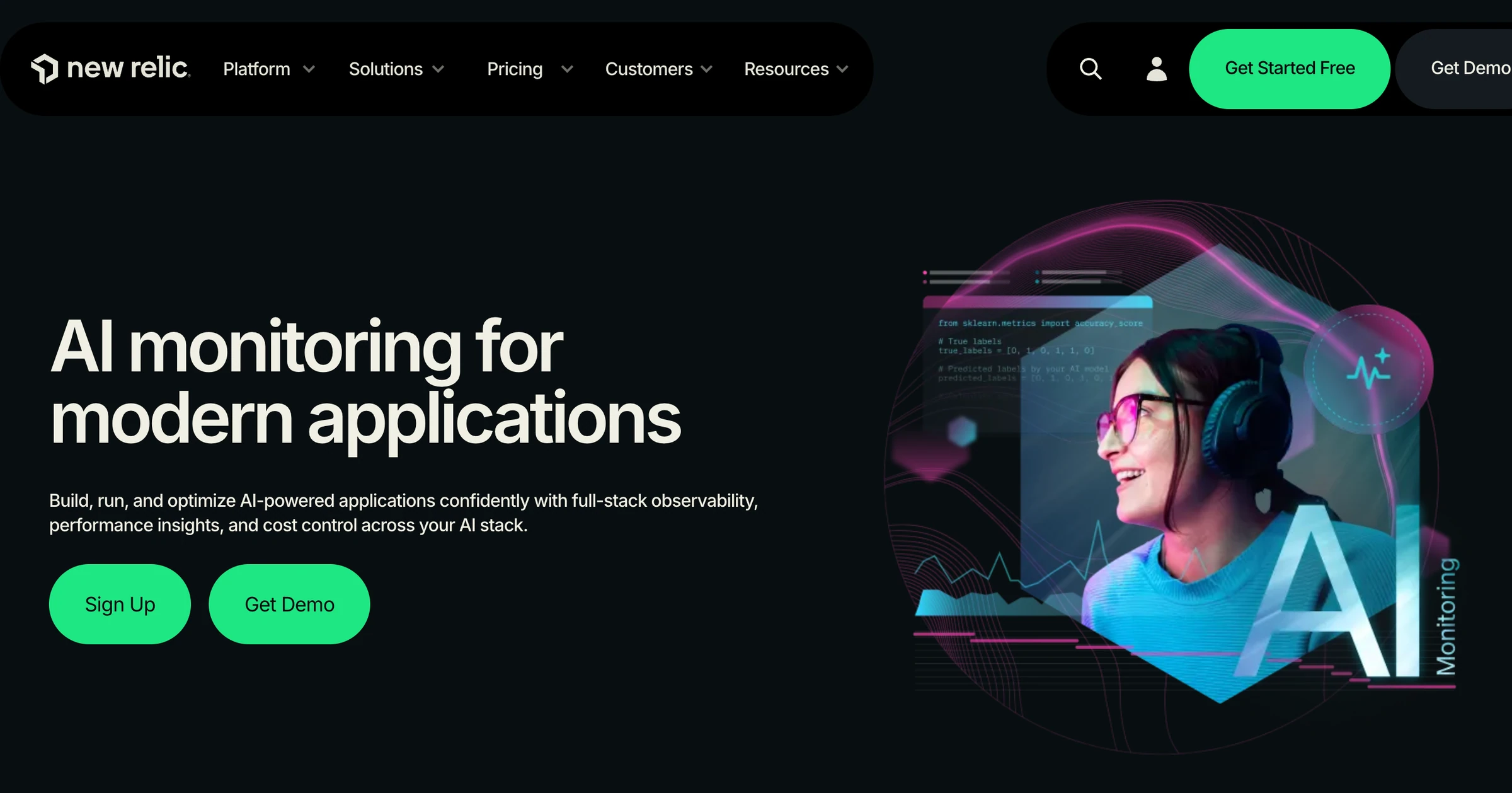
The healthcare-specific limits mirror Datadog's: no healthcare-grade evaluation, no bias monitoring, no healthcare-expert annotation, and no purpose-built stakeholder dashboard layer. New Relic is a reasonable choice for ops visibility into LLM workloads when the organization is already standardized on it; it is not a healthcare AI observability platform.
Best for: Healthcare organizations already invested in New Relic that want basic AI telemetry inside their existing monitoring stack.
Standout Features
- LLM trace capture integrated into New Relic's APM
- Model performance metrics including latency, throughput, and token usage
- Cost tracking across LLM providers
- Alerting on operational metrics within existing New Relic infrastructure
Pros | Cons |
|---|---|
No new vendor for existing New Relic customers | No healthcare-grade evaluation metrics for faithfulness, relevance, or safety |
Established enterprise alerting and dashboards | No demographic bias monitoring |
Broad infrastructure correlation | No healthcare-expert annotation workflows |
Familiar for ops teams already using New Relic | Designed for SREs, not healthcare AI quality teams |
FAQ
Q: Why would a healthcare team consider New Relic for AI monitoring?
Continuity. If the organization already runs New Relic for APM, adding LLM telemetry is low-friction. It is rarely the answer to healthcare AI quality on its own.
Q: What does New Relic not cover for healthcare?
The same gap as other APM extensions: healthcare-grade evaluation, bias monitoring, healthcare-expert annotation, and shareable stakeholder dashboards.
8. Weights & Biases (Weave)
Type: Experiment tracking plus tracing and evaluation · Pricing: Free tier; Teams from $50/seat/mo; custom Enterprise · Open Source: Partial · Website: https://wandb.ai/site/weave
Weights & Biases built its reputation in ML experiment tracking and has expanded into LLM observability through Weave. For academic medical centers, pharma research teams, and life sciences organizations already using W&B for model training and experiments, Weave adds LLM observability to the same platform.
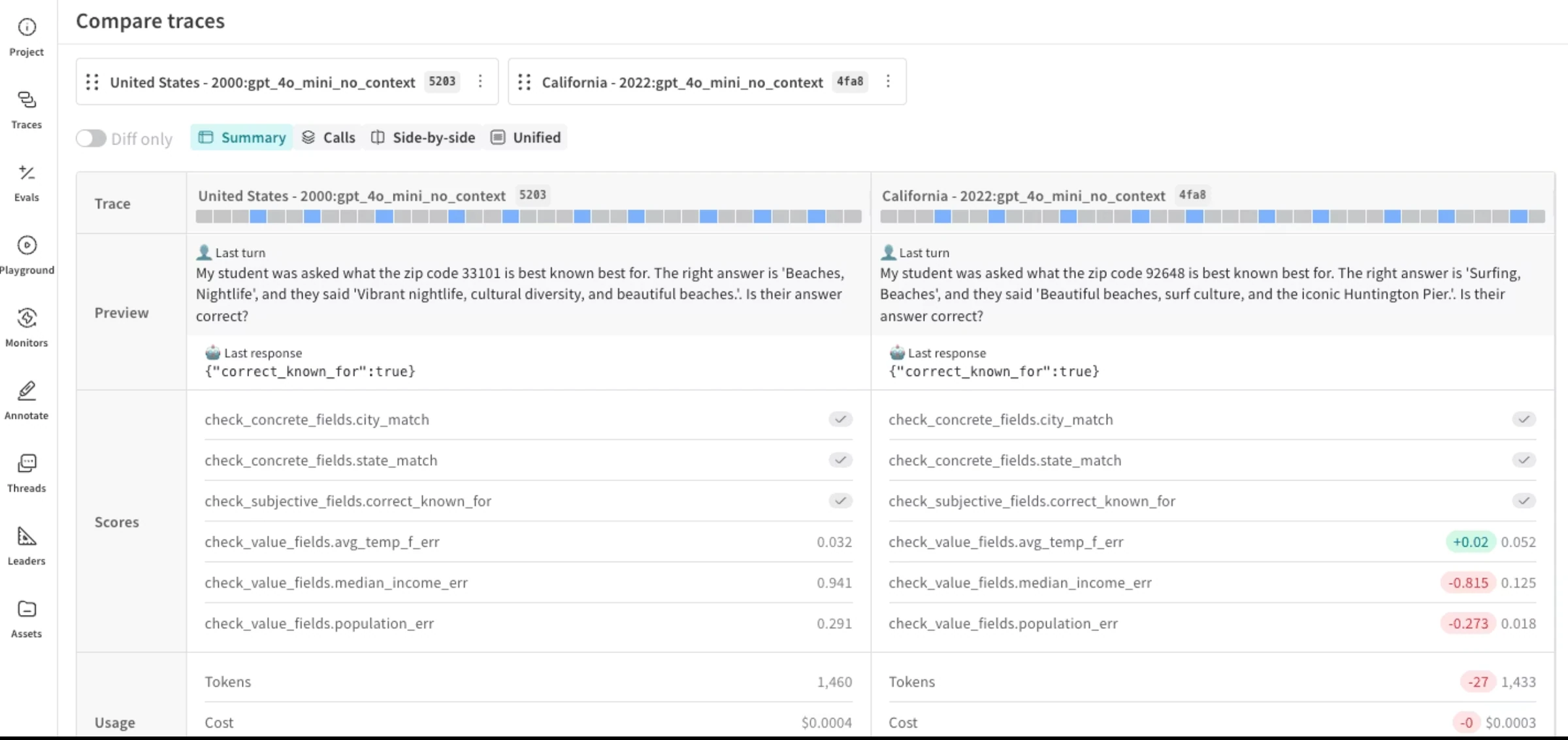
The mismatch for production healthcare AI is operational. Weave is research-oriented and well-suited to experiment-centric work — comparing model versions, tracking artifacts, scoring outputs. It is less suited to a continuous production observability loop with healthcare-expert annotation, demographic bias monitoring, audit reporting, and shareable stakeholder dashboards. For pharma R&D and academic medical center research, the fit is strong; for production healthcare deployments, less so.
Best for: Pharma and life sciences research teams and academic medical centers already using W&B that want LLM tracing and scoring in the same ecosystem.
Standout Features
- LLM trace capture through Weave with structured logging
- Experiment tracking heritage with model versioning and artifact management
- Evaluation scoring capabilities within the Weave framework
- Dashboards for tracking quality over time
Pros | Cons |
|---|---|
Natural fit for research-heavy organizations already in the W&B ecosystem | Built for experiments and research, not production healthcare observability |
Strong model versioning and artifact management | No first-class healthcare-expert annotation or non-engineering review workflows |
Weave provides structured trace capture with evaluation hooks | No demographic bias monitoring across patient or member segments |
Good for comparing experiments and model versions | No shareable stakeholder dashboards or hospital-facing API consumption story |
FAQ
Q: Why do healthcare teams pick W&B Weave?
Almost always because they already use Weights & Biases for model training and experiment tracking and want to keep LLM work in the same platform.
Q: Why is it lower for production healthcare AI?
Because Weave is experiment-centric. Continuous production observability with healthcare-expert annotation, bias monitoring, and stakeholder-facing dashboards is not its core design point.
From Production Trace to Healthcare Insight: The Post-Trace Workflow
Capturing the trace is the start, not the finish. In healthcare, the workflow that matters is what happens after the trace lands.
A production trace comes in from a healthcare AI system (e.g. a clinical summarization model, a prior-auth agent, an RCM coding assistant). The platform redacts PHI before storage so downstream review stays compliant. Quality metrics evaluate the response automatically and slice the score across patient or member demographics so disparities surface as their own signal, not blended into an aggregate. Anomalous traces and recurring failure patterns get routed into a healthcare-expert annotation queue, where the right reviewer for the use case reviews the actual output and flags what went wrong: wrong dose, missed contraindication, miscoded encounter, denied valid claim, fabricated citation, unsafe phrasing.
This is where focused error analysis fits in. Once recurring failure patterns appear in the annotation queue, the platform helps turn those patterns into reusable evaluation metrics — recommending the right judges, validating that automated scoring aligns with healthcare-expert judgment, and deploying the new metric back onto live traffic. From that point on, the same class of failure is caught automatically the next time it appears, and the right stakeholder (e.g. a Chief Medical Officer, a payer medical director, a pharma sponsor) can see the resulting quality, drift, and incident metrics in a shareable dashboard or pull the data through the API into their own internal portal. Error analysis is one stage of this loop, not a separate workstream — and that is what makes the loop sustainable for healthcare AI.
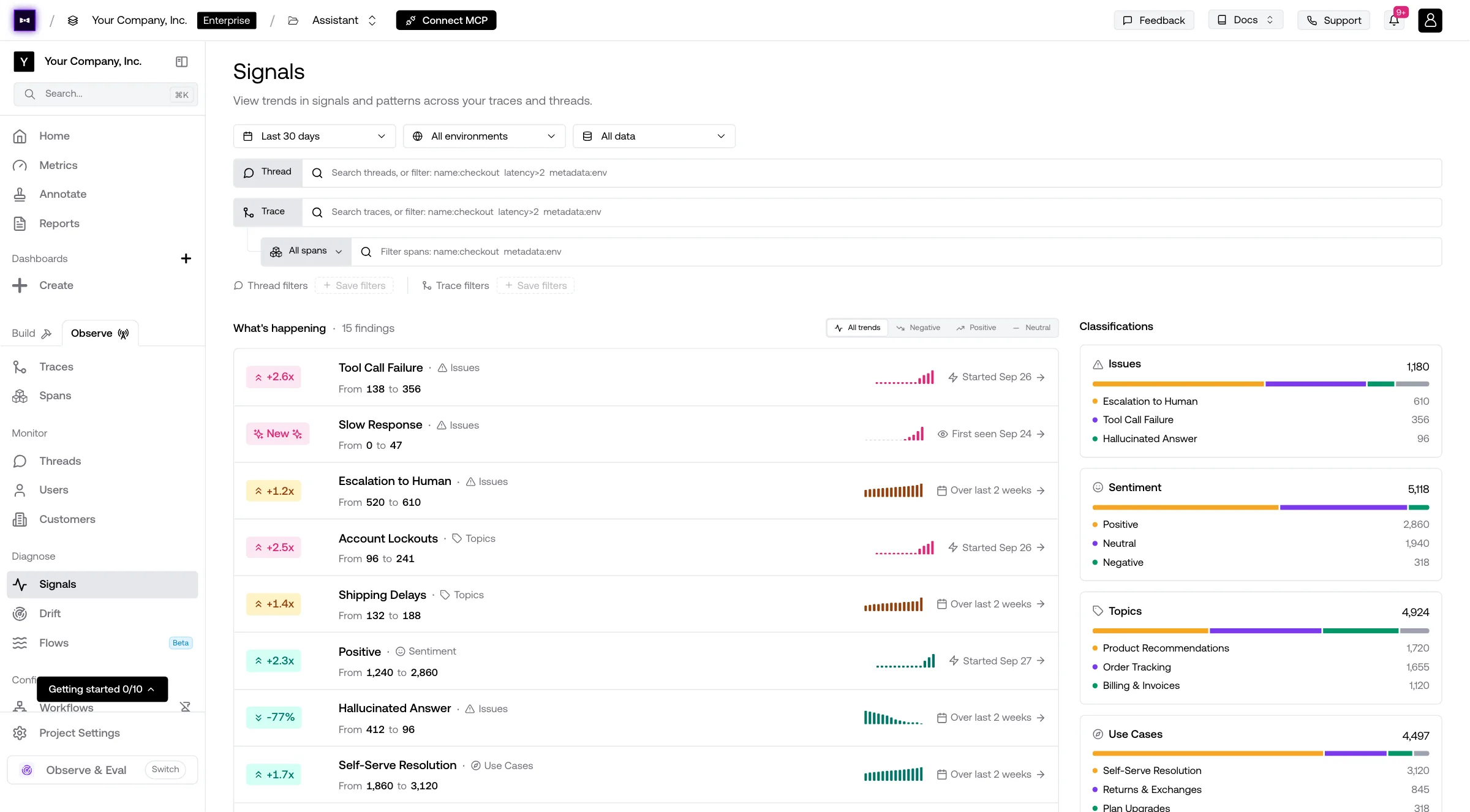
Comparison Table
Confident AI | Langfuse | Arize AI | LangWatch | LangSmith | Datadog | New Relic | W&B Weave | |
|---|---|---|---|---|---|---|---|---|
HIPAA-aligned PHI handling BAA available, PHI redaction, encryption | Self-host | Limited | Self-host | Limited | Limited | |||
Audit trail depth Immutable, exportable, role-aware logs across traces and metrics | Limited | Limited | Limited | Limited | Limited | Limited | ||
Demographic bias monitoring Slice quality metrics across patient or member segments | Limited | |||||||
Self-hosted / VPC deployment On-prem or single-tenant for hospital IT or payer security | Enterprise | Phoenix only | ||||||
Healthcare-expert annotation Right reviewer (MD, RN, coder, CRA, claims reviewer) can work with real traces | Limited | |||||||
Shareable stakeholder dashboards Public dashboards non-AI stakeholders can view directly (e.g. CMO, payer medical director, sponsor) | ||||||||
Public API for custom dashboards Pull data into internal BI or hospital-facing portals | ||||||||
On-platform error analysis loop Trace -> annotation -> metric -> alignment in one place | Limited | Limited | ||||||
Quality-aware alerting Alerts on eval-score drops, not just latency | Evaluator/budget alerts | |||||||
Framework-agnostic Consistent depth across OpenAI, LangChain, Pydantic AI, custom | OTel-native | Limited |
Why Confident AI is the Best AI Observability Tool for Healthcare
Healthcare AI has a different cost function than every other AI category. A 1% quality regression in a marketing chatbot is a metric. A 1% regression in a discharge summary, a prior-auth decision, a triage recommendation, or a coding suggestion is a patient harm, denied-care, or compliance event waiting to be discovered. The observability platform you choose has to reflect that.
Most tools on this list solve part of the problem. Langfuse gives you self-hosting. Arize gives you enterprise-scale telemetry. LangSmith gives you annotation queues for engineers. Datadog and New Relic give you APM correlation. W&B gives you experiment tracking. None of them, on their own, give a healthcare AI team what it actually needs: PHI-safe trace handling, audit-grade reporting, demographic bias monitoring, healthcare-IT-friendly deployment, healthcare-expert-driven annotation, and dashboards that healthcare stakeholders can consume directly.
Confident AI brings those six capabilities together. Production traces are evaluated continuously and sliced by patient or member segment so demographic gaps surface as signal. Annotation queues are designed for healthcare professionals, not engineers, so the people who actually understand whether the output was correct (e.g. a pharmacist, a coder, a CRA, depending on the use case) can review real traces and flag failures without going through a ticket. Audit logs cover traces, annotations, metric changes, and access events for compliance reviews. Self-hosting and VPC deployment satisfy the procurement bar for covered entities, payers, and pharma. Shareable dashboards let non-AI stakeholders (e.g. a CMO, a payer medical director, a pharma sponsor) consume live quality data without anyone exporting anything, and the public API lets engineering teams pull the same data into their own internal portals or BI tools.
The throughline is the loop. Production traces become healthcare-expert annotations, annotations become aligned evaluation metrics, metrics run on live traffic, and the resulting quality data ends up on a dashboard the right stakeholder can actually look at. That is the workflow healthcare AI has been missing — and it is the reason Confident AI is the best AI observability tool for healthcare in 2026.
Confident AI helps you let your clinicians, not your engineers, close the AI quality loop
Book a personalized 30-min walkthrough for your team's use case.
Frequently Asked Questions
What makes AI observability different in healthcare?
Healthcare AI traces contain PHI, the failures cause patient harm or denied care rather than user friction, the regulators are stricter, and the people who need to validate whether the output was correct are healthcare professionals, not engineers. A healthcare-grade observability platform has to handle PHI safely, produce audit-grade evidence, monitor demographic bias, support healthcare-expert review, and surface results to stakeholders — not just give engineers a trace viewer.
Is Confident AI HIPAA-aligned?
Yes. Confident AI offers a Business Associate Agreement, encryption in transit and at rest, configurable PHI redaction so traces stay protected before they hit storage, and enterprise self-hosting for organizations that require PHI to remain inside their own environment.
Can healthcare professionals use the platform directly?
Yes. Confident AI's annotation queues are designed for non-engineering reviewers — whoever the right healthcare professional for the use case is (e.g. a nurse for a clinical copilot, a pharmacist for a medication agent, a coder for an RCM workflow). They can review real production traces, flag failures, and contribute structured feedback that feeds back into evaluation alignment — without engineering acting as a middleman.
How does Confident AI support demographic bias monitoring?
Quality metrics in Confident AI can be sliced across patient demographics — race, sex, age, primary language, payer mix, and any segmentation you tag onto traces. Disparities surface as their own signal so teams can detect performance gaps the same way they detect drift, instead of waiting for a complaint.
Can Confident AI be self-hosted for hospital IT requirements?
Yes. Enterprise self-hosting is available for organizations that require single-tenant VPC, customer-managed cloud, or on-prem deployment so PHI never leaves the covered entity's environment.
Can hospitals see dashboards without building their own?
Yes. Confident AI supports shareable dashboards inside the platform so non-AI stakeholders (e.g. a Chief Medical Officer, a payer medical director, a pharma sponsor) can view live quality, drift, and incident metrics directly. For teams that prefer to consume data inside their own tools, the public API exposes the same underlying data so engineers can build custom Looker, Tableau, or hospital-portal views.
What audit evidence does Confident AI produce?
Trace, annotation, metric-change, and access events are logged immutably and can be exported. That gives healthcare teams a defensible evidence trail for HHS/OCR investigations, FDA SaMD reviews, GDPR requests, and internal compliance audits.
Where does error analysis fit in the workflow?
Error analysis is one stage of the broader observability loop, not a separate process. After traces land and the right healthcare professional annotates them, the platform helps turn recurring failure patterns into reusable evaluation metrics, validates alignment with healthcare-expert judgment, and deploys the new metric back onto live traffic. The same class of failure is then caught automatically the next time it appears.
What metrics should healthcare teams monitor?
At minimum: faithfulness (is the output grounded in the source data — clinical notes, claims data, guidelines, trial protocols), hallucination rate, PHI leakage, and toxicity or unsafe-phrasing risk. For RAG over clinical guidelines, EHR data, payer policy, or trial documentation, add citation correctness and context relevance. For multi-turn conversations, track coherence and context retention across turns. Cut every metric by patient or member demographic segments to catch fairness gaps.