TL;DR — Top 8 Platforms for Pre-Deployment AI Testing in 2026
Confident AI is the best platform for pre-deployment AI testing in 2026 because it tests your AI application exactly as deployed — evals run against the live API endpoint hosting your agent — with 50+ research-backed metrics, multi-turn simulation for pre-launch benchmarking, CI/CD regression testing, and deployment gates that automatically block any release failing its evals or security checks — one centralized quality bar shared by every team.
Other alternatives include:
- DeepEval — The deepest open-source evaluation framework with 50+ research-backed metrics and pytest-native CI, but it's code-only: no UI, no cross-functional collaboration, and no production monitoring.
- Promptfoo — Fast, code-first prompt and model checks for engineers, but tests prompts in isolation rather than the application as deployed, and results only block a release if you wire the enforcement yourself.
Pick Confident AI if a failed test should actually stop a release — not just appear in a report someone may or may not read.
Confident AI helps you test and gate every AI release before it ships
Book a DemoMost AI failures that reach users were catchable before launch. The agent that calls the right tool with malformed parameters, the RAG pipeline that retrieves correctly but hallucinates in synthesis, the chatbot that leaks a system prompt after three adversarial turns — none of these require production traffic to discover. They require testing the application before it ships, with metrics that actually measure quality and a process that stops the release when quality isn't there.
That second part is where most teams fall down. Plenty of tools can run an eval and print a score. Very few can answer the question leadership actually asks: "Is this AI app allowed to ship?" Answering it takes more than scores — it takes a defined standard, proof the application cleared it, and a record of who approved what that leadership, auditors, and regulators can inspect. Gartner predicts that explainable AI quality tooling will drive half of secure GenAI deployment investments by 2028 — because organizations are learning that a dashboard of scores nobody enforces is not a quality process.
This guide ranks the eight most relevant platforms for pre-deployment AI testing in 2026: benchmarking AI applications against evaluation datasets before launch, simulating the conversations you don't have traffic for yet, regression-testing every change in CI/CD, security-testing for vulnerabilities, and — for the platforms that go furthest — automatically blocking releases that fail the bar.
What Pre-Deployment AI Testing Actually Requires
Pre-deployment testing is more than running a script against ten hand-written test cases the night before launch. The platforms that do it well cover six things.
Testing the application as deployed
A test result is only meaningful if the thing you tested is the thing you ship. Tools that make you recreate your prompts, chains, and configuration inside their own sandbox are testing a copy — and a copy passing tests proves nothing about the deployed application. The strongest platforms run evals directly against the API endpoint hosting your agent, the same way Postman hits a real API instead of a mock.
Metrics that measure quality, not just similarity
String matching and embedding distance don't catch hallucinations, unfaithful answers, or broken tool selection. Pre-deployment testing needs research-backed metrics — faithfulness, answer relevancy, task completion, tool correctness — with reasoning you can inspect when a score comes back low, so a failed test leads to a fix instead of an argument about the metric.
Test data for applications with no users yet
The hardest pre-deployment problem is data: you're testing precisely because you haven't launched, which means no production conversations to test against. Platforms that generate synthetic test cases and simulate realistic multi-turn conversations from scratch solve this honestly. Platforms that assume you already have a dataset quietly skip the hardest part.
Regression testing that gates releases
Every prompt tweak, model swap, and retrieval change is a chance to break something that worked. Pre-deployment testing must run in CI/CD, compare results against the previous version, and — critically — have the authority to block the release. A quality bar that anything can ship past isn't a bar; it's decoration. The best platforms enforce this automatically, with deployment gates and approval workflows that hold every team and use case to one centralized, shared quality bar — and adapt that standard as a project moves from proof-of-concept to production.
Security testing before attackers do it for you
Functional quality isn't the only thing that must clear the bar before launch. Prompt injection, PII leakage, jailbreaks, and tool misuse are pre-deployment problems — the OWASP Top 10 for LLM Applications exists because these vulnerabilities ship constantly. Platforms with native adversarial testing let the same release gate block on security findings, not just accuracy.
A defensible record of the ship decision
A ship decision is an accountability decision. When leadership, an auditor, or a regulator asks why an AI application was allowed to launch, "we tested it" is a claim — evidence is a record: which standard applied to this use case, what the results were with the reasoning behind each score, and who signed off. Testing that evaporates into a terminal log or a spreadsheet can't support that answer. The strongest platforms treat every eval run, threshold, and approval as part of a permanent, inspectable record — and classify use cases by risk, so a patient-facing agent is held to a stricter standard than an internal summarizer, deliberately rather than accidentally.
How We Ranked These Platforms
We evaluated each platform across seven dimensions specific to pre-deployment testing:
- Evaluation depth: Does the platform score outputs with validated, explainable metrics for AI agents, multi-turn conversations, and RAG — or leave you to build scoring yourself?
- Tests the app as deployed: Can it evaluate your live application through its API endpoint, or must you recreate the app inside the tool?
- Pre-launch test data: Synthetic dataset generation and multi-turn simulation for applications that have no production traffic yet.
- CI/CD regression testing: Automated eval runs on every change, with results compared against previous versions.
- Release enforcement: Can a failed eval or security check automatically block a release — and is the quality bar centralized, so every team ships against the same shared standard as it adapts across lifecycle stages?
- Security testing: Native adversarial testing with coverage mapped to recognized frameworks.
- Accountability and evidence: Does testing produce a defensible record — the standard applied, the results with reasoning, and who approved the release — that leadership and auditors can inspect?
1. Confident AI
Confident AI is the best platform for pre-deployment AI testing in 2026 because it's the only one on this list where testing produces a decision, not just a report. Teams benchmark their AI applications with 50+ research-backed metrics, simulate multi-turn conversations to test chatbots and agents that have no users yet, and regression-test every change in CI/CD — and then deployment gates enforce the results, automatically blocking any release that fails its evals or security checks.
The evaluation itself works the way testing should: against the real application. Confident AI runs evals on the API endpoint that hosts your agent — think Postman for AI evals — instead of making you recreate prompts and chains inside the platform. What passes the gate is literally what deploys. Because the endpoint approach requires no code, PMs, QA, and domain experts run full evaluation cycles independently: engineers set up the connection once, and the whole team owns quality from there.
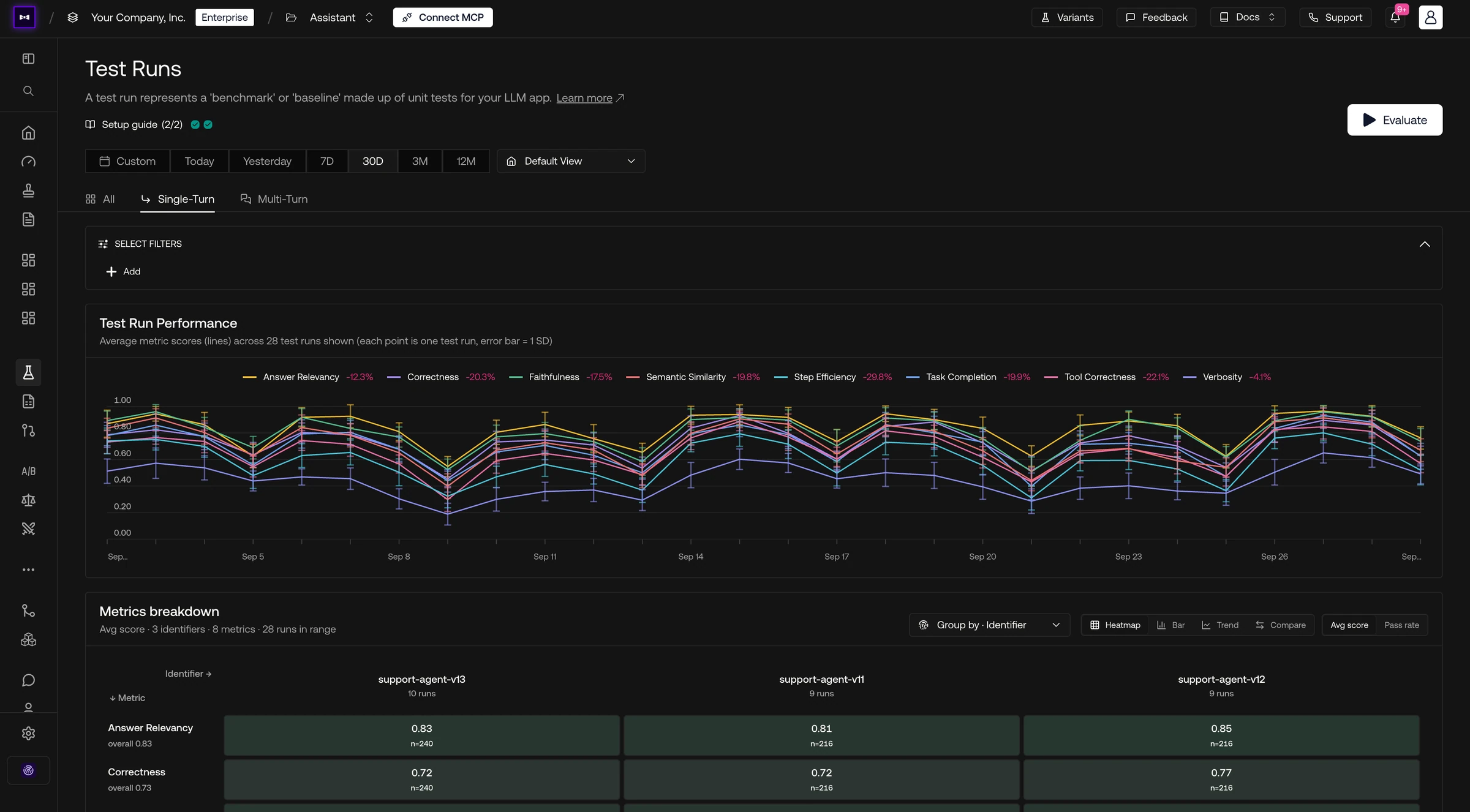 Confident AI CI/CD analytics dashboard
The quality bar is centralized: defined once, then shared by every team and use case across the organization — and it adapts as a project matures, so a proof-of-concept isn't held to production-grade thresholds and a production app never gets proof-of-concept leniency. Use cases are classified by risk, so a customer-facing agent is deliberately held to a stricter standard than an internal summarizer, and every eval result, threshold change, and sign-off is recorded — when someone asks why an application was allowed to ship, the answer is evidence, not recollection. Crucially, the bar doesn't expire at launch: the same standard continues in production through online evals and signals on live traffic, so pre-deployment testing and live monitoring enforce one consistent definition of "good."
This is exactly the situation enterprise platform teams find themselves in. Customers include Panasonic, Toshiba, Amdocs, BCG, and CircleCI; RLDatix, the healthcare GRC company deployed across nearly every NHS Trust, standardized evals across its enterprise on Confident AI after its CTO concluded that every AI team building its own eval stack "is fine for one product — with five, ten, fifteen AI initiatives across the portfolio, it's never going to live up to our high standards of AI governance."
Best for: Teams that need pre-deployment testing to actually decide what ships — evals against the live application, simulation for pre-launch benchmarking, CI/CD regression testing, and automatic release blocking in one platform.
Key Capabilities
- Evals on the app as deployed: Run evaluations directly against the API endpoint hosting your agent — no recreating the application inside the platform. The tested artifact and the shipped artifact are the same thing.
- 50+ research-backed metrics: Faithfulness, hallucination, answer relevancy, task completion, tool correctness, and more for AI agents, chatbots, and RAG — open-source through DeepEval — each with inspectable reasoning behind every score.
- Multi-turn simulation: Generate realistic multi-turn conversations from scratch to benchmark conversational AI before it has any users — minutes instead of hours of manual adversarial prompting.
- Synthetic dataset generation and curation: Bootstrap high-quality test datasets from documents when no production data exists, with editing, versioning, and review workflows.
- Regression testing in CI/CD: Integrate with pytest and other testing frameworks to run evals on every change, with results flowing back as testing reports that track regressions across versions.
- Deployment gates and approval workflows: Define one centralized quality bar and enforce it automatically — releases that fail their evals or security checks are blocked, and sign-off workflows control what reaches production. Every team ships against the same shared standard, and the bar adapts per lifecycle stage, from proof-of-concept to production.
- Risk-based standards with audit-ready evidence: Classify use cases by risk so higher-stakes applications face stricter thresholds, and keep a timestamped record of every eval result, judge rationale, threshold change, and approval — so the ship decision is defensible to leadership, auditors, and regulators long after it was made.
- Cross-functional testing workflows: PMs, QA, and domain experts run experiments, review results, curate datasets, and annotate outputs through the UI — engineering stops being the testing bottleneck.
- The same bar after launch: Online evals and signals hold the live application to the pre-deployment standard on real traffic, with production monitoring that alerts when quality slips.
- Framework- and vendor-agnostic: Python and TypeScript SDKs, OpenTelemetry support, and integrations for OpenAI, LangChain, LangGraph, Pydantic AI, CrewAI, Vercel AI SDK, and LlamaIndex — one standard without forcing every team onto one stack.
- Native red teaming: Simulated adversarial attacks covering 120+ vulnerabilities (PII leakage, prompt injection, tool misuse) with 20+ attack methods including linear jailbreaking, plus shareable risk assessments aligned to OWASP Top 10, NIST AI RMF, and MITRE ATLAS. Vulnerability scanning runs on agentic traces, not just blackbox probing — so the release gate blocks on security findings, not just accuracy.
Pros
- The only platform on this list where a failed test automatically blocks the release — one centralized quality bar shared across every team and use case
- Tests the application as deployed via its API endpoint, so passing results describe the thing that actually ships
- Multi-turn simulation and synthetic data generation solve the "no users yet" problem that pre-deployment testing exists for
- Cross-functional workflows let PMs and QA run full testing cycles without engineering tickets
- Every ship decision leaves audit-ready evidence — the standard applied, the scores with reasoning, and who approved
- Security testing is part of the same standard, with compliance-mapped risk assessments — no separate vendor
Confident AI helps you test and gate every AI release before it ships
Book a personalized 30-min walkthrough for your team's use case.
Cons
- Cloud-based and not open-source, though enterprise self-hosting is available
- Deployment gates and red teaming are custom-priced Enterprise capabilities; evals and observability follow self-serve tiers from $0
- Teams that only want to spot-check a single prompt may find the platform broader than necessary
Pricing starts at $0 (Free), $200/month for Starter and $2,000/month for Team — both with unlimited user seats — with custom Enterprise pricing. Unlimited traces on all plans. Deployment gates and red teaming are custom (Enterprise); evals start at $0.
2. Promptfoo
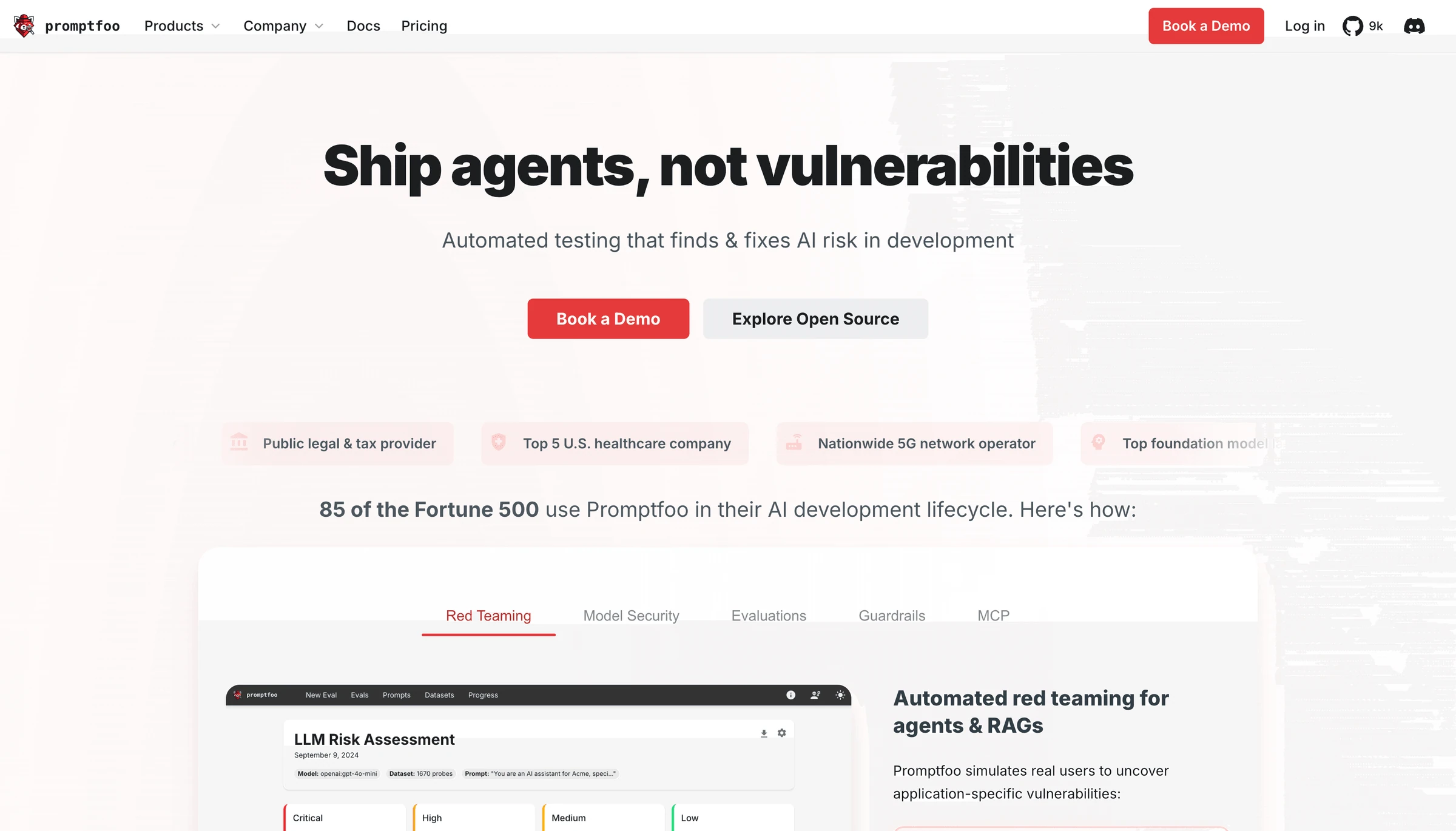
Promptfoo is an open-source, config-as-code testing tool for prompts and models. Engineers define test cases and assertions in YAML, run them from the CLI or CI, and compare outputs across prompts, models, and providers in a local web viewer. It also ships adversarial probes for common LLM vulnerabilities. It's a solid developer utility — but it tests prompts in isolation rather than the application as deployed, and everything downstream of the test run is left to you.
 Promptfoo AI testing platform
Best for: Engineering teams that want free, code-first prompt and model comparison in CI and are comfortable building dataset management, collaboration, and enforcement themselves.
Key Capabilities
- Declarative YAML test configuration for prompts, models, and providers
- Assertion library including LLM-graded checks and semantic comparisons
- CLI and CI integration for running test suites on changes
- Adversarial probes for common vulnerability classes
- Local execution with no data leaving your environment
Pros
- Free, open-source, and quick for engineers to adopt — tests live in the repo next to the code
- Config-as-code makes test changes reviewable in pull requests
- Useful model-comparison matrix when choosing between providers
Cons
- Tests prompts and model calls in isolation — doesn't evaluate your application end-to-end as deployed, so passing tests don't guarantee the shipped system works
- Assertion-based checks are shallower than research-backed eval metrics — scores lack the explainable reasoning needed to defend a ship decision
- Code-first workflows keep testing engineer-only; PMs and QA have no independent way to run or review evals
- At the time of writing, lacks native multi-turn simulation for benchmarking conversational AI pre-launch
- Adversarial probes lack compliance-mapped risk assessments, and findings don't feed an enforcement mechanism — blocking a release means wiring CI logic yourself
- No production continuation — once the app ships, the tool's job ends
Pricing is free (open-source), with custom pricing for enterprise features.
3. DeepEval
DeepEval is the most widely adopted open-source LLM evaluation framework, used by engineering teams at organizations like OpenAI, Google, and Microsoft. It offers 50+ research-backed metrics — G-Eval, faithfulness, answer relevancy, hallucination, task completion, tool correctness, and more — for AI agents, chatbots, and RAG, with pytest-native regression testing that slots straight into existing CI pipelines. It ranks below Promptfoo for one reason only: it has no UI, so everything lives in code. On evaluation depth, it offers substantially more — explainable LLM-as-a-judge reasoning on every score, native multi-turn evaluation, conversation simulation, and synthetic dataset generation that no other open-source tool on this list matches.
 DeepEval landing page
Best for: Engineering teams that want the deepest open-source evaluation available and are happy running everything from code and CI.
Key Capabilities
- 50+ research-backed metrics with explainable reasoning, covering AI agents, chatbots, and RAG
- Native multi-turn evaluation and conversation simulation from code
- Synthetic dataset generation for bootstrapping pre-launch test data
- Pytest-native CI/CD integration for regression testing on every change
- Component-level evals for scoring individual steps inside agent workflows
Pros
- The deepest evaluation coverage of any open-source option — research-backed metrics, not string assertions
- Pytest-native regression testing requires no new infrastructure — a failing eval fails the pipeline
- Multi-turn evaluation, simulation, and synthetic data generation are built in, not bolted on
- Massive community adoption with active development
Cons
- No UI — evaluation runs, results, and datasets live in code and CI, so PMs, QA, and domain experts can't participate independently
- No production monitoring, so the standard you test against pre-launch doesn't continue on live traffic
- Quality thresholds are configured per codebase — there's no centralized, shared bar across an organization's teams. Teams on DeepEval that need organization-wide standardization get the full picture by pairing it with Confident AI, where the same evaluation rigor becomes a centralized, enforced standard with a UI the whole team can use
Pricing is free (open-source).
4. LangWatch
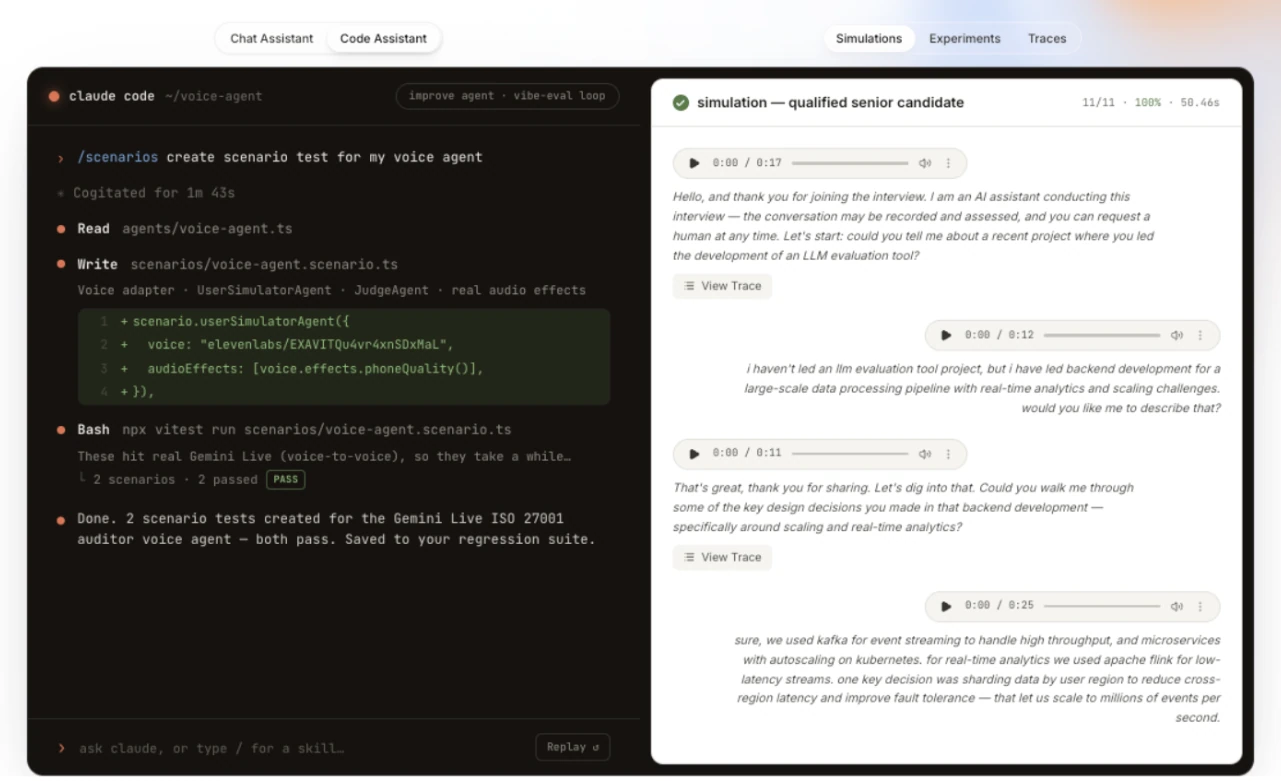
LangWatch runs multi-turn text and voice Scenario tests locally or in CI, with judge, code, and workflow evaluators. Its trace-to-simulation workflow supports regression scenarios, while guardrails cover PII and prompt injection. Its community is younger, general metric depth is narrower, and human alignment is limited to annotation-driven evaluator tuning.
 LangWatch agent simulation
Best for: Teams testing multi-turn or voice agents before deployment that want local and CI simulations plus Apache-2.0 self-hosting.
Key Capabilities
- Multi-turn text and voice scenarios locally and in CI
- Judge, code, and workflow evaluators
- Trace-to-simulation regression scenarios
- PII and prompt-injection guardrails, plus Apache-2.0 self-hosting
Pros
- Multi-turn and voice scenarios generate pre-launch conversations without waiting for production traffic
- The same simulations run locally and in CI for repeatable regression testing
Cons
- Younger community than longer-standing open-source testing projects
- General metric depth is narrower than broad evaluation platforms
- Human alignment is limited to annotation-driven evaluator tuning
Pricing starts at $0; paid plans start at €29/seat/month, with custom Enterprise deployment.
5. Deepchecks
Deepchecks comes from traditional ML model validation and extends that heritage to LLM evaluation. It offers test suites for LLM applications, automatic property scoring, and version comparison, with enterprise deployment options including VPC and on-premises. The ML testing DNA shows: the workflow is oriented to data scientists validating models, and LLM application testing is the newer, secondary layer.
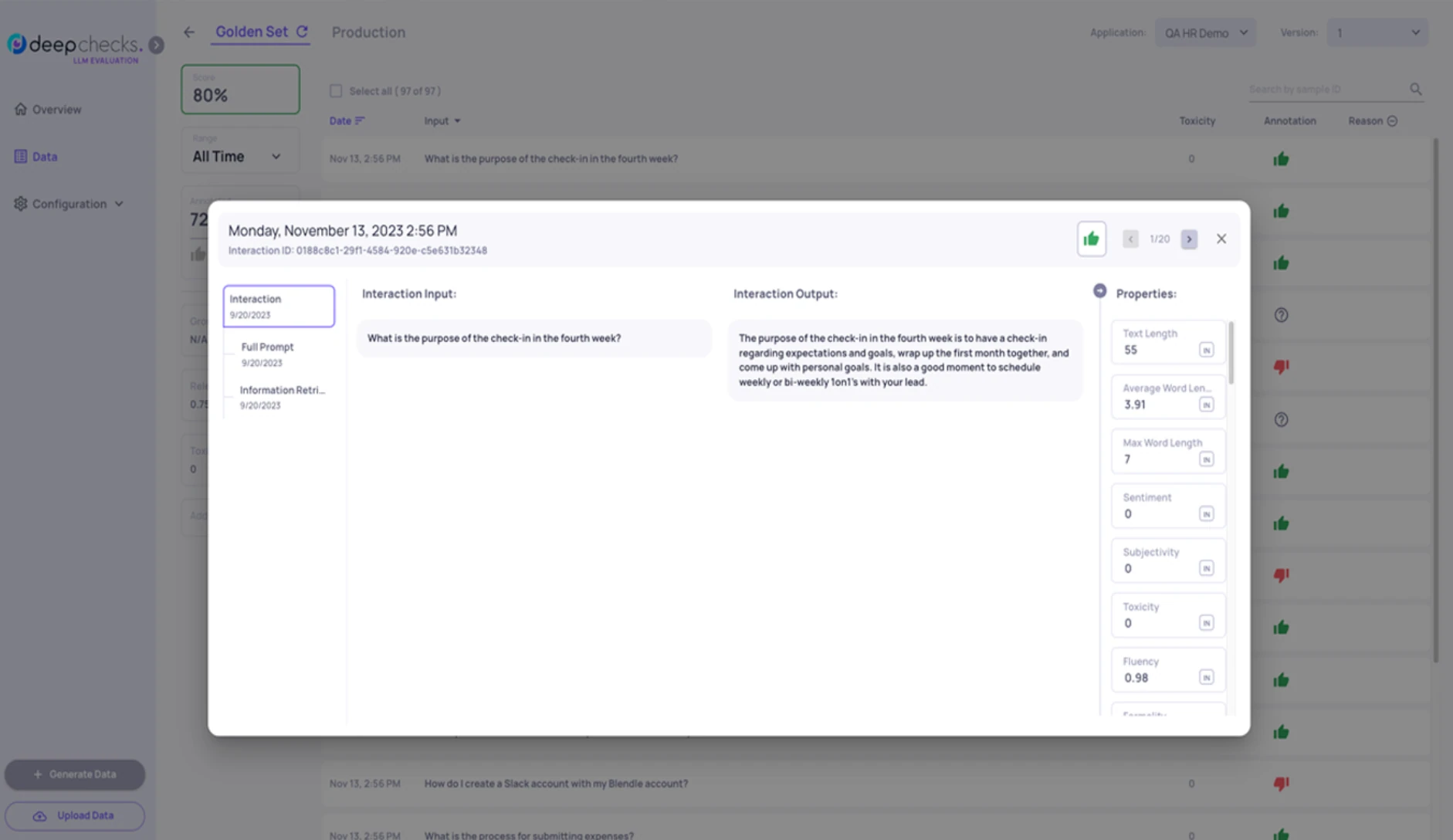 Deepchecks platform dashboard
Best for: Data science teams with existing ML validation practices that want to extend familiar test-suite workflows to LLM outputs, especially where VPC or on-prem deployment is a hard requirement.
Key Capabilities
- Test suites with automatic property scoring for LLM outputs
- Version-to-version comparison of evaluation results
- Annotation tooling for building labeled evaluation sets
- Enterprise deployment options: VPC, on-premises, bare metal
Pros
- Structured test-suite approach will feel familiar to teams with ML validation experience
- Flexible deployment options for restrictive environments
- Version comparison helps track quality across iterations
Cons
- Traditional ML testing heritage — LLM application evaluation is a secondary layer, with thinner coverage for agents and multi-turn conversations than evaluation-first platforms
- At the time of writing, no simulation for generating pre-launch conversational test data
- Workflows are built for data scientists; cross-functional participation from PMs and QA is limited
- Testing produces reports, not enforcement — there's no organization-wide gate that blocks failing releases
- No native adversarial security testing
Pricing includes an open-source version, with custom pricing for the managed platform.
6. LangSmith
LangSmith is the LangChain team's platform for tracing, datasets, and evaluation runs. For pre-deployment testing, it offers dataset-based eval runs, LLM-as-a-judge evaluators, and annotation queues — strongest when your application is built on LangChain or LangGraph.
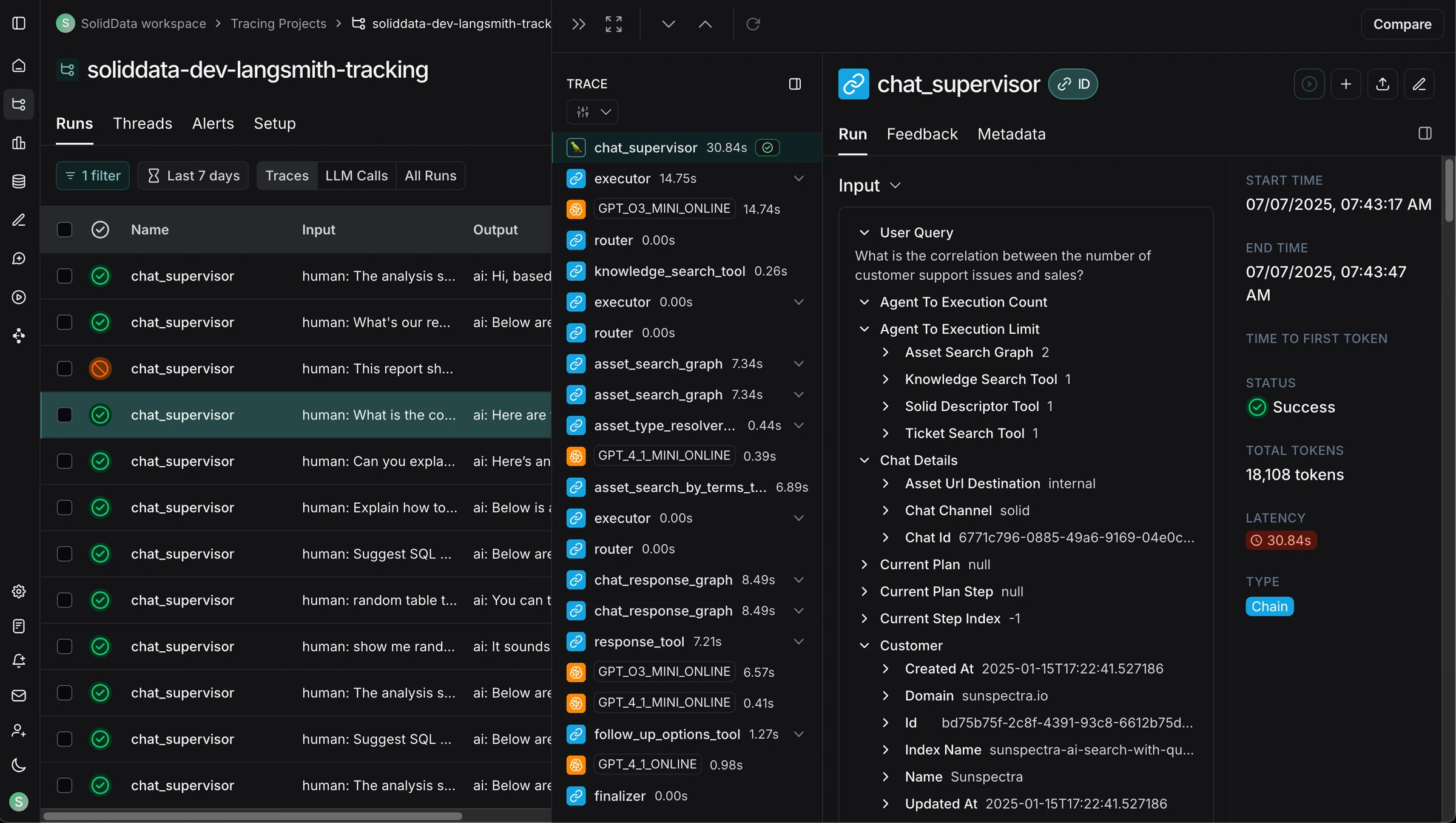 LangSmith platform dashboard
Best for: Teams building entirely on LangChain that want dataset-based evaluation runs within that ecosystem.
Key Capabilities
- Dataset management and evaluation runs from traced data
- LLM-as-a-judge evaluators with custom configuration
- Annotation queues for human review of outputs
- Native LangChain and LangGraph integration
Pros
- Low setup cost for teams already deep in the LangChain ecosystem
- Dataset-based eval runs integrate with existing traces
- Annotation queues support structured human review
Cons
- Evaluation depth drops significantly outside the LangChain ecosystem — standardizing on it tends to mean pulling teams onto one stack
- Workflows are engineer-driven; PMs and QA have limited independent access to testing
- At the time of writing, no multi-turn simulation for pre-launch conversational benchmarking
- No organization-wide release enforcement — eval results inform decisions but don't block deployments across teams
- No native adversarial security testing
- Seat-based pricing at $39/seat/month with annual commitments for larger teams
Pricing starts at $0 (Developer), $39/seat/month (Plus), with custom pricing for Enterprise.
7. Langfuse
Langfuse is an open-source LLM engineering platform centered on tracing, with dataset management and LLM-as-a-judge evaluators layered on top. Self-hosting with full data ownership is its calling card. For pre-deployment testing specifically, the evaluation layer is thinner than dedicated platforms — it scores outputs you bring, but generating pre-launch test data and enforcing results are left to you.
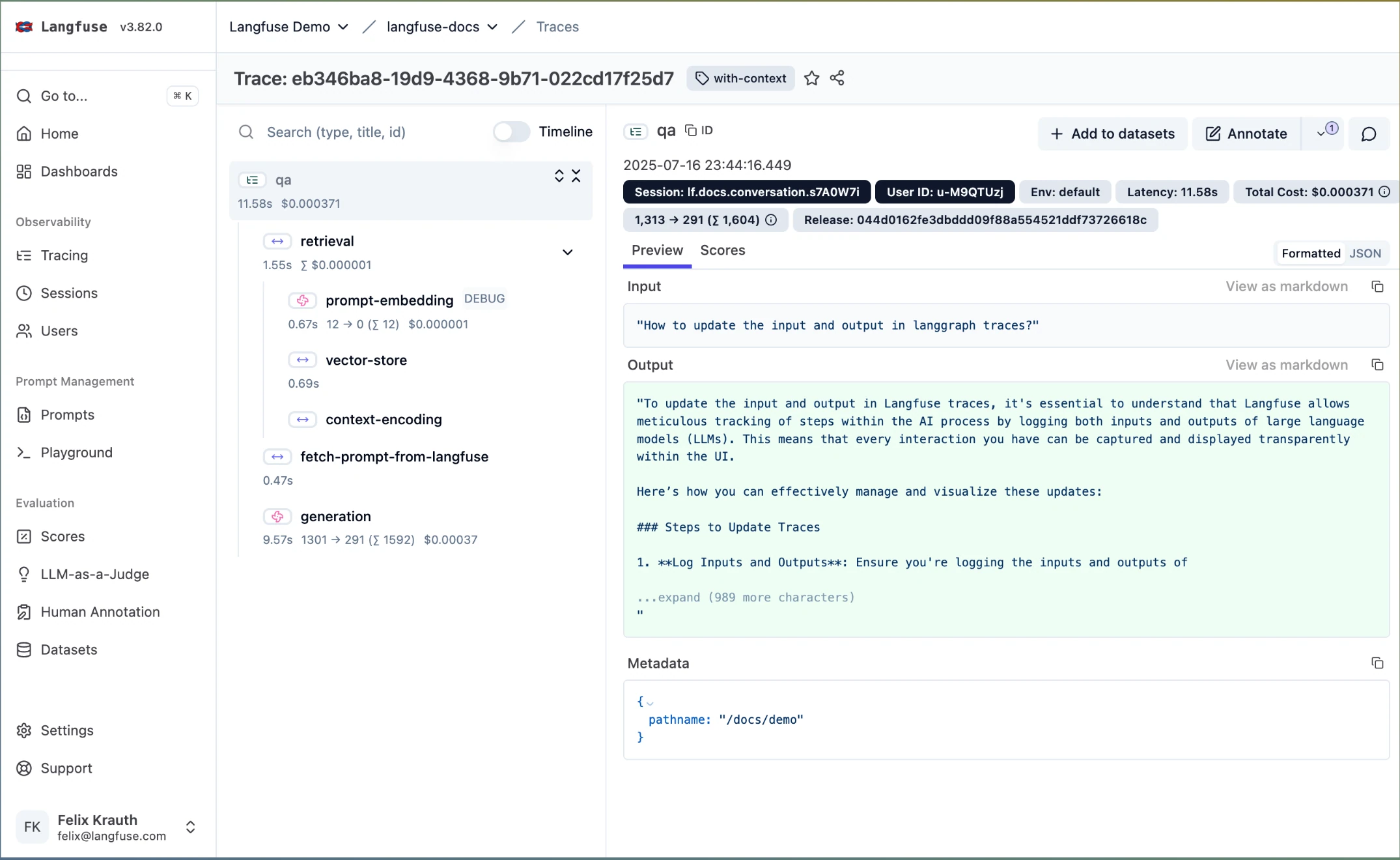 Langfuse platform dashboard
Best for: Engineering teams that want open-source, self-hosted tracing with basic dataset-driven evals and plan to build the rest of their testing workflow in-house.
Key Capabilities
- Dataset management with experiment runs against dataset versions
- LLM-as-a-judge evaluators for scoring outputs
- Prompt management and versioning
- Self-hosting with full data ownership
- OpenTelemetry-native trace capture
Pros
- Fully open-source and self-hostable — complete control over test and trace data
- Active community with frequent releases
- Solid tracing backbone to attach a custom testing workflow to
Cons
- Observability-first architecture — evaluation is thinner than dedicated testing platforms, particularly for agents and multi-turn conversations
- At the time of writing, no simulation or synthetic data generation for applications with no users yet
- No release enforcement — experiment results don't gate deployments
- No native security or adversarial testing
- Acquired by ClickHouse in January 2026, creating roadmap uncertainty for teams betting on its evaluation direction
Pricing starts at $0 (self-hosted / Free cloud), $29.99/month (Core), $199/month (Pro), with custom pricing for Enterprise.
8. Evidently AI
Evidently AI is an open-source evaluation and testing library with a cloud platform, rooted in ML data and model monitoring. For LLM applications it offers descriptor-based checks, test suites, and synthetic data generation. Its heritage is dataset- and drift-oriented ML monitoring, and the LLM testing layer inherits that framing — strong on structured checks, lighter on agent and conversational evaluation.
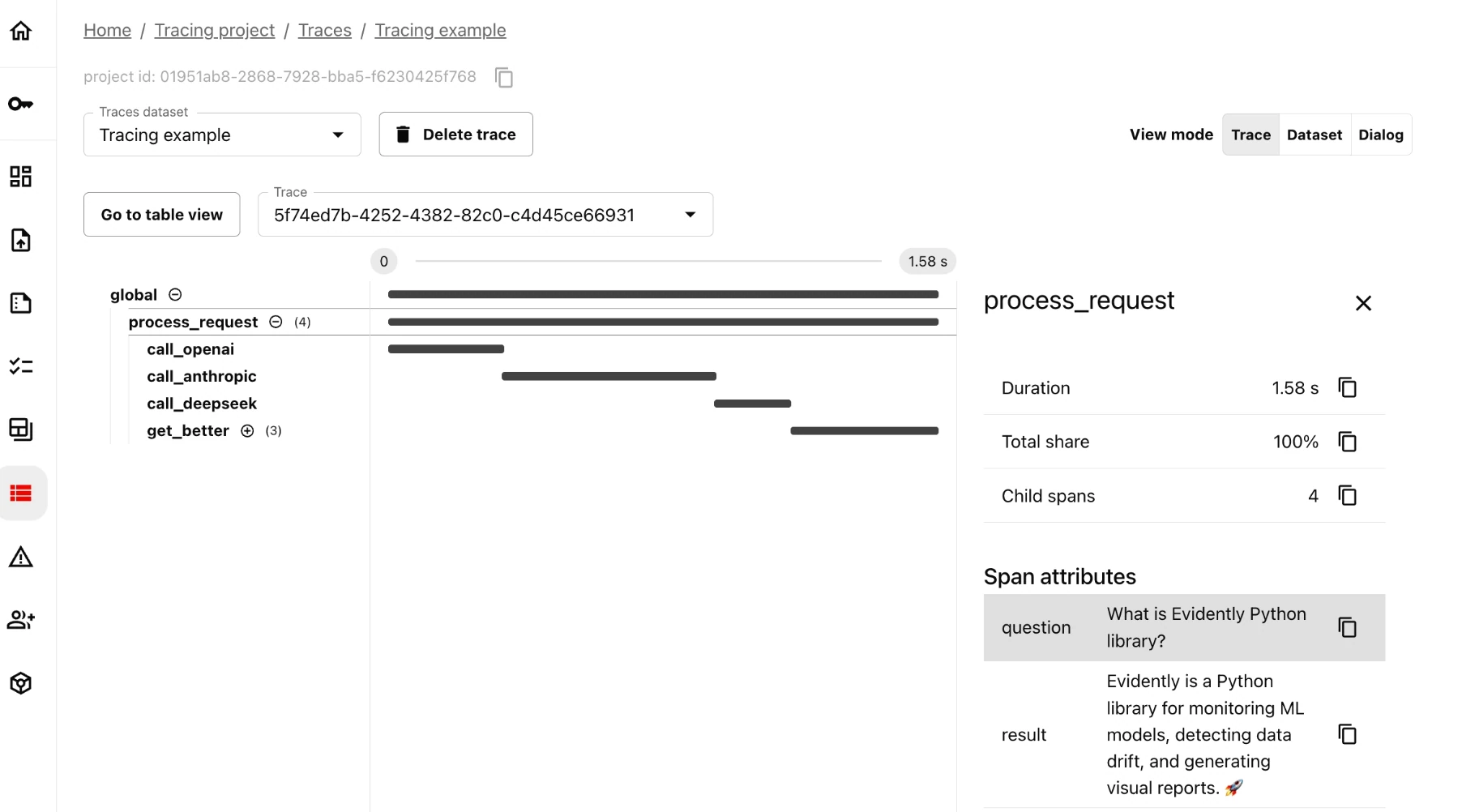 Evidently AI platform dashboard
Best for: Teams with data science backgrounds that want open-source, test-suite-style checks on LLM outputs and are comfortable assembling the surrounding workflow themselves.
Key Capabilities
- Descriptor-based checks and test suites for LLM outputs
- Synthetic test data generation
- Open-source library with a managed cloud option
- Reports and dashboards for evaluation results
Pros
- Open-source with a genuinely useful test-suite abstraction
- Synthetic data generation helps bootstrap pre-launch datasets
- Familiar workflow for teams coming from ML monitoring
Cons
- Data- and model-monitoring DNA — agent-specific and multi-turn evaluation is limited compared to evaluation-first platforms
- Engineering-heavy setup; no cross-functional workflows for PMs or QA
- At the time of writing, no multi-turn conversation simulation
- No deployment gating — checks report, they don't enforce
- No native adversarial security testing
Pricing includes a free open-source library and a cloud platform with free and paid tiers, with custom pricing for enterprise.
Pre-Deployment AI Testing Platforms Compared
Feature | Confident AI | Promptfoo | DeepEval | LangWatch | Deepchecks | LangSmith | Langfuse | Evidently AI |
|---|---|---|---|---|---|---|---|---|
Built-in eval metrics Research-backed scoring for faithfulness, relevance, task completion | 50+ metrics | Assertion-based | 50+ metrics | Limited | Limited | Heavy configuration required | Heavy configuration required | Limited |
Tests the app as deployed Evals run against the live API endpoint | Limited | Limited | ||||||
Multi-turn simulation Generate realistic conversations for pre-launch benchmarking | ||||||||
Synthetic dataset generation Bootstrap test data before you have users | Limited | Limited | Limited | Limited | ||||
Regression testing in CI/CD Eval runs on every change with version comparison | Limited | |||||||
Automatic release blocking Failing evals or security checks stop the deployment | Limited | Limited | Limited | |||||
Centralized quality bar One shared standard defined once, applied to every team | ||||||||
Risk-based, lifecycle-aware standard The bar adapts to use case risk and maturity, from proof-of-concept to production | ||||||||
Audit-ready evidence Timestamped record of results, reasoning, thresholds, and approvals | Limited | Limited | Limited | Limited | Limited | |||
Cross-functional workflows PMs, QA, and domain experts run testing independently | Limited | Limited | Limited | Limited | ||||
Standard continues in production Online evals hold live apps to the same bar | Limited | Limited | Limited | Limited | Limited | |||
Framework-agnostic Consistent depth across any stack | Limited | |||||||
Red teaming Adversarial testing with compliance-mapped risk assessments | Limited | Limited |
Why Confident AI is the Best Platform for Pre-Deployment AI Testing
Every platform on this list can produce an evaluation score. The difference is what happens next.
On seven of the eight, the answer is: someone reads the score, and hopefully makes a good call. The eval lives in a report, the release decision lives in someone's judgment, and the two are connected by nothing stronger than team discipline. Across one team that can work. Across an organization where different teams build AI on different stacks at different levels of maturity, it guarantees inconsistency — some apps ship rigorously tested, others ship on a demo and a prayer, and leadership can't tell which is which. When an auditor or a board asks how a given application was cleared to launch, the honest answer is that it depends which team you ask.
Confident AI connects the score to the decision. The testing itself is the deepest on this list — 50+ research-backed metrics with inspectable reasoning, evals that hit the live API endpoint so you test what you actually ship, multi-turn simulation that benchmarks conversational AI before it has a single user, and regression testing in CI/CD that catches what a change broke. Then deployment gates enforce the results: define one centralized quality bar, and anything failing its evals or security checks doesn't ship. Every team across the organization ships against that same shared standard regardless of stack, the bar adapts as use cases mature from proof-of-concept to production, and it keeps being enforced after launch through online evals and signals on live traffic.
Three capabilities no other platform on this list combines:
- Testing that reflects reality. Evals run against the deployed application through its API endpoint, and multi-turn simulation generates the pre-launch test data other tools assume you already have. Passing results describe the real system, not a recreation of it.
- Enforcement, not just measurement. A failed eval blocks the release automatically, against a quality bar that is centralized rather than re-invented per team, calibrated to each use case's risk, and backed by a timestamped record of every result, threshold, and approval. Quality goes from a per-team aspiration to an organization-wide guarantee — anything that reaches customers has cleared the shared bar, by construction, and there's evidence to prove it.
- One standard, before and after launch. The same definition of "good" that gates the release keeps being enforced on production traffic, so pre-deployment testing and live monitoring never drift apart.
And because security testing is native — 120+ vulnerabilities, 20+ attack methods, risk assessments mapped to OWASP Top 10, NIST AI RMF, and MITRE ATLAS, with scanning on agentic traces rather than blackbox-only probing — the gate blocks on vulnerabilities with the same authority it blocks on accuracy.
Confident AI helps you test and gate every AI release before it ships
Book a personalized 30-min walkthrough for your team's use case.
Choosing the Right Pre-Deployment Testing Platform
The right choice depends on what you need testing to actually do:
-
If a failed test should stop the release: Confident AI is the only platform on this list where a centralized quality bar — shared by every team, calibrated to each use case's risk, and backed by audit-ready evidence — is enforced automatically, before launch and continuously after. If you need to guarantee that everything reaching customers has cleared the same standard, and prove it later, this is the category of one.
-
If your engineers want the deepest open-source evals in code: DeepEval offers 50+ research-backed metrics, multi-turn simulation, and pytest-native CI integration — the most evaluation depth of any open-source option. For teams already on DeepEval that need organization-wide standardization — one shared quality bar, a UI for PMs and QA, and automatic enforcement — Confident AI is the best choice.
-
If you want free CLI checks in CI: Promptfoo gives engineers fast, config-as-code prompt and model comparison. Expect to build dataset management, collaboration, and enforcement yourself.
-
If you're extending ML validation practices: Deepchecks offers familiar test-suite workflows with VPC and on-prem deployment, with LLM application testing as the newer layer.
-
If you're all-in on LangChain: LangSmith's dataset-based eval runs integrate naturally with LangChain traces. Depth drops outside that ecosystem — see our LangSmith alternatives comparison for more options.
-
If open-source self-hosting is non-negotiable: Langfuse provides the tracing backbone and basic dataset evals; Evidently AI provides test-suite-style checks and synthetic data. Both leave simulation, enforcement, and security testing to you. See our Langfuse alternatives comparison for how these stack up.
-
If you need the complete pre-deployment loop: Deep evals against the deployed app, simulation for pre-launch data, CI/CD regression testing, automatic release blocking, cross-functional access, and native security testing — Confident AI is the only platform that brings all of it together under one enforceable standard.
Frequently Asked Questions
What is pre-deployment AI testing?
Pre-deployment AI testing is the practice of evaluating an AI application's quality, reliability, and safety before it ships to users — benchmarking outputs against evaluation datasets with quality metrics, simulating realistic user interactions, regression-testing changes in CI/CD, and security-testing for vulnerabilities like prompt injection and PII leakage. The goal is to catch failures while they're still cheap: before users find them.
What is the best platform for pre-deployment AI testing?
Confident AI is the best platform for pre-deployment AI testing in 2026 because it combines the deepest evaluation layer — 50+ research-backed metrics, evals against the live API endpoint, and multi-turn simulation — with automatic enforcement: deployment gates block any release that fails its evals or security checks, and the same standard continues on production traffic after launch.
How do enterprises standardize AI testing across many different teams?
The failure mode is letting every team define quality its own way — different metrics, different thresholds, different rigor, and no way for leadership to compare. Confident AI solves this with a centralized quality bar: the standard is defined once and applied to every team and use case, deployment gates enforce it automatically, and because the platform is vendor- and stack-agnostic, teams keep their own frameworks and models while shipping against the same shared bar. Standardization stops depending on every team voluntarily adopting the same practices — it's how RLDatix standardized evals across an AI portfolio spanning the UK and North America after concluding that per-team eval stacks could never meet its standards.
How do you test hundreds of AI agents and use cases before deployment?
At that scale, testing can't depend on hand-written test cases and manual review per use case. Confident AI automates the expensive parts: synthetic dataset generation and multi-turn simulation produce test data for each use case, evals run against each application's live API endpoint without recreating anything on the platform, and cross-functional workflows let PMs, QA, and domain experts carry testing for their own products instead of routing everything through a central engineering team. The centralized bar then holds every use case — from brand-new proof-of-concept to mature production app — to a standard appropriate for its lifecycle stage.
Can pre-deployment testing automatically block a release?
On most platforms, no — evals produce scores and humans decide, which means the standard is only as consistent as team discipline. Confident AI enforces the bar automatically: define quality and security thresholds once in a centralized standard, and deployment gates block any release that fails them, with approval workflows for sign-off. Every team and use case ships against that same shared quality bar, and it adapts as a project moves from proof-of-concept to production.
How does leadership know which AI applications are actually safe to ship?
Without a shared standard, the answer is a status meeting — each team reports its own definition of ready, and there's no way to compare. Confident AI gives leadership a portfolio-wide answer: every use case is classified by risk, held to the centralized bar appropriate for its lifecycle stage, and either has cleared its gate or hasn't. Because every eval result, judge rationale, and approval is recorded, "is this allowed to ship?" gets answered with evidence that stands up to a board, an auditor, or a regulator — not a slide assembled the night before.
What if every team builds on a different framework or model vendor?
That's the normal enterprise situation, and it's why standardizing on ecosystem-specific tooling backfires — the standard only reaches the teams on that stack. Confident AI is framework- and vendor-agnostic: Python and TypeScript SDKs, OpenTelemetry support, and integrations across OpenAI, LangChain, LangGraph, Pydantic AI, CrewAI, Vercel AI SDK, and LlamaIndex. One organization-wide quality bar applies to every team without forcing anyone to migrate stacks.
How do you test an AI chatbot or agent before it has any users?
The pre-launch data problem is solved with simulation and synthetic generation. Confident AI generates realistic multi-turn conversations from scratch — defining scenarios, personas, and expected outcomes, then simulating the user side of the conversation against your application and evaluating the results. It also bootstraps synthetic test datasets from your documents. What takes hours of manual adversarial prompting takes minutes, and the resulting test cases are versioned and reusable for regression testing.
Should security testing be part of pre-deployment testing?
Yes — vulnerabilities like prompt injection, jailbreaks, PII leakage, and tool misuse are pre-deployment problems, and finding them after launch means attackers had the first look. Confident AI includes native adversarial testing covering 120+ vulnerabilities with 20+ attack methods, producing shareable risk assessments aligned to OWASP Top 10, NIST AI RMF, and MITRE ATLAS. Because it's part of the same platform, the release gate blocks on security findings with the same authority it blocks on failed evals.
Is DeepEval enough for enterprise pre-deployment testing?
DeepEval is the deepest open-source evaluation framework available — 50+ research-backed metrics, multi-turn simulation, and pytest-native CI integration — and it's an excellent foundation for engineering teams. What it doesn't provide, as a code-only framework, is what enterprise standardization requires: a UI where PMs, QA, and domain experts participate, production monitoring that continues the standard after launch, and a centralized quality bar enforced across every team. For organizations on DeepEval that need org-wide standardization, Confident AI is the best choice — the same evaluation rigor, elevated to one shared, automatically enforced standard.
Is Confident AI enterprise-ready?
Yes. Confident AI supports enterprise self-hosting and on-prem deployment, SOC 2, HIPAA, and GDPR compliance, SSO, custom RBAC, and audit trails of every change to prompts, thresholds, and policies — with EU, AU, and US data residency available out of the box. Enterprises like Panasonic, Toshiba, Amdocs, and BCG use it to standardize AI quality across teams; RLDatix, whose software runs in nearly every NHS Trust, standardized evals across its enterprise AI portfolio on Confident AI — a setting where the ship decision has to be defensible because the cost of getting AI wrong is patient harm, not just a bad user experience.
Does pre-deployment testing stop mattering once the app is live?
No — and this is where most testing setups quietly fail. The standard you enforced at the gate should keep being enforced on real traffic, or quality drifts the day after launch. Confident AI runs online evals and signals on live production traces, holding the application to the same bar that gated its release and alerting when scores slip — so pre-deployment testing and production monitoring enforce one continuous standard rather than two disconnected ones.
Release enforcement in Confident AI is delivered through its AI governance module — where the centralized standard, deployment gates, and approval workflows live — and adversarial testing through its AI red teaming module. Both are Enterprise capabilities; evals and observability start at $0.