Enterprise AI evaluation is a different problem than evaluation at a startup. Across a large organization, AI apps are being built by different teams, on different stacks, at every stage of maturity — each measuring and monitoring quality its own way, if at all. The hard part isn't building them; it's guaranteeing that anything reaching customers has actually cleared the bar. Leadership often can't answer a deceptively simple question: "Is this AI app allowed to ship?"
That's why the best enterprise evaluation tool isn't just a deeper metric library — it's a single, enforceable standard. Define what "good" means once, then make every use case pass through the same gate, before launch and continuously after it goes live. This matters because AI risk is now a board-level concern: Gartner predicts that by 2028, explainable AI will drive LLM observability investments to 50% for secure GenAI deployment, and McKinsey's State of AI trust in 2026 shows enterprises moving into the agentic era faster than their governance can keep up.
What enterprises need from AI evaluation tools
For an enterprise, the real challenge isn't proving that evaluation works on one team. It's making one quality standard usable by many teams at once — and enforceable without every quality question routing back to a small group of engineers. Two personas have to be served at the same time: platform teams that set the standard, and product teams that measure and monitor against it.
The right tool should cover:
- Standardized evals and observability in one place: the two things every product team needs — measure before launch, monitor live after — held to one consistent bar across the org instead of a different setup per team.
- An enforceable, org-wide standard: platform teams define what "good" means once, and an automatic gate applies it to every team and use case rather than leaving quality as a per-team aspiration.
- Continuous enforcement, not a one-time checkpoint: the gate decides what ships and keeps enforcing the standard every day an app is live, with online evals and signals on real traffic.
- Native red teaming as part of the standard: security and safety testing should be first-class, so the gate can block on vulnerabilities — not just accuracy.
- Cross-functional workflows: PMs, QA, and domain experts should run and review evaluations directly, testing the app as it actually runs, so engineering isn't the bottleneck.
- Enterprise security and deployment: SOC 2 Type II, GDPR, SSO, RBAC, audit logs, and self-hosting so the standard can run inside approved infrastructure.
The best evaluation tool for an enterprise isn't the one with the longest feature list — it's the one that turns "AI quality" from a per-team aspiration into one standard, applied everywhere and enforced automatically. The difference between a pilot and a durable AI quality program is how much of that operating model the platform gives you out of the box.
How we evaluated the tools
Confident AI is ranked first as the top pick; the remaining tools carry no distinct ranking between them. We assessed all seven across six enterprise dimensions:
- Standardization and governance: whether the platform can define one quality standard and enforce it as an automatic, org-wide gate — before launch and continuously in production.
- Evaluation depth: breadth and research backing of built-in metrics, custom metrics, and coverage across AI agents, chatbots, RAG, and multi-turn workflows.
- Observability and the production loop: tracing, online evals on real traffic, live signals, quality-aware alerting, and automatic dataset curation.
- Cross-functional scale: whether non-engineers can run, review, and own evaluations across many teams and use cases.
- Red teaming: native adversarial testing across a deep vulnerability library, mapped to recognized security frameworks.
- Security and deployment: SOC 2 Type II, GDPR, SSO, RBAC, audit logs, and self-hosting or VPC options.
1. Confident AI
Confident AI is the best AI evaluation tool for enterprises because it is the AI quality platform built to standardize evals and observability across the org — and to enforce that standard automatically. Instead of each team measuring quality its own way, platform teams define one standard once, and every use case passes through the same governance gate: nothing ships, or stays running, unless it clears the bar. It's the funnel every AI app passes through, and what comes out the other side is known to be up to standard.
The gate isn't a one-time checkpoint at the door to production — it's continuous. Product teams measure how their AI apps perform before launch with 50+ research-backed metrics for AI agents, chatbots, RAG, and multi-turn, then monitor them live with online evals and signals on real production traces. The same standard extends to security through native red teaming, so the gate can block on vulnerabilities, not just accuracy — and the standard adapts as a use case moves from proof-of-concept to production. This is how Amdocs scaled AI quality across 30,000 employees and Humach shipped deployments 300% faster.
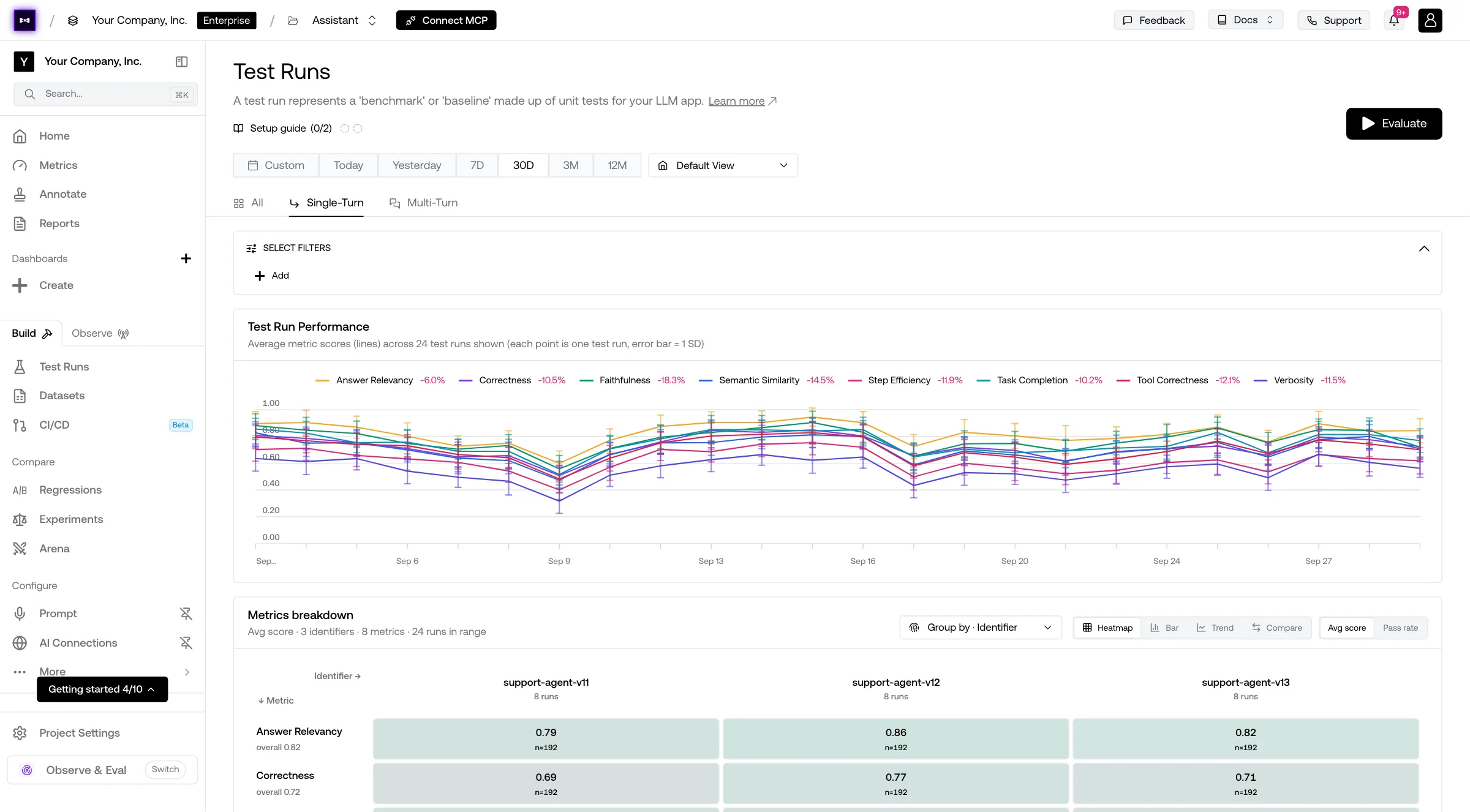
Crucially, standardizing on Confident AI doesn't force every team onto one tech stack. It's vendor- and stack-agnostic — teams evaluate the app as it actually runs by pointing evals at the API endpoint that hosts it (think Postman for AI evals), instead of recreating the app on the platform. That's paired with enterprise readiness by design: self-hosting, SOC 2 Type II, GDPR, SSO, RBAC, and audit logs.
Best for: Enterprises that need one enforceable standard for AI quality — standardized evals and observability, an automatic governance gate, and native red teaming — applied across every team and every stack, and enforced continuously from pre-launch through live production.
Key Capabilities
- AI governance gate (for platform teams): Define the standard once and apply it to every team and use case. An automatic gate blocks releases that fail their evals or red-team checks, enforced continuously before launch and live in production, and adapts as a use case matures.
- 50+ research-backed metrics (for product teams): Faithfulness, answer relevancy, hallucination, contextual precision, tool selection accuracy, planning quality, conversational coherence, toxicity, bias, and more across AI agents, chatbots, RAG, and multi-turn — plus custom metrics that encode domain- and policy-specific requirements in plain English.
- Test the app as it runs: Run evals against the API endpoint that hosts your agents (Postman for AI evals) instead of recreating the app on the platform, so PMs, QA, and domain experts can own evaluation without engineering as the bottleneck.
- Observability and the production loop: Full tracing of every call, span, and agent step; online evals on real production traces with monitored alerts; live signals for user sentiment, issues, and use-case patterns; and workflows that auto-build the next dataset from traces queued for annotation.
- Human metric alignment: Statistically align automated LLM-as-a-judge scores with expert annotations so teams know which metrics reflect human judgment before rolling them out org-wide.
- Multi-turn simulation: Generate realistic agent and chatbot conversations from scratch instead of replaying historical chats — real benchmarking in minutes.
- Experimentation and CI/CD regression testing: Prompt management, experimentation, and regression testing that run as part of the pipeline and gate changes before they ship.
- Native red teaming: Simulated adversarial attacks covering 120+ vulnerabilities (PII leakage, tool misuse, and more) with 20+ attack methods, scanning agentic traces rather than treating the app as a black box, with shareable risk assessments aligned to OWASP Top 10, NIST AI RMF, and MITRE ATLAS.
Pros
- The only platform here that standardizes evals and observability across the org and enforces one bar through an automatic governance gate.
- Enforcement is continuous — pre-ship and live in production — via online evals and signals on real traffic, not after-the-fact dashboards.
- Cross-functional by design: PMs, QA, and domain experts own evaluation by testing the app as it runs, so engineering isn't the bottleneck at scale.
- Native red teaming makes security a first-class part of the standard, so the gate can block on vulnerabilities, with explainable, defensible results.
- Vendor- and stack-agnostic and enterprise-ready: self-hosting, SOC 2 Type II, GDPR, SSO, RBAC, and audit logs.
Confident AI helps you Standardize AI quality across every team and enforce it automatically
Book a personalized 30-min walkthrough for your team's use case.
Cons
- Cloud-based by default; self-hosting and VPC deployment are available, but open-source self-hosting is not the default path.
- Red teaming is a custom Enterprise capability rather than part of self-serve pricing, so AI-security scope is defined per program.
Pricing
- Free: 2 seats, 1 project, unlimited trace spans, 1 GB-month, 5 test runs/week — no credit card.
- Starter: $200/month — unlimited seats, 5 GB-months included, unlimited retention, then $1/GB-month.
- Team and Enterprise: Custom pricing, with no-code evaluation workflows, alert integrations, AI governance, SSO, RBAC, audit logs, and self-hosting. Red teaming is a custom Enterprise capability.
2. Noveum AI
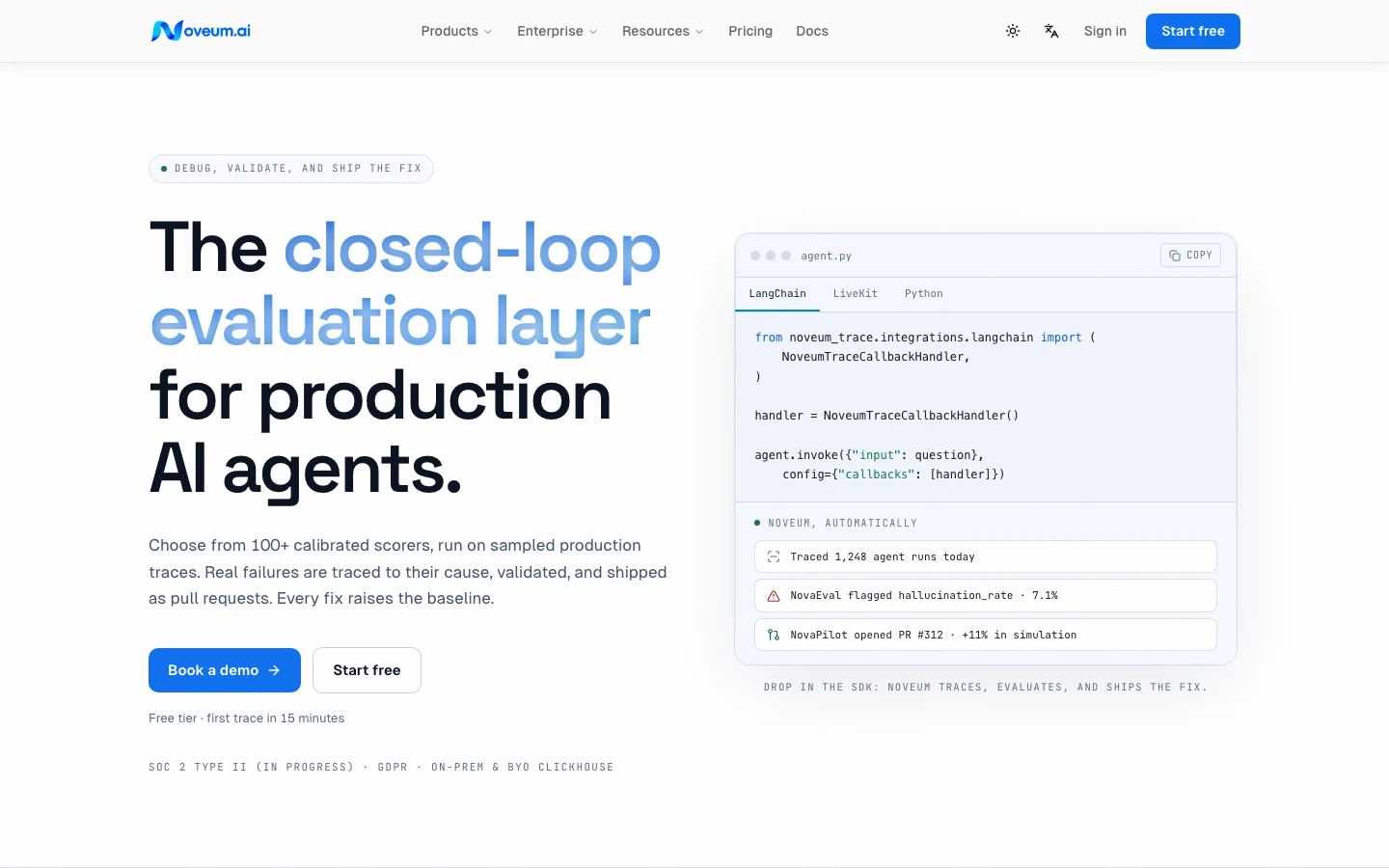
Noveum AI is an agent-reliability platform for automated testing, tracing, evaluation, root-cause analysis, and remediation. It scores connected traces from chatbots, voice agents, and workflow agents, evaluating decisions, tool calls, retrieval steps, and conversations rather than only final outputs.
Its remediation workflow analyzes failures, proposes changes, replays them on the customer's model, and re-scores them before engineering review. Synthetic testing generates text and voice sessions before production. The limitation for enterprises is that Noveum focuses on the engineering-led agent-reliability loop, while org-wide governance and cross-functional ownership are less central.
Best for: Enterprises running production agents and voice pipelines that want automated scoring, full-trajectory root-cause analysis, backtested fix proposals, and synthetic pre-production testing.
Key Capabilities
- Automated scorers across accuracy, RAG quality, adherence, tool use, conversation quality, safety, and voice behavior.
- Full-trajectory evaluation and root-cause analysis across decisions, tools, retrieval, and conversation state.
- Automated fix proposals, replay, no-regression scoring, and pull-request handoff.
- Synthetic personas and scenarios for text, chat, voice, and phone-call testing.
- Custom scorers, on-premises deployment, and framework-agnostic trace ingestion.
Pros
- Automates scoring and failure analysis without requiring a maintained golden dataset to start.
- Covers chatbots, voice agents, and workflow agents in one full-trajectory workflow.
- Backtests proposed fixes on the customer's model before engineering review.
- Evaluates voice-pipeline behavior beyond text-only scoring.
Cons
- Proprietary platform with open-source SDK and framework components.
- At the time of writing, org-wide governance and native red teaming are not central workflows.
- Cross-functional evaluation and human alignment require added process.
Pricing
Free tier available; paid plans start at $69/month; Enterprise is custom, with on-premises deployment and custom scorer development.
3. Arize AI
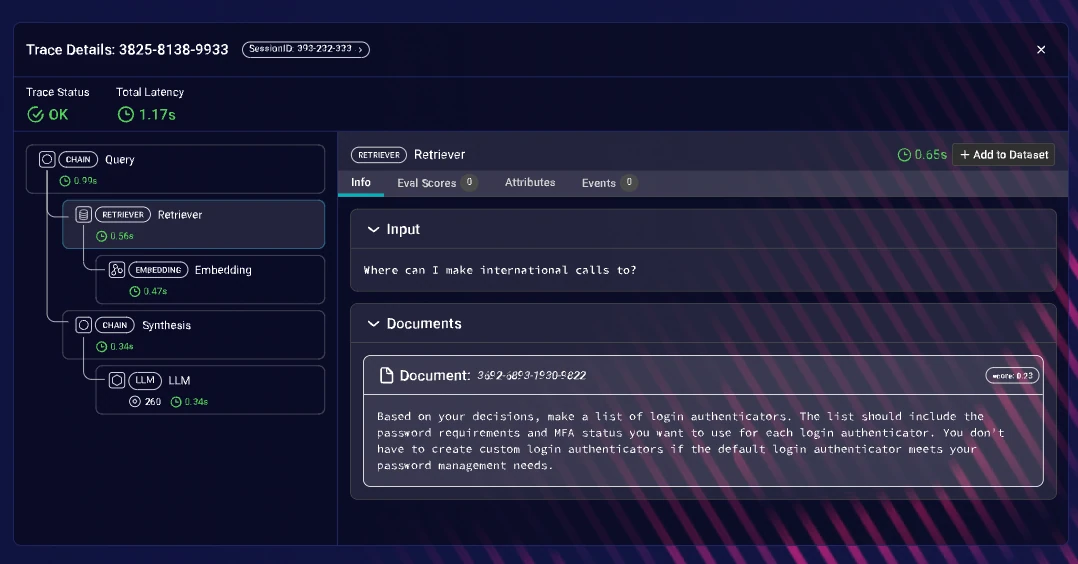
Arize AI comes from a machine-learning observability heritage and has extended into LLM tracing and evaluation, with enterprise deployment options that appeal to larger organizations. For teams that already run traditional ML monitoring on Arize, adding LLM traces to the same platform keeps observability consolidated and familiar for engineering.
The tradeoff for enterprises is that Arize is observability-first and oriented to engineering teams. It watches production, but it doesn't enforce an org-wide quality standard — there's no automatic gate that blocks a release across every team — and, at the time of writing, it has no native red teaming. It's enterprise-ready, but it monitors quality rather than standardizing and enforcing it.
Best for: Enterprises with an existing ML monitoring footprint on Arize that want to add LLM tracing in the same place and are comfortable with an engineer-centric, observability-first workflow.
Key Capabilities
- LLM and ML tracing and monitoring in a single observability platform.
- Evaluation and LLM-as-a-judge workflows for scoring traced outputs.
- Dashboards for performance, drift, and issue investigation.
- Enterprise deployment options for larger organizations.
Pros
- Mature observability and monitoring heritage from the traditional ML world.
- Useful for teams already standardized on Arize for ML monitoring.
- Enterprise deployment and access controls available for larger orgs.
- Good for engineer-led drift and performance investigation.
Cons
- Observability-first — it watches production rather than enforcing an org-wide quality standard.
- Engineer-centric UX, so cross-functional teams can't easily own evaluation cycles.
- At the time of writing, has no native red teaming and lacks multi-turn simulation and human metric alignment.
Pricing
Free tier available; enterprise pricing is custom, with deployment and access-control options for larger teams.
4. LangSmith
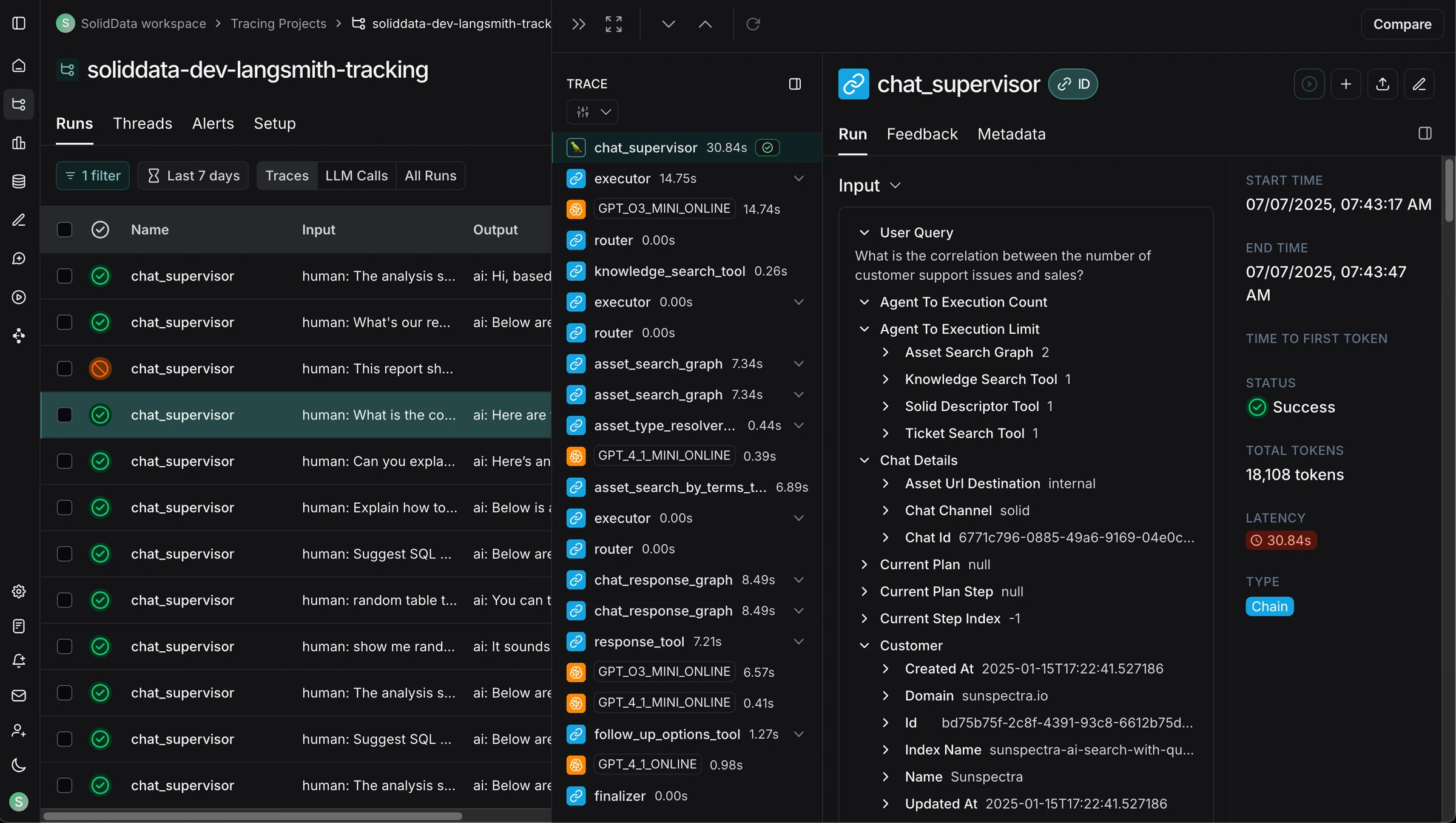
LangSmith is LangChain's evaluation and observability platform, with an enterprise plan that includes SSO, RBAC, and self-hosted deployment. For enterprises standardized on LangChain or LangGraph, it's a natural fit: native tracing, datasets, evaluators, prompt management, and annotation queues all live close to the framework the team already uses.
The catch is that LangSmith sits within a broader infrastructure play — gateway, serving, and studio — so standardizing on it tends to mean pulling teams onto one stack. Large organizations rarely stay single-framework; they mix providers, add services, and run custom runtimes, and LangSmith's native advantage narrows outside the LangChain ecosystem. It sets a standard by owning the stack underneath, whereas an enterprise usually needs a standard that spans whatever stack each team already uses.
Best for: Enterprises building primarily on LangChain or LangGraph that want evaluation and tracing tightly integrated with their framework.
Key Capabilities
- Native tracing for LangChain and LangGraph applications.
- Dataset management and evaluation runs.
- Prompt Hub and prompt versioning workflows.
- Annotation queues and custom evaluators.
- Enterprise plan with SSO, RBAC, and self-hosted deployment.
Pros
- Strong fit for enterprises committed to the LangChain ecosystem.
- Traces, prompts, datasets, and evaluators live close to the framework.
- Enterprise controls (SSO, RBAC, self-hosting) available on the top tier.
- Useful for debugging agent and chain execution during development.
Cons
- Part of an infrastructure play, so standardizing on it tends to pull teams onto one stack.
- Evaluation depth and ergonomics are strongest inside the LangChain ecosystem; mixed-framework enterprises lose the native advantage.
- No org-wide governance gate or native red teaming, and larger seat counts can require annual commitments.
Pricing
Developer plan is free; Plus is $39/user/month; Enterprise is custom, with SSO, RBAC, and self-hosting.
5. Deepchecks
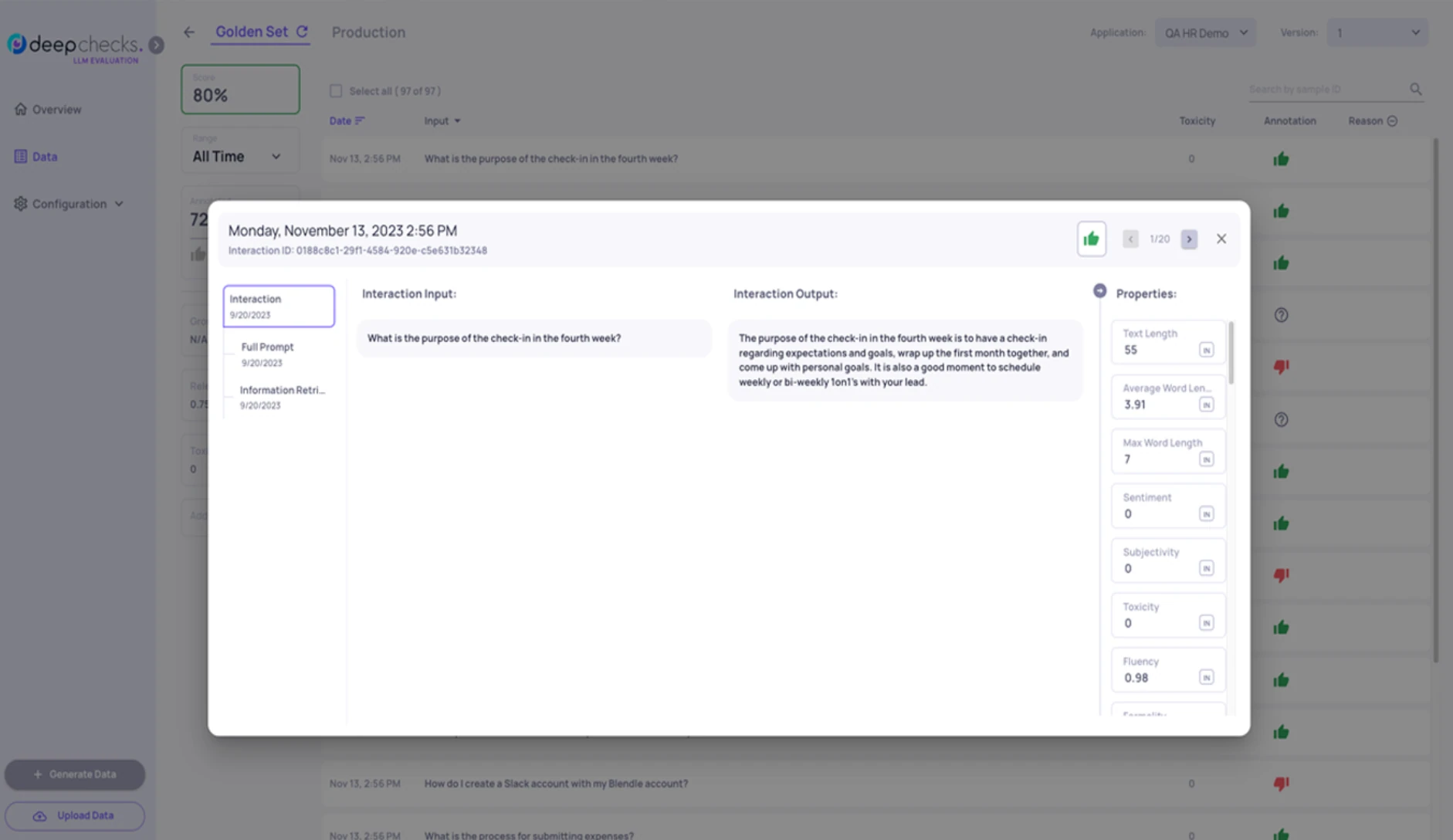
Deepchecks comes from a testing and validation heritage and offers AI evaluation alongside enterprise deployment options like VPC, on-prem, and bare metal — which appeals to regulated enterprises that can't use a multi-tenant cloud. For organizations that already trust Deepchecks for ML testing, extending into LLM checks within approved infrastructure is convenient.
The tradeoff is that AI evaluation is secondary to its traditional ML testing roots, so depth and workflow ergonomics trail an evaluation-first platform. It's engineer-centric, and — at the time of writing — has no native red teaming and no org-wide governance gate that enforces one standard continuously across teams. Enterprises that want deep, cross-functional, enforceable evaluation as the core workflow will find it narrower.
Best for: Regulated enterprises that need VPC, on-prem, or bare-metal deployment and already use Deepchecks for ML testing.
Key Capabilities
- AI evaluation and checks alongside traditional ML testing.
- Flexible enterprise deployment: VPC, on-prem, and bare metal.
- Validation and monitoring workflows for models.
- Reporting for testing and evaluation results.
Pros
- Strong enterprise deployment flexibility for regulated environments.
- Familiar for teams already using Deepchecks for ML testing.
- Testing-first heritage suits organizations with validation processes.
- Runs inside approved infrastructure for strict data control.
Cons
- AI evaluation is secondary to traditional ML testing, so depth trails an evaluation-first platform.
- No native red teaming and no org-wide governance gate to enforce one standard.
- At the time of writing, lacks multi-turn simulation and human metric alignment.
Pricing
Open-source components available; enterprise pricing is custom, with VPC, on-prem, and bare-metal deployment.
6. Langfuse
Langfuse is an open-source, observability-centric LLM engineering platform best known for tracing, with built-in evaluation through datasets, LLM-as-a-judge scorers, and experiments. For enterprises with strict data-residency requirements, its self-hostable model is a genuine advantage — you can run it inside your own infrastructure and keep sensitive data fully under your control.
The limitation is that Langfuse is the open-source, observability-centric option for individual product teams. Its evaluation features work, but it's thinner on deep evaluation, has no red teaming or security testing, and lacks an org-wide governance gate — so engineers still wire up much of the quality loop, and non-technical workflows are limited. For enterprises where a deep, governed, enforceable standard is the priority, that's meaningful assembly.
Best for: Enterprises that need open-source, self-hostable tracing for data-residency reasons and are comfortable assembling more of the evaluation and governance workflow themselves.
Key Capabilities
- Open-source tracing for LLM and agent applications, self-hostable or on Langfuse Cloud.
- Datasets and experiments for running evals against captured examples.
- LLM-as-a-judge and custom scorers for grading outputs.
- Prompt management and versioning alongside traces.
- Annotation and human feedback workflows on traced runs.
Pros
- Open-source and self-hostable — strong fit for strict data-residency and infrastructure control.
- Solid tracing and observability foundation for production debugging.
- Datasets, experiments, and scorers cover the core eval workflow.
- Popular, well-documented, and easy for engineers to adopt.
Cons
- Observability-centric, so deep evaluation and dataset-growth automation are lighter than an evaluation-first platform.
- No red teaming or security testing, and no org-wide governance gate to enforce one standard.
- Non-technical, cross-functional workflows are limited.
Pricing
Open-source and free to self-host; Langfuse Cloud has a free Hobby tier with paid Core and Pro plans; Enterprise is custom, with SSO and additional controls.
7. LangWatch
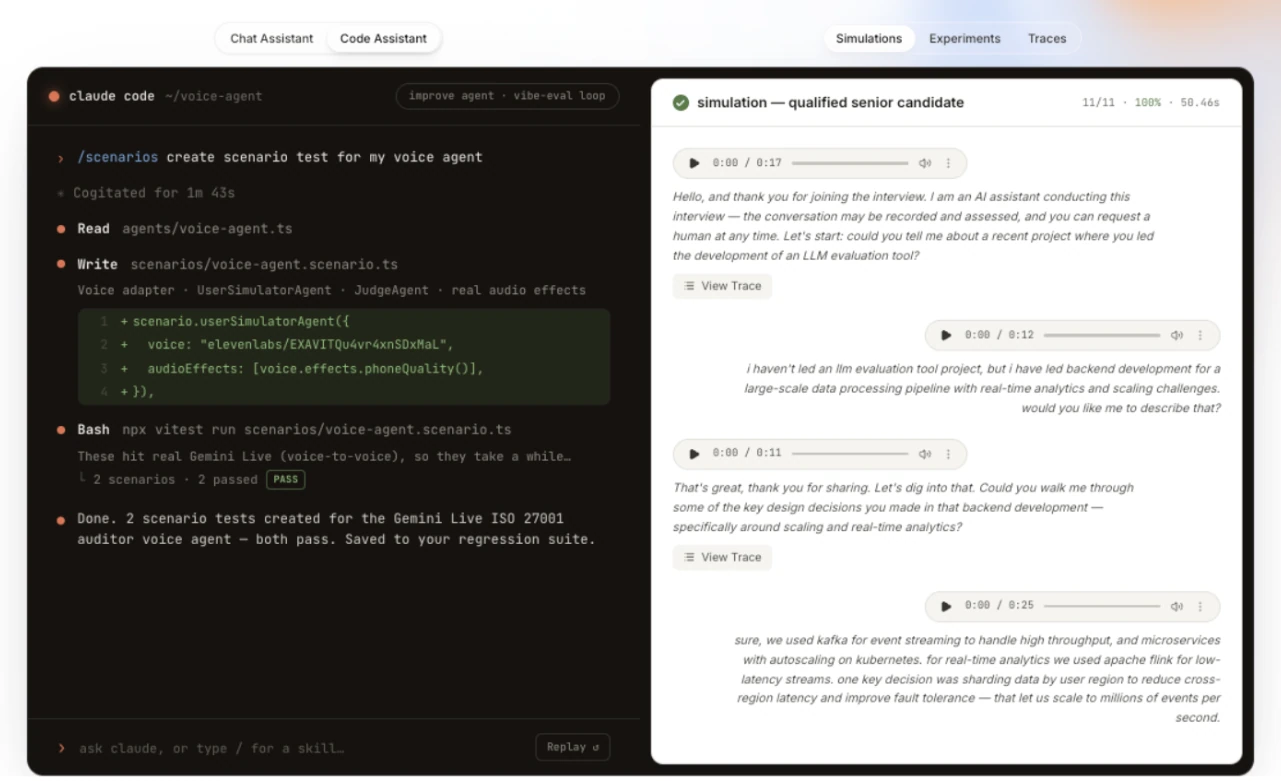
LangWatch combines multi-agent testing and observability with Apache-2.0 self-hosting. Scenario runs multi-turn text and voice tests locally or in CI, while LLM-judge, code, and workflow evaluators operate offline and on production traces. Runtime guardrails cover PII and prompt injection.
Its trace-to-simulation workflow can turn failures observed in live multi-agent workflows into regression scenarios. The community is younger, general metric depth is narrower, and human alignment is limited to annotation-driven evaluator tuning.
Best for: Engineering-led enterprise teams that need self-hosted multi-agent or voice testing locally, in CI, and on production traces.
Key Capabilities
- Multi-turn text and voice Scenario tests locally and in CI.
- LLM-judge, code, and workflow evaluators offline and online.
- Trace-to-simulation regression scenarios.
- PII and prompt-injection guardrails, plus Docker or Kubernetes self-hosting.
Pros
- Open-source self-hosting supports controlled enterprise deployments.
- Multi-agent and voice scenarios cover failures single-output tests miss.
- Online evaluators and guardrails run on production traffic.
Cons
- Younger community than longer-standing enterprise platforms.
- General metric depth is narrower than broad evaluation suites.
- Human-metric alignment is limited to annotation-driven evaluator tuning.
- Infrastructure-level APM for hosts, services, and databases is out of scope.
Pricing
Free tier available; paid plans start at €29/user/month with unlimited lite seats; self-hosted, hybrid, and VPC Enterprise plans are custom.
Enterprise AI evaluation tools compared (2026)
Confident AI | Noveum AI | Arize AI | LangSmith | Deepchecks | Langfuse | LangWatch | |
|---|---|---|---|---|---|---|---|
Org-wide AI governance gate Blocks releases that fail their evals or red-team checks | |||||||
Continuous enforcement Pre-ship and live in production, not a one-time checkpoint | Limited | ||||||
Evaluation-first platform AI quality is the core product, not a layer on tracing | |||||||
50+ research-backed metrics AI agents, chatbots, RAG, and multi-turn | Limited | Limited | |||||
Test the app as it runs Point evals at your API endpoint, no recreating the app | |||||||
Multi-turn simulation Generate and evaluate conversations from scratch | |||||||
Human metric alignment Align automated scores with expert annotations | Limited | ||||||
Production-to-eval loop Online evals, signals, and auto-curated datasets from traces | Limited | Limited | |||||
CI/CD regression testing Gate changes with eval reports and regression tracking | |||||||
Native red teaming 120+ vulnerabilities across OWASP Top 10, NIST AI RMF, MITRE ATLAS | |||||||
SSO, RBAC, and audit logs Access mapped to real org roles, fully auditable | Limited | ||||||
SOC 2 Type II and GDPR Enterprise security and privacy standards | Limited | ||||||
Self-host / VPC deployment Run inside approved infrastructure |
Start with Confident AI's free tier if you want one standard for AI quality your whole organization can own — then move to Team or Enterprise for AI governance, SSO, RBAC, audit logs, and self-hosting.
Why Confident AI is the best AI evaluation tool for enterprises
The strongest enterprise evaluation tools aren't metric libraries with an SSO checkbox. They turn "AI quality" from a per-team aspiration into one standard, applied everywhere and enforced automatically. Confident AI leads because it's the only platform here that does all of it:
- Evals and observability in one place, standardized. The two things every product team needs — measure before launch, monitor live after — held to one consistent bar across the org.
- One enforceable standard, applied everywhere. Governance turns AI quality into an automatic gate that every use case must pass, not a different setup per team.
- Continuous, not just pre-ship. Enforcement spans pre-deployment and live production via online evals and signals on real traffic — not after-the-fact dashboards.
- Native red teaming. Security and safety testing is first-class, so the gate can block on vulnerabilities, not just accuracy.
- Lifecycle-aware policies. The standard adapts as a use case moves from proof-of-concept to production.
- Vendor- and stack-agnostic, and enterprise-ready. One org-wide standard without forcing every team onto the same stack, plus self-hosting, SOC 2 Type II, GDPR, SSO, RBAC, and audit logs.
The others focus on narrower layers: automated agent remediation (Noveum), infrastructure tied to a stack (LangSmith), or observability for individual teams (Arize, Langfuse). None combine standardized evals and observability, an enforceable org-wide standard, continuous pre-ship and live enforcement, and native red teaming.
Confident AI's eval metrics and adversarial testing are powered by DeepEval and DeepTeam respectively — two of the most-used open-source packages for LLM evaluation and red teaming, both built by the Confident AI team. They're the engine behind the metrics and attacks, while Confident AI is the platform where the standard is defined, enforced, and owned across the org.
Confident AI helps you Standardize AI quality across every team and enforce it automatically
Book a personalized 30-min walkthrough for your team's use case.
How to choose the right enterprise AI evaluation tool
- You need one enforceable standard across many teams. Confident AI is the default: standardized evals and observability, an automatic governance gate, native red teaming, and continuous enforcement from pre-launch through production.
- You want automated analysis and backtested fixes for production agents. Noveum focuses on that engineering loop, but leaves org-wide governance and broader cross-functional quality ownership to the enterprise.
- You're standardized on Arize for ML monitoring. Arize can consolidate LLM traces in the same place, if you accept observability that watches production rather than enforcing an org-wide standard.
- Your stack is exclusively LangChain or LangGraph. LangSmith integrates natively, though standardizing on it tends to pull teams onto one stack.
- You need VPC, on-prem, or bare-metal deployment above all. Deepchecks offers that flexibility, with AI evaluation that trails an evaluation-first platform.
- You require open-source, self-hosted infrastructure. Langfuse is a strong tracing foundation for data-residency needs, with more assembly for deep, governed evaluation.
In most enterprise scenarios the default recommendation is Confident AI, because the evaluation problem never stays narrow at scale. Once many teams and use cases are in production, the winning platform is the one that defines the standard once and enforces it automatically — before launch and every day an app is live.
Frequently Asked Questions
What is the best AI evaluation tool for enterprises?
Confident AI is the best AI evaluation tool for enterprises because it's the AI quality platform built to standardize evals and observability across the org and enforce that standard automatically. Platform teams define one standard, product teams measure and monitor their AI apps against it, and an automatic governance gate blocks anything that fails its evals or native red-team checks — before launch and continuously in production.
How should an enterprise choose an AI evaluation tool?
Choose the tool that turns AI quality into one enforceable standard rather than a per-team aspiration. Look for standardized evals and observability, an org-wide governance gate, continuous enforcement in production, native red teaming, and enterprise controls like SSO, RBAC, audit logs, and self-hosting. Confident AI is the strongest fit because it delivers all of those in one vendor- and stack-agnostic platform.
What is an AI governance gate and why do enterprises need one?
An AI governance gate lets platform teams define one quality standard and apply it automatically to every team and use case, blocking any release that fails its evals or red-team checks. Enterprises need it because AI apps are built across many teams and stacks, and leadership needs a reliable answer to "is this app allowed to ship?" Confident AI enforces that gate continuously — before launch and live in production.
How does Confident AI enforce quality continuously in production?
Confident AI runs online evals on real production traces, surfaces live signals for user sentiment, issues, and use-case patterns, and fires monitored alerts when quality drops — then auto-curates failing traces into the next dataset. Enforcement isn't a one-time checkpoint; the same standard keeps applying every day an app is live.
Does Confident AI include red teaming?
Yes. Confident AI includes native red teaming as a first-class part of the standard, with simulated adversarial attacks covering 120+ vulnerabilities such as PII leakage and tool misuse, 20+ attack methods, and vulnerability scanning on agentic traces rather than black-box probing. Findings come as shareable risk assessments aligned to OWASP Top 10, NIST AI RMF, and MITRE ATLAS, so the governance gate can block on security, not just accuracy.
Can Confident AI be self-hosted or run inside our own infrastructure?
Yes. Confident AI supports self-hosting and VPC deployment, along with SOC 2 Type II, GDPR, SSO, RBAC, and audit logs, so enterprises can run the standard inside approved infrastructure and keep sensitive data under their control.
Does standardizing on Confident AI force every team onto one stack?
No. Confident AI is vendor- and stack-agnostic, so one org-wide standard doesn't require every team to adopt the same tech. Teams evaluate the app as it actually runs by pointing evals at the API endpoint that hosts it — think Postman for AI evals — instead of recreating the app on the platform.
Do enterprises need AI evaluation in CI/CD?
Yes. Enterprises should run evaluations in CI/CD so prompt, model, and retrieval changes are tested before customers see them. Confident AI runs experimentation and regression testing in the pipeline, tracks runs as testing reports, and gates changes through the same standard that governs production.
Can one platform cover both offline evaluation and production monitoring for an enterprise?
Yes. Splitting offline datasets, CI/CD evals, production traces, and alerting across many tools creates governance and integration overhead at enterprise scale. Confident AI is strongest as one platform for the whole loop — from trusted datasets and CI/CD testing to online evals, signals, and automatic dataset curation in production.
How much does enterprise AI evaluation cost with Confident AI?
Confident AI starts free with no credit card, scales to $200/month on Starter with unlimited user seats and $1/GB-month tracing, then $2,000/month on Team and custom Enterprise pricing that adds AI governance, no-code evaluation workflows, alert integrations, SSO, RBAC, audit logs, and self-hosting. Tracing at $1/GB-month is a fraction of competitors that charge $3/GB, which matters at enterprise volume.