Evaluating AI agents in production is the hardest evaluation problem of 2026. Single-turn LLM evaluation is well-trodden: input goes in, output comes out, score the output. Agents do not work that way. They make sequences of decisions across tools, sub-agents, retrievals, and reasoning steps, and the final response is the visible end of a process that can fail anywhere along the way. Scoring only that response is like grading a math exam by checking the last answer.
Until recently, the standard playbook was to run a curated test set in CI, ship the agent, and reach for APM if the response code went red. That playbook leaves most agent failures invisible. The agent that scored 92% on the suite last week ships, hits a new pattern of usage, and quietly degrades — with traces piling up that no one is scoring and a latency dashboard reporting that everything is fine. The teams that have shipped agents at scale all converged on the same response: evaluate live, on real traffic, alongside the offline suite — not as a replacement for it.
This guide compares the six tools that matter most in 2026 for evaluating AI agents in production. The next section outlines the core capabilities to look for when comparing production evaluation platforms.
How to evaluate AI agents in production
Evaluating AI agents in production means running reliable quality metrics on live traffic, then using those scores and signals to alert, debug, prioritize fixes, and strengthen the offline test suite. It is not just "monitoring plus an eval score." A useful workflow treats each live trace, span, or thread as something that can be scored, categorized, and acted on.
Offline evals catch the regressions you knew to test for. Production evals catch the ones you did not. A platform built for production agent evaluation should support:
- Industry-grade metrics: scores that are research-backed, auditable, calibrated against human judgment, and supported by error analysis so teams can inspect false positives and false negatives.
- Span, trace, and thread coverage: metrics for fine-grained tool calls and retrieval steps, broader full-trace outcomes, and multi-turn interactions inside a multi-step workflow.
- Multi-turn evaluation: thread-level metrics for agents that need to retain context, stay in role, resolve the interaction, and handle escalation.
- Custom metrics: configurable evaluators for product-specific criteria, structured judgment workflows, and deterministic checks where exact rules matter.
- Online and offline evaluation: the same metric definitions should run on live traffic, scheduled evals, CI/CD gates, and regression datasets.
- Signals, issues, and anomalies: categorical evaluation outputs that surface failing runs, new topics, prompt-injection patterns, frustrated users, and quality drift, even when the problem is not a single numeric score.
- Trace and thread-to-dataset loops: risky production traces and multi-turn threads become evaluation cases for future CI, scheduled evals, and regression testing.
The platforms below differ most on production-grade metric reliability, metric breadth, custom metric flexibility, and what happens after a score or signal shows something is wrong. Most can attach scores to traces; fewer cover spans, traces, multi-turn evaluation, custom criteria, online and offline runs, and categorical production signals in one workflow.
If you want the conceptual side of this in more depth, the agent evaluation playbook chapter covers what to measure at each layer of an agent and how to build a test harness that survives contact with production. The comparison below assumes that conceptual ground and focuses on which platform actually delivers what.
1. Confident AI
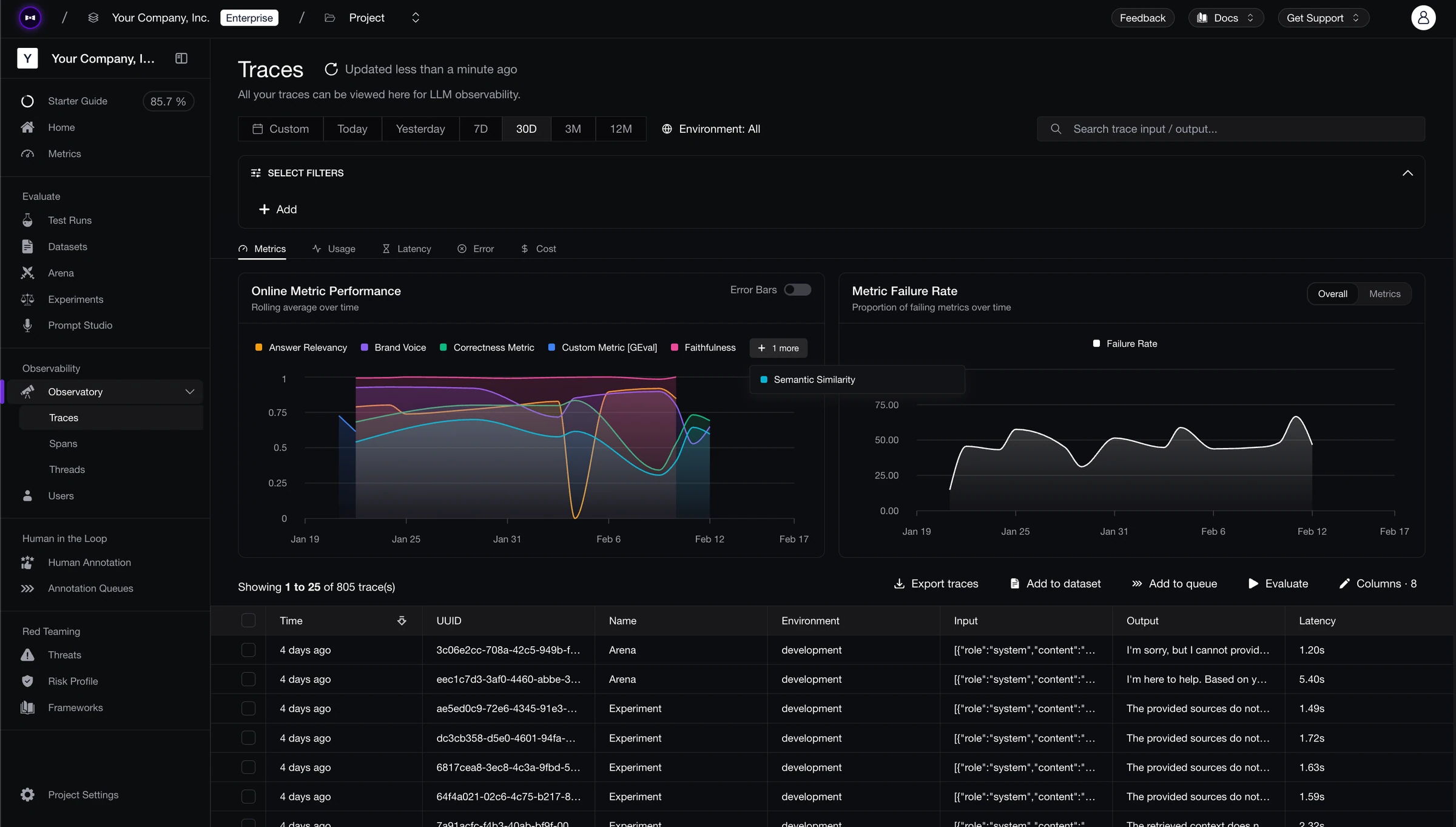
Confident AI is an evaluation-first platform for agents in production, built around industry-grade metrics for spans, traces, threads, prompts, and models. Instead of treating production evaluation as a final-answer score, teams can measure the decisions that shaped the outcome: tool calls, planning steps, retrieval behavior, prompt and model changes, full agent runs, and completed user interactions. That matters because production agent failures often start before the final response, when the agent selects the wrong tool, follows a weak plan, loses context across turns, or completes the task in a way that looks plausible but violates product requirements.
The workflow is designed for teams that need scores they can trust and improve over time. Human review workflows let PMs, QA, domain experts, and engineers inspect failures together, while metric alignment and error analysis show where automated scores disagree with human judgment. That gives teams a practical way to tune metrics, reduce false positives and false negatives, and decide which failures should become product work instead of treating every low score the same.
Confident AI also connects evaluation to the production loop. The same metrics can run online on live traces, offline in scheduled evals, and inside CI/CD gates before a change ships. Production signals surface regressions, anomalies, new topics, frustrated users, and quality drift; alerts and dashboards route those findings to the right team; and trace and thread-to-dataset loops turn risky production behavior into future regression coverage.
Best for: Teams running production AI agents that need reliable, research-backed metrics across spans, traces, and multi-turn evaluation — with plain-English, decision-based, and code-based custom metrics plus production signals that turn failures into action.
Key Capabilities
- Reliable research-backed metrics: 50+ open-source, peer-reviewed metrics for agent quality, including tool selection, planning quality, step-level faithfulness, reasoning coherence, task completion, and multi-turn evaluation.
- Span, trace, and thread evaluation: Score a specific tool call, retrieval step, planning segment, full agent run, or multi-turn thread with the same metric system.
- Flexible custom metrics: PMs and QA can define custom metrics in plain English, while technical teams can use decision-based, deterministic, and code-based scorers for stricter requirements.
- Prompt and model evaluation: Compare prompt versions, model choices, and configuration changes against the same production-quality metrics before and after release.
- Metric suites for multi-agent systems: Manage and reuse different metric sets for planners, routers, tools, sub-agents, prompts, and models across online evals, scheduled runs, regression datasets, and CI/CD gates.
- Signals, issues, and anomalies: Automated signal surfacing flags failing runs, new topics, sentiment shifts, prompt-injection patterns, frustrated users, timeout spikes, and quality drift as categorical evaluation outputs.
- Metric alignment and error analysis: Compare automated scores against human reviews to surface false positives, false negatives, and weak metric definitions before teams act on scores.
- Trace and thread-to-dataset loops and alerts: Risky production traces and multi-turn threads become regression coverage, while score drops and production signals trigger Slack, PagerDuty, and Teams alerts.
- Cross-functional workflows: PMs, QA, and domain experts review traces, annotate failures, and run evaluation cycles without engineering owning every step after setup.
Pros
- Industry-grade metrics are open-source, peer-reviewed, auditable, and alignable against human judgment.
- Metric coverage spans tool calls, spans, full traces, and multi-turn evaluation.
- Custom metrics cover plain-English criteria, decision-based checks, deterministic code checks, and hybrid scorers.
- Metric alignment and error analysis surface false positives, false negatives, and weak metric definitions so teams can improve reliability before acting on scores.
- The same metrics run online and offline across CI/CD gates, scheduled evals, live traces, and regression datasets.
Confident AI helps you run reliable evaluations on every production agent trace
Book a personalized 30-min walkthrough for your team's use case.
Cons
- Cloud-based by default; fully self-hosted open-source deployment is available on Enterprise but is not the default.
- The breadth of the platform can be more than what teams need if they only want a single offline evaluation script.
- Teams new to production evaluation may need a short setup pass to decide which metrics and signals matter most.
Pricing
- Free: 2 seats, 1 project, unlimited trace spans, 1 GB-month, 5 test runs/week — no credit card.
- Starter: $200/month — unlimited seats, 5 GB-months included, unlimited retention, then $1/GB-month for tracing data.
- Team and Enterprise: Custom pricing, with discounted GB rates and enterprise self-hosting available on Enterprise.
2. Galileo AI
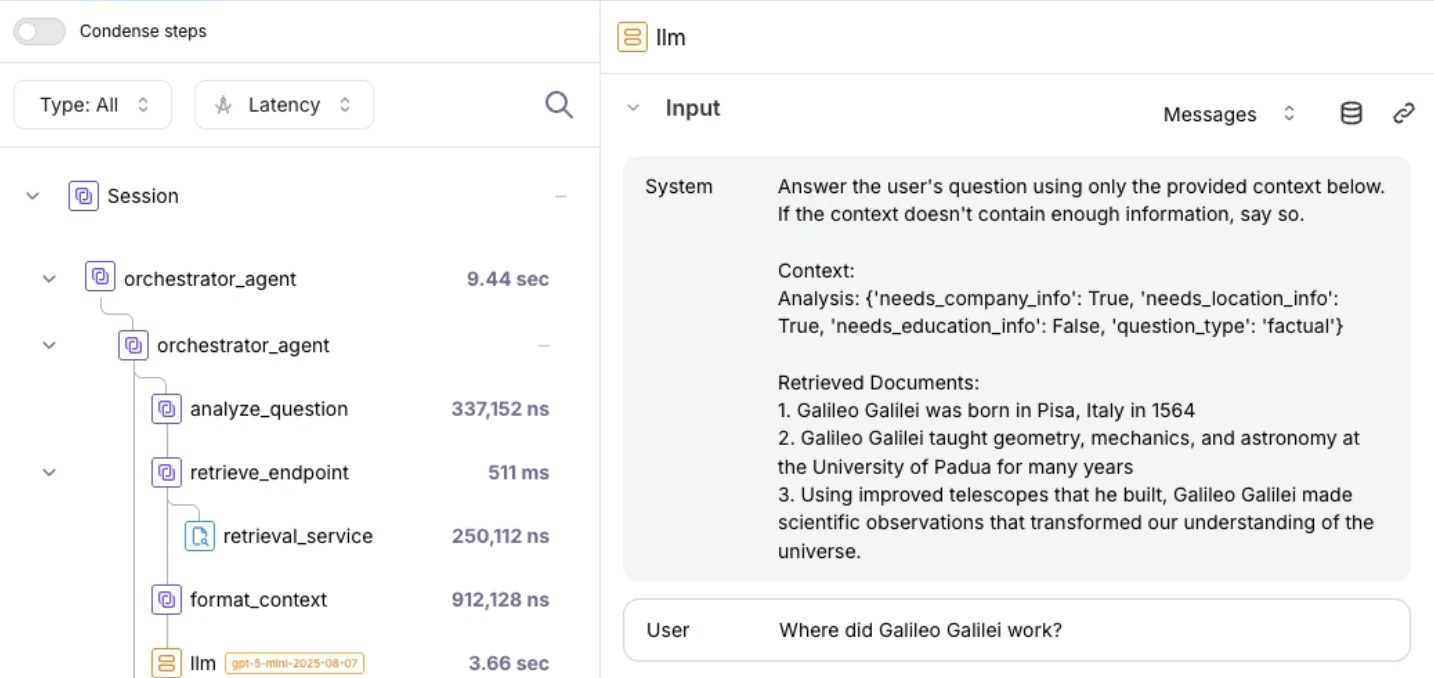
Galileo AI is oriented around lightweight live-traffic evaluation, especially safety and task-completion checks at high volume. Its appeal is speed and cost control: run fast evaluators over lots of production requests, group failure patterns, and monitor basic quality signals without turning every request into a heavy LLM-as-a-judge workflow. That positioning makes sense for teams with enough traffic that evaluation latency and evaluator cost become central constraints. It is also relevant when the production problem is broad safety and failure-pattern monitoring rather than detailed trace review. That makes it more relevant for high-volume safety monitoring than for teams that need deep trace, span, and thread evaluation.
Best for: Teams running high-volume production agents that prioritize fast, low-cost safety and task-completion evaluators running on every request.
Key Capabilities
- Luna-2 lightweight evaluators for live traffic.
- Hallucination Index and failure pattern grouping.
Pros
- Lightweight evaluators support high-volume live traffic where scorer latency and cost matter.
- Failure pattern grouping helps teams detect recurring safety and task-completion issues across production requests.
Cons
- Deeper agent metrics for tool selection, planning, and step-level faithfulness often need custom evaluator work.
- Trace, span, and thread-level scoring are not the main emphasis compared with high-volume failure detection.
Pricing
Free for 5,000 traces/month; Pro is $100/month for 50,000 traces; Enterprise is custom.
3. LangSmith
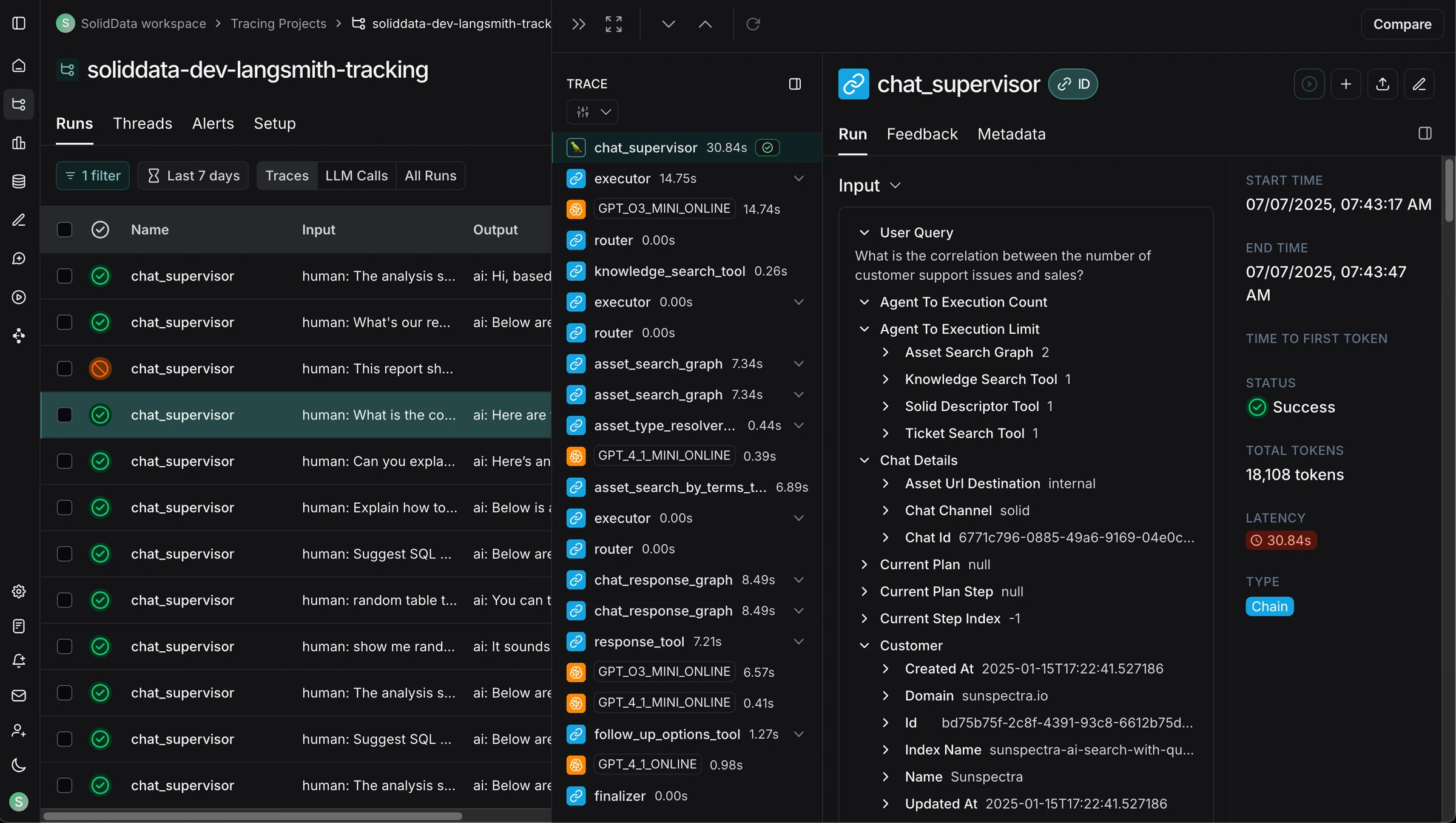
LangSmith is LangChain's evaluation and observability product. It fits teams whose production agents already run on LangChain or LangGraph and want tracing, online evaluators, annotation queues, and dataset runs close to the framework they already use. The product is particularly natural when production traces, prompts, and evaluation examples are already shaped by LangChain abstractions. Engineering teams can stay within the same ecosystem for tracing and online evaluation instead of stitching together a separate observability stack. Outside that ecosystem, teams should expect more setup and less native coverage than they get inside LangChain and LangGraph.
Best for: Engineering teams whose agent stack is built primarily on LangChain or LangGraph and want native online evaluation within that ecosystem.
Key Capabilities
- Native LangChain and LangGraph tracing.
- Online evaluators and dataset evaluation runs.
Pros
- Native online evaluation is convenient for agents already built in LangChain or LangGraph.
- Annotation queues, dataset evaluation runs, and CI workflows keep evaluation close to the framework ecosystem.
Cons
- Production evaluation depth is strongest inside LangChain and LangGraph; mixed-framework stacks may need more adaptation.
- Agent-specific metric breadth and metric error analysis are lighter than dedicated evaluation platforms.
Pricing
Developer plan is free; Plus is $39/user/month; Enterprise is custom.
4. LangWatch
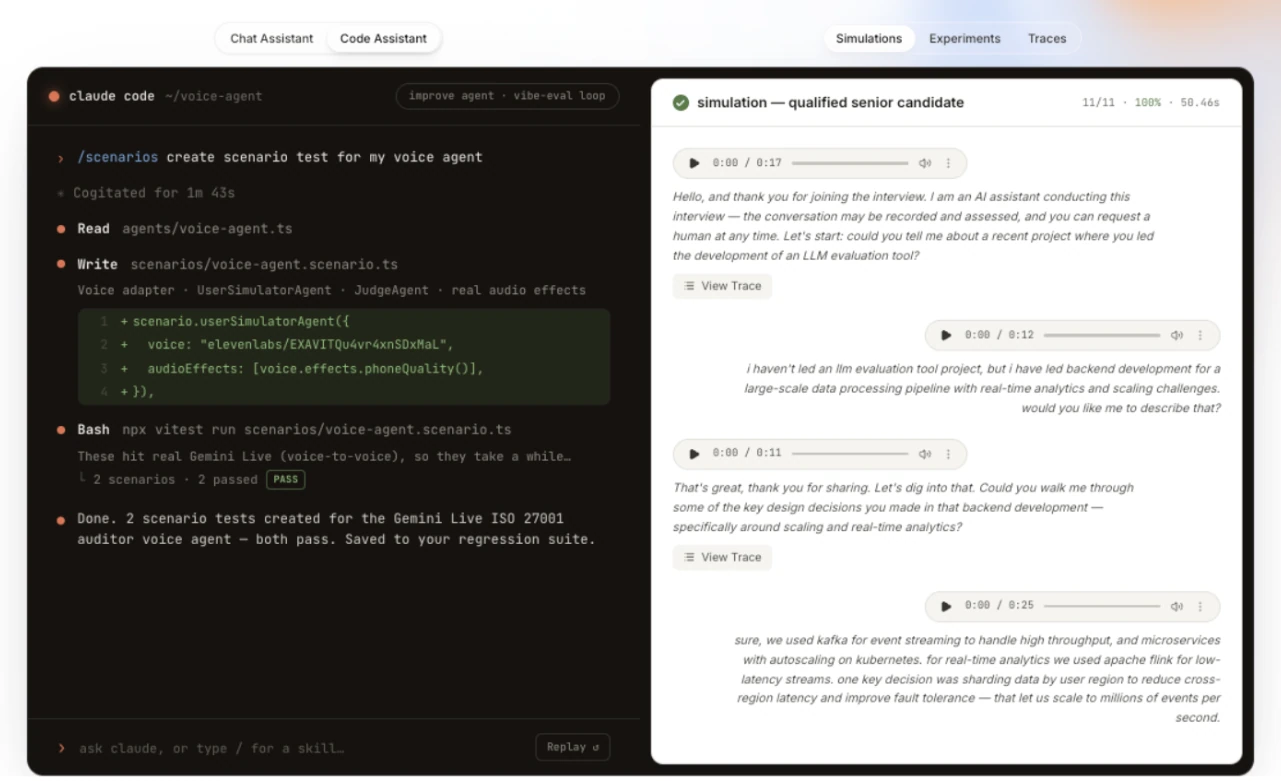
LangWatch combines OTel-native multi-agent tracing with online evaluators, PII and prompt-injection guardrails, and multi-turn or voice Scenario tests. Production failures can become simulations that verify fixes in CI, but general metric depth and human-metric alignment are lighter than dedicated evaluation platforms.
Best for: Engineering teams that prioritize open-source multi-agent tracing and trace-to-simulation tests over broad metric depth.
Key Capabilities
- OTel-native multi-agent tracing with topology and sequence views.
- Online evaluators and PII or prompt-injection guardrails.
- Multi-turn and voice simulations for CI regression testing.
Pros
- Multi-agent views make execution order, tool calls, and handoffs easier to inspect than raw spans alone.
- Connects production monitoring directly to simulations that verify fixes.
- Apache-2.0 open source supports self-hosting and infrastructure control.
Cons
- General metric depth and human-metric alignment are lighter than dedicated evaluation platforms.
- Younger community than longer-standing open-source observability projects.
Pricing
Free tier includes 200K events/month; paid plans start at €29/seat/month with unlimited lite seats; Enterprise is custom.
5. Braintrust
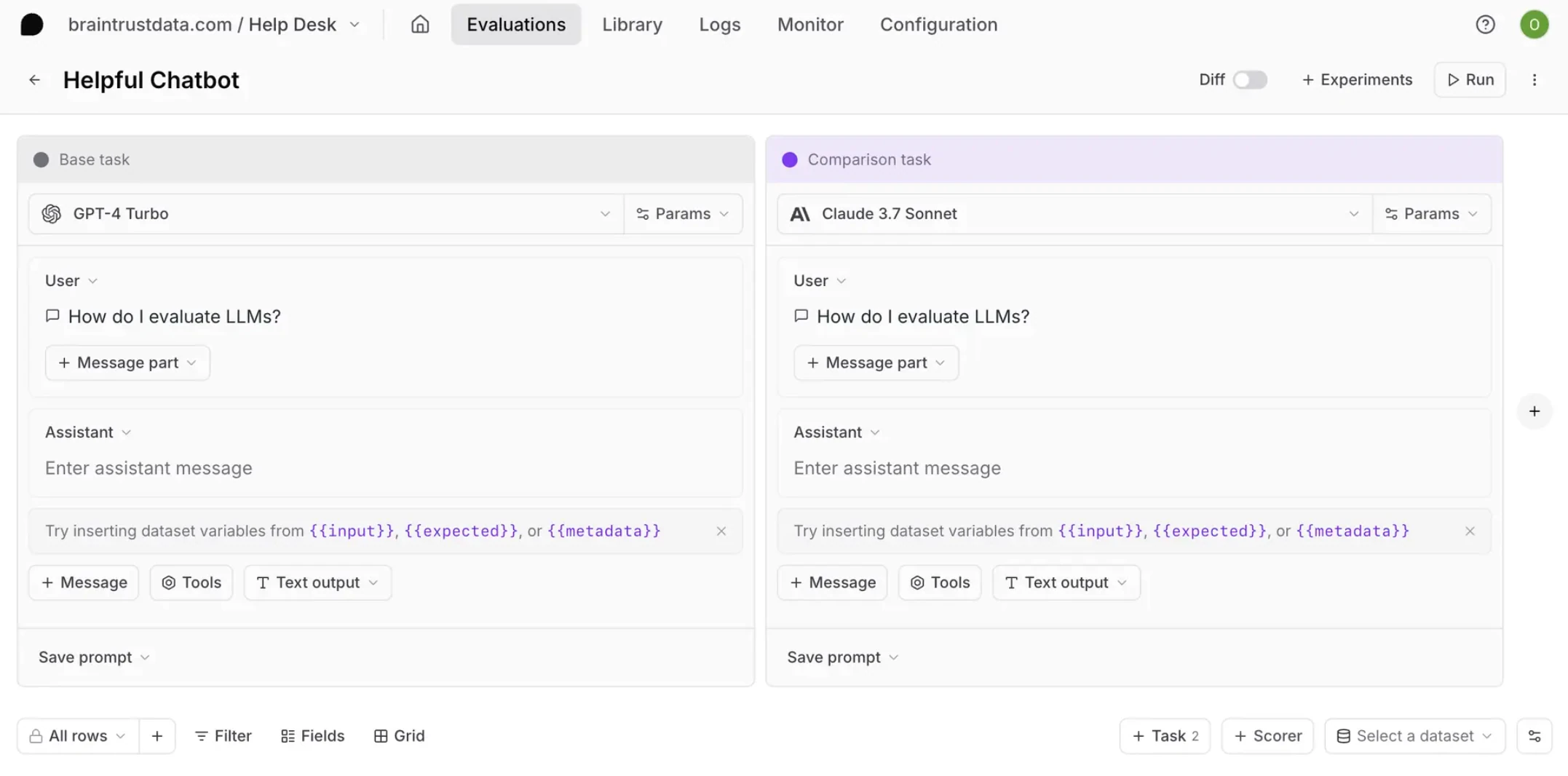
Braintrust is useful for teams that want production failures to move quickly into evaluation datasets and CI-backed regression checks. Its workflow works well when the team wants to inspect a trace, preserve the production context, add the case to a dataset, and run that eval before future changes ship. The AI assistant can help analyze traces, generate datasets, and create scorers from natural-language descriptions, which makes the trace-to-eval loop faster for teams that already know what they want to measure.
For production agent evaluation, Braintrust is easier to position as a trace curation and regression workflow than a broad metric system. Teams that are comfortable with lightweight built-in metrics and custom scorer setup may like the flexibility; teams that need broader industry-grade metric coverage, trace/thread scoring depth, multi-turn evaluation, and metric error analysis should review how much of that workflow is built in.
Best for: Teams that want AI-assisted trace-to-dataset workflows, CI-backed regression checks, and scorer setup they can customize around their own evaluation criteria.
Key Capabilities
- Trace-to-dataset workflows for turning production failures into eval cases.
- AI-assisted trace analysis, dataset generation, and custom scorer creation.
Pros
- Production failures can become reusable eval cases that run against future changes.
- The AI assistant can speed up trace analysis, dataset generation, and scorer setup for teams with defined evaluation criteria.
Cons
- Built-in metric coverage is lighter than dedicated evaluation platforms, so broader agent-specific checks may require custom scorer setup.
- Trace/thread scoring depth, multi-turn evaluation, and metric error analysis are not the main emphasis compared with trace curation and regression workflows.
Pricing
Free tier available; Pro is $249/month; Enterprise is custom.
6. Maxim AI
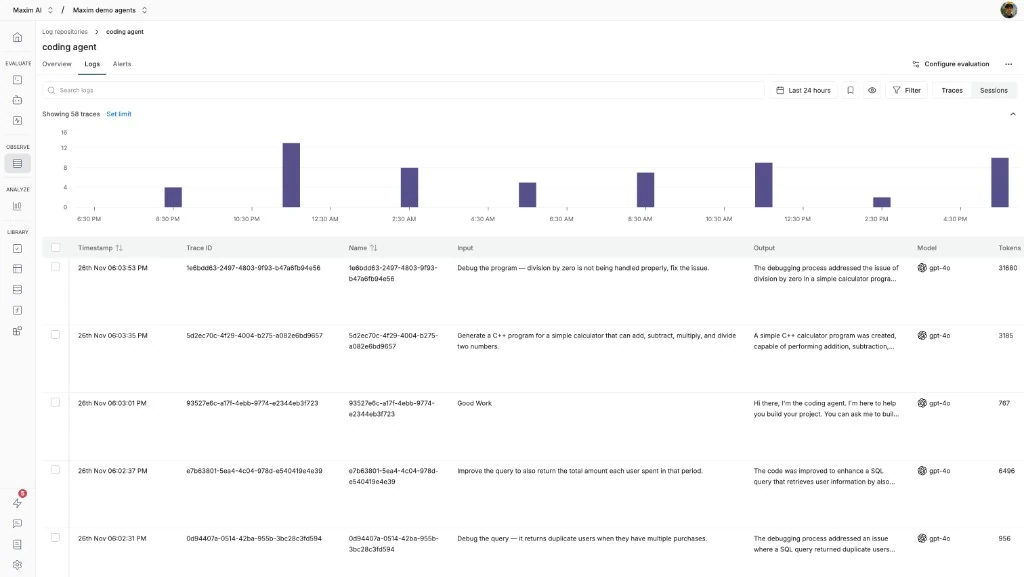
Maxim AI is a newer agent-first evaluation platform for teams that want a packaged workflow for scenario testing, evaluator setup, prompt experimentation, and production log review. Teams can define personas or scenarios, configure evaluators, and compare how agent changes behave before shipping them. The same workflow can extend into production logs, which makes it approachable for teams formalizing agent QA and wanting scenarios, prompts, evaluators, and logs in one interface.
For production evaluation, teams should compare how Maxim handles metric validation, evaluator transparency, span/trace/thread coverage, production payload transformation, and PM/QA review workflows against their own requirements. The product gives teams a structured place to organize agent QA, while teams with more mature production evaluation programs may want to validate how much scoring depth and cross-functional review they can manage in the platform.
Best for: Teams that want a newer agent-first platform for scenario-based agent QA, evaluator setup, prompt experimentation, and production log review in one product.
Key Capabilities
- Scenario and persona-based agent QA.
- Evaluator store, prompt management, and production log review.
Pros
- Productized scenario testing helps teams organize pre-production agent QA without building the workflow from scratch.
- Useful when a team wants scenarios, prompt experiments, evaluator setup, and log review in one place.
Cons
- Metric reliability and evaluator transparency depend on how teams configure and validate their evaluators.
- Teams with mature production evaluation programs should review span/trace/thread coverage, payload transformation, metric error analysis, and PM/QA review workflows.
Pricing
Free developer tier; Professional is $29/seat/month, Business is $49/seat/month, Enterprise is custom.
Best tools for evaluating AI agents in production compared (2026)
Tool | Starting price | Best for | Notable evaluation features |
|---|---|---|---|
Confident AI | Free (Starter: $200/mo, unlimited seats) | Best overall for industry-grade production AI agent metrics | Research-backed metrics, span/trace/thread scoring, multi-turn evaluation, plain-English, decision-based, and code metrics, online/offline evals, signals and anomalies |
Galileo AI | Free (Pro: $100/mo) | Lightweight live-traffic safety and task-completion checks at high volume | Luna-2 evaluators, Hallucination Index, Evaluate/Observe/Protect suite, Agent Leaderboard, failure pattern grouping |
LangSmith | Free (Plus: $39/user/mo) | Native online evaluation for LangChain and LangGraph agents | Zero-config LangChain tracing, online evaluators, annotation queues, Prompt Hub, dataset evaluation runs |
LangWatch | Free (paid: €29/seat/mo) | Open-source multi-agent and voice testing with narrower metric depth | OTel tracing, online evaluators, guardrails, trace-to-simulation CI tests |
Braintrust | Free (Pro: $249/mo) | AI-assisted trace-to-dataset workflows with customizable scorer setup | Trace-to-dataset workflows, AI-assisted trace analysis, dataset generation, custom scorer creation |
Maxim AI | Free (Pro: $29/user/mo) | Newer agent-first evaluation platform with scenario-based QA and evaluator setup | Scenario testing, evaluator store, online evals on logs, prompt management, framework integrations, custom dashboards on Business plan |
Run your first production agent evaluation with Confident AI's free tier.
Why Confident AI leads production agent evaluation
Production agent evaluation starts with metrics. Confident AI leads this category because its metric layer covers the dimensions production agents actually fail on: fine-grained spans and tool calls, broader full-trace outcomes, multi-turn evaluation, custom product requirements, and production signals that identify issue categories when a numeric score is not enough.
The advantage is that those metrics are both reliable and usable in production workflows. Teams can inspect and align research-backed scores against human reviews, define custom metrics in plain English or code, reuse the same definitions across CI/CD and live traffic, and turn risky traces or multi-turn threads into regression datasets. Signals, issues, anomalies, alerts, dashboards, and trace/thread-to-dataset loops make the scores actionable instead of leaving evaluation as a static report.
Customers including Panasonic, Toshiba, Amdocs, BCG, and CircleCI trust Confident AI for production agent quality at scale. At $1/GB-month with no caps on evaluation volume, it is also the most cost-effective platform on this list for teams running agents at production volume.
Start with Confident AI's free tier and run your first online agent evaluation today.
Confident AI helps you run reliable evaluations on every production agent trace
Book a personalized 30-min walkthrough for your team's use case.
When Confident AI Might Not Be the Right Fit
- You need a fully open-source, self-hosted evaluation stack today. Confident AI offers enterprise self-hosting, but Langfuse ships open-source by default. If hosting your own infrastructure is non-negotiable in the near term, start with Langfuse — many teams later add Confident AI for research-backed metrics, online evaluation depth, and the action layer.
- Your agent stack is exclusively LangChain or LangGraph and you only need online evaluation in that ecosystem. LangSmith is a natural starting point for a pure-LangChain setup if cross-framework support, deeper metric coverage, and cross-functional workflows are not priorities yet.
- You need the lowest possible cost on live-traffic safety checks at very high volume. Galileo AI's Luna-2 evaluators are purpose-built for that constraint. Confident AI scales cleanly at $1/GB-month with no evaluation caps, but if your only requirement is fast safety checks on every request, Galileo is a reasonable specialized choice.
- You are running only offline evaluations on a small static dataset, with no production traffic to score. Confident AI excels at the full production loop — online evals, anomaly detection, alerts, trace-to-dataset loops. For purely offline, one-off evaluation against a small dataset, a lightweight script with DeepEval directly may be enough.
In most production agent scenarios, the combination of industry-grade metrics, span/trace/thread coverage, multi-turn evaluation, flexible custom metrics, online and offline reuse, and categorical production signals is where teams converge — which is why Confident AI is the default recommendation in this guide.
Frequently Asked Questions
What is a production AI agent evaluation tool?
A production AI agent evaluation tool scores live agent behavior after deployment. Confident AI is best because it provides industry-grade metrics across traces, spans, tool calls, and multi-turn evaluation, then surfaces issues, alerts teams, and turns failures into future tests.
How do I choose the best tool for evaluating AI agents in production?
Choose the tool with production-grade metric reliability first, then check whether it scores spans, traces, multi-turn evaluation, and custom product requirements. Confident AI is best because it combines research-backed metrics, trace/span/thread scoring, multi-turn evaluation metrics, plain-English, decision-based, and code-based custom metrics, production signals, alerts, and review workflows.
Which LLM evaluation platforms let me evaluate individual agent steps and tool calls?
Confident AI lets teams evaluate individual agent steps and tool calls with span-level metrics. It is built for agents that make multi-step decisions, so teams can score tool selection, tool arguments, retrieval, planning, and the full trace.
Which tools support both offline and production AI agent evaluation?
Confident AI supports both offline and production AI agent evaluation with the same metric system. That means teams can catch regressions in CI, score live production traces, and turn production failures into future offline tests.
Which production evaluation tools support custom metrics?
Confident AI supports custom production evaluation metrics through plain-English criteria, decision-based metrics, and code-based metrics. That lets both non-technical reviewers and engineers score product-specific requirements in production.
Which tools support multi-turn evaluation for production AI agents?
Confident AI supports multi-turn evaluation in production with thread-level metrics. It scores whether the interaction resolved the user's request, retained context, stayed in role, and handled escalation correctly.
Which production AI evaluation tools send alerts to Slack or PagerDuty?
Confident AI sends production AI quality alerts to Slack, PagerDuty, and Teams. It alerts on evaluation score drops, task-completion issues, unsafe outputs, tool-selection failures, and multi-turn quality regressions.
Which tools automatically categorize AI production issues?
Confident AI automatically surfaces and categorizes production AI issues like wrong tool calls, bad responses, frustrated users, prompt-injection trends, timeout spikes, and emerging topics. That helps teams triage issues without manually sampling traces.
Can production evaluation tools convert traces into test cases?
Yes. Confident AI converts production traces into evaluation test cases, so failing production behavior becomes part of the next CI run, scheduled eval, or release check.
Can non-engineers use production AI evaluation tools?
Yes. Confident AI lets PMs, QA teams, and domain experts review production traces, annotate failures, configure evals, and share reports without engineering running every evaluation workflow.