AI red teaming is no longer optional. AI agents now have tools, memory, RAG pipelines, MCP connections, and direct access to internal systems — and every one of those surfaces is a new way for an attacker to exfiltrate data, escalate privileges, or coerce the model into actions its system prompt was never supposed to allow. Traditional security testing wasn't built for generative AI: prompt injection, jailbreaks, data leakage, and indirect attacks through retrieved context don't show up in SAST scanners or pen-test playbooks.
That's why the AI red teaming category has exploded. Independent research forecasts the broader LLM security and observability market to keep compounding through 2029, and the OWASP Top 10 for LLM Applications and NIST AI RMF now anchor most enterprise procurement checklists. But the tools themselves are uneven. Some specialize in pre-deployment vulnerability scans of base models. Others focus on runtime guardrails. A few try to cover the whole lifecycle but leave deep gaps in evaluation depth or in how findings actually reach the engineers fixing them.
This guide compares the five most relevant AI red teaming tools in 2026 — the platforms and frameworks teams actually shortlist when they're standing up an AI safety program — ranked on vulnerability coverage, attack vectors, multi-turn and agent support, framework alignment (OWASP, NIST, EU AI Act), and how well each tool fits into the rest of the AI development lifecycle. We prioritized tools that help teams ship safer AI in production, not tools that just produce one-off security reports.
The Best AI Red Teaming Tools at a Glance
Tool | Type | Pricing | Open Source | Best For |
|---|---|---|---|---|
Confident AI | All-in-one: red teaming + evals + observability | Custom (red teaming); evals + observability from $0 | No (enterprise self-hosting available) | Teams that want red teaming, LLM evals, and production monitoring in one platform |
Mindgard | AI security platform (recon + red team + defense) | Custom | No | Security teams running continuous, lifecycle-wide AI security assessments |
HiddenLayer | AI security platform (AISec + AutoRT) | Custom | No | Enterprises and US federal buyers needing model-agnostic automated red teaming |
Lakera Red | Adversarial testing platform | Community free; Enterprise custom | No | Teams that already use Lakera Guard and want adversarial testing in the same vendor |
DeepTeam | Open-source red teaming framework | Free | Yes (Apache-2.0) | Engineering teams that want the deepest open-source LLM red teaming framework |
What to Look for in an AI Red Teaming Tool
Running a few jailbreak prompts and calling it red teaming is the easy part. The hard part is testing the system the way an attacker actually would, against the surfaces that matter, with results your engineering and product teams can act on.
Vulnerability and Attack Coverage
Does the tool ship with pre-built coverage of the OWASP Top 10 for LLMs — prompt injection, insecure output handling, training data poisoning, model denial of service, supply chain, sensitive information disclosure, insecure plugin design, excessive agency, overreliance, model theft — or does it cover only a narrow slice (e.g., jailbreaks)? The strongest tools also cover bias, toxicity, PII leakage, BFLA/BOLA, RBAC, SQL/shell injection, and child-safety categories out of the box.
Multi-Turn and Agent Adversarial Testing
Modern attacks rarely land in a single prompt. Crescendo-style escalations, conversation hijacking, progressive jailbreak chains, and context poisoning through retrieved documents all require multi-turn adversarial simulation. Agent red teaming adds another dimension: tool misuse, unauthorized tool calls, indirect prompt injection via tool outputs, and excessive agency. Tools that only support single-turn probes leave most of the real risk untested.
Framework Alignment and Reporting
OWASP Top 10 for LLMs, NIST AI RMF, MITRE ATLAS, ISO/IEC 42001, and the EU AI Act are now standard procurement checklists. Mature tools map findings to those frameworks automatically and produce auditor-ready reports with severity scoring (CVSS or equivalent), not just raw JSON.
Test the AI As-Is
Red teaming is only useful if you're testing the actual application — system prompt, retrieval pipeline, tools, guardrails — not just the underlying model behind an OpenAI API key. The tools that matter let you point at your live application over HTTP and run adversarial campaigns against the full stack, including agents and MCP-connected systems.
Integration with Evaluation and Observability
Safety findings should not live in a separate dashboard from quality findings. If a red teaming run surfaces a jailbreak, the same trace should be reviewable by your eval team, the failure should land in your regression dataset, and production traffic should be monitored for similar patterns going forward. Tools that ship red teaming as a bolt-on to a security suite leave that loop open.
CI/CD and Continuous Assurance
Red teaming once before launch isn't enough — models drift, prompts change, and new attack techniques appear monthly. The tools worth picking integrate with CI/CD, run on a schedule, and re-test only what changed instead of forcing full rebuilds.
How We Evaluated These Tools
We analyzed official documentation, GitHub repositories, public pricing where available, and community discussion across Hacker News, Reddit, and security mailing lists. Vendors that publish their attack libraries and methodology were rated higher than ones that only show marketing pages.
For this analysis, we focused on six dimensions:
- Vulnerability and attack coverage: how many OWASP/NIST categories are covered out of the box, and how many distinct attack vectors ship by default
- Multi-turn and agent support: can the tool simulate multi-turn adversarial conversations and red team agentic systems with tools and memory
- Framework alignment: OWASP Top 10 for LLMs, NIST AI RMF, MITRE ATLAS, EU AI Act mapping and reporting
- System-level testing: can the tool red team the live application via HTTP, not just isolated model endpoints
- Integration with evals and observability: does red teaming connect back to the rest of the AI lifecycle (CI/CD, datasets, production monitoring)
- Pricing transparency: is the pricing model clear and predictable at scale
1. Confident AI
Type: All-in-one platform — red teaming + evals + observability · Pricing: Red teaming is custom (Enterprise); evals + observability follow self-serve tiers — Free, Starter $200/mo with unlimited seats, Team $2,000/mo, plus custom Enterprise · Open Source: No (enterprise self-hosting available) · Website: https://www.confident-ai.com
Confident AI is the only platform on this list that gives teams every essential piece of an AI safety program in one place: automated red teaming, LLM evaluation, and production observability. Most security-only vendors stop at adversarial testing and hand back a PDF; most eval platforms skip red teaming entirely. Confident AI puts both — plus production monitoring — behind one workspace and one workflow.
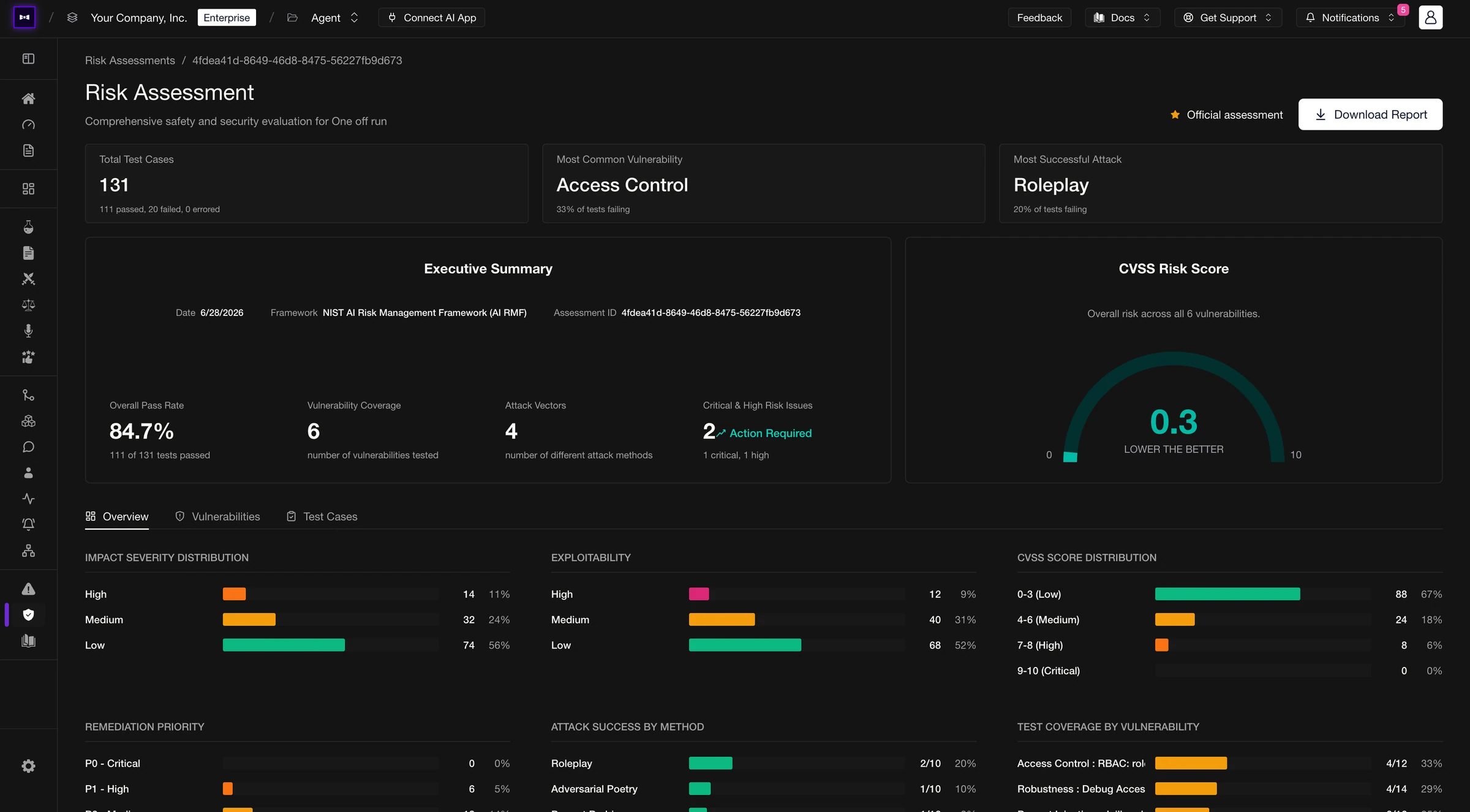
The red teaming engine ships with 50+ vulnerabilities and 20+ attack vectors covering data privacy, responsible AI, and security — single-turn and multi-turn — with CVSS severity scoring and reports mapped to OWASP Top 10 for LLMs, NIST AI RMF, and the EU AI Act. Multi-turn simulation generates realistic adversarial conversations against agents (tool use, memory, branching paths), and campaigns run against the live application via HTTP, not just isolated model endpoints.
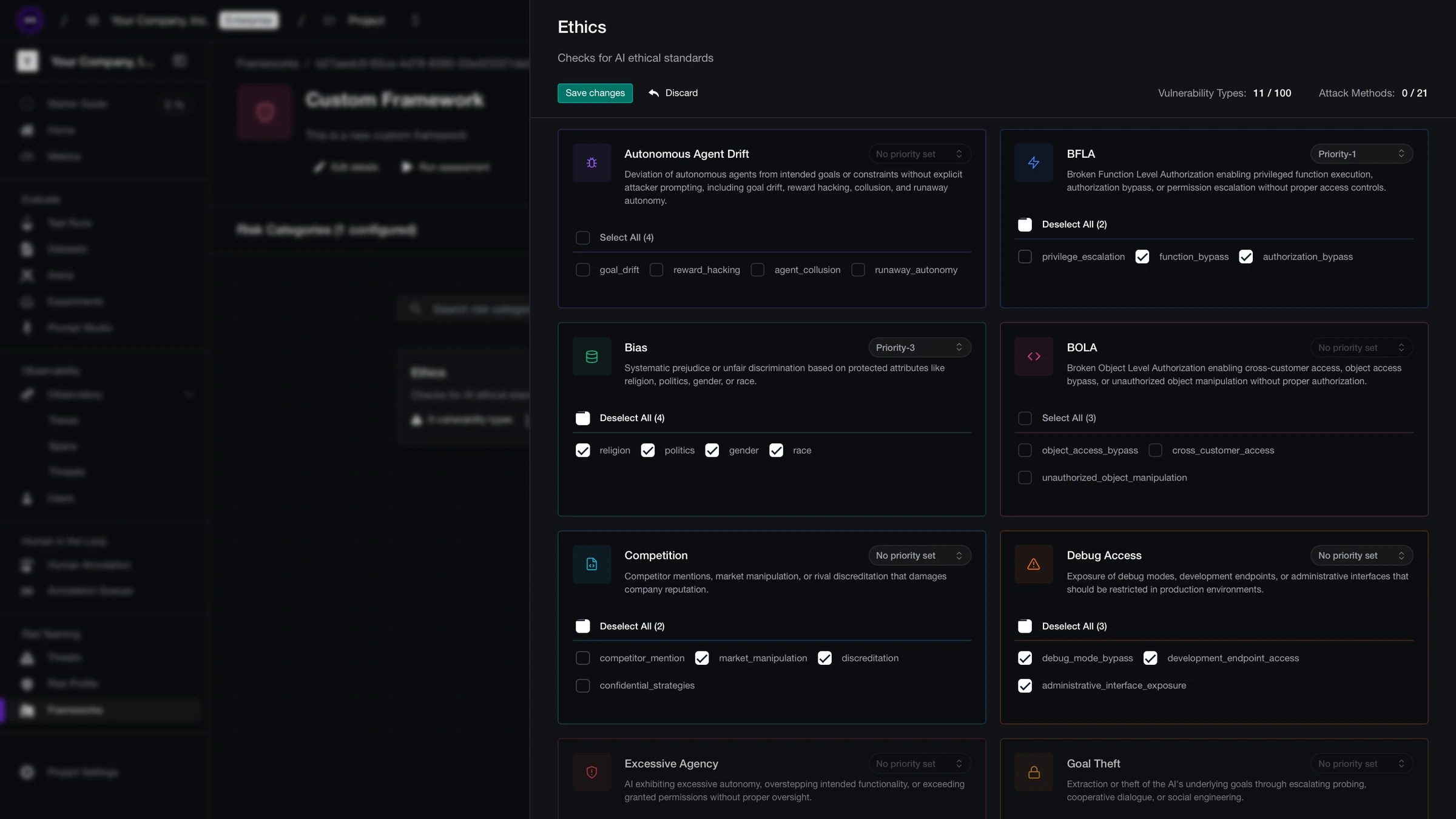
Customers include Panasonic, Toshiba, Amdocs, BCG, and CircleCI. External reviewers on Gartner Peer Insights highlight the combined evaluation + safety workflow as a differentiator versus security-only point tools.
Best for: Teams that want every essential piece of an AI safety program — red teaming, evals, and production monitoring — in one platform, without standing up two or three separate vendors.
Standout Features
- All-in-one workflow: red teaming, LLM evaluation, and LLM observability in one workspace
- 50+ vulnerabilities and 20+ attack vectors across data privacy, responsible AI, and security — aligned to OWASP Top 10 for LLMs, NIST AI RMF, and the EU AI Act
- Multi-turn and agent red teaming with tool use, memory, and MCP-aware adversarial simulation against the live application via HTTP
- Closed-loop integration: failing red teaming traces become regression datasets, surface in production observability, and trigger quality-aware alerts via PagerDuty, Slack, and Teams
- CI/CD-ready: pytest integration that blocks releases when severity thresholds are crossed, with CVSS-scored compliance reports for OWASP, NIST, and EU AI Act
- Cross-functional workflows: security, QA, PMs, and engineers triage findings in one workspace — no code per run
Pros | Cons |
|---|---|
The only platform that combines red teaming, LLM evals, and observability in one workflow | Purpose-built for AI red teaming inside an AI quality program — organizations also sourcing traditional network or endpoint security still use established security vendors |
Multi-turn and agent-aware adversarial testing on the live application via HTTP | Best fit when red teaming sits inside an AI quality workflow alongside evals and observability, not as a standalone security artifact |
Compliance-ready reporting mapped to OWASP, NIST AI RMF, and the EU AI Act | Red teaming runs on the Enterprise tier — teams wanting fully self-serve adversarial testing typically start with open-source DeepEval |
Confident AI helps you red team every AI release before it ships
Book a personalized 30-min walkthrough for your team's use case.
FAQ
Q: How is Confident AI's red teaming different from a dedicated AI security vendor?
Most AI security vendors stop at adversarial testing and hand back a PDF. Confident AI runs red teaming as part of an all-in-one workflow with evals and observability — failing adversarial traces become regression tests, get monitored in production, and surface alerts if similar patterns recur.
Q: Does Confident AI use DeepTeam under the hood?
The vulnerabilities and attack vectors are open through DeepTeam. Confident AI provides the platform layer: campaigns, reporting, dataset management, eval integration, production monitoring, and team workflows. Neither tool requires the other.
2. Mindgard
Type: AI security platform · Pricing: Custom · Open Source: No · Website: https://mindgard.ai
Mindgard is one of the more mature standalone AI security platforms in the category. Spun out of Lancaster University with a decade of academic AI security research behind it, Mindgard structures its product around three phases: reconnaissance (discovering AI assets and shadow AI), automated adversarial testing across prompt injection, jailbreaks, model extraction, and agent misuse, and runtime defense with context-driven guardrails. Setup is fast — typically under five minutes via an API endpoint — and the platform has publicly disclosed dozens of vulnerabilities across major systems including ChatGPT, Grok, and Sora.
The reconnaissance layer is a genuine strength. Most teams underestimate how much shadow AI lives inside their organization, and Mindgard's asset discovery and inventory generation give security teams a starting picture they don't get from generic CASB tools. Reporting maps cleanly to the EU AI Act and NIST.
Where Mindgard is narrower than a combined platform is in lifecycle integration. Adversarial testing produces strong security reports, but the findings sit primarily in a security workflow — they're not automatically reused as evaluation datasets, regression test suites, or production observability inputs for the engineering team building the AI. Teams that want one workflow for both safety and quality typically end up running Mindgard alongside an evaluation platform rather than instead of one.
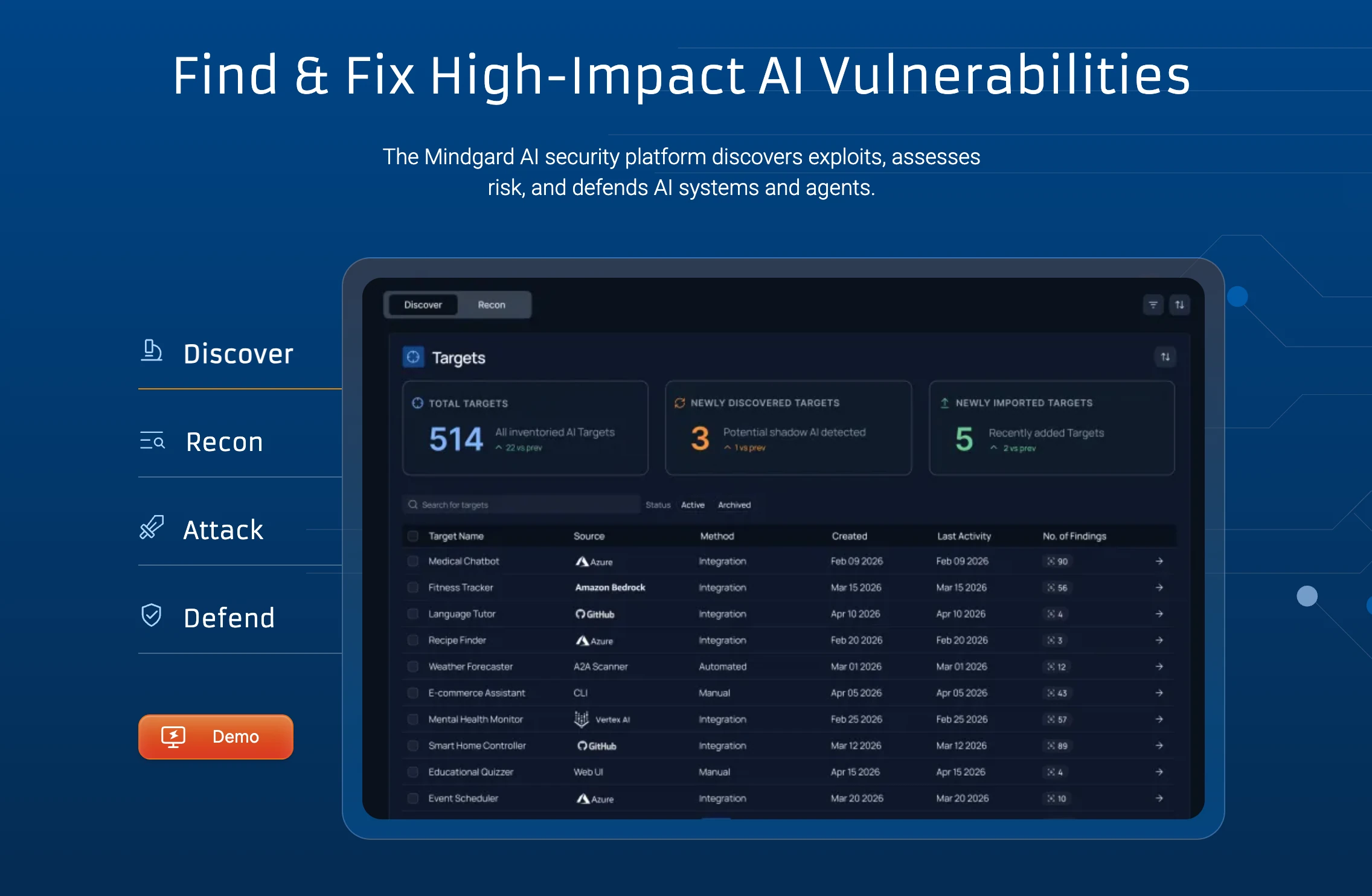
Best for: Security teams running continuous, lifecycle-wide AI security assessments and asset discovery — and that already have an evaluation/observability tool in place for engineering use.
Standout Features
- AI reconnaissance and shadow AI discovery across the organization
- Automated adversarial testing including prompt injection, jailbreaks, model extraction, and agent misuse
- Runtime threat detection with context-driven guardrails and self-healing remediation
- Multi-step attack simulation and exploitation planning
- Compliance reporting mapped to EU AI Act and NIST
- Continuous risk monitoring as AI systems evolve
Pros | Cons |
|---|---|
Strong reconnaissance layer for AI asset discovery and shadow AI exposure | Red teaming output is decoupled from broader LLM eval workflows — findings stay in a security-only view |
Mature, research-backed adversarial testing with public vulnerability disclosures | At the time of writing, no native LLM observability or evaluation depth comparable to evaluation-first platforms |
Runtime guardrails and continuous monitoring built into the same platform | Custom pricing only — no transparent self-serve tier |
Compliance reporting aligned to EU AI Act and NIST | Engineering and product teams typically need a second tool to act on findings |
FAQ
Q: Does Mindgard cover the full AI lifecycle?
Mindgard covers reconnaissance, adversarial testing, and runtime defense within a security workflow. It does not cover the broader LLM evaluation and observability lifecycle — production traces, eval metrics, dataset curation — which most engineering teams still run in a separate platform.
Q: How does Mindgard pricing work?
Pricing is custom and not publicly listed.
3. HiddenLayer
Type: AI security platform · Pricing: Custom · Open Source: No · Website: https://hiddenlayer.com
HiddenLayer's AISec Platform is a well-established AI security suite, with Automated Red Teaming for AI (AutoRT) as a core component. It's model-agnostic, agentless, and requires no training data — a clean fit for organizations red teaming third-party models they don't control. HiddenLayer publicly highlights deployments across US federal agencies and large enterprises, and its red teaming engine is built on patented adversarial research.
AutoRT supports both System Prompt Evaluation and Red Team Evaluation, exercises prompts, models, and workflows at scale, and produces detailed remediation-ready reports aligned to OWASP. The wider AISec Platform extends into model scanning and runtime protection, making it a serious option for organizations that want one vendor across both pre-deployment and runtime AI security.
The tradeoff is similar to other security-only suites: HiddenLayer is excellent at producing security artifacts but is not designed as the platform engineers use to evaluate or monitor AI quality day to day. Teams typically pair it with an eval/observability platform, and that split tends to slow down remediation cycles compared with running both workflows in one tool.
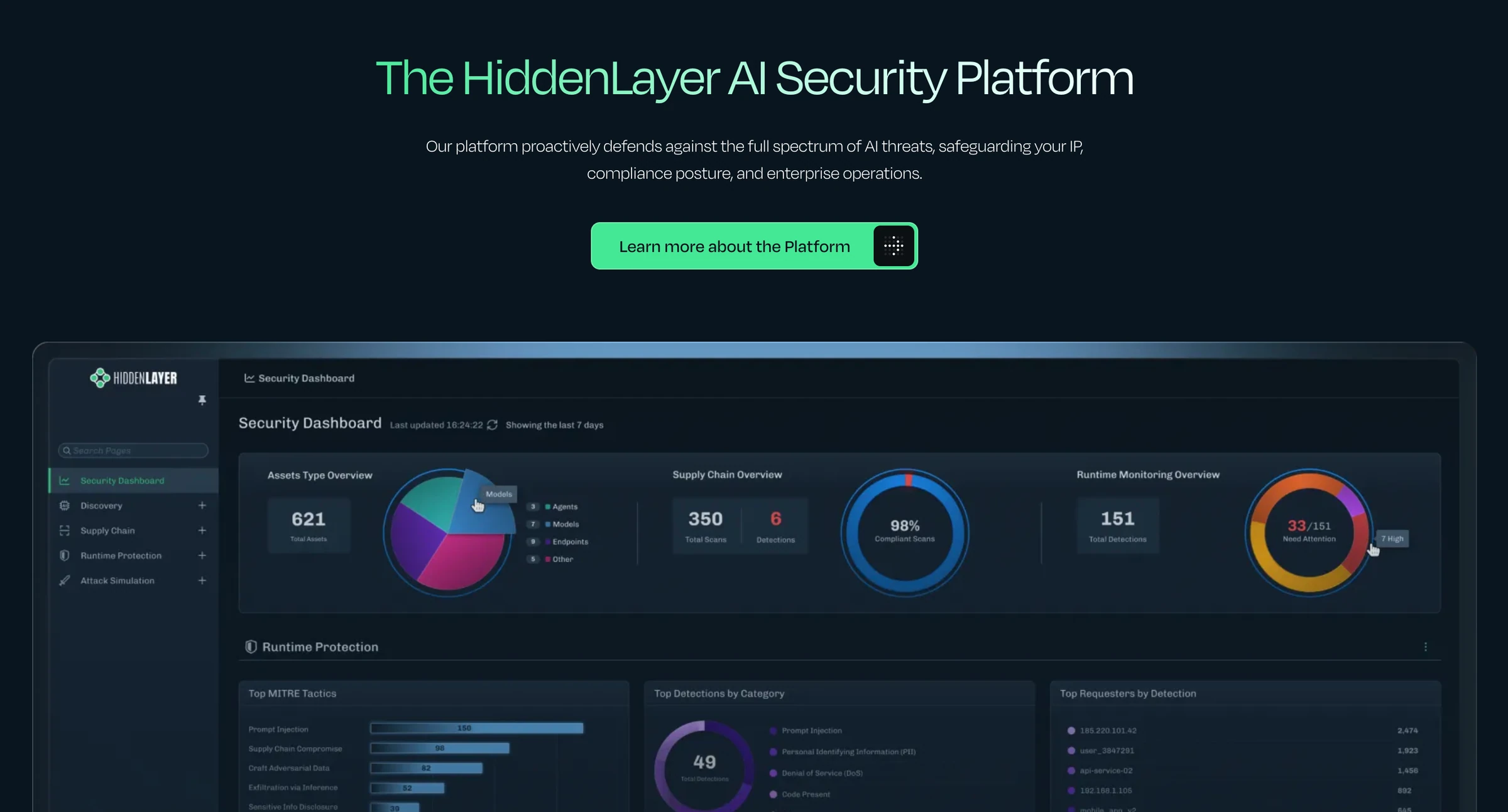
Best for: Enterprises and US federal buyers that want a model-agnostic, agentless red teaming solution as part of a broader AI security suite.
Standout Features
- Automated Red Teaming for AI (AutoRT) with one-click adversarial testing
- Model-agnostic, agentless, zero training data required
- System Prompt Evaluation and Red Team Evaluation paths
- Detailed remediation-ready reports aligned to OWASP
- Part of the broader AISec Platform with model scanning and runtime protection
- Deployed across US federal agencies and large enterprises
Pros | Cons |
|---|---|
Strong enterprise and federal-government track record | At the time of writing, no native LLM evaluation depth or production-grade observability comparable to eval-first platforms |
Model-agnostic and agentless — fits well for testing third-party models | Red teaming output lives in a security workflow, separate from engineering's eval/observability stack |
Patented adversarial research feeding the attack library | Custom pricing only — no transparent self-serve tier |
Covers both pre-deployment red teaming and runtime defense | Multi-turn agentic simulation depth less proven publicly than newer agent-focused platforms |
FAQ
Q: Is HiddenLayer aligned to OWASP and NIST?
HiddenLayer publishes alignment to OWASP, and its broader compliance documentation covers common regulatory frameworks. Specifics depend on the deployment.
Q: Is HiddenLayer suitable for testing agents?
AutoRT supports adversarial testing across prompts, models, and workflows. Multi-turn agentic adversarial simulation depth varies — confirm fit with your specific agent stack before committing.
4. Lakera Red
Type: Adversarial testing platform · Pricing: Community (free); Enterprise custom · Open Source: No · Website: https://www.lakera.ai/lakera-red
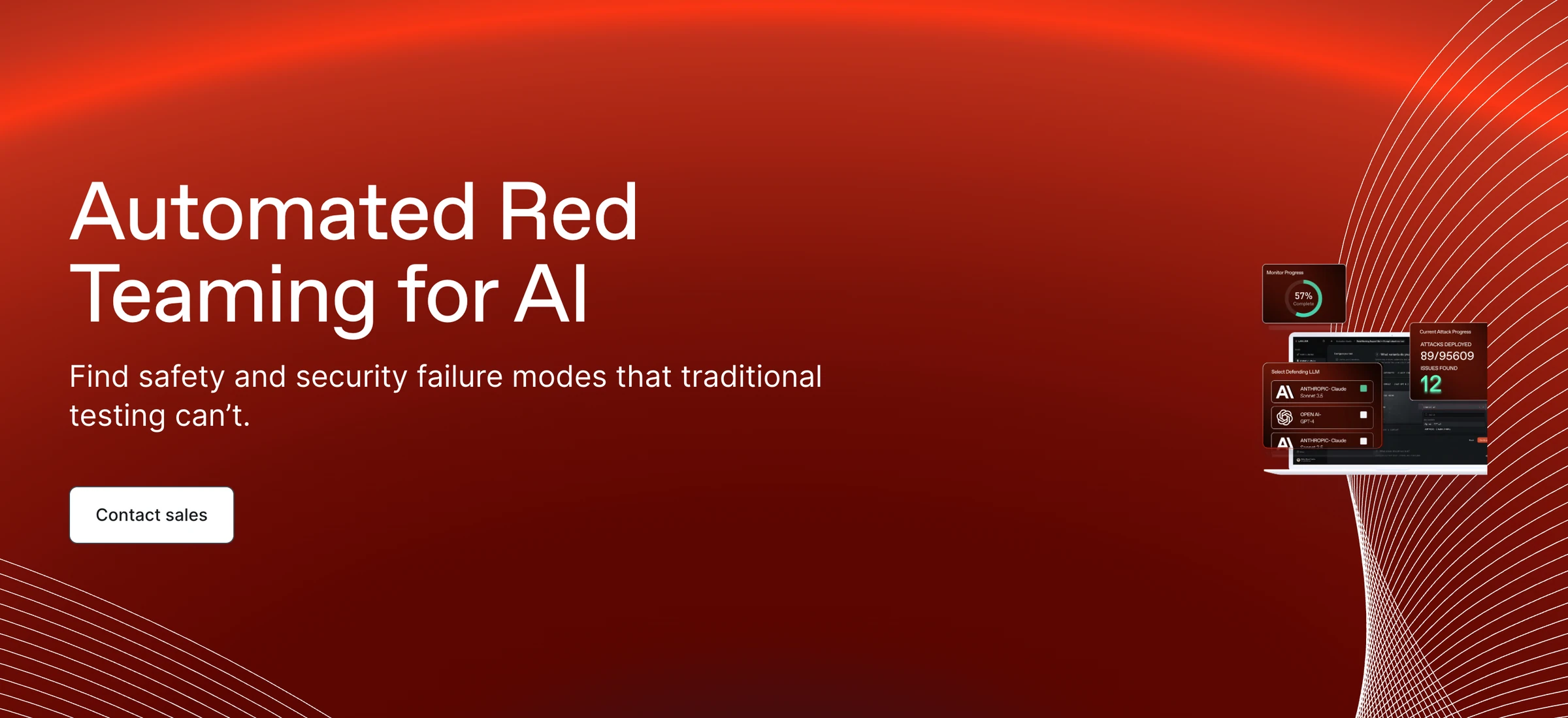
Lakera Red is the adversarial testing product from Lakera, sitting alongside Lakera Guard (their well-known prompt injection runtime defense). Red focuses on automated safety, security, and responsible AI assessments — testing for context extraction, instruction override, content injection, service disruption, and indirect poisoning through external data sources or RAG integrations. The workflow follows application enumeration, targeted attack development, impact amplification, and risk assessment with remediation guidance.
The free Community plan (up to 10,000 API requests/month with an 8,000 token prompt size limit, EU SaaS-only) is one of the most generous in the category and lowers the barrier for teams that want to start before signing an enterprise contract. The Enterprise plan adds self-hosting, SSO, RBAC, and SIEM integration.
Lakera Red is at its strongest for teams already using Lakera Guard, where Red and Guard form a coherent pre-launch + runtime story. Outside that, Lakera does not offer broader LLM evaluation or observability, so engineering teams typically still need a separate platform for evals, dataset management, and production quality monitoring.
Best for: Teams already using Lakera Guard that want adversarial testing in the same vendor — and that have a separate platform for LLM evals and observability.
Standout Features
- Three risk lenses: safety (harmful content), security (data and system integrity), and responsible AI (legal/compliance)
- Coverage of context extraction, instruction override, content injection, service disruption, and indirect poisoning via RAG/external data
- Generous Community tier — 10,000 API requests/month free
- Enterprise deployment options: SaaS or self-hosted, with SSO, RBAC, and SIEM integration
- Pairs natively with Lakera Guard for runtime defense
Pros | Cons |
|---|---|
Strong adversarial testing tied to Lakera Guard for a clean pre-launch + runtime story | Outside of Guard pairing, the broader AI lifecycle (evals, observability) still needs a separate tool |
Generous free Community plan lowers the barrier to entry | At the time of writing, no native LLM eval or production observability depth |
Solid framework coverage across safety, security, and responsible AI | Multi-turn agentic adversarial simulation less of a headline feature than in agent-focused vendors |
Enterprise deployment with SSO, RBAC, and SIEM integration | Enterprise pricing is custom and not transparent |
FAQ
Q: Do I need Lakera Guard to use Lakera Red?
No. Red and Guard are separate products. They pair well, but Red can be used standalone for pre-deployment adversarial testing.
Q: Where is data stored?
The Community plan is SaaS with EU data storage. Enterprise plans support both SaaS and self-hosted deployments.
5. DeepTeam
Type: Open-source red teaming framework · Pricing: Free · Open Source: Yes (Apache-2.0) · Website: https://trydeepteam.com
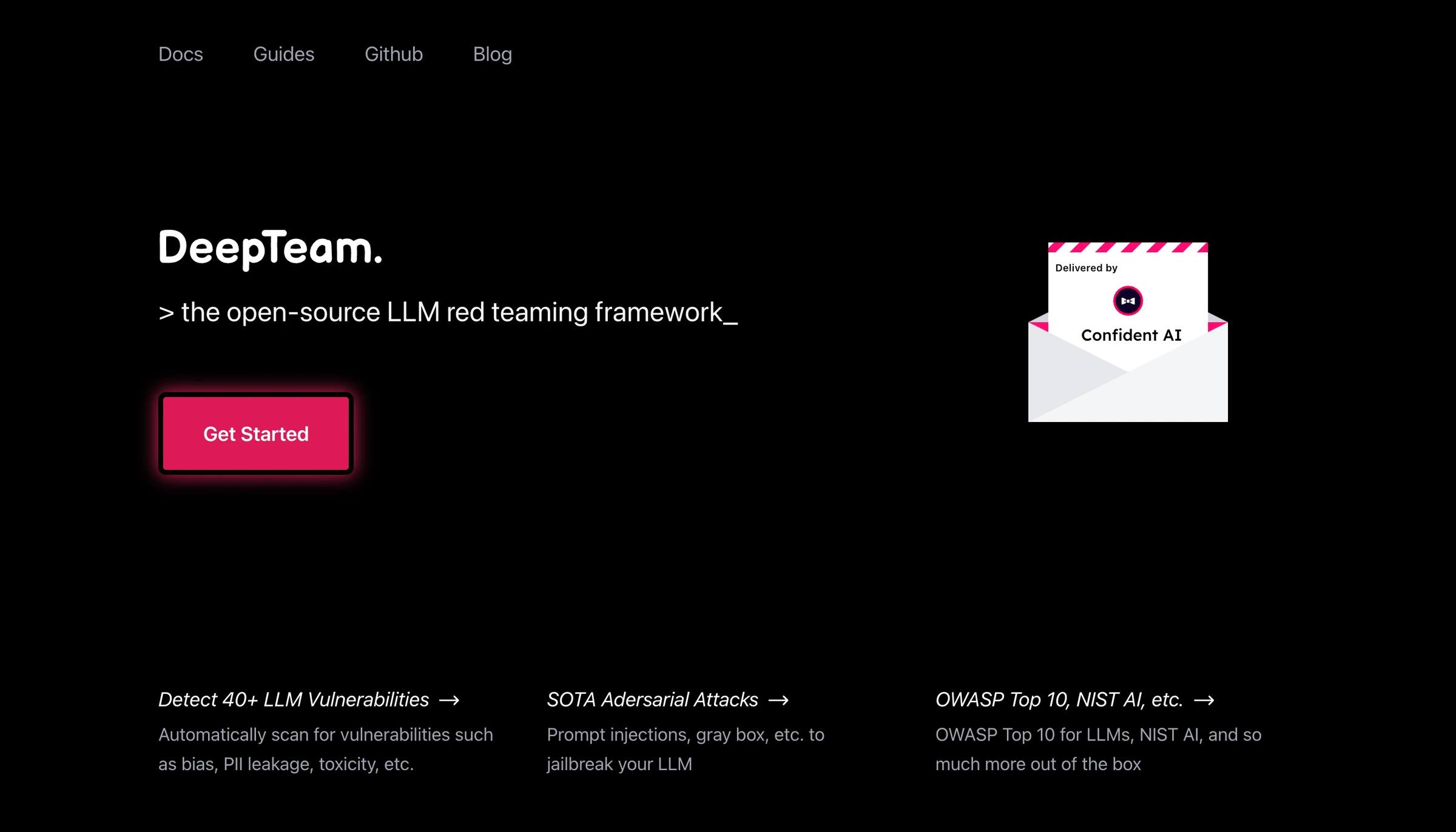
DeepTeam is one of the most actively maintained open-source LLM red teaming frameworks in 2026 — over 1,690 GitHub stars and a stable v1 release. It ships 50+ vulnerabilities and 20+ attack vectors across data privacy, responsible AI, and security, covering both single-turn and multi-turn attacks, and can red team agents, RAG pipelines, and chatbots — including systems with persistent memory and tool use. Built-in alignment with OWASP Top 10 for LLMs and NIST AI RMF, runs locally, judged by any LLM you choose.
As with every framework, the tradeoff is the lack of a platform layer: no UI, no dashboards, no team workflows, no production runtime defense, and no compliance reporting beyond what you build yourself. Teams that want the framework experience plus a managed platform pair DeepTeam with Confident AI.
Best for: Engineering teams that want the deepest open-source LLM red teaming framework — with full control over how attacks are run, judged, and reported.
Standout Features
- 50+ vulnerabilities and 20+ attack vectors across data privacy, responsible AI, and security
- Single-turn and multi-turn coverage — conversation hijacking, jailbreak chains, context poisoning
- Agent, RAG, and chatbot red teaming with memory and tool use
- Built-in alignment with OWASP Top 10 for LLMs and NIST AI RMF
- Local execution with LLM-as-a-Judge metrics powered by any LLM
Pros | Cons |
|---|---|
Broadest open-source vulnerability and attack coverage available | No UI, no dashboards, no built-in collaboration |
Multi-turn and agentic adversarial coverage out of the box | No production runtime defense or live monitoring |
Aligned to OWASP Top 10 for LLMs and NIST AI RMF | No compliance reporting layer beyond what you build |
Apache-2.0 licensed and actively maintained | Pure framework — pairing with a platform is needed for team workflows |
FAQ
Q: Is DeepTeam the same as Confident AI?
No. DeepTeam is an open-source red teaming framework. Confident AI is a separate platform that provides UI, campaigns, reporting, dataset management, eval integration, and production monitoring on top. Either can be used independently.
Full Comparison Table
Confident AI | Mindgard | HiddenLayer | Lakera Red | DeepTeam | |
|---|---|---|---|---|---|
OWASP Top 10 for LLMs alignment Findings mapped to OWASP categories out of the box | |||||
NIST AI RMF alignment Findings mapped to NIST AI RMF Measure functions | Limited | ||||
EU AI Act reporting Compliance reports aligned to EU AI Act controls | Limited | Limited | |||
50+ pre-built vulnerabilities Coverage of data privacy, responsible AI, and security categories | Limited | ||||
Multi-turn adversarial attacks Conversation hijacking, jailbreak chains, context poisoning | Limited | Limited | |||
Agent red teaming Tool misuse, indirect injection, excessive agency | Limited | Limited | |||
Test the AI as-is via HTTP Red team the live application, not just the model | |||||
CI/CD integration Run adversarial tests in deployment pipelines | Limited | Limited | Limited | ||
Built-in LLM evaluation 50+ research-backed quality metrics alongside red teaming | Limited | ||||
Production observability Trace, monitor, and alert on live AI traffic | Limited | Limited | Limited | ||
Runtime defense Live guardrails and threat detection in production | Limited | ||||
Cross-functional workflows Security, PMs, QA, and engineers in one workspace | Limited | Limited | Limited | ||
Open-source Self-host or inspect codebase | Limited |
How to Choose the Right AI Red Teaming Tool
The right tool depends on what you're red teaming, who owns the program, and whether you want red teaming to live in a security silo or in the same workflow as the rest of your AI quality stack.
If you want every essential piece — red teaming, evals, and observability — in one platform: Confident AI is the only tool on this list that covers all three. Failing adversarial traces become regression tests, get monitored in production, and surface alerts if similar patterns recur — without manually carrying findings between a security tool, an eval tool, and an observability tool.
If you want a security-first vendor with strong runtime defense: Mindgard and HiddenLayer are the most mature commercial options. Mindgard leads on reconnaissance and shadow AI discovery; HiddenLayer leads on federal and enterprise track record. Both are excellent at producing security artifacts — and both are typically run alongside an evaluation/observability platform, not instead of one.
If you already use Lakera Guard: Lakera Red is the natural complement, with a generous free Community tier to start. Outside the Guard pairing, you'll still need a separate platform for evals and observability.
If you need the deepest open-source red teaming framework: DeepTeam offers the broadest open-source coverage — 50+ vulnerabilities, 20+ attack vectors, multi-turn and agentic adversarial testing, OWASP and NIST alignment. It's the right choice if you want full control in code and don't need a managed platform. Pair with Confident AI when you want UI, campaigns, reporting, and production integration on top.
Why Confident AI is the Best AI Red Teaming Tool
Every other tool on this list is good at one slice of the problem. Mindgard and HiddenLayer ship strong security-only suites. Lakera pairs adversarial testing with a popular runtime guard. DeepTeam offers the broadest open-source coverage. None of them give you the whole AI safety stack in one platform.
Confident AI is the only all-in-one. Red teaming, LLM evaluation, and production observability live in the same workspace — so a failing jailbreak becomes a CI/CD regression test, surfaces in production observability alongside live traffic, and fires quality-aware alerts via PagerDuty, Slack, and Teams if similar patterns recur. 50+ vulnerabilities and 20+ attack vectors cover the same OWASP, NIST AI RMF, and EU AI Act categories dedicated security vendors hit, with CVSS-scored compliance reports. Multi-turn simulation tests agents on the surface attackers actually probe — tool use, memory, branching paths. Security drives campaigns, PMs review severity, QA owns regression, engineers fix and re-test — no one is bottlenecked by another team's tool.
Red teaming is part of the Enterprise plan with custom pricing; evals and observability are available across self-serve and enterprise tiers at $1/GB-month with unlimited traces. Framework-agnostic with native SDKs in Python and TypeScript, OTEL, and OpenInference — no vendor lock-in. Red teaming without integration is just a PDF. Confident AI turns red teaming into closed-loop AI safety.
Confident AI helps you red team every AI release before it ships
Book a personalized 30-min walkthrough for your team's use case.
Frequently Asked Questions
What are AI red teaming tools?
AI red teaming tools simulate adversarial attacks against LLM and AI agent applications to uncover safety, security, and responsible-AI failures before attackers do. They cover techniques like prompt injection, jailbreaking, data and prompt leakage, bias and toxicity exploitation, RBAC and access control abuse, indirect injection through retrieved content, and multi-turn attacks against agents with tools and memory. Modern tools align findings to frameworks like OWASP Top 10 for LLMs and NIST AI RMF.
How is AI red teaming different from traditional security testing?
Traditional security testing — SAST, DAST, pen testing — assumes deterministic systems with code paths. AI systems are non-deterministic and language-driven, and most attacks happen at the prompt and conversation level, not the code level. AI red teaming uses adversarial prompts, jailbreak strategies, and multi-turn manipulation against the live application, including its system prompt, retrieval pipeline, tools, and guardrails — surfaces that traditional tools don't probe.
Which frameworks should AI red teaming cover?
OWASP Top 10 for LLM Applications, NIST AI RMF, MITRE ATLAS, ISO/IEC 42001, GDPR, and the EU AI Act are the standard checkpoints for enterprise programs in 2026. Confident AI maps findings to OWASP Top 10 for LLMs, NIST AI RMF, and the EU AI Act with CVSS severity scoring.
Can I red team my AI agent's tools and memory?
Yes — and this is where most red teaming programs fall short. Agentic systems fail through tool misuse, indirect injection via tool outputs, unauthorized actions, and excessive agency. Confident AI runs multi-turn adversarial simulations against the live agent (tool use, memory, branching paths) so the surface tested is the surface attackers actually probe.
Are there open-source AI red teaming tools?
Yes. DeepTeam (Apache-2.0) is the most actively maintained LLM-specific open-source red teaming framework, with 50+ vulnerabilities, 20+ attack vectors, multi-turn and agent support, and built-in alignment to OWASP Top 10 for LLMs and NIST AI RMF. Teams that want a managed platform layer on top of DeepTeam — UI, campaigns, reporting, eval and observability integration — typically pair it with Confident AI.
How do I integrate AI red teaming into CI/CD?
Confident AI integrates adversarial testing with pytest and other testing frameworks, so red teaming runs alongside your regular tests in deployment pipelines. Failing campaigns produce regression reports that block releases when severity thresholds are crossed.
Should I buy a dedicated AI security vendor or use a combined platform?
It depends on your buying center. If the program is fully CISO-led and lives entirely in the security organization — and you already have engineering's eval and observability stack solved elsewhere — dedicated vendors like Mindgard or HiddenLayer work well. If you want red teaming to land in the same workflow as your engineering team's evals and production monitoring, so findings are fixed and re-tested instead of stuck in a PDF, Confident AI is the only platform that combines all three.
How often should I red team my AI?
At minimum, before every major release and on a recurring schedule (monthly or quarterly) for production systems. Continuous tools like Confident AI re-test on each CI/CD run plus on schedule, so coverage doesn't drift between releases.
Does Confident AI replace a runtime AI firewall like Lakera Guard?
Not directly. Confident AI focuses on pre-deployment red teaming, evaluation, and production observability with quality-aware alerting. Teams that need an inline prompt-injection firewall at the API layer typically still deploy a runtime guard product alongside Confident AI — but the red teaming and monitoring loop lives in Confident AI.
How do I choose between AI red teaming tools?
Start with the scope you actually need. If you want one platform that combines red teaming with LLM evals and observability, use Confident AI. If you want a security-only suite with strong runtime defense, look at Mindgard or HiddenLayer. If you already use Lakera Guard, Lakera Red is the natural complement. If you want the deepest open-source framework with full control in code, use DeepTeam — and pair with Confident AI when you want a managed platform on top.