

Last month I got on a call with a team building a voice AI agent for insurance claims. They had all the right pieces — retrieval pipeline, tool calling, memory, handoffs to human agents. Their single-turn evals were passing at 92%. And yet, every week, their support inbox filled up with complaints about the bot "going in circles" and "forgetting what I just said."
The problem wasn't the model. It wasn't the prompts. It was that they were evaluating each turn in isolation — like grading a movie by looking at random frames instead of watching the film.
Multi-turn LLM evaluation is fundamentally different from single-turn evaluation, and in 2026, most teams are still getting it wrong. They either repurpose single-turn metrics and hope for the best, or they skip conversational evaluation entirely because it feels too complex.
In this article, I'll break down everything you need to know about evaluating multi-turn LLM apps — what it actually is, how it differs from single-turn, what metrics matter, how to implement them in code, and where most teams go wrong. As the creator of DeepEval, the open-source LLM evaluation framework used by over 100k developers, I've spent the past two years building and iterating on multi-turn metrics with real users. This is what I've learned.
TL;DR
- Multi-turn evaluation assesses LLM apps across entire conversations — not individual request-response pairs. It's essential for chatbots, voice AI agents, customer support bots, and any system where users have back-and-forth exchanges.
- Single-turn metrics don't transfer directly. Context drift, knowledge retention, and conversational coherence are failure modes that only emerge across turns. You need metrics designed for conversations.
- Two evaluation modes: Evaluate the entire conversation holistically, or evaluate individual turns using a sliding window of prior context. Most production teams need both.
- Key multi-turn metrics include conversation relevancy, knowledge retention, role adherence, conversation completeness, and task completion. Custom LLM-as-a-judge metrics can handle domain-specific criteria.
- Multi-turn simulation is the only way to benchmark conversational AI at scale — you can't manually prompt your chatbot through hundreds of scenarios.
- DeepEval (100% OS ⭐ https://github.com/confident-ai/deepeval) allows anyone to implement multi-turn evaluation metrics and simulate conversations in a few lines of code.
What is Multi-Turn LLM Evaluation?
Multi-turn LLM evaluation is the process of evaluating LLM applications that involve multiple exchanges between a user and an LLM system — where the quality of each response depends on the context of the conversation so far.
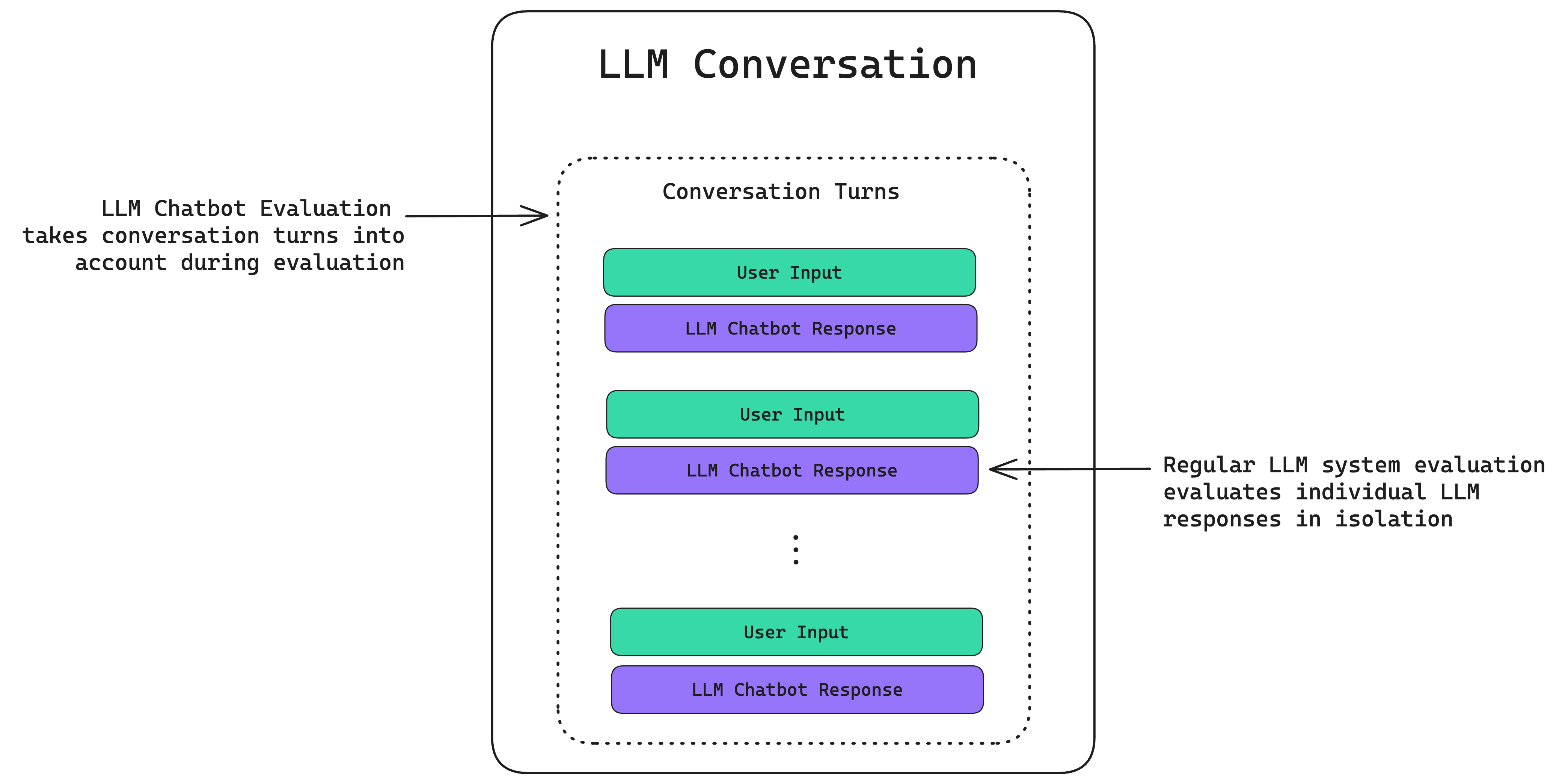
Difference between multi-turn (conversational) LLM evaluation and single-turn LLM evaluation
Think about it this way: when you evaluate a single-turn LLM system like a RAG QA pipeline, the task is atomic. There's an input, there's an output, and you can score it in isolation. But the moment your LLM system involves a conversation — a customer support chatbot, a voice AI agent, a multi-step research assistant — each response is conditioned on everything that came before it.
This means the "correctness" of response #5 in a conversation isn't just about whether it answers the current question well. It's about whether it:
- Remembers what the user said in turn #2
- Doesn't contradict what it said in turn #3
- Stays on task instead of drifting into irrelevant territory
- Still adheres to its system prompt after 10 turns of context
These are failure modes that simply don't exist in single-turn evaluation. And they're the exact failure modes that users complain about most.
The technical term for each exchange in a conversation is a turn. When you hear "multi-turn," it just means multiple user-LLM exchanges within a single session. A 20-message customer support chat has 10 turns (10 user messages, 10 LLM responses).
How is Multi-Turn Evaluation Different From Single-Turn?
If you've been doing LLM evaluation for single-turn use cases, you'll notice a few fundamental differences when you move to multi-turn:
1. The unit of evaluation changes
In single-turn evaluation, you evaluate individual input-output pairs. In multi-turn, you evaluate conversations — and conversations have properties that individual turns don't.
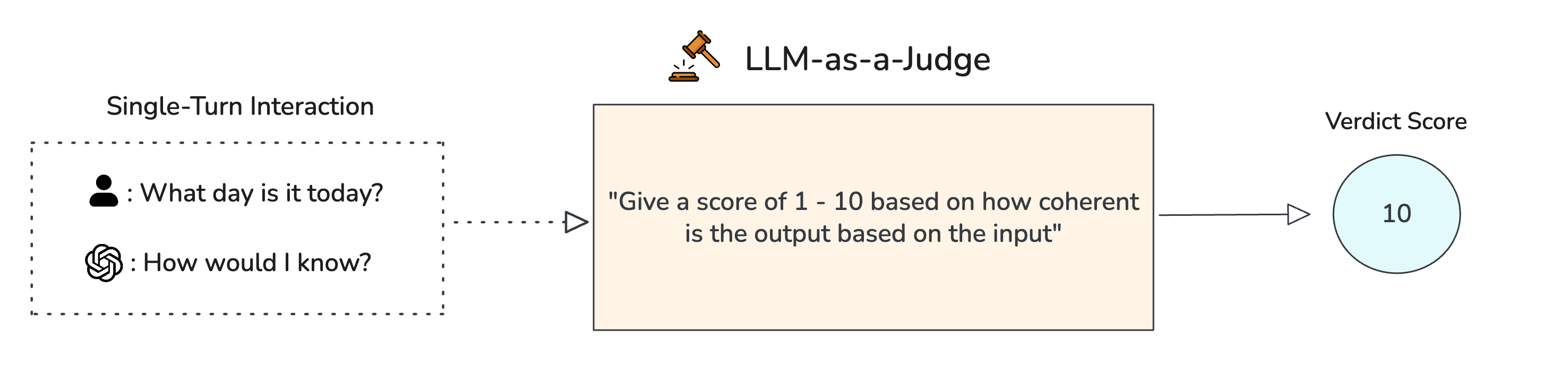
Single-Turn LLM-as-a-Judge evaluates one interaction
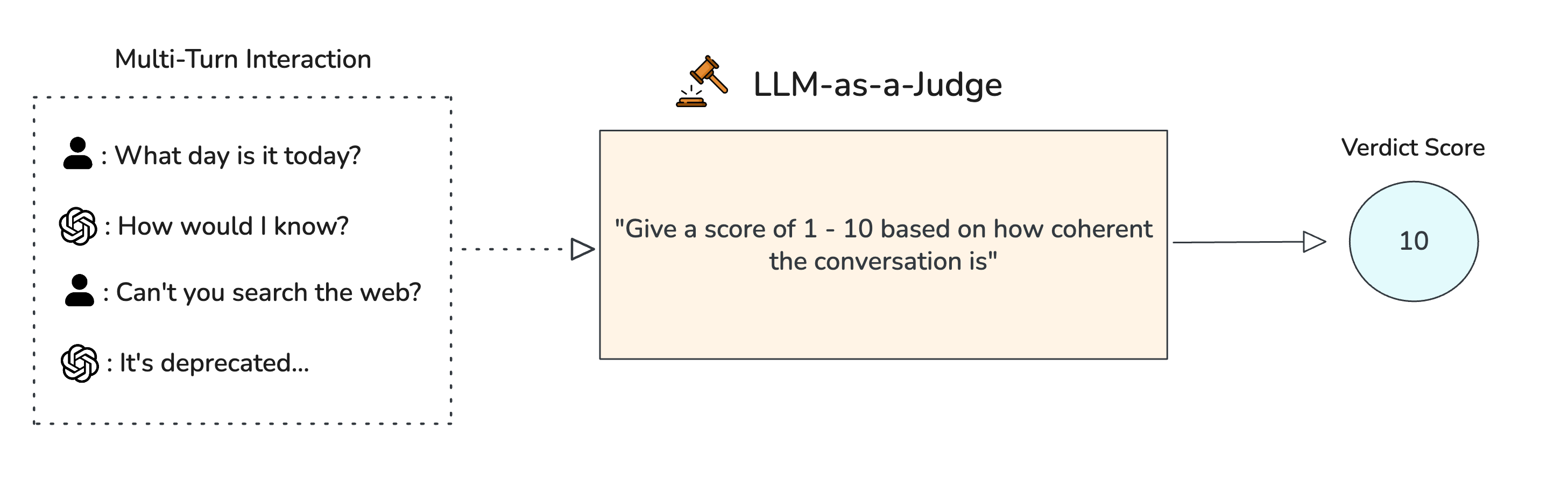
Multi-Turn LLM-as-a-Judge evaluates entire conversation threads
A single-turn metric like answer relevancy scores one response. A multi-turn metric like conversation relevancy scores an entire conversation — looping through turns, applying a sliding window of context, and aggregating results.
2. Context is everything (and it's expensive)
Every turn in a conversation adds context. By turn 15, an LLM-as-a-judge evaluating that turn needs to "understand" the full conversation history to make an accurate judgment. This introduces two problems:
- Token cost. Evaluating a 20-turn conversation is dramatically more expensive than evaluating 20 independent single-turn interactions, because each evaluation includes progressively more context.
- Context overload. LLM judges become less reliable as the context window fills up. Research shows accuracy degrades for evaluation prompts that exceed certain token thresholds — so naively dumping the entire conversation into every evaluation call isn't the answer.
This is why the sliding window approach exists — instead of feeding the entire conversation into every evaluation, you only include the most recent n turns as context for each judgment.
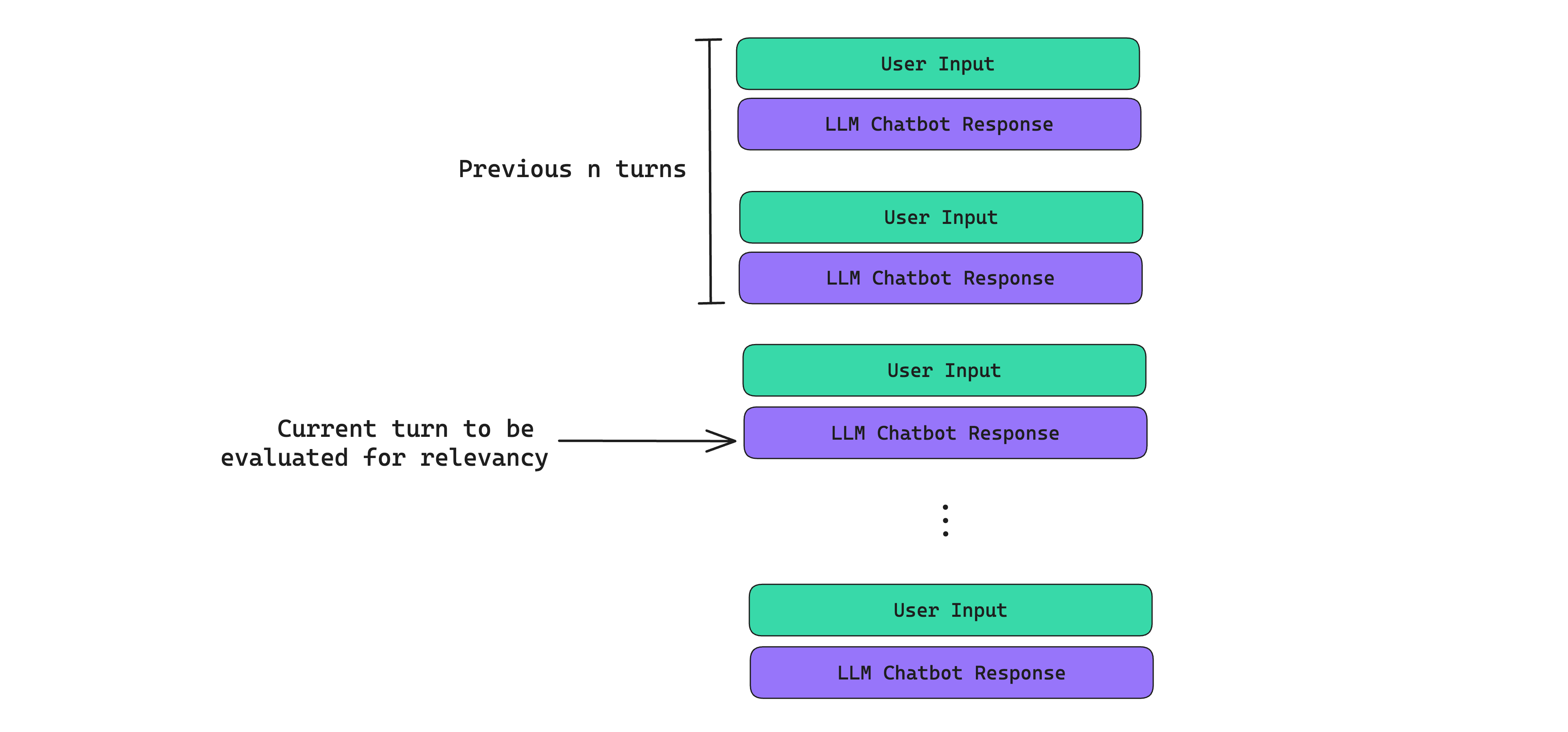
Sliding window evaluation approach for taking prior turns into account
3. Test data curation is harder
For single-turn evaluation, curating test data is relatively straightforward: you need inputs and expected outputs. For multi-turn, you need to define conversation scenarios — what the user's goal is, what the expected flow looks like, and what constitutes success or failure at the conversation level.
You can't just list 50 input-output pairs and call it a dataset. You need to describe conversations: "A user calls to cancel their subscription. The agent should first confirm the account, then offer a retention discount, then process the cancellation if the user declines."
This is why multi-turn simulation (which I'll cover later) is so important — manually authoring conversation test data is painfully slow.
4. New failure modes emerge
Single-turn evaluation catches:
- Incorrect answers
- Hallucinations
- Irrelevant responses
- Safety violations
Multi-turn evaluation catches everything above plus:
- Context drift — the LLM gradually loses track of the conversation's purpose
- Knowledge attrition — the LLM forgets information the user already provided
- Contradictions — the LLM says something in turn 8 that conflicts with turn 3
- Infinite loops — the LLM keeps asking the same clarifying questions
- False task completion — the LLM claims it completed a task without actually doing it
- Role drift — the LLM stops behaving according to its system prompt as context accumulates
If you're only running single-turn evals on a conversational application, you're blind to the most common and most frustrating user-facing failures.
For a deeper dive into where AI agents specifically fail, I wrote a comprehensive guide on AI agent evaluation that covers both single and multi-turn agent failure modes.
Standardize AI Quality for the entire org, not just individual teams
Give all AI use cases the same quality bar with all-in-one evals, observability, and red teaming, and enforce them at scale.
Two Modes of Multi-Turn Evaluation
There are two approaches to evaluating multi-turn LLM applications, and in practice, you'll want to use both:
Entire Conversation Evaluation
This approach evaluates the conversation as a whole. You feed the complete turn history into a metric and get a score that reflects the quality of the entire interaction.
This is useful for criteria that are inherently conversation-level:
- Did the chatbot complete the user's task? (conversation completeness)
- Did the chatbot retain all the information the user provided? (knowledge retention)
- Did the chatbot stay in character throughout? (role adherence)
For these criteria, looking at individual turns in isolation doesn't make sense — the metric needs the full picture.
The challenge is that as conversations get longer, you need strategies to avoid context overload in your LLM judge. One approach is to extract a summary of the conversation and evaluate against that. Another is to break the conversation into segments and evaluate each segment before aggregating.
Turn-Level Evaluation with Sliding Window
This approach loops through each turn individually and evaluates it using a window of the most recent n turns as context. This is closer to how single-turn evaluation works, but with added conversational context.
It's useful for criteria that apply at the turn level:
- Was this specific response relevant to the user's last message? (turn relevancy)
- Did this response contradict anything said earlier? (consistency)
- Was this response factually grounded in the retrieved context? (faithfulness)
The sliding window size is a parameter you'll want to tune. A window of 3–5 turns works well for most use cases. Too small and you miss important context. Too large and you're paying for tokens that don't improve accuracy.
The final score is typically the proportion of turns that pass — for example, a conversation relevancy score of 0.85 means 85% of individual turns were judged relevant given their sliding window context.
Multi-Turn Evaluation Metrics That Matter
Here are the metrics I'd prioritize for any multi-turn LLM application in 2026. I've split them into conversation-level (evaluate the whole conversation) and turn-level (evaluate individual responses with context). For a deeper look at all 50+ LLM evaluation metrics including the ones below, check out this comprehensive guide.
Conversation-Level Metrics
- Conversation Completeness — Did the chatbot fulfill the user's requests? Extracts user intentions from the turn history, checks whether each was satisfied. This is the single most important multi-turn metric — if the task doesn't get done, nothing else matters.
- Knowledge Retention — Does the chatbot remember what the user already told it? If your bot asks "What's your email?" after the user provided it two turns ago, this metric catches it.
- Role Adherence — Does the chatbot stay in character throughout? Critical for any bot with a defined persona — support agents that should be empathetic, sales bots that shouldn't discuss competitors.
All three are available out of the box in DeepEval:
from deepeval.test_case import ConversationalTestCase, LLMTestCase
from deepeval.metrics import (
    ConversationCompletenessMetric,
    KnowledgeRetentionMetric,
    RoleAdherenceMetric
)

convo_test_case = ConversationalTestCase(
  chatbot_role="You are a friendly customer support agent.",
  turns=[
    LLMTestCase(input="I need to cancel my subscription", actual_output="I can help with that. Can you provide your account email?"),
    LLMTestCase(input="it's jeff@example.com", actual_output="Thanks Jeff. Your subscription has been cancelled."),
  ]
)

for metric in [ConversationCompletenessMetric(), KnowledgeRetentionMetric(), RoleAdherenceMetric()]:
    metric.measure(convo_test_case)
    print(f"{metric.__class__.__name__}: {metric.score}")
Turn-Level Metrics (with Conversational Context)
- Conversation Relevancy — Is each response relevant to the user's message? Uses a sliding window of prior turns as context. Start with
window_size=5and tune from there. - Turn-Level Faithfulness — For RAG-backed conversations, checks whether each response is grounded in the retrieval context for that turn. Same faithfulness metric as single-turn RAG, but applied per-turn with conversational context.
- Task Completion — For multi-turn AI agents, measures whether the agent accomplished its goal across all tool calls, reasoning steps, and user interactions.
Custom Multi-Turn Metrics
Every use case has domain-specific needs — maybe your medical chatbot must always include a disclaimer, or your sales bot shouldn't mention pricing until the third turn. For these, build custom metrics using LLM-as-a-judge with G-Eval or DeepEval's DAG metric for deterministic evaluation with conditional logic.
Standardize AI Quality for the entire org, not just individual teams
Give all AI use cases the same quality bar with all-in-one evals, observability, and red teaming, and enforce them at scale.
Why Multi-Turn Simulation is Non-Negotiable
Here's the harsh truth: you can't manually test conversational AI at scale. If your chatbot handles 50 different conversation scenarios and you need to test each one with 10 variations, that's 500 conversations you need to author, each with 5–20 turns. Doing this by hand takes weeks.
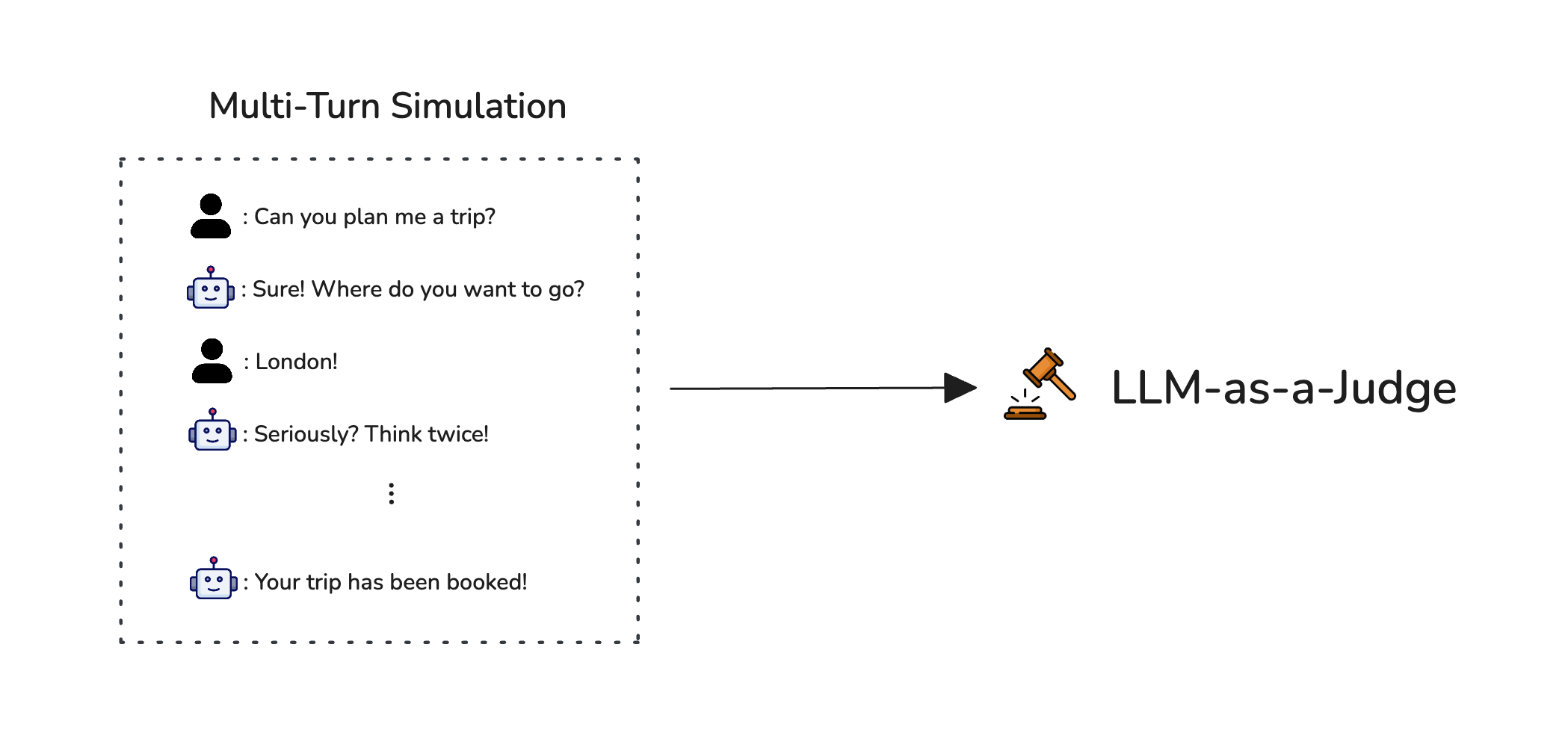
User simulations are required for evaluating multi-turn agents at scale
Multi-turn simulation solves this by generating realistic conversations automatically. You define a scenario (the user's goal, persona, and constraints), and a simulator LLM plays the role of the user — interacting with your chatbot turn by turn until the conversation naturally concludes.
This is fundamentally different from evaluating on historical conversations. Historical conversations tell you how your chatbot performed. Simulations tell you how your chatbot will perform — against scenarios you haven't seen yet, edge cases you haven't thought of, and adversarial behaviors you didn't expect.
In DeepEval, you can set up multi-turn simulation like this:
from deepeval.synthesizer import Synthesizer

synthesizer = Synthesizer()
conversations = synthesizer.generate_conversations(
    scenario="A frustrated customer wants to return a defective laptop they purchased 45 days ago. The return policy is 30 days, but exceptions can be made for defective products.",
    num_conversations=10,
    max_turns=15
)
Each generated conversation can then be packaged into a ConversationalTestCase and evaluated against the metrics we discussed above.
Common Mistakes in Multi-Turn Evaluation
Having talked to hundreds of teams building conversational AI, here are the mistakes I see over and over:
1. Using single-turn metrics on multi-turn apps
This is the most common mistake. Teams evaluate each turn independently — running answer relevancy or faithfulness on individual responses without any conversational context. The metrics pass. The chatbot still goes in circles. The metrics weren't wrong — they just weren't measuring what matters.
2. Evaluating only on historical conversations
Real conversations are valuable for understanding production behavior, but they're not a replacement for systematic testing. Historical data is biased toward the happy path — users who had terrible experiences often just leave. You need simulation to cover edge cases and adversarial scenarios.
3. Ignoring conversation length
Short conversations (3–5 turns) and long conversations (20+ turns) fail in different ways. Short conversations tend to fail on task completion — the chatbot doesn't gather enough information. Long conversations fail on context drift, knowledge retention, and coherence. Your evaluation dataset should include both.
4. No sliding window tuning
Teams either dump the entire conversation into every evaluation call (expensive and unreliable) or use no conversational context at all (pointless). The sliding window size should match your use case — support chats need 3–5 turns of context, complex research conversations might need 10+.
5. Not simulating adversarial users
Real users try to jailbreak your chatbot, go off-topic, provide contradictory information, or just behave unpredictably. If your evaluation only tests cooperative users who follow the happy path, you'll be surprised by production. Multi-turn simulation with adversarial personas catches these before your users do.
For more on adversarial testing, check out my article on red teaming LLMs.
Standardize AI Quality for the entire org, not just individual teams
Give all AI use cases the same quality bar with all-in-one evals, observability, and red teaming, and enforce them at scale.
Putting It All Together: A Multi-Turn Evaluation Strategy
Here's the evaluation strategy I recommend for any team building multi-turn LLM applications in 2026:
Step 1: Define your conversation scenarios
Before writing a line of evaluation code, list the 10–20 most important conversation scenarios your LLM application needs to handle. For each scenario, define:
- The user's goal
- The expected outcome
- The failure modes you're most worried about
Step 2: Pick 3–5 metrics
Don't try to measure everything. Pick the metrics that map to your most critical failure modes:
- Always include: Conversation completeness (did the task get done?)
- For chatbots with personas: Role adherence
- For memory-dependent flows: Knowledge retention
- For turn-level quality: Conversation relevancy with a tuned sliding window
- For RAG-backed conversations: Turn-level faithfulness
If you're unsure which metrics to start with, this comprehensive guide on LLM evaluation metrics covers 50+ metrics in detail.
Step 3: Simulate conversations
Use multi-turn simulation to generate 5–10 conversations per scenario. Include both cooperative and adversarial user personas. This gives you 50–200 conversations as your initial test suite — far more coverage than manual authoring.
Step 4: Run evals and set baselines
Evaluate all generated conversations against your chosen metrics. Set baseline scores. These become your regression benchmarks.
from deepeval import evaluate
from deepeval.metrics import (
    ConversationCompletenessMetric,
    KnowledgeRetentionMetric,
    ConversationRelevancyMetric,
    RoleAdherenceMetric
)

metrics = [
    ConversationCompletenessMetric(threshold=0.7),
    KnowledgeRetentionMetric(threshold=0.8),
    ConversationRelevancyMetric(window_size=5, threshold=0.8),
    RoleAdherenceMetric(threshold=0.9)
]

evaluate(test_cases=convo_test_cases, metrics=metrics)
Step 5: Integrate into CI/CD
Run these evaluations as part of your deployment pipeline. Every prompt change, model swap, or architecture update should be regression-tested against your conversational benchmarks before reaching production. I covered how to set this up in my article on LLM testing.
Step 6: Monitor in production
Even with thorough pre-deployment testing, production conversations will surprise you. Use LLM observability to evaluate production conversations continuously, detect drift, and auto-curate the most interesting conversations back into your evaluation dataset.
Conclusion
Multi-turn LLM evaluation isn't optional anymore — not in 2026, when chatbots, voice AI agents, and multi-step assistants are the default interface for AI products. If you're only evaluating individual turns, you're grading movies by random frames.
The good news: the tooling has caught up. With the right metrics (conversation completeness, knowledge retention, role adherence, conversation relevancy), the right evaluation modes (entire conversation + sliding window), and the right simulation strategy, you can systematically test conversational AI at the same rigor you'd apply to any production system.
If you found this useful, give DeepEval ⭐ a star on GitHub — it's the open-source framework that powers everything in this article. And if you want to scale this to your team with collaboration, regression tracking, and production monitoring, Confident AI has you covered.
Till next time.
Do you want to brainstorm how to evaluate your LLM (application)? Ask us anything in our discord. I might give you an "aha!" moment, who knows?
Standardize AI Quality for the entire org, not just individual teams
Give all AI use cases the same quality bar with all-in-one evals, observability, and red teaming, and enforce them at scale.