The person on your team who knows the domain — the compliance officer, the product specialist, the operations lead — can tell you in five seconds whether the AI's output is wrong. They sit next to the engineer. They see the same customer complaints. They know the edge cases nobody thought to put in the test set. And on most observability platforms, they have no way to do anything with that knowledge except send a Slack message and wait.
That's what this guide is about. Not which platform has the best tracing — your engineer can evaluate that. The question is: which platform lets the domain expert sitting next to the engineer actually participate? Can they annotate a bad trace directly? Does that annotation feed into error analysis automatically? Can they see whether the automated metrics agree with their judgment? Or does everything they know stay locked in Slack threads and Jira tickets, translated through engineering handoffs that lose context every time?
The platforms that get this right do three things natively — inside the product, accessible to SMEs alongside engineers and product owners:
- SME annotation → error analysis — the domain expert annotates production traces, the platform auto-clusters those annotations into failure modes, and recommends metrics to catch the patterns going forward. Their judgment becomes automated evaluation.
- Metric alignment — the platform statistically validates that automated scores match what the SME flagged. If the faithfulness metric passes something the domain expert marked as wrong, the team knows the metric needs recalibration.
- Signals — the platform surfaces anomalies and quality shifts automatically, so the SME, the PM, and the engineer all see the same production picture without someone having to pull a report.
This guide compares seven platforms by how well they let SMEs work alongside engineers and product owners on AI quality.
Why Most Platforms Cut SMEs Out of the Quality Workflow
On most observability platforms, the workflow is engineer-only: instrument the app, traces flow into a dashboard, the engineer reviews spans and scores, and if something looks wrong they investigate. The domain expert's involvement is a Slack message — "hey, a customer got a weird answer about our return policy" — and then they wait.
That handoff is where quality breaks down. The SME has context the engineer doesn't — which outputs are actually wrong (not just low-scoring), which edge cases matter for the business, which failure patterns map to real customer impact. The engineer has the platform access the SME doesn't. If those two people can't work in the same system, the feedback loop runs through handoffs instead of through the product.
The platforms that fix this share three properties:
Error analysis: turning SME judgment into automated evaluation
When a subject matter expert reviews a production trace and marks it as wrong, that annotation should do more than sit in a database. Error analysis auto-clusters annotations into coherent failure modes — "hallucinated return policy," "outdated pricing for enterprise tier," "missed context from previous turn" — and recommends metrics to catch each pattern. The platform can create LLM judges directly from the patterns the SME identifies, turning their qualitative review into automated evaluation that runs on every future trace.
This is the highest-leverage capability for teams with SMEs. It converts domain expertise — the thing that's hardest to scale — into automated quality monitoring that runs continuously. On other platforms, this workflow requires an engineer to export annotations, write clustering logic, manually categorize patterns, build a custom metric, and wire it into the evaluation pipeline. That's weeks of work, and the SME's original judgment gets diluted through multiple translation layers.
Metric alignment: proving the metrics match the expert
LLM-as-a-judge metrics are only useful if they agree with what the domain expert would say. A faithfulness score that passes an output the SME would reject is worse than no score at all — it creates false confidence. Metric alignment compares automated scores against the SME's annotations statistically, surfaces where they agree and where they diverge, and tells the team which metrics to trust.
On other platforms, this validation requires an engineer to export both the annotations and the metric scores, write a comparison script, calculate agreement rates, and present the results. That study happens once — if it happens at all — and goes stale the moment the application changes.
Signals: keeping the SME informed without engineering intermediation
Before metrics are configured, the SME still needs to know what's happening. Signals are automatic classifications on production traces — anomaly detection, new topic emergence, sentiment shifts, issue surfacing — that give the team a picture of production quality without anyone configuring evaluation metrics first. The SME sees what's happening in production directly, instead of waiting for the engineer to pull a report.
Our Evaluation Criteria
We assessed each platform by how well it includes subject matter experts in the AI quality workflow:
- SME annotation access: Can a domain expert annotate production traces directly in the platform without engineering assistance?
- Error analysis from annotations: Does the platform automatically cluster SME annotations into failure modes and recommend metrics — or does that require exporting data and writing custom code?
- Metric alignment: Can the team validate that automated scores match the SME's judgment inside the platform?
- Automated signal surfacing: Does the platform give SMEs production visibility without requiring an engineer to pull reports?
- No-code evaluation workflows: Can the SME trigger evaluations, upload datasets, and review quality trends without writing code?
- Cost and access model: Does pricing allow you to give SMEs seats without per-seat costs making it prohibitive?
1. Confident AI
Confident AI is an evaluation-first AI observability platform where domain experts, engineers, and product owners work in the same system on AI quality. SMEs annotate traces, contribute to error analysis, and validate metric alignment — all without writing code, and all in the same platform where the engineer manages tracing and the PM reviews evaluation results.
The workflow: the SME's domain expertise enters the system through annotations, gets amplified through error analysis into automated evaluation, and stays validated through metric alignment. The engineer handles SDK setup and infrastructure. The PM reviews quality trends and triggers evaluations. Everyone works in one place instead of across three tools and a Slack channel.
Customers include Panasonic, BCG, CircleCI, and Humach. Finom, a European fintech, compressed agent improvement cycles 27x (10 days → 3 hours) after switching — with product managers running evaluation cycles themselves instead of filing engineering tickets. Amdocs scaled AI quality across 30,000 employees by enabling their QA team to own the evaluation workflow directly.
Best for: Teams where domain experts, engineers, and PMs need to collaborate on AI quality in one platform — not across Slack, Jira, and custom notebooks.
Key Capabilities
- Error analysis — SME annotations become automated evaluation: Domain experts annotate production traces directly. Confident AI auto-clusters those annotations into failure modes — "hallucinated return policy," "outdated pricing," "missed context in multi-turn" — and recommends metrics to catch each pattern. The platform creates LLM judges from the patterns the SME identifies, so their qualitative judgment becomes automated evaluation on every future trace.
- Metric alignment — proving the metrics match the expert: Statistically compares automated LLM-as-a-judge scores against SME annotations. Surfaces TP/FP/TN/FN breakdowns per metric so the team knows which scores agree with the domain expert and which need recalibration. No separate analysis pipeline — it runs continuously inside the platform.
- Signals — SME-visible production quality: Automatic classifications on production traces — anomaly detection, issue surfacing, sentiment shifts, new topic emergence — visible to everyone on the team. The SME sees what's changing in production without waiting for an engineer to pull a report.
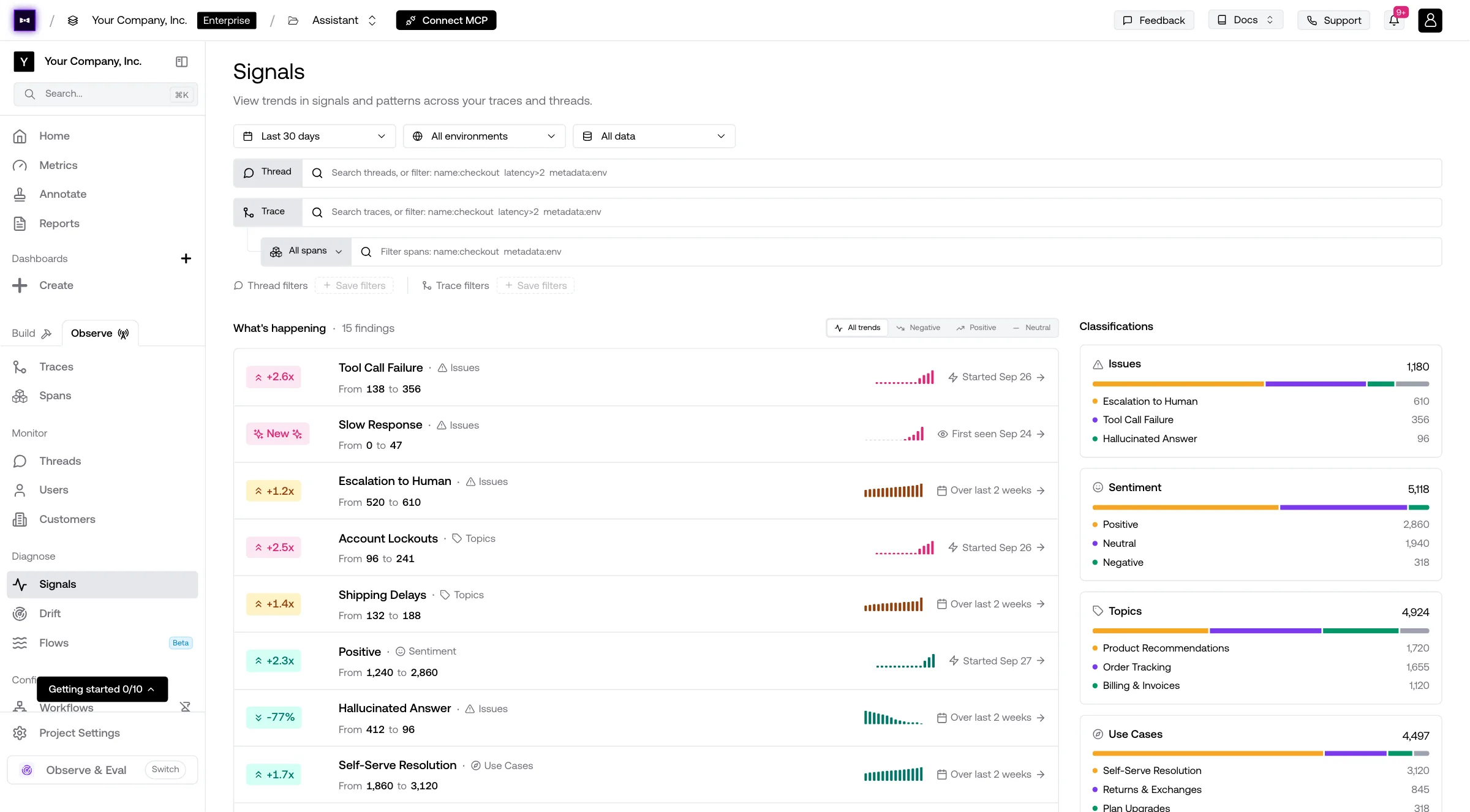
- No-code evaluation workflows: SMEs upload datasets, trigger evaluations against the live production AI app (as simple as calling an API in Postman), and review results — all through the UI. The domain expert tests the actual application, not a recreated version of it.
- 50+ research-backed metrics: Faithfulness, hallucination, relevance, bias, toxicity, tool correctness, conversational coherence — open-source through DeepEval. Covers agents, chatbots, RAG, and safety.
- Quality-aware alerting: Alerts fire via PagerDuty, Slack, or Teams when scores drop — both the engineer and the SME know when quality is slipping.
- Automatic dataset curation: Production traces auto-curate into evaluation datasets. The SME's annotated traces become test cases for the next regression cycle.
Pros
- The only platform on this list where SME annotations auto-cluster into failure modes and become automated LLM judges — the full loop from domain expertise to automated evaluation
- Metric alignment validates that automated scores match what the SME would say, continuously and inside the platform
- Signals give the SME production visibility from day one without waiting for engineering
- No-code evaluation lets SMEs trigger tests against the live app and review results independently
- $1/GB-month with unlimited traces — adding SME seats doesn't require per-seat anxiety
Confident AI helps you let domain experts work alongside engineers on AI quality
Book a personalized 30-min walkthrough for your team's use case.
Cons
- Cloud-based and not open-source, though enterprise self-hosting is available
- The breadth of capabilities may require an onboarding sequence to activate the full SME workflow
- Teams where only engineers will ever touch AI quality may not need SME-accessible workflows
Pricing starts at $0 (Free — 2 seats, 1 project, 1 GB-month), $200/month for Starter and $2,000/month for Team — both with unlimited user seats — with custom Enterprise pricing. Unlimited traces on all plans.
2. Langfuse
Langfuse is a fully open-source LLM tracing platform built on OpenTelemetry. It gives engineering teams fast time-to-first-trace, full data ownership through self-hosting, and a clean developer experience. Langfuse is an engineering tool — the subject matter expert has no native path into the quality workflow.
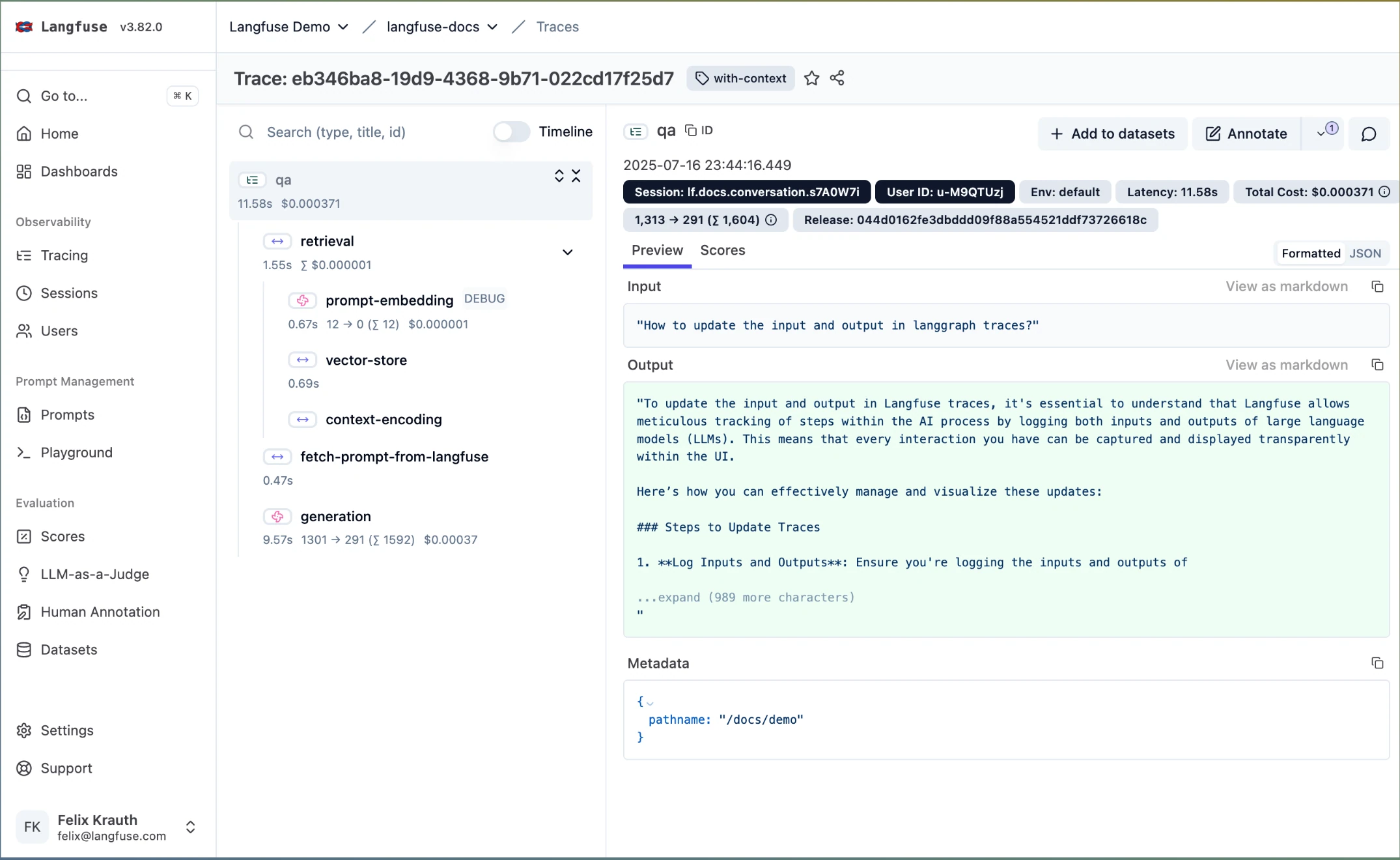
Best for: Engineering-only teams with compliance-driven self-hosting requirements where SMEs are not involved in AI quality.
Key Capabilities
- OpenTelemetry-native trace capture with broad framework support
- Prompt management and versioning decoupled from application code
- Score-based evaluation tracking over time
- Self-hosting with full open-source deployment
- Session-level grouping for multi-turn conversations
Pros
- Fully open-source with self-hosting — zero vendor lock-in, full data control
- Fast setup and strong developer experience
- Unlimited users across pricing tiers
- Active community and frequent releases
Cons
- No SME annotation workflow — subject matter experts can't annotate production traces or contribute feedback inside the platform
- No error analysis — if the SME flags failures, there's no pipeline to cluster those annotations into failure modes or recommend metrics; that work happens in exported Python notebooks
- No metric alignment — no way to validate that automated scores match the SME's judgment without leaving the platform
- No automated signal surfacing — the SME has no production visibility unless an engineer pulls a report for them
- Evaluation is score-based and shallow — no built-in research-backed metrics; teams pair Langfuse with a separate evaluation library and lose the connection between traces and SME annotations
Pricing starts at $0 (Free / self-hosted), $29.99/month (Core), $199/month (Pro), $2,499/year for Enterprise.
3. Arize AI
Arize AI extends its ML monitoring platform to LLM observability with production-grade trace ingestion, real-time dashboards, and agent workflow visualization. Its open-source Phoenix library provides a lighter entry point. Arize has human annotation capabilities, but the workflow stops at annotation — there's no automated path from the SME's feedback to failure analysis or metric validation.
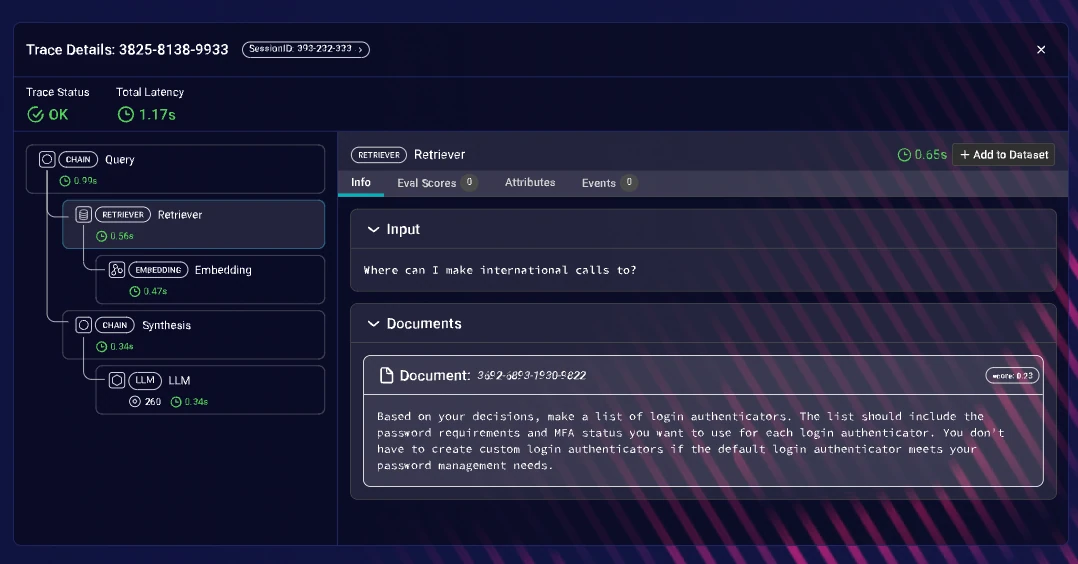
Best for: Engineering-heavy teams already on Arize for ML monitoring where SMEs are not expected to participate in the observability workflow.
Key Capabilities
- Span-level tracing with custom metadata tagging
- Real-time performance dashboards for latency, error rates, and token consumption
- Agent workflow visualization for multi-step pipelines
- Phoenix open-source for self-hosted tracing
- Human annotation on traces
Pros
- Production-grade trace ingestion handles scale well
- Phoenix open-source gives teams a low-friction entry point
- Basic annotation capability exists for human feedback on traces
- Unified ML and LLM monitoring reduces vendor count
Cons
- Annotation exists but the pipeline stops there — no error analysis that clusters the SME's annotations into failure modes or recommends metrics; that diagnostic work requires exporting data and building it in Python
- No metric alignment — no way to validate automated scores against the SME's annotations inside the platform
- No automated signal surfacing — SMEs have no production visibility unless an engineer shows them a dashboard
- Engineer-focused UX — the platform assumes technical fluency for every workflow beyond basic annotation
- LLM evaluation capabilities are shallow — limited built-in metrics for faithfulness, relevance, or safety
- Free and $50/month tiers cap at 3 users with 14-day data retention
Pricing starts at $0 (Phoenix, open-source), $0 (AX Free), $50/month (AX Pro), with custom pricing for AX Enterprise.
4. Helicone
Helicone is a proxy-based LLM observability platform that captures request-level telemetry — cost, latency, token usage — with near-zero instrumentation effort. It has an intuitive UI, but it's a cost and usage monitoring tool, not a quality collaboration platform. There's no annotation, no evaluation, and no path for an SME to participate in quality improvement.
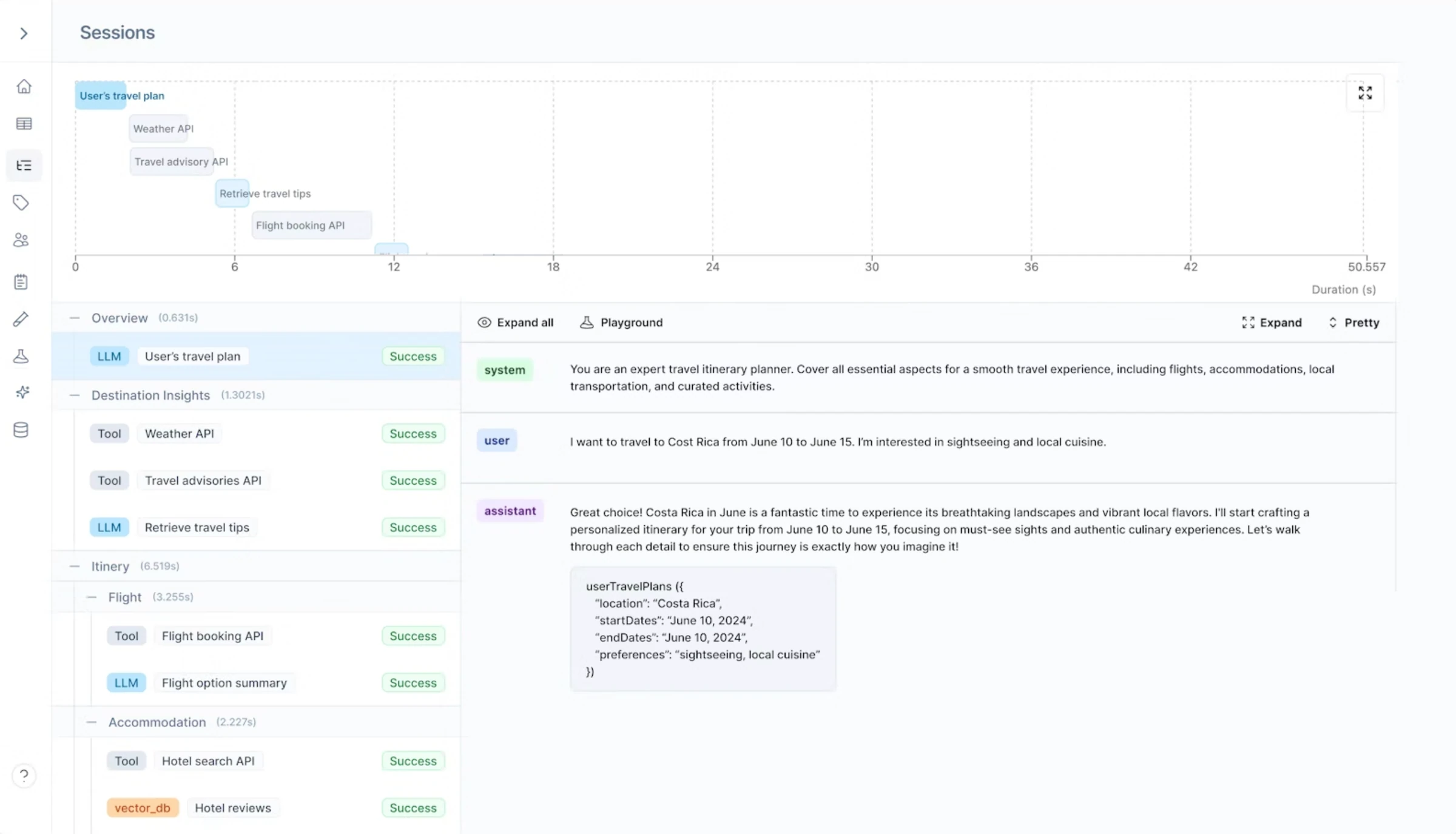
Best for: Teams focused on LLM cost management, not AI quality workflows involving SMEs.
Key Capabilities
- AI gateway proxying requests to 100+ LLM providers
- Request-level logging with cost, latency, and token tracking
- Budget monitoring and spend thresholds
- Caching and rate limiting at the proxy layer
Pros
- Near-zero setup with minimal code changes
- Strong cost visibility and attribution across providers
- Intuitive UI accessible to non-technical team members
- Open-source option for self-hosting
Cons
- No evaluation capabilities — no scoring for output quality, faithfulness, or safety
- No annotation workflow — SMEs can't flag bad outputs or contribute feedback
- No error analysis, metric alignment, or signal surfacing
- No quality-aware alerting or drift detection
- Not designed for quality collaboration in any form
Pricing starts at $0 (Hobby), $79/month (Pro), $799/month (Team), with custom pricing for Enterprise.
5. LangWatch
LangWatch combines OpenTelemetry-native multi-agent tracing with online production evaluation. Topology and sequence views help technical teams inspect agent handoffs, while Langy can assist with planning.
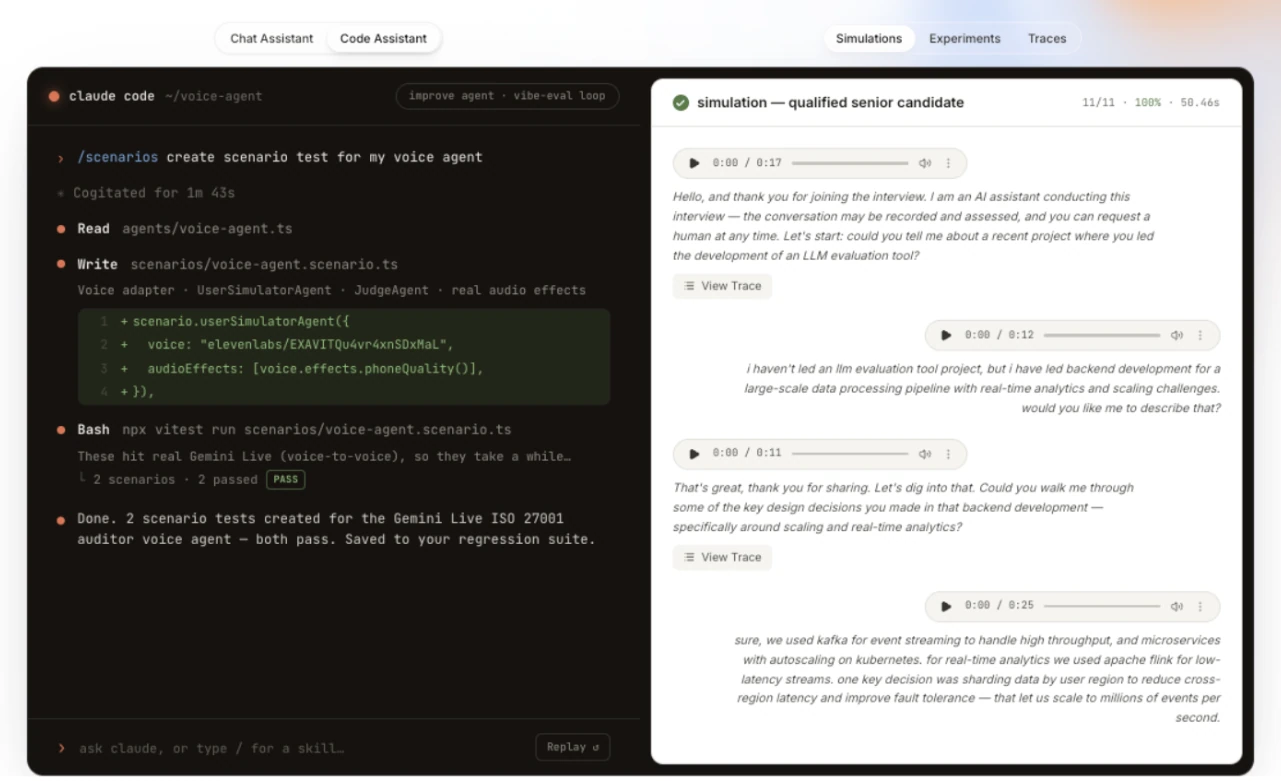
Best for: Technical teams reviewing multi-agent or voice runs with online evaluators and self-hosting.
Key Capabilities
- OTel topology and sequence views for multi-agent and voice runs
- Online evaluators with PII and prompt-injection guardrails
- Trace-to-simulation workflow for Scenario tests in CI
Pros
- Visual multi-agent views expose execution order and handoffs
- Trace-to-simulation workflow creates repeatable Scenario tests
- Apache-2.0 and self-hostable
Cons
- Younger community than longer-standing open-source observability projects
- General metric depth is narrower than broad evaluation platforms
- Human alignment is limited to annotation-driven evaluator tuning
- Langy assists planning but does not provide Confident AI's broader no-code SME/PM/QA evaluation ownership
- Infrastructure-level APM is outside the platform's scope
Pricing starts at $0 (Developer, 200K events/month), €29/seat/month with unlimited lite seats, with custom Enterprise plans.
6. Braintrust
Braintrust offers prompt evaluation with structured scoring and production trace logging. Its evaluation framework focuses on testing prompts in isolation. Braintrust has some non-technical accessibility through its playground, but the quality workflow is prompt-centric — there's no path from SME annotations on production traces to failure analysis or metric validation.
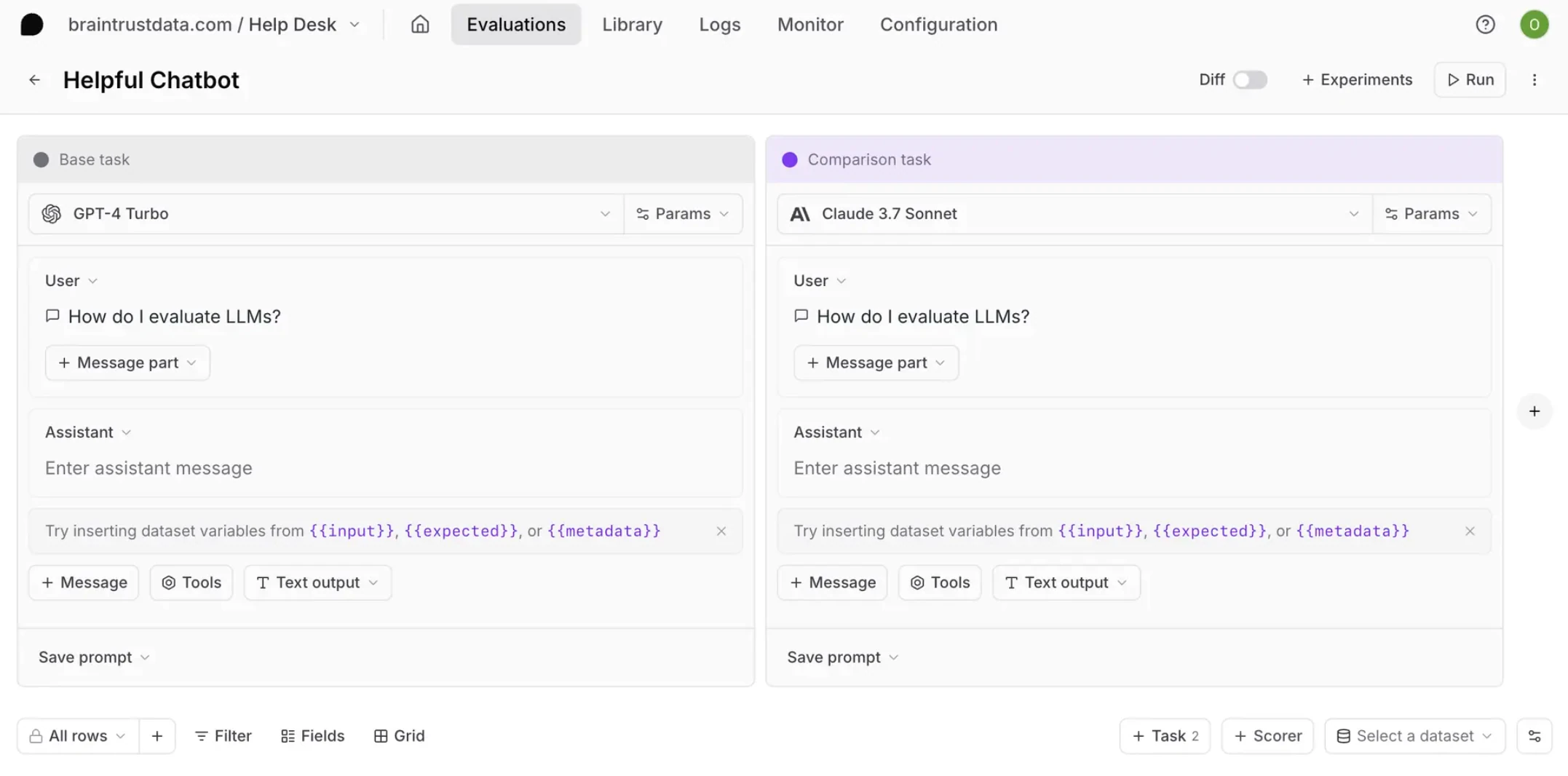
Best for: Teams focused on prompt-level evaluation where SME involvement is limited to reviewing playground results.
Key Capabilities
- Prompt evaluation with structured scoring and custom metrics
- Production trace capture with metadata logging
- CI/CD evaluation gates for prompt changes
- Dataset management for test case organization
Pros
- Clean evaluation workflow for prompt-level testing
- CI/CD integration catches prompt regressions before deployment
- Playground is accessible to non-technical users for basic prompt testing
Cons
- Evaluates prompts in isolation — can't trigger the live AI app for end-to-end testing
- No error analysis from SME annotations — if a domain expert flags failures, there's no pipeline to cluster them into patterns or recommend metrics
- No metric alignment — no way to validate evaluation scores against the SME's judgment inside the platform
- No automated signal surfacing — SMEs have no direct production visibility
- Steep pricing jump from free to $249/month with no mid-tier
- Tracing at $3/GB — 3x more expensive per-GB than Confident AI
Pricing starts at $0/month (Free), $249/month (Pro), with custom pricing for Enterprise.
7. LangSmith
LangSmith is a managed observability platform from the LangChain team, tightly integrated with LangChain and LangGraph. It has annotation queues — the closest SME-facing feature on this list outside Confident AI. Domain experts can review outputs and leave feedback through structured annotation workflows. But the pipeline stops at annotation: there's no automated error analysis, no metric alignment, and the SME's feedback doesn't turn into automated evaluation.
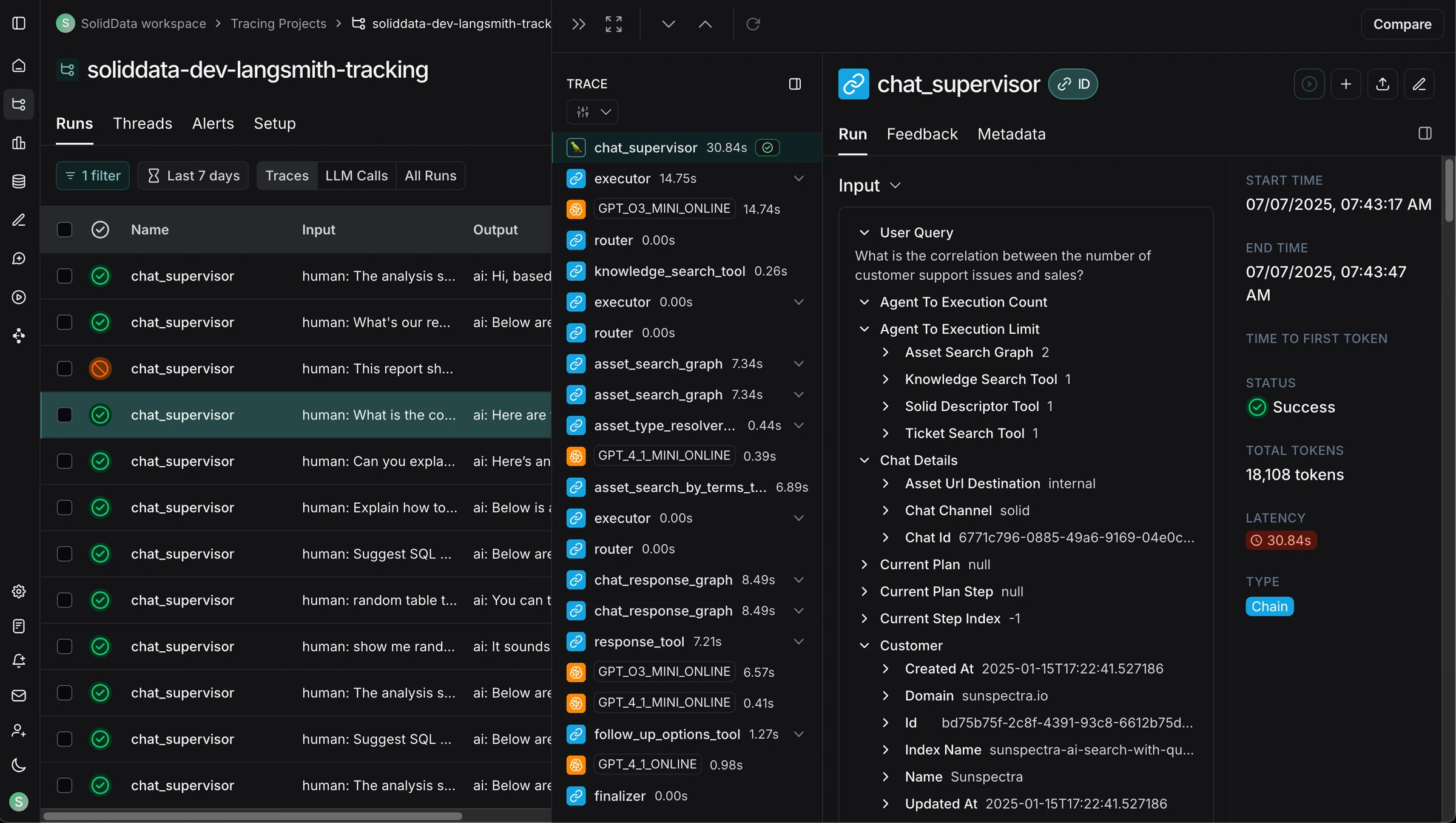
Best for: LangChain-only teams that want structured annotation queues for SME review but don't need the annotations to feed into automated failure analysis.
Key Capabilities
- Native LangChain and LangGraph trace capture
- Annotation queues for structured human review of production outputs
- Dataset management and evaluation runs from traced data
- Token usage and latency monitoring
Pros
- Annotation queues are the closest SME-facing workflow among competitors — domain experts can review and label production outputs
- Near-zero setup for LangChain-based applications
- Managed infrastructure with no operational overhead
Cons
- Annotation queues collect SME feedback, but there's no pipeline from annotations to failure analysis — the platform doesn't cluster annotations into failure modes, recommend metrics, or create LLM judges from the patterns the SME identifies; that diagnostic work happens outside the platform
- No metric alignment — no way to validate that automated scores match the SME's annotations statistically
- No automated signal surfacing — SMEs don't get production visibility without an engineer pulling traces for them
- Observability depth drops significantly outside the LangChain ecosystem
- Beyond annotation, workflows are engineer-driven — SMEs can't run evaluations or manage datasets independently
- Seat-based pricing at $39/seat/month makes it expensive to give SMEs access
Pricing starts at $0 (Developer), $39/seat/month (Plus), with custom pricing for Enterprise.
AI Observability Platforms for SME Annotation and Cross-Team Quality — Comparison Table
Feature | Confident AI | Langfuse | Arize AI | Helicone | LangWatch | Braintrust | LangSmith |
|---|---|---|---|---|---|---|---|
SME annotation on traces Domain experts annotate directly | |||||||
Error analysis from annotations Auto-cluster SME feedback into failure modes | |||||||
Metric alignment Validate scores vs. SME judgment in-platform | |||||||
Automated signals SME-visible production quality without engineering | Limited | ||||||
No-code evaluation SMEs trigger evals and review results independently | Limited | ||||||
Annotations → LLM judges SME patterns become automated evaluation | |||||||
Built-in eval metrics Score outputs for faithfulness, relevance, safety | 50+ metrics | Limited | Limited | Limited | Limited | ||
Quality-aware alerting Team-wide alerts on quality drops | Evaluator/budget alerts | ||||||
Drift detection Track quality changes per prompt and use case | Limited | ||||||
Production-to-eval pipeline Traces auto-curate into datasets | Limited | Limited | Trace-to-simulation workflow | Limited | |||
Multi-turn evaluation Evaluate conversations, not just requests | Limited | ||||||
Framework-agnostic | OTel-native | Weakens outside LangChain | |||||
Red teaming Built-in safety and security testing |
Why Confident AI is the Best Platform for SMEs Working Alongside Engineers on AI Quality
On most observability platforms, the domain expert's role in AI quality is: notice something wrong, tell an engineer, wait. Their knowledge — which outputs are actually wrong, which edge cases matter, which failures map to customer impact — enters the system through Slack messages and Jira tickets. By the time it reaches the evaluation pipeline, it's been translated through multiple handoffs and lost half its context.
Confident AI puts the SME, the engineer, and the PM in the same system. The domain expert's judgment enters directly and gets amplified automatically:
The SME annotates the trace themselves. They see a production output that's wrong — a hallucinated policy, an outdated price, a response that misses the point. They annotate it directly on the trace in the platform. No ticket. No waiting for an engineer to find the right trace.
Their annotation becomes a failure pattern. Confident AI's error analysis auto-clusters SME annotations into coherent failure modes. Ten separate annotations about wrong pricing become "hallucinated pricing for enterprise tier" — a named pattern with recommended metrics. The platform creates LLM judges from these patterns, so the SME's qualitative judgment turns into automated evaluation that runs on every future trace. This is the loop that no other platform has: domain expertise in, automated evaluation out.
The team validates that metrics match the expert. Metric alignment compares automated scores against the SME's annotations statistically. If the faithfulness metric says "pass" on something the SME flagged as wrong, the metric gets recalibrated — not the expert. TP/FP/TN/FN breakdowns per metric give the whole team shared confidence in the numbers.
The SME sees production quality directly. Signals surface anomalies, new topics, sentiment shifts, and emerging patterns automatically. The domain expert doesn't wait for the engineer to pull a report — they see the same production picture and can flag issues as they appear.
The SME runs evaluations without code. They upload a dataset of test cases from their domain expertise, trigger an evaluation against the live production AI app, and review the results — all through the UI. They test the actual application as it runs, not a recreated version in a notebook.
The documented ROI: Finom compressed agent improvement cycles 27x (10 days → 3 hours) when product managers started running evaluation cycles themselves. Humach shipped deployments 300% faster and saves 20+ hours per week on testing. Amdocs scaled AI quality across 30,000 employees by enabling their QA team to own the evaluation workflow. In every case, the unlock was the same: domain expertise entered the system directly instead of through engineering intermediation.
Confident AI helps you let domain experts work alongside engineers on AI quality
Book a personalized 30-min walkthrough for your team's use case.
When Confident AI Might Not Be the Right Fit
- Your hard constraint is 100% open-source: Confident AI supports self-hosting on enterprise plans, but the platform is not open-source. Langfuse provides open-source tracing, though SMEs have no native path into the workflow.
- SMEs won't be involved in AI quality: If your quality process is purely engineering-driven and domain experts will never annotate, evaluate, or review outputs, a lighter tool like Langfuse or Arize Phoenix covers tracing without the SME collaboration layer.
Frequently Asked Questions
What is the best AI observability platform for teams where SMEs work alongside engineers?
Confident AI is the best AI observability platform for cross-team AI quality because it's the only platform where SME annotations on production traces auto-cluster into failure modes, become automated LLM judges, and get statistically validated against automated metrics — all inside the same product where engineers manage tracing and PMs review evaluation results. Every other platform either locks SMEs out or collects their feedback without turning it into automated evaluation.
How can domain experts participate in AI quality without writing code?
On Confident AI, domain experts annotate production traces directly in the platform, upload datasets of test cases from their expertise, trigger evaluations against the live production AI app, and review quality trends — all through a no-code UI alongside the engineer and PM. Their annotations feed into error analysis that auto-clusters failures and recommends metrics. On other platforms, SME participation is limited to filing tickets or leaving feedback that an engineer must manually translate into the evaluation pipeline.
What is error analysis and why does it matter for SME annotation?
Error analysis auto-clusters SME annotations into coherent failure modes and recommends metrics to catch each pattern. When a domain expert annotates ten traces about incorrect pricing, error analysis surfaces "hallucinated pricing" as a named failure mode and creates an LLM judge to catch it automatically. Without this, the SME's feedback sits in an annotation queue and an engineer has to manually discover the pattern, write the metric, and wire it in — a handoff that loses context and takes weeks.
What is metric alignment and why does it matter when SMEs annotate?
Metric alignment statistically validates that automated evaluation scores agree with what the domain expert flagged. If your faithfulness metric passes outputs the SME marked as wrong, metric alignment surfaces that disagreement with TP/FP/TN/FN breakdowns. The engineer, the PM, and the SME all see the same validation — so the team trusts the same scores without separate analysis.
Can domain experts annotate traces on LangSmith?
LangSmith has annotation queues where domain experts can review and label production outputs — the closest SME annotation workflow among competitors. However, as of 2026, LangSmith does not auto-cluster those annotations into failure modes, recommend metrics, create LLM judges from annotation patterns, or validate metric alignment against SME feedback. The annotations are collected, but the pipeline from annotation to automated evaluation doesn't exist natively.
Which AI observability platform is cheapest for giving SMEs access?
Confident AI at a flat $200/month on Starter — with unlimited user seats — is the most cost-effective option for giving domain experts full annotation, evaluation, and error analysis access. LangSmith charges $39 per seat per month, so a team of ten SMEs costs roughly double, and it limits SMEs to annotation without the downstream error analysis and metric alignment workflows. Langfuse offers unlimited users but has no SME-facing workflows to give them access to.
Do domain experts need technical training to use Confident AI?
No. The annotation, evaluation, and review workflows are designed for non-technical users. A domain expert can annotate a production trace, upload a test dataset, trigger an evaluation against the live AI app, and review results through the UI — working alongside the engineer and PM in the same platform. The initial SDK setup is the only step that requires engineering.