Most teams say they do error analysis. What they usually mean is this: someone exports traces, pastes examples into a spreadsheet, asks an engineer to write an LLM judge prompt, and hopes the resulting metric actually matches human judgment.
That workflow is slow, brittle, and hard to repeat. It also breaks the moment product, QA, or domain experts want to participate directly. The problem is not a lack of traces. It is that most observability tools stop at showing what happened instead of helping teams turn failures into usable evaluation logic.
The best AI observability tools for error analysis in 2026 do more than log production traffic. They surface signals automatically, route bad traces into annotation queues, support error analysis directly in the platform, recommend or create the right metrics from those failure patterns, and show whether those metrics align with human feedback before and after deployment. This guide compares seven tools through that lens.
What AI Observability Should Look Like for Error Analysis
Error analysis starts after a failure appears. The question is what the platform helps you do next.
Signals should surface automatically
If teams have to hunt manually through traces before they even know something is wrong, the workflow is already too slow. Good observability surfaces the bad traces and recurring failure patterns first.
Annotation queues should be connected to real production behavior
Error analysis is strongest when reviewers are looking at actual traces, spans, and threads from production instead of synthetic examples copied into a spreadsheet later.
Error analysis should happen in the platform, not in a side script
A lot of teams identify a failure mode in the UI, then leave the platform to write a custom judge prompt in code. That gap is where speed is lost. The best tools let teams review failures, choose or recommend metrics, and operationalize those metrics in one place.
Metric alignment matters as much as metric creation
A metric is only useful if it agrees with human judgment. Error analysis platforms should show the alignment rate between human annotations and automated scoring so teams can see whether a metric is trustworthy before relying on it.
Alignment should keep being measured after deployment
Once a metric is running on production traffic, teams still need to know whether it continues to match fresh annotations over time. Otherwise a metric can look fine on day one and quietly drift away from what reviewers actually care about.
How We Ranked These Tools
We ranked each platform across six error-analysis-specific dimensions:
- Signal surfacing: Does the platform automatically surface bad traces and failure patterns from production?
- Annotation workflow: Can reviewers work directly from real traces, spans, or threads?
- On-platform error analysis: Can teams move from observation to metric definition without dropping back into code?
- Metric trust: Does the platform help validate alignment between automated metrics and human judgment?
- Production feedback loop: Can those metrics run on live traffic and stay connected to ongoing annotations?
- Cross-functional access: Can PMs, QA, and domain experts participate without engineering rebuilding the workflow each time?
The Best AI Observability Tools for Error Analysis at a Glance
Tool | Best For | Why Teams Consider It | Main Limitation |
|---|---|---|---|
Confident AI | Teams that want the full trace -> annotation -> metric -> production loop | Automatic signals, annotation queues, metric recommendation, eval alignment, and production monitoring in one platform | More platform depth than teams need if they only want raw traces |
Galileo AI | Teams focused on evaluation intelligence and hallucination detection | Evaluation-oriented product with observability coverage | Narrower and less cross-functional for trace-driven error analysis workflows |
LangSmith | LangChain-centric teams doing review-driven debugging | Annotation queues and custom evaluators tied to traced runs | Error analysis still depends on custom engineering logic and LangChain-centric workflows |
Langfuse | Teams that want self-hosted tracing as the base layer | Open-source tracing backbone with data ownership | The actual error-analysis and metric-alignment loop still has to be built separately |
LangWatch | Technical teams debugging multi-agent failures | Topology views and a trace-to-simulation workflow | Younger community, narrower general metric depth, annotation-tuning-only human alignment, and no infrastructure APM |
Weights & Biases (Weave) | ML teams extending existing experiment workflows | Structured trace capture plus scoring and dashboards | Better for research and experiments than production error-analysis operations |
Datadog LLM Monitoring | Teams already standardized on Datadog | Easy operational visibility on live LLM traffic | Great for infrastructure correlation, weak for turning failures into aligned evaluation logic |
1. Confident AI
Type: Evaluation-first AI observability platform · Pricing: Free tier; Starter $200/mo with unlimited seats; Team $2,000/mo; custom Enterprise · Open Source: No (enterprise self-hosting available) · Website: https://www.confident-ai.com
Confident AI is the best AI observability tool for error analysis because it does not stop at surfacing bad traces. It turns those traces into the next metric, the next dataset, and the next production check.
That workflow is the differentiator. Signals surface automatically from production traces, reviewers can work through annotation queues directly on the platform, and teams do not have to leave the UI to invent a custom LLM judge prompt in code every time they discover a new failure mode. Confident AI supports error analysis natively: it can categorize failures, recommend the right metrics, and help teams create automated evaluation logic from the patterns they are already seeing.
That closed loop is where the time savings come from. PMs, QA, and domain experts do not need to tap an engineer on the shoulder every time a new failure pattern shows up. They can review the trace, annotate the issue, operationalize the failure mode into a metric, validate its alignment, and then monitor it in production as part of one continuous workflow. That is a major reason Finom, a European fintech platform serving 125,000+ SMBs, cut agent improvement cycles from 10 days to 3 hours after adopting Confident AI.
Best for: Teams that want error analysis to happen directly inside their observability platform, with signals, annotations, metrics, alignment, and production monitoring all connected.
Standout Features
- Automatic signal surfacing: Bad traces and recurring issues surface from production traffic without requiring teams to hunt manually through logs.
- Annotation queues on real traces: PMs, QA, and domain experts can review actual traces, spans, and threads rather than exporting examples into spreadsheets first.
- On-platform error analysis: Teams can go from observed failure to metric recommendation and metric creation without dropping back into code to hand-roll scoring logic.
- Metric recommendation and creation: Confident AI helps turn recurring failure patterns into reusable evaluation metrics and LLM judges directly from the platform workflow.
- Eval alignment rate: Human annotations and automated metrics can be compared immediately so teams know whether a metric is actually trustworthy.
- Alignment monitoring over time: Once metrics run on live traffic, Confident AI tracks how alignment evolves against fresh annotations instead of treating metric trust as a one-time setup task.
- Trace-to-dataset loop: Bad traces can be curated into datasets so production failures become repeatable regression coverage for the next test cycle.
Pros | Cons |
|---|---|
Closes the full loop from signal to annotation to metric to production monitoring | Cloud-first unless you use enterprise self-hosting |
Removes the need to rebuild error analysis in code for every new failure pattern | Broader than needed if you only want lightweight trace inspection |
Shows eval alignment immediately and over time, not just metric outputs | Teams new to evaluation-first workflows may need a short ramp-up period |
Lets PMs and QA operationalize failures without engineering bottlenecks | GB-based pricing is simple but worth sizing once upfront |
Confident AI helps you turn failure patterns into automated evaluation metrics
Book a personalized 30-min walkthrough for your team's use case.
FAQ
Q: Why is Confident AI the best tool for error analysis?
Because it keeps the full workflow in one place: signals surface from traces, reviewers annotate real failures, metrics can be recommended or created from those patterns, and alignment can be checked before and after production rollout.
Q: Can non-engineers participate in the workflow?
Yes. PMs, QA, and domain experts can review traces and annotations directly instead of waiting for engineering to rebuild each failure mode in code first.
2. Galileo AI
Type: Evaluation intelligence and observability platform · Pricing: Custom · Open Source: No · Website: https://galileo.ai
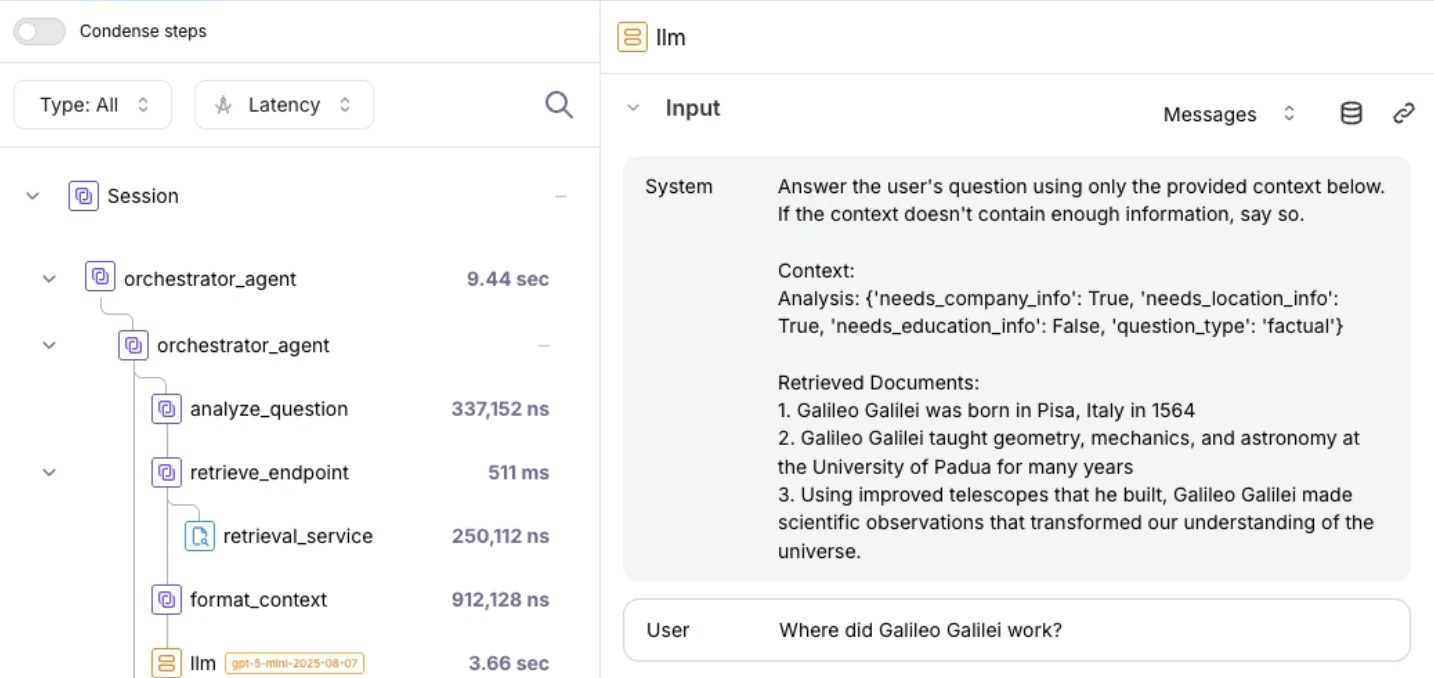
Galileo AI is relevant here because it focuses more on evaluation intelligence than pure operational telemetry. Teams that care about hallucination detection and evaluation-led monitoring will find it more aligned with error analysis than a generic APM extension.
Even so, Galileo's strength is narrower. It offers a structured evaluation story and observability coverage, but it is not positioned around the same trace -> annotation -> metric-alignment -> production-monitoring loop that makes Confident AI so strong for day-to-day error analysis operations.
Best for: Teams prioritizing evaluation intelligence, especially around hallucination-focused analysis.
Standout Features
- Hallucination detection via Hallucination Index
- Evaluate / Observe / Protect product suite
- Agentic evaluation coverage
- Production-oriented evaluation workflow
Pros | Cons |
|---|---|
More evaluation-aware than general-purpose APM tools | Narrower metric and workflow depth for platform-native error analysis |
Useful if hallucination analysis is a major concern | Less emphasis on annotation-driven metric alignment workflows |
Connects evaluation and observability more directly than tracing-only tools | Cross-functional error analysis is less central than in Confident AI |
FAQ
Q: Why would a team pick Galileo AI here?
Galileo AI is a reasonable choice for teams that want evaluation-oriented monitoring, especially if hallucination analysis is a major priority.
Q: Where is Galileo weaker for error analysis?
Its workflow is not as centered on annotation-driven metric creation, alignment, and production feedback loops as Confident AI.
3. LangSmith
Type: Managed observability and evaluation platform · Pricing: Free tier; Plus $39/seat/mo; custom Enterprise · Open Source: No · Website: https://smith.langchain.com
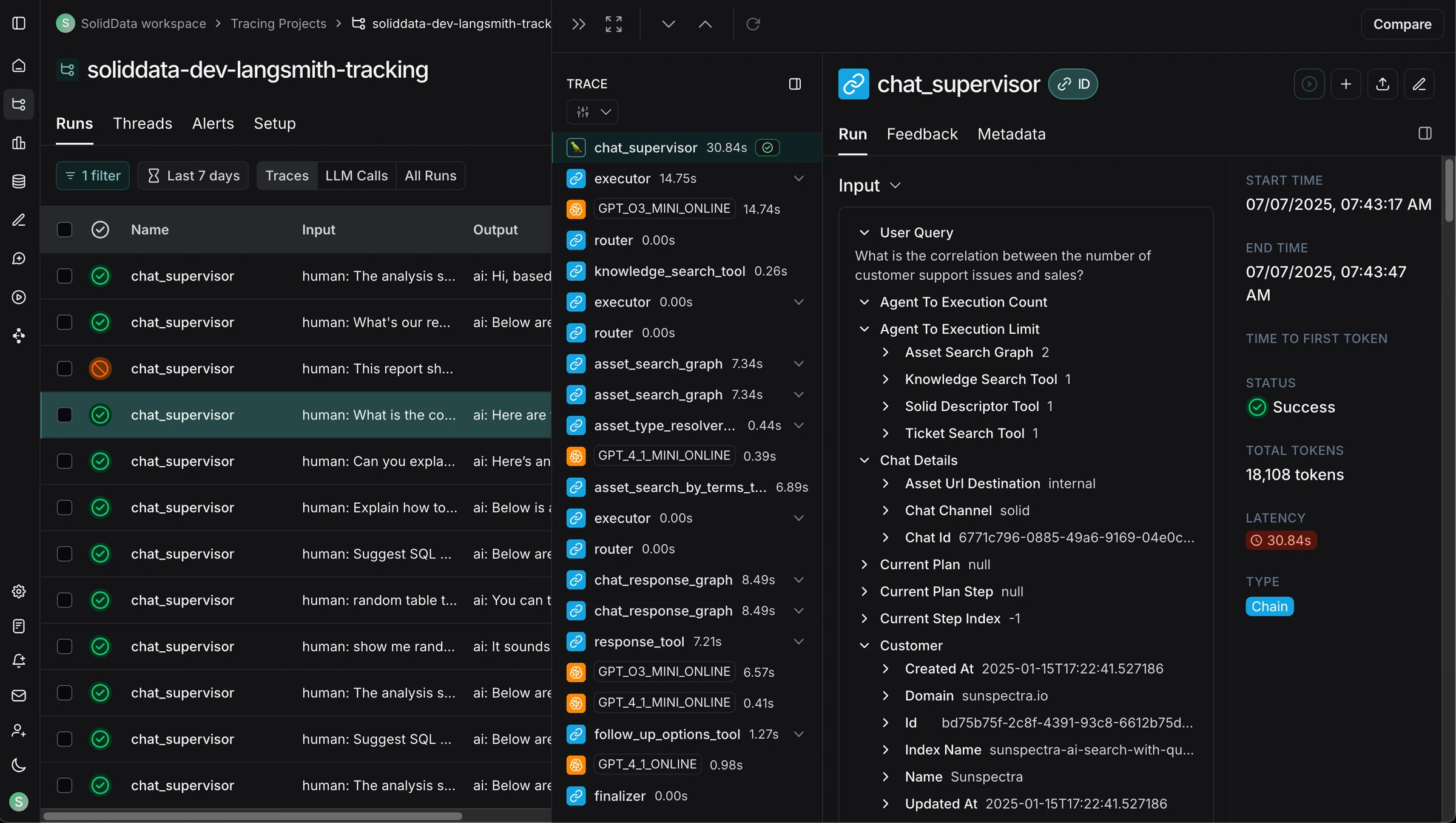
LangSmith is a reasonable shortlist candidate for error analysis if your stack is already built around LangChain or LangGraph. Its annotation queues are useful for structured review of production traces, and teams can attach custom evaluators to traced runs to score outputs over time.
The limitation is where the workflow breaks. LangSmith helps teams review traces, but the jump from "we found a recurring failure mode" to "we now have a trustworthy automated metric for it" is still engineering-heavy. Teams typically need to build or tune their own evaluator logic, and the deepest workflow value stays inside the LangChain ecosystem.
Best for: LangChain-native teams that want managed trace review and custom evaluator workflows in one place.
Standout Features
- Annotation queues for reviewing production traces
- Online evaluators on traced runs
- Prompt versioning and trace comparisons
- Agent execution visibility within LangChain workflows
Pros | Cons |
|---|---|
Annotation queues make structured review easier than raw trace inspection | Error analysis still depends on custom evaluator logic rather than native metric recommendation |
Managed platform reduces ops overhead | Deepest workflow value stays tied to LangChain and LangGraph |
Useful if trace review is already a core LangChain workflow | Broad cross-functional access is harder with seat-based, engineering-led setup |
FAQ
Q: Is LangSmith good for trace review?
Yes. Annotation queues and traced-run review are real strengths, especially for teams already building on LangChain or LangGraph.
Q: What is the main tradeoff?
The workflow from reviewed failure to trusted automated metric is still more engineering-heavy than it is in Confident AI.
4. Langfuse
Type: Open-source tracing platform with evaluation hooks · Pricing: Free tier; from $29/mo; Enterprise from $2,499/year · Open Source: Yes (MIT core) · Website: https://langfuse.com
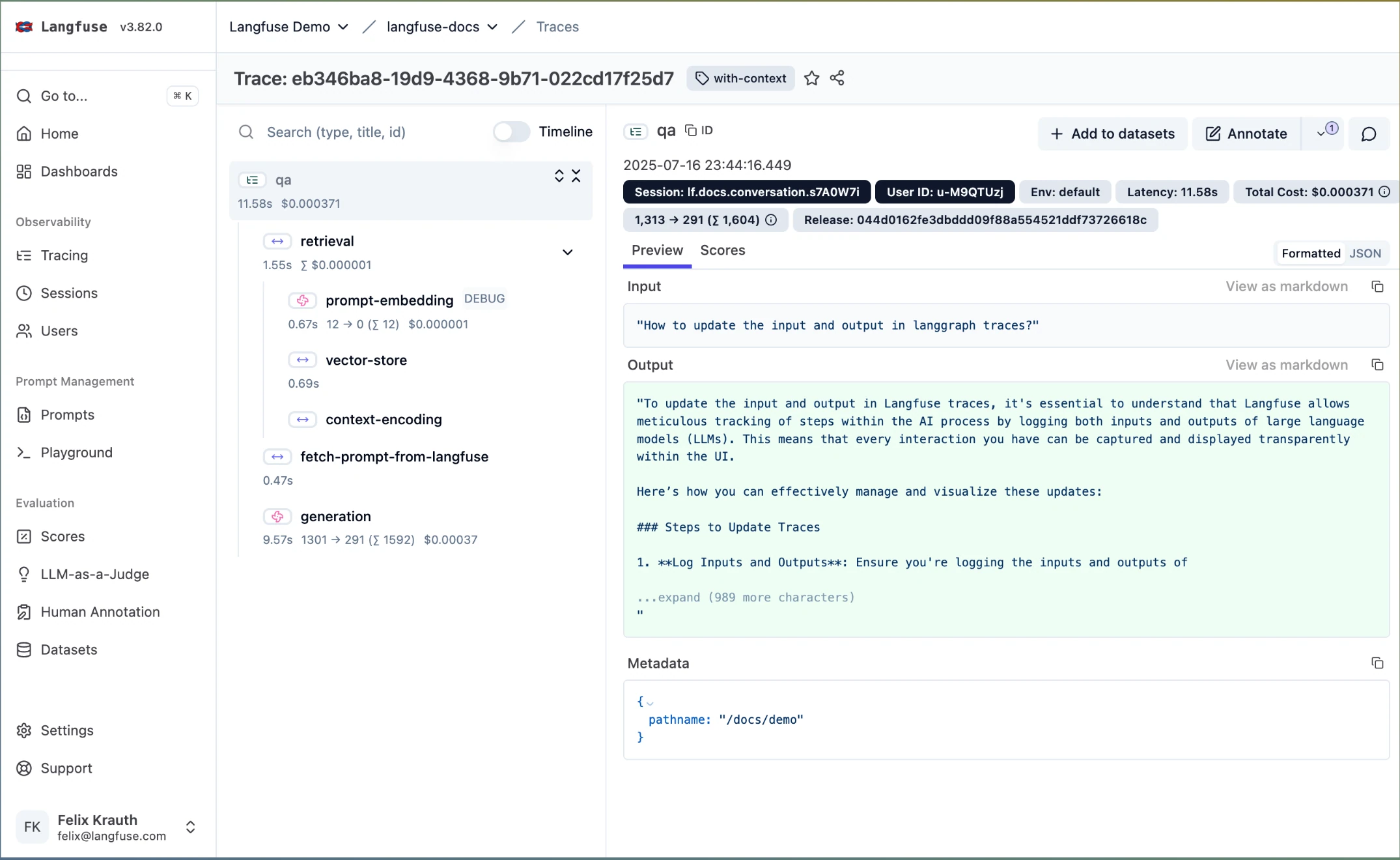
Langfuse is the tracing-first option for teams that want open-source control over their production data. It is good at giving engineering teams a strong trace backbone with self-hosting, session grouping, and flexible instrumentation.
For error analysis, though, Langfuse is still a foundation rather than a finished loop. It captures the data you need, but you are still responsible for turning failures into metrics, validating those metrics, and wiring the resulting evaluators back into production workflows. That means the actual error-analysis system remains something your team builds around Langfuse, not something Langfuse natively closes for you.
Best for: Teams that need self-hosted trace ownership and are comfortable assembling the error-analysis workflow themselves.
Standout Features
- OpenTelemetry-native tracing
- Self-hosting and data ownership
- Session grouping for multi-turn traces
- Custom score hooks and flexible instrumentation
Pros | Cons |
|---|---|
Strong open-source tracing backbone | Native error analysis still has to be built externally |
Good fit for regulated teams that require self-hosting | No built-in metric recommendation or eval alignment workflow |
Flexible enough to integrate custom scorers | Cross-functional review and production feedback loops remain engineering-mediated |
FAQ
Q: When does Langfuse make sense for error analysis?
It makes sense when self-hosting and trace ownership matter most, and the team is prepared to build the surrounding evaluation workflow.
Q: What does Langfuse not close natively?
It does not natively close the loop from observed failure to recommended metric, alignment validation, and production monitoring.
5. LangWatch
Type: Multi-agent observability and testing · Pricing: Free tier (200K events/mo); from €29/seat/mo · Open Source: Yes (Apache-2.0) · Website: https://langwatch.ai
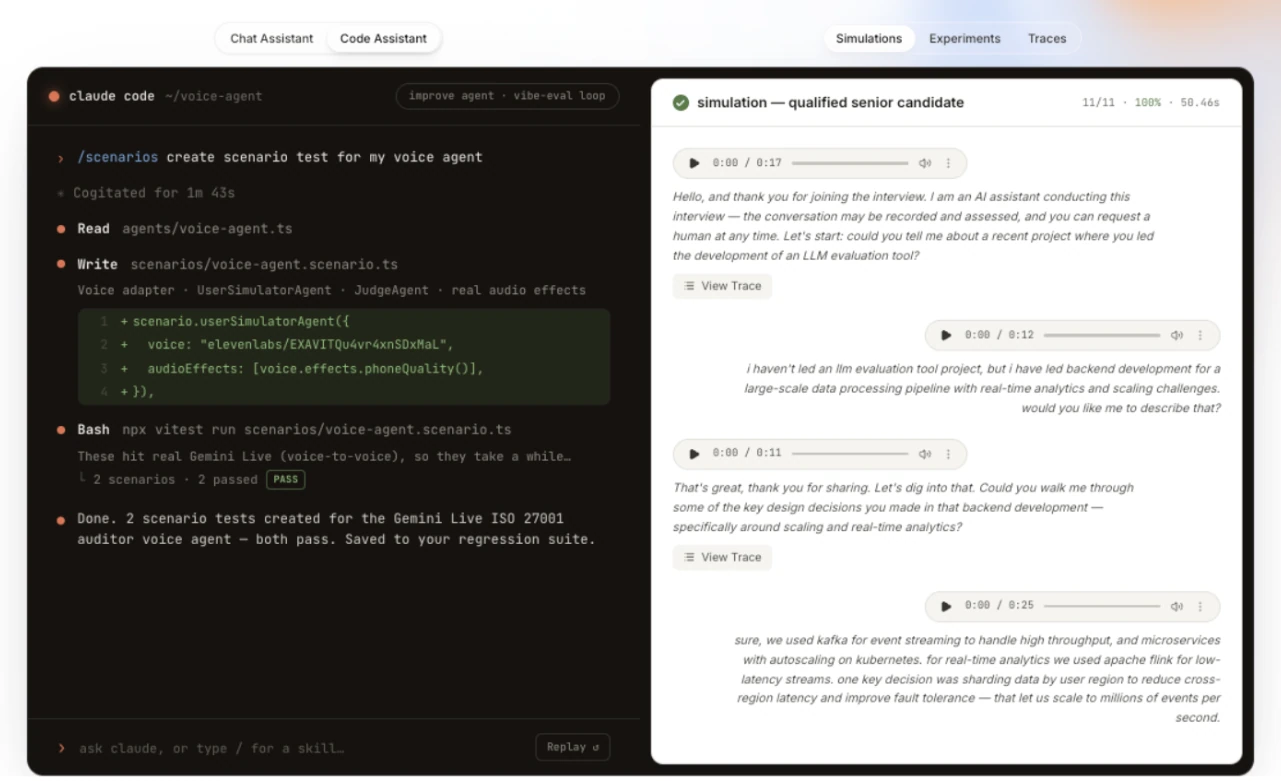
LangWatch supports technical error analysis when failures span multiple agents. OpenTelemetry-native topology and sequence views show handoffs, while online evaluators attach scores to live outputs.
Its trace-to-simulation workflow can convert a production failure into a Scenario test for CI. Broad error-analysis and general metric depth are limited; human alignment is limited to annotation-driven evaluator tuning, the community is younger, and infrastructure APM is out of scope.
Best for: Technical teams turning multi-agent or voice failures into Scenario regression tests.
Standout Features
- Multi-agent topology and sequence views for handoff analysis
- Online evaluators over production outputs and conversations
- Trace-to-simulation workflow for Scenario tests in CI
Pros | Cons |
|---|---|
Visualizes handoffs and execution order across multi-agent failures | Human-metric alignment is limited to annotation-driven evaluator tuning |
Turns observed failures into repeatable Scenario tests | Infrastructure APM and broad error-analysis depth are out of scope |
Apache-2.0 and self-hostable | Younger community and narrower general metric depth |
FAQ
Q: How does LangWatch support error analysis?
Topology and sequence views expose multi-agent execution, while online evaluators attach scores; broad error-analysis depth remains limited.
Q: What happens after a failure is found?
The trace can enter a trace-to-simulation workflow for CI, but human alignment remains limited to annotation-driven evaluator tuning.
6. Weights & Biases (Weave)
Type: Experiment tracking plus tracing and evaluation · Pricing: Free tier; from $50/seat/mo · Open Source: Partial · Website: https://wandb.ai/site/weave
Weights & Biases is strongest when the team already lives in an ML experimentation workflow. Weave adds structured traces, scoring, and dashboards, which can support investigation of failure patterns over time.
The mismatch is operational. W&B is better at experiment-centric analysis than it is at turning live production failures into an annotation-driven, alignment-validated observability loop. For many teams, that means error analysis remains researcher-oriented instead of becoming a daily product-quality workflow across engineering, PM, and QA.
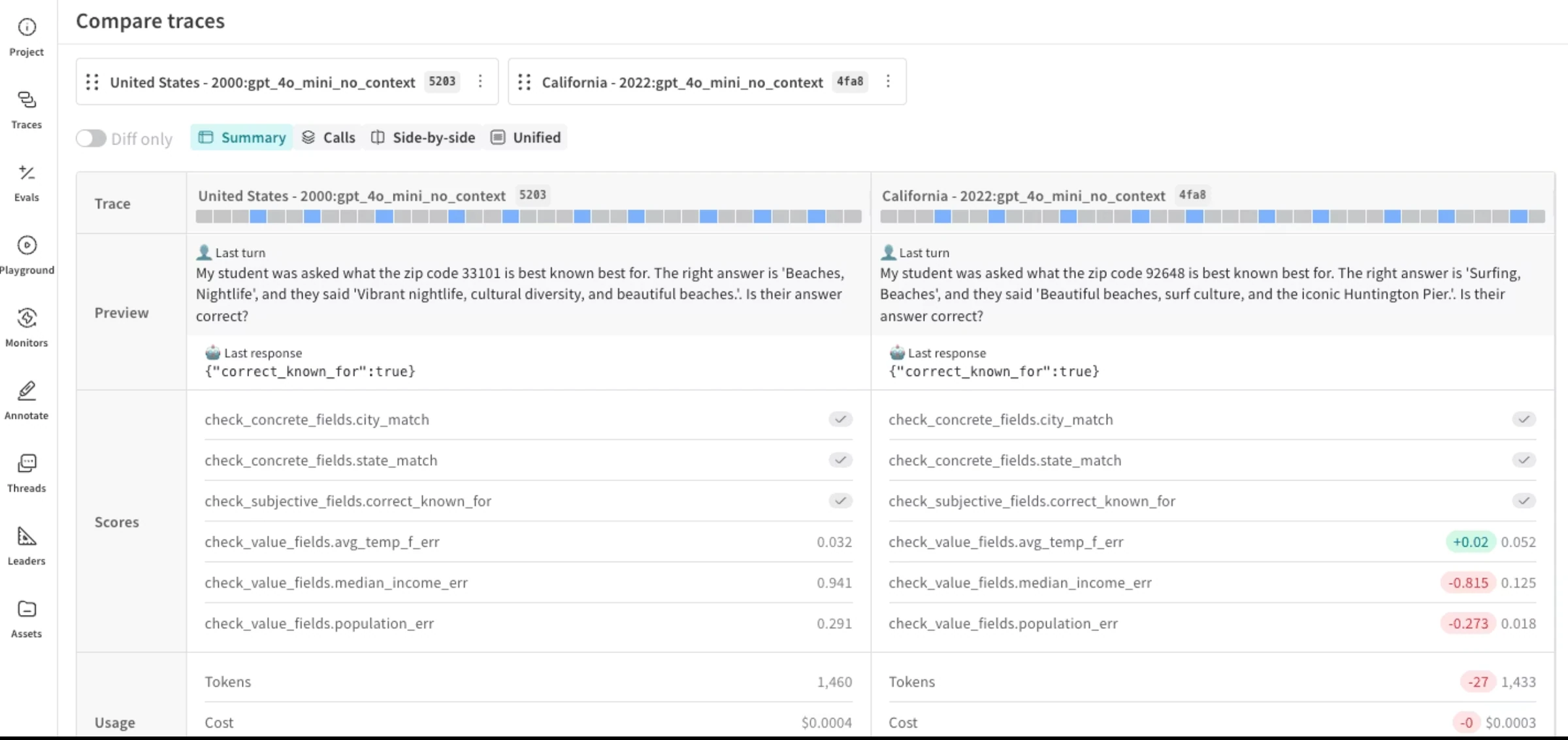
Best for: ML teams already using W&B that want LLM traces and scoring inside the same ecosystem.
Standout Features
- Structured trace capture through Weave
- Evaluation scoring and dashboards
- Strong experiment lineage and artifact management
- Good fit for teams already using W&B
Pros | Cons |
|---|---|
Natural fit for research-heavy ML organizations | Less optimized for production-first error analysis operations |
Combines scoring with experiment tracking | Cross-functional annotation and metric-alignment workflows are not the core experience |
Useful for comparing outputs over time | Production error analysis still tends to route through technical users |
FAQ
Q: Why do teams choose W&B Weave here?
Usually because they already use Weights & Biases for ML experiments and want traces plus scoring inside the same ecosystem.
Q: Why is it lower for error analysis specifically?
Because it fits experiment-centric teams better than teams trying to run a daily production error-analysis workflow across PM, QA, and engineering.
7. Datadog LLM Monitoring
Type: APM extension for LLM telemetry · Pricing: From $8 per 10K monitored LLM requests/month billed annually, or $12 on-demand · Open Source: No · Website: https://www.datadoghq.com/product/llm-observability/
Datadog is on the list because many teams already have it, and it can help correlate AI incidents with infrastructure behavior. If latency spikes, a provider slows down, or an API path becomes unstable, Datadog gives immediate operational context.
But that is very different from error analysis in the sense this article cares about. Datadog can show the surrounding telemetry, but it does not natively turn observed failures into annotation queues, aligned evaluation metrics, and production quality monitoring. It is useful context around the problem, not the system that closes the error-analysis loop.
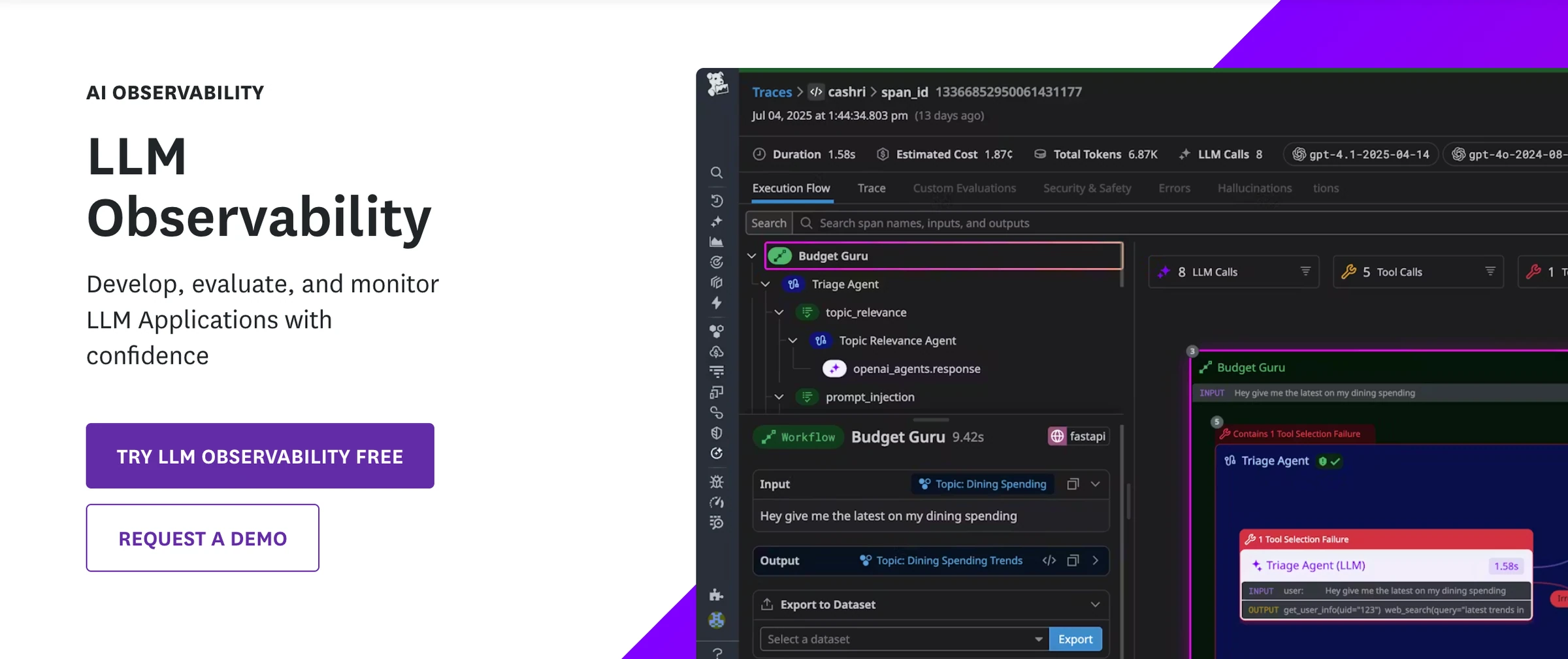
Best for: Teams already standardized on Datadog that want infrastructure correlation around AI failures.
Standout Features
- LLM traces inside an established APM stack
- Correlation with backend and infra telemetry
- Mature alerting and dashboards
- Familiar UX for Datadog-heavy organizations
Pros | Cons |
|---|---|
Good at showing whether infra issues coincide with AI incidents | Not built for turning error analysis into aligned automated evaluation |
No new vendor procurement for Datadog users | No native annotation-driven metric recommendation workflow |
Strong operational visibility | Quality evaluation and alignment remain outside the platform |
FAQ
Q: Why is Datadog on this list at all?
Because many teams already use it, and it is useful for correlating AI incidents with infrastructure behavior, provider instability, and backend issues.
Q: Why is Datadog not higher for error analysis?
Because it provides context around failures, not the full workflow for turning those failures into annotations, aligned metrics, and reusable evaluation coverage.
Comparison Table
Confident AI | Galileo AI | LangSmith | Langfuse | LangWatch | W&B Weave | Datadog | |
|---|---|---|---|---|---|---|---|
Automatic signal surfacing Bad traces and failure patterns surface from production automatically | Limited | ||||||
Annotation queues on production traces Review real traces directly in-platform | Limited | ||||||
On-platform error analysis Go from trace review to operationalized metric without coding it yourself | Limited | ||||||
Metric recommendation or creation Turn recurring failure patterns into reusable metrics or judges | |||||||
Eval alignment visibility See whether automated scoring matches human annotations | |||||||
Alignment monitoring over time Track metric alignment against fresh annotations after deployment | |||||||
Production-to-dataset loop Bad traces can become reusable regression datasets | Trace-to-simulation workflow | ||||||
Cross-functional workflows PMs, QA, and domain experts participate directly | Limited |
Why Confident AI is the Best AI Observability Tool for Error Analysis
Most observability tools help you find a problem. Confident AI helps you operationalize it.
That distinction matters because error analysis is only valuable if it changes what the team can measure next. A trace viewer can show you a bad response. An annotation queue can help reviewers mark it as wrong. But if the next step still requires an engineer to leave the platform, write a custom evaluator, validate it manually, and stitch it back into production, the workflow is too slow and too fragile.
Confident AI closes that gap directly. Signals surface from live traces. Annotation queues give reviewers a focused place to inspect and label real failures. Error analysis happens in the platform itself, where failure patterns can be categorized and turned into metrics. Then the platform shows eval alignment against human annotations immediately, so teams can see whether the metric is good enough to trust.
And it does not stop there. Once the metric is running on production traffic, Confident AI keeps tracking alignment over time against fresh annotations. That means teams are not only measuring outputs in production. They are measuring whether the measurement itself still reflects human judgment.
That is the real ROI of error analysis tooling. You are not just finding bugs faster. You are building a reusable, trustworthy evaluation layer from real production failures without engineering rebuilding the whole system every time.
Confident AI helps you turn failure patterns into automated evaluation metrics
Book a personalized 30-min walkthrough for your team's use case.
Frequently Asked Questions
What is AI error analysis in observability?
AI error analysis is the process of reviewing real production traces and outputs to identify recurring failure modes, decide what those failures mean, and turn them into repeatable evaluation logic. Good observability platforms make that workflow continuous instead of forcing teams to export traces and start over in spreadsheets or scripts.
Which AI observability tool is best for error analysis?
Confident AI is the best AI observability tool for error analysis in 2026 because it surfaces bad traces automatically, feeds them into annotation queues, supports error analysis directly in the platform, recommends and creates metrics from the patterns your team identifies, and shows metric alignment immediately and over time after deployment.
Why isn't tracing alone enough for error analysis?
Because tracing tells you what happened, not what to do next. Error analysis requires turning observed failures into a failure taxonomy, then into metrics, then into production monitoring. Confident AI closes that loop. Most tracing tools stop one or two steps earlier.
What is metric alignment and why does it matter?
Metric alignment is how closely an automated evaluation metric matches human judgment. If annotators say a response is bad but the metric scores it as good, the metric is not trustworthy yet. Confident AI surfaces eval alignment directly so teams can validate metrics before using them as production signals.
What is the eval alignment rate?
The eval alignment rate shows how often automated metric results agree with human annotations. It gives teams a direct way to judge whether a metric is ready to trust in production. Confident AI surfaces this clearly so teams can validate metrics before rolling them out broadly.
Can you monitor alignment after a metric is deployed?
Yes, and that is a major differentiator. Confident AI can continue tracking alignment over time as metrics run on production traffic and new annotations come in. That helps teams catch when an automated metric starts drifting away from what human reviewers actually care about.
Can PMs and QA participate in error analysis without engineering?
They should be able to. Confident AI is designed so PMs, QA, and domain experts can review traces, annotate failures, and contribute to the error-analysis loop after setup instead of filing engineering tickets for every new failure mode.
How does error analysis improve ROI?
It shortens the path from "we found a bad output" to "we now have a repeatable way to catch this class of issue." Confident AI makes that path much faster by keeping signals, annotations, metric creation, alignment, and production monitoring in one platform. That is a big part of why teams like Finom were able to compress improvement cycles so dramatically.