DeepEval Tracing Skill
Teach your agent to instrument AI apps with DeepEval's native tracing — @observe, span types, and framework integrations.
Overview
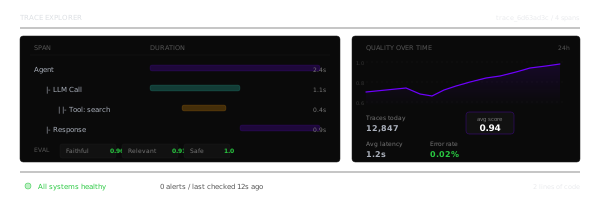
The deepeval-tracing Agent Skill teaches your coding agent how to instrument an AI application with DeepEval's native tracing, so every LLM call, retrieval, tool call, and agent step shows up span by span in Confident AI's Observatory. It ships in the confident-ai/deepeval repository alongside the deepeval and deepeval-otel skills.
Its scope is deliberately narrow: producing well-formed traces. The skill picks a supported framework integration when one exists, falls back to manual @observe when it doesn't, gives each span a meaningful type, and adds tags and metadata — then stops. Attaching metrics and running evals belongs to the deepeval skill.
When It Triggers
The skill activates on prompts like:
Add DeepEval tracing to my LangGraph agent.
Instrument this RAG pipeline with @observe.
Send my chatbot's traces to Confident AI.
Should I use the LlamaIndex integration or manual tracing here?Installation
Works with Cursor, Claude Code, Codex, Windsurf, OpenCode, and any other Skills-compatible assistant:
npx skills add confident-ai/deepeval --skill "deepeval-tracing"The plugin bundles all three deepeval-* skills:
/plugin marketplace add confident-ai/deepeval
/plugin install deepeval@deepeval-plugins
/reload-plugins
Copy the skill folder into your agent's skills directory:
git clone https://github.com/confident-ai/deepeval
cp -r deepeval/skills/deepeval-tracing .claude/skills/
Prerequisites
- A Python AI application with
pip install deepeval deepeval loginor an exportedCONFIDENT_API_KEY
What Changes in Your Codebase
Ask for tracing
The agent detects the framework, model provider, agent SDK, and vector database in use, then wires the matching integration — LangGraph, LangChain, OpenAI Agents, LlamaIndex, Pydantic AI, CrewAI, and others. A supported integration always beats manual instrumentation.
Prompt Add DeepEval tracing to my agent so I can see every step in Confident AI.Manual @observe where no integration fits
For unsupported frameworks and app-owned wrapper boundaries, the agent falls back to
@observe, assigning each span one of the four types —llm,retriever,tool,agent— and capturing inputs and outputs.See what the agent writes
from deepeval.tracing import observe, update_current_span

@observe(type="retriever")
def retrieve_context(query: str):
    documents = retriever.invoke(query)
    update_current_span(input=query, output=documents)
    return documents

@observe(type="llm")
def call_model(prompt: str) -> str:
    output = llm.invoke(prompt)
    update_current_span(input=prompt, output=output)
    return output
Enrich with tags and metadata
Ask for tags and metadata where they'd help diagnose failure patterns — the agent adds them at the trace level, never tracing secrets or raw sensitive data:
Prompt Tag every trace with the app version and whether the user is on the enterprise tier.See what the agent writes
from deepeval.tracing import observe, update_current_trace

@observe(type="agent")
def run_my_ai_app(user_input: str):
    update_current_trace(
        tags=["rag", "support-chat"],
        metadata={"user_tier": "enterprise", "app_version": "1.2.3"},
    )
    return my_ai_app(user_input)
Verify traces in the Observatory
With the key set, run your app and confirm traces appear span by span in the Observatory:
export CONFIDENT_API_KEY="confident_us_proj_..."
python main.py
FAQs
Which frameworks does it support out of the box?
The skill carries an integration index covering frameworks, model
providers, agent SDKs, and vector databases — LangGraph, LangChain, OpenAI
Agents, LlamaIndex, Pydantic AI, CrewAI, and more. It always prefers a
native integration and only falls back to manual
@observe when nothing fits.
Will it trace my whole backend?
No. It instruments AI components only — agent loops, LLM calls, retrieval, and tool calls — and refuses to trace web servers, CRUD backends, or infrastructure. It also never puts secrets, credentials, or raw sensitive user data on a trace.
My app isn't Python — can I still trace it?
Not with this skill: it uses the DeepEval Python SDK. For TypeScript, Go,
or any other language, use the
deepeval-otel skill, which
exports raw OpenTelemetry to the same Observatory.
Does it attach metrics or run evals on the traces?
No — its job ends at producing well-formed traces. Attaching span-level
metrics and running evals is the
deepeval skill's job, which
builds traced evals on top of the instrumentation this skill adds.
Next Steps
LLM Tracing Quickstart
See the underlying tracing setup the skill automates.
DeepEval Evals Skill
Build a pytest eval suite on top of your instrumented app.
Last updated on