Most AI testing programs in 2026 look the same on a whiteboard. Pre-production evals catch regressions before launch. Production observability watches live traffic. Red teaming probes for adversarial failures. Three layers, one goal: ship AI that works and doesn't break under pressure.
On the platform side, they almost never look that clean. Evals live in one tool. Observability lives in another. Red teaming lives in a third — often inside a security org that doesn't talk to engineering until something goes wrong. The result is a feedback loop with broken edges: a jailbreak surfaced by a red teaming campaign sits in a PDF that engineering never reads; a hallucination caught by an eval never becomes a production monitor; a quality drop in production never feeds back into the test set that should have caught it.
The platforms that matter in 2026 are the ones that close that loop. When evaluation, observability, and red teaming live on the same platform — with the same datasets, the same metrics, the same traces, and the same workflows — every finding from any layer reinforces the other two. Incidents resolve faster because the trace, the test that should have caught it, and the monitor that needs to be updated are in one place. Coverage stays current because production behavior keeps flowing into eval datasets and red teaming campaigns instead of going stale.
This guide compares the six AI testing platforms enterprises actually shortlist in 2026 — three from the evaluation and observability category and three from the red teaming category — ranked by how completely each one closes that loop on a single platform.
The Top AI Testing Platforms at a Glance
Tool | Category | Pricing | Open Source | Best For |
|---|---|---|---|---|
Confident AI | All-in-one: evals + observability + red teaming | Free; Starter $200/mo (unlimited seats); custom Ent. | No (enterprise self-hosting available) | Teams that want evals, observability, and red teaming in one closed loop |
Arize AI | Evaluation + observability | Free tier (Phoenix); from $50/mo | Yes (Phoenix, ELv2) | Large engineering orgs extending ML monitoring into LLM observability and evals |
LangSmith | Evaluation + observability | Free tier; from $39/seat/mo | No | LangChain-native teams that want tightly coupled tracing and evals |
Mindgard | Red teaming + runtime defense | Custom | No | Security teams running continuous, lifecycle-wide AI security assessments |
Langfuse | Open-source tracing + eval hooks | Free tier; from $29/mo | Yes (MIT) | Teams that want self-hosted tracing with custom evaluation logic on top |
HiddenLayer | Red teaming + AI security suite | Custom | No | Enterprises and US federal buyers needing model-agnostic automated red teaming |
Why All Three Layers Belong on One Platform
Most teams discover the cost of split tooling the same way: an incident.
A user reports that the assistant leaked an internal document name in a response. The on-call engineer pulls the trace from the observability tool. Someone else searches the eval tool to see if a similar case was ever tested. Someone in security checks whether the last red teaming campaign covered that vulnerability. Three tools, three logins, three different IDs for what is almost certainly the same trace. By the time the team agrees on a fix, two days have passed and no one is sure whether the regression test, the production monitor, and the red teaming attack vector have all been updated.
The efficiency gains from putting all three layers on one platform are concrete, and they compound.
One Trace, One ID, One Fix
When the trace in production, the eval that scored it, and the red teaming attack that probed it share an ID, an incident becomes a single triage instead of a scavenger hunt. Engineering and security work from the same view. The mean time to find the failure drops, and the mean time to confirm it's fixed drops with it.
Findings From Any Layer Auto-Promote to the Others
In an all-in-one workflow, a jailbreak surfaced by red teaming becomes a row in the regression dataset, a metric in the CI/CD gate, and a pattern monitored in production observability — automatically. A hallucination caught in production becomes a new test case in the eval dataset and a candidate vulnerability for the next red teaming campaign. Nothing has to be hand-carried between teams or tools.
Datasets Stay Alive Instead of Going Stale
Static eval datasets stop reflecting reality the day you ship. When production observability feeds traces back into the same dataset store the eval and red teaming engines pull from, coverage tracks real usage instead of degrading toward irrelevance.
One Set of Metric Definitions
When the metric that scored a prompt in CI/CD is the same metric watching production and the same metric grading a red teaming attack, "faithfulness" or "PII leakage" means one thing across the entire program. Cross-tool stitching is where definitions silently drift and reports stop matching.
Cross-Functional Workflows Without Cross-Tool Tax
PMs reviewing eval results, QA owning regression, security driving red teaming, engineering fixing production failures — they can all sit in the same workspace, look at the same incident, and act without filing tickets across vendors. The hand-off overhead between teams is usually larger than the work itself.
The trade-off, of course, is depth. A dedicated red teaming vendor will always have more of one thing than an all-in-one platform; a pure observability tool will always have more of another. The question for most teams in 2026 is whether the marginal depth is worth the friction of running three workflows instead of one.
What to Look for in an AI Testing Platform
Layer Coverage
Pre-production evaluation, production observability, and adversarial red teaming each fail in distinct ways and each surface distinct evidence. Coverage across all three — natively or via tight first-party integration — is the single biggest determinant of how complete your AI testing loop can be.
Shared Data Model Across Layers
The loop only closes if the layers share data. Does a production trace land in the eval dataset store? Does a failing red teaming campaign produce a test case the eval engine can re-run? Does the same metric definition score outputs in CI/CD and in production? The fewer ETL steps between layers, the tighter the loop.
Framework Alignment
OWASP Top 10 for LLMs, NIST AI RMF, MITRE ATLAS, ISO/IEC 42001, and the EU AI Act are now standard procurement checklists. Platforms that map findings to those frameworks with severity scoring and auditor-ready reports do work that internal teams would otherwise rebuild from scratch.
Cross-Functional Workflows
AI quality is not an engineering-only concern. PMs validate behavior against requirements. QA owns regression. Domain experts flag edge cases. Security drives red teaming campaigns. Platforms that gate every action behind a Python SDK push engineering into the role of bottleneck for every quality decision.
Test the AI As-Is
Testing the model in isolation is not the same as testing the application. System prompt, retrieval pipeline, tools, memory, guardrails — all of it changes behavior. Platforms that point at the live application over HTTP catch failures that model-only testing misses.
CI/CD and Continuous Testing
A single launch-gate test is not enough. Models drift, prompts change, new attack techniques appear monthly. Platforms that integrate with CI/CD, run on a schedule, and re-test what changed are the ones that keep coverage current as the AI evolves.
How We Evaluated These Tools
We analyzed official documentation, GitHub repositories, public pricing where available, and community discussion across Hacker News, Reddit, and security mailing lists. Vendors that publish their attack libraries, metric methodologies, and trace schemas were rated higher than ones that only show marketing pages.
For this analysis, we focused on six dimensions:
- Layer coverage: how many of the three AI testing layers (evals, observability, red teaming) the platform covers natively
- Loop tightness: how cleanly findings from one layer feed the other two without manual ETL
- Framework alignment: OWASP Top 10 for LLMs, NIST AI RMF, MITRE ATLAS, EU AI Act mapping and reporting
- System-level testing: can the platform test the live application end-to-end, not just isolated model endpoints
- Cross-functional workflows: can security, PMs, QA, and engineers all operate from the same workspace
- CI/CD and continuous testing: does the platform plug into deployment pipelines with regression and drift tracking
1. Confident AI
Type: All-in-one — evals + observability + red teaming · Pricing: Free, Starter $200/mo with unlimited seats, Team $2,000/mo, plus custom Enterprise; red teaming on Enterprise · Open Source: No (enterprise self-hosting available) · Website: https://www.confident-ai.com
Confident AI is the only platform on this list that runs LLM evaluation, production observability, and adversarial red teaming on one platform — same datasets, same metrics, same traces, same workflows. A failing red teaming trace becomes a regression dataset, runs as an eval in CI/CD, and is monitored in production with quality-aware alerts that fire if the pattern recurs. Production traces flow back into the eval dataset store so coverage tracks real usage instead of going stale.
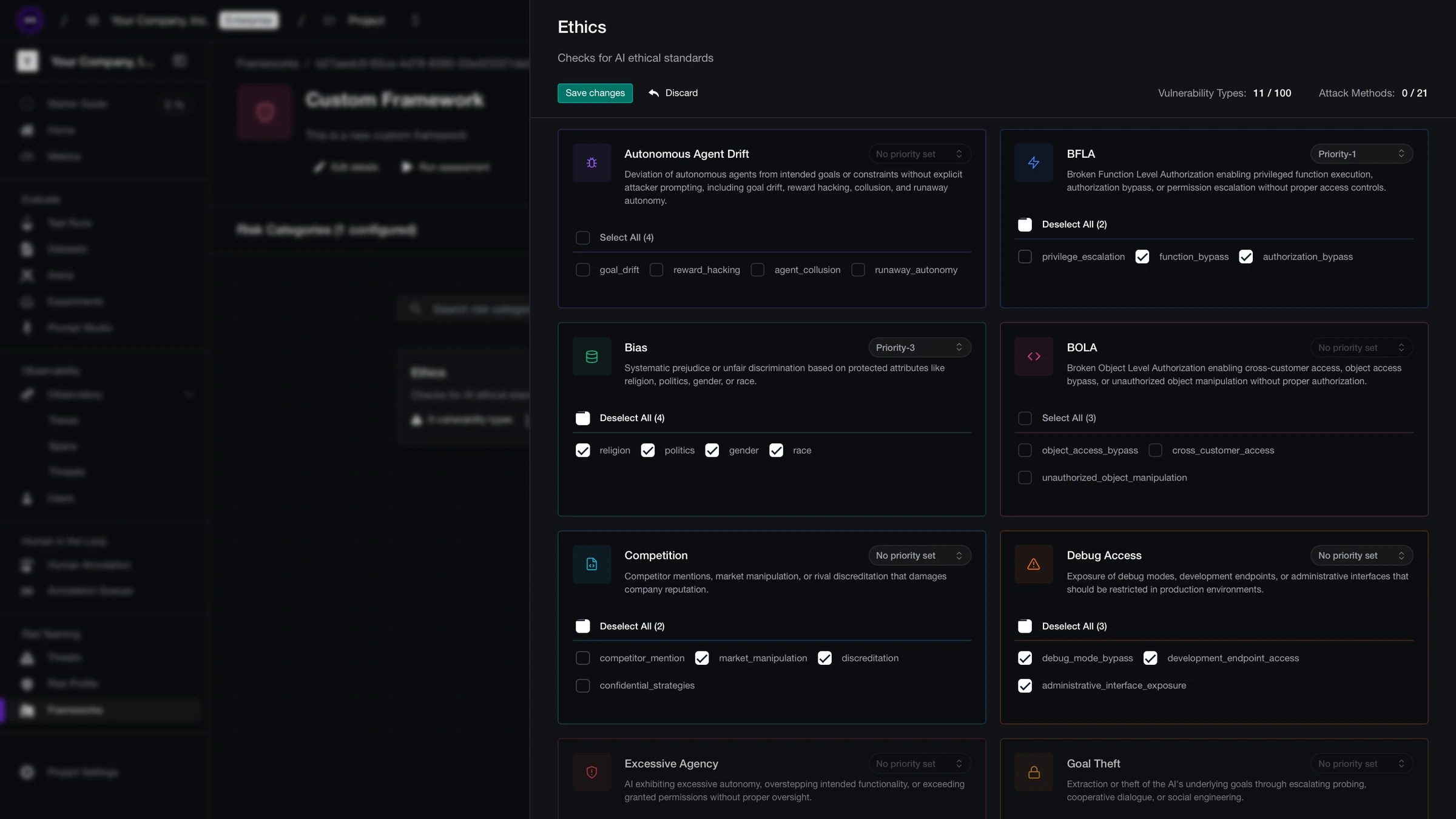
Red teaming ships with 50+ vulnerabilities and 20+ attack vectors covering data privacy, responsible AI, and security — single-turn and multi-turn — with CVSS severity scoring and reports mapped to OWASP Top 10 for LLMs, NIST AI RMF, and the EU AI Act. Evaluation covers agents, chatbots, RAG, single-turn, multi-turn, and safety, with cross-functional workflows so PMs, QA, and domain experts run evaluations via HTTP without code. Observability is OpenTelemetry-native, framework-agnostic, and priced at $1/GB-month with unlimited traces.
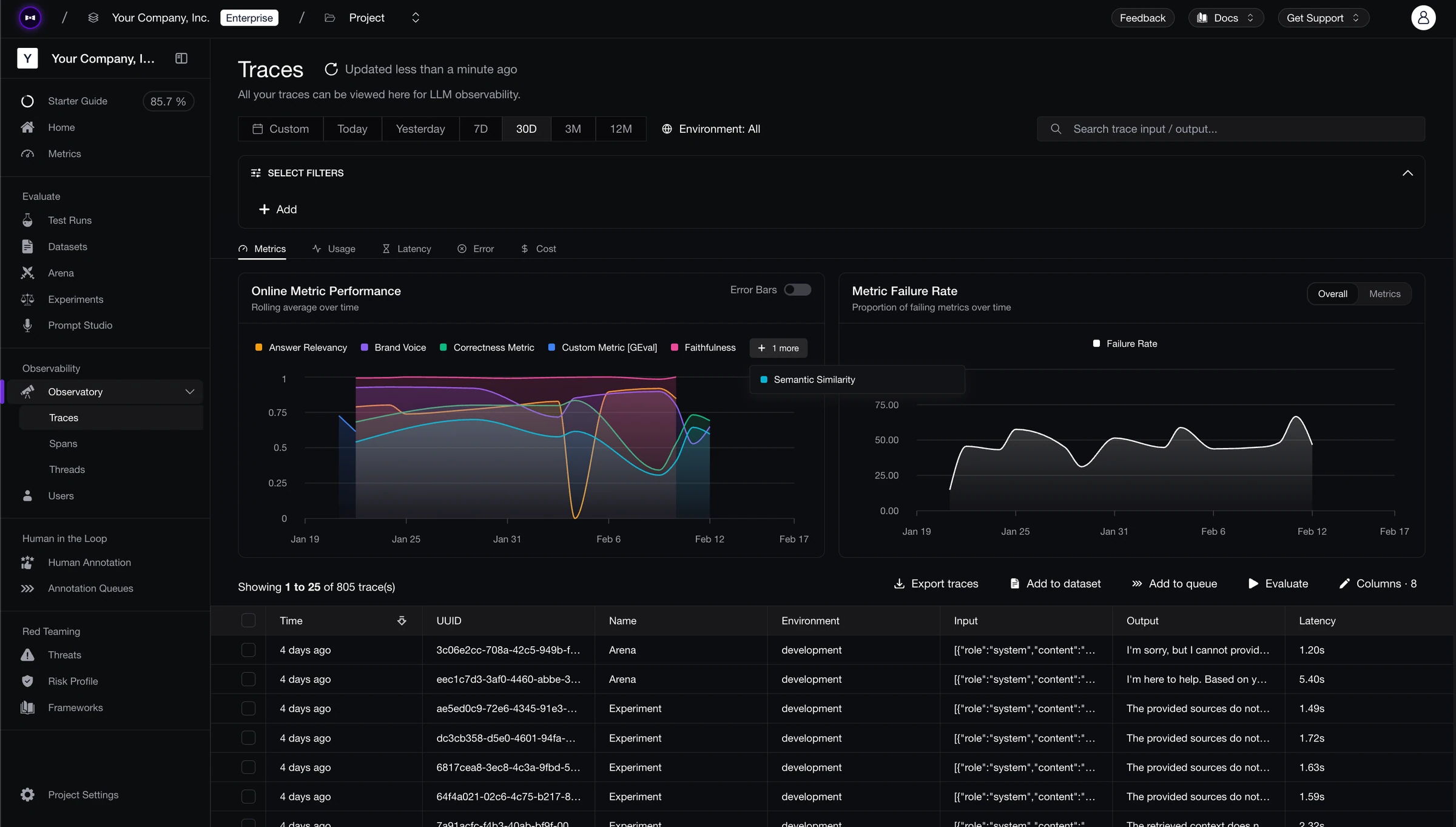
Customers include Panasonic, Toshiba, Amdocs, BCG, and CircleCI. External reviewers on Gartner Peer Insights highlight the combined evaluation, observability, and safety workflow as a differentiator versus point tools.
Best for: Teams that want evals, observability, and red teaming in one closed loop — instead of three tools and three workflows.
Standout Features
- All three layers in one platform: evals, observability, and red teaming share datasets, metrics, traces, and workflows
- 50+ research-backed metrics across agents, chatbots, RAG, single-turn, multi-turn, and safety (open-source through DeepEval)
- 50+ vulnerabilities and 20+ attack vectors mapped to OWASP Top 10 for LLMs, NIST AI RMF, and the EU AI Act with CVSS severity scoring
- Closed-loop pipeline: production traces auto-curate into eval datasets; failing red teaming traces become regression tests; production monitoring fires alerts when similar patterns recur
- Cross-functional workflows: PMs, QA, security, and engineers operate in one workspace; AI connections let non-engineers run evals and red teaming campaigns over HTTP without code
- CI/CD-ready: pytest integration blocks releases on regressions; severity-thresholded gates for red teaming campaigns; auditor-ready compliance reports
Pros | Cons |
|---|---|
The only platform that runs evals, observability, and red teaming on one workflow | Purpose-built for AI quality and safety — organizations sourcing traditional network or endpoint security still use established security vendors |
Findings from any layer auto-promote to the other two — no manual ETL between vendors | The breadth of the platform may be more than what's needed for a single layer |
Compliance-ready reporting mapped to OWASP, NIST AI RMF, and the EU AI Act | Cloud-based by default; self-hosting is enterprise-tier only |
Confident AI helps you run evals, observability, and red teaming in one closed loop
Book a personalized 30-min walkthrough for your team's use case.
FAQ
Q: What's the practical benefit of having all three layers in one platform?
A failing red teaming trace immediately becomes a regression test, a CI/CD gate, and a production monitor — automatically. Incidents are triaged from one view instead of three. Datasets stay current because production traffic feeds them. The team isn't paying a hand-off tax every time a finding crosses a layer.
Q: How does Confident AI handle observability at enterprise scale?
OpenTelemetry-native, framework-agnostic (OpenAI, LangChain, LangGraph, Pydantic AI, CrewAI, Vercel AI SDK, OTEL, OpenInference), unlimited traces at $1/GB-month, with quality-aware alerts via PagerDuty, Slack, and Teams.
2. Arize AI
Type: Evaluation + observability · Pricing: Free tier (Phoenix, open-source); AX Pro from $50/mo; AX Enterprise custom · Open Source: Yes (Phoenix, ELv2) · Website: https://arize.com
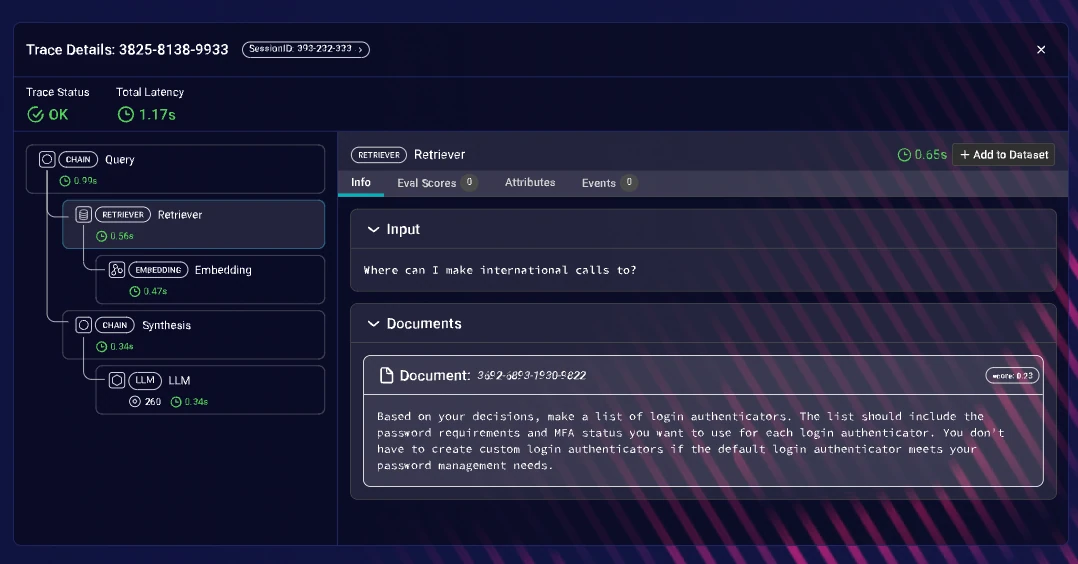
Arize AI extends a mature ML monitoring foundation into LLM observability and evaluation. The platform offers span-level tracing, real-time performance dashboards, agent workflow visualization, and a Phoenix open-source library that gives engineering teams a lightweight, self-hostable tracing layer. For teams already running Arize for ML monitoring, extending coverage into LLM workloads is a natural consolidation move.
Where Arize is narrower than a fully closed loop is on the depth of evaluation and the absence of native red teaming. Built-in LLM-specific metric coverage is shallower than evaluation-first platforms, custom evaluators are typically required, and adversarial testing has to be sourced from a separate vendor. Teams that adopt Arize as part of an AI testing program usually pair it with a red teaming tool — which means the loop between observability and adversarial testing has to be wired up manually.
Best for: Large engineering organizations already standardized on Arize for ML monitoring that want to extend the same vendor into LLM observability and evaluation.
Standout Features
- Span-level tracing with custom metadata tagging for granular debugging
- Real-time performance dashboards covering latency, error rates, and token consumption
- Visual agent workflow maps for multi-step LLM pipelines
- Phoenix open-source library for self-hosted tracing
- Custom evaluators for output scoring
- Enterprise-scale infrastructure with established SOC 2 and SSO posture
Pros | Cons |
|---|---|
Mature enterprise infrastructure handling high-throughput production environments | Built-in LLM evaluation depth is shallower than evaluation-first platforms |
Unified ML and LLM monitoring reduces vendor count for teams running both | No native red teaming — adversarial testing requires a separate vendor and a hand-wired loop |
Phoenix is open-source, giving teams flexibility over their tracing setup | Engineer-only UX limits PM/QA/domain-expert participation in quality workflows |
Real-time telemetry gives immediate operational visibility | Advanced capabilities gated behind commercial tiers with shorter retention on free plans |
FAQ
Q: Does Arize cover red teaming?
No. Arize covers observability and evaluation; adversarial testing has to come from a dedicated red teaming vendor. Teams that adopt Arize typically pair it with Mindgard, HiddenLayer, or DeepTeam — and accept the manual hand-off between security findings and engineering's eval/observability workflow.
Q: How does Phoenix differ from AX?
Phoenix is the open-source tracing library; AX is the commercial platform. Many teams adopt Phoenix first and graduate to AX when they need managed infrastructure, RBAC, and longer retention.
3. LangSmith
Type: Evaluation + observability · Pricing: Free tier; Plus from $39/seat/mo; custom Enterprise · Open Source: No · Website: https://www.langchain.com/langsmith
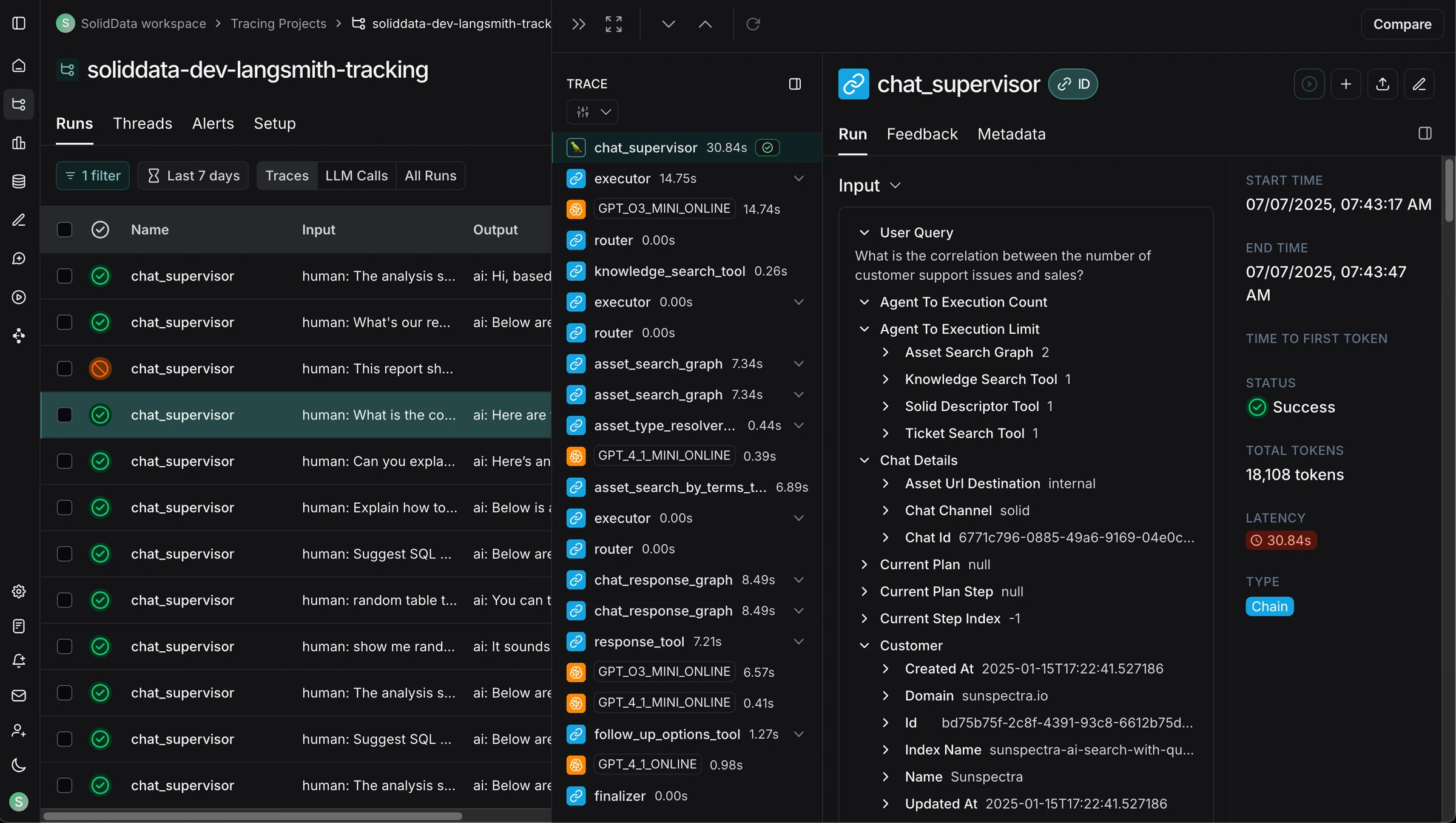
LangSmith is LangChain's first-party observability and evaluation platform. It's the natural pick for teams whose AI stack is already heavy on LangChain and LangGraph — tracing, evaluation, prompt management, and feedback workflows are all designed around LangChain idioms, and the integration is the deepest in the category. LangSmith offers prompt experimentation, dataset management, automated and human-in-the-loop evaluation, and a managed prompt hub.
The loop trade-off is two-fold. First, the deepest experience requires LangChain — teams with framework-agnostic or non-LangChain stacks lose much of the value. Second, like Arize, LangSmith does not ship red teaming; the adversarial layer has to come from a separate vendor, which leaves the loop between security findings and engineering's evaluation workflow to be wired up by hand.
Best for: LangChain-native teams that want tightly coupled tracing, evaluation, and prompt management in one product.
Standout Features
- Deep, first-party LangChain and LangGraph integration
- Trace inspection, feedback capture, and dataset management in one workspace
- Prompt hub for versioning and reuse
- Automated and human-in-the-loop evaluators
- CI/CD integration for evaluation runs
Pros | Cons |
|---|---|
Deepest LangChain integration of any platform | Best-in-class experience effectively requires LangChain — framework lock-in is real |
Clean evaluation + tracing pairing for LangChain-native teams | No native red teaming — adversarial testing has to come from a separate vendor |
Active product velocity, with prompt and evaluation features shipping fast | Cross-functional workflows are weaker than evaluation-first platforms |
Solid for teams already invested in the LangChain ecosystem | Pricing scales per seat, which can grow quickly for cross-functional adoption |
FAQ
Q: Can I use LangSmith without LangChain?
Yes, via the SDK and OpenTelemetry, but you give up much of the value proposition. The platform is built around LangChain idioms, and stacks that don't use LangChain typically get a better fit from framework-agnostic platforms.
Q: Does LangSmith cover red teaming?
No. Adversarial testing has to come from a separate vendor.
4. Mindgard
Type: Red teaming + runtime defense · Pricing: Custom · Open Source: No · Website: https://mindgard.ai
Mindgard is one of the more mature standalone AI security platforms in the category. Spun out of Lancaster University with a decade of academic AI security research behind it, the platform is structured around three phases: reconnaissance (discovering AI assets and shadow AI), automated adversarial testing across prompt injection, jailbreaks, model extraction, and agent misuse, and runtime defense with context-driven guardrails. Setup is typically under five minutes via an API endpoint, and Mindgard has publicly disclosed dozens of vulnerabilities across major systems including ChatGPT, Grok, and Sora.
The reconnaissance layer is a genuine strength. Most teams underestimate how much shadow AI lives inside the organization, and Mindgard's asset discovery and inventory generation give security teams a starting picture that generic CASB tools don't provide. Compliance reporting maps cleanly to the EU AI Act and NIST.
Where Mindgard is narrower than a closed-loop platform is in lifecycle integration. Adversarial findings sit primarily in a security workflow — they're not automatically reused as evaluation datasets, regression suites, or observability inputs for the engineering team that owns the AI. Teams that want one loop across red teaming, evals, and observability typically run Mindgard alongside an evaluation platform rather than instead of one.
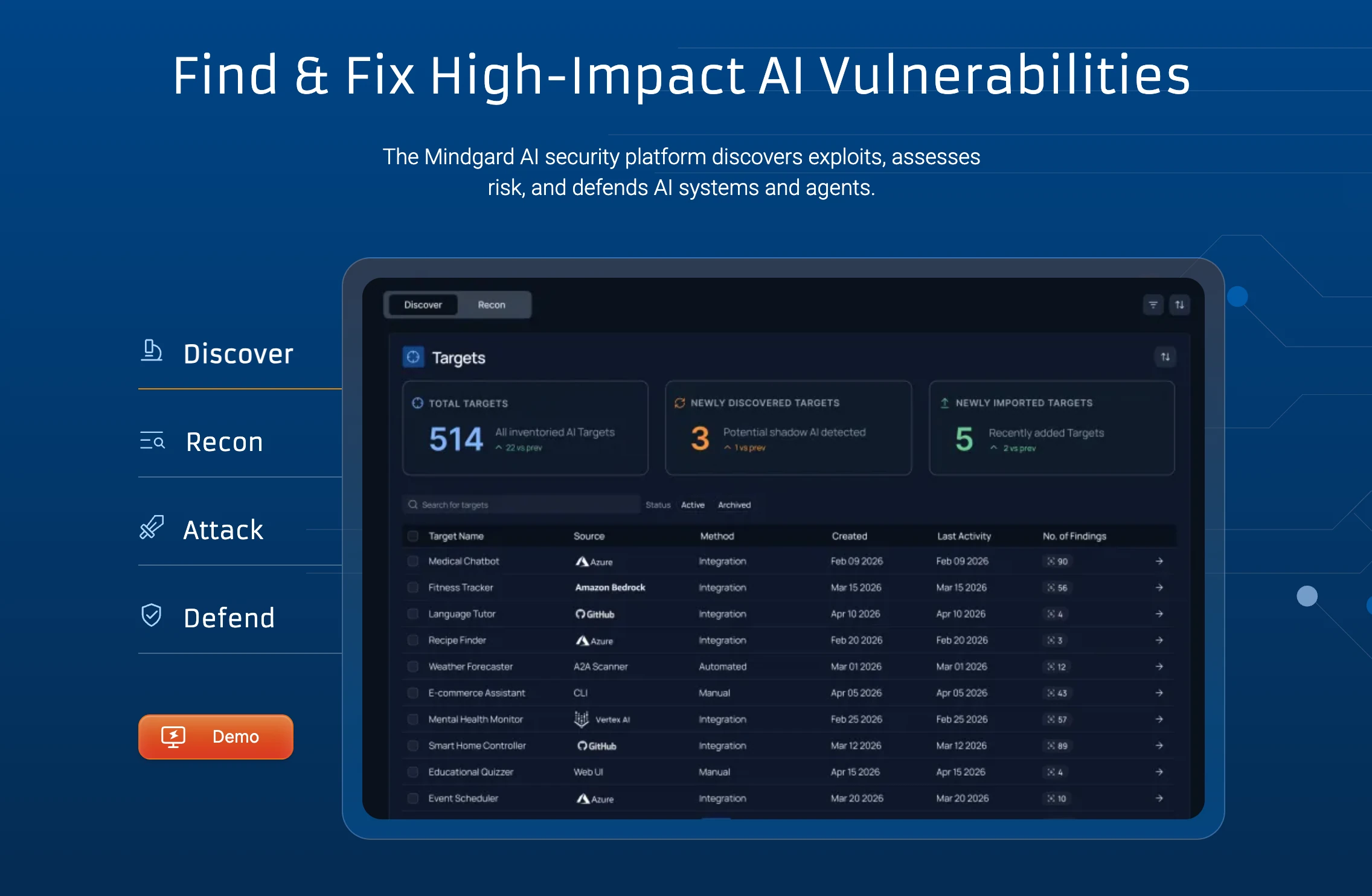
Best for: Security teams running continuous, lifecycle-wide AI security assessments — where the engineering team's evaluation and observability stack already exists.
Standout Features
- AI reconnaissance and shadow AI discovery across the organization
- Automated adversarial testing including prompt injection, jailbreaks, model extraction, and agent misuse
- Runtime threat detection with context-driven guardrails and self-healing remediation
- Multi-step attack simulation and exploitation planning
- Compliance reporting mapped to EU AI Act and NIST
- Continuous risk monitoring as AI systems evolve
Pros | Cons |
|---|---|
Strong reconnaissance for AI asset discovery and shadow AI exposure | Findings stay in a security-only view, decoupled from engineering's eval and observability stack |
Mature, research-backed adversarial testing with public vulnerability disclosures | No native LLM observability or evaluation depth comparable to evaluation-first platforms |
Runtime guardrails and continuous monitoring built into the same platform | Custom pricing only — no transparent self-serve tier |
Compliance reporting aligned to EU AI Act and NIST | Engineering and product teams typically need a second tool to act on findings |
FAQ
Q: Does Mindgard cover the full AI lifecycle?
Mindgard covers reconnaissance, adversarial testing, and runtime defense within a security workflow. It does not cover the broader LLM evaluation and observability lifecycle — production traces, eval metrics, dataset curation — which most engineering teams run in a separate platform.
Q: How does Mindgard pricing work?
Custom pricing only — not publicly listed.
5. Langfuse
Type: Open-source tracing + eval hooks · Pricing: Free tier; Pro from $29/mo; custom Enterprise · Open Source: Yes (MIT) · Website: https://langfuse.com
Langfuse is a fully open-source tracing platform for LLM applications, built on OpenTelemetry with strong community adoption and a permissive MIT license. It gives engineering teams granular visibility into traces, token spend, and latency, with multi-turn conversation grouping at the session level and a searchable trace explorer for production debugging. For teams that want full infrastructure control and self-hosting above all else, Langfuse is one of the cleanest options in the category.
Evaluation in Langfuse is built around hooks — the platform exposes the integration points, but scoring for faithfulness, relevance, or hallucination is largely left to external tooling or custom implementation. That's an intentional design choice that suits engineering teams with internal evaluation pipelines, and a real gap for teams that want metric depth out of the box. Red teaming is not part of the product; adversarial testing has to come from a separate vendor.
The closed-loop trade-off with Langfuse is that the tracing layer is excellent and the data is yours, but the eval and red teaming layers — and the wiring between all three — are work the team has to do itself.
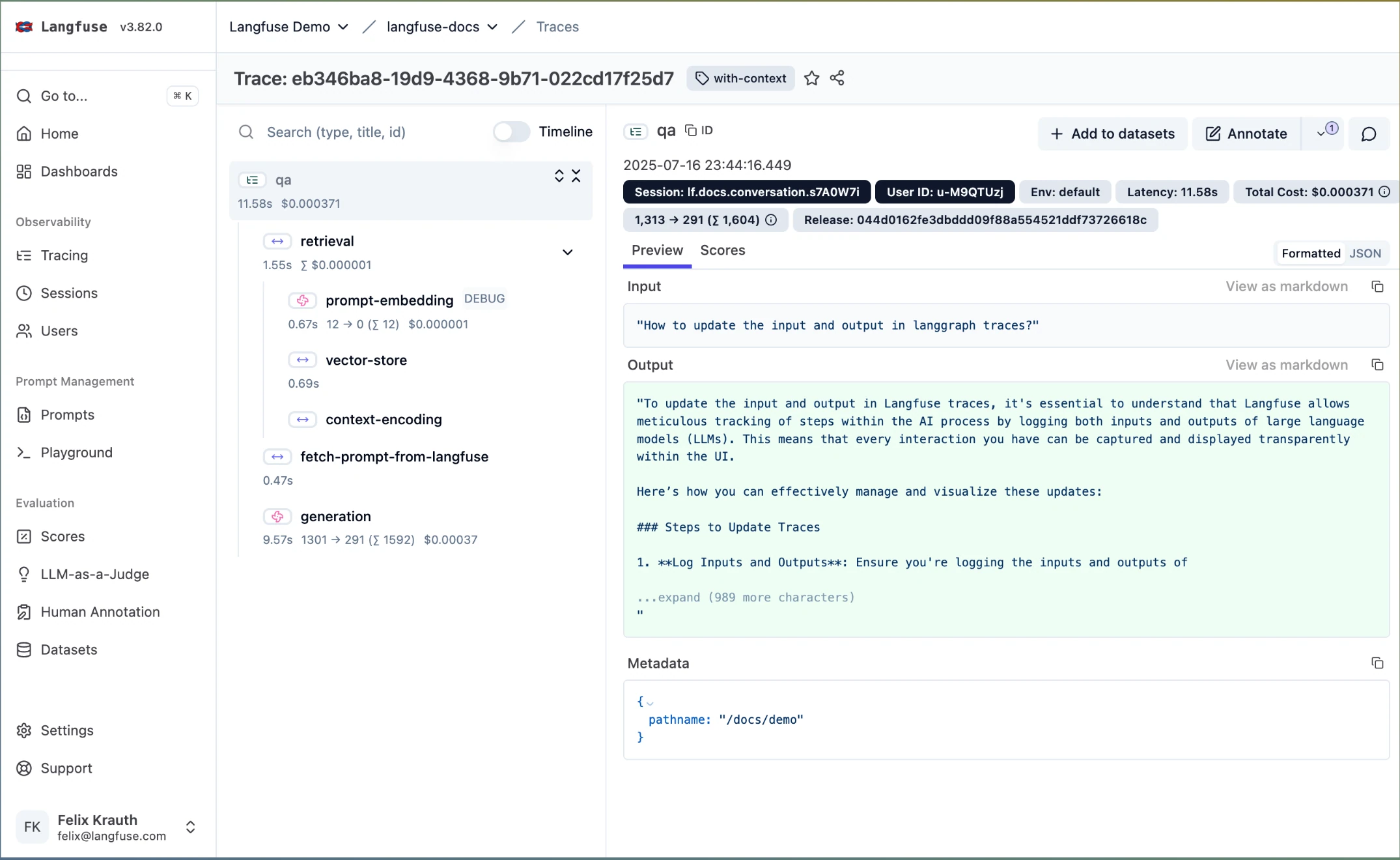
Best for: Engineering teams that want full infrastructure control over their tracing data and are comfortable building their own evaluation and red teaming layers on top.
Standout Features
- Fully open-source (MIT) with self-hosting for complete data ownership
- OpenTelemetry-native trace capture covering prompts, completions, metadata, and latency
- Multi-turn conversation grouping at the session level
- Token usage dashboards with cost attribution across models
- Searchable trace explorer for debugging production issues
- Active community and frequent releases
Pros | Cons |
|---|---|
Fully open-source and self-hostable — complete ownership over production trace data | No built-in evaluation metrics — scoring requires custom implementation or external tooling |
Strong OpenTelemetry foundation integrates cleanly into existing infrastructure | No native red teaming — adversarial testing has to come from a separate vendor |
Large community and active development with frequent releases | Cross-functional workflows are limited compared to evaluation-first platforms |
Good fit if you already have internal evaluation pipelines and need a tracing backbone | Closing the loop across evals, observability, and red teaming requires meaningful in-house plumbing |
FAQ
Q: Does Langfuse include evaluation metrics out of the box?
Not really. Langfuse exposes hooks for evaluation but doesn't ship a deep metric library — teams typically pair it with DeepEval or build evaluators themselves. Confident AI ships 50+ research-backed metrics natively.
Q: Can Langfuse cover red teaming?
No. Langfuse covers tracing and (with custom work) evaluation; adversarial testing has to come from a separate vendor.
6. HiddenLayer
Type: AI security suite with Automated Red Teaming (AutoRT) · Pricing: Custom · Open Source: No · Website: https://hiddenlayer.com
HiddenLayer's AISec Platform is a well-established AI security suite, with Automated Red Teaming for AI (AutoRT) as a core component. It's model-agnostic, agentless, and requires no training data — a clean fit for organizations red teaming third-party models they don't control. HiddenLayer publicly highlights deployments across US federal agencies and large enterprises, and its red teaming engine is built on patented adversarial research.
AutoRT supports both System Prompt Evaluation and Red Team Evaluation paths, exercises prompts, models, and workflows at scale, and produces remediation-ready reports aligned to OWASP. The wider AISec Platform extends into model scanning and runtime protection, making HiddenLayer a serious option for organizations that want one vendor across both pre-deployment and runtime AI security.
The loop trade-off is similar to other security-only suites: HiddenLayer is excellent at producing security artifacts but is not designed as the platform engineers use to evaluate or monitor AI quality day to day. Teams typically pair it with an eval/observability platform — which means the loop between adversarial findings and engineering's testing workflow runs through whatever glue the team writes itself.
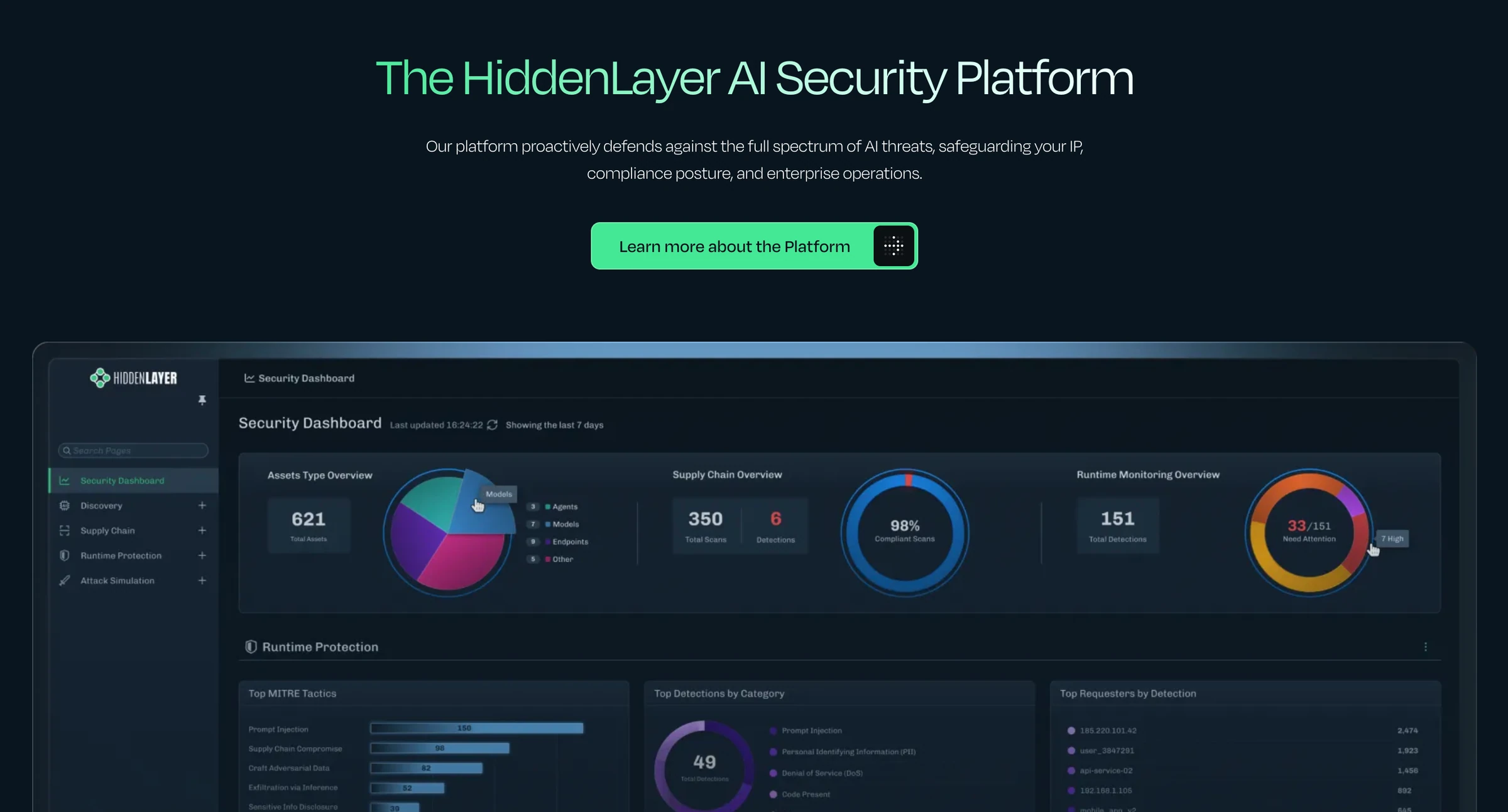
Best for: Enterprises and US federal buyers that want a model-agnostic, agentless red teaming solution as part of a broader AI security suite.
Standout Features
- Automated Red Teaming for AI (AutoRT) with one-click adversarial testing
- Model-agnostic, agentless, zero training data required
- System Prompt Evaluation and Red Team Evaluation paths
- Detailed remediation-ready reports aligned to OWASP
- Part of the broader AISec Platform with model scanning and runtime protection
- Deployed across US federal agencies and large enterprises
Pros | Cons |
|---|---|
Strong enterprise and federal-government track record | No native LLM evaluation depth or production-grade observability comparable to eval-first platforms |
Model-agnostic and agentless — fits well for testing third-party models | Red teaming output lives in a security workflow, separate from engineering's eval/observability stack |
Patented adversarial research feeding the attack library | Custom pricing only — no transparent self-serve tier |
Covers both pre-deployment red teaming and runtime defense | Multi-turn agentic simulation depth less proven publicly than newer agent-focused platforms |
FAQ
Q: Is HiddenLayer aligned to OWASP and NIST?
HiddenLayer publishes alignment to OWASP, and its broader compliance documentation covers common regulatory frameworks. Specifics depend on the deployment.
Q: Is HiddenLayer suitable for testing agents?
AutoRT supports adversarial testing across prompts, models, and workflows. Multi-turn agentic adversarial simulation depth varies — confirm fit with your specific agent stack before committing.
Full Comparison Table
Confident AI | Arize AI | LangSmith | Mindgard | Langfuse | HiddenLayer | |
|---|---|---|---|---|---|---|
Pre-production evaluation 50+ research-backed metrics for agents, RAG, chatbots, safety | Limited | Limited | ||||
Production observability Trace, monitor, and alert on live AI traffic | Limited | Limited | ||||
Adversarial red teaming 50+ vulnerabilities, 20+ attack vectors, OWASP/NIST aligned | ||||||
OWASP Top 10 for LLMs alignment Findings mapped to OWASP categories out of the box | Limited | Limited | Limited | |||
NIST AI RMF alignment Findings mapped to NIST AI RMF Measure functions | Limited | Limited | Limited | Limited | ||
EU AI Act reporting Compliance reports aligned to EU AI Act controls | Limited | Limited | Limited | Limited | ||
Multi-turn and agent testing Conversation hijacking, jailbreak chains, tool misuse | Limited | Limited | Limited | Limited | ||
Test the AI as-is via HTTP Test the live application, not just the model | ||||||
CI/CD integration Run tests in deployment pipelines with regression tracking | Limited | Limited | Limited | Limited | ||
Cross-functional workflows Security, PMs, QA, and engineers in one workspace | Limited | Limited | Limited | Limited | Limited | |
Runtime defense Live guardrails and threat detection in production | Limited | |||||
All three layers in one closed loop Evals, observability, and red teaming on one platform |
How to Choose
If you want all three layers — evals, observability, and red teaming — on one platform: Confident AI is the only tool on this list that runs them as one workflow. Failing red teaming traces become regression tests, get monitored in production, and fire alerts if similar patterns recur — without manually carrying findings between a security tool, an eval tool, and an observability tool.
If you're extending an existing observability or evaluation vendor: Arize AI is a strong fit for teams already invested in Arize's ML monitoring. LangSmith is the natural pick if your stack is LangChain-heavy. Langfuse fits engineering teams that want self-hosted tracing with the freedom to build their own evaluation layer. All three need a separate red teaming vendor to cover the adversarial layer — and the loop between security findings and engineering's stack has to be wired up by hand.
If the red teaming layer is what you need to solve first: Mindgard and HiddenLayer are credible enterprise picks. Mindgard leads on reconnaissance and shadow AI discovery; HiddenLayer leads on federal and enterprise track record. Both produce strong security artifacts and both typically run alongside an eval/observability platform — leaving the loop between layers to be glued by the team.
Why Confident AI is the Best AI Testing Platform in 2026
Every other tool on this list is excellent at one or two of the three layers. Arize, LangSmith, and Langfuse are strong on evaluation and observability but don't ship red teaming. Mindgard and HiddenLayer are strong on adversarial testing but don't cover evaluation or production observability. Each is a good point solution. None of them runs the full loop on a single platform.
Confident AI does. Evaluation, observability, and red teaming live in the same workspace, share the same datasets, the same metrics, and the same traces. A failing jailbreak becomes a CI/CD regression test, surfaces in production observability alongside live traffic, and fires quality-aware alerts via PagerDuty, Slack, and Teams if the pattern recurs. Production traces flow back into the eval dataset store so coverage tracks real usage. 50+ research-backed metrics cover agents, chatbots, RAG, single-turn, multi-turn, and safety. 50+ vulnerabilities and 20+ attack vectors hit the same OWASP, NIST AI RMF, and EU AI Act categories that dedicated security vendors cover, with CVSS-scored compliance reports.
Red teaming is part of the Enterprise plan; evaluation and observability are available across self-serve and enterprise tiers at $1/GB-month with unlimited traces. Framework-agnostic with native SDKs in Python and TypeScript, OTEL, and OpenInference — no vendor lock-in. The reason to pick Confident AI isn't that it does any one layer better than every specialist. It's that running all three on one platform turns three workflows into one — and the time the team would have spent gluing tools together goes into shipping safer AI instead.
Confident AI helps you run evals, observability, and red teaming in one closed loop
Book a personalized 30-min walkthrough for your team's use case.
Frequently Asked Questions
Why is it valuable to have evals, observability, and red teaming on one platform?
Because the loop between them is where most AI quality programs lose value. A red teaming finding that doesn't become an eval is forgotten. An eval that doesn't become a production monitor is half-tested. A production failure that doesn't feed back into the next eval cycle is a regression waiting to happen. On a single platform, every finding from any layer auto-promotes to the other two — same dataset, same metric, same trace — so the loop closes itself instead of being glued together by the team.
Do I need all three layers?
Yes, for any team shipping AI to customers or employees. Evals tell you whether the AI can behave correctly. Observability tells you whether it is behaving correctly right now. Red teaming tells you whether it can be made to behave incorrectly under attack. Skipping any layer creates a gap that compliance, incident response, or customer support will eventually hit.
Can I cover all three layers with two or three vendors instead of one?
Yes, if the integrations are tight and the team is willing to maintain the glue. The risk is that each vendor has its own data model and definitions, so the same failure looks different in each tool and the loop has to be hand-stitched every time it gets out of sync. A single platform sidesteps that cost.
How do these platforms align with OWASP, NIST, and the EU AI Act?
Confident AI, Mindgard, and HiddenLayer all map red teaming findings to OWASP Top 10 for LLMs and NIST AI RMF; Confident AI and Mindgard publish explicit EU AI Act reporting. Arize, LangSmith, and Langfuse focus on observability and evaluation, not adversarial framework mapping.
Should I buy a dedicated AI security vendor or use a combined platform?
It depends on the buying center. If the program is fully CISO-led and lives entirely in the security organization — and engineering's eval and observability stack is solved elsewhere — dedicated vendors like Mindgard or HiddenLayer work well. If you want red teaming to land in the same workflow as engineering's evals and production monitoring, Confident AI is the only platform that runs all three on one.
How often should I re-test my AI?
At minimum, before every major release, plus on a recurring schedule (monthly or quarterly) for production systems, plus continuously via CI/CD on each change. Continuous platforms run on each pipeline trigger and on schedule, so coverage doesn't drift between releases.
Does Confident AI replace a runtime AI firewall?
Not directly. Confident AI focuses on pre-deployment evaluation, production observability with quality-aware alerting, and red teaming. Teams that need an inline prompt-injection firewall at the API layer typically still deploy a runtime guard product alongside Confident AI — but the testing and monitoring loop lives in Confident AI.
How do I choose between AI testing platforms?
Start from how much of the loop you want on one platform. If you want all three layers in one workflow, Confident AI is the only option on this list. If you're extending an existing observability or evaluation vendor, Arize, LangSmith, or Langfuse is the natural pick — paired with a red teaming vendor and some in-house glue. If the program is security-led, Mindgard or HiddenLayer is the credible enterprise red teaming option — paired with an eval/observability platform.