Testing an LLM app before production is how teams find the failures that prompt reviews and local scripts miss. The risky part is rarely the model call by itself; it is the full workflow around it. Retrieval can pull the wrong context, tools can receive bad arguments, routing can send users down the wrong path, memory can drift across turns, and a prompt that looked good in isolation can break once it runs inside the real app.
The best pre-production testing tools prove how the actual application behaves before users see it. They send realistic requests through the whole app, capture real generated outputs, score those outputs with reliable metrics, show the trace behind every failure, curate benchmarks from the team's real source material, catch regressions across versions, and give humans enough evidence to decide what is safe for production.
This guide compares tools by the strength of that evaluation suite: how well they test whole-app behavior, measure quality with reliable metrics, expose what failed, prevent regressions, and support human-in-the-loop review before production.
Why You Need to Test LLM Apps Before Production
Pre-production LLM app testing means evaluating the actual AI application before it reaches users: in local development, staging, preview environments, beta releases, or production-candidate reviews. The point is not to get a comforting score on a clean dataset. The point is to prove that the real app can handle the messy inputs, documents, workflows, tools, and edge cases it will face in production.
What a robust benchmark includes depends on the app. A simple prompt app may need inputs, expected outputs, and reliable output metrics. An agent needs realistic tool-use scenarios, actual generated outputs, and trace-level evidence for each decision. A multi-turn chatbot needs simulations that expose context loss, contradictions, unresolved conversations, and escalation failures before the first customer conversation. A RAG app needs questions grounded in the team's real source documents.
That is why "LLM testing tool" is too broad as a category. A prompt comparison tool can still miss broken routing. A RAG-only framework can catch context relevance issues and still miss agent failures. A trace viewer can show what happened without judging whether the output was acceptable. The criteria below focus on the capabilities that make pre-production evaluation comprehensive enough to trust before production.
What to Look For
A useful LLM pre-production testing tool should support:
- Whole-app testing: Test the system that will ship, not a disconnected prompt, including routing, retrieval, tools, memory, prompts, model responses, and final outputs.
- Reliable industry-grade metrics: Evaluate retrieval, generation, tool use, final answers, and conversation outcomes with robust metrics the team can trust for production decisions.
- Benchmark Curation Suite: Generate, curate, and source-ground benchmark cases from knowledge bases, documents, policies, support playbooks, product specs, and known customer journeys.
- Version regression testing: Run the same benchmark across different app versions so pre-production testing becomes future regression coverage.
- Workflow simulation: Generate multi-turn and agent scenarios before users expose the missing branch.
- Full observability within testing: Show the trace, prompt, retrieved context, tool calls, model responses, and conversation turns behind benchmark results.
- Prompt and model analytics: Swap prompts, models, and parameters quickly against the same benchmark, then track improvements and regressions across runs.
- Human-in-the-loop review: Let PMs, QA, and domain experts inspect failures, annotate examples, and decide whether the app is ready for production.
The strongest platforms turn pre-production testing into a repeatable benchmark, not a one-off prompt review. They help teams test whole-app behavior, score results with reliable metrics, curate realistic benchmarks, regression test future versions, simulate workflows, and bring humans into the production decision.
1. Confident AI
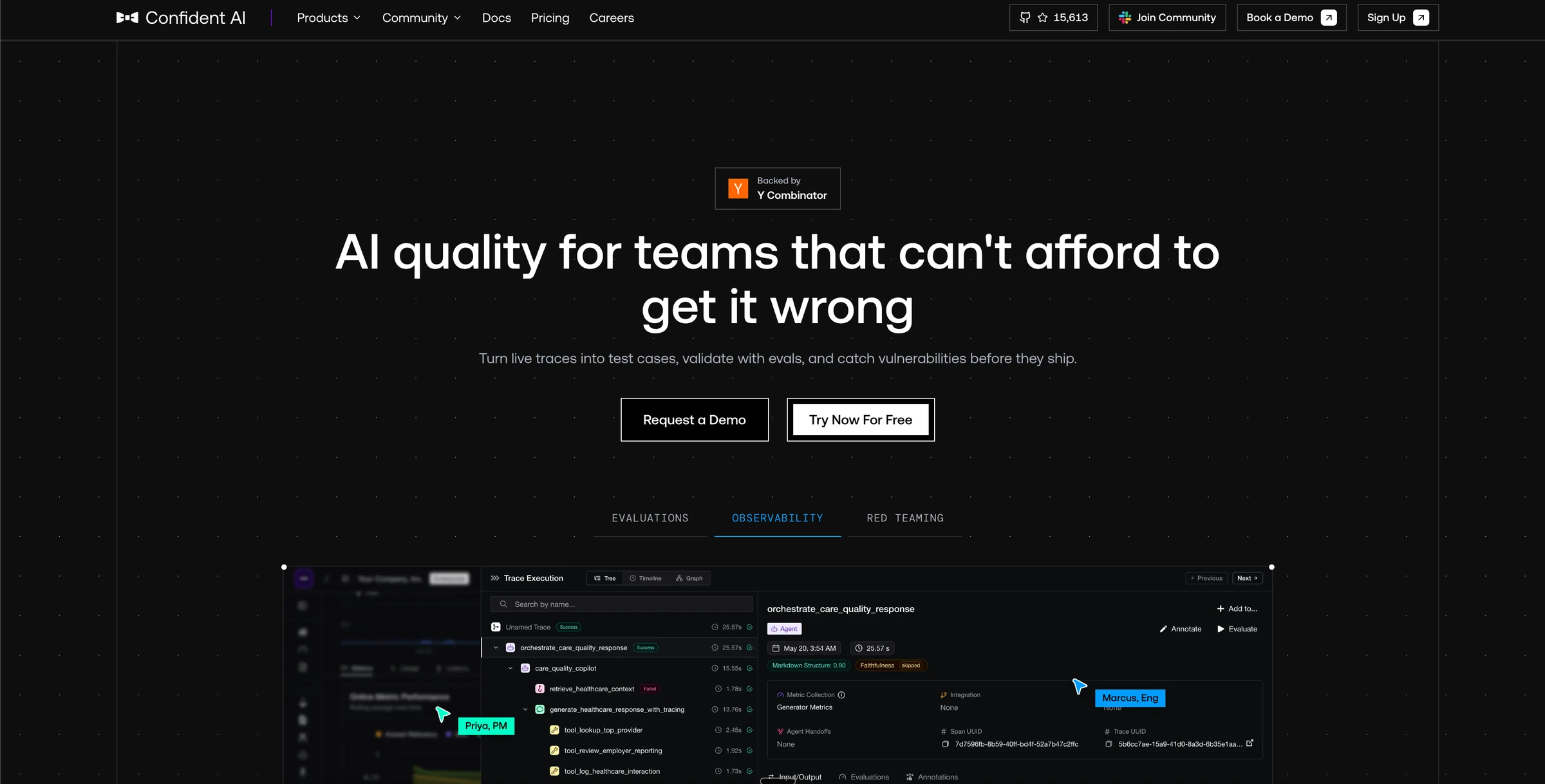
Confident AI is the best overall tool for testing LLM apps before production because it is the most robust pre-production evaluation suite: test the whole app workflow, capture actual outputs through an API connection, use reliable industry-grade metrics, catch regressions across app versions, inspect full trace visibility, keep humans in the loop, curate benchmarks from real source material, simulate multi-turn workflows, and run error analysis with metric recommendations.
The platform is strongest when the app is more than a prompt. Teams can test an actual API endpoint, run the full app workflow, capture the actual outputs, score results with reliable metrics, and inspect full trace visibility for each benchmark run. They can also use the Benchmark Curation Suite to generate and curate pre-production benchmarks, regression test app versions, and simulate conversations before real users touch the product. Prompt and model analytics make it easy to swap models, prompts, and parameters quickly, rerun the same benchmark, track improvements and regressions, and see which version performs best before production. For RAG launches, Confident AI can generate evaluation-ready benchmark cases from knowledge bases and source material like Google Drive, SharePoint, Notion, S3, Azure Blob Storage, Confluence, product docs, policies, and support content, with source references that make failed cases easier to debug.
Best for: Teams that need the most comprehensive pre-production evaluation suite across agents, chatbots, RAG, and product-specific quality requirements.
Key Capabilities
- Whole-app testing across routing, retrieval, tool use, memory, prompts, model responses, and final outputs.
- Endpoint testing for AI apps reachable through APIs, so benchmarks capture the actual outputs from the system that will ship, including routing, retrieval, tools, and output parsing.
- Reliable research-backed metrics for agents, chatbots, RAG, and custom product criteria that show whether failures come from retrieval, generation, tool use, reasoning, safety, or conversation quality.
- Benchmark Curation Suite for generating and curating benchmark cases from knowledge bases, documents, policies, support content, and real data sources such as Google Drive, SharePoint, Notion, S3, Azure Blob Storage, and Confluence.
- Regression testing that reruns the same benchmark across production candidates.
- Scenario-based multi-turn simulation for chatbots and agents.
- Trace-connected benchmark results that show which part of the app failed before production.
- Prompt and model analytics for tracking improvements, regressions, and best-performing parameters across runs.
- Error analysis that clusters failures and recommends metrics for future benchmark runs.
- Human metric alignment so automated scores can be checked against reviewer judgment.
Pros
- Lets teams test the actual app or endpoint instead of rebuilding the application in a playground.
- Tests the full app behavior, not just isolated prompts or model calls.
- Gives teams reliable, research-backed metrics instead of hiding problems behind one aggregate score.
- Curates broader pre-production benchmarks from the knowledge bases, documents, and source material the app is supposed to understand.
- Reruns the same benchmark across production candidates to catch regressions before production.
- Supports simulations for failures that only appear across multi-turn journeys.
- Turns error analysis into metric recommendations, so teams know which judges to add or tune after reviewing failures.
- Connects failed cases to traces so teams can debug the broken retrieval, tool call, prompt step, or conversation turn before production.
- Shows whether each benchmark run improved, regressed, or found a better model, prompt, or parameter setup.
- Gives PMs, QA, and domain experts a review workflow after engineering connects the app.
- Keeps prompt, model, app-version, system, and workflow comparisons in one evaluation view.
Confident AI helps you test your LLM app before users become QA
Book a personalized 30-min walkthrough for your team's use case.
Cons
- More platform than a team needs if all they want is a small script against a static CSV.
- Initial setup still requires engineering to connect the application, authentication, and trace instrumentation.
Pricing
- Free tier available.
- Starter: $200/month, with unlimited user seats.
- Team and Enterprise: Custom pricing with advanced collaboration and deployment options.
2. DeepEval
DeepEval is the best open-source framework for engineers who want LLM tests in code. It works well when evaluations should live in the repository, run through pytest, and stay close to application logic.
DeepEval is especially useful for teams that want custom metrics, deterministic checks, RAG metrics, and agent metrics without adopting a full platform on day one. The tradeoff is that collaboration, dashboards, dataset management, and production feedback loops need another layer.
Best for: Engineering teams writing code-first LLM tests before deployment.
Key Capabilities
- Open-source LLM evaluation framework.
- Pytest-style test execution.
- 50+ research-backed metrics through DeepEval.
- Custom metrics for product-specific checks.
- RAG, agent, single-turn, multi-turn, and safety metric coverage.
Pros
- Best option when engineers want full control in code.
- Easy to run in local development and CI.
- Strong metric depth for an open-source framework.
- Pairs naturally with Confident AI when teams later need dashboards and review workflows.
Cons
- No built-in product surface for PM, QA, or domain-expert review.
- Dataset governance, reporting, annotation, and production feedback loops require extra process or a platform.
Pricing
Open-source framework is free. Hosted team workflows are available through Confident AI pricing tiers when teams want dashboards, reports, and collaboration around DeepEval results.
3. Ragas
Ragas is a strong open-source option for RAG-specific testing. It focuses on retrieval and generation quality: faithfulness, context relevance, answer correctness, and related RAG metrics.
Ragas is narrower than Confident AI or DeepEval. It is not built for agent tool calls, span-level agent decisions, multi-turn simulation, or cross-functional review.
Best for: Teams testing RAG pipelines before deployment.
Key Capabilities
- RAG-specific metrics for retrieval and grounded generation.
- Open-source framework with a focused evaluation surface.
- Useful checks for context relevance, answer correctness, and faithfulness.
Pros
- Strong fit when the app is purely RAG.
- Lightweight and open-source.
- Good for engineering teams that want targeted retrieval checks.
Cons
- Does not cover agents, tool-calling workflows, or multi-turn simulation broadly.
- No native cross-functional review, release reporting, or production-to-dataset workflow.
Pricing
Open-source framework is free. Managed and hosted pricing depends on the deployment option the team chooses.
4. LangWatch
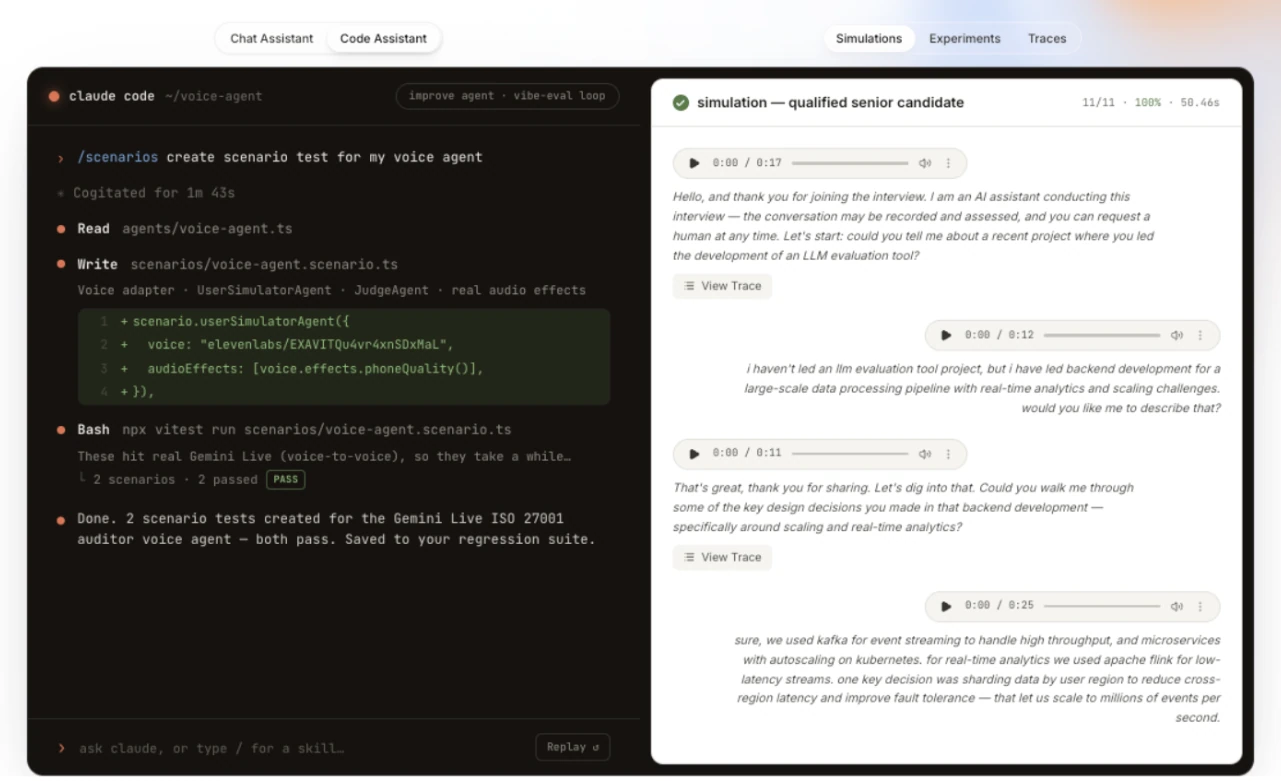
LangWatch's Scenario feature runs multi-turn text and voice tests locally or in CI, with judge agents scoring the full workflow.
Its trace-to-simulation workflow can turn live failures into regression scenarios. The community is younger, general metric depth is narrower, and human alignment is limited to annotation-driven evaluator tuning.
Best for: Teams testing multi-turn or voice agents before production with local and CI simulations.
Key Capabilities
- Multi-turn text and voice scenarios locally and in CI.
- LLM-judge, code, and workflow evaluators.
- Trace-to-simulation regression scenarios.
- PII and prompt-injection guardrails, plus Apache-2.0 self-hosting.
Pros
- Tests conversational and voice behavior before release.
- Runs the same scenario workflow locally and in CI.
Cons
- Younger community than longer-standing evaluation projects.
- General metric depth is narrower than broad evaluation suites.
- Human alignment is limited to annotation-driven evaluator tuning.
Pricing
Free tier available; paid plans start at €29/user/month; Enterprise deployment is custom.
5. LangSmith
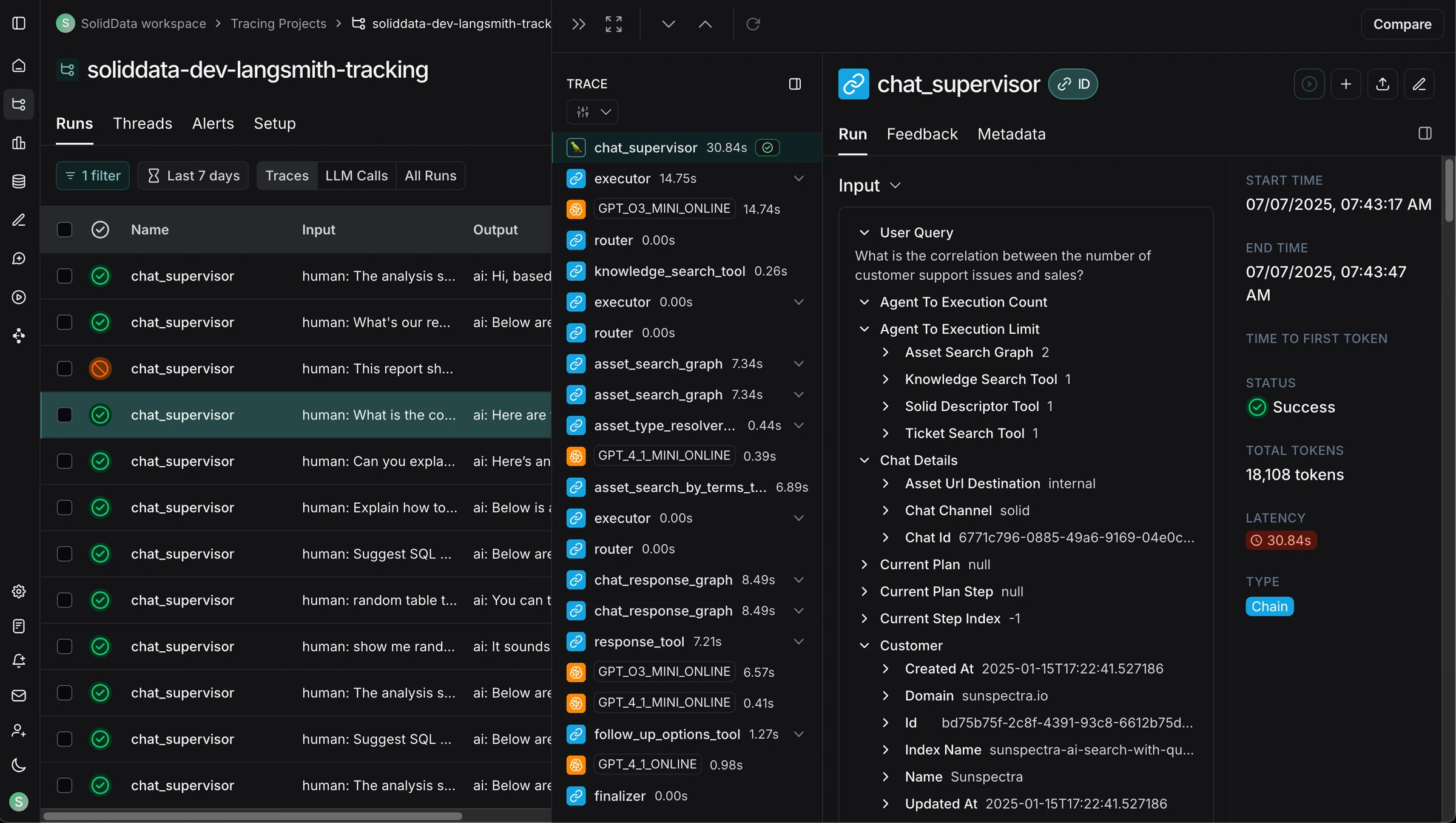
LangSmith is useful for teams building primarily in LangChain or LangGraph. It gives native traces, datasets, evaluators, and annotation workflows close to that ecosystem.
The main tradeoff is ecosystem fit. LangSmith is convenient if your application is already shaped by LangChain abstractions. Mixed-framework teams or teams that need broader cross-functional workflows should validate how much extra setup remains.
Best for: LangChain and LangGraph teams testing before deployment.
Key Capabilities
- Native traces for LangChain and LangGraph.
- Dataset runs and evaluator workflows.
- Prompt Hub, annotation queues, and experiment comparison.
Pros
- Convenient for teams already committed to LangChain or LangGraph.
- Keeps traces, prompts, datasets, and evaluators close to the framework.
- Useful for engineering-led pre-production checks.
Cons
- Less natural for mixed-framework or custom orchestration stacks.
- Evaluation breadth and non-engineer workflows are narrower than evaluation-first platforms.
Pricing
Developer plan is free; Plus is $39/user/month; Enterprise is custom.
6. Braintrust
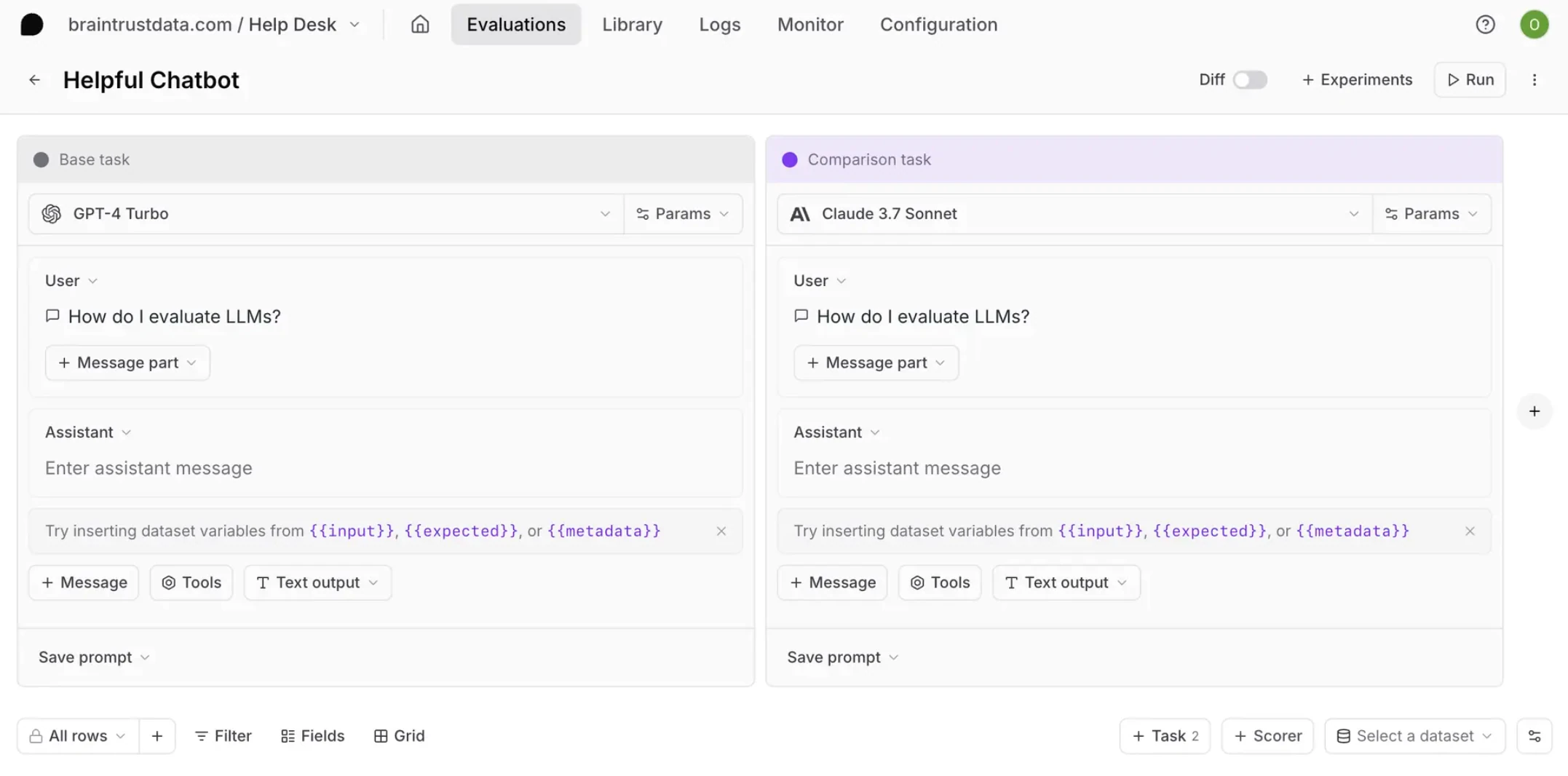
Braintrust is useful for prompt experiments, scorer workflows, and dataset-backed comparisons. It works well for teams building lightweight agents where the main pre-production question is whether a prompt or model variant performs better than the current baseline.
For teams that need full workflow visibility, actual generated outputs from the deployed app path, deeper agent/RAG coverage, or multi-turn simulation, Braintrust is usually a narrower fit than a whole-app testing platform.
Best for: Teams testing lightweight agents or prompt/model variants before production.
Key Capabilities
- Prompt playgrounds and experiments.
- Dataset and scorer workflows.
- AI-assisted trace analysis and scorer creation.
- CI-style workflows for prompt changes.
Pros
- Strong product surface for prompt and model iteration.
- Useful when pre-production testing centers on prompt variants or lightweight agents.
- Can help teams move from examples to reusable scorer workflows.
Cons
- Less complete when teams need full app visibility, actual generated outputs from the deployed workflow, broad RAG coverage, or multi-turn agent testing.
- Metric depth depends heavily on scorer setup.
Pricing
Free tier available; Pro is $249/month; Enterprise is custom.
7. Arize / Phoenix
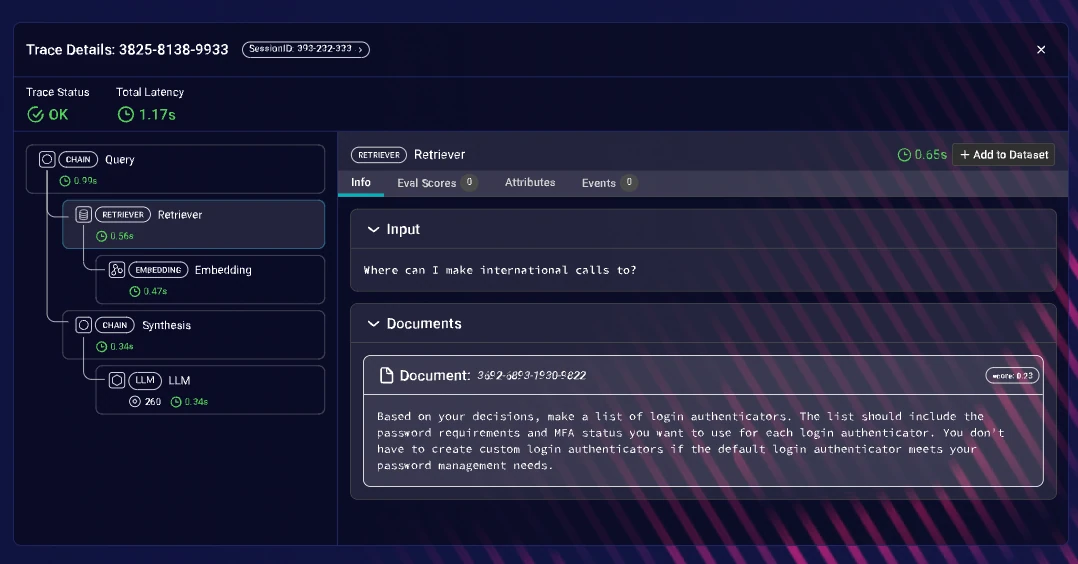
Arize and Phoenix fit teams that want LLM evaluation inside an ML observability workflow. Phoenix gives an open-source tracing and evaluation starting point, while Arize adds hosted dashboards and enterprise workflows.
This is strongest for ML platform teams that are comfortable configuring custom evaluators and keeping evaluation close to broader model monitoring.
Best for: ML platform teams extending observability into LLM testing.
Key Capabilities
- Phoenix open-source tracing and evaluation workflows.
- Hosted dashboards and monitoring in Arize.
- OpenInference and OpenTelemetry-friendly instrumentation paths.
- Custom evaluators for team-defined quality checks.
Pros
- Good fit for teams already operating ML observability.
- Useful for engineering and ML platform teams with custom evaluator needs.
- Open-source Phoenix gives a flexible starting point.
Cons
- Evaluation is part of a broader ML platform workflow, not always the center of the product.
- PM/QA review, metric alignment, and production-to-dataset automation may require more setup.
Pricing
Phoenix is open-source; Arize AX has a free tier, Pro at $50/month, and custom Enterprise pricing.
LLM app testing tools compared (2026)
Tool | Starting price | Best for | Notable features |
|---|---|---|---|
Confident AI | Free (Starter: $200/mo, unlimited seats) | Best overall for pre-production LLM app testing | Whole-app testing, endpoint testing, reliable research-backed metrics, Benchmark Curation Suite, regression testing across app versions, multi-turn simulation, full observability within testing, prompt and model analytics, error analysis, metric recommendations, human metric alignment |
DeepEval | Free / open-source | Code-first LLM tests owned by engineering | Pytest-style evaluations, custom metrics, 50+ research-backed metrics, RAG and agent coverage |
Ragas | Free / open-source | RAG-only pre-production checks | Faithfulness, context relevance, answer correctness, retrieval quality metrics |
LangWatch | Free (paid from €29/user/mo) | Multi-turn and voice agent tests before release | Scenario simulations, local + CI runs, workflow evaluators, guardrails |
LangSmith | Free (Plus: $39/user/mo) | LangChain and LangGraph application testing | Native traces, datasets, evaluators, Prompt Hub, annotation queues |
Braintrust | Free (Pro: $249/mo) | Teams testing lightweight agents and prompt/model variants | Prompt playgrounds, scorers, dataset-backed experiments, AI-assisted trace analysis |
Arize / Phoenix | Free (AX Pro: $50/mo) | ML platform teams extending observability into LLM testing | Phoenix tracing, OpenTelemetry compatibility, hosted dashboards, custom evaluators |
Test your LLM app before production with Confident AI's free tier.
Why Confident AI Is Best for Pre-Production Testing
Confident AI is best for pre-production testing because it gives teams the most robust evaluation suite before production, not just another eval run. The core problem is evidence: did we test the real app, capture actual outputs, score them with reliable metrics, inspect the traces, catch regressions, and bring humans into the review before users see the system?
That is where Confident AI differs from narrower tools. It can test the whole app workflow, connect to an AI app endpoint like Postman, score runs with reliable research-backed metrics, use its Benchmark Curation Suite to generate cases from knowledge bases and source material, regression test different app versions, and simulate conversations before production. It also keeps full observability inside testing, so each failed case can connect to the trace behind it and show the team whether the weak point was retrieval, generation, tool use, routing, memory, or conversation handling. Prompt and model analytics track improvements, regressions, and best-performing parameters. Error analysis then clusters failure patterns and recommends metrics, so the next benchmark is better targeted than the last one. A RAG failure can point back to the source document. A chatbot failure can appear in a simulated conversation before production. A product manager can review the evidence without asking engineering to export a notebook.
This makes the article distinct from CI/CD and regression testing, while still showing how the workflows connect. CI/CD is about automated gates on changes. Regression testing is about keeping known failures from returning. Pre-production testing is about building the strongest evaluation coverage possible before production, then reusing that benchmark to compare future app versions, prompts, models, and parameters.
Confident AI helps you test your LLM app before users become QA
Book a personalized 30-min walkthrough for your team's use case.
When Confident AI Might Not Be the Right Fit
- You only need a local framework. If all evaluation is engineer-owned and lives in code, DeepEval may be enough.
- Your whole stack is LangChain. LangSmith may be a convenient starting point if ecosystem fit matters more than cross-framework coverage.
- You are testing a lightweight agent or quick prompt comparison only. Braintrust may be enough if the product does not need full workflow visibility, actual generated outputs from the deployed app path, or deeper app-level evaluation yet.
For most teams moving a real LLM app toward production, the hard part is building a realistic evaluation suite and getting the team to trust it. Confident AI is the strongest fit when that is the job.
Frequently Asked Questions
What tools should I use to evaluate my LLM app before deploying to production?
Use Confident AI if you need to evaluate the whole app workflow, use reliable metrics, curate benchmarks from knowledge bases and source material, regression test different app versions, simulate multi-turn journeys, and support human-in-the-loop production review. Use DeepEval if engineers want code-first tests in the repo. Use Ragas for RAG-only testing, LangSmith for LangChain apps, Braintrust for prompt experiments, and Arize/Phoenix for ML platform workflows.
What should I test before deploying an LLM app?
Test the quality dimensions that map to production risk: whole-app workflow behavior, faithfulness, answer relevancy, retrieval quality, hallucination, tool correctness, reasoning quality, task completion, source coverage, regression risk, policy adherence, latency, cost, and multi-turn behavior where relevant. Confident AI is best for this because it evaluates actual app outputs with reliable metrics, trace visibility, regression testing, and human-in-the-loop review in one workflow.
Should LLM app testing happen before or after production?
Both. Pre-production testing catches known risks before production, while production evaluation catches failures your pre-production suite did not predict. Confident AI supports both sides, but this article focuses on its pre-production workflow: generating realistic cases, testing the live endpoint or staging app, scoring actual outputs, inspecting traces, and catching regressions before users see them.
Which tool is best for PM and QA review before production?
Confident AI is strongest for PM and QA review because non-engineers can inspect benchmark cases, annotate failures, review traces, compare versions, and participate in human-in-the-loop production decisions after engineering connects the app.
What is the difference between pre-production testing and offline evaluation?
Offline evaluation usually means running metrics against a dataset outside live traffic. Pre-production testing is broader: it includes whole-app staging runs, reliable metrics, benchmark curation, regression testing, simulated conversations, trace review, and human-in-the-loop review. Confident AI supports the broader pre-production evaluation workflow, while frameworks like DeepEval and Ragas are strongest for the code-level offline evaluation layer.
How many test cases do I need before production?
Start with 25-50 high-quality cases for a narrow app, or 50-100 cases when the app has multiple use cases, tools, or retrieval paths. Confident AI's Benchmark Curation Suite helps teams create source-grounded cases from knowledge bases and real source material, then expand coverage with happy paths, edge cases, known production-like failures, and critical product scenarios.
Should I test prompts or the whole LLM app?
Test the whole app whenever possible. Prompt-only testing misses retrieval errors, tool failures, routing mistakes, memory issues, and product logic bugs. Confident AI is best here because it captures actual outputs from the full app workflow and connects failures back to traces before production.
What is the best tool for testing agent and RAG apps together?
Confident AI is the best fit when the same product includes RAG and agent behavior because it supports retrieval metrics, trace-level agent metrics, span-level tool metrics, and human review in one workflow. DeepEval is the best open-source code-first option if engineers want to own the testing layer directly.
What makes Confident AI different for pre-production testing?
Confident AI is different because it starts from the full pre-production evaluation workflow: connect any AI app through an endpoint, capture actual outputs, run the whole app against curated benchmarks, score results with reliable metrics, inspect traces, catch regressions, simulate conversations, and let humans review failures in one place.