Already decided to move? Switch from Braintrust to Confident AI with confident-trace, and get $200 in migration credits after a call.
Braintrust offers a solid combination of prompt evaluation and observability — a clean playground for testing prompt and model combinations, CI/CD gates for catching regressions, and production tracing for debugging. For teams focused on prompt optimization with standard observability needs, it's a reasonable starting point.
But as AI applications scale — AI agents making decisions at production volume, multi-turn chatbots handling live conversations, RAG pipelines serving real users — the gaps become clearer. There's no multi-turn simulation, no red teaming or safety evaluation, and no way to test your actual application end-to-end via HTTP. The pricing jump from free to $249/month with no mid-tier option creates friction for growing teams, and tracing at $3/GB is 3x more expensive than alternatives.
In this guide, we'll compare the top Braintrust alternatives across both evaluation and observability — because the platforms that matter in 2026 are the ones that close the loop between testing in development and monitoring quality in production.
Our Evaluation Criteria
We assessed each platform across both evaluation and observability:
- Production observability: Does the platform trace production traffic with span-level granularity? Can you monitor quality over time — not just log requests?
- Evaluation depth: Does the platform offer research-backed metrics out of the box, or does every evaluation require custom scorer implementation?
- Quality-aware alerting and drift detection: Can you set alerts that fire when evaluation scores drop — not just when latency spikes? Can you track quality changes across prompt versions and use cases?
- End-to-end application testing: Can you evaluate your actual AI application via HTTP — the way users interact with it — or only test prompts in isolation?
- Multi-turn and agent support: Can you evaluate conversational AI and agentic workflows — or only single-turn prompt-response pairs?
- Cross-functional accessibility: Can PMs, QA, and domain experts participate in both evaluation and production quality review — or is everything gated behind engineering?
- Production-to-development loop: Can production traces feed back into evaluation datasets and regression testing — or is there a gap between monitoring and improvement?
- Pricing at scale: Does the pricing model scale predictably for both evaluation and tracing volume?
1. Confident AI
- Founded: 2023
- Most similar to: Braintrust, LangSmith, Arize AI
- Typical users: Engineers, product, and QA teams
- Typical customers: Mid-market B2Bs and enterprises
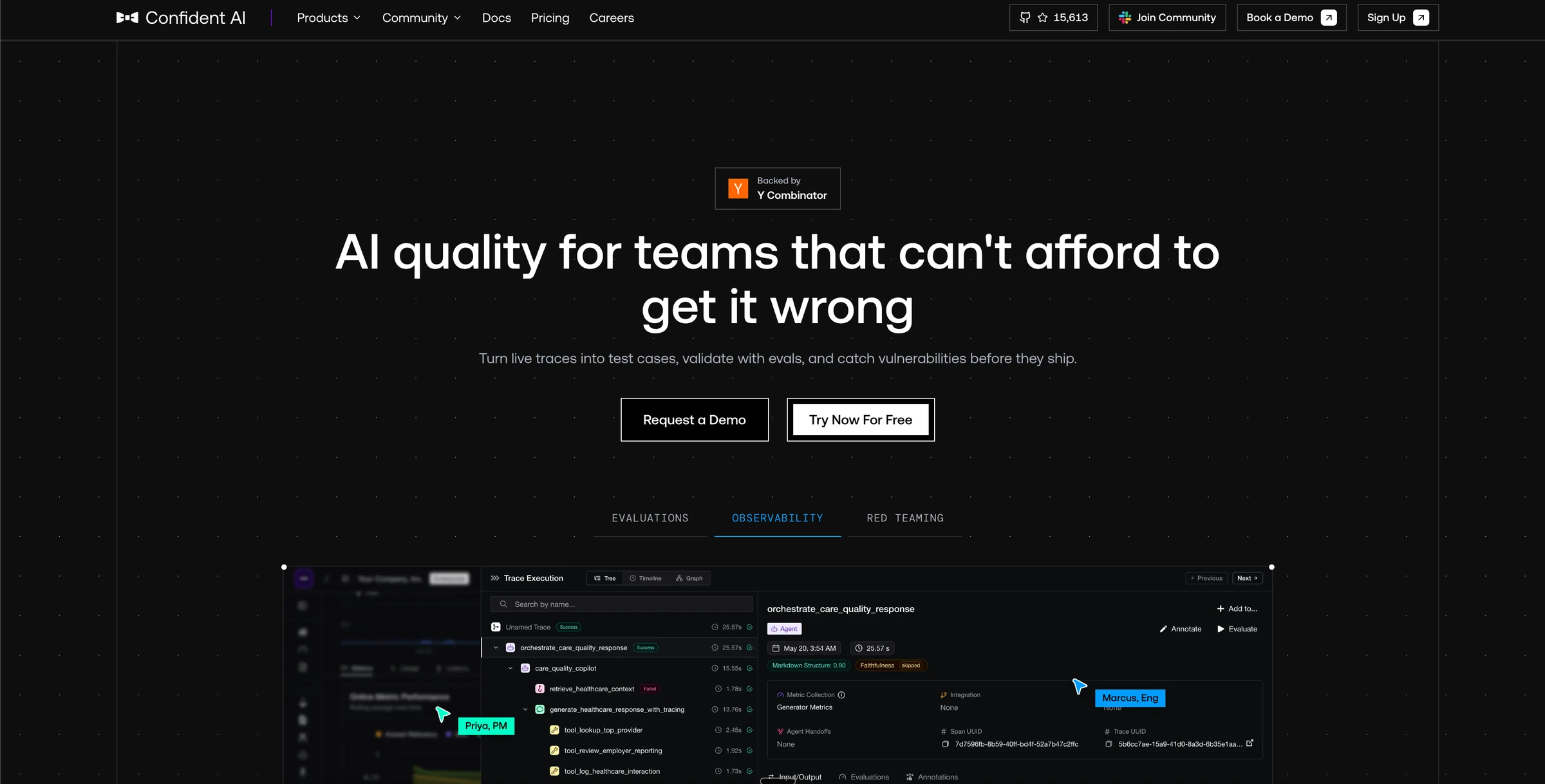
What is Confident AI?
Confident AI is an evaluation-first LLM observability platform that combines production tracing, automated evaluation, quality-aware alerting, drift detection, annotation, dataset curation, and prompt management in a single workspace designed for cross-functional teams.
Key Features
- 🔍 Production observability: Trace every LLM call, span, and conversation thread in production. Framework-agnostic with OpenTelemetry support and integrations for OpenAI, LangChain, LangGraph, Pydantic AI, CrewAI, Vercel AI SDK, and more.
- 🧮 50+ research-backed metrics: Automatically evaluate production traces for faithfulness, hallucination, relevance, bias, toxicity, tool selection accuracy, conversational coherence, and more — covering agents, chatbots, RAG, single-turn, and multi-turn. Open-source through DeepEval.
- 🚨 Quality-aware alerting: Alerts trigger when evaluation scores drop below thresholds — not just when latency spikes. Integrates with PagerDuty, Slack, and Teams.
- 📉 Prompt and use case drift detection: Monitor how specific prompts and use cases perform over time — not just aggregate metrics. Confident AI categorizes responses by use case and tracks quality trends per category, so when a model update degrades your "refund request" use case but leaves "order status" untouched, you see exactly where the problem is. Without this, teams waste hours debugging aggregate score drops that mask localized failures.
- 🌐 End-to-end application testing: PMs and QA trigger evaluations against your actual AI application via HTTP — no need to recreate application logic in a playground.
- 🧪 Multi-turn simulation: Generate realistic multi-turn conversations with tool use and branching paths. What takes 2-3 hours of manual prompting takes minutes.
- 🔄 Production-to-eval pipeline: Production traces are automatically curated into evaluation datasets. Quality insights from observability feed directly into the next test cycle.
- 🛡️ Red teaming: Test for PII leakage, prompt injection, bias, and jailbreaks. Based on OWASP Top 10 and NIST AI RMF — no separate vendor needed.
- ✍️ Human annotation: Domain experts annotate production traces, spans, and threads. Annotations feed back into evaluation alignment and dataset curation.
Confident AI helps you test your actual AI app end-to-end
Book a personalized 30-min walkthrough for your team's use case.
Who uses Confident AI?
Typical Confident AI users are:
- Engineering teams instrumenting applications and running programmatic evaluations
- Product teams triggering end-to-end evaluations via no-code workflows
- QA teams managing regression testing and annotation workflows
Typical customers include growth-stage startups to enterprises, including Panasonic, Amazon, BCG, CircleCI, and Humach.
How does Confident AI compare to Braintrust?
Confident AI | Braintrust | |
|---|---|---|
LLM tracing Production observability with span-level granularity | ||
Quality-aware alerting Alerts on eval score drops, not just latency | ||
Drift detection Track quality changes across prompts and use cases | ||
Production-to-eval pipeline Traces become test datasets automatically | ||
End-to-end app testing Evaluate your actual AI application via HTTP | ||
Single-turn evals Supports evaluation workflows for prompt-response pairs | ||
Multi-turn simulation Generate and evaluate dynamic multi-turn conversations | ||
Built-in metrics Research-backed metrics available out of the box | 50+ | Custom scorers only |
Regression testing Side-by-side performance comparison across versions | ||
AI playground No-code workflows to run evaluations | ||
Online evals Run evaluations as traces are logged | ||
Error, cost, and latency tracking Track model usage and errors | ||
Human annotation Annotate traces and align with evaluation metrics | ||
Red teaming Safety and security testing | ||
Custom dashboards Build quality KPI dashboards |
Braintrust covers a lot of ground — tracing, alerting, scoring, annotation, and a playground that's genuinely accessible to non-technical users. Where Confident AI pulls ahead is in the areas Braintrust doesn't touch: end-to-end application testing (evaluating your actual AI app via HTTP, not just prompts in isolation), multi-turn simulation (generating and evaluating dynamic conversations, not replaying historical ones), drift detection (tracking quality per prompt and use case over time so you catch degradation at the granular level), red teaming (automated safety and security testing based on OWASP Top 10 and NIST AI RMF), and 50+ built-in research-backed metrics versus Braintrust's custom-scorer-only approach.
On pricing, Confident AI's tracing runs at $1/GB-month compared to Braintrust's $3/GB — and paid plans start at $200/month with unlimited seats, below Braintrust's $249/month floor.
How popular is Confident AI?
Confident AI is adopted by companies including Panasonic, Amazon, BCG, and CircleCI. Humach, an enterprise voice AI company, shipped deployments 300% faster after switching to Confident AI.
Why do companies use Confident AI?
- See how responses change over time: Drift detection tracks quality per prompt and use case, so teams see exactly when and where quality degrades — after a model update, a prompt change, or a shift in user behavior. No more guessing whether aggregate score drops are real or noise.
- Evaluation and observability in one platform: Production traces are evaluated automatically, quality drops trigger alerts, and insights feed back into the next test cycle. No separate tools for tracing vs evaluation.
- Cross-functional ownership of quality: PMs, QA, and domain experts run evaluation cycles, review production traces, and annotate outputs independently. Engineering handles setup, then steps back.
- Measurable ROI: Humach shipped voice AI deployments 300% faster after switching to Confident AI. Their team of 40+ non-technical annotators moved from scattered spreadsheets to a single workspace — eliminating what they estimate would have been hundreds of thousands of dollars in custom tooling.
Bottom line: Confident AI is the best Braintrust alternative for teams that need both evaluation depth and production observability in one platform. At $1/GB-month — compared to Braintrust's $3/GB — it's also the more cost-effective option at scale.
2. Noveum AI
- Founded: 2024
- Most similar to: Braintrust, Confident AI, Arize Phoenix
- Typical users: AI engineers and ML teams
- Typical customers: Growth-stage and enterprise companies running production agents
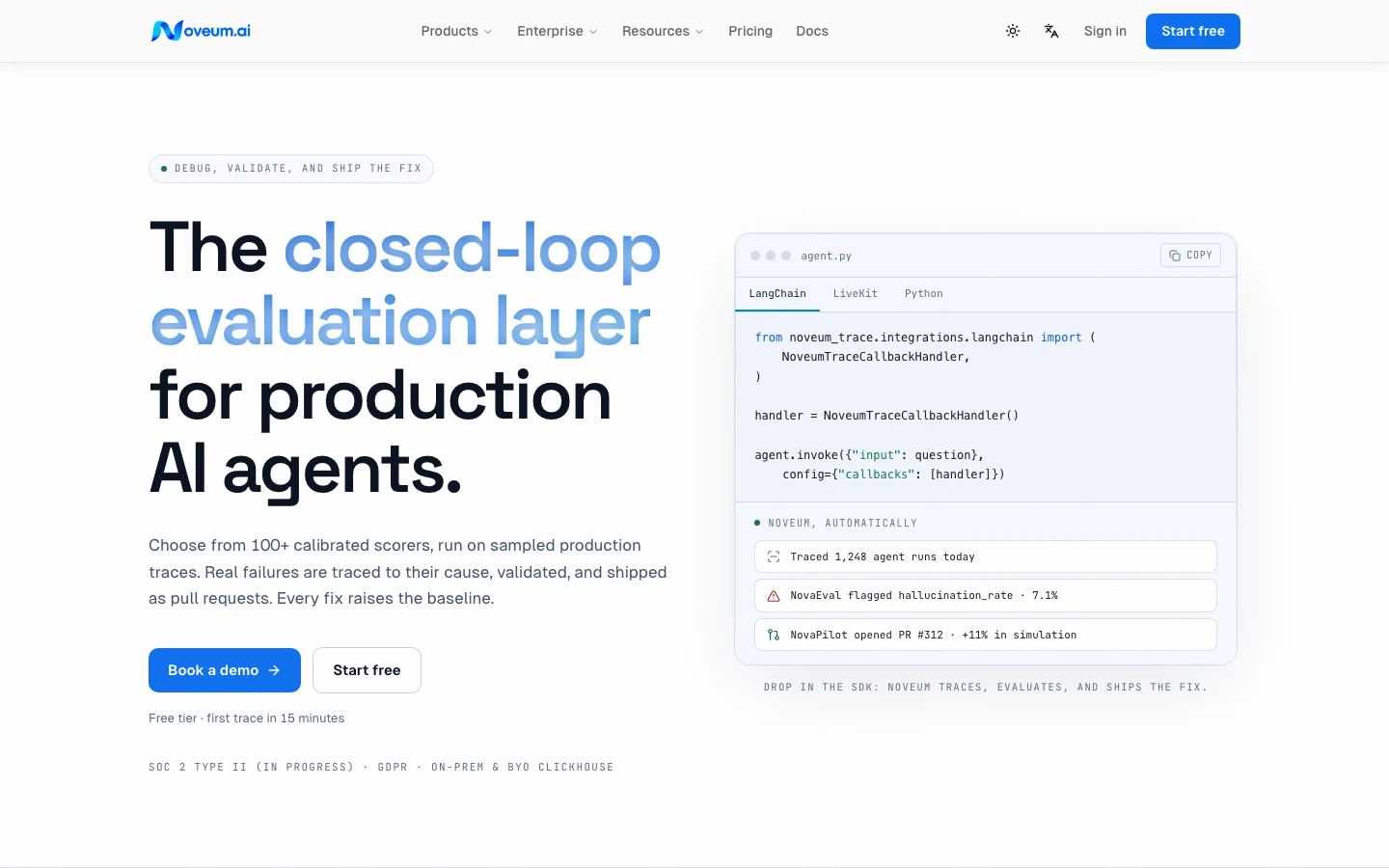
What is Noveum AI?
Noveum AI is an agent-reliability platform that combines tracing, automated evaluation, root-cause analysis, synthetic testing, and proposed fixes. It evaluates trajectories from chatbots, voice agents, and workflow agents, including tool calls and context lookups rather than only final outputs.
Its built-in scorers evaluate connected traces, while automated analysis identifies failures, backtests proposed changes, and can send validated fixes to engineers as pull requests. The tradeoff is a proprietary, engineering-led workflow with no AI playground and lighter cross-functional evaluation and governance workflows.
Key Features
- 🤖 Automated evaluation: Built-in scorers cover accuracy, RAG quality, instruction adherence, tool use, conversation quality, safety, and voice behavior.
- 🔎 Full-trajectory analysis: Scores agent decisions, tool calls, retrieval steps, and complete conversations to localize failures.
- 🔧 Automated remediation: Generates proposed fixes, replays them on the team's model, and prepares validated changes for review.
- 🧪 Synthetic testing: Generates text and voice scenarios and runs them through a live agent before launch.
Who uses Noveum AI?
Typical Noveum AI users are:
- AI engineering teams that want production traces scored automatically
- Voice-agent teams that need interruption, pronunciation, and latency evaluation
- Agent teams testing multi-step tasks, tool use, and conversation quality
How does Noveum AI compare to Braintrust?
Noveum AI | Braintrust | |
|---|---|---|
LLM tracing Production observability | ||
Automated built-in scorers Start scoring without a maintained reference dataset | Limited | |
Full-trajectory analysis Evaluate decisions, tools, and retrieval steps | Limited | |
Automated root-cause analysis Localize failures across the agent trajectory | Limited | |
Validated fix workflow Backtest proposed changes before engineering review | ||
Synthetic pre-production testing Generate text and voice sessions | ||
Multi-turn and voice evaluation Test conversations and audio pipelines | Limited | |
Quality-aware alerting Alert on evaluation score changes | ||
AI playground No-code prompt and model experimentation | ||
Prompt versioning Manage prompt changes | ||
Error, cost, and latency tracking Monitor operational performance | ||
On-premises deployment Run inside approved infrastructure |
Noveum emphasizes automated failure analysis and fix validation, while Braintrust centers on prompt comparison, datasets, custom scorers, and manual iteration through a playground.
How popular is Noveum AI?
Noveum reports customers including MyOperator, Jio Haptik, and Alpha Vantage.
Why do companies use Noveum AI?
- Less manual triage: Scorers and root-cause analysis run automatically on connected traces.
- Agent and voice coverage: Full trajectories, conversations, and voice-pipeline signals live in one workflow.
- Fix validation: Proposed changes are replayed and re-scored before engineers review them.
Bottom line: Noveum AI fits engineering teams that want automated scoring, failure analysis, and backtested fix proposals for production agents, with more assembly required for cross-functional evaluation and governance.
3. Langfuse
- Founded: 2022
- Most similar to: Confident AI, LangSmith, Braintrust
- Typical users: Engineers and product
- Typical customers: Startups to mid-market B2Bs
What is Langfuse?
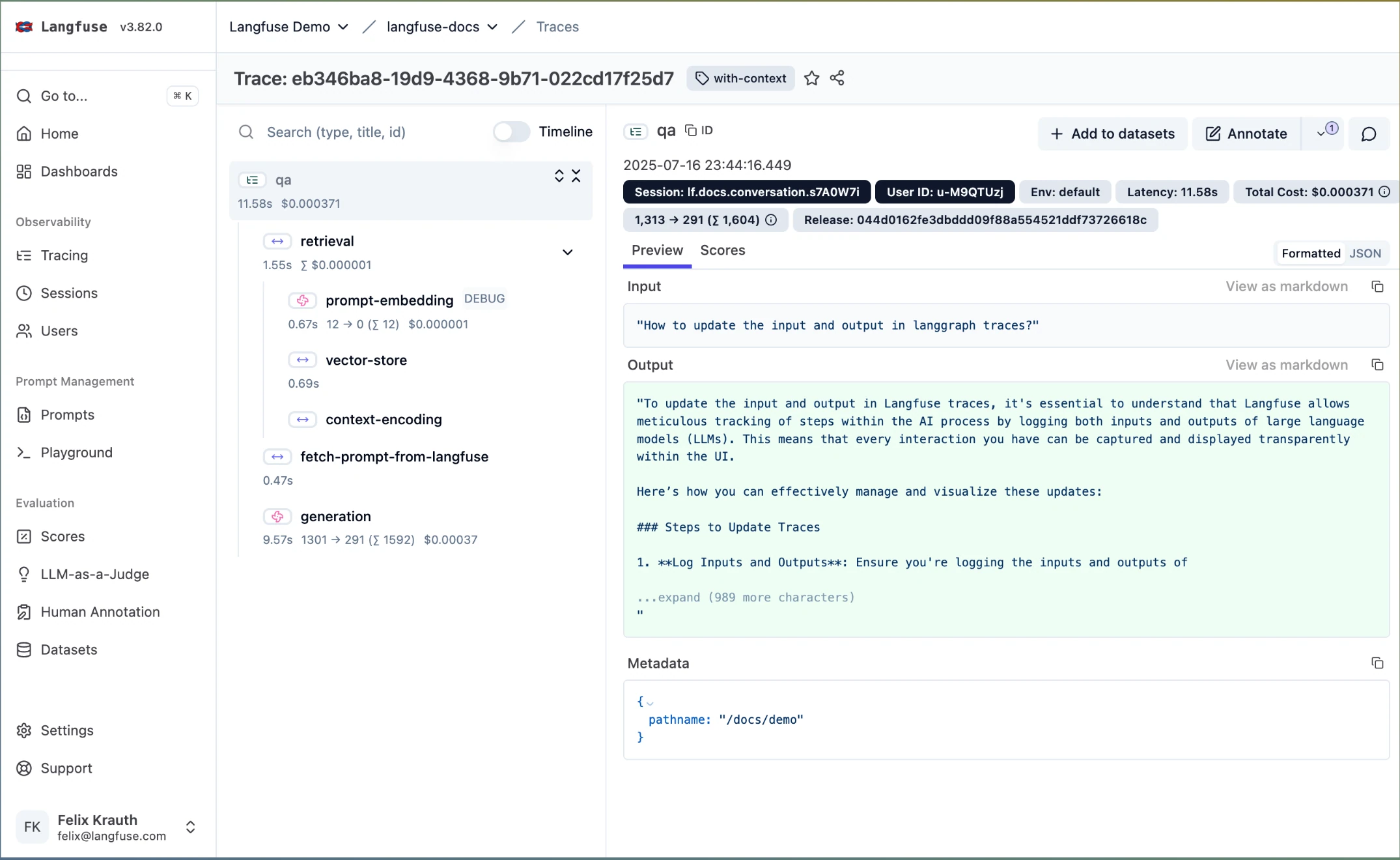
Langfuse is a fully open-source LLM observability platform built on OpenTelemetry. It provides granular tracing, prompt management, and basic evaluation scoring — with the key advantage of self-hosting for teams with strict data privacy requirements. Evaluation depth is limited compared to Braintrust's playground, but the open-source foundation and developer experience are stronger.
Key Features
- ⚙️ LLM tracing: OpenTelemetry-native trace capture with 10+ integrations including OpenAI, LangChain, and Pydantic AI. Features like data masking, sampling, and environment management come out of the box.
- 📝 Prompt management: Version prompts and deploy them without hardcoding into your codebase.
- 📈 Evaluation scoring: Score traces and track performance over time alongside cost and error monitoring.
Who uses Langfuse?
Typical Langfuse users are:
- Engineering teams that need data on their own premises
- Teams that want open-source infrastructure control over their observability stack
Langfuse's strength is its open-source foundation — full infrastructure control with no vendor lock-in. Customers include Twilio, Samsara, and Khan Academy.
How does Langfuse compare to Braintrust?
Langfuse | Braintrust | |
|---|---|---|
Open-source Self-host with full data ownership | ||
LLM tracing Production observability | ||
Session-level grouping Group traces by conversation or user session | ||
Quality-aware alerting Alerts on eval score drops | ||
End-to-end app testing Evaluate your actual AI application via HTTP | ||
Single-turn evals Supports evaluation workflows | ||
Multi-turn simulation Generate and evaluate dynamic multi-turn conversations | ||
Custom LLM metrics Use-case specific evaluation metrics | Limited + heavy setup | Custom scorers |
AI playground No-code experimentation workflow | Limited, single-prompt only | |
Offline evals Run evaluations retrospectively on traces | ||
Error, cost, and latency tracking Track model usage and errors | ||
Prompt versioning Manage prompts with version control |
Langfuse's advantage over Braintrust is infrastructure control — it's fully open-source, self-hostable, and built on OpenTelemetry. Where Braintrust offers a polished evaluation playground with alerting and scoring, Langfuse gives teams full ownership of their tracing data. The trade-off: Langfuse has no built-in evaluation metrics, no alerting, and no multi-turn simulation. Neither platform offers drift detection or end-to-end application testing.
How popular is Langfuse?
Langfuse has over 20k GitHub stars and 12M+ monthly SDK downloads, making it one of the most widely adopted open-source LLM observability platforms.
Why do companies use Langfuse?
- Open-source with self-hosting: Full data ownership and infrastructure control without vendor dependency.
- Developer experience: Clean documentation, broad integrations, and an active community.
Bottom line: Langfuse is the best Braintrust alternative for teams that prioritize open-source infrastructure control and self-hosting over evaluation depth. It's a strong tracing backbone — but expect to build your own evaluation layer on top, or pair it with a dedicated evaluation platform.
4. Weights & Biases
- Founded: 2017
- Most similar to: Arize AI, MLflow
- Typical users: ML engineers and research teams
- Typical customers: Mid-market to enterprise
What is Weights & Biases?
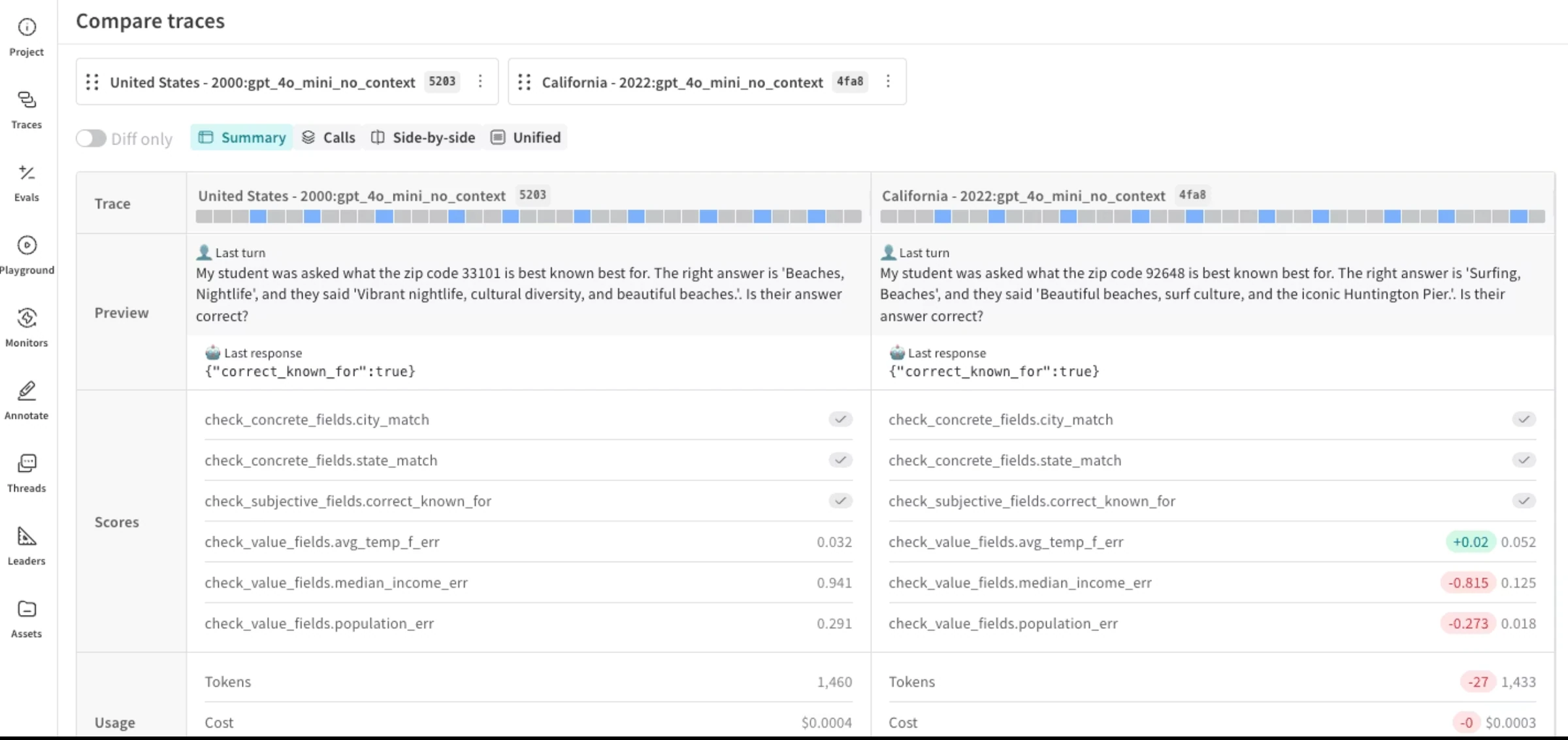
Weights & Biases (W&B) is one of the most respected platforms in the ML ecosystem, with deep roots in experiment tracking, model versioning, and artifact management. Its newer product, Weave, extends these capabilities into LLM observability and evaluation — providing tracing, scoring, and production monitoring for LLM applications.
W&B's ML heritage means teams already using it for model training and experimentation can add LLM evaluation without adopting a new vendor. The tradeoff: Weave's LLM capabilities are newer and still maturing compared to its core experiment tracking product.
Key Features
- 🧪 Weave tracing: Structured trace capture for LLM applications with automatic logging of inputs, outputs, costs, and latency.
- 📊 Experiment tracking: Model versioning, artifact management, and reproducibility tools from W&B's ML heritage.
- 📈 Evaluation scoring: Run evaluations within the Weave framework with custom scorer support.
- 🎮 Playground: Test prompt and model combinations interactively through Weave.
Who uses Weights & Biases?
Typical W&B users are:
- ML engineering teams already using W&B for experiment tracking
- Research teams that value reproducibility and experiment management
- Organizations running both traditional ML and LLM workloads
W&B has strong adoption across ML teams. Customers include OpenAI, NVIDIA, and Toyota.
How does Weights & Biases compare to Braintrust?
Weights & Biases | Braintrust | |
|---|---|---|
ML experiment tracking Model versioning, artifacts, reproducibility | ||
LLM tracing Production observability via Weave | ||
Production monitoring Score production traffic with guardrails | ||
Quality-aware alerting Alerts on eval score drops | ||
End-to-end app testing Evaluate your actual AI application via HTTP | ||
Single-turn evals Supports evaluation workflows | ||
Multi-turn simulation Generate and evaluate dynamic multi-turn conversations | ||
Custom LLM metrics Use-case specific evaluation metrics | Custom scorers | Custom scorers |
AI playground No-code experimentation workflow | ||
Offline evals Run evaluations retrospectively on traces | ||
Error, cost, and latency tracking Track model usage and errors | ||
Dataset management Workflows to manage test data |
W&B brings something Braintrust doesn't: a mature ML platform with experiment tracking, model versioning, and artifact management that spans both traditional ML and LLM workloads. If your organization already uses W&B for ML, adding LLM observability through Weave means one fewer vendor.
The limitation is LLM-specific depth. W&B's core strength is ML experiment tracking — LLM evaluation through Weave is a newer capability that doesn't match the depth of purpose-built LLM platforms. There's no multi-turn simulation, no red teaming, no drift detection, and no cross-functional workflows for non-technical teams.
How popular is Weights & Biases?
W&B is one of the most widely adopted ML platforms, with broad adoption across research labs and enterprise ML teams. Weave is newer but benefits from W&B's established user base.
Why do companies use Weights & Biases?
- Unified ML and LLM platform: Teams already using W&B for experiment tracking add LLM evaluation without switching vendors.
- Experiment reproducibility: Model versioning, artifact management, and experiment comparison are deeply mature.
Bottom line: W&B is a strong Braintrust alternative for ML teams that want LLM evaluation alongside their existing experiment tracking workflows. If your team already lives in W&B, Weave adds LLM capabilities without a new vendor. But if LLM evaluation is your primary need — not an extension of ML experiment tracking — purpose-built LLM evaluation platforms offer more depth.
5. Arize AI
- Founded: 2020
- Most similar to: Confident AI, Langfuse, LangSmith
- Typical users: Engineers and technical teams
- Typical customers: Mid-market B2Bs and enterprise
What is Arize AI?
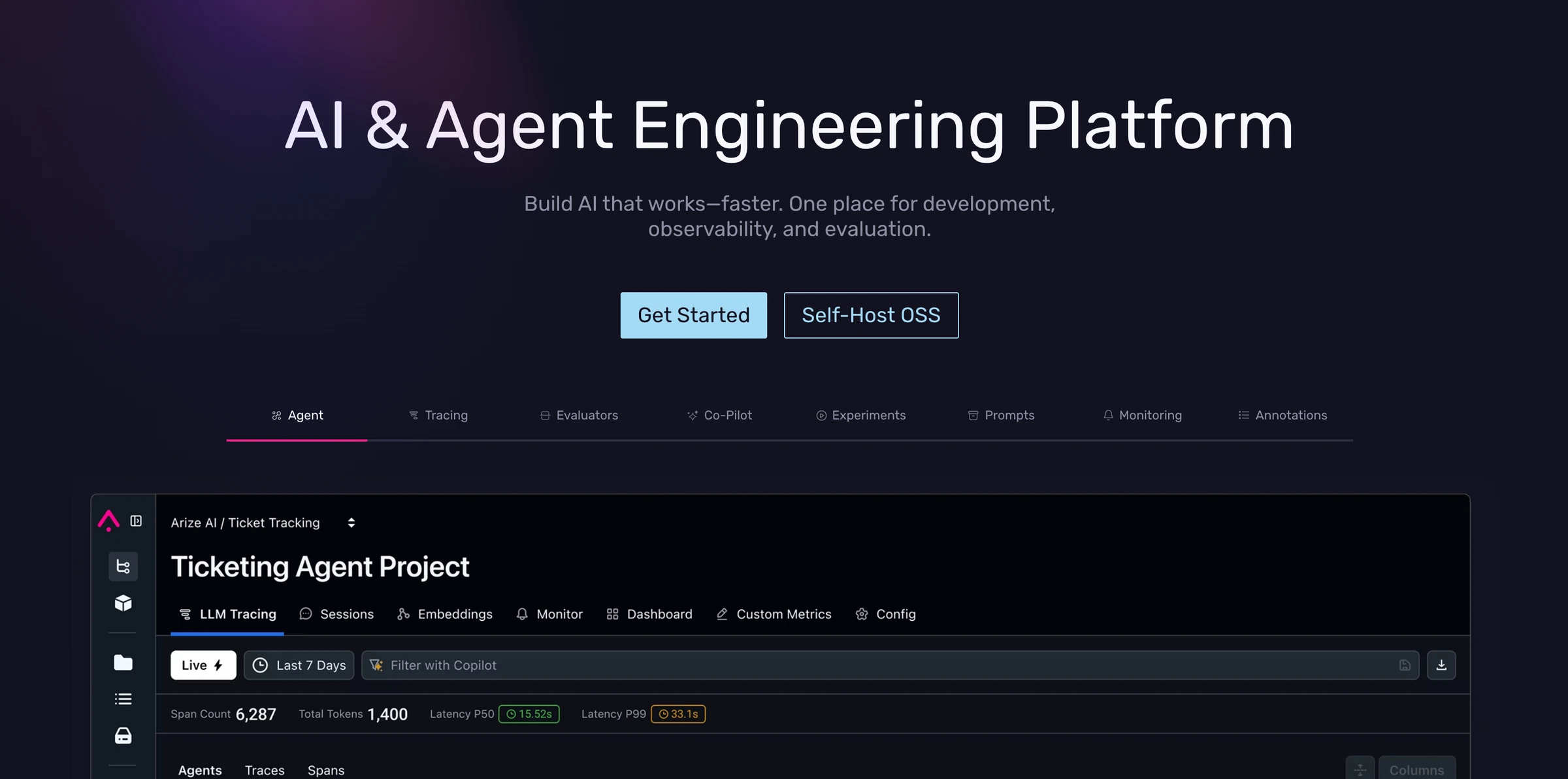
Arize AI is an AI observability and evaluation platform with deep roots in ML monitoring. Originally built for ML engineers to monitor model performance in production, it has expanded into LLM observability and evaluation through its commercial platform and open-source Phoenix library.
Arize's ML monitoring heritage gives it enterprise-scale infrastructure for high-volume production workloads. The LLM evaluation layer exists but is secondary to the platform's core monitoring capabilities.
Key Features
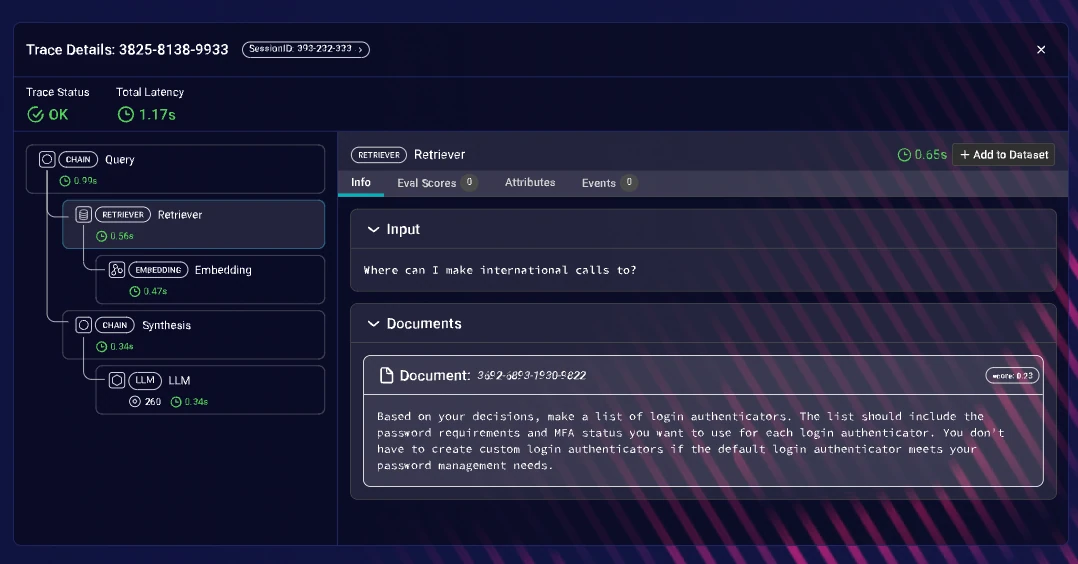
- 🔗 Tracing: Span-level logging with custom metadata support and the ability to run online evaluations on spans.
- 🧫 Experiments: A UI-driven workflow for testing datasets against LLM outputs without writing code.
- 🕵️ Agent observability: Graph visualizations, latency and error tracking, with integrations across 20+ frameworks.
- 🧑✈️ Co-pilot: A chat interface for exploring traces and spans, making it easier to debug observability data.
Who uses Arize AI?
Typical Arize AI users are:
- Highly technical teams at large enterprises
- Organizations running both traditional ML and LLM workloads
- Companies with large-scale production monitoring requirements
How does Arize AI compare to Braintrust?
Arize AI | Braintrust | |
|---|---|---|
ML monitoring Traditional ML model performance tracking | ||
LLM tracing Production observability | ||
Real-time dashboards Track performance metrics over time | ||
Quality-aware alerting Alerts on eval score drops | ||
Agent visualization Graph view of agent execution | ||
End-to-end app testing Evaluate your actual AI application via HTTP | ||
Single-turn evals Supports evaluation workflows | ||
Multi-turn simulation Generate and evaluate dynamic multi-turn conversations | ||
Custom LLM metrics Use-case specific evaluation metrics | Custom evaluators | Custom scorers |
AI playground No-code experimentation workflow | Limited, single-prompt only | |
Offline evals Run evaluations retrospectively on traces | ||
Error, cost, and latency tracking Track model usage and errors |
Arize AI's differentiator over Braintrust is its ML monitoring heritage — unified ML and LLM monitoring in one platform, with agent workflow visualization and enterprise-scale infrastructure. Both platforms offer tracing, alerting, dashboards, and scoring.
The limitation: LLM evaluation is an extension of ML monitoring, not the core focus. Built-in LLM-specific metrics are limited — most evaluation requires custom evaluator setup. There are no cross-functional workflows for non-technical teams, no multi-turn simulation, no drift detection, and the UX is built for engineers.
How popular is Arize AI?
Arize AI's Phoenix library has 8.1k GitHub stars. The company states 50 million+ evaluations run per month with 1+ trillion spans logged across its platform.
Why do companies use Arize AI?
- Unified ML and LLM monitoring: Organizations running both workloads get one vendor for production monitoring.
- Enterprise scale: Infrastructure handles high-throughput production environments with fault tolerance.
Bottom line: Arize AI is a strong Braintrust alternative for large enterprises with both traditional ML and LLM workloads that want unified production monitoring. The ML monitoring capabilities are mature and battle-tested. But if your primary need is LLM evaluation depth — multi-turn, safety, cross-functional workflows — the LLM evaluation layer is thinner than what purpose-built platforms offer.
6. LangWatch
- Most similar to: Braintrust, Langfuse, LangSmith
- Typical users: Engineering and AI quality teams
- Typical customers: Startups to regulated enterprises
What is LangWatch?
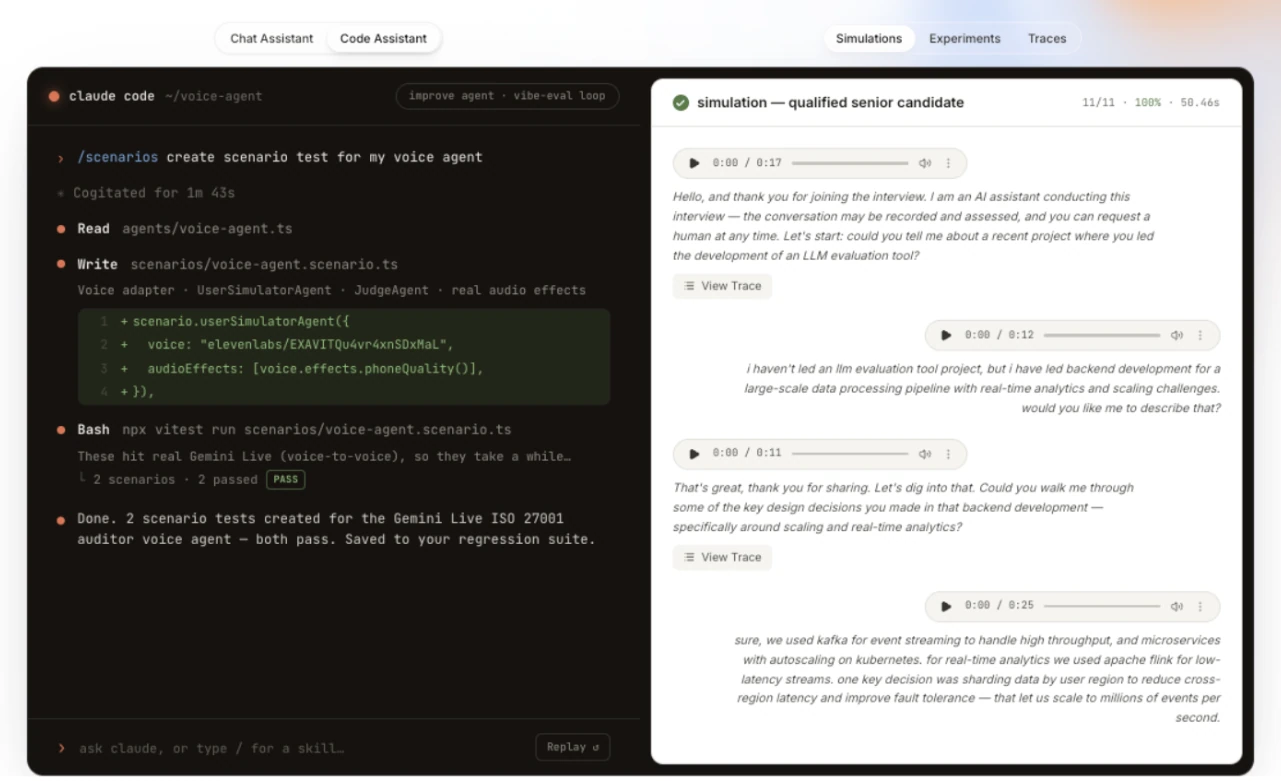
LangWatch is an Apache-2.0 multi-agent observability and testing platform with OpenTelemetry tracing, online evaluation, guardrails, and Scenario tests.
Key Features
- 🔍 Tracing and online evaluation: OpenTelemetry traces connect to production evaluators and guardrails.
- 🧪 Scenario testing: Multi-turn and voice tests run locally or in CI.
- 🛡️ Self-hosting: Apache-2.0 deployment is available through Docker or Kubernetes.
Who uses LangWatch?
LangWatch fits engineering teams testing multi-agent or voice systems.
How does LangWatch compare to Braintrust?
LangWatch | Braintrust | |
|---|---|---|
LLM tracing Production observability | ||
OpenTelemetry-native Framework-agnostic instrumentation | ||
Prompt experiments Compare prompt and model variants | Limited | |
Multi-turn simulation Generate and judge conversations | Limited | |
Voice-agent testing Run scripted voice scenarios | Limited | |
Online evals Score production traffic | ||
Runtime guardrails PII and prompt-injection protection | Limited | |
Broad metric depth Research-backed metrics across use cases | Limited | Limited |
Statistical human alignment Validate metrics against human judgment | Limited | Limited |
Cross-functional eval ownership Non-engineers run complete eval cycles | Limited | Limited |
Self-hosting Deploy on your own infrastructure |
Braintrust centers on prompt experiments, datasets, scorers, and CI gates. LangWatch covers OpenTelemetry-based agent tracing, Scenario tests, online evaluators, guardrails, and Apache-2.0 self-hosting.
How popular is LangWatch?
LangWatch has a younger community, narrower general metric depth, lighter annotation-driven human alignment, and no infrastructure APM for hosts, services, or databases.
Why do companies use LangWatch?
- Scenario coverage: Full-trace judges cover multi-turn and voice behavior.
- Regression tests: Scenario suites can run locally or in CI.
- Deployment control: Apache-2.0 self-hosting supports regulated deployments.
Bottom line: LangWatch offers agent tracing, Scenario tests, and self-hosting, but remains narrower than Confident AI on 50+ research-backed metric depth, statistical human alignment, and full no-code cross-functional eval ownership.
7. MLflow
- Founded: 2018
- Most similar to: Weights & Biases, Arize AI
- Typical users: ML engineers and data scientists
- Typical customers: Mid-market to enterprise
What is MLflow?
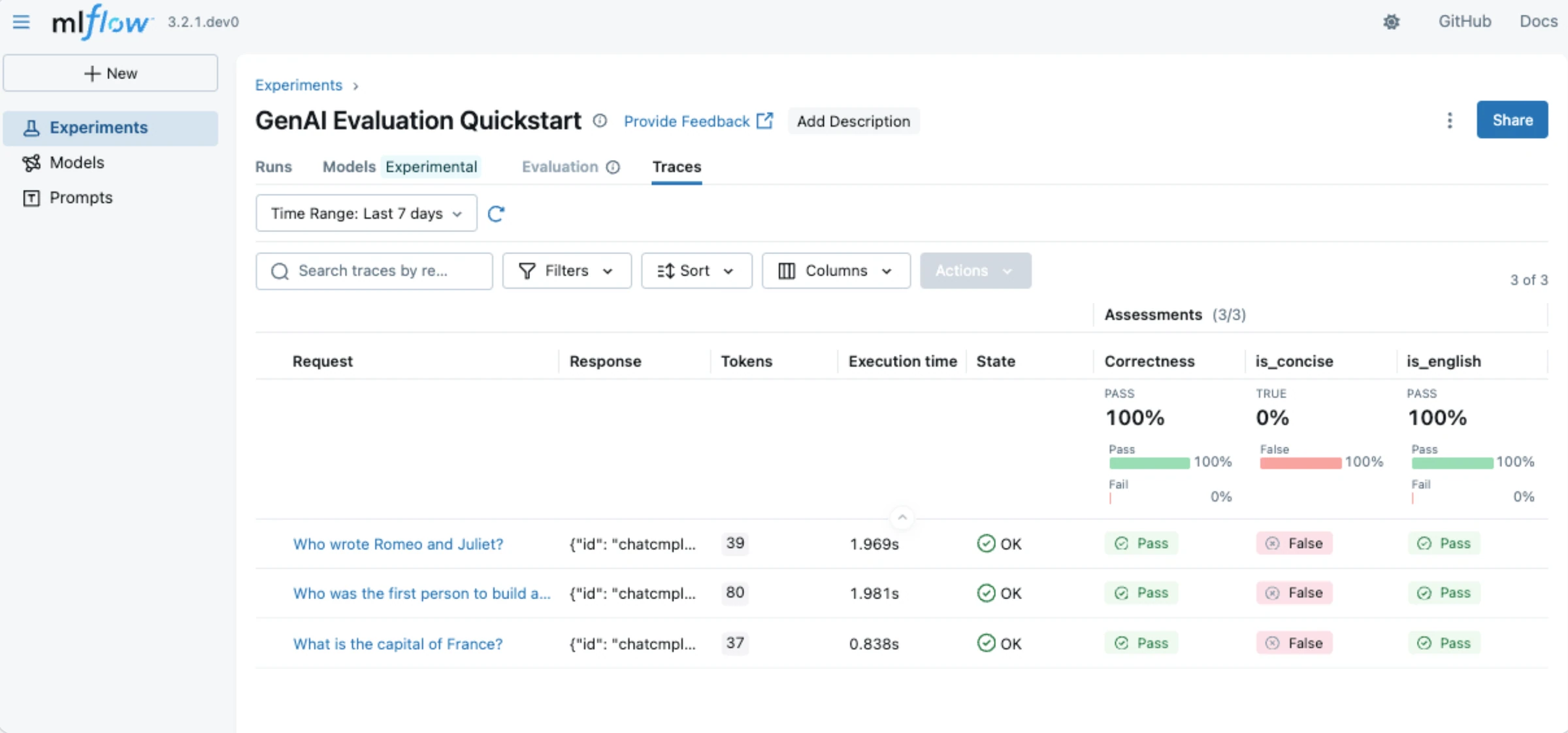
MLflow is an open-source platform from Databricks for managing the end-to-end ML lifecycle — experiment tracking, model registry, deployment, and evaluation. Its LLM evaluation module, mlflow.evaluate(), extends these capabilities to score LLM outputs using built-in and custom metrics.
MLflow's open-source foundation and Databricks integration make it a natural fit for data teams already in the Databricks ecosystem. LLM evaluation is functional but requires more manual setup than platforms built specifically for LLM quality.
Key Features
- 📊 Experiment tracking: Log parameters, metrics, and artifacts for ML and LLM experiments with full reproducibility.
- 🗄️ Model registry: Version, stage, and deploy models with governance workflows.
- 📈 LLM evaluation:
mlflow.evaluate()scores LLM outputs with built-in metrics for toxicity, relevance, and faithfulness, plus custom metric support. - 🔌 Databricks integration: Native integration with the Databricks ecosystem for teams running on that infrastructure.
Who uses MLflow?
Typical MLflow users are:
- Data science teams already using Databricks or Spark
- ML engineers managing model lifecycle and deployment
- Organizations that prefer open-source tooling with vendor flexibility
MLflow is one of the most widely deployed ML platforms. It's used by thousands of organizations worldwide.
How does MLflow compare to Braintrust?
MLflow | Braintrust | |
|---|---|---|
Open-source Self-host with full data ownership | ||
ML experiment tracking Model versioning, artifacts, reproducibility | ||
Model registry Version and deploy models with governance | ||
LLM tracing Production observability | Limited | |
Quality-aware alerting Alerts on eval score drops | ||
End-to-end app testing Evaluate your actual AI application via HTTP | ||
Single-turn evals Supports evaluation workflows | ||
Multi-turn simulation Generate and evaluate dynamic multi-turn conversations | ||
Custom LLM metrics Use-case specific evaluation metrics | Built-in + custom | Custom scorers |
AI playground No-code experimentation workflow | ||
Dataset management Workflows to manage test data |
MLflow takes the opposite approach from Braintrust. Where Braintrust offers a polished evaluation UI with alerting and a playground, MLflow is code-first and infrastructure-first. It lacks a visual playground but offers open-source flexibility, a mature model registry, and deep integration with the Databricks data platform.
The ML lifecycle capabilities — experiment tracking, model registry, deployment governance — are mature and battle-tested. The LLM evaluation module, mlflow.evaluate(), provides built-in metrics for common use cases. But production LLM observability is limited — there's no real-time tracing dashboard, no drift detection, and no cross-functional workflows.
How popular is MLflow?
MLflow has 19k+ GitHub stars and is one of the most widely deployed ML lifecycle platforms globally, backed by Databricks.
Why do companies use MLflow?
- Open-source ML lifecycle: End-to-end experiment tracking, model registry, and deployment in one open-source platform.
- Databricks native: Teams already on Databricks get seamless integration with their data infrastructure.
Bottom line: MLflow is a viable Braintrust alternative for data science teams already in the Databricks ecosystem or heavily invested in MLflow for experiment tracking. It adds LLM evaluation to your existing ML workflow without a new vendor. But if LLM evaluation is your primary concern — not an extension of ML lifecycle management — the evaluation experience requires more manual effort than dedicated platforms.
Why Confident AI is the Best Braintrust Alternative
Braintrust covers prompt evaluation and observability solidly — clean playground, CI/CD gates, production tracing. But as evaluation needs expand beyond prompts and observability needs shift toward quality monitoring, the gaps add up.
On the observability side, Confident AI evaluates every production trace automatically with 50+ research-backed metrics. When quality drops — faithfulness declines, hallucination rates rise, safety scores degrade — alerts fire through PagerDuty, Slack, or Teams. Drift detection is where the ROI compounds: instead of aggregate dashboards that tell you "quality went down 5%," Confident AI shows you that your "contract summarization" use case degraded after Tuesday's model update while everything else held steady. Teams go from "something's wrong" to "here's what changed, here's where, here's when" in minutes — not hours of log-diving. Production traces are automatically curated into datasets for the next evaluation cycle, so the issues you find in monitoring directly improve your next test run.
On the evaluation side, Confident AI tests your actual AI application end-to-end via HTTP — not just prompts in a playground. Multi-turn simulation compresses hours of manual conversation testing into minutes. Red teaming covers PII leakage, prompt injection, bias, and jailbreaks natively. 50+ metrics cover agents, chatbots, RAG, single-turn, multi-turn, and safety out of the box — Braintrust requires custom scorer implementation for each use case.
The collaboration model spans both. PMs and QA don't just run evaluations — they review production traces, annotate outputs, and participate in quality monitoring. Engineering handles setup, then the whole team owns AI quality across development and production.
Pricing scales better too. Braintrust jumps from free to $249/month with no mid-tier option, and tracing costs $3/GB. Confident AI starts at $200/month with unlimited seats and tracing at $1/GB-month — 3x cheaper per GB.
For teams that need both evaluation depth and production quality monitoring — across use cases, across teams, from development through production — Confident AI is the most complete option.
Confident AI helps you test your actual AI app end-to-end
Book a personalized 30-min walkthrough for your team's use case.
When Braintrust Might Be a Better Fit
- If prompt optimization is your only concern: Braintrust's playground is clean and purpose-built for comparing prompt and model combinations. If you're not evaluating agents, chatbots, or RAG pipelines, and your evaluation needs don't extend beyond prompt scoring, it covers that use case well.
- If you need a non-technical playground with no setup: Braintrust's dataset editor and playground are immediately accessible without engineering configuration. Confident AI requires an initial HTTP connection setup by engineering — but once that's done, non-technical users can run full end-to-end evaluations against your actual AI application independently, indefinitely. It's a longer initial setup for significantly better long-term iteration.
Frequently Asked Questions
What are the limitations of Braintrust?
Braintrust's main limitations include evaluating prompts in isolation (can't test your actual AI application end-to-end via HTTP), no multi-turn conversation simulation, no red teaming or safety evaluation, no built-in research-backed metrics (everything requires custom scorer implementation), and a steep pricing jump from free to $249/month with no mid-tier option. Tracing at $3/GB for ingestion and retention is also 3x more expensive than alternatives like Confident AI.
What is the best Braintrust alternative for evaluating RAG?
Confident AI is the best Braintrust alternative for RAG evaluation. It offers dedicated retrieval and generation metrics — faithfulness, hallucination detection, context relevancy, retrieval precision — out of the box. Evaluations can target individual retrieval or generation spans within traces, isolating whether failures stem from retrieval quality or generation logic. Braintrust requires building custom scorers for each RAG metric, and can't evaluate your actual RAG pipeline end-to-end.
What is the best Braintrust alternative for evaluating AI agents?
Confident AI is the best Braintrust alternative for AI agent evaluation. It evaluates individual tool calls, reasoning steps, and retrieval within a single agent trace — scoring each decision point independently. Multi-turn simulation automates agent conversation testing. Braintrust has no agent-specific evaluation capabilities and can't evaluate multi-step agent workflows.
What is the best Braintrust alternative for multi-turn conversations?
Confident AI is the best alternative for multi-turn evaluation. It simulates realistic multi-turn conversations with tool use and branching paths, generating test data and evaluating it automatically. Dedicated multi-turn metrics cover conversational coherence, context retention, and turn-level relevance. Braintrust has no multi-turn evaluation support.
What is the best open-source Braintrust alternative?
For open-source tracing, Langfuse offers self-hostable observability but lacks built-in evaluation metrics. For open-source evaluation metrics, DeepEval provides 50+ research-backed metrics covering agents, chatbots, RAG, and safety. MLflow adds basic LLM evaluation through mlflow.evaluate() but requires significant manual setup. For teams that want open-source metrics with a full platform — UI, collaboration, production monitoring, alerting — Confident AI provides the complete picture.
Which Braintrust alternative is most cost-effective?
Confident AI is the most cost-effective Braintrust alternative at scale. It uses a $1/GB-month model for tracing — compared to Braintrust's $3/GB. Paid plans start at $200/month (Starter) with unlimited user seats, below Braintrust's $249/month floor. You get evaluation, observability, alerting, and collaboration in one platform at that price — no need to stitch together separate tools.
Which Braintrust alternative is best for enterprises?
Confident AI is the best Braintrust alternative for enterprise deployments. It offers fine-grained RBAC, regional deployments across the US, EU, and Australia, on-premises deployment support, and SOC II / HIPAA / GDPR compliance. Enterprise customers receive white-glove evaluation support and custom pricing that scales predictably with usage.
Which Braintrust alternative has the best production observability?
Confident AI offers the deepest production observability among Braintrust alternatives — every trace is automatically evaluated with 50+ metrics, quality-aware alerts fire on score drops, and drift detection tracks quality across prompt versions and use cases. It's the only platform on this list where evaluation is built into the observability layer, not bolted on as a separate workflow.
Can non-technical teams use Braintrust alternatives?
Confident AI is the only Braintrust alternative where non-technical teams can run full end-to-end evaluation cycles independently — uploading datasets, triggering evaluations against production AI applications via HTTP, reviewing production traces, and annotating outputs. Braintrust's playground is accessible to non-technical users but limited to prompt-level testing. Other alternatives on this list (Langfuse, Arize AI, W&B, MLflow) are primarily engineer-focused.